


Increased annual precipitation and more frequent episodes with heavy precipitation are expected in Norway due to climate change. The purpose of this paper is to use two case studies to investigate effects of precipitation on the amounts of faecal indicator bacteria and parasitic protozoa (Cryptosporidium and Giardia) loaded to surface waters from catchment areas exposed to different faecal sources.
In the first case study, the loads of faecal indicator bacteria and Cryptosporidium and Giardia, were investigated in relation to precipitation in a stream from a small valley where cattle and sheep are grazed. In the second case study, historical data (monthly values from 2004‐2009) regarding faecal coliforms and water flow in five tributaries (urban and rural) of a lake used as a drinking water source, were used for calculating loads of faecal indicator bacteria. These loads were evaluated in relation to historical data on precipitation. Additional sampling during/after rainfall, including analysis of samples for Cryptosporidium and Giardia, was performed.
The study visualises how heavy rainfall may increase the load of faecal microorganisms and potential pathogens in Norwegian water sources.
This study provides supplementary information about microbial contamination (including by parasites) of Norwegian surface waters during or after rainfall. This is useful input for decision making regarding protection of vulnerable water sources and for risk assessments. Data are also provided for evaluation of water treatment needs for Norwegian municipalities and waterworks responsible for providing safe drinking water under future climatic conditions.
1 Introduction
Most pathogens that may cause waterborne diseases have a faecal‐oral transmission route, i.e. their transmission stages occur in human or animal faeces, and transmission occurs by these stages being ingested by the next host. For routine monitoring of hygienic water quality, faecal indicator bacteria, such as faecal coliforms (FC), Escherichia coli, intestinal enterococcus, and Clostridium perfringens are usually used. Such indicator bacteria are generally not pathogenic in themselves, but they can be used to indicate that the water is contaminated with faecal material and there is therefore a risk that pathogens may also be present. Human pathogens, including pathogenic bacteria, viruses, and protozoa, only occur in water sources if there are infected people or animals excreting these pathogens in the catchment area.
In order to protect public health, the faecal contamination of water sources used for activities such as bathing/recreation, irrigation of fruits and vegetables, and for drinking water, should be minimised. According to the bathing water directive, water used for bathing/recreational activities should contain less than 1,000 E. coli per 100 ml (EC, 2006). For drinking water, faecal indicator bacteria and pathogens should be below the limit of detection, and, in addition to protection of water sources, sufficient water treatment and disinfection are required to guarantee this. According to the Norwegian drinking water regulations, there should be at least two hygienic barriers against all contaminants in the water supplies (HOD, 2001). For surface water, at least one barrier against microbial pathogens should be a water treatment procedure, but the other barrier could be either water treatment or restrictions/protection of the catchment area/water source.
The waterborne route of transmission of the parasitic protozoa Cryptosporidium and Giardia is of particular concern in Norway, and other industrialised countries due to their association with large, community‐wide outbreaks of infection (Karanis et al., 2007). A recent large outbreak of waterborne giardiasis occurred in Bergen, Norway during 2004 and affected over 1,500 individuals (Robertson et al., 2006b). Both Giardia and Cryptosporidium are particularly suited to this transmission route since excretion rates of the transmission stages are high, the transmission stages are highly robust being able to survive for prolonged periods in the environment under a range of environmental pressures, they are resistant to many disinfectants (including chlorine), and the infectious doses for both parasites are low (Smith et al., 1995). The Bergen outbreak was most probably caused by heavy rainfall which caused sewage contamination of the lake used as drinking water source, coupled with deficiencies in the water treatment. Analysis of sewage influent at Norwegian wastewater treatment plants has indicated that Giardia and Cryptosporidium occur frequently, with concentrations reaching as high as in excess of 20,000 parasites/l (Robertson et al., 2006a). A survey of Norwegian surface waters has shown that although these parasites occur relatively frequently (25 per cent of 408 samples positive), concentrations are relatively low, seldom exceeding two parasites per 10 l sample (Robertson and Gjerde, 2001). As both Cryptosporidium and Giardia can be zoonotic, animal infections in the catchment may be important. In Norway, infections of cervids, sheep, and cattle may all be considered to have a potential role in transmission of either Cryptosporidium or Giardia (Hamnes et al., 2006; Robertson et al., 2007, 2010). Foxes might also have a role in zoonotic transmission (Hamnes et al., 2007).
Most of the largest Norwegian waterworks have upgraded, or are planning to upgrade, their water treatments to include two barriers against pathogens, including chlorine‐resistant parasitic protozoa, but there are still many small waterworks which supply water with only one barrier against these pathogens, or an absence of such barriers (Norwegian Food Safety Authority, 2008). Data from France and the UK have suggested that the risk of Cryptosporidium and Giardia occurring in small water supplies (serving 50‐5,000 person equivalents) and very small water supplies (serving <50 person equivalents) exceeds the maximum acceptable daily risk. In Norway, at least one in four persons receive water from such supplies. Data indicate that these supplies are less likely to have protected catchments and that the treatments are less likely to provide an adequate barrier against parasites (Robertson, 2010). Water supplies with inadequate treatment barriers are vulnerable if sources of parasitic contamination are present in the catchment area, and if the water source itself does not act as a hygienic barrier, i.e. if the retention and dilution in the catchment area and water source are insufficient for inactivation or removal of the parasites.
Most (90 per cent) of Norwegian drinking water is obtained from surface water. In comparison with ground water, surface water is more vulnerable to chemical and microbial contamination due to the absence of natural soil protection. Large deep lakes, or smaller lakes located in areas considered to be “pristine”, or with relatively low influence of human sewage or domestic animal faeces are often used as drinking water sources. However, it should be noted that it is almost impossible to prevent access by wild animals to such water sources. The occurrence of faecal microorganisms at the water intake of a drinking water treatment plant, depends on the load, and on the dilution, survival, and transport of the faecal microorganisms in the water source. For typical Norwegian lakes, an increase in faecal indicator bacteria at deep water intake is observed during autumn and spring circulations (Hem, 2008). A warmer climate, due to climate changes, will result in shorter periods with ice cover, longer periods with water circulation and therefore a reduced hygienic barrier effect in such lakes (Bomo et al., 2008; Tjomsland and Rohrlack, 2008). A potential increase in the load of pathogens from the tributaries will exacerbate the situation.
Several international studies have shown an association between heavy rainfall and elevated concentrations of pathogens in surface waters (Kistemann et al., 2002) as well as with waterborne outbreaks (Nichols et al., 2009). For Norway it is predicted that by 2100, the annual rainfall will increase by 5‐30 per cent. The increase will vary by season and location. In general, a higher frequency of extreme rainfalls is predicted (Hanssen‐Bauer et al., 2009). Water supplies without adequate water treatment will be particularly sensitive to the possible increased mobilisation of pathogens during extreme precipitation. More information about the load of pathogens in Norwegian water sources during heavy rainfalls will be useful for decision making regarding restrictions/measures in catchment area/water source and optimal water treatment, and also for filling data gaps in risk assessments (NSCFS, 2009).
The purpose of this paper is to investigate the potential effects of rainfall on the quantities of faecal indicator bacteria and parasitic protozoa (Cryptosporidium and Giardia) loaded to water sources from tributaries/catchment areas with different faecal sources.
2 Methods
2.1 Microbial detection methods
E. coli and total coliforms were enumerated using the commercially available kit Colilert 18® QuantiTray (IDEXX Laboratories). The results are given as most probable number (MPN). Intestinal enterococci and faecal (thermotolerant) coliforms were quantified after membrane filtration using the Norwegian Standard (NS, 1990, 2000) methods. C. perfringens were quantified after membrane filtration, using mCP agar, anaerobic incubation at 44°C for 24 h, followed by exposure to vapours of ammonium hydroxide as described by Mueller‐Spitz et al. (2010). For intestinal enterococci, FC, and C. perfringens the results are given as colony forming units (cfu). Water samples were analysed directly or, if necessary, after dilution in phosphate buffer. Faecal samples (1 g wet weight) were added to 10 ml phosphate buffer, mixed vigorously by vortex mixer and, if necessary, further diluted in phosphate buffer before analysis of faecal indicator bacteria. The content of microorganisms in the faecal samples was calculated per gram wet weight.
Water samples were analysed for the occurrence of Cryptosporidium and Giardia using methodology based on ISO (2006) Method 15553 and US EPA Method 1623 (Anonymous, 2005). This involves membrane filtration of the water sample (10 l), elution from the membrane, concentration by centrifugation, isolation of the parasites by immunomagnetic separation, and detection by immunofluorescent antibody test (IFAT), using inclusion of the fluorogenic vital dye DAPI to assist in identification, and for confirmation of presumptive positive samples, however presumptive cysts/oocysts that did not include DAPI (i.e. were non‐nucleated, empty shells) were included in the total numbers. The theoretical limit of detection is one cyst or oocyst in 10 l water.
Faecal samples were analysed for Cryptosporidium and Giardia using homogenisation in water, coarse filtration, concentration by centrifugation, and IFAT of 5 μl sub‐samples.
2.2 Determination of water flows in rivers
Water level was measured continuously using different types of electronic sensors and data loggers. Using these measurements, bathymetric profiles, and calibration curves between water level and water current, the water flow was estimated for each river individually.
2.3 Study sites
1 Stream from a small valley/catchment area with grazing animals
A small (approximately 0.07 km2) funnel‐shaped ravine located near Gardermoen airport in the east of Norway (Figure 1), which was used as pasture land for livestock, was selected as a case site for studying effects of precipitation on the runoff of faecal microorganisms from grazing land. Livestock, i.e. 10‐30 dairy calves and young stocks, 10‐20 sheep and goats, were grazing in the entire catchment area during the study period. Runoff from the gully was discharged through a small, first‐order tributary stream, which connects to the River Leira. The farm animals had free access to the stream, but droppings were scattered over the whole area. The catchment was otherwise unaffected by human sewage (i.e. no sources of septage/sewage) or other anthropogenic activities. Water flows were estimated and water samples were taken from the outlet stream from the ravine under different weather conditions in the period August‐September 2010. The water samples were analysed for E. coli, coliforms, intestinal enterococcus, C. perfringens, and the protozoa Giardia and Cryptosporidium. Based on the water flows and the microbial concentrations, the loads of the different microorganisms were calculated. Data on precipitation were obtained from the nearby weather station at Gardermoen using the Norwegian Metrological Institutes webpages (www.eklima.no; www.yr.no). Samples of fresh faeces (calves and young stock) were also collected from the catchment area (n=15; 1 September 2010) and analysed for E. coli, coliforms, intestinal enterococcus, C. perfringens, and the protozoa Giardia and Cryptosporidium.
2 The main tributaries of Lake Gjersjøen
Lake Gjersjøen is located in the east of Norway (Figure 1) and is a drinking water source for about 40,000 residents in Oppegård and Ski municipalities. Owing to its large volume (6×10⁷ m3), long theoretical retention time (three years), and deep water intake for drinking water, there is significant self‐purification in the lake. Extensive water treatments, including chemical coagulation, filtration, chlorination, and planned UV‐treatment, are also included for production of safe drinking water. The study site was selected because historical data on FC and water flows are available for the main tributaries, which are useful for illustrating the effect of precipitation on the load of faecal microorganisms from Norwegian urban/rural areas. There are more than 30,000 inhabitants in the catchment area of Lake Gjersjøen, an extensive net of sewage pipes, as well as agricultural land, and domestic and wild animals. Human sewage is assumed to be the main source of faecal contamination in the five tributaries: Kantorbekken, Greverudbekken, Tussebekken, Dalsbekken, and Fåleslora, but runoff from agricultural land may also be significant in some of the tributaries. Historical data on FC (E. coli data from 2009 are included as FC) and water flow in the five tributaries and the outlet river (Gjersjøelva) were taken from the 2004 to 2009 surveillance reports produced by the Norwegian Institute for Water Research for Oppegård municipality (www.niva.no). The historical data consisted of one sample event every month for FC and continuous measurements of water flow. Based on the water flows measured at actual sample days, the loads of FC were calculated. For the period 2004‐2009 this generated 70 day‐values of FC per second for each of the five tributaries and the outlet river. Historical data on precipitation, from the nearby weather station Nordstrand, were obtained from the Norwegian Metrological Institutes webpage (www.eklima.no). Additional water sampling, including analysis for the parasitic protozoa Cryptosporidium and Giardia, was performed during/after rainfall events 24 September 2010 (i.e. after about 29 mm precipitation the week before sampling and about 13 mm last 24 h).
3 Results from test sites
The runoff of faecal microorganisms from the grazing land (study site 1) was strongly affected by the weather conditions. The loads of the different faecal indicator bacteria from the stream were 100‐20,000 times higher on the days with heavy rainfall compared with dry days (Table I). Parasitic protozoa were only detected on the rainy days (Table I).
In total, 15 samples of fresh faeces from calves and young stocks were collected from the grazing land and tested for faecal bacteria, Giardia and Cryptosporidium. The content of E. coli in the different faecal pats varied from 2×10⁴ to 1×10⁷/g, with an average of 2×10⁶/g. The E. coli numbers were 65‐100 per cent of the total coliform numbers. In one of the faecal samples the number of intestinal enterococcus was 3×10⁶/g, but the other samples contained low numbers of intestinal enterococcus, 1×10³/g or lower. The mCP agar was found insufficient for detection of C. perfringens in the faecal samples due to overgrowth of non‐typical colonies. Giardia cysts were found at low levels, i.e. 200‐600 cysts/g in five of the faecal samples. The other faecal samples did not contain Giardia cysts or Cryptosporidium oocysts above the detection limit (200/g).
In Figure 2 the loads of FC from the five different main tributaries to Lake Gjersjøen, as well as in the outlet river, are plotted against the total precipitation for the week before sampling. For some of the tributaries there is a clear trend showing an increase in FC load with increasing precipitation; for example, for Tussebekken the exponential trend line increased by 2 log10 (i.e. 100 times higher load) after 50 mm/week precipitation compared with an absence of precipitation (Figure 2(D)). In other tributaries, like Greverudbekken, the fact that sewage contamination may occur also in dry weather is illustrated, with the highest bacterial load (109 FC/s) observed after a week without precipitation (Figure 2(E)). Despite these variations, for all water courses (Figures 2(A)‐(F)) there was a trend of increased load of FC if precipitation in the week before sampling was elevated.
For samples taken during rainfall periods 24 September 2010, Giardia cysts and Cryptosporidium oocysts were detected in samples from all the tributaries of Lake Gjersjøen, with the exception of Fåleslora (Table II) with approximately twice as many Giardia cysts detected as Cryptosporidium oocysts. The total load of the two parasites in all the five tributaries was 401 parasites per second, and in the outlet river 130 parasites per second were measured at this sampling occasion. Similarly, the total load of E. coli was 3×10⁷ per second in the five tributaries and 5×10⁵ per second in the outlet river. The ratio between parasites and E. coli varied between the tributaries (Table II).
4 Discussion
In many catchments it is difficult to distinguish between the contamination from sewage/septic systems and animal faeces. Test site 1 was selected because it is unaffected by sewage contamination, and the results enable a visualisation and quantification of how heavy rainfalls may increase the input of faecal microorganisms into surface waters from non‐restricted grazing land. The test site was located in the eastern part of Norway, where the increase in precipitation due to climate changes is predicted to be less pronounced (in the summertime) than in the western and northern parts (Hanssen‐Bauer et al., 2009), but the general findings of increased microbial loads after rainfall may be valid for similar catchments at other locations. At least 100 times increase in the load of all the faecal indicator bacteria was observed after heavy rainfall, compared with dry days. The calves and young stock on the test site excreted much lower numbers of parasites than E. coli, and this was also reflected in the water samples taken after rainfall, in which the numbers of Giardia cysts were 104 to 105 times lower than the numbers of E. coli. However, the detection methods for Giardia and E. coli are very dissimilar and therefore direct comparison of the results may not provide a true representation. Calves infected with parasites are likely to have a higher parasite excretion rate, than the animals at our test site (e.g. up to 107 parasites/g of faeces (Fayer et al., 1998), which is comparable with the E. coli excretion). If infected calves with higher excretion of parasitic protozoa had been present in the catchment, then it would be assumed that the load of these pathogens would be correspondingly higher.
Vegetation buffers have been shown to be an effective method for reducing animal agricultural inputs of E. coli and Cryptosporidium into surface waters (Tate et al., 2006; Atwill et al., 2006). Such measures, as well as fences to reduce the access of animals to vulnerable water sources, may be even more important under future climate conditions with more heavy rainfalls and runoff. However, whether these buffers function as effectively under different climatic conditions has not been the subject of many studies. The need for restrictions will depend on several factors, such as the number of animals, their location, volume/dilution factor of the water source, the utilisation of the water (irrigation of fruits and vegetables or bathing water), and the performance of water treatment if the water is used for drinking water production.
Test site 2, tributaries to Lake Gjersjøen, represented a much more complicated and larger catchment area, with urban areas with a net of sewage pipes, as well as agricultural land, and domestic and wild animals. The fact that sewage pipes may break and sewage leakages may occur in dry weather as well as wet weather, and that faecal contamination may occur randomly, was illustrated by the scattered data points in Figure 2. Nevertheless, the figures from all the tributaries showed a trend of increased load of FC with increasing precipitation the week before sampling. This may be explained by an increase in overflows or leakages from sewage systems during heavy rainfalls and an increased mobilisation of FC in surface runoff from areas with faecal contamination. Similar results have also been obtained in several other international studies (Kistemann et al., 2002; Signor et al., 2007; Åström et al., 2007).
Specific pathogens, like Giardia and Cryptosporidium, will only occur in water sources if there are people or animals infected with these pathogens, and excreting their transmission stages, in the catchment area. Water sources may therefore contain faecal material and high numbers of the faecal indicator E. coli, but no specific pathogens. However, it is also true, that with more infected, or more heavily infected, individuals in the catchment, the pathogen load will be greater. The ratio between parasites and E. coli varied between the tributaries and depends not only on the numbers of infected individuals in the different catchments, but also on the distance/time from the faecal sources to the sample point. Giardia cysts and Cryptosporidium oocyst are known to have prolonged survival in the environment (Smith et al., 1995; Robertson et al., 1992), compared with E. coli and therefore it is not surprising that this ratio was higher in the outlet river than in the tributaries. For the samples taken during/after rainfall, the E. coli numbers were not very different from the total coliform numbers in the rivers Kantorbekken, Greverudbekken, and Tussebekken. This indicates fresh faecal contamination in these rivers, e.g. from sewage overflows.
5 Conclusions and recommendations
Accurate predictions on the future prevalence of infectious diseases, including waterborne pathogens, among Norwegian people and animals are extremely difficult, although increasing globalisation and travel suggest that prevalence is likely to rise. However, this study illustrates that rainfall increases the input of faecal microorganisms from catchment areas with animal faeces (test site 1) and human sewage (test site 2) to surface waters. Predicted climate changes with increased annual precipitation and more frequent episodes with heavy precipitation may therefore cause an increased risk of microbial pathogens in Norwegian water sources, especially if infection within the catchment is also elevated. This may result in the development of a spiral of increased infection, greater contamination, and thus yet further increases in infection. Whether development of immunity may have a dampening effect on such a spiral should also be considered. However, arrival of young or naïve individuals into this environment, elevates their risk of infection and of spreading the infections further, either within the same catchment or elsewhere.
In surveillance programmes, the water sampling for monitoring of faecal contamination is often done at regular intervals, e.g. once every week or month, or, for irrigation water, once a year. Since weather conditions may strongly affect the load of faecal microorganisms to water sources, it is also recommended that sampling when the risk may be considered to be elevated, e.g. after heavy rainfalls, could be included in the surveillance programmes. This will generate better data for risk assessments, and, if the water source is used as raw water for drinking water production, for determining water treatment needs. Waterworks should be designed to handle worst‐case raw water quality.
Although several Norwegian waterworks have been upgraded during recent years, some Norwegian water supplies still do not have active barriers against parasitic protozoa in the water treatment, i.e. they have no disinfection, no suitable barriers, or use only chlorine for disinfection. Such water supplies are particularly vulnerable if sources of parasitic contamination are present in the catchment area. Climate change with more extreme precipitation and runoff will aggravate the situation. Such waterworks, using surface water as drinking water source, are strongly recommended to upgrade the water treatment, e.g. with UV‐treatment or membrane filtration, which will also inactivate/remove parasitic contamination.
According to the Norwegian drinking water regulations, there should be at least two hygienic barriers against all contaminants in water supplies serving more than 50 person equivalents, food enterprises, or health institutions. If the catchment area/water source itself can no longer be considered as a hygienic barrier, e.g. due to increased contamination, at least two barriers should be included in the water treatment. However, even if the water treatments are upgraded, then the important principle traditionally used in Norwegian water supplies, i.e. it is better to avoid contamination of water sources than to remove it later, should not be forgotten. Water treatment processes may fail and appropriate catchment management, including implementation of restrictions regarding human and agricultural activities and upgrading of sewage systems, are still important. Under predicted climate change, ensuring that these measures are optimised for individual situations may be particularly important.
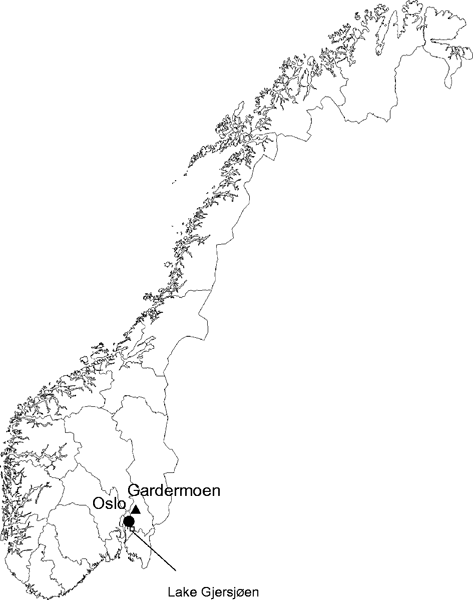
Map of Norway showing Gardermoen (located near test site 1) and Gjersjøen (test site 2)
Map of Norway showing Gardermoen (located near test site 1) and Gjersjøen (test site 2)
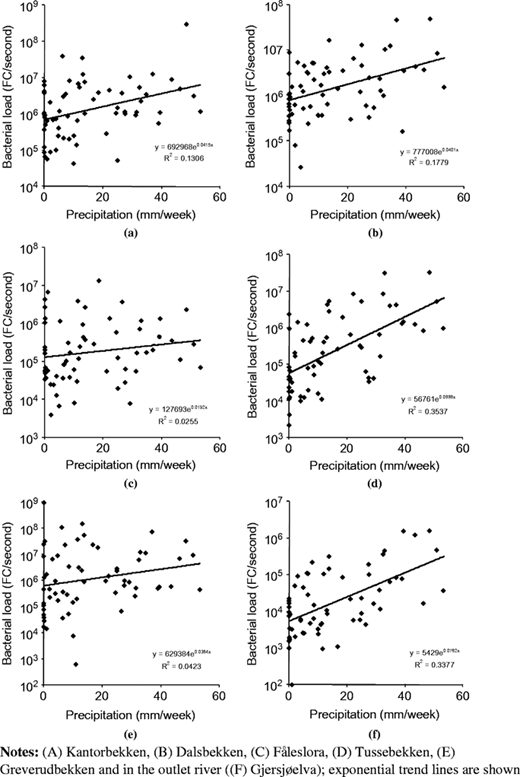
Bacterial load (FC per second) versus precipitation the week before sampling for the five main tributaries to Lake Gjersjøen
Bacterial load (FC per second) versus precipitation the week before sampling for the five main tributaries to Lake Gjersjøen
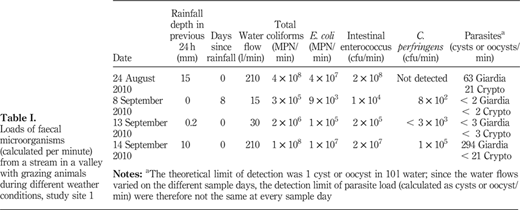
Loads of faecal microorganisms (calculated per minute) from a stream in a valley with grazing animals during different weather conditions, study site 1
Loads of faecal microorganisms (calculated per minute) from a stream in a valley with grazing animals during different weather conditions, study site 1
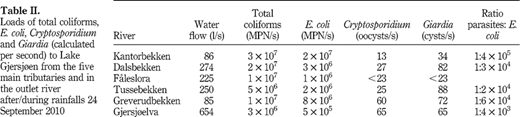
Loads of total coliforms, E. coli, Cryptosporidium and Giardia (calculated per second) to Lake Gjersjøen from the five main tributaries and in the outlet river after/during rainfalls 24 September 2010
Loads of total coliforms, E. coli, Cryptosporidium and Giardia (calculated per second) to Lake Gjersjøen from the five main tributaries and in the outlet river after/during rainfalls 24 September 2010
References
About the authors
Ingun Tryland is a Research Scientist at the Norwegian Institute for Water Research (NIVA). She has a PhD in Water Hygiene (1999) from the Norwegian University of Science and Technology (NTNU). Her main research interests are monitoring of water quality (drinking water, irrigation water, recreational water) and water treatment/disinfection. Ingun Tryland is the corresponding author and can be contacted at: ingun.tryland@niva.no
Lucy Robertson is an Associate Professor at the Norwegian School of Veterinary Science. She has a PhD in Parasitology (1989) from the University of Glasgow, UK. Her main research interests are concerned with the epidemiology of intestinal parasites, detection and identification in environmental matrices, outbreak control, viability assessment and method development, and host‐parasite interactions.
Anne‐Grete B. Blankenberg is a Senior Researcher at the Norwegian Institute for Agricultural and Environmental Research (Bioforsk).
Markus Lindholm is a Research Scientist at the Norwegian Institute for Water Research (NIVA).
Thomas Rohrlack is a Research Scientist at the Norwegian Institute for Water Research (NIVA).
Helge Liltved is a Research Manager at the Norwegian Institute for Water Research (NIVA).

