


The purpose of this paper is to discuss freshwater vulnerability to environmental change, including climate change, in Levant countries.
The paper uses the methodological guidelines prepared by UNEP and Peking University, using the fresh water vulnerability index (VI) for each country of the Levant region. The VI was calculated for a five‐year period interval, i.e. 1985, 1990, 1995, 2000, 2005, and was predicted for the years 2020 and 2040 taking into consideration the expected impacts of climate change.
The vulnerability of freshwater resources was explored by isolating strategically‐important issues related to different functions (uses) of freshwater systems in the Levant region. All Levant countries are very vulnerable according to the adopted methodology (VI values are from 0.5‐0.7), with Palestine being the worst case. The value of each parameter was calculated for five‐year interval period and for each Levant country. The most dominant parameter was the water variation parameter (RSv), which is a natural factor and highlights how vulnerable the region is to climate change. The second most important parameter was the water exploitation pressures (DPs), which reflect the efforts of the countries to satisfy their water needs from the limited water resources. Cooperation and exchange of data and information at the regional level regarding the vulnerability of the region to climate change and measures for mitigation and adaptation could help in alleviating its impacts on the countries of the region.
This paper highlights that fresh water resources in Levant region are under increasing pressures due to human‐made and natural reasons. High population growth and economic activities rates have placed extensive pressure on the already limited water resources. Moreover, the prevailing arid climate and the expected impact of climate change will decrease the fresh water availability.
Introduction
Water resources availability in arid and semi arid parts of the world, including the Levant region, constitutes a major constraint to socio‐economic development.
In Levant countries (Syria, Jordan, Iraq, Palestine and Lebanon) water scarcity is attributed to large temporal and spatial variation of most of the hydrological parameters especially precipitation and evaporation.
The most stressor parameter is the rainfall pattern which influences the generation and dependability of freshwater availability in terms of amount, frequency and distribution. The rainfall seasonality influences the renewable flow of the major rivers, size of rain‐fed agriculture, and amount of groundwater recharge. Climate change will further increase the variant of rainfall adding more uncertainty and complication to the planning and management process of the water sector.
In addition to the natural water scarcity, the high population growth and increasing rates of urbanization and economic activities have placed extensive pressure on the already limited water sources to achieve the Millennium Development Goals. The increases in water demand especially in the irrigation sector have contributed to further exploitation of surface and groundwater sources. Pollution sources from domestic, industrial and agriculture wastes are contributing to the loss of limited freshwater resources.
In addition to the prevailing arid climate, freshwater availability is expected to suffer from the impact of climate change due to the expected changes to the rainfall and temperature regimes. Even that the Arab world contributes merely 4.2 percent to the global GHG emissions, the impact of climate change on the fragile environment of the region and its people is expected to be immense, which demands urgent planning for adaptation measures (Arab Forum for Environment and Development, 2009)
Increased temperatures as well as reduced and more erratic precipitation will exacerbate an already critical state of vulnerability. This variation in precipitation amount and frequency will impact the quantity and quality of rivers flow of the Levant region (e.g. water flow in the Euphrates may decrease by 30 percent and that of the Jordan river by 80 percent before the turn of the century (Arab Forum for Environment and Development, 2009)). The expected decrease in rainfall (IPCC, 2007) will be felt in rain‐fed areas and reflected in the amount of recharge to groundwater.
Methodology
The approach used for this vulnerability assessment is based on the Methodological Guidelines prepared by UNEP and Peking University (UNEP, 2003). The vulnerability of freshwater resources was explored by isolating strategically‐important issues related to different functions (uses) of freshwater systems in the Levant region, marking a considerable departure from the preconceived notion of “water crisis” being synonymously linked to vulnerability. Thus, this analysis is based on the premise that the vulnerability assessment must have a precise understanding of four components of water resources system, including their states and relationships, these are:
- 1.
total water resources;
- 2.
water resources development and use;
- 3.
ecological health; and
- 4.
management.
The methodology based on DPSIR principles evaluates the main drivers such as the population growth and the associated urbanization, the pressure parameters, The state of water resources availability and deficit due to natural and man‐made activities and pollutions from different sources especially wastewater. The impacts could be the change in the state of water sector performance and adaptability resulting from climate change and other socio‐economic activities while the response parameter is estimated by the adaptive capacity of the ecosystem and human being to potential threats.
Vulnerability index estimation
According to the UNEP methodology (UNEP, 2003) the vulnerability is function of four main water availability, use and management parameters. The vulnerability index (VI) can be assessed from the application of a number of governing equations to estimate the four parameters of.
i‐The resource stress (RS) parameter
The water stress indicator is influenced by the renewable water resources availability and consumption level of the growing population (RSs) and water variation parameter resulting from long‐term rainfall variability (RSv).
ii‐Water development pressures (DP) parameter
Freshwater resources in the region depend on the rainfall and recharge distributions. The higher frequency of occurrence and the amounts contribute to an enhanced the water availability and dependability. Water development may experience different degrees of pressures from increasing demand in different sectors and its pollution from different sources of wastes as these two factors can diminish supply potential.
iii‐Ecological health (EH) parameter
The water ecological health parameter is a measure of the pollution impact from different sources on the ecosystem equilibrium and protection. The arid ecosystem with low resiliency takes long time to regenerate or adjust to a reasonable stage of sustainability. Water pollution in the Western Asia region represents major threats to future water availability as well as poses a major health impact.
iv‐Management capacity (MC) parameter
Freshwater vulnerability is improved by the implementation of effective management practices as it will contribute to water sustainability. Evaluation of the management capacity provides a mean to evaluate how effective the water sector is being managed.
v‐Freshwater VI estimation
It is estimated based the consolidation of the values of the four main parameters estimated by the above mentioned VI=f (RS, DP, ES, and MC) can be accessed from two perspectives:
- 1.
Water availability. The main threats to the availability of water resources, its development and water utilization dynamics.
- 2.
Water management. Water use efficiency and capacity to cope with the potential national and regional threats to water availability.
The VI provides an estimated value for a given year ranging from 0 (non‐vulnerable) to 1 (most vulnerable) to delineate severity of the stress being experienced by the water sector.
All the governing equations to estimate the above mentioned parameters are presented in UNEP methodology (UNEP, 2003).
VI interpretation
Low (0.0‐0.2). This indicates a healthy basin, in terms of resource richness, development practices, ecological state, and management capacity.
Moderate (0.2‐0.4). This indicates the river basin is generally in a good condition in regard to realization of sustainable water resources management. It may still face major challenges.
High (0.4‐0.7). This indicates the river basin is experiencing high stresses, and great efforts should be made to design policy to provide technical support and policy backup to mitigate the pressures.
Severe (0.7‐1.0). This indicates the river basin is highly degraded in regard to being a water resources system with a poor management structure.
Results and discussions
The freshwater VI for each country of the Levant region was calculated for a five‐year period interval, i.e. 1985, 1990, 1995, 2000 and 2005, and was estimated for the years 2020 and 2040. The calculated values for each of the four parameters range from 0 to 1. A value close to one means severity of freshwater vulnerability to threats such as climate change, depletion and pollution. The estimation of the different parameters for the countries of the region were extracted from a collection of extensive published data on water resources, water pollution and economic information of the national ministries, research centers, and international organizations (ACSAD, 2009, 2004, 1998, 1997a, b, 1986; AOAD, 1985, 1995, 2000; CEDARE, 2005; ESCWA.U.N, 2007; FAO, 2008; FAOSTAT, 2008; AMF, 2007; UNEP, 2003, 2006). Data extrapolation was made to fill in the missing data information as well as to make future projections.
i‐Resources stress parameter (quantity and quality)
The vulnerability of freshwater resources to external threats either natural or man‐made or both may impact the water quantity and quality, thus contributing to stress on water availability and distribution variation in time and places.
1‐Water stress parameter (RSs)
The renewable water stress for each country was estimated based on per capita water resources and the population growth as shown in Figure 1. There is a general increase in trend with time for the period 1985‐2005 for all countries of the sub‐region with high water stress observed for Jordan and Palestine, while Iraq has lower value due to relatively abundant river flow from its two major rivers (Euphrates, Tigris). The figure shows that most of the countries in the sub‐region (except Iraq) are increasingly suffering from water shortage. Critical water stress in the range of 0.7‐0.95 is being experienced by Jordan and Palestine, while lower values for the remaining countries as they have large volume of surface water generated outside their boundaries and also relatively higher rainfall rates and snow accumulation.
2‐Water variation parameter (RSv)
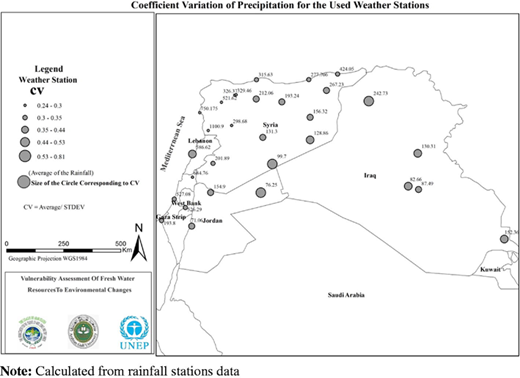
The water availability variation can be estimated by the coefficient of variation (CV) of the long‐term average precipitation over a long period of observation preferably covering 50 years. It is known that higher the rainfall coefficient of variation, lower the dependability of water availability, and consequently higher vulnerability to climate change (e.g. changes in the rainfall regimes). The coefficient of rainfall variation for a number of rainfall stations in the Levant sub‐region is shown in Figure 2.
The analysis indicates that all countries with the relative exception of Syria, have large water variation, due to their arid and semi arid climate, and thus will be very vulnerable to climate change impacts and RSv values will be close to one as shown in Figure 3. This large rainfall variation in time and space will add more difficulties in rain water management.
ii‐Water development pressure parameter (DP)
The other variable related to water development pressure is the availability and the provision of adequate drinking water supply to meet the basic needs for the well being of the society. It represents the degree of social adaptation to the freshwater shortage and how the development facilities to address the population need (UNEP, 2003). The water development pressure can be estimated from the available renewable freshwater sources, total water requirement, water supply coverage and the total population.
1‐Water exploitation parameter (DPs)
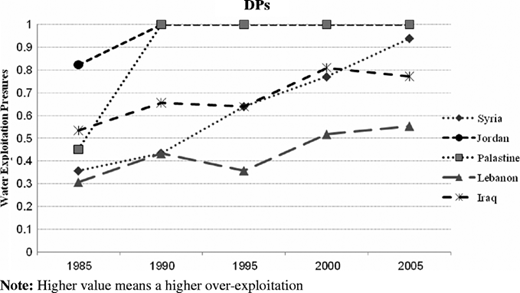
The exploitation of the renewable water sources result from the utilization of water in excess of the amount of replenishment from rainfall and snow melt. Over‐exploitation will result in the decreases in surface water flow and spring discharge and decline in groundwater table levels. The study indicates that the countries of Jordan, Palestine have the worst case in the development of their water sources for the water demands exceed the available water resources (higher value means a higher over‐exploitation). Other countries are approaching this stage, with Syria having the highest rate as shown in Figure 4.
2‐Safe drinking water coverage parameter (DPd)
This parameter represents the percentage of population without access to improved drinking water sources (Figure 5). A slight decrease of this parameter (i.e. an improve of access) for Syria, Jordan and Iraq and only from 2000 to 2005. Figure 5 shows that Lebanon maintains its levels and Palestine slightly increases (higher value means a lower access to drinking water) because of the Israeli occupation and lack of financial capacity. The decreases observed in Iraq and Jordan from 2000 to 2005, however are not sufficient to achieve the levels observed in these countries on 1985.
iii‐Ecological health parameter (EH)
The ecological health can be measured with two parameters; namely, the water quality/water pollution parameter and the ecosystem deterioration parameter.
Water pollution from domestic and industrial wastes will diminish its utilization and reduce the available freshwater. The estimation of the ecological health can be estimated from calculation of the pollution level and ecosystem deterioration. The ecosystem may be degraded from various socio‐economic development activities such as urbanization expansion, land use, removal of vegetation, over grazing and desertification.
1‐Water pollution parameter (EHp)
Water resources pollution due to wastewater discharge is considered as one of the major challenges in the region. Data limitation hinders the evaluation of the impact for most countries of the Levant region. The analysis indicated a trend of increasing the risk of pollution in Syria as shown in Figure 6.
2‐Ecosystem deterioration parameter (EHe)
Ecosystem deterioration to the vulnerability of water resources can result from the decreases in vegetation coverage due natural and man‐made actions. Three countries Iraq, Lebanon and Palestine are experiencing higher ecosystem deterioration that may have resulted from decrease in vegetation covers due to decrease in rainfall amount, over grazing and urbanization, while Syria and Jordan have relatively less desertification as shown in Figure 7.
iv‐Management capacity parameter (MC)
The capacity of the water sector to manage its freshwater resources can be assessed from three aspects: efficiency in water utilization, human health in relation to accessibility to adequate and safe sanitation services, and competition over the shared surface and groundwater sources.
1‐Water use efficiency parameter (MCe)
The analysis indicates an improvement in water use efficiency in Lebanon and Jordan with high value in Jordan particularly in the last decade. Iraq and Syria still need to improve their irrigation infrastructure and use more suitable irrigation systems as shown in Figure 8. The mean GDP value produced from 1 m3 of water of selected advanced countries was taken 40 USD (as considered by UNEP methodology).
2‐Improved sanitation inaccessibility parameter (MCs)
Most of the countries are investing in sanitation facilities, except Palestine. In Palestine, the situation is deteriorating as the result of border closure with the collapsing of sewage system in Gaza strip (Zarour et al., 1994). Nearly all sewage and water pumps are now out of operation due to lack of electricity and diminished fuel supplies to operate backup power generators. The values of this parameter are shown in Figure 9.
3‐Conflict management capacity parameter
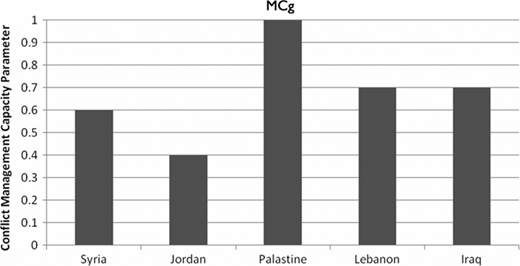
This is a parameter that demonstrates the capacity of the country management system to deal with transboundary conflicts. A good management system can be assessed by its effectiveness in institutional arrangements, policy formulation, communication mechanisms, and implementation efficiency. The conflict management capacity can be assessed utilizing the matrix illustrated in Methodology Guidelines (UNEP, 2003). The final score of the conflict management capacity parameter (MCs) is determined by an expert consultation based on the scoring criteria.
Palestine has the worst score since the Israeli occupation has the overall control on water resources (Figure 10). Other countries scores vary according to the scoring criteria.
v‐Vulnerability index
Based on the above‐noted parameters, and following the Methodologies Guidelines adopted for assigning weights to each parameter, the VI was calculated. All countries are experiencing high stresses, with Palestine being the worst case (Figure 11).
To analyze which is the most important factor for each country the previous graph was re‐plotted as a stacked bar showing all the component factors. As can be seen from Figure 12, the most dominant factor is the water variation parameter (RSv), which is a natural factor and could be used as an indicator to highlight how vulnerable the region is to climate change. The second most important factor is the Water Exploitation Pressures (DPs), which reflect the efforts of the countries to satisfy their water needs from the limited water resources. Lebanon suffers the most from the deterioration of its ecosystem.
For the Levant sub‐region the analysis indicates that most countries have been experiencing different degrees of water stress depending on the availability of dependable flows from major rivers specially shared ones. Some of countries as Jordan and Palestine are under severe stress while the remaining countries have adequate surface water sources. Additional effort is needed for improving water use efficiency in most of the Levant countries as well as any variation in precipitation will affect the available water resources. The estimated VI showed that all the Levant countries are very vulnerable to climate change. This means an urgent mitigation and adaptation plans should be adopted by all the countries of the region.
Future of freshwater vulnerability in Levant region
Impacts of climate change scenario
Climate change is an important, uncertain key driver for water resources. Although the impacts of climate cannot be quantified due to the lack of detailed studies and downscaled RCMs in the region, the expected impacts of climate change can be described and estimated qualitatively. For example, it is expected that the frequency of extreme events (floods and droughts) would increase with climate change leading to further variation in rainfall in the arid WA region (water variation parameter (RSv)), with major implications on the vulnerability to freshwater resources. Furthermore, it is expected the region will face a decrease in rainfall and snow accumulation accompanied with increase in temperatures and evaporation, leading to a decrease in the overall water endowment of the region (Water Scarcity Parameter (RSs)).
In this scenario, the impacts of climate change are imposed on the previous prediction (business as usual). A decrease in available water resources by 7 percent due to climate change for all the countries is expected to lead to increasing water stress and a general decrease in the amount of exploitable resources.
Figure 13 shows the projected water stress for the countries of Levant region up to 2040. Climate change will increase the threats to freshwater resources in the region by the expected water variation; the RS contribution to freshwater vulnerability in Levant countries would reach high values.
Palestine and Jordan have already developed their water to or beyond their capacity and are currently experiencing water deficits (Figure 14) present the DPs estimation for the countries of Levant for the years 2020 and 2040 starting from the year 2005. By the year 2040, all Levant countries, except Lebanon and Iraq, will have the highest values due to over‐exploitation of their water resources. Climate change is expected to lead to more water scarcity and deficits in the countries of the region.
Agricultural sector will be badly hit by climate change and the region is already suffering from this impact. In Syria, for example, during the 1998‐1999 drought, the rainfall, which is the main source of water for food production and essential for maintaining irrigation reserves, was between 25 and 67 percent below normal in various agro‐climatic zones.
As a result, barley production, which is almost entirely rain‐fed, was 72 percent below the previous five‐year average. As 40 percent of wheat is irrigated, the impact of the drought was less severe, but still significant. Production was 28 percent below average (FAO‐GIEWS – WFP, 1999).
Conclusions
The vulnerability of freshwater resources was explored by isolating strategically‐important issues related to different functions (uses) of freshwater systems in the Levant region. All Levant countries are very vulnerable according to the adopted Methodology (VI values are from 0.5‐0.7), with Palestine being the worst case. The most dominant parameter was the water variation parameter (RSv), which is a natural factor and highlight how vulnerable the region is to climate change. Here rainwater harvesting and small collecting dams are very useful practices for mitigating the impact of rainfall variation.
The second most important parameter was the Water Exploitation Pressures (DPs), which reflect the efforts of the countries to satisfy their water needs from the limited water resources. Better water use efficiency is very critical to balance water demand and water supply. Using modern irrigation methods, improving drinking water networks, encouraging closed cycle industries that applying economical tools in allocating water resources are some of good practices which will help in reducing the water demand.
Climate change will increase the threats to freshwater resources in the region by the expected water variation; the RS contribution to freshwater vulnerability in Levant countries would reach high values. Cooperation and exchange of data and information at the regional level regarding the vulnerability of the region to climate change and measures for mitigation and adaptation could help in alleviating its impacts on the countries of the region.






This study was part of a project funded by UNEP‐ROWA in cooperation with Arab Centre for the Studies of Arid Zones and Dry Lands (ACSAD) and Arabian Gulf University (AGU).
References
Further Reading
About the authors
Dr M. Al‐Sibai received his PhD in Engineering from University of Newcastle upon Tyne, UK in 1996. He worked as the head of the IWRM Program at ACSAD till 2007. Currently he is a Consultant at ACSAD and the Acting Dean of the Higher Institute for Water Management in Homs, Syria, which is affiliated to the Ministry of Higher Education. He has a wide experience in IWRM and groundwater modeling. M. Al‐Sibai is the corresponding author and can be contacted at: mahmoud.alsibai@hotmail.com
Dr A. Droubi received his PhD in Geochemistry from University of Loius Pasteur, France in 1976. He worked as a researcher at the Arab Centre for the Studies of Arid Zones and Dry Lands (ACSAD) in Damascus, Syria, which is affiliated to the League of Arab States. He was appointed as the Director of the Water Resources Department in 2002. He has wide experience in isotopes studies, hydrogeological mapping and groundwater protection.
H. Al‐Ashkar received her BSC in Civil Engineering from Al‐Baath University, Syria in 2002. She worked at the Ministry of irrigation in Syria until 2009. Currently she is a Research Assistant at ACSAD, Syria. She is working as specialist in applying GIS for water resources management.

