


The purpose of this paper is to increase the knowledge about the strategies and actions that organisations are implementing to control and reduce their greenhouse gas emissions, as well as to identify and know the influence of the factors that can contribute to the consolidation of an organisational behaviour that is effective in the fight against climate change.
The paper presents a case study conducted in Heineken Spain, which is primarily engaged in manufacturing and distributing beer, and some of its facilities are covered by the European Union – Emissions Trading System regulation. The results of this case study are analysed and interpreted according to institutional theory.
The paper illustrates the strategies developed by Heineken Spain in order to control and reduce their emissions and identifies these factors that are influencing on the consolidation of an effective practice in the fight against climate change: top management support, communication, training, formalization, technical/rational, internal supervision and consistency.
The paper reveals in‐depth the strategies and actions that have been implemented by an organization to fight against climate change. Also, this study allows managers to know the influence of the different factors affecting the stages of the consolidation process within the organization of an effective policy for the control and reduction of emissions, which is very useful for planning and evaluating during the process.
1 Introduction
The fight against climate change is having important consequences on the environment of organizations, like the implementation of technological or emissions standards (Hernández and Del Río, 2007); the establishment of environmental taxes that have been instrumental to spreading the “Green Tax Reforms” across Europe (Labandeira et al., 2008); and, more recently, the emergence of several carbon markets, among which the EU ETS (European Union – Emissions Trading Scheme) stands out for its international features (Brohé et al., 2009). More specifically, the enforcement of the European Parliament and Council Directive 2003/87/CE, which establishes the regime of EU ETS, has forced many companies in specific sectors (electricity, cement, steel, paper, etc.) to control and reduce their greenhouse gas (GHG) emissions.
Some of the features that characterise climate change, such as globalisation, the long period of impact, uncertainties, the irreversibility of some of its consequences and the cost of the adaptation and mitigation measures (Stern, 2007; Giddens, 2009; Terceiro, 2009), may deter organizations from effectively adopting practices to control and reduce their GHG emissions. Instead, organizations can opt for a ceremonial approach, in other words, for legitimacy reasons with their environment (Meyer and Rowan, 1977; Kostova and Roth, 2002), without a real organizational behaviour that is truly committed to effectively fight against climate change. This fact, coupled with little consideration of the response of organizations to climate change (Pinkse and Kolk, 2007), has led the authors to consider the following questions: how are organizations acting against climate change? And what factors contribute to the consolidation of an effective behaviour in the fight against climate change in organizations?
The institutional theory has proven to be appropriate for studying the adoption and consolidation of business practices in organizations (DiMaggio and Powell, 1983; Abrahamson, 1991; Oliver, 1991; Zeitz et al., 1999; Araújo, 2003), in general, and those related to the fight against climate change (Wijen and Ansari, 2007; Kolk et al., 2008), in particular, when considering institutions or those “forms of thought or action taken for granted” (Burns and Scapens, 2000) that facilitate and limit organizational behaviour. In this sense, this theory allows to analyse the influence of those factors that may facilitate the internalisation of the practices consisting of controlling and reducing GHG emissions and, therefore, can lead to the consolidation of an effective performance in fighting climate change.
Thus, the aim of this paper is to increase the knowledge about the strategies and actions that organizations are implementing to control and reduce GHG emissions, as well as to identify and know the influence of the factors within organizations that can contribute to the consolidation of an organizational behaviour that is effective in the fight against climate change. To achieve this goal, this paper has conducted a case study, given that this is the most appropriate method to perform profound research on a little‐studied phenomenon, as is the control and reduction of GHG emissions, and to analyse in greater detail what factors can promote the consolidation of this practice within organizations (Scapens, 1990; Yin, 1994). The studied case has been Heineken Spain, a subsidiary of the Dutch multinational group Heineken N.V., which is primarily engaged in manufacturing and distributing beer, and some of its facilities are covered by the EU ETS regulation. During the 2000s this company has developed several actions in the fight against climate change, which make it a relevant company for the purpose of this study. Several information sources have been used to develop the study, among them: interviews with several members of the organization, including the National Environmental Coordinator of Heineken Spain; review of documents (e.g. sustainability reports, environmental reports, presentations, regulations, press releases and web pages); attendance to conferences participated by members of the organization, visits to the company and informal conversations with some of their employees during the research phase.
2 Theoretical framework
The factors of the environment may induce organizations to adopt certain practices (DiMaggio and Powell, 1983), although the form of adoption can vary considerably due to the endogenous factors of each organization (Zeitz et al., 1999). Therefore, even though a practice is adopted to meet environmental requirements (Oliver, 1991), it may not become significant and consolidated if the organization does not make the necessary extra effort for its implementation beyond its mere adoption (Hess and Warren, 2008).
This paper is interested in knowing those factors that can foster the consolidation of an effective and committed performance in the fight against climate change. This would result in the employees' consensus that the practice is really valuable for the organization and its environment, and would proceed to assume its rules, norms and values (Kostova and Roth, 2002). Similarly, the employees would have positive attitudes towards the practice, resulting in an impact in the organization's daily affairs (González, 2008). In this case, the organization would have a real interest in fighting against climate change, providing society with the benefits of a reduction in environmental contamination (Hess and Warren, 2008).
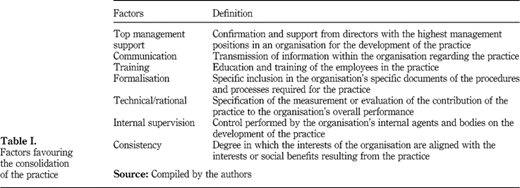
As a result of the revision of the institutional literature on the adoption and consolidation of business practices (Ghoshal and Bartlett, 1988; Abrahamson, 1991; Zeitz et al., 1999; Füssel and Georg, 2000; Kostova and Roth, 2002; Hess and Warren, 2008), several factors that can facilitate the consolidation of the control and reduction of GHG emissions by organizations have been identified (Table I).
The top management usually develops a relevant role in the adoption of business practices, since their social position in the organizational hierarchy allows them to exercise power and press for the enforcement and implementation of new practices (Battilana, 2006). However, as Garud et al. (2007) have also pointed out, the top management of an organization may lack the necessary motivation to enforce and undertake these changes, since they could potentially endanger their dominant position.
The communication allows them to share the rules, values and beliefs surrounding the business practices within the organization. It may also contribute to make achievements more visible and, therefore, increase the value of the practices for the members of the organization, thus facilitating their assimilation (González, 2008). On the other hand, training in the new business practice allows the employees to share knowledge and ideas that together form the nature of the social reality and exert an influence on the interpretation of the phenomena (Scott, 2001). By making the rules and values of the practices known through training initiatives, the employees can appreciate how these practices are valuable for the organization.
The relevance of the formalisation of business practices lies in their better “retrievability” by the employees and it increases the chances of a continuous use, thus contributing to their consolidation within the organization. This formalisation can adopt different forms, such as formal organizational policies or contracts between parties. Likewise, the institutional theory considers the technical/rational factor is relevant for the maintenance of business practices. In this way, the perception of the members of the organization that the business practices provide improvements in terms of technical efficiency, which can be measured objectively and rationally, may contribute to the continuous use of those business practices (Zeitz et al., 1999).
On the other hand, internal supervision is an important mechanism to facilitate and force the employees to perform the business practices as expected, by reinforcing the continuous application of the principles, rules and values among them (Zeitz et al., 1999). Similarly, supervision allows for the identification of hazardous behaviours that could be against the practices, giving way to measures that would allow avoiding such behaviours in the future.
Finally, another relevant factor for the consolidation of business practices is the consistency. In this case, if the requirements related to the fight against climate change are aligned with the organization's goals and fit in with the system of values and beliefs shared by the employees, the chances that the control and reduction of GHGs becomes consolidated within the organization will be significantly higher (Hess and Warren, 2008).
The adoption of the institutional theory to analyse the factors that may contribute to the assimilation of the employees of an organization of the rules and values of business practices such as the control and reduction of GHG emissions, allows to verify if the organization under study has adopted the practices in an effective way or if, on the contrary, a ceremonial or symbolic adoption of the business practice has taken place; in other words, it will serve to determine if the practices have been implemented solely for legitimating purposes in its environment (Suchman, 1995), without there being a real belief in the value of the practices for the organization (Meyer and Rowan, 1977) and, in short, without really modifying the organizational behaviours in favour of the fight against climate change. In this sense, the lack of commitment of top management with the practices, a reduced communication, the lack of training of the employees, the lack of formalisation of the procedures, the absence of measures to assess the performance of the practices and the inconsistency with the goals of the organization, could be considered as indications of a ceremonial adoption of the practices within the organizations in their fight against climate change (Kostova and Roth, 2002; González, 2008).
3 Selection of Heineken Spain
Heineken Spain was established in 2000 as a result of the merger between Grupo Cruzcampo and El Águila‐Heineken. It is currently the leading company in the Spanish beer industry, with a turnover of €1,231.1 million in 2010, and an output of 10.1 million Hl and a workforce of 2,479 employees. The company has four manufacturing centres in Spain (Seville, Jaen, Madrid and Valencia), in addition to their headquarters in Seville and Madrid.
One of the reasons behind choosing this company for this study was that it has an installed capacity of thermal generation above 20 MW and, therefore, it is included in the scope of CE Council Directive 2003/87/CE that establishes EU ETS, thus participating in the carbon market, which forces it to measure and control its GHG emissions.
The second reason to choose Heineken Spain is that this organization is “firmly committed to the defence of environmental issues” (Environmental Policy of Heineken Spain, 2009), including their efforts to minimise atmospheric contamination by GHG emissions. This fact was evidenced, for example, by its inclusion in the “Dow Jones Sustainability Index” and in “FTSE4Good” in the year 2009; its contribution to the development of the Best Available Techniques Guidelines in Spain for the Beer Sector, in which the technical criteria for measuring and controlling GHG emissions are established; and its participation in Beverage Industry Environmental Roundtable (the BIER), an international coalition of beverage companies that, among other activities, are contributing to the development of a common framework for good practices in the beverage industry in terms of climate change.
Two main reasons justify the study of one sole case in this paper: first, to illustrate in depth the strategies and actions of an organization on a phenomenon that has been scarcely studied from an academic point of view, like the fight against climate change (Pinkse and Kolk, 2007; Wittneben et al., 2009); and second, to identify and explore the factors that can result in the consolidation within the organization of an effective practice in the fight against climate change, generating ideas or propositions that may later become subject to rigorous empirical contrasting (Coller, 2000; Woodside, 2010).
4 The case of Heineken Spain
This section expounds on some strategies and actions undertaken by Heineken Spain to control and reduce its GHG emissions, it will later present the evidences regarding the factors collected in the theoretical framework.
4.1 Control and reduction of emissions
One of the strategic sustainability lines of Heineken Spain to reduce its environmental impact is called “Green brewer”, it consists of the reduction of the consumption of energy and raw materials, GHG emissions to the atmosphere, and a reduction of spills and waste resulting from their activity. Specifically considering GHG emissions, it is possible to differentiate between those generated at the manufacturing centres and road transport on the one hand, and their corporate premises on the other.
Manufacturing and transport centres
First, Heineken Spain differentiates between regulated emissions (subject to EU ETS) and diffuse emissions (that are yet to be covered by the regulations of the European emissions market). Regulated emissions correspond to the CO2 emissions from the combustion boilers at the manufacturing centres (direct emissions) and the electrical consumption throughout the development of their production processes (indirect emissions). Table II shows the evolution of regulated emissions of Heineken Spain from 2005 to 2010.
Heineken Spain was allotted an annual allowance of 72,331 emission rights during the first EU ETS period (2005‐2007) and 59,396 annual emission rights during the second period (2008‐2012). Except for 2005 and 2006, its CO2 emissions remained below their allotted emissions allowance, having performed an important reduction in their emissions over the last two years. This has resulted in Heineken Spain's surplus of emissions rights, for which they have considered two alternatives: cash sale (“spot”); and swap of 7.9 per cent of their annual allotted allowance for other carbon assets (like CER – certified emissions reduction).
Several factors have contributed to the control and reduction of the regulated emissions of Heineken Spain, including the following:
Integration of environmental concerns, and more specifically the control of GHG emissions, in business management, becoming one of the pillars of its quality and environment management system.
Construction of a new manufacturing plant in Seville following the guidelines established in the Best Available Techniques Guidelines in Spain for the Beer Sector. This centre, which will replace the former one, is currently one of the most efficient plants in the world in terms of energy consumption and GHG emissions. In comparison with the data from 2003, the new plant has resulted in a reduction of 15 per cent of thermal energy consumption and 28 per cent reduction of electricity consumption, in addition to reducing CO2 emissions by 19 per cent and NOx by 62 per cent.
Elimination of diesel and fuel in 2008 and extending the use of natural gas, resulting in a more efficient and cleaner combustion in their production processes and improving the quality of their emissions. Similarly, they have started using biogas produced in the purifying plants.
Implementation in all their manufacturing centres of total productive management (TPM), which is a version of the lean production method. Heineken Spain has designed and developed their own version, adapted to the beer sector, which has allowed them to register minimal losses and reductions thanks to a productive and uniform flow, without interruptions, increasing the efficiency of their processes.
Application of a programme of specific measures to increase energy efficiency, including: the integration of a network of exchangers throughout the production process, the performance of investments in more efficient equipment (like the use of overheated water instead of vapour), the use of energy accumulation batteries, the introduction of new technologies in the lighting systems, the development of campaigns to turn off lights, and the “Green Cold” programme, consisting in replacing all the beer cooling equipments in the market for more efficient ones.
Implementation of more efficient measuring and control systems, for energy consumption and GHG emissions. Thus, for example, for gas consumption in factories, the implementation of tele‐measurements would enable real‐time readings of the natural gas consumed by the large combustion boilers.
Training and environmental awareness of employees, specifically in terms of the control and reduction of emissions.
Likewise, it should be mentioned that all the Heineken Spain factories have obtained the Integrated Environmental Authorisation established in Act 16/2002 on Prevention and Integrated Control of Contaminants, necessary for the development of their activities. This authorisation, granted and audited by the competent bodies of each autonomous community, includes several environmental authorisations and establishes environmental requirements, among others, the limit values of CO2, SOx and NOx.
Besides the aforementioned regulated emissions, Heineken Spain has controlled and implemented measures to reduce the diffuse emissions, including the so‐called fugitive emissions and those resulting from road transport. Fugitive emissions are those that are not emitted to the atmosphere through a channel or chimney and correspond to CFC, HCFC, halogens and ammonia. One of the measures implemented by Heineken Spain for their reduction has been, for example, the performance of inventories and replacing CFC and HCFC gases used in air conditioning equipments for other, less aggressive, refrigerants in new equipments. Likewise, to reduce CO2 emissions from transport, the company has implemented several measures, including: improvement of stock management to reduce movements between warehouses by 17 per cent; maximising truckloads, that now transport 1,200 litres more per vehicle; and launching a new format for one of its beer brands that allows them to transport 18 boxes more per pallet.
Corporate buildings
The diffuse emissions of Heineken Spain's office buildings in Seville and Madrid are basically due to electricity consumption and gas (for heating). In the case of the offices in Seville, for example, the annual GHG emissions estimated for both items are 549 tonnes/year and 68 tonnes/year, respectively.
For 2010, the company set a goal to reduce the estimated consumption in 2009 by 5 per cent. For this, they implemented several measures, including: replacement of incandescent light bulbs for LEDs; control and monitoring of the programming of the air conditioning and heating systems, and lighting; study and monitoring of the electric efficiency of buildings and the performance of energy‐saving awareness programmes for their employees.
In the case of Madrid, Heineken Spain inaugurated in 2010 their new sustainable architecture building. Thus, for example, the air circuit generated by the building's design, thermal isolation from the composition of the façades and its orientation following bioclimatic criteria, have provided the company more efficient energy usage and, in consequence, a reduction in GHG emissions.
For the Seville offices, on the other hand, a significant measure to control and reduce GHG emissions has been their voluntary adhesion to the Andalusian System for the Compensation of Emissions (hereinafter, SACE, its Spanish acronym). By means of this system, a pioneer system in Spain, the company is committed to control and reduce their emissions, environmentally compensating those that surpass their established limit by participating in reforestation projects. Currently, the company must pay €4 per tonne of GHG emitted above the established limit, money that the Andalusian Regional Government uses to hire a company to plant trees. Annually, the competent body of the Andalusian Regional Government performs an audit to evaluate the emissions, which serves as a reference for the elaboration of a reduction plan based on energy savings and efficiency. In exchange, Heineken Spain obtains a certificate of their collaboration with the Andalusian Regional Government, which contributes to the projection of their environmental sustainability and commitment before the public opinion, improving the transparency of their activities.
4.2 Influence of the factors
Top management support
As one of the respondents said, their corporate social responsibility is established in the senior management of the organization and, within the environmental dimension, fight against climate change occupies a relevant position. This fact is also patent in the CEO's Letter in the 2009 Environmental Report, which expresses his support and commitment to the establishment of measures to reduce GHG emissions. As proof of the commitment of top management levels it could be highlighted, for example, the implementation of a multi‐conference system for the periodic meetings of their directors, reducing indirect emissions from air transport.
Likewise, a respondent said that the group's top management has supported the actions implemented by Heineken Spain to control and reduce emissions in their factories and office buildings by assigning financial and authority resources required for their organization, execution and coordination.
Communication
As the director of the Presidential Secretariat said, the strategic sustainability plan includes all the guidelines established by the top directors in terms of energy saving and efficiency, and to measure, control and reduce GHG emissions, “we have overall and transversal communication and all the members of Heineken Spain take part”. In this sense, the communication channels for the Heineken Spain employees are varied, including: news bulletins and internal newspapers, intranet news clips, news in bulletin boards and in the company's web site. Through these means mainly, information is provided to the employees at the factories and offices as regards to the company's emissions and their evolution, as well as the measures implemented for the reduction of these emissions and monitoring. Similarly, through specific campaigns such as the “Green Point Day”, “Paperless Office Day” or “Good Transport Practices”, they provide employees with guidelines for energy saving and the reduction of emissions.
Training
In 2009, a total of 900 h of training and environmental awareness were taught. Office employees received a mandatory on‐line course, while factory employees were taught a longer mandatory‐attendance module; the latter had a larger follow‐up than the former. In addition to this generalist training targeting all the employees, some technicians and production employees received additional specialised courses on specific and relevant aspects of the organization, including, atmospheric emissions. As the Heineken Spain employees said:
[…] the environmental policy implemented by the company affects the development of an awareness to care for the environment in a personal level, by training and demanding efforts of the employees of Heineken Spain.
It is also worth mentioning that, since 2009, Heineken Spain has its own corporate school for training and development of their employees, in which the environmental issues, in general, and those issues related to climate change, in particular, are the main training goals.
Formalisation
Heineken Spain prepares reports on the control and reduction of GHG emissions targeting external agents and internal users to support their decisions, complying with different formalised procedures, criteria and initiatives, among them:
IT application created by the company to perform a continuous registry and supply of information on emissions, both externally (for example, to obtain and revise the integrated environmental authorisation or the revision of the emissions of SACE), and internally (for example, to implement measures to reduce emissions or inform employees on the evolution of the emissions).
Annual environmental plans detailing operation goals and the environmental performance of the organization, which are broken down into more specific plans to achieve them.
Emissions inventories in compliance with standard ISO 14064, first implemented in the factories and later extended to the offices.
Criteria and technical procedures to measure and control the GHG emissions established in the Best Available Techniques Guidelines in Spain for the Beer Sector, created by Heineken Spain together with other brewers and the Spanish Ministry of Environment.
Specific criteria on atmospheric emissions established in the “Dow Jones Sustainability Index” and “FTSE4Good”, which are considered as the organization's references in the elaboration of information.
Technical/rational
Employees have been able to corroborate the contribution of the control and reduction of emissions to the performance of Heineken Spain through their emissions inventories and the specification of the organization of several indicators. Given that the regulated emissions of Heineken Spain are less than the allotted emissions, these inventories have shown that the company can obtain financial benefits by spot sales or in the EU ETS. In regards to the indicators, Heineken Spain has quantified their savings in €3.8 million in costs thanks to the reduction in energy consumption (€2.2 million) and the replacement of diesel and fuel for natural gas (€1.6 million). It is also important to highlight the design and calculation of the specific indicators of the organization's environmental performance: the “social responsibility” indicator, which comprises other indicators such as Eco‐Care (including over 30 parameters, some of which are related to the use of renewable energy and the reduction of GHG emissions) and the “Ecological Backpack” indicator (which informs on how much “nature” is required to elaborate the final product, including the use of fuels, expressed in their oil‐equivalents weight). While the first indicator has improved by 17 per cent during the 2003‐2009 period (from 68.93 to 86.5 per cent), the second indicator has improved by 15 per cent during the 2002‐2009 period (from 594 to 505 kg/Hl).
Internal supervision
The internal supervision of the control and reduction of GHG emissions is performed in Heineken Spain by the Quality and Environment Committee in each of their four manufacturing sites, and by the Central Quality and Environment Committee, on a corporate level. The first, consist of representatives of the centre's management and the departments with environmental impact, who supervise the correct implementation of the adopted measures and constantly monitor this implementation, meeting regularly throughout the year. Meanwhile, the central committee meets annually to revise thoroughly the organization's environmental management system, coordinating and supervising the actions implemented in the different centres in regards to the control and reduction of emissions.
In the case of the main headquarters, the Environmental Department registers the emissions (with employees of the Maintenance Department), proposing reduction measures for which it has the approval of the top management, and supervises their implementation and monitoring.
Consistency
Different members of Heineken Spain have expressed that the values and standards regarding corporate social responsibility and sustainability were already part of the organization's culture, therefore their fight against climate change through the control and reduction of emissions has reinforced their existent environmental dimension. In this sense, there has been a high consistency of this practice with the interests and the environmental values previously established by Heineken Spain. The sources of information used in this study show several evidences of this fact. Thus, for example, it could be mentioned the organization's slogans to highlight their environmental commitment such as: “Be green, be Heineken”, “Think Green” or “Committed with Sustainable Development”. Another example is their internal document on environmental policy, distributed to all their employees, including the guidelines for the reduction of energy consumption and regarding the control of the environmental impact of their facilities and processes, including GHG emissions. Likewise, their corporate social responsibility policy establishes their commitment to create an environmental culture through training, communication and constant revision of the company's activities.
Another specific example that proves the consistency of the environmental interests of Heineken Spain with the implementation of control and reduction measures of GHG emissions is their voluntary participation in SACE. Prior to the existence of this system, Heineken Spain was developing a project for their “Heineken Forest”, voluntarily compensating their emissions. Later, the Andalusian Regional Government contacted the company to offer them the possibility of participating in SACE, which Heineken Spain subscribed immediately, which not only compensated their emissions but also provides the company with a collaboration certificate, thus improving the public image and reputation of the company.
5 Discussion of results
This paper has considered, first, the main strategies and actions implemented by Heineken Spain to control and reduce their GHG emissions, allowing to know how it is fighting climate change. In the analysed case, the organization has adopted this practice effectively (Meyer and Rowan, 1977; Kostova and Roth, 2002), since it controls its emissions and implements significant measures to reduce them, affecting their organizational performance in favour of the fight against climate change. Similarly, the significance of this commitment is evidenced by the fact that Heineken Spain has just complied with the legal requirements, simply controlling their regulated emissions, but they have performed a voluntary extra effort (Hess and Warren, 2008) to control and reduce their diffuse emissions at their factories, transport and offices.
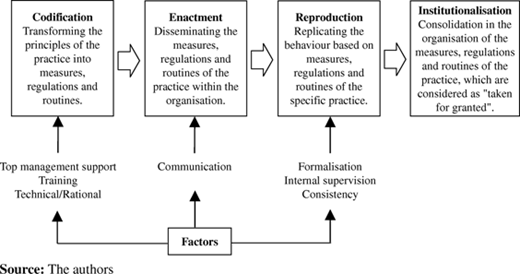
Second, this paper has shown the factors that can contribute to the consolidation or institutionalisation of the control and reduction of emissions, which would mean that this practice would become predominant and stable in the organization, becoming part of the habits and behaviours of its members (Tolbert and Zucker, 1996). In this regard, Barley and Tolbert (1997) designed a sequential model to explain institutionalisation, which was later developed by Burns and Scapens (2000). They established four phases in this model: codification, announcement, reproduction and institutionalisation. Figure 1 shows how each of the analysed factors in this paper are predominantly influencing on some of the phases leading to the institutionalisation or consolidation of the practice.
The dominant position of the top management in Heineken Spain within the organizational hierarchy confirmed their authority to promote the implementation of the control and reduction of GHG emissions, as well as their power to assign the necessary financial resources for their development (Battilana, 2006). The top management support has been indicative for the employees of the appropriate behaviour that is expected from them, expressed by means of regulations and measures that codify the control and reduction of emissions. Thus, for example, in the Environmental Policy for Heineken Spain, issued by the top management, states the goals of this practice and includes the employees in their achievement. As stated in the institutional theory, the expectations of the management constitute regulatory demands that, with the passage of time, lead to “taken‐for‐granted” ideas in the organization that influence its behaviour (Scott, 2001; Järvenpää, 2009).
The training received by the employees of Heineken Spain has also played an important role in the codification phase, since it has promoted a social awareness that is favourable to the control and reduction of emissions, which is shared by all the members of the organization, creating positive attitudes towards these practices, thus favouring the employees' assimilation (Kostova and Roth, 2002). Through training, employees have received the rules and values of the practice, as well as their practical application within the organization through the measures to be implemented, raising the employees' awareness regarding the value of these practices for their organization and the environment (Zeitz et al., 1999; Füssel and Georg, 2000). According to Zeitz et al. (1999), training employees in the technical characteristics and in the beliefs and values related to them, constitutes one of the main drivers for the consolidation of a practice within the organization.
The third factor affecting the codification phase is the technical/rational factor. As shown in the work by Meyer and Rowan (1977) and Scott (2001), this factor shows the employees that the practice implies a rational behaviour that results in an improvement of the organization's technical efficiency, thus improving their commitment with such practices. In this sense, the inventories of emissions performed by Heineken Spain, and the indicators that they have designed (e.g. “Social Responsibility”, “Ecological Backpack”), have contributed to specify the control and reduction of emissions, and their contribution to organizational performance, raising awareness among their employees regarding the need to adopt and embrace these measures. Although in the beginning the institutional theory considered legitimacy and technical efficiency as mutually exclusive (Meyer and Rowan, 1977), further developments of this theory sustain that a practice that only provides legitimacy and does not offer an improvement in terms of technical efficiency is hard to maintain over time and become consolidated within the organization (Powell, 1991).
Similarly, communication has been a key factor to promote the control and reduction of emissions in Heineken Spain. Once the regulations and principles have been coded, communication took place at different levels of the hierarchy and functions of the organization, for which they used different means. This broad communication scheme contributed to disseminating and reinforcing the rules and measures regarding the control and reduction of emissions, making their achievements more visible and, therefore, improving the value of the practice for the organization (González, 2008). As Campbell (2007) also points out, the regulatory demands of the top management can be transmitted to the employees through different means of communication thus facilitating the adoption of an organizational behaviour that conform to these regulatory demands.
In terms of the reproduction phase, the most relevant factors were formalisation, internal supervision and consistency. The formalisation of the control and reduction of emissions in Heineken Spain through different means (e.g. specific IT applications, annual environmental programmes, emissions inventories, technical criteria and procedures included in the Best Available Techniques Guidelines in Spain for the Beer Sector), have contributed to the reproduction of the practice within the organization, improving access and opportunities for the constant use by the employees. Once the rules and measures related to the practice were written and accepted, these tend to endure over time, reinforcing the behaviour of the employees that is based on these rules and measures and, therefore, promoting the maintenance of these practices (Zeitz et al., 1999).
Internal supervision of the control and reduction of emissions in Heineken Spain performed by the Quality and Environment Committees (in the factories) and the Department of Environment (in the offices), have contributed to the reproduction of the practice by ensuring its correct application in obtaining the desired results, promoting a greater visibility as how this practice is valuable for the organization. Furthermore, as established by Hess and Warren (2008), the presence of internal organs that oversee the implementation and performance of the practice, can force the organization to seek more efficiency and, therefore, provide increased social benefits in the form of a reduced atmospheric contamination, in this case. Likewise, it is important to highlight that the creation of organizational structures such as the mentioned department or committees can be interpreted as a mobilisation of authority resources that show the dominance of some actors over others to achieve the desired results (Lawrence, 2008).
Finally, the consistency of the environmental interests of Heineken Spain in terms of the adoption of the control and reduction of their GHG emissions has also facilitated the reproduction of this practice. In this sense, Heineken Spain has taken advantage of their corporate social responsibility and sustainability practices, that are integrated in their organizational culture, to develop their initiative to control and reduce emissions, which has reinforced the continuance of the practice, and its effectiveness in obtaining environmental benefits for society (Hess and Warren, 2008). Thus, this case study corroborates that when a new business practice is promoted in an institutional environment and it also contributes to the achievement of the organization's formerly existing goals, the company will then be willing to commit its resources in this new practice, thus favouring its consolidation (Zeitz et al., 1999).
6 Conclusions
The importance and dissemination of climate change strategies are increasing in the business arena, due to the proliferation – on national and international levels – of the regulations that require organizations to control and reduce their emissions, and voluntary initiatives (e.g. voluntary agreements between companies and governments, multi‐stakeholder partnerships, unilateral activities, etc.) developed by corporations (Pinkse and Kolk, 2009). In this respect, this paper has illustrated the main strategies and actions that are being undertaken by Heineken Spain in order to fight against climate change. This is interesting in order to know what organizations are doing against climate change. Also, these strategies of Heineken Spain could be a good reference for both companies that belong to the same industrial sector and companies that operate in similar institutional contexts.
In addition, this paper has identified and analysed several factors that have affected the consolidation of an effective practice in the fight against climate change. Besides to verifying the positive influence of these factors, the paper indicates the specific phases of the institutionalisation process in which the factors develop a more critical role, what have not been specified until now from the institutional theory perspective. So, this study has shown that the top management support, training and the technical/rational aspect are key factors in the codification phase; the communication is a critical element in the enactment phase; and the formalisation, internal supervision and consistency are key factors in the reproduction of an effective practice in the fight against climate change. These results could be useful for managers in order to plan and evaluate the influence of the factors affecting the consolidation process of an effective practice for the control and reduction of emissions.
Subsequent studies could contrast if the analysed factors are also relevant in other companies, industrial sectors and institutional contexts. Moreover, the development of similar case studies in other organizations of the industry with different levels of commitment in the fight against climate change would allow to compare the results and delve in the understanding on the influence of the analysed factors. For the development of the research, it would be also important to analyse the reasons why organizations can react differently to climate change and implement different strategies or actions, despite belonging to the same organizational field and being subjected to the same competitive and institutional pressures. It could be also interesting to acquire deeper knowledge on the process for the implementation and consolidation of the emissions control and reduction practices when the organization has other conflicting consolidated practices.

References
About the authors
José María González‐González is a Doctor Contracted in Management Accounting at the University of Seville (Spain) as well as a Visiting Research Fellow at Sheffield Hallam University (UK). His specific research interests include management accounting change and social aspects of accounting. He has published in international journals on the adoption, implementation and diffusion of business practices such as business process re‐engineering, total quality management, corporate social responsibility and carbon emissions control. José María González‐González is the corresponding author and can be contacted at: jgonzalez@us.es
Constancio Zamora‐Ramírez is a Senior Lecturer in Financial Accounting at the University of Seville (Spain) and he is currently the Director of the Research Group on Financial Economics and Accounting of the University of Seville. Specific research interests include International Accounting Standards, financial instruments, carbon finance and carbon markets. He has published about these topics in both national and international journals.

