


The purpose of this paper is to understand how cities at different stages of development each subject to its own challenges in adapting to climate change can manage greenhouse gas (GHG) emissions.
Case studies are undertaken for three cities: Amman, Jakarta and Dar es Salaam, including determination of GHG emissions and analysis of climate change data (where available) for each.
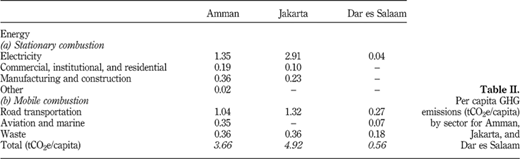
In Amman, the most climate‐sensitive municipal service is water; Jordan is exceptionally dry, and nearly 15 per cent of all electricity consumption is by the water authority. Jakarta has already experienced extreme flooding. The climate vulnerabilities associated with sea‐level rise are intensified by subsidence in parts of Jakarta. Alternating floods and droughts are climate impacts already experienced in Dar es Salaam. Droughts have impacted Tanzania's electricity infrastructure disrupting hydroelectricity production, requiring new natural gas infrastructure to maintain power, thereby increasing GHG emissions. Nonetheless, Dar es Salaam's GHG emissions at 0.56 t CO2e/cap are small compared to Amman and Jakarta at 3.66 and 4.92 t CO2e/cap., respectively.
Synergist development strategies, addressing climate change mitigation and adaptation are suggested. In Amman an increased share of photovoltaic electricity production might be used for service provision, especially for energy needs surrounding water supply. Advanced slum upgrading in Jakarta could see relocation of the at‐risk poor to safe areas with energy efficient homes connected to public transit and decentralized, community‐based electricity generation. The focus in Dar es Salaam community‐based waste‐to‐energy facilities would reduce climate change impacts and vulnerabilities while addressing energy poverty in poor communities.
Introduction
The majority of the world's population now lives in cities and for many of those urban residents poverty is widespread. Inadequate access to water, energy, food, and employment are all realities of daily life. A changing climate will exacerbate the issues faced by the urban poor: climate change is a problem primarily caused by the rich will affect poor most severely (Bartlett et al., 2009; Hoornweg et al., 2010). Urban development aims to improve the quality of life for the urban poor, now and as the climate changes, while ideally seeking to minimize increases in greenhouse gas (GHG) emissions.
The Intergovernmental Panel on Climate Change (IPCC, 2007) has given some dire predictions of the consequences of climate change. Such consequences include: a decrease of water availability in dry areas by up to 30 percent; sea‐level rise; and increased ocean temperatures that disrupt ecosystems and intensify storms. For cities, these consequences take on particular significance. The infrastructure in cities, or lack thereof, has profound impacts on how severely the consequences of climate change are experienced. In cities with strong emergency systems, diverse power sources, and well‐coordinated drainage and water systems, climate change may be more easily managed. However, the majority of cities in developing regions of the world do not even have the infrastructure to provide for all of their citizens on a daily basis, let alone adjust to disruptions caused by climate change. It is in these cities that the impacts of climate change will be most severe.
The potential to combine strategies for mitigation and adaptation is of great interest to the development community – especially in the urban context (Beg et al., 2002; Dang et al., 2003). The IPCC's Fourth Assessment Report noted that “Information on interrelationships between adaptation and mitigation at regional and sectoral levels is rather scarce” (Klein et al., 2007). Experts contend that mitigation and adaptation need not compete for development resources, for they can be complementary pursuits (Wilbanks and Sathaye, 2007). Wilbanks et al. (2003) describe how mitigation and adaptation target different geographical and temporal scales: mitigation is global with long‐term impacts, and adaptation is local with short‐term impacts. Therefore, if mitigation can keep climate change moderate, adaptation can take case of the rest. Such a synergetic approach is essential to incorporate into urban planning practices (Susskind, 2010). Venema and Rehman (2007) and Simon (2010) bring up challenges unique to Africa: energy is a sector to target. Energy poverty, if left unaddressed, contributes to climate change with deforestation and biomass burning, while making poor populations even more vulnerable to climate impacts. Moreover, the costs of reducing GHG emissions in developing countries can be one or two orders of magnitude lower than in developed countries for some technologies (Kennedy et al., 2010a). It becomes clear that in developing regions, strategies that can address both mitigation and adaptation simultaneously will be the most efficient use of limited resources.
Not all mitigation and adaptation strategies are necessarily complementary. Moser (2012) discusses tradeoffs that sometime occur including inadequate conditions for pursuing dual policies, competition for resources, and potentially negative consequences of pursuing simultaneous actions. Figure 1 shows examples of cases where actions taken to increases climate resilience, such as greater use of conventional air‐conditioning systems, or desalination of water, is detrimental to mitigation, Conversely, very high population density and use of small hydropower may help reduce emissions, but decrease resilience to climate change.
Nevertheless, there are examples of strategies that can be synergetic in address adaptation and mitigation, including urban greenery, building insulation, water efficiency and storage, distributed and centralised renewable energy systems and multi‐modal transportation (Figure 1). Moreover, these synergetic strategies become particularly apparent in an urban context. Integrated modelling of the Paris region by Viguié and Hallegatte (2012) shows, for example, how three urban policies for greenbelts, zoning to reduce flood risk, and transport, may separately involve tradeoffs, but can be combined to give win‐win strategies.
The objective of this paper is to identify synergistic strategies by which cities in different stages of development can manage their GHG emissions while adapting to climate change. The challenges of sustainable development today are immense; each city is at a different stage in the development process and faces unique everyday circumstances. The contribution of the paper is to find original strategies that address the dual problem of mitigation and adaptation, in the context of the climate vulnerabilities, GHG impacts, and low‐carbon, adaptive development opportunities of urbanizing regions in developing countries.
The methodology of the paper draws upon case studies of three cities: Amman, Jakarta, and Dar es Salaam. The three case studies demonstrate different opportunities for climate change mitigation and adaptation within a development context. After brief background on the cities, the paper will then outline the main vulnerabilities of each city to climate change. Next, GHG inventories for each city are presented, as well as associated data and methodological issues. Finally, the cities' current plans to address climate change are presented, along with further original suggestions of synergetic opportunities for mitigation, adaptation, and development identified in this research.
Cities used as case studies
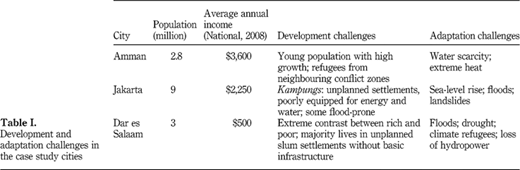
The three cities were selected due to data availability (primarily for GHG emissions calculations) and to give representation of low income (Dar es Salaam), low middle income (Jakarta) and high middle income (Amman) developing country cities (Table I).
Amman is the largest city in Jordan: home to 2.8 million people. The population growth in the city accelerated in the later half of the last century, as Amman has been a place of refuge for those escaping from neighbouring conflict zones. The majority of the population in Jordan is under the age of 25 (WDI, 2008). The climate is moderate with seasonal variations and cool winter months. The annual per capita income in Jordan is about US$3,600 on average (WDI, 2008), and the economy in Amman is primarily service‐based.
Jakarta is on the northwest coast of Java, Indonesia; with a population of nine million, it is the archipelago's largest city. The climate is tropical, with warm temperatures and an eight‐month long rainy season. Economic activity centres on services, finance, and manufacturing. The average income per capita in Indonesia is about US$2,250, growing at a rate of 6.1 percent per year (WDI, 2008).
Dar es Salaam is the largest city in Tanzania, and although not the capital of the country, it is considered a hub for business, government, and transportation. The population is approaching three million, growing recently at a rate of 6 percent per year (Kimbisa, 2010). The climate is tropical, and the average income per capita of Tanzania is about US$500 per year (WDI, 2008). The local job market centres on manufacturing and natural resources, such as fishing, and many people support themselves with entrepreneurial enterprises.
The amount and severity of urban poverty in each city varies. In all three cities, the poor live primarily in unplanned areas that are not connected to basic municipal services. In Amman, while the economy is flourishing, there are still portions of the population that live in unsafe squatter settlements without access to reliable services. The poor in Amman are primarily refugees from conflicts in neighbouring regions (Tavernise, 2007), and the government has made housing upgrade projects and infrastructure access for poor communities a development priority (Gerlach and Franceys, 2009; Bisharat and Tewfik, 1985). Unplanned settlements in Jakarta are known as kampungs. The kampungs are not equipped with reliable water or energy infrastructure, some are located in flood‐prone areas, and they are not exclusive to the urban poor: some kampung residents have low‐ to mid‐range incomes (Argo and Laquian, 2007; Rustamadji, 1992).
In Dar es Salaam, the contrast between the rich and the poor is most extreme. The rich live in comfortable, planned developments with access to water, electricity, and cars. The poor majority (nearly 70 percent) inhabits over populated, unplanned slum settlements without basic municipal infrastructure, including roads, water, and sewerage (Government of Tanzania, 2000; Tweehuysen and Hayes, 2006). The conditions in the slums are worsened by everyday behaviour caused by desperation. Biomass is burned in the home for cooking, which produces soot that deteriorates interior air quality (Sanderson, 2000). Solid waste, human waste, and wastewater are dumped in the streets to decompose, where they contaminate the meagre water supply and spread dysentery and disease (Victor et al., 2008). While the problems in Dar es Salaam are seemingly overwhelming, city officials have successfully taken steps to upgrade some areas.
Vulnerabilities of cities to climate change
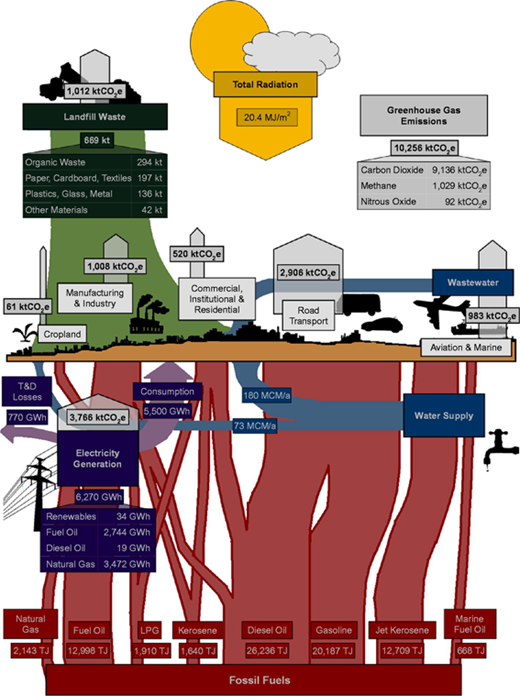
In Amman, the most climate‐sensitive municipal service is water. Jordan is exceptionally dry, and nearly 15 percent of all electricity consumption is by the Water Authority of Jordan (GTZ, 2004). Accordingly, Amman uses approximately 825 GWh of electricity to pump water each year (see the urban metabolism diagram for Amman, Figure 2). While Amman has nearly a 100 percent connection rate to the municipal water supply, providing a consistent water flow is something authorities are already struggling with (Gerlach and Franceys, 2009).
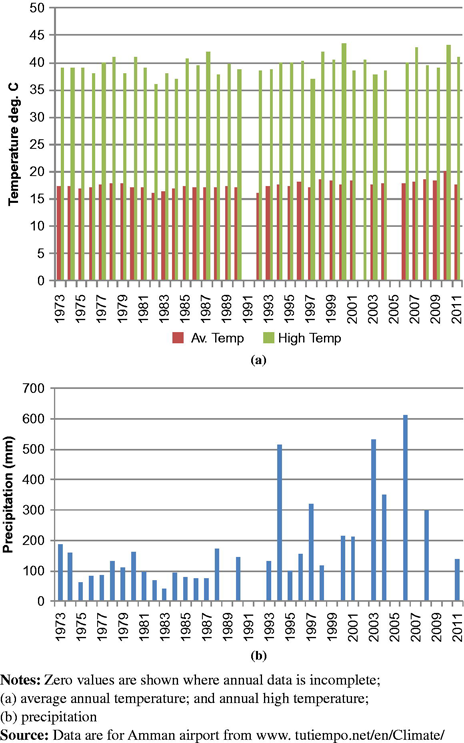
With climate change and population growth, water scarcity may become more severe in Amman, although there may also be some opportunity for greater capture. Average annual temperature in Amman has increased from 17.4°C in the 1970s (1973‐1980) to 18.4°C in the first decade of the century (2001‐2010). Moreover, the average highest annual temperatures recorded has increased from 39.1°C in the 1980s, to 39.5°C in the 1990s to 40.0°C in the 2000s (Figure 3(a)). Precipitation levels have increased, but also become more variable. The average annual precipitation was just 95 mm in the 1980s; this has increased to 402 mm in the 2000s (based on five years data only). Annual precipitation of over 500 mm has been experienced in three years since 1994 (for which records are complete), while other recent years are more like previous decades (Figure 3(b)).
In Jakarta, projected sea‐level rise, flooding and landslides are risks (Bowo, 2010). The city has already experienced extreme flooding, with flooding being most severe in low‐elevation kampungs (Texier, 2008). Hurford et al. (2010) note that from 2003 to early 2007 there were four storms that produced rainfall exceeding 150 mm:
- 1.
December 31, 2003 (01:00): 264 mm.
- 2.
January 19, 2005 (04:00): 168 mm.
- 3.
July 15, 2005 (20:00): 191 mm.
- 4.
February 2, 2007 (10:00): 153 mm.
The climate vulnerabilities associated with sea‐level rise are also intensified by local actions: parts of Jakarta are already subsiding because of an over‐exploitation of ground water and soil compression from heavy construction (Van Sluis and van Aalst, 2006).
In Dar es Salaam, alternating floods and droughts are climate impacts already experienced. Climate data for the city is quite poor with incomplete records for most years. Nonetheless, the average temperature since 2006 of 26.3°C is one degree higher than the average of 25.3°C recorded between 1957and 1961. The city is witnessing an unprecedented influx of climate refugees from rural areas (Kimbisa, 2010), which puts increased pressure on already strained services. Flooding in Dar es Salaam is intensified by the poor drainage infrastructure (Mwandosya et al., 1998), causing roads to be washed out and economic activity to be put on hold. Conversely, droughts are also impacting Tanzania's electricity infrastructure: a low water level disrupts hydroelectricity production, requiring new natural gas infrastructure to maintain power. Not only is this response expensive, it also increases GHG emissions that further the climate problem.
The climate vulnerabilities of the three cities point to a common theme: infrastructure that is resilient to extreme circumstances will be the best response to climate change. As demonstrated by the example of electricity in Tanzania, development responses should not exacerbate the climate change problem by producing GHG emissions. Similarly, the water situation in Amman shows that infrastructure access and supply need to be considered in concert. A big picture perspective is needed that address impacts as well as contributions to climate change.
GHG emissions from cities
GHG emissions from developing cities, though sometimes challenging to quantify, can give insight into urban activities that are contributing to the climate change problem. Cities in developing economies to not generally emit as many emissions per capita as cities in developed regions, simply because the quality of life and consumption practices are lower on average. However, conducting an inventory of emissions by sector is the first step towards targeting the most effective low‐carbon development strategies for a given city.
Methodology and data sources
The GHG inventories for Amman, Jakarta, and Dar es Salaam were conducted following the methodology of Kennedy et al. (2010b) and the Standard for Determining Greenhouse Gas Emissions from Cities (UNEP et al., 2010), which is a city‐scaled version of the IPCC (2006) methodology for nations. The urban GHG inventory is a hybrid of a consumption and production inventory; that is, it includes GHG emissions produced within the city boundary, as well as emissions that are a direct result of urban activity. For example, the inventory includes emissions from heating, industrial, and transportation fuels, as well as electricity consumption (though electricity production often takes place outside the urban boundary).
The IPCC defines four categories of emissions: energy (stationary and mobile combustion of fossil fuels); industrial processes and product use (non‐energy related emissions); agriculture, forestry, and other land uses (AFOLU); and waste. In cities, the most significant categories of emissions are energy (fossil fuel combustion and electricity consumption) and waste. Some cities have high industrial process emissions (e.g. Chinese cities, see Sugar et al., 2012), but these emissions are not considered for the three cities studied in this paper. Amman and Dar es Salaam do not have significant industrial activity, and the industrial data for Jakarta is currently unavailable. Similarly, AFOLU emissions are not included for lack of available data; however, they are estimated to be insignificant for the three cities based on previous studies conducted in other cities (Kennedy et al., 2009).
In general, GHG emissions are calculated as follows: Equation 1 Activity data varies with inventory component; for example, the amount of energy consumed and the amount of waste produced are both forms of activity data for their respective sectors. Both the activity data and GHG intensity are required to complete calculations. For the three cities studied, GHG intensities are either based on national averages or IPCC default values.
The GHG inventories for Amman, Jakarta, and Dar es Salaam were conducted in collaboration with city officials and local consultants to give an “on‐the‐ground” advantage to data collection. Officials were able to access statistical data and engage local experts to provide reasonable estimations. For Amman, city officials from the Greater Amman Municipality were able to provide data for all necessary sectors; when needed, national data was scaled to values appropriate to the local context and confirmed with city officials. Data for Jakarta were readily available, as local consultants had recently conducted a thorough air quality report outlining sources of carbon dioxide, methane, and nitrous oxide (Suhadi, 2009). The inventory data for Dar es Salaam were the most difficult of the three cities to acquire, for it is where the conditions of poverty are most extreme. Local officials, academics, and development agencies were able to provide some data, and the remaining data were scaled from national statistics to the urban context. It is important to note that the three urban GHG inventories presented in this paper are an important first step; future inventories will improve as urban data collection becomes more thorough and the practice of inventorying becomes a higher priority to cities.
Results
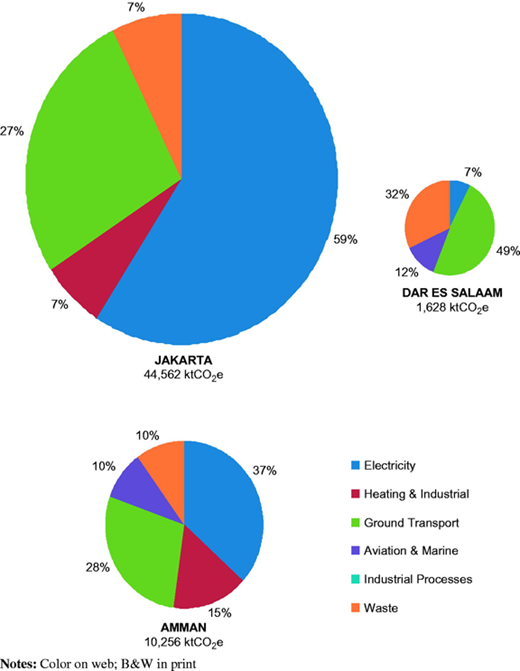
The urban characteristics of the cities are well represented in their GHG inventories. In the study year, Amman, Jakarta, and Dar es Salaam produced 10.3, 44.6, and 1.6 megatonnes of carbon dioxide equivalent (CO2e) emissions, respectively, (Table II and Figure 4). The major contributors of emissions are highly dependant on the amount and type of urban infrastructure in each city.
Emissions from road transportation were quite high in all three cities, accounting for 28, 27, and 49 percent of the total emissions from Amman, Jakarta, and Dar es Salaam, respectively. In all cities, there is little in terms of a public transportation infrastructure: the public transportation networks are still growing, and privately owned automobiles are still the mode of choice for those who can afford them. In all the cities, mass transit takes the form of buses or mini‐buses, which give mobility access to more people but do not necessarily take private cars off the road.
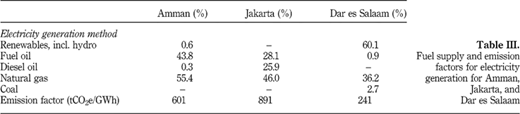
Electricity consumed in the cities had varying impacts on the GHG inventories, primarily due to differing levels and methods of generation (Table III). Emissions from electricity for Amman and Jakarta were quite high: 37 and 59 percent, respectively. This can be attributed to high levels of electricity generated using fossil fuels. Dar es Salaam, however, had the lowest percentage of emissions from electricity (7 percent), chiefly because electricity is generated primarily from hydropower and service is inconsistent.
Waste in all three cities is managed at landfill sites, with a small portion composted in Jakarta. The percentages of emissions from waste are quite low in Amman and Jakarta: 10 and 7 percent, respectively. However, waste in Dar es Salaam produced 32 percent of total emissions. It is important to note that waste emissions only account for waste that is collected and managed by the cities; in reality, waste in unplanned settlements is collected rarely and may not be collected at all.
Given that these inventories are the first for all three cities, there are some emissions that are left unaccounted for. Emissions from fossil fuel combustion in the industrial, commercial, and residential sectors were available for Amman and Jakarta (15 and 7 percent, respectively), but not for Dar es Salaam as the data was not available. Similarly, emissions from the aviation and marine sectors were not calculated for Jakarta because the ports lie outside the city boundary, and assigning emissions based on city‐related port use was not possible due to lack of available data. However, given their statuses as regional business and commercial hubs, aviation in Amman and Dar es Salaam were significant, accounting for 10 and 12 percent of total emissions, respectively.
In examining the GHG inventories of the three cities, it is important to revisit the living conditions of the urban poor. Those living in poverty do not have access to the same energy, water, or waste management infrastructure as other urban residents. Therefore, it becomes important to question to what degree the inventories reflect the consumption habits of the entire city. One may argue that the inventories focus primarily on residents living in well‐connected areas of the city, though this is a topic requiring further research. An understanding of the attribution of emissions within the city will help inform sectors best suited for either mitigation measures or low‐carbon development.
Development opportunities
As demonstrated in previous sections, the access to services, climate change vulnerabilities, and GHG emissions in the study cities are quite different, demanding unique and innovative solutions. The most efficient use of development resources will address all three issues simultaneously. For some examples: decentralized renewable energy addresses energy poverty, reduces GHG emissions, and enhances resilience of poor communities (Venema and Rehman, 2007); improved water and waste management services improve resilience while avoiding emissions from untreated decomposition; and slum upgrading from dangerous areas to safe, energy efficient homes reduces emissions and vulnerabilities to extreme events. Current development plans in each city begin to address these issues. Further recommendations of specific strategies that will address mitigation, adaptation, and development are provided for each city.
Officials in Amman have been working to improve urban life for a number of decades. In the 1980s, the city introduced housing upgrading programs that legalized land tenure in squatter settlements and built household connections to water, sewer, and electricity infrastructure (Bisharat and Tewfik, 1985). The upgrades made the settlements less prone to washout and lessened safety and health risks. Today, authorities are continually addressing the problem of water scarcity, approaching the issue from multiple angles including water management infrastructure projects (GTZ, 2004) and public‐private partnerships (Gerlach and Franceys, 2009). Recently, some of the most significant projects have focused on the city's social fabric: sidewalks, park benches, and pedestrian walkways with trees are improving infrastructure resiliency and quality of life while “tearing down walls between rich and poor” (Slackman, 2010). Mobility is increasingly important for the young population, and creating connectivity and curbing sprawl are top priorities.
The greatest contributor to the GHG inventory in Amman is the electricity sector, and the greatest climate vulnerability is the water supply. The latter issue exacerbates the former: the electricity consumption for water pumping is already high, and it will grow with climate change. Therefore, a strategy for climate change mitigation, adaptation, and service provision in Amman is an increased share of photovoltaic electricity production, especially for energy needs surrounding water supply. Amman receives a high amount of solar radiation each year (20.4 MJ/m2; Figure 2), making photovoltaic electricity a viable renewable energy option. Water technologies, such as deep groundwater pumping or desalination, are very energy intensive, and meeting those energy needs in a resilient, carbon‐neutral manner is essential.
In Jakarta, the tradition of community‐based development is also applied in response to climate change (Karamoy and Dias, 1986). The municipal government is working with communities on disaster preparedness and budget management programs, as well as water treatment, waste management, and waste‐to‐energy programs that are currently in progress (Bowo, 2010). Some major successes in Jakarta have been the conversion of users of kerosene to LPG, car free days, emissions testing for cars, expansion of green spaces, and plans to shift public transportation to alternate fuels (Bowo, 2010). Not only do these efforts reduce emissions, they also improve the resilience of Jakarta's communities: diversity in energy sources reduces vulnerability to energy infrastructure disruption and shortages, and increases in vegetation provide adaptive ecosystem services improving community life.
Jakarta's highest emitting sectors are electricity and road transportation. The government's current work to enhance public transportation and reduce vehicle use targets GHG emissions as well as local air pollution. However, one of the greatest aspects of vulnerability in Jakarta is flooding and sea‐level rise, specifically for the urban poor living in unsafe, flood‐prone areas. A synergetic recommendation for Jakarta addressing mitigation, adaptation, and development is advanced slum upgrading: relocation of the at‐risk poor to safe areas with energy efficient homes connected to public transit and decentralized, community‐based electricity generation. There are a variety of vernacular, Southeast Asian architecture techniques that take advantage of passive day‐lighting and ventilation strategies. Combined with electricity produced nearby using renewable resources, the resultant community would be more resilient to climate change with a minimal carbon footprint.
The municipal government of Dar es Salaam has a number of programs that address development and climate change mitigation. For example, the government has programs in place to encourage waste‐to‐energy briquettes and cooking stoves (as an energy alternative to charcoal), tree planting, methane flaring at the local dumpsite, as well as a planned bus rapid transit project (Kimbisa, 2010). International development banks also have projects in Dar es Salaam, such as the World Bank's Community Infrastructure Upgrading Program (CIUP) that has built roads with drainage systems, street lights, water kiosks, and solid waste containers (The World Bank, 2002). These programs improve resiliency to flooding and landslides, diversify energy resources, promote economic activity, and encourage waste management.
The World Bank's CIUP projects in Dar es Salaam are excellent ways to improve the resiliency of poor communities to flooding. Building on this strategy, a recommendation for Dar es Salaam focuses on community habits of waste disposal. Waste emissions are the second highest category in the city's inventory, which only represents waste collected and disposed in landfills. The waste left to decompose in the streets not only produces emissions, it also causes contamination of the water supply and disease during floods. A synergetic way to address this issue is to implement waste dumping practices combined with community‐based waste‐to‐energy facilities. This would reduce climate change impacts and vulnerabilities while addressing energy poverty in poor communities.
Waste management is likely to take on increased importance in all three cities. Methane – largely generated from the waste sector – is being particularly targeted for mitigation as a short‐live climate forcer. Also, in cities like Dar es Salaam, reducing uncollected waste has emerged as a critical adaptation strategy. Amman, Dar es Salaam, and Jakarta all have active CDM projects in the solid waste sector. As climate financing increases, these carbon finance programs are anticipated to expand.
Conclusions
The need to address climate change mitigation and adaptation simultaneously is quite pronounced in developing cities. The strategies to manage and mitigate risks are complementary: reducing emissions now will ensure climate change does not surpass a level manageable by adaptation in the future. This is especially relevant for the urban poor, for they will experience the effects of climate change most severely.
The cities presented in this paper are examples at different stages of development. Amman has a young population with a primarily service‐based economy; Jakarta is the most population city in Indonesia with economic activity focusing on services, finance, and manufacturing; and Dar es Salaam has a rapidly growing population and many support themselves with small‐scale entrepreneurship. The severity of the living conditions of the urban poor varies, but an important commonality remains: the poor live in unplanned developments with little access to municipal infrastructure, putting them highly at risk to the extreme events associated with climate change.
The climate change vulnerabilities in the three study cities have the potential to drastically impact the way of life of urban residents. In Amman, water scarcity is a problem that worsens each year, and it will continue to as the region experiences an increase in population. In Jakarta, flooding and sea‐level rise have the potential to alter the normal way of life. Alternating droughts and floods in Dar es Salaam challenge the resilience of already fragile infrastructure. In all cases, the unplanned developments are at a particularly high risk of experiencing the most devastating of these consequences.
The per capita GHG emissions for the three cities are related to their level of development, as is typically seen from national data. The annual GHG emissions for the low income city, Dar es Salaam (0.56 t CO2e/cap) are significantly lower than those of the middle income cities: Jakarta (4.92 t CO2e/cap) and Amman (3.66 t CO2e/cap). The sectors responsible for the highest percentage of emission in the three cities were generally road transportation, electricity generation, and waste. This pattern raises an issue that warrants further investigation: the highest emissions result from services and infrastructure that are typically inaccessible to the urban poor. The local distribution of emissions attribution could be a useful element in future development planning.
In all three cities studied, an aggressive reduction in GHG emissions will need to target the lifestyles of the rich; nevertheless, climate change adaptation and access to basic services remain priorities for the poor. Strategies that address mitigation, adaptation, and development together will be the most effective in cities in developing regions. Officials in Amman, Jakarta, and Dar es Salaam have recognized the importance of including climate change in their development strategies, and they are implementing projects that address both climate change and the development needs of their residents. Further synergetic climate change strategies are recommended for each city. For Amman, solar energy has the potential to meet many electricity needs, particularly those related to water pumping. The relocation of the poor from unsafe areas is a top priority in Jakarta, and alternative housing could be met with energy efficient homes connected to transit and community‐generated electricity. In Dar es Salaam, upgrading the waste collection in unplanned settlements and using the waste to produce energy locally is a potential solution to both waste dumping and energy poverty. In all three recommendations, key adaptive requirements have been addressed along with heavy emitting sectors. Similar synergic approaches could be developed for other cities as well.
In developed and developing regions of the world, it is increasingly important for cities to address climate change mitigation and adaptation as part of their strategic development plans. All cities are unique in their infrastructure, municipal priorities, and social fabric; therefore, local involvement in assessment and planning is crucial. Sustainable development requires not only an understanding of climate change science, but also leadership that encourages creativity and innovation in project implementation. Perhaps most importantly, it will be essential for cities to disseminate their experiences, allowing cities to learn from each other and explore new ideas.

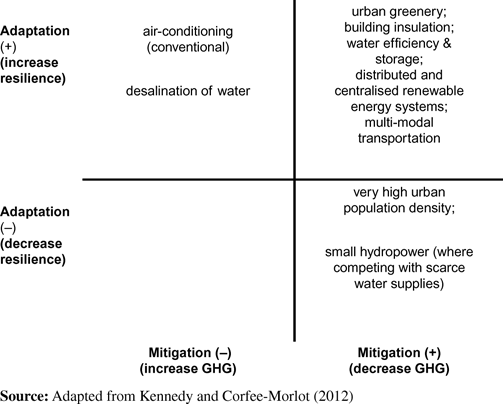
Examples of positive and negative interactions between adaptation and mitigation strategies
Examples of positive and negative interactions between adaptation and mitigation strategies
Per capita GHG emissions (tCO2e/capita) by sector for Amman, Jakarta, and Dar es Salaam
Per capita GHG emissions (tCO2e/capita) by sector for Amman, Jakarta, and Dar es Salaam
Fuel supply and emission factors for electricity generation for Amman, Jakarta, and Dar es Salaam
Fuel supply and emission factors for electricity generation for Amman, Jakarta, and Dar es Salaam

