


The purpose of this paper is to assess the local communities' perception of climate variation effects on crop production and the adopted strategies by farmers in order to cope with the negative effects of climate on the agriculture in the coastal zone of Benin.
A total of 290 agricultural households were sampled and surveyed through structured interviews. The principal component analysis (PCA) was performed on the relative frequencies citation of perceived climate variation indication in order to describe the relationship between risk perceptions according to socio‐demographic characteristics. The relative frequency of citation was calculated according to age, gender, ethnic group and agro‐ecological region.
Results showed that almost 83 per cent of the respondents already perceived the climate change risks through several indications. Climate variation perception varied with respect to age. Respondents' opinion regarding climate variation causes depended generally on their age, religion and level of education. As far as climate variation risks impact on crop production is concerned, the respondents' opinions diverged.
The assessment of local communities' perception is important to design participatory and sustainable measures to cope with harmful effects of climate variation on crop production.
1 Introduction
Climate is changing and this phenomenon adversely affects rain‐fed agriculture (Nicholls, 1995; Adger, 2006; IPCC, 2007; Mongi et al., 2010). Climate change is predicted by scientists to have important impact on agriculture, economy and livelihood of the human population of developing countries and mainly in sub‐Saharan Africa (Kandji et al., 2006). For the rural population of the developing countries, agriculture is the primary source of food, employment and income. This population will be most affected due to the vulnerability of agriculture to climate change (Adger, 2006; Mongi et al., 2010). Thus, one of solutions for these rural populations seems to be adequate and relevant adaptation strategies (Akponikpè et al., 2010b). Since risk management and planning activities cannot be sustainably and efficiently implemented unless being based on a participatory approach resulting from the problem consciousness and perception of the local communities, successful planning should also include information collection for adaptation and mitigation measures. These prerequisites may favour the participation of all stakeholders including local populations (Teka and Vogt, 2010).
Benin is situated in West Africa and undergoes the effects of the climate variation. Previous works (Afouda, 1990; Houndénou, 1999; Ogouwalé, 2006; Akponikpè, 1999; Teka, 2010; Agbossou, 2010) underlined for this country a decrease of annual rainfall, a rise in temperature and a reduction of the length of the active growing season. Especially in the coastal area of Benin, the analysis of climate data recorded for the last 40 years as well as the climate model implementation show a decrease of annual rainfall pattern and the shortening of the rainy seasons (Afouda, 1990; Teka, 2010). These changes in climate parameters may impact the agricultural production.
Moreover, the coastal area of Benin is characterized by a high population density, reduction of land access, depletion of soil fertility, unsustainable use of natural resources, low yield and income, which lead to conflicts between stakeholders (Teka, 2010). All these problems are exacerbated by the harmful effects of climate variation on agriculture. In this area, small‐scale farmers, rural communities and indigenous farming communities depend mainly on rain‐fed agriculture for their well‐being. The rain‐fed agriculture is practiced by more than 60 per cent of the population and this contributed approximately to 35 per cent of the GDP and 40 per cent of the exportation incomes (INSAE, 2003).
In prevision of climate variation impact on agriculture production, adaptive methods were elaborated and popularized by the scientific and national agricultural services in Benin (MEHU, 2003; PANA‐Bénin, 2008). These measures are summed up to the choice of adapted variety and seed resistant to drought, the modification of the agricultural calendar and the mode of drainage and irrigation techniques (PANA‐Bénin, 2008). Although these methods are proved to be economically profitable and ecologically sustainable by researchers and technicians, the local communities remain reserved and are reluctant to adopt them. In fact, the perception of climate variation risks seems to be different according to local communities and could affect significantly their coping mechanisms as well as the participation form in implementing adaptation and mitigation measures (Jodelet, 1989; Jan and Anja, 2007; Ishaya and Abaje, 2008).
Therefore, the assessment of the local population perception of climate variation risks is an important step in finding participatory adaptation, and mitigation measures to alleviate negative effects on cropping system. The perception of climate risk and of climate variation impacts remain less investigated in Benin despite the relevance of such study for the setting up participatory management strategies (Teka and Vogt, 2010; Akponikpè et al., 2010a). Hence, this work aims to fill this gap. For this purpose, we address how local communities assess the risks of climate variation on the agricultural production, what the causes and the consequences on the agricultural production of climate variation processes according to local farmers are, and how this may affect the endogenous coping mechanisms. Responses to these issues are relevant for participatory risk management in order to overcome harmful effects of climate variation on agriculture and furthermore to improve the local communities' livelihood and also to ensure food security in Benin.
2 Materials and methods
2.1 Investigation area
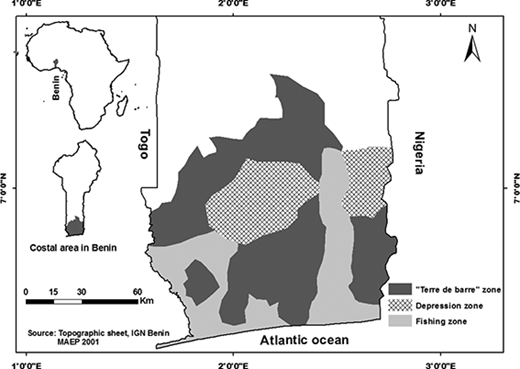
This study was carried out in the coastal zone of Benin, which is located at the Gulf of Guinea, alongside the Atlantic Ocean in West Africa and extends between 1°35′ and 7°30′E from Togo in the West to Nigeria in the East and between 6°20′ and 7°30′ N (Figure 1). The coastal zone of Benin stretches over 12,000 square kilometers, corresponding to approximately 10.5 per cent of the national area.
The coastal area of Benin is characterized by a high population density. The density of population of this area is estimated to be roughly 305 inhabitants per square kilometer (INSAE, 2003). Over 30 ethnic groups live in the coastal area of Benin. But the four most important are Fon, Wemenou, Holli and Houeda as well as the related ethnic groups who have traditionally been the owners and users of the land, principally for agriculture.
Culturally, the coastal area of Benin distinguishes itself by a high diversity of belief systems. The principal religions in the coastal zone of Benin are traditionally the “Vodun”, Catholicism and Islam. Since 1989, i.e. after the National Conference of Benin, there has been observed an increase in the number of evangelical churches (protestant, apostolic, evangelic, etc.). In southern Benin, “Vodun” is for its adepts a traditional religion of mediation between god and humans. It is based on invocation practices, traditional bans, sacrifices, and thanksgiving in honour of deities who are related to nature resources. In the belief system of “Vodun”, cultural occasions on the one hand represent the respect to god, who controls the natural resources. This sacral belief system constitutes an important social capital which can affect the perception of climate risk and furthermore the adaptation strategies by local inhabitants of the Beninese coastal area.
The climate of the coastal area of Benin is characterized by two rainy seasons and two dry seasons (Adam and Boko, 1993). The annual rainfall range fluctuates from 820 to 1,300 mm and the daily thermal amplitude is weak with approximately 3°C (Afouda and Houanye, 2004). The most common soil types are sandy soils, dry soils, hydromorphic soils and ferralitic soils (Adam and Boko, 1993). Roughly, three agro‐ecological zones can be distinguished in the Beninese coastal area. There are the fishing zone, the depression zone and the terre de barre zone. The fishing zone is characterized by the presence of sea and rivers which limit the availability of agricultural land. This zone is also characterized by the dominance of the sandy and hydromorphic soil types. The main cultivated crops are maize, cassava and vegetable crops. The depression zone is characterized by a predominance of hydromorphic soil type. The main cultivated crops are also maize, cassava and vegetable crops. The terre de barre zone is characterized by a predominance of ferralitic soil type. Maize, cassava, bean and the groundnut represent the main practiced crops by farmers. In total, the coastal area of Benin has 39 districts with 656,048 households and 324,743 rural households. Around 60 per cent (194,846 households) are engaged in agriculture.
2.2 Data collection
The methodological approach was based on surveys with various stakeholders through structured and semi‐structured interviews as well as participatory observations. A total of 290 agricultural households were sampled and surveyed through structured interviews. The farmers were selected randomly from the database of the Regional Centre for Agricultural Promotion (CeRPA) of the three agro‐ecological regions in the coastal area. Altogether, 54 women and 236 men from the four main ethnic groups (Fon, Wemenou, Holli and Houeda) were randomly selected and interviewed. The initial objective was to have a sample consisting of 50 per cent men and 50 per cent women. However, men were more inclined to participate in the interview than women, explaining the divergence in the number of interviewed women and men. Information was gained through discussion with the household heads selected according to gender, age, ethnicity, location (agro‐ecological zone) and the type of the main produced crops. The collected data were related to:
the perception of climate variation risks;
the indications of the climate variation (rise in temperature, abnormal rainfall, frequent flood, drought and heavy storms);
the causes of climate variation;
the impacts of the climate variation on the agricultural production; and
the adopted adaptation measures in order to reduce the harmful effects of climate variation on the agriculture and on crop system (the use of resistant crop varieties, the modification of agricultural calendar, application of irrigation system, the draining and the crops' association).
2.3 Data analysis
The members of each ethnic group were assembled according to gender (men (Mi) and women (Fi)), as well as age according to Teka and Vogt (2010):
young adults (18<i≤30 years old);
adults (30<i≤60 years old or less); and
elderly persons (i ≥ 60 years old or more).
In each ethnic group, six subgroups were defined: young men (M1), adult men (M2), old men (M3), young women (F1), adult women (F2) and old women (F3). Thus, 24(4×2×3=24) subgroups were derived from the four ethnic groups (Fon, Wemenou, Holli and Houeda), two gender (male and female) and three ages classes (young, adult and elderly). The relative frequency of climate risk perception was computed for each defined subgroup. Moreover, we calculated the relative frequency of climate variation indications of these risks, the adoption level of popularized adaptation measures, and the relative frequency of endogenous adaptive measures as well as strategies to secure their livelihood. The relative frequency represents the proportion of respondents belonging to the subgroup who gave a positive answer to a given modality for the different questions (Teka and Vogt, 2010). Its application allows adjustment to the possible effects that might be caused by the difference between:
the number of women and men interviewed on the one hand; and
the difference among the number of individuals of the subgroups on the other hand.
A matrix containing the data on the relative frequency of each perception of climate variation indication and the ethnic‐demographic characteristics of the 24 subgroups was edited with the principal component analysis (PCA). This statistical method based on relative frequencies also helps minimize the effect of the difference of the number among the different subgroups (Assogbadjo et al., 2008; Abdi and Williams, 2010). It was applied in order to describe the relationship between respondent subgroups and the way they perceived the climate variation indication. For graphic purposes, the subgroups were labelled by the ethnic group's prefix preceding the label of one of the six groups defined above, e.g. the notation FonM1 stands for a young man of the ethnic group of Fon, whereas an old woman of the same ethnic group is described by FonF3.
3 Results
3.1 Perception of climate variation risks by farmers
Climate variation was perceived by agricultural households of the coastal area of Benin. 82.4 per cent of the respondents (agricultural households) declared that they observed variation in climate while 11.5 per cent declared do not observe any variation in climate during the last decade. About 6.1 per cent of respondents were not aware of climate variation. The proportion of respondents who opined variation in climate vary depending on their ethnic group, age, gender and agro‐ecological region (Figure 2). Only 44 per cent of the Holli ethnic group perceived the effects in comparison to 92 per cent of the Fon group. Meanwhile, 83 per cent of the men confirmed climate variation risks in comparison to 78 per cent women. 100 per cent of the elder stated the climate variation risks in comparison to 71 per cent of the young. The age of the respondent impacts on their opinion about the climate variation risks because climate variation may be a process whose perception falls under duration of exposure.
3.2 Perception of climate variation causes by local population
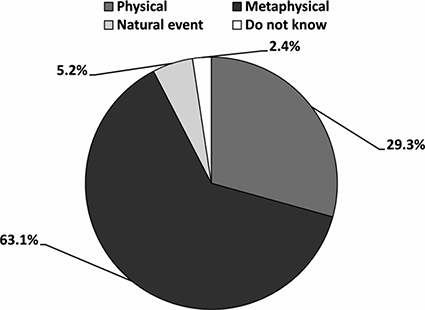
Regarding the perception of the climate variation causes, four types of statements were declared by interviewees (Table I). While 63.1 and 29.3 per cent of the respondents stated, respectively, metaphysical and physical causes of climate variation, 5.2 per cent of respondents claimed that climate variation is natural event. However, 2.4 per cent of respondents have none idea about climate variation to have.
As the metaphysical causes, farmers declared among other the destruction of the sacred forest. Indeed, in the region some deities like “Vodun” Dan, Sakpata and Hèvioso were traditionally sheltered in the sacred forest and ceremonies were periodically performed in their honour to solicit their contribution for good weather for agriculture. Unfortunately, these forest types nowadays are facing logging and lose their primary purpose which is the conservation of the biodiversity. In addition, the non‐observance of traditional customs and endogenous laws by the local inhabitants were considered as some factors which contribute to climate variation. For that category of respondents (63.1 per cent) who mentioned the metaphysical causes, the climate is a natural process governed by deities, so that the disrespect of these deities and endogenous laws necessarily implies their anger expressed by drought, flood, abnormal rain, etc.
Respondents (29.3 per cent) who were more inclined to believe in physical factors mainly declared deforestation, vegetation fire, agriculture and rarely urbanization and industrialization as climate variation causes. They relate climate variation to a high emission of green house gas through anarchic land use. Thus, they believe that the current unsustainable way of using natural resources is abnormal and may involve climate variation (Figure 3).
Nonetheless, it appears that the respondent opinion regarding climate variation causes may depend on their age, religion and level of education. People who believed in abroad religion (Christianity and/or Islam) often rejected the assumption of deities' defiance while farmers with an appreciable level of education (new farmers) considered some factors like deforestation, urbanization and industrialization as most important causes of climate variation. Among those respondents who stated deforestation and agriculture (slash and burn cropping system) as causing climate variation, almost 78 per cent were aware through local radio broadcasting.
3.3 Indication of climate variation
The main indications of climate variation name by the coastal farmers are shown in Figure 4. Coastal farmers identified climate variation by the occurrence of drought (56.5 per cent), the rise in temperature (52.4 per cent), the abnormal rainfall (49.3 per cent), and the frequent flood waters (37.9 per cent). The heavy storm was declared only by 9.3 per cent of the respondents.
The PCA performed on the relative frequencies of the perceived climate variation indication by respondents showed that 88.8 per cent (72.2 per cent for axis 1 and 16.6 per cent for axis 2; Figure 5) of the information is backed up by the first two axes (components). The correlations between the climate variation indications and these two PCA axes are presented in Table II.
The first axis (axis 1) includes the rise in temperature, the decreasing number of rainy days, the frequent flood waters and the drought, while the second axis (axis 2) includes heavy storms and in a lower level the drought and the rise in temperature.
The projection of the interviewed subgroups in a plane, made up of the first two axes (Figure 4), demonstrates a high variability in climate variation indications between:
ethnicity;
gender; and
age groups.
The graphic shows that climate variation is differently characterized by coastal farmers depending on the ethnicity, gender and age category. Adults (men and women) are located at the positive part of the axis 2. Thus, adults identify the climate variation risks more through heavy storms than the elder and young groups. Young people are located nearer the centre of the graphic. So, we can conclude that young people remains indifferent to climate variation indications. This may be explained by the small life experience of young people who do not perceive the modification of climate parameters which requires long time experience. It is quite understandable that young people do not often declare the indications of climate variations. Concerning elderly persons, their position on the graphic (negative part of the axis 2) indicates that they characterize the variation of climate more through drought as well as rise in temperature.
3.4 Local perception of climate variation risks on agricultural production
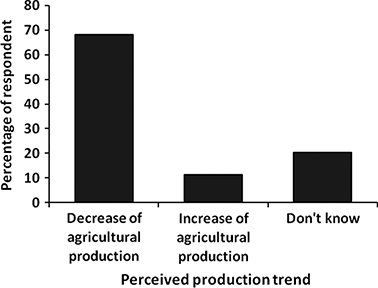
When ask what are the effects of climate variation on the agricultural production coastal farmers opine differently. The majority (68.3 per cent) of the respondents declared that climate variation decreases their crop production. In contrast, 11.4 per cent of respondents thought that climate variation increases their production, and approximately 20.3 per cent declared no effects of climate variation on their agricultural system (Figure 6).
The analysis of respondents' opinions according to the cultivated crop types and the agro‐ecological zone where their farms are located (fishing zone, depression zone and terre de barre zone) showed that the majority of respondents (48 out of 59 farmers) who declared not to have observed climate variation effects on their crop system practiced vegetables cultivation through an irrigation system and/or have their farms situated in the depression zone and used the drainage technique. So they reduced the dependence of their agriculture on the rain.
3.5 Adaptation measures and local acceptance
To cope with the harmful effects of climate variation on crop production, mitigation and adaptation measures were elaborated and popularized by the agricultural national office (PANA‐Bénin, 2008). The use of more resistant crop varieties, the cultivation of various crops combination, the variation of agricultural calendar, the use of irrigation and draining systems were some new adaptation measures popularized by agricultural extension services in Benin. The evaluation of knowledge level of these measures among farmers showed variation of knowledge depending on the mitigation measure. Indeed, 98.4 and 87.5 per cent of the farmers stated that they wellknow, respectively, crops combination system and agricultural calendar shifting as adaptation measure while only 15.6 per cent of respondents know the drainage as mitigation measure (Figure 7). However, the knowledge of the adaptation and mitigation measures by the farmers does not necessarily imply its adoption. For instance, while 98.4 and 87.5 per cent of the farmers declared that they know, respectively, crops combination system and agricultural calendar shifting as adaptation measures, only 35.6 and 55.2 per cent adopted, respectively, crops association and cultivation calendar shifting (Figure 6).
When asked why they do not adopt the popularized measures not withstanding their knowledge of the popularized adaptation measures, farmers declared many factors that impede the adoption of the measures (Table III). Among these, economic factors emerged as the most important. Almost 85 per cent of the respondents stated their financial incapacity to use some of the popularized measures such as irrigation which is often blamed by low level income farmers as well as the absence of adaptive credits (Table III). About 35 per cent of the respondents claim socio‐cultural factors as a constraint to the adoption of the measures. The conservation and storage of the new crops variety were declared by 23 per cent of the farmers. In fact, they argue that these new cultivars present a high risk of attack by insects in contrast to their traditional varieties. Factors such as soil characteristics and ecological constraints were less declared.
Taking into account the gender, it appears a difference in adoption of the adaptation and mitigation measures.
When asked how to adapt or mitigate agriculture to climate variation, respondents who gave metaphysical causes of climate variation proposed the restoration and application of traditional laws such as the regular thanksgiving to deities that govern the nature as well as the prevention of harmful effects on agricultural production through installation of fetishes in fields (59.3 per cent). Respondents who gave physical causes to climate variation suggested measures leading to the reduction of greenhouse gas emissions from deforestation or forest degradation. Especially, these measures were agro‐forestry (11.1 per cent), reforestation (8.7 per cent) and sustainable forest management (6.5 per cent). We also found that most of farmers (67.4 per cent) arguing that the climate variation has metaphysical origin were more inclined to traditional value respect while the majority (73.5 per cent) of farmers which declared physical causes were more inclined to sustainable use of natural resources and popularized adaptation measures.
Concerning popularized adaptation measures by agricultural services, only 14.4 per cent of the respondents (in their majority young people) think that they are relevant and can help to overcome harmful effects of climate variation on agricultural production.
4 Discussion
4.1 Local communities' perception of climate variation risk on agricultural production
The results of this study showed that a high proportion of farmers were aware of the climate variation risks and hazards over the past time. The investigation identified some factors which affect the perception of local population. The age, the ethnicity, and the geographical location (situation on agro‐climatic zone) were found to influence the perception of climate variation effects on agriculture. First, the age of respondents has been found as a relevant parameter in the climate variation risk perception because experienced and elder farmers were more inclined to confirm the variation of the climate. In fact, the variation of climate parameters is a long‐term process and its assessment needs long time experience. Thus, elderly people are more inclined to have better view of this phenomenon comparatively to younger people. This could likely explain the difference obtained with respect to the respondents' age. This result is consistent with those obtained by Jan and Anja (2007), who underlined that experience and age of farmers were very important parameters helping to better confirm the changing of climate in Kaduna state in Nigeria. Teka and Vogt (2010) came also to the same conclusion regarding the age importance on climate variation risk perception in Benin. The lack of awareness of young people could also be explained by the fact that young people may be less concerned about environmental changes. It is not only that young adults (18‐30 years) might be concerned about other issues, like making a life for themselves, having a family, their future and aspirations, but also adults, from 30 to even 59 years are more concerned about issues like rising their family, creating enough income to have a good life for themselves and their families, children, job responsibilities. Secondary, the ethnicity played a key role in the perception of climate variation risk in the study area. In developing countries, it was found that an ethnization of economic branches (Pliya, 1981; Teka, 2010). Through this ethnization process, members of each ethnic group specialize in a given traditional economic activity. For instance, people belonging to the Fon group specialize themselves in the agriculture. Meanwhile, for the Houeda who are inclined to fishery, the agricultural production represents a secondary activity. Thus, these various ethnic groups depend differently on the rain‐fed agriculture. Therefore, they appreciate differently the effects of climate variation on their production. This may explain the difference of climate variation perception regarding the ethnic groups in the coastal area of Benin. Third, the geographic location of respondents' affects the climate variation risk perception. Due to the fact that respondents were situated in different agro‐ecological zone, they are facing to various ecological and agro‐climatic conditions. Thus, they developed different coping mechanisms which conditioned their risk assessment. Indeed, the geographic location represents a decisive factor to risk perception. Similar results have been obtained by Carvalho and Coelho (1998), Brody and Highfield (2004) and Teka and Vogt (2010), underlining that the geographical location influences the perception of inhabitants from different regions. Indeed, the geographical location determines the accessibility to infrastructures and media and thus of information. Apart from all this, the location and especially the agro‐climatic zone offer various possibilities for inhabitant livelihood. Therefore, the people are differently exposure to climate variation.
4.2 Social capital and climate variation risk perception
The religion and the education level represent two main social assets which seem relevant for the explanation of climate variation risk on the agriculture. The religion and the education level of respondents may play important roles for the identification of climate variation impacts on the agricultural production. Our results showed that farmers were aware of climate variation and attributed to this process some causes. However, local communities state different types of factors governing climate variation according to their religion and their education level. Climate variation is steered by carbon dioxide released into the atmosphere by human activities (Nicholls, 1995; IPCC, 2007). But the metaphysical belief as disrespect of some traditional values (sacred forest cutting) showed an overlapping of the scientific statement of climate variation causes and the local system of belief as shown by Sokpon and Agbo (1999). Only low proportion (5.3 per cent) of the farmers still believes that climate variation has no cause and is a natural process. This result brings back the recent debate between scientists on the main causes of climate variation. The perception of climate variation results of the social status and level of information (Roussel et al., 2008). This also is result of individual and/or cultural factors that determines the selection and the analysis of information (Jodelet, 1989; Chevassus‐au‐Louis, 2007). Indeed, the religion and the education level are important social assets that determined a variability of climate risk perception on agricultural production.
4.3 Perception as relevant factor for adaptation
Most of respondents perceived a decrease of agricultural production. However, strategies implemented to cope with climate variation risk vary according to farmer's perception on the climate variation (Etkin and Ho, 2007). The causes (metaphysical, physical, natural events) that respondents attribute to the climate variation explain the specific way they manage the risk for all eviating the harmful effects on their agricultural production. Therefore, the representations of the climate variation by farmers have to be integrated for effective and sustainable adaptive strategies in order to reduce the gap between endogenous adaptation measures and planned strategies to cope with negative effects of climate variation.
5 Conclusions
The present analysis of climate risks in the coastal area of Benin showed that farmers perceived the climate variation and its effects on their crop production system. Overall, farmers noticed the decreasing of their agricultural production under climate variation. The explanations of climate variation causes as well as the adopted adaptation and mitigation measures already applied and suggested by farmers vary according to their age, religion and education level. It appears that scientists, technicians and traditional conservationists have to work closely together to challenge climate variation effects on agriculture and accordingly enhance food security insurance in developing countries despite climate variation.
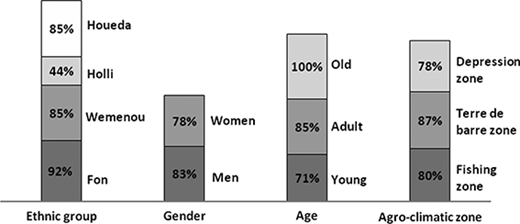
Relative proportion of climate variation risks by coastal farmers according to ethnic group, gender, age category and agro‐climatic zone in Benin
Relative proportion of climate variation risks by coastal farmers according to ethnic group, gender, age category and agro‐climatic zone in Benin
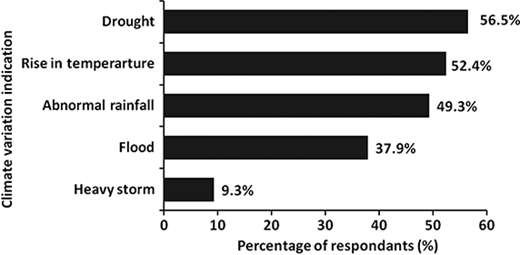
Indication of climate variation according to local farmers in coastal zone in Benin
Indication of climate variation according to local farmers in coastal zone in Benin
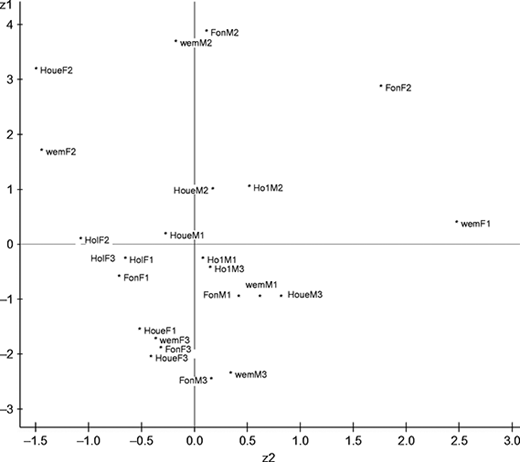
PCA showing linkages between climate variation indications according to socio‐demographic characteristics of Benin's coastal farmers
PCA showing linkages between climate variation indications according to socio‐demographic characteristics of Benin's coastal farmers
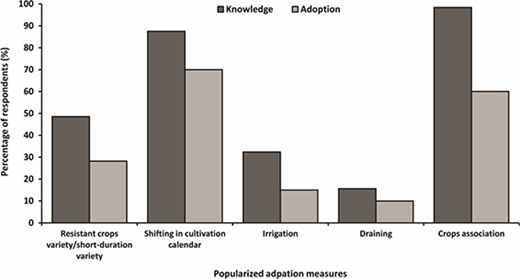
Relative proportion of knowledge and adoption of popularized adaptation measures by local farmers in the coastal area of Benin
Relative proportion of knowledge and adoption of popularized adaptation measures by local farmers in the coastal area of Benin

Causes of climate variation according to local population in the coastal area of Benin
Causes of climate variation according to local population in the coastal area of Benin

Correlation matrix between indication of climate variation and the first two axes
Correlation matrix between indication of climate variation and the first two axes

Factors impeding the adoption of popularized adaptation and mitigation measures by local farmers in the coastal area of Benin
Factors impeding the adoption of popularized adaptation and mitigation measures by local farmers in the coastal area of Benin
This work is supported by the Africa Initiative Research Grant. The authors thank Totin Solvyte, Noudomessi Fidel and Djibril Binoutiri, who were committed to data collection. The authors are grateful to farmers of the coastal zone of Benin for sharing their knowledge on climate variation with them. They thank agricultural department staff and local authorities who were surveyed.
References
About the authors
Dr Ir. Oscar Teka is a Lecturer and Researcher at the University of Abomey‐Calavi (Benin Republic). His current research focuses on climate change adaptation and mitigation, crop and grassland production modeling in the context of climate change as well as risk management in tropical and sub‐tropical regions. Oscar Teka is the corresponding author and can be contacted at: oscar_teka@yahoo.fr
Ir. Gbenato Laurent Houessou is a Researcher at the Laboratory of Applied Ecology of the University of Abomey‐Calavi. His main interests are related to grassland management, biodiversity, ethnobotany and sustainable natural resources management.
Professor Dr Madjidou Oumorou is a Researcher at the Polytechnic School of Abomey‐Calavi, Department of Environment, University of Abomey‐Calavi (Benin Republic). His main interests are related to applied ecology, grassland management, climate change adaptation and mitigation, and climate change impacts assessment.
Professor Dr Joachim Vogt is the head of the Institute of Regional Science at the Karlsruhe Institute of Technology (Germany). His research interests include methods and techniques of spatial planning, regional planning and applied climatology as well as adaptation strategies to climate change in tropical and subtropical regions.
Professor Dr Ir. Brice Sinsin is an agronomical and ecological engineer. He is the head of the Laboratory of Applied Ecology of the Faculty of Agronomic Sciences, University of Abomey‐Calavi (Benin Republic). His research interests focus on management of natural resources, ethnobotany and plant domestication in traditional agroforestry systems, applied ecology and wildlife management.

