


The problem of climate change is one aspect of the broader problem of sustainability. Many businesses in most sectors now accept that they must address the issue of climate change in order to survive and grow in ever‐changing entangled business economies. Due to mounting pressure from stakeholders, top executives of many organisations are now implementing various carbon emissions reduction strategies. However, the extent to which businesses embrace climate change and carbon management as an integral pillar of their business models remains unclear and poorly understood. This paper seeks to address these issues.
The aim of this research is to investigate the key carbon emissions reduction initiatives currently being implemented in the UK industrial sectors so as to improve their competitiveness. In order to achieve this aim, a mixed research methodological approach was adopted to collect and analyse data. Four industry sectors were examined, specifically: energy and utilities, transportation, construction and not‐for‐profit organisations; with specific respect to their environmental, social and economic impact on the UK society.
The level of implementation of carbon emissions reduction strategies within the UK industrial sectors is fairly “low” and varies significantly across the four sectors; with relatively high uptake in the energy and utilities sector, and low uptake in the construction sector. The level of implementation of change management initiatives to deal with carbon emissions reduction initiatives is also relatively “low”.
This study suggests that carbon emissions reduction strategies are in their infancy. Taken together, the impact of management commitment and leadership, climate change‐related policies, structures, reward systems, training programmes and performance reporting are key factors in successful implementation of low carbon strategies. The paper concludes that there is a need for cross‐sector collaboration to capture and share best and worst practices relating to low carbon strategies.
The paper provides a richer insight into the understanding and awareness of low carbon strategies for competitive advantage.
Introduction
Periodically, new major forces dramatically reshape the business world. As globalisation, the information technology revolution and the knowledge economy have been doing for the past several decades, in the early part of this twenty‐first century, the most important pressures facing businesses worldwide, especially those in the developed world, is espousing the need for integrating sustainability issues into daily business operations. This may be due to Middle East conflicts, recent terrorists attacks, spikes in the prices of energy and material resources, mega mergers, hostile takeovers, climate change, diminishing social systems and global corporate scandals (Smith and Ward, 2007; Sterling, 2001). Among these forces, Stern (2007) noted that climate change is the most severe problem we are facing in the early part of the twenty‐first century.
The problem of climate change is one aspect of the broader problem of sustainability. Therefore, climate change appears to be among the most prominent sustainability issues of this century (van Vuuren et al., 2007). Climate change is widely recognised as the most significant environmental issue facing the global economy. Some consider it is the greatest challenge facing humanity (Schultz and Williamson, 2005).
According to the IPCC (2007) report the extreme climate events such as variations in temperature and rainfall, increasing sea levels, and extermination of species may be a result of climate change. The evidence that increased greenhouse gases in atmosphere is a key reason for climate change, according to Begg et al. (2005). The most important of these greenhouse gases is carbon dioxide (CO2), which is emitted when fossil fuels, such as oil, natural gas, and coal are burned. Increasing concentrations of CO2 in the atmosphere is a major contributor to climate change according to Stern (2007) report. Climate change may potentially have very large impacts across the planet. However, it is also becoming evident that reducing carbon emissions may require substantial sacrifice (IPCC, 2007).
There is considerable international political and business interest associated with mitigating the impacts of climate change. In just under two decades, climate change has risen to the status of a nationally recognised concern (Hulme and Turnpenny, 2004). The UK Government has taken a lead in focusing political and economic attention on the state of the climate, in particular during its presidency of the European Union in 2005 and the G8 summit. In the UK, momentum was further strengthened with the commissioning of the Stern (2007) report by the Finance Ministry which outlined the urgent economic case for tackling climate change. The UK Government has passed legislation which introduces the world's first long‐term legally binding framework to tackle the dangers of climate change. The UK Government continues to position the UK as a pioneer in the fight against climate change, based on its adoption of legally binding carbon budgets covering the three consecutive five‐year periods to 2022. The UK Climate Change Act 2008 sets legally binding emission reduction targets for 2020 (reduction of 34 per cent in greenhouse gas emissions from 1990 levels) and for 2050 (reduction of at least 80 per cent in greenhouse gas emissions from 1990 levels), and introduces five‐yearly carbon budgets to help ensure those targets are met.
Also, in April 2010 the UK Government has introduced a new mandatory Carbon Reduction Commitment (CRC) energy efficiency scheme aimed at improving energy efficiency and cutting carbon emissions in large public and private sector organisations. These organisations are responsible for around 10 per cent of the UK's emissions. This is vital to achieve the UK's overall targets of reducing greenhouse gas emissions by 2050 by at least 80 per cent compared to the 1990 baseline. This has implications in the long run for achieving the 80 per cent target and suggests a need to reduce emissions across all sectors. Therefore, the issue of climate change is becoming strategically important to business in a manner that transcends the sustainability agenda. While many organisations may still think of climate change as a corporate responsibility issue, business leaders need to approach it in the same hard headed manner as any other strategic threat or opportunity (Porter and Reinhardt, 2007). However, corporate leaders face a commensurate challenge in helping to build an effective, sustainable global climate regime – a challenge they have yet to fully embrace.
As international policymakers step up their fight to curb climate change, the economic, business and investing implications of climate change are taking centre stage. The Lehman Brothers Report (Llewellyn, 2007) noted that the progress of climate change may be slow and hard to quantify but the impact on business can be sharp and sudden. Schultz and Williamson (2005) noted that European businesses may be exposed to climate change in up to three broad ways. First, governments are imposing limits on carbon emissions. Second, some of the impacts of climate change will directly impact the business environment. And finally, public perceptions of corporate behaviour have the potential to impact the bottom line of organisations. Therefore, the issue of climate change is generating a host of new strategic challenges and opportunities for both public and private sector organisations in the UK. Business and industry have a crucial role to play in reducing carbon emissions. They are major emitters of greenhouse gasses and government's pressure is mounting for them to engage in a range of mitigation strategies, from emission inventories and trading schemes to development of and investments in low carbon technologies (Begg et al., 2005).
Skjaerseth and Skodvin (2003) found that commercial interest, domestic regulatory environment and the international regime constitute the most important factors for corporate climate actions. Renukappa (2009) noted that the key drivers for embedding carbon emissions reduction initiatives into daily business operations include: reducing operating costs, to improve and/or protect reputation; government legislation/regulation; stakeholders' demand; globalisation; and to attract socially responsible investment (SRI). Kolk and Pinkse (2005) and Hoffman (2005) noted that a growing threat of regulation and the desire to promote climate‐related market changes for competitive advantage were two of the most important issues driving business response to climate change.
The strategic impact of climate change on business relates mainly to potential impacts on competitiveness. According to Kolk and Pinkse (2005), such impact can be broken down into three main areas: namely, changes in the cost of operations related to higher energy prices; changes in demand as the market shifts towards low‐emission products; and the development of new technologies that could render core competencies obsolete. To set a firm's approach to climate change and assess the strategic opportunity, business leaders need to look “inside out” to understand the impact of the firm's activities on the climate and “outside in” at how changing climate may affect the business environment in which the firm competes (Porter and Reinhardt, 2007).
Kolk and Pinkse (2004) noted that there has been an immense increase in the range and depth of corporate climate activities in the past decade, existing classifications for climate change strategies remain somewhat rooted in the “corporate activity” in the early stages of the international climate regime development and are therefore “not yet able to grasp the new realities properly”. Therefore, it is crucial to investigate the key carbon emissions reduction initiatives currently being implemented in the UK organisations so as to improve their competitiveness, which is the core raison d'être of this paper. A fundamental problem stalling the implementation of carbon emissions reduction strategies is that organisations are typically hesitant to act until they have a clear picture of how any initiative being considered will affect the value of business.
Hoffman (2005) noted the reduction in carbon emissions can at times expose opportunities for process optimisation that can lower energy costs, reduce material utilisation rates, or lower costs of transportation. Moreover, many decision makers are dubious about these advantages because of the uncertainties of elements affecting the impact of carbon emissions reduction and implementation of the climate change policy such as Kyoto Protocol (Boiral, 2006).
Selection of sectors
For this research, four industry sectors were examined, specifically: energy and utilities, transportation, construction and not‐for‐profit organisations (NPOs); with specific respect to their environmental, social and economic impact on the UK society. The construction industry is a significant part of the UK economy. The UK construction industry provides a tenth (10 per cent) of the UK's GDP and employees over 3 million people in over 250,000 firms. Furthermore, the industry is key to the quality of life – in terms of housing, utilities and transport infrastructure (HM, 2009). In the UK almost 10 per cent of the CO2 emissions arise from the production and use of building materials, and materials production. Also, the UK construction industry consumes over 1.2 million tons of oil equivalent energy and produces over 3,620,000 tonnes of carbon equivalent greenhouse gases. Construction industry produces over 78 million tonnes of construction waste per annum, 17 per cent of the UK in total (HM, 2009).
The energy and utilities sector is a strategic sector of the UK economy that accounts for approximately 7.5 per cent of GDP and employed over 522,000 people (Wilson et al., 2006). The energy and utilities sector is responsible for approximately 51 per cent of all carbon emissions and produces 7.9 million tonnes of waste per annum (Stern, 2007). Also, the UK energy and utilities sector consumes over 59 million tonnes of oil equivalent energy and produces over 188,793,000 tonnes of carbon equivalent greenhouse gases (DEFRA, 2005).
The UK transportation sector is a significant contributor to economic growth and employed over 743,000 people in 200,500 organisations (Wilson et al., 2006). It is also the fastest growing source of greenhouse gas emissions and accounts for 14 per cent of global greenhouse gas emissions (Stern, 2007). The majority of these emissions are from road transport (76 per cent) and aviation (12 per cent). The transport sector is responsible for 28 per cent of total UK CO2 emissions and 26 per cent of these are attributable to emissions by road users (DfT, 2004). Also, the UK transportation sector accounts for over one third of total energy demand (Stern, 2007).
The NPOs sector is as value‐driven and which principally reinvest their surpluses to further social, environmental, or cultural objectives, rather than being driven the need to maximise profit for shareholders and owners'. It includes voluntary and community organisations, charities, social enterprises, and cooperatives (HM Treasury, 2006). The National Council for Voluntary Organisations (NCVO, 2006) report indicate that the sector: has an income of £26.3 billion; has an operating expenditure of £24.9 billion; and has a paid workforce of at least 608,000 in 169,000 organisations. This equates to 2.2 per cent of the overall paid workforce.
Research methodology
The aim of this research is to investigate the key carbon emissions reduction initiatives currently being implemented in the UK industrial sectors so as to improve their competitiveness. In order to achieve this aim, a mixed research methodological approach (comprising both qualitative and quantitative methods) was adopted to collect and analyse data in order to adequately capture the complexity of the research topic (Creswell, 2009). According to Bryman and Bell (2007), the use of mixed research methods helps ensure the credibility of the analysis and interpretation of the research data. In addition, the triangulation of data was made possible through mixed methods means. This contributes to the reliability and validity of this study. The concept of triangulation is based on the assumption that any bias inherent in particular data sources or method used would be nullified when used in conjunction with other sources of data or methods (Jick, 1979).
Quantitative data collection and analysis
Questionnaire survey instruments have many advantages in the data collection process. They provide a larger geographical coverage for the sample population than case studies or semi‐structured interviews could provide (Bourque and Fielder, 1995). Questionnaire survey instruments also permit anonymity, helping to ensure that the individual is responding with their true beliefs and feelings, which is especially important in research involving attitudes. Therefore, in order to ensure sufficient breadth in the study, a postal questionnaire survey method was employed to collect quantitative data.
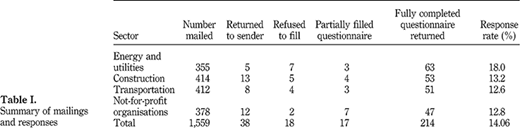
According to Creswell (2009) three typical question types used in questionnaire surveys. They are open ended and closed ended for types of question format; and scale items for opinion questions which require subjective measurement. The study included scale items for opinion questions. Standard sources of information such as trade and telephone directories, business information publications and the internet were used to identify the samples in each sector for the distribution of the postal questionnaire. A total of 1,559 sample were randomly selected. From this data set, 355 samples were from the energy and utilities sector, 414 samples were from the construction sector, 412 samples were from the transportation sector, and 378 samples were from the NPOs sector (Table I).
From the sample data set of 1,559, 214 fully completed and usable questionnaires were received, representing a 14.06 per cent ([214/(1,559−38)]*100) response rate. Of them, 31.3 per cent (67 of the 214 respondents) were from small and medium sized organisations (employee size less than 250) and 68.7 per cent (147 of the 214 respondents) were from large organisations (employee size greater than 250). Saunders et al. (2003) argue that a minimum number (i.e. effective responses) for statistical analysis should be 30. Therefore, the statistical analysis of 214 responses collected in the current study is seen as reasonable and effective, especially for a survey of this kind. Of the 214 usable questionnaires, 63 were from the energy and utilities sector, 53 were from the construction sector, 51 were from the transportation sector, and 47 were from the NPOs sector. The fieldwork of this survey was carried out between 16 June and 15 September 2007.
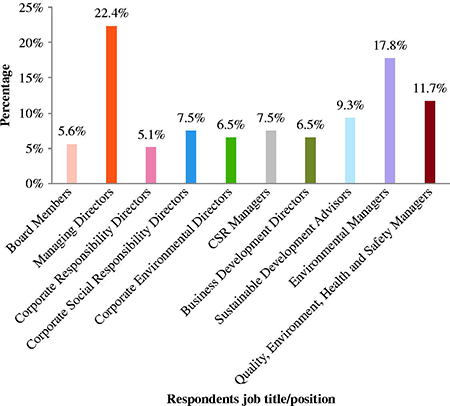
Figure 1 shows the respondents' job title/position in their organisations. A total of 14.95 per cent (32 of 214 respondents) are board members or sustainable development advisors, 48.13 per cent (103 of 214 respondents) are managing directors or corporate responsibility directors or corporate social responsibility directors or corporate environmental directors or business development directors, and 36.91 per cent (79 of 214 respondents) are corporate social responsibility managers or environmental managers or quality, environmental, health and safety managers. Descriptive analysis was used to analyse the quantitative data obtained from the 214 completed postal questionnaires. The quantitative results were further augmented by qualitative results.
Qualitative data collection and analysis
Qualitative data was collected through semi‐structured interviews. Semi‐structured interviews provide some flexibility and it is one of the ways to obtain a “realistic” picture of an individual's view (Bryman and Bell, 2007). The purposive sampling technique was used in order to achieve representativeness (Tashakkori and Teddlie, 2010). To ensure greater dependability and transferability (Creswell, 2009), a total of 59 individual professionals from 40 UK organisations across four industry sectors (Table II) – energy and utilities (14 interviewees from 10 organisations), transportation (14 interviewees from nine organisations), construction (17 interviewees from 12 organisations) and NPOs (14 interviewees from nine organisations) were interviewed.
The interviews lasted between 30 and 90 minutes. The format of these interviews was face‐to‐face, and the transcripts were recorded and supplemented with field notes as appropriate. The semi‐structured interview sample included board members, directors, advisers and managers responsible for corporate environmental, social and economic sustainability initiatives in their respective organisations.
Analysis of the interviews was undertaken using content analysis, which is increasingly being used in qualitative studies (Silverman, 2004). The use of content analysis enabled large amounts of textual information to be evaluated, e.g. the frequencies of most used keywords in context, etc. Threats to validity were minimised through triangulation of data collection methods (interviews, internal and external documents) and verification of the initial thematic codes by participants, where they judged the accuracy of data collected, though not its conclusions. The unit of analysis adopted for this study was the UK “industrial sector”, and the embedded unit of assessment was the “individual employee”. Research findings are discussed at both aggregate and sector levels.
Level of implementation of key carbon emissions reduction initiatives
According to Renukappa (2009) carbon emissions reduction initiatives are defined as key practices undertaken by an organisation to reduce carbon footprint in its entire value chain to fulfil organisation's commitments to climate change. Through the postal survey questionnaire, respondents were asked to indicate the level of implementation of key carbon emissions reduction initiatives on a four‐point Likert scale ranging from “do not have any plan for implementation (1)”, “planned to be implemented in the next five years (2)”, “implemented but not in current use (3)” and “implemented and in use (4)”. Table III shows the level of implementation of carbon emissions reduction initiatives at the aggregate level as well as at the sector level. The data presented in Table III is only the response on key carbon emissions reduction initiatives that have been implemented and in use (4).
From Table III, 56 per cent (121 of 214) of the survey respondents indicated that their organisations had implemented carbon emissions reduction initiatives. Although the agenda of climate change is high in the UK Government policy circles, the results of this study suggest that the extent to which carbon emissions reduction initiatives that have been implemented in the UK organisations is relatively low. The result of this study suggests that it is an uncomfortable fact that reduction in carbon emissions is needed on a large‐scale and in a relatively short time to avoid extreme risks associated with higher CO2 equivalent concentrations in the atmosphere. However, results of this study have demonstrated that there is a new wave of interest among the UK businesses to combat climate change issues. At the sector level, the extent of implementation of carbon emissions reduction initiatives varies significantly across the four sectors (Table III). For instance, 71 per cent (45 of 63) of the respondents from the energy and utilities sector indicated that their organisations had implemented carbon emissions reduction initiatives compared with 69 per cent (35 of 51) from the transportation sector, 53 per cent (25 of 47) from the NPOs sector, and only 30 per cent (16 of 53) from the construction sector. These results suggest that the extant of implementation of carbon emissions reduction initiatives is relatively high in the energy and utility and the transportation sector organisations and very low in the construction sector.
The relatively high level of implementation of carbon emissions reduction initiatives in the energy and utilities and the transportation sector organisations could be stimulated by the perception of long‐term market opportunities in new high‐margin, low‐emission products and technologies, as well as cost savings from lower energy use and the development of carbon management related resources and capabilities. The development of markets for trading carbon credits presents a further stimulus for implementing carbon emissions reduction initiatives in these organisations compared to other sectors in this study. In spite of the UK Government's target of reducing carbon emissions of at least 80 per cent of 1990 levels by 2050, the extent of implementation of carbon emissions reduction initiatives is relatively low in the construction sector. This could be due to lack of awareness on the benefits of implementing carbon emissions reduction initiatives and the industry has not yet taken account of the scale and implications of the changes in climate. Results of this study, however clearly shows that only a small part of construction organisations are currently implementing carbon emissions reduction initiatives, but still a large part of organisations are yet to be implemented. Therefore, findings of this study suggest that construction organisations have considerable work to do if they are going to combat climate change issues.
There is significant potential for innovation in developing new materials, products and services to address aspects of climate change, but, as yet, specific briefing requirements for the construction industry to address future climate impacts are rare.
The key carbon emissions reduction initiatives
To validate the quantitative results, and in order to further explore this data in depth, interviewees were asked to list and describe key carbon emissions reduction initiatives that have been implemented in their organisations through face‐to‐face interviews. Analysis of the qualitative data revealed that, at the aggregate level, 66 per cent (39 of 59) of the interviewees asserted that their organisations had implemented carbon emissions reduction initiatives. Many of these interviewees noted that the main source of carbon emissions in their organisations are primarily related to product use (e.g. burning of fossil fuel in the logistics operation or burning of fossil fuel for heating office buildings) and operations (e.g. power generation from fossil fuels). Almost 90 per cent (35 of 39) of these interviewees strongly believe that climate change, which is caused by the emission of greenhouse gases, is likely to have local and global environmental effects. However, 10 per cent (four of 39) of the interviewees echoed that they are only beginning to come to terms with the new realities of a carbon constrained economy.
Interestingly, 44 per cent (20 of 59) of the interviewees believed that climate change was a passing fad. Of these, 50 per cent (ten of 20) of the interviewees from the construction sector, 25 per cent (five of 20) from the NPOs sector, 20 per cent (four of 20) from the transportation sector and only 5 per cent (one of 20) from the energy and utilities sector. These interviewees rejected the phenomenon of climate change on economic grounds. They claimed that the potential harm from climate change, even if nothing were done to prevent it, would be slight compared to the high‐priced cost of reducing carbon emissions. Ambitious climate policies directed at dramatic reductions in greenhouse gas emissions were seen as ill advised. This is in contrast with evidence that climate change presents serious global economic risks if measures are not taken. For instance, the Stern (2007) on the economics of climate change states that our actions over the coming few decades related to climate change could create risks of major disruptions to economic activity, and the costs of extreme weather alone could reach 0.5‐1 per cent of world GDP per annum by the middle of the century.
At the sector level, 93 per cent (13 of 14) of the interviewees from the energy and utilities sector noted that their organisations had implemented carbon emissions reduction initiatives such as moving to renewable energy and energy saving initiatives. These interviewees deem that climate change has significant threat to their organisations' image/reputation and operating costs. Therefore, top management is committed to implementing carbon emissions reduction initiatives voluntarily in order to gain long‐term financial opportunities and minimise climate change related business risks in future. For example, some of the energy organisations are moving towards generating wind power, bio‐fuel, and nuclear power. Although, nuclear power has the advantage of being a zero greenhouse gas emitting power generation technology but major public concerns exist at the lack of safe radioactive waste treatment and disposal.
While 71 per cent (ten of 14) of the interviewees from the transportation sector noted that their organisations had implemented carbon emissions reduction initiatives such as changing existing technologies with more energy efficient technologies and using renewable energy sources for operations. These organisations are implementing carbon emissions reduction initiatives for long‐term economic benefits, while at the same time attempting to reap short‐term economic and strategic benefits. In this study, interviewees most often cited reason for implementing carbon emissions reduction initiatives in their organisations include to improve industry image and to reduce operating costs. Unlike many other environmental improvement initiatives, economic benefits are more obvious for carbon emissions reduction initiatives such as energy efficiency.
Whereas 64 per cent (nine of 14) of the interviewees from the NPOs sector noted that their organisations had implemented carbon emissions reduction initiatives such as office energy saving initiatives, considering climate change issues in purchasing and supply chain management, and switching to renewable energy sources. For instance, 78 per cent (seven of nine) of the interviewees noted that their organisations now encourage employees to use a “bicycle” to travel to work and also providing shower facilities and secure parking at the workplace. In addition, many organisations are encouraging the use of public transport and car‐pooling. Car‐pooling is a transportation service organised by a company which encourages its employees to pick up colleagues while driving to/from work to minimise the number of private cars travelling to/from the company site.
While only 41 per cent (seven of 17) of the interviewees from the construction sector noted that their organisations had implemented carbon emissions reduction initiatives such as site energy efficiency improvement initiatives, reducing logistics operations, and procuring locally available construction materials. For instance, interviewees noted that their organisations had energy saving promotion initiatives and do their best to reduce energy consumption in their business process, with each piece of consumer equipment, including office lighting, being technically analysed, and with clear targets being set. However, since, the present climate change initiatives are in their infancy, most of the interviewees from the construction sector believe that a significant knowledge gap exists in their organisations, as they try to develop strategies to combat climate change. Interviewees felt that identifying, capturing and sharing best practices related to carbon emission reduction practices amongst businesses is key to combating the climate change issue. Overall, the qualitative results discussed above are in concordance with the 121 respondents who participated in the postal questionnaire survey of the study.
Analysis of the above qualitative results suggest that most often implemented initiatives under the umbrella of carbon emissions reduction initiatives are diverse across the four sectors, but as shown in Table IV three key initiatives stand out. From the data in Table IV, it is clear that energy saving initiatives is the most implemented carbon emissions reduction initiatives. This is followed by fuel switching initiatives, and eco‐friendly transportation initiatives. Each of these initiatives is discussed below.
Energy saving initiatives
Of the interviewees, 64 per cent (25 of 39) noted that their organisations had implemented energy saving initiatives as part of their broader climate change strategy. Innovation for improved energy consumption efficiency in the business sector and changing individual energy usage moving consciously toward an environmentally sustainable attitude are the necessary first steps that should be carried out by all concerned. Today, the primary purpose of energy saving is the reduction of carbon emissions so as to prevent global warming, which causes various environmental problems on the planet. But, it is not so persuasive to promote energy savings on commercial grounds, since both in the industrial sectors and in our daily life, the reduction of carbon emissions itself does not often bring any immediate benefits or any immediate profit to organisations (Mizuta, 2003).
At the sector level, 64 per cent (nine of 14) of the interviewees from the transportation sector, 50 per cent (seven of 14) from the energy and utility sector and 36 per cent (five of 14) from the NPOs sector noted that their organisations had implemented energy saving initiatives. However, only 23 per cent (four of 17) from the construction sector asserted the same. Analysis of these results suggests that key energy saving initiatives is widely implemented in the transportation sector compared to other sectors and least implemented in the construction sector. Since, the end‐use fuel is much larger component of costs of the transportation sector, so switching to more energy efficient vehicles or equipment is more cost effective than in other sectors. Furthermore, the rise in fuel prices over the last few years, stringent government environmental regulations, and key stakeholders demand have forced the transportation sector organisations to move towards more energy efficient operation.
Some of the interviewees noted that their organisations had chosen “smart life”, which focus at less energy consumption and a simple daily life with concrete target figures, such as mild setting of heater temperature, motion sensors, compact fluorescent tubes, turning‐off unnecessary light, computer monitors, television, or other appliances, double‐sided printing, and more public transportation use than private cars.
Fuel switching initiatives
Of the interviewees, 62 per cent (24 of 39) stated that their organisations had implemented fuel switching initiatives as part of carbon emissions reduction initiatives. At the sector level, 57 per cent (eight of 14) of the interviewees from the energy and utility sector, 50 per cent (seven of 14) from the transportation sector and 43 per cent (six of 14) from the NPOs sector noted that their organisations had implemented fuel switching initiatives. However, only 17 per cent (three of 17) from the construction sector asserted the same. Analysis of these results suggests that fuel switching initiatives is widely implemented in the energy and utility sector and scantily implemented in the construction sector. Fuel switching from coal to gas, the increased uptake of wind, tidal, biogas and nuclear energy (if public concerns can be overcome), and the possible physical capture and storage of CO2 could provide cheap carbon emissions mitigation options. For example, one of the interviewee's noted that their organisation had signed the world's largest green energy contract which means that almost all of its UK electricity needs will be met from environmentally‐friendly, sustainable sources, including wind, tidal, and hydroelectric schemes or low carbon fuel‐efficient energy from combined heat and power sources.
Eco‐friendly transportation initiatives
Of the interviewees, 56 per cent (22 of 39) noted that their organisations have amended their logistics operations as part of carbon emissions reduction initiatives. These organisations are moving to minimising their logistics operations through telecommuting, teleconferencing, and other alternatives which help to minimise the environmental effects of travel. However, the remaining 44 per cent (17 of 39) of the interviewees noted that their organisations have plans to improve efficiency of their transport through procuring products that are light in weight, manufacturing products in closer proximity to sites and use of information and communication technology which could reduce the need to travel and consequently solve many of the problems associated with increasing mobility.
At the sector level, 57 per cent (eight of 14) of the interviewees from the transportation sector, 43 per cent (six of 14) from the energy and utility sector and 29 per cent (four of 14) from the NPOs sector noted that their organisations had implemented eco‐friendly transportation initiatives. However, only 24 per cent (four of 17) from the construction sector asserted the same. Analysis of these results suggests that eco‐friendly transportation initiatives are widely implemented in the transportation sector and least implemented in the construction sector. Employee commuting and business travel provides examples of company operations that can result in severe environmental damage. As it occurs today, such travel typically relies on aeroplanes, cars, buses, or trains that run on petroleum‐based products, thereby resulting in increased emissions. This pollution includes the release of CO2, which contributes to climate change, as well as the release of other pollutants, which can result in respiratory and other human health problems.
Managing change associated with carbon emissions reduction initiatives
In order to respond to key stakeholders demands and embrace sustainability issues, organisations across sectors have implemented various change initiatives to deal with climate change issues. However, it is widely asserted that a high proportion of change initiatives fail (Dunphy et al., 2007; Senge et al., 2007). Through the postal survey questionnaire, respondents were asked to indicate the level of implementation of key change management initiatives for dealing with carbon emissions reduction initiatives on a four‐point Likert scale ranging from “do not have any plan for implementation (1)”, “planned to be implemented in the next five years (2)”, “implemented but not in current use (3)” and “implemented and in use (4)”. Table V shows the level of implementation of key change management initiatives for dealing with carbon emissions reduction initiatives at the aggregate level as well as at the sector level. The data presented in Table V is only the response on key change management initiatives that have been implemented and in use (4).
At the aggregate level, it is evident from the Table V that a specific board member/director/adviser/manager responsible for carbon emissions reduction initiatives (54 per cent) is the most implemented change management initiatives. This is closely followed by a written climate change policy (51 per cent), a reward system to promote carbon emission reduction initiatives (49 per cent), formal training programmes related to carbon emissions reduction initiatives (45 per cent); and an annual carbon emissions reduction activities and performance reporting (34 per cent). Table V further revealed that the degree of implementation of change management initiatives for dealing carbon emissions reduction initiatives varies across the four sectors.
For instance, the degree of implementation of a written climate change policy is relatively high in the energy and utilities sector (70 per cent) compared to other sectors in this study. Likewise, the degree of implementation of a reward system to promote carbon emissions reduction initiatives is relatively high in the energy and utilities sector (63 per cent) and low in the construction sector (21 per cent). Further, analysis of the Table V clearly suggests that the level of implementation of change management initiatives to deal with carbon emissions reduction initiatives relatively high in the energy and utilities sector and transportation sector whereas in the construction sector and NPOs sector the level of implementation is relatively low. Whittington et al. (1999) noted that the focus of change is not only on organisational process and structure, but also organisational culture. This will, in turn, help harness the discretionary effort essential for installing a sustainable enterprises culture and successfully propelling the entire organisation into future. However, study results suggests that cultural change initiatives such as reporting carbon emissions performance, training programmes, and reward systems for promoting carbon emissions reduction initiatives are not quite institutionalised yet in the construction sector compared to other sectors.
To validate the quantitative results, and in order to further explore this data in depth, interviewees were asked to list and describe the key change management initiatives that have been implemented in dealing with carbon emissions reduction initiatives in their organisations through face‐to‐face interviews. Analysis of the qualitative data at the aggregate and sector levels are discussed below.
A written climate change policy
Epstein (2008) noted that a written policy statement is generally used to guide the development and implementation of organisations carbon management strategies. A written policy statement represents the goals the company will strive to achieve and the commitments it has made to its various key stakeholders. At the aggregate level, only 46 per cent (27 of 59) of the interviewees noted that their organisations had implemented a written climate change policy. Of these interviewees, 71 per cent (ten of 14) from the energy and utility sector noted that their organisations had implemented a written climate change policy whereas 57 per cent (eight of 14) from the transportation sector, 36 per cent (five of 14) of the interviewees from the NPOs sector and 24 per cent (four of 17) from the construction sector echoed the same. It is evident from the above results that a written climate change policy is relatively well implemented in the energy and utility sector and less implemented in the construction sector. For example, a typical climate change policy in one of the interviewed organisations includes:
Organisation “x” believes that the risks of climate change associated with increasing greenhouse gas concentrations in the atmosphere need to be addressed through accelerated action. The actions should aim to stabilise concentrations at levels guided by the research of the United Nations Intergovernmental Panel on Climate Change. Behavioural change, innovation and technological progress are necessary to achieve stabilisation in a manner consistent with meeting natural resource and energy needs. Building on our earlier efforts, we will take action within our own businesses and work with governments, industry and other stakeholders to address this global challenge of climate change.
The aforementioned climate change policy statement describes an organisations' commitment to the reduction of greenhouse gas emissions. Most often cited areas covered in a written climate change policy include: energy management issues, sustainable transportation issues, and renewable energy issues.
Creation of new positions and job roles to deal with carbon emissions reduction initiatives
Translating a sustainability strategy into action and driving it through a complex organisation is a substantial challenge (Epstein and Roy, 2001). Therefore, creating new structure (i.e. new position, roles and responsibilities) to organisational support system that facilitates change process in an organisation is very important. Of the interviewees, only 34 per cent (20 of 59) noted that their organisations had created new positions and job roles to deal with carbon emissions reduction initiatives and 44 per cent (26 of 59) noted that their organisations had plans to create new positions and job roles in the next five years. The overall responsibilities of new managers were to develop, implement and monitor carbon emission reduction initiatives. At the sector level, 50 per cent (seven of 14) of the interviewees from the energy and utility sector, 36 per cent (five of 14) from the transportation sector and 29 per cent (four of 14) from the NPOs sector noted that their organisations had created new positions and job roles to deal with carbon emissions reduction initiatives whereas only 23 per cent (four of 17) from the construction sector asserted the same. It is clear from the above results that the creation of new positions and job roles to deal with carbon emissions reduction initiatives is relatively very low among the four sectors. Some specific new positions and job roles include: “climate change director”, “carbon emissions reduction manager”, “carbon management adviser”, “energy management/carbon management managers” and “carbon management champion”.
Reward system to promote carbon emissions reduction initiatives
A reward system is a critical tool to implement sustainability‐related change management initiatives (Dunphy et al., 2007). This is because it aligns with the interests of the senior managers, all employees, and suppliers. In this study, at the aggregate level, 36 per cent (21 of 59) of the interviewees noted that their organisations had implemented reward systems to promote carbon emissions reduction initiatives. In order to achieve cultural change, in this study many interviewees noted that their organisations include carbon targets as a variable in the compensation of top executives and operational directors. In addition, some organisations have rewarded employee stock ownership to the management team based on the company's performance on key climate change related goals. At the sector level, 50 per cent (seven of 14) of the interviewees from the energy and utilities sector, 43 per cent (six of 14) from the transportation sector, and 29 per cent (four of 14) from the NPOs sector noted that their organisations had implemented reward systems to promote carbon emissions reduction initiatives whereas only 23 per cent (four of 17) from the construction sector echoed the same. Analysis of the above results clearly suggests that reward systems to promote carbon emissions reduction initiatives is relatively well implemented in the energy and utilities sector compared to other sectors.
Senge et al. (2007) noted that the obstacles to reduce carbon emissions are not technological or economic. Rather, they are cultural and procedural. For instance, one of the interviewees noted that their organisation had established an environmental cash prize in recognition of employees' exemplary low carbon contributions. It is a positive incentive for employees to go beyond their regular job responsibility and to become eligible for a cash award of £250‐£500. However, many interviewees believe that, monetary benefits are not the only way to encourage low carbon culture. To encourage employees and other key stakeholders, many organisations in this study, give out special “low carbon innovation awards” every month, quarter, or annually to teams or an individual who successfully introduce new change processes. Typical non‐monetary rewards include: public recognition through press releases, newsletter which was distributed to key stakeholders such as suppliers, employees, and local communities, letter of thanks and commendation.
Formal training programmes related to carbon emissions reduction initiatives
The development of the right attitudes and skills for all key stakeholders including employees to help them cope with the daily practice of carbon emissions reduction is very important. Comprehensive executive training programmes are valuable ways to raise awareness and nurture buy‐in from managers responsible for implementing low carbon related change initiatives (Hart, 2005; Senge et al., 2007). At the aggregate level, 51 per cent (30 of 59) of the interviewees noted that their organisations had implemented formal training programmes related to carbon emissions reduction initiatives. Of these interviewees, 71 per cent (ten of 14) were from the energy and utilities sector, 57 per cent (eight of 14) from the transportation sector and 50 per cent (seven of 14) from the NPOs sector echoed that their organisations had implemented formal training programmes related to carbon emissions reduction initiatives. However, only 36 per cent (five of 17) from the construction sector asserted the same. Clearly, the results indicate that the formal training programmes related to carbon emissions reduction initiatives is well practiced in the energy and utilities sector compared to other sectors. Typical topics covered under formal training programmes related to carbon emissions reduction initiatives vary across the sectors. However, most often covered topics include: carbon auditing, energy management, renewable energy, and latest available low carbon technologies.
An annual carbon emissions reduction activities and performance reporting
One way of demonstrating a firm's commitment to comply with relevant environmental, social and economic regulations and other requirements is to devise an effective communication strategy via tools such as environmental, social, and economic performance reporting or announcement of policy statements to the public domain (Doppelt, 2009). At the aggregate level, only 29 per cent (17 of 59) of the interviewees noted that their organisations had implemented climate change related activities and performance reporting initiatives. For instance, one of the interviewees noted that, their organisation had included climate change related activities and performance data in their annual report to communicate their carbon emissions mitigation strategies with key stakeholders. Interviewee further noted that, the key reasons for their organisation choosing to report on climate change related activities and performance is in response to shareholder demands and to enhance their organisational reputation. In addition, the emergence of SRI in the UK has provided further impetus for their organisation to report on climate change activities and performance. Reporting on climate change related activities and performance may provide an opportunity to check organisation climate change related strategic positioning, redefine their climate change related mission and values, evaluate climate change related initiatives progresses, reorient organisation climate change related actions, and improve relationships with key stakeholders. However, 71 per cent (42 of 59) of the interviewees noted that their organisations are not formally reporting on climate change related activities and performance. The key reasons cited by these interviewees include: reluctance to report sensitive data, to avoid providing key information to competitors, and lack of a recognised reporting framework.
At the sector level, 43 per cent (six of 14) of the interviewees from the energy and utilities sector, 36 per cent (five of 14) from the transportation sector and 21 per cent (three of 14) from the NPOs sector noted that their organisations had implemented climate change related activities and performance reporting initiatives whereas only 18 per cent (three of 17) from the construction sector asserted the same. It is clear from the above results that climate change related activities and performance reporting initiatives is relatively very low among the four sectors. Reporting on climate change related activities and performance is an opportunity for organisations to tell the story of its climate change related achievements to the wider stakeholders. But, obtaining accurate and complete data in these areas is still a challenge for most of the organisations irrespective of the industry sector. Therefore, it is apparent that there is a need for developing sector specific key carbon performance and reporting indicators.
Conclusion
Climate change is one of the global sustainability issues that have increasingly attracted business attention in the early part of the twenty‐first century, when a range of stakeholders, including governments, started to pay attention to the potentially very serious consequences, and to the need to take action. Central to the problem of climate change is the massive production of CO2 from contemporary processes of production and consumption. This requires businesses to substantially reduce the carbon intensity within the economy. However, the level of implementation of carbon emissions reduction strategies within the UK is fairly “low” and varies significantly across the four sectors; with relatively high uptake in the energy and utilities sector, and low uptake in the construction sector. Further, the study suggest that presently carbon emissions reduction strategies are in their infancy and organisations tend to use a wide mix of initiatives to mitigate carbon emissions. The most often implemented strategies to reduce carbon emissions include: energy saving initiatives, fuel switching, and eco‐friendly transportation initiatives. Taken together, the impact of management commitment and leadership, climate change related policies, structures, reward systems, training programmes and performance reporting are key factors in successful implementation of low carbon strategies. The level of implementation of change management initiatives to deal with carbon emissions initiatives are well embraced in the energy and utilities sector and the transportation sector whereas still evolving in the construction sector and the NPOs sector. Therefore, there is a need for cross‐sector collaboration to capture and share best and worst practices related to managing change associated with carbon emissions reduction initiatives.
Some of the best practices include (Carbon Trust, 2011; CPSL, 2009): develop a solid business case for carbon management; identify the carbon emissions “hotspots”; consider developing a carbon management policy; develop an action plan to meet targets/achieve the desired reductions; allocate responsibility and resources (financial and human) for carbon management; engage and incentivise employees, customers, and suppliers; develop systems and procedures to ensure the quality of carbon emissions data; and consider public disclosure of carbon emissions data and reduction plans.
This paper highlighted that climate change is complex and entangled. The paucity of knowledge and expertise in the context of climate change is a huge challenge for many organisations regardless of industry sector. It could be noted that, although the importance of climate change is broadly acknowledged across four industry sectors, there is a significant lack of a common and operationalised understanding on the concept of climate change. In the long‐term, businesses should be aiming to create more openness in acknowledging and addressing the issue of climate change. Therefore, an industry‐wide awareness‐raising programme on the concept of climate change needs to be to developed and deployed. Education and training programmes should be re‐orientated to cover issues of climate change, drivers for embedding climate change issues into daily business operations, leading change towards low carbon operations, challenges associated with embedding climate change issues into business operations, and business case for climate change, and the role of leadership for successful implementation of low carbon initiatives. In addition, education and training should be dynamic and adaptable to the increasing changing needs of business, society and people at large.
In summary, therefore, a complex mix of political, economic, social and environmental forces govern the implementation of carbon management strategies. Therefore, understanding the drivers for implementing carbon emissions reduction initiatives is important. This understanding could assist decision makers to develop carbon strategies based on the drivers. However, business opportunities presented by climate change may not be enough to encourage the stepwise change needed for climate stabilisation. The development of a strong regulatory framework that generates strong profit incentives and penalties for non‐compliance is needed to encourage businesses to develop more far‐reaching climate strategies. Given that the research reported in this paper is largely exploratory by nature, the results presented here provide a useful insight for the purposes of generalisability and repeatability. Therefore, it is advocated that additional research should explore the complex issues of climate change, particularly the business case for climate change within organisational settings and the contextual constraints that shape decisions.

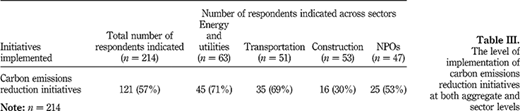
The level of implementation of carbon emissions reduction initiatives at both aggregate and sector levels
The level of implementation of carbon emissions reduction initiatives at both aggregate and sector levels

Carbon emissions reduction initiatives that have been implemented in the UK industrial sectors
Carbon emissions reduction initiatives that have been implemented in the UK industrial sectors
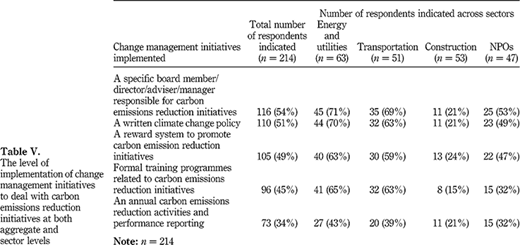
The level of implementation of change management initiatives to deal with carbon emissions reduction initiatives at both aggregate and sector levels
The level of implementation of change management initiatives to deal with carbon emissions reduction initiatives at both aggregate and sector levels
References
Further Reading
About the authors
Dr Suresh Renukappa is a Research Associate in sustainable procurement and economics at the University of Central Lancashire, UK. After his doctoral research on managing change and knowledge associated with sustainability initiatives for improved competitiveness, he has worked in research and consultancy in the areas of knowledge management and sustainability in India, the UK and the USA. He also worked as a management consultant in the software industry. His current research interests are in the areas of sustainable business practices, corporate social responsibility, knowledge management in the context of sustainability, business strategies for climate change, sustainable infrastructure investment and procurement, and sustainable public‐private partnerships. Suresh Renukappa is the corresponding author and can be contacted at: Suresh.Renukappa@btinternet.com
Professor Akintola Akintoye is a Chartered Surveyor and a Chartered Builder. He holds the Chair of Construction Economics and Management. His current activities include comprehensive research in issues related to public and private partnership (PPPs) and private finance initiative (PFIs). He has served in various consultancy teams which have advised government institutions and private organisations on PPPs and PFIs across Europe and Asia. He has edited two books on PPPs and he is a member of European Cooperation in the field of Scientific and Technical Research COST Action TU1001: Public Private Partnerships in Transport: Trends and Theory – involving ten European member states.
Professor Charles Egbu holds the Chair in Project Management and Strategic Management in Construction at the University of Salford, England, UK. He is a Fellow of the Royal Institution of Chartered Surveyors (FRICS), a Fellow of the Chartered Institute of Building (FCIOB), a Fellow of the Association for Project Management (FAPM), and a Fellow of the Higher Education Academy (FHEA). He lectures at undergraduate and postgraduate levels in the areas of construction management; and project, programme and portfolio management. He supervises doctoral and post‐doctoral researchers in varied areas of project and programme management, strategic management in construction, sustainable development as well as in innovation and knowledge management. He has contributed over 350 publications in various international journals and conferences. He has also authored more than ten books in construction management, knowledge management, sustainable development, refurbishment management, and health and safety in construction. He is a Visiting Professor to a number of universities in Europe, Africa, and Asia. He has examined over 50 PhD candidates world‐wide, and has acted as an external examiner to many undergraduate and postgraduate programmes in many universities all over the world. He is a co‐ordinator of the Working Commission on “Information and Knowledge Management”, and Working Commission on “Performance Measurement in Construction” of the International Council for Research and Innovation in Building and Construction (CIB).
Professor Jack Goulding is a chartered Construction Manager, Professor of Construction Project Management, and Director of the Centre for Sustainable Development at the University of Central Lancashire, UK. His research interests include ICT and business strategy development, Open Manufacturing, training and development, and moving forward the sustainability agenda. He has worked on several national and international research projects in the AEC sector and has published widely in these areas. He is the Co‐Editor for the International Journal of Construction Innovation, Associate Editor for the International Journal of 3D Information Modelling, and Joint Coordinator of CIB TG74 (New Production and Business Models in Construction).

