


– The purpose of this paper is to give policy makers, professionals and researchers in Sultanate of Oman and in the region an understanding of the impacts of climate change (CC) related to agriculture and offer farming communities a basis for developing adaptation strategies. It is important to clearly understand and realize what is happening at the community level, because farming communities are the most climate vulnerable groups in this region. The information generated from this study is expected to be used by stakeholders, particularly the Omani Ministry of Agriculture and Fisheries, to address issues related to CC and its variability in areas of similar agro-climatic conditions.
– Primary data from the study site were collected through structured interview, interviews with community leaders, and field observation. The participatory rural appraisal method was applied to gather information on perception and awareness of CC, vulnerability, adaptation measures of local farmers and communities to minimize such impacts. The focused group discussions approach was used to understand the attitudes, perceptions and existing practices.
– The analysis of primary data and the perception of the local people indicated that a shift in the sowing period has occurred from July to the end of September. This shift appears to be in response to the shortening of rainfall period and increased frequency of drought. A combination of adaptation strategies are in place, such as proper timing of agricultural operations and crop diversification, changing planting dates, the use of crop varieties, the use of increased water and soil conservation measures and diversifying from farm to non-farm activities.
– This paper provides valuable inputs for policy makers, managers at the Ministry of Agriculture and Fisheries, researchers and other stakeholders on issues related to CC impacts on agriculture and its management through appropriate adaptation strategies in Oman and the region.
Introduction
Climate change (CC) has attracted much scientific and public attention over the last few years. It is now widely accepted that humans economic activities are leading to a largely uncontrolled increase in greenhouse gas (GHG) emission and that concentration in the earth's atmosphere are responsible for a global rise in the earth's temperature (Sarina and Bhupendra, 2009). Warming of the globe is projected to be in the range of 1.4-5.8°C by 2100 in comparison to 1990 (IPCC, 2003). There is increasing observational evidence that regional changes in climate have contributed to various changes in physical and biological systems in many parts of the world (IPCC, 2003). These changes include changes in rainfall frequency and intensity, the shrinkage of glaciers, gradual shifts in the growing season, early flowering of trees, emergence of insects, and likely shifts in the distribution ranges of plants and animals, insects in response to changes in climatic conditions. Recent projections suggest that there will be decline in the agricultural production over the next few decades (Verner, 2012). Associated risks with CC and agriculture arise from the strong relationships between agriculture and the climate system, including the high reliance of agriculture on finite natural resources, such as water and soils (AFED, 2008).
In the context of Oman, according to the study carried out by the World Resources Institute (WRI, 2005) the main CO2 emission sources are gaseous fuel combustion, followed by liquid fuels, which contributes about 28 percent of the total emissions (Based on 1998 data). However, the per capita CO2 emission history during 1950 shows lower contribution in comparison with the Middle East and the rest of the world. But, in the 1975-1998 data show that Oman has significantly higher contributions in comparison with Middle East and the rest of the world. This fact is an indication of rapid growth that has taken place in Oman over the last few decades (Mushtaque and Choudri, 2012). The analysis of CO2 emissions by sector in Oman (1999 data) indicated that the highest contributions stem from electricity and heat production (about 30 percent), followed by manufacturing and construction activities and approximately 12 percent from the transportation sector.
The impact of CC is especially affecting farming communities in both developing and developed countries in which farm in ecologically fragile zones and which rely directly on their immediate environments for subsistence and livelihood (UNFCCC, 2004). The productivity of agriculture can be affected by CC in two ways; first, changes in temperature, precipitation and CO2 levels. The latter affecting crop productivity. Second, through changes in soil quality, distribution and frequency of infestation by pests, diseases, insects, and weeds (Sarina and Bhupendra, 2009). The agricultural system in most Arab countries is rainfed and the total irrigated area in the Arab world is less than 28 percent (FAO, 2008). Given this fact, the annual agricultural productivity and food security are highly correlated to the annual variability of precipitation, which has exhibited major changes in recent decades (Abou-Hadid, 2006). On the other hand, Arab countries have serious problems in agricultural production as a result of limited economic resources, limited crop patterns, low levels of technology and environmental limitations and pressures (Agoumi, 2001).
Background and objective of the study
CC is a global phenomenon while adaptation to this change is largely site specific. One of the common disadvantages for local coping strategies is that they are often not well documented, rather handed down through oral history and local expertise (Mary and Majule, 2009). Area specific or the site specific issues certainly require some site specific knowledge. Also, experience has shown that identified adaptation measures do not necessarily translate into planned changes because there are context specific financial, social, cultural, psychological and physiological barriers to adaptation (IPCC, 2007). On this background, it is important to clearly understand and realize what is happening at the community level, because farming communities are the most climate vulnerable groups. This present study explored vulnerability, indigenous knowledge, local perceptions, adaptations and coping strategies coupled with scientific analysis of the prevailing climatic regimes in the area of study and established enhanced understanding of adaptations of agricultural systems. The overall objective of this study was to assess the vulnerability of farmer communities in the Al-Suwayq Wilayat of Al-Batinah coastal region to CC as well as to understand the adaptation strategies taken to mitigate climate-induced change on agriculture.
Methods
a. Study area
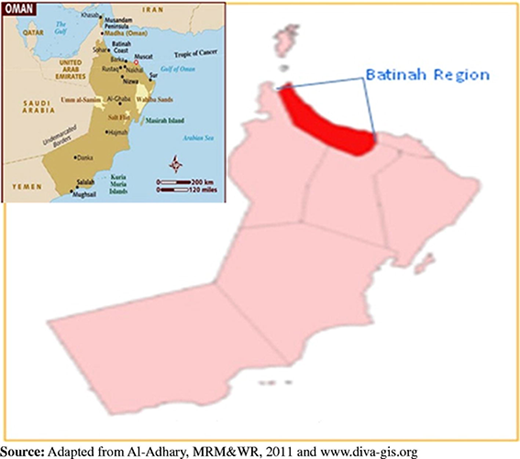
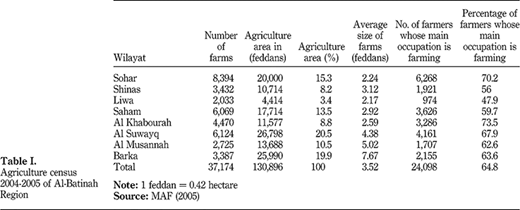
By far the most important agricultural area in Oman is the Batinah Region (Figure 1). It is a low-lying alluvial plain extending for about 240 km from Muscat to the border with the United Arab Emirates (UAE). It extends approximately 30 km inland from the coast, located between the Hajar Mountain ranges and the Gulf of Oman. The Batinah Region (Table I) presents almost 60 percent of the Omani agricultural production and has witnessed dynamic agricultural development in recent years. The Al-Batinah Region contains the largest number of wilayats (administrative divisions), numbering twelve. Al-Suwayq is considered the biggest wilayat in the Batinah Region and is the focus area of this study. It contributes about 20.5 percent of agriculture output in the region.
b. Survey and data collection
Primary data from the study site were collected through structured questionnaire interviews, interviews with community leaders and field observations. In order to ensure well distributed representation, the selection of samples from the study area was done by a simple random sampling. The participatory rural appraisal (PRA) method was used to gather information about perception and awareness of CC, vulnerability, adaptation measures of local farmers and communities to minimize such impacts. In year 2011, a total of 40 questionnaires were distributed to farmers. In addition ten focused group discussions were organized with experts and community leaders to understand the attitudes, perceptions and existing practices of farmers. Quantitative data collected through the questionnaires was edited, coded and analyzed using Microsoft Office Excel 2007. Multiple response questions were analyzed to calculate percentages. Pie charts were generated to graphically represent the variables.
Farmer's vulnerability to CC was examined by asking structured questions as given below:
Variability and the extent of CC impacts on crop and livestock in the wilayat.
The impacts and variability of CC on the livelihood.
Type of crops more vulnerable to the impacts and why.
Coping mechanisms locally used to reduce the impacts on agriculture.
Efforts of institutions to reduce future impacts on farmers and agriculture.
Main challenges related to agriculture and how do farmers think they can be improved.
In addition, data were collected from secondary sources, such as previous projects and reports related to the study area in order to understand land use, meteorology and topography.
Results and discussion
Rainfall and temperature
In Oman, the high variability and unpredictability of rainfall leads to an inability to rely on an assured water supply at any given period of time (MRMEW, 2005). Wadi flow is one of the important sources of the groundwater recharge in Oman. During periods of heavy rain, water in wadis usually flow from mountainous regions towards the plains and water is lost through recharges to the aquifers, evaporation, and in some cases lost to the sea and desert. In most cases the flows lasts a few hours to several days, depending on rainfall intensities, hydrological settings and hydro-geological characteristics of each wadi. In coastal areas, the rainfall amount was below the long-term average since the year 1998, with an exception of the tropical cyclone “Gonu” event in 2007. Estimated annual average rainfall is 80 mm for Al-Suwayq Wilayat (Ayesha, 2011).
Studies on temperature trends in Al-Suwayq area have identified increasing annual mean and annual maximum temperature together with increasing levels of humidity. Mean annual temperatures are typically between 26°C and 29°C but maximum daily temperatures rise to above 48°C during the summer months (Ayesha, 2011). Agriculture in the area is very much dependent on the groundwater and the rainfall and any significant change in the air temperature can result in changing climatic conditions and subsequent shifts in agriculture pattern. This was confirmed by local respondents who are now experiencing difficulties in carrying out traditional subsistence farming.
Livelihood and local perception on long-term changes in rainfall and temperature
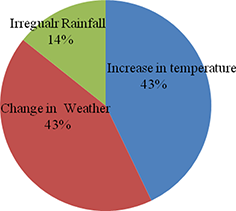
More than 75 percent of the respondents have average agriculture land and landholding of 4.5 feddans (1 feddan=0.42 ha). Major agriculture crops grown in the study area occupy almost 60 percent of the agricultural production area. The area has witnessed dynamic agricultural development in recent years. Now, crop production entirely depends on rainfall and irrigation; the main crops being fruit crops, dates, vegetables and other forage crops. Figure 2 shows that 43 percent of respondents in Al-Suwayq feel that there is an increase in temperature over the last 10 years and 14 percent of respondents perceived there is a trend to more irregular rainfall over the recent years. About 43 percent of respondents perceived a changing in overall weather conditions in the area.
Impact of weather conditions variability on agriculture
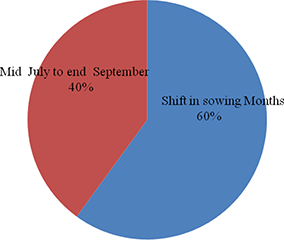
Figure 3 summarizes the local perceptions regarding the CC on agriculture practices. That is, most of the respondents (60 percent) remarked that there has been a shift in the timing of the sowing months, i.e. that there has been a shift from mid of July to end of September while earlier cultivation started by the end of July and August.
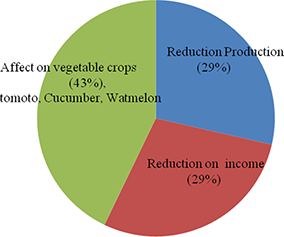
Figure 4 shows the perceptions of farmers regarding the impact and variability of CC on crops over the last few years. The perception is that a change in weather conditions (43 percent) affected the production of vegetable crops, such as tomato, cucumber and watermelon. About (29 percent) of respondents felt that their income has been reduced due changing weather conditions.
Local coping mechanisms used to reduce CC on agriculture
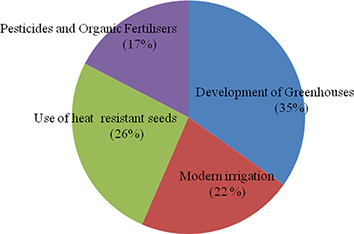
Figure 5 shows how respondents cope with CC effects on agriculture. About 35 percent of the farmers responded to have built or building new, single and double gated greenhouses in which they grow vegetables and other fruit crops. This promises better yields and protection from CC effects. About 17 percent of the farmers have stated that they recently applied pesticides and organic fertilizers to improve the yields and about 26 percent of farmers responded to now use heat resistant seeds. The crop seed have been brought in from other countries. There is also an increase in modern irrigation methods (22 percent), such as drip irrigation to provide water intermittently through growing season. This resulted in better yields and protection of the crops.
Factors affecting crop production and institutional efforts to improve agriculture
Based on household surveys in the Al-Suwayq Wilayat, it is understood that CC related factors are very important constraints to crop production. These factors are unpredictable rainfall (delayed and unclear onset and ending of rains in the area) and increased incidences of pests and diseases likely linked to warming as well as declining soil fertility associated with frequent droughts.
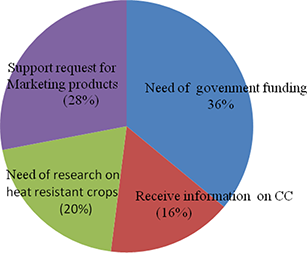
Figure 6 shows the responses related to which institutional efforts are needed to improve the CC impact on agriculture and the production. About 28 percent of the farmers felt that there should be marketing mechanisms by the government to get better price for products. About (36 percent) suggested that government should provide funding to build more of greenhouses. When asked about their awareness to CC and related information, 16 percent had received information or training from the local agriculture department through seminars and media, such as news papers, radio and TV channels. Given the increasing temperatures in the area, about 20 percent of respondents suggested that there should be more research and extension activities to develop heat resistant seeds and crops.
Adaptation practices
Adaptation practices to increased temperature and humidity include planning of agricultural activities around weather conditions, particularly precipitation, as well as introduction of greenhouses. Most of the farmers now use greenhouses to grow most of their vegetables.
In order to tackle changes in cropping, harvesting, irregular rainfall and increased temperature conditions, farmers were found adopting heat resistant seeds. Other strategies include cultivating before the onset of the rainy season with the help of drip irrigation and support sticks to prevent crops from falling down because of drying. The wide spread use of pesticides and organic fertilizers was also found abundant among small scale farmers. In addition, farmers were found adopting a mixture of modern and traditional farming practices to protect their agricultural field.
Many farmers formed farmer associations. These associations support groups of farmers and may involve activities such as buying and selling of agriculture products, sharing data and latest information related to market coverage and climatic conditions. Moreover, the farmers associations found to be in contact with local and national level organizations, such as the Department of Agriculture and Fisheries, which helped in getting access to latest farming technologies and subsidies for the construction of greenhouses. In general, the feeling of farmers is that there is a change in climate and that they were able to communicate through the associations to adapt to the climate and minimize loss.
Conclusion and recommendations
The present study established that temperature in study area has been increasing and rainfall decreasing. This has affected the production and management of crops. Different CC effects have been identified, including a shrinking duration of the rainy season by one month together with a later onset of the rainfall period, i.e. shifting from July-August to mid-September and into October.
The analysis of questionnaire data and the perception of the local people also indicated that shifts in the sowing period occurred as the consequence of shifting rainfall patterns and increase droughts. A combination of strategies are put in place to adapt to the changes, including proper timing of agricultural operations and crop diversification, changing planting dates, use of more resilient crop varieties, use of modern irrigation and soil conservation measures. Also a trend to diversifying from farm to non-farm activities was observed. However, this study recommends that such measures have to be further investigated.
Agriculture has traditionally been the main livelihood strategy for most of the farmer communities in the study area. But reduced yield, noticeable shifts in growing and harvesting of major crops and vegetables were identified. In some cases, a change in flowering and fruiting patterns was noticed. In addition, the emergence of new species of trees, vegetables like tomato, chilies, pumpkin and fruit, including watermelon appear to be used as a way to adapt to CC.
To mitigate the challenges of CC at the local and community level, risk reduction would be a point of entry. This should start with a vulnerability analysis. Also, it is important by often difficult to build trust in the communities. Using intermediaries, such as non-government organizations for interventions can help minimize the impact of CC on agriculture in the region. Capacity building programmes need to provide information on CC in general and education on how these changed in increased temperature and reduced rainfall require farmers to develop adequate adaptation strategies. Mainstreaming adaptation into development activities will therefore be essential, but requires time and additional funding together with improved knowledge and farming technologies.
References
About the authors
Dr Bheemanagoud S. Choudri is presently working as Senior Researcher (Research Scientist) and has more than 12 years of experience in research and capacity building activities, his PhD is on environmental management and special interests have been environmental management issues related to developmental activities including global climate change. He has supported the research and capacity-building activities at the national and international level as a resource person in the areas of environmental assessment and reporting, watershed development programmes, water resources management and remediation technologies, climate change impacts on coastal zone management and environmental mainstreaming. Bheemanagoud S. Choudri is the corresponding author and can be contacted at: bchoudri@squ.edu.om
Dr Ahmed Al-Busaidi working as Associate Researcher in the Department of Soils, Water and Agricultural Engineering, College of Agricultural & Marine Sciences, Sultan Qaboos University, Oman. Dr Busaidi obtained PhD in bioenvironmental science, Tottori University, Japan in the year 2007. He has conducted extensive research on soil, water and plant system, invited researcher in international universities and also invited instructor in local universities and colleges. Dr Busaidi has published many research papers and participated in the number of research projects supported by various agencies at the national and international level.
Dr Mushtaque Ahmed obtained his PhD from Iowa State University, USA in 1988. He is currently an Associate Professor of the Department of Soils, Water and Agricultural Engineering of Sultan Qaboos University (SQU), Oman. He joined SQU in 1996. Prior to that he worked for various organizations in Australia (Land and Water Conservation Department – NSW; CSIRO – Perth; Department of Water Resources – Griffith, NSW). His current research interests are baseline agriculture, managed aquifer recharge, climate change and adaptability. He has published more than 140 scientific papers in peer-reviewed refereed journals, book chapters, conference proceedings, and manuals, as well as serving as Editor of various publications.

