


– Climate change is perhaps the most serious environmental threat to agriculture in Africa, because of its impact on pre- and post-harvest agricultural productivity. The purpose of this study is to provide empirical information on the challenges of cassava post-harvest adaptation to climate change.
– The study was conducted in two randomly selected states of southeast Nigeria. Data collection was done in two phases; first, there was a rapid rural appraisal and then a detailed survey using a questionnaire administered to 320 randomly selected cassava processors, 40 from each of eight randomly selected cassava farming communities.
– The respondents were predominantly women, who process, and grow cassava. The factors affecting their level of vulnerability were gender, household size and farm size. While women were more vulnerable than men, households with greater number of persons and/or larger farm size were less vulnerable. Women's vulnerability declined from the 25th income quantile through the 50th to the 75th while the positive effect of farm and household size increased through the same trend. Education was only positively important for the 75th income quantile. The factors constraining adaptation were scarcity of processing inputs, institutional, water and poverty constraints.
– Available literature show that most of the recent studies on climate change and agriculture have tended to concentrate on pre-harvest. Ozor et al. studied barriers to climate change adaptation among farm households of southern Nigeria. Enete and Onyekuru studied empirical evidence of challenges of agricultural adaptation to climate change, also among farmers of southeast Nigeria. Enete and Amusa presented a literature survey of challenges of agricultural adaptation to climate change. This study is, not only commodity specific, but also focused on post-harvest.
Introduction
Probably no less than a quarter of the world population belongs to farm households and most of this is in the less developed countries of the world (Ellis, 2000). In addition, world poverty is also disproportionately found among them particularly in sub-Saharan Africa (World Bank, 2000; WBGU, 2004). Poverty is however, one of the largest challenges of mankind in the twenty first century. This is underscored by the fact that one of the Millennium Development Goals of the United Nations is to combat global poverty and to halve the number of poor people by 2015.
The achievement of this target is jeopardized by global changes such as climate change, because poor people have the least capabilities to cope with its negative effects (Enete et al., 2011). As the planet warms, rainfall patterns shift, and extreme events such as droughts, floods, and forest fires become more frequent (Zoellick, 2009), farmers in Africa, particularly, battle with the challenge of poor and unpredictable yields/post-harvest losses, thereby making them even more vulnerable (UNFCCC, 2007). They (who constitute the bulk of the poor in Africa), face prospects of tragic crop failures, reduced agricultural productivity, increased post-harvest losses, increased hunger, malnutrition and diseases (Zoellick, 2009). As the people of Africa strive to overcome poverty and advance economic growth, this phenomenon threatens to deepen vulnerabilities, erode hard-won gains and seriously undermine prospects for development (WBGU, 2004).
Cassava (Manihot spp.) is Africa's second most important staple, after maize, in terms of calories consumed with Nigeria as the World leading producer (Nweke, 2004). Africa produces more cassava than the rest of the world combined and the largest producing nations, as at 2002, were, in order of magnitude, Nigeria (19 per cent of world and 35 per cent of African production), Democratic Republic of Congo (19 per cent of African production), Ghana (8 per cent), Tanzania (7 per cent) and Mozambique (6 per cent). These four largest producers increased their share of African production from 70 to 80 per cent in the last two decades (Hillocks, 2002). Information from FAOSTAT for 2011, showing the 20 highest cassava producing countries in the World indicate that the above observation is still largely correct. Africa still produce more cassava than the rest of the World combined with Nigeria in the leadership position (23 per cent of World and 40 per cent of African production). However, while Ghana now occupies the fourth position (11 per cent of African production), Tanzania is now seventh with 3.5 per cent of African production. A recent study on cassava in Nigeria shows that it accounts for about 70 per cent of the total calorie intake of more than half of Nigerians (Nneoyi et al., 2008). In addition, approximately 16 per cent of cassava root production is utilized as industrial raw materials (Phillips et al., 2004) and it is a major source of income for producing/processing households. It is therefore, not only capable of, providing food security (Kolawole et al., 2010) but also reducing poverty through enhanced income, especially for vulnerable groups in Nigeria, because it is relatively cheap to produce. Because of its hardy nature, cassava has also become increasingly dominant with the advent of climate change (Enete et al., 2011); being tolerant to extreme weather conditions.
Cassava fresh roots are however, very bulky to transport, extremely perishable and for some varieties, contain poisonous cyanogenic compounds (Enete et al., 2004). Hence, bulkiness and high perishability of harvested roots make immediate processing of the roots necessary. Processing makes cassava roots easier to transport, gives them longer shelf-life, removes the cyanogenic compound and improves their palatability (Nweke, 1994). Despite the capacity of cassava in providing financial and food security (Kolawole et al., 2010), its production and processing is challenged by many factors, of which climate related variables are among the major ones. This is because, temperature, sunlight, water, relative humidity do not only constitute the main drivers of crop growth and yield in Nigeria (Adejuwon, 2004) but also influence their processing and storage. For instance, cassava roots deteriorate within three to four days after harvest depending on heat intensity and thus are either consumed immediately or processed into a form with better storage qualities (FAO, 1995). Enete et al. (2011) have shown that climate change has brought about increased heat intensity in Nigeria. In addition, heavy rainfall could prevent the drying of cassava bread; and may increase product perishability and seasonal inadequacy of food supplies. One of the variables identified to be on the increase as a result of climate change is heavy rainfall (Enete et al., 2011). The heat effect of climate change on processing of agricultural products include the growth and development of spoilage moulds which affect products in storage by causing adverse quality changes, heat-damage, dull appearance, musty odours, visible moulds, production of toxins and allergens (Canadian Grain Commission, 2009). Unfavourable environmental condition is one of the major causes of post harvest loses in the world with special emphases on developing countries such as Nigeria (FAO, 1995). Thus, the potential impact of climate change also threatens the post-harvest of food systems, particularly cassava. Recent research findings (from where this paper was written) show that as a result of climate change, the length of time cassava tubers can stay in the soil without spoiling has been decreasing while its water content has been increasing. Similarly, the storage quality of all cassava products has been deteriorating (Enete et al., n.d.). There is therefore the need for concerted efforts towards tackling this menace.
Recognizing, most especially the negative impacts of climate change on agriculture, farmers as victims, continuously try out some adaptation strategies to reduce them. However, in carrying out these, they encounter some obvious challenges. Mark et al. (2008) argued that a lack of adaptive capacity due to constraints on resources may result in further food insecurity. Wisner et al. (2004) reports that the vulnerability of agriculture is not determined by the nature and magnitude of environmental stress like climate change per se, but by the combination of the societal capacity to cope with and/or recover from environmental change. While the coping capacity and degree of exposure is related to environmental changes, they are both also related to changes in societal aspects such as cultural practices, which results, for instance, in modifications of cassava processing stages and/or products. This study examines some of the challenges of cassava processing adaptation to climate change in southeast Nigeria. Ozor et al. (2010) studied barriers to climate change adaptation among farm households of southern Nigeria. Enete and Onyekuru (2011) also studied empirical evidence of challenges of agricultural adaptation to climate change. The focus of these two studies was entirely on pre-harvest and they were not commodity specific. Enete and Amusa (2010) presented a literature survey of challenges of agricultural adaptation to climate change with no empirical information. This study is not only commodity specific but also focused on post-harvest.
Methodology
Area of study
Southeast Nigeria is located within Longitudes 5° 30I and 9° 30I E and latitudes 4° 30I and 7° 00I N. It occupies a land area of 75,488 km2 and comprises nine states namely Abia, Akwa Ibom, Anambra, Bayelsa, Cross River, Ebonyi, Enugu, Imo, and Rivers. These states fall into two geopolitical zones in Nigeria namely the south-south and southeast. While, Akwa Ibom, Bayelsa, Rivers and Cross River are in the south-south, Abia, Anambra, Ebonyi, Enugu and Imo are in the southeast.
The region has a total population of 31,371,941 and an average population density of 416 persons per square kilometer. This average however conceals the true picture of population pressure in the region. About 21 years ago, Okafor (1991) noted that a prima facie evidence of population pressure has been established and that the region stands out prominently on maps of sub-Saharan Africa showing population distribution and high crude densities. Also, Madu (2005) demonstrated that population pressure is the most important problem of rural development in the region. The effects of population pressure in the area have been recognized in a broad spectrum of livelihood activities such as intensive agriculture, engagement in non-farm activities and migration.
Sampling
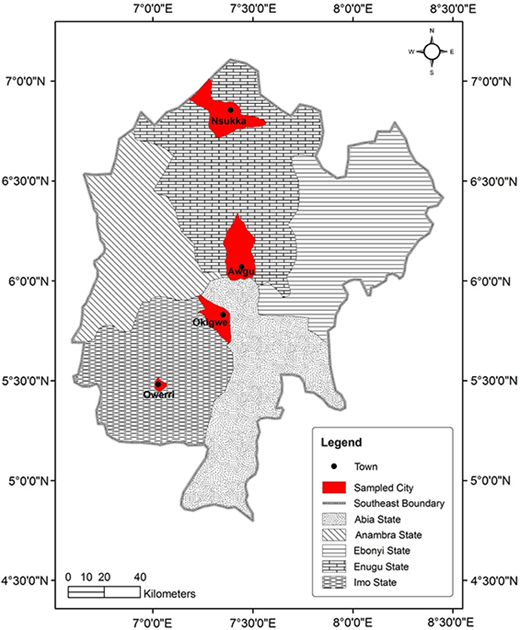
For logistic reasons, the study was restricted to the southeast geo-political zone. It was conducted in two phases. Phase one involved a rapid rural appraisal (RRA) of the study area. Two states were randomly selected from the five states of the zone namely Enugu and Imo states. Each state in Nigeria is usually made up of three agricultural zones. In each selected state therefore, two agricultural zones were randomly selected making four agricultural zones for the study. In Enugu, Nsukka and Awgu agricultural zones were selected while in Imo, Okigwe and Owerri agricultural zones were selected for the study (Figure 1 shows the map of Southeast geopolitical zone of Nigeria with the sampled agricultural zones indicated). The pilot survey was however restricted to Okigwe in Imo state and Nsukka in Enugu state and in each of the two agricultural zones, with the assistance of the Extension Services Department (ESD), male and female cassava processors with a wide age range were constituted (50 in Okigwe and 40 in Nsukka) and interviewed, first collectively in a focus group discussion, and then individually with a structured instrument. The purpose was to have baseline information regarding the current situation on climate change and cassava processing in the area and help validate the survey instrument. This was conducted in October, 2011. The duty of the ESD officials was just to assist in assembling the processors. They did not take part in the administration of the survey instrument.
The second phase involved detailed processor to processor visit of the respondents. The two states already visited during RRA were still used for this part of the study. In each of the four agricultural zones and with the assistance of ESD, cassava farming communities (which invariably were also processing communities) were compiled, from which two communities were randomly selected making a total of eight communities for the study. These were Ogugu and Mgbowo in Agwu agricultural zone; Umualumo in Okigwe and Okwe in Onuimo, all in Okigwe agricultural zone; Opanda and Nkpologu, in Nsukka agricultural zone; Amaigbo and Okpuala in Owerri agricultural zone. In each community, a list of cassava processors was compiled, also with the assistance of the ESD. 40 processors were randomly selected from each of them, to make a total of 320 processors for the study. This was done in November/December 2011.
Estimation procedure
The data were analysed using descriptive statistics, ordinary least squares (OLS)/quantile regressions and principal component factor analysis. The purpose of using quantile regression along with OLS was to check whether the rate of change of the conditional quantile of the response variable (income) depends on the quantile. The details are presented below.
The regression models
A multiple regression analysis involving the use of OLS and quantile estimation techniques were used to determine the effect of household socio-economic variables on the processors' level of vulnerability (defined here as their level of income) to climate change. The implicit form of the OLS regression model used was: Equation 1 where:
Y = annual income.
X1= age of cassava processor (years).
X2= gender of farmer (1, if female, 0 otherwise).
X3= number of years of experience in cassava processing.
X4= level of education (no of years spend in school).
X5= household size.
X6= scale of processing (whether processes only the cassava from own farm (yes/no).
X7= farm size (ha).
U = error term.
Quantile regression
Given a random variable Y with probability distribution function:
F(y) = Prob (Y≤y), the Tth quantile of Y is defined as the inverse function.
Q(T) = invf {y: F(y) ≥T}, where 0<T<1.
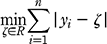
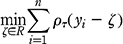
For a random sample {y1, … , yn} of Y, the sample median is the minimizer of the sum of absolute deviations: Equation 2 In general, the Tth sample quantile ξ (T), which is the equivalent of Q(T), may be formulated as the solution of the optimization problem: Equation 3 where ρT(z) = z(T−I(z<0)), 0<T<1. I ( · ) denotes the indicator function.
The linear conditional quantile function, Q(T|X=x) = X″β(T), can be estimated by solving: Equation 4 for any quantile T ∈ (0, 1).
The quantity β(T) is called the Tth regression quantile. The case T=1/2, which minimizes the sum of absolute residuals, corresponds to median regression (Chen, 2005).
The exploratory factor analysis
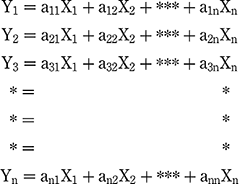
Exploratory factor analysis procedure was employed to identify the major problems encountered by the cassava processors in adapting to the effects of climate change. The problems enumerated by the respondents were grouped using principal component analysis with iteration and varimax rotation. The model is represented as: Equation 5 where:
Y1, Y2, … , Yn= observed variables/constraints to adaptation; a1 – an = constraint loadings or correlation coefficients.
X1, X2, … , Xn= unobserved underlying problems constraining cassava processors from adapting to climate change.
Limitations of the study
The use of income as a measure of household welfare has often been questioned because of the permanent income hypothesis. Although expenditure is often preferred, it was not collected for this study. However, given the volatile nature of rain fed agriculture, particularly under the climate change phenomena and the level of poverty of the respondents, we do not think they would have expectations of any permanent income, hence the basis for our use of income. Moreover, the study was limited to Southeast geo-political zone because of logistic reasons. Given the wherewithal, we would have preferred a wider coverage, preferably the whole of Nigeria.
Results and discussion
Socioeconomic characteristics of respondents
Majority (about 88 per cent) of the respondents were women while about 12 per cent of them were men. Nweke and Enete (1999) reported that cassava processing was carried out mostly by women in 75 per cent of the Collaborative Study of Cassava in Africa (COSCA) villages across six countries of sub-Saharan Africa. They were aged about 46 years on the average with the oldest being 102 years and the youngest being 15 years. Their average number of years of cassava processing experience was 18 years with the most and least experienced processor having 80 and one years, respectively. Majority (67 per cent) of the respondents were married while the remaining 33 per cent were distributed between Single (5 per cent), divorced (4 per cent) and widowed (24 per cent).
About 38 per cent of the respondents had no certificate to show for their level of education, while majority (45 per cent) had first school leaving certificate. About 13 per cent of them had secondary school certificate, 1 per cent each had ordinary national diploma and first degree, respectively, while 2 per cent had other unspecified certificates. On the average, the respondents had about five years of formal education.
The average household size was about six persons with a minimum of one person and a maximum of 26 persons per household. Cassava processing was the major occupation for about 48 per cent of the respondents while 43 per cent reported farming was their major occupation. Those who were traders were about 6 per cent of the respondents, 1 per cent were civil/public servants while the remaining 2 per cent were artisans. This is not surprising as the study was targeted at cassava processors. However, almost all (92 per cent) the respondents were also farmers, in addition to cassava processing, and mixed farming (see the next section for details of the type of crops and animals grown/reared by the respondents) was the predominant activity for about 65 per cent of the respondents while the remaining 35 per cent engaged in crop farming.
Factors affecting the vulnerability of the respondents
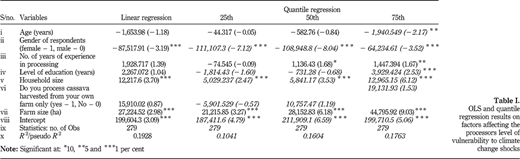
Vulnerability in this context was defined using the level of income of the respondents. Deressa (2008) reported that most of the problems or constraints encountered by farmers in adaptation to climate change were associated with poverty. In assessing the factors that influenced the vulnerability of the respondents to climate change, the OLS and quantile regression analyses were used. The result of the analysis (Table I) showed that three of the six explanatory variables were significant for the OLS case. However, while the three were also significant and consistently signed in each of the quantile regressions, education was in addition significant in the case of the 75th quantile.
Gender of respondents (1 if female and 0 if male) was negatively and highly significantly (p<0.01) related with the level of income of the respondents in each of the regressions. The quantile regression showed that the negative impact of women's income declined from the 25th through the 50th and was smallest for the 75th quantile. Wade (2010) reported that efforts to close the wage gap between men and women were much more successful at the top of the economic ladder than at the bottom. The negative effect of gender suggests that female respondents (even though they constituted the bulk of them) in this study were more vulnerable than their male counter parts, because they had, on the average, lower income. This is not surprising as previous studies have shown that women were generally more vulnerable to climate change than men. For instance, disaster management research showed the high level of vulnerability among women to climatic threats than men (FAO, 2008). In addition, the report of IPCC (2007) showed that the poor, majority of who were women were more vulnerable to the impacts of climate change, because they lack the capacity (e.g. financial, technical, human and institutional resources) to cope and adapt. The vulnerability of women to the effects of climate change in African countries is worsened by a number of factors, these include: limited access to resources, dependence on natural resources, lack of education and access to information, limited mobility and limited roles in decision-making (UNDP, 2010). This is particularly relevant for cassava production because the crop responds positively to the application of purchased inputs (Nweke, 2004). Producers with less of such inputs, such as women, are most likely to have less output and hence less income.
Household size was positively and significantly (p<0.01) related with the level of income. Larger households may have more family labour which could help in the expansion of the scope of the family business operation, particularly for women who constituted the bulk of our respondents and reportedly lack access to the necessary resource inputs. Agarwal (1992) reported that women generally had limited access to crucial resources, such as land, livestock, tools, and credit in poor countries. In addition, Enete and Achike (2008) suggested that the positive effect of household size to household income imply that all household members contribute in various ways to the household wealth. Again, the result of the quantile regression showed that the positive effect of household size increased consistently from the 25th through the 50th to the 75th quantile, for which it was largest. In addition to the above noted observation by Wade (2010), the positive and highly significant effect of education at the 75th quantile suggests that education of women may only be effective if it translates to higher income for them.
Farm size was also positively and significantly related with the dependent variable. All the respondents in this study did not just process cassava but were also farmers. The size of their farm would therefore also determine the scale of their operation not only at the production but also at the processing level, because of the enhanced capacity that could accompany it. Benhin (2006) noted that farm size is a major determinant of speed of adoption of adaptation measures to climate change. The trend observed above for gender and household size was also repeated for farm size regarding the quantile regressions. The above explanation may also apply in this case.
Level of education was not significant in the OLS case and was also not significant for the 25th and 50th quantiles. However, its effect followed the same trend as reported above. It was positive and highly significantly related with the dependent variable in the case of the 75th quantile. The observation by Wade (2010) as noted above may explain this result.
Constraints to climate change adaptation by cassava processors
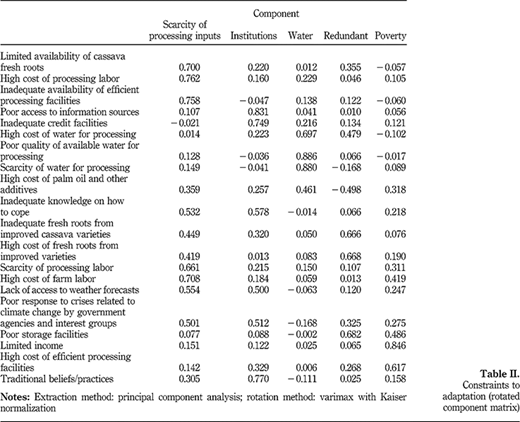
Table II shows the varimax-rotated factors constraining farmers in the area from climate change adaptations. From data in the table, five factors were extracted based on the responses of the respondents. Only variables with factor loadings of 0.40 in absolute terms and above, were used in naming the factors. Variables that had factor loading of less than 0.40 in absolute terms and those that loaded in more than one factors were not used (Madukwe, 2004). The next step was to give each factor a denomination according to the set of variables or characteristics it was composed of. In this regards, the variables were grouped into four major factors as; factor 1 (scarcity of processing inputs constraints), factor 2 (institutional constraints) and factor 3 (water constraints) and factor 4 (poverty constraints).
Under factor 1 (scarcity of processing input constraints), the specific constraining variables against climate change adaptation include limited availability of cassava fresh roots (0.700), high cost of processing labour (0.762) and inadequate availability of efficient processing facilities (0.758). This may have to do with poverty. With limited income (poverty), the acquisition of necessary facilities will be difficult. They may not only be costly, but may also appear scarce for poor processors, especially the vulnerable group, like women, who constituted the bulk of our respondents in this study. In addition, previous analyses of barriers to climate change adaptation showed that shortage of farm labour was one of the major constraints to adaptation by farmers (Deressa, 2008).
Under factor 2 (institutional constraints –communication, credit and traditional institutions), the constraining variables were poor access to information sources (0.831), inadequate credit facilities (0.749) and traditional beliefs/practices. The bulk of the respondents in this study were women, who have been widely described as relatively resource poor and also greatly discriminated against by traditional institutions. They may therefore lack the necessary wherewithal for the acquisition of, modern communication and adequate credit, facilities. Moreover, extension services are hardly targeted at women. In addition, most financial institutions in developing countries do not usually lend to agriculture, not only because the practitioners lack the basic collateral as a result of poverty, but also because the sector is considered very risky (Enete, 2003). This hinders them from rendering adequate support to the farmers/processors, which is necessary for them to sufficiently adapt to climate change. Also, most traditional beliefs are usually oppressive to women.
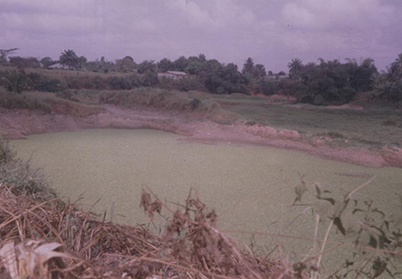
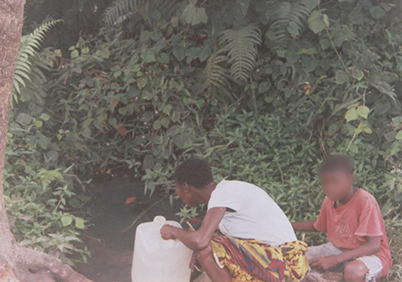
The factors that loaded under factor 3 (water constraints) were poor quality of available water for processing (0.886) and scarcity of water for processing (0.880). The quality of water for domestic use including cassava processing is sometimes very poor in some of the villages, particularly during the dry season. For instance, one of the pictures (Plate 1) showed the source of water in one of our survey villages. The water was already covered with some light greenish substance, thereby making it of poor quality, but the villagers still used it. In addition, in some of the cases, the water source was gradually drying up due to climate change (Plate 2 for instance).
Under factor 4 (poverty), the specific constraining variables were limited income (0.846) and high cost of efficient processing facilities (0.617). With limited income, the acquisition of necessary facilities will be difficult. They may not only be costly, but may also appear scarce for poor farmers. This underscores the problems of under capitalization of farmers (Enete and Achike, 2008) and suggests the need to improve the availability of credit to them. Benhin (2006) reported that lack of access to credit or saving and adequate information about climate change were some of the major problems encountered by farmers in adapting to climate change in Africa. Deressa (2008) reported that most of the problems or constraints encountered by farmers in adaptation to climate change were associated with poverty.
Conclusion and policy implications
The respondents in this study were mostly women who, in addition to cassava processing, also grow cassava. Some of the factors identified to be affecting the respondents' level of vulnerability were gender, household size, farm size and their level of education. While women were more vulnerable than men, households with greater number of persons and/or larger farm sizes were less vulnerable. In addition, while the level of vulnerability of women declined from the 25th income quantile through the 50th to the 75th quantile, the positive effect of farm size and household size increased through the same trend. Education was however only positively important for the 75th income quantile. The factors constraining adaptation were scarcity of processing inputs, institutional, water and poverty constraints. The result of the quantile regression particularly suggests that interventions to empower women may only be effective after a certain threshold of income, below which such may not work. In addition, most of the observed constraints to adaptation bother on poverty. Since the processors are mostly undercapitalized smallholders, usually with little or no assets to present as collateral to formal credit institutions, they should be encouraged to form cooperatives so as to leverage their financial status through collective efforts. Government can also assist by establishing special credit schemes, which could work with the cooperatives to advance credits to the processors with the cooperatives acting as guarantors.


OLS and quantile regression results on factors affecting the processors level of vulnerability to climate change shocks
OLS and quantile regression results on factors affecting the processors level of vulnerability to climate change shocks
References
Further Reading
About the author
Anselm Anibueze Enete is currently a Lecturer at the Department of Agricultural Economics, University of Nigeria, Nsukka (UNN). From 1994 to 1998, he was a Research Fellow with the Collaborative Study of Cassava in Africa (COSCA), International Institute of Tropical Agriculture (IITA), Ibadan, Nigeria. From 1999 to 2004, he was at the Katholieke Universiteit Leuven (K.U. Leuven), Belgium, where he completed his PhD programme in agricultural economics in December 2003. His current research interest is on climate change and agriculture in Africa. Anselm Anibueze Enete can be contacted at: anselm.enete@unn.edu.ng
This paper was produced as part of a project sponsored by the Centre for International Governance Innovation (CIGI), Canada. The author wishes to thank CIGI for the financial assistance and anonymous reviewers for their very useful comments, which helped to bring the paper to the present level.

