


– The study aimed at examining the current and future impact of climate change on cocoa production in West Africa.
– A translog production function based on crop yield response framework was used. A panel model was estimated using data drawn from cocoa-producing countries in West Africa. An in-sample simulation was used to determine the predictive power of the model. In addition, an out-sample simulation revealed the effect of future trends of temperature and precipitation on cocoa output.
– Temperature and precipitation play a considerable role in cocoa production in West Africa. It was established that extreme temperature adversely affected cocoa output in the sub-region. Furthermore, increasing temperature and declining precipitation trends will reduce cocoa output in the future.
– An important implication of this study is the recognition that lagging effects are the determinants of cocoa output and not coincident effects. This finds support from the agronomic point of view considering the gestation period of the cocoa crop.
– Although several studies have been carried out in this area, this study modeled and estimated the interacting effects of factors that influence cocoa production. This is closer to reality, as climatic factors and agricultural inputs combine to yield output.
1. Introduction
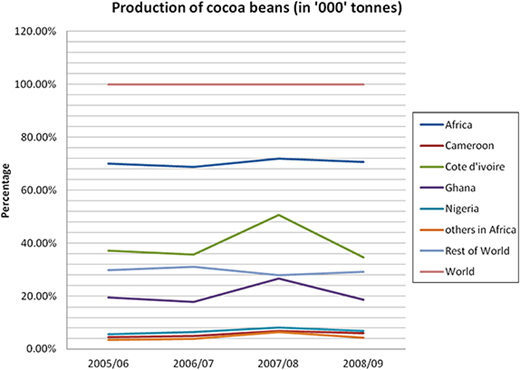
Cocoa is one of the major agricultural exports from West Africa. Production from Côte D’Ivoire alone is 40 per cent of the world’s market share and constitutes 1.2 million metric tonnes per annum (UNCTAD, 2009). In 2000, raw cocoa represented 80 per cent of the Côte D’Ivoire’s commodity exports, over 50 per cent of all exported goods and services and 21 per cent of gross domestic product (Bogetic et al., 2007). Currently, Ghana and Nigeria contribute 20.98 and 6.70 per cent, respectively, to the world market (ICCO, 2009). Other cocoa-producing countries in West Africa include Togo, Benin, Guinea, Liberia and Sierra Leone (ICCO, 2009). Overall, the West African sub-region contributes a total of 70 per cent of world market share of cocoa and yields considerable revenue to these economies. World production of three million tonnes with exports of the beans and semi-processed products is valued at > US$5 billion annually.
Unfortunately, scientific reports on global warming have indicated that the average global temperature has increased by around 0.7°C (1.3°F) since the advent of the industrial era (Asafu-Adjaye, 2008; UNDP, 2007/2008). Evidence shows the trend is accelerating such that the average temperature is rising at 0.2°C every decade (UNDP, 2007/2008). With the global rise in temperature, local rainfall patterns are changing, ecological zones are shifting, the seas are warming and ice caps are melting (IPCC, 2007b). Developing countries are currently at a double disadvantage because the tropical areas stand to experience some of the most severe impacts of climate change and agriculture, which is the sector most sensitive to climate change, is expected to be immediately impacted. Although increasing global temperature is likely to boost agricultural production in the temperate regions, it is expected to reduce yields in the tropical regions of the world (UNEP-WTO Report, 2009). According to the Intergovernmental Panel on Climate Change (IPCC) report, (2007a), it is projected that many regions of Africa will suffer from droughts and floods with greater frequency and intensity in the nearest future and that, the rise in average temperature between 1980-1999 and 2080-2099 would be in the range of 3-4°C across the entire African continent; that is, 1.5 times more than the global level (Duguma et al., 2001).
Cocoa production, like all other agricultural commodities, depends, to a large extent, on the interaction between comparative advantage, which is determined by climate and resource endowments, as well as a wide ranging set of policies. Because climate change results in new patterns of temperature and precipitation, cocoa comparative advantage enjoyed by the West African economies is likely to change, setting up the possibility of changes in trade flows as producers respond to changing constraints and opportunities. As with any change in comparative advantage, unfettered international trade allows comparative advantage to be fully exploited. Incidentally, studies on the impact of climate change have focused on arable crops with very little attention to cash crops.
This study, therefore, examined the current and future impact of climate change on cocoa production in West Africa from 1969 to 2009. The main aim of this study is to determine the extent of impact of climate change on cocoa production in West Africa and also simulate the possible future changes in cocoa production under various temperature and precipitation scenarios.
The rest of the paper is organized as follows. Following is Section 2 which provides a brief background on cocoa production in West Africa. Section 3 is a review of related literature. The theoretical framework and methodology are presented in Section 4. Section 5 is the discussion of results. Finally, Section 6 is the conclusion of the study.
2. Background
2.1 The economics of cocoa production in West Africa
Cocoa, a tropical perennial tree crop, is the product of the fruit of the cocoa tree. Cocoa flourishes well only in hot, rainy climates with cultivation generally confined to areas not more than 20 degrees north or south of the equator. A mean shade temperature of 27°C, with daily variation < 8°C and well-distributed rainfall of at least 12 cm are the ideal climatic conditions for the growth of cocoa (Kishore, 2010). Annual rainfall between 1,100 and 3,000 mm with a dry season not more than three months, with the minimum rainfall level of about 100 mm per month is required for good output. The cocoa itself is grown from seedlings raised in nurseries; more usually, it is grown directly from the seed. When the seedlings grow to a height of about 5 cm or so, they are transplanted at a distance of about 3 or 4 m. The planters also grow shady plants, in between the rows, to protect the young plants from strong winds and direct rays of the sun. The most commonly grown type of cocoa may give a first small yield after about five years, although the period considerably varies with local conditions and farming methods. But a full crop cannot be expected for at least ten years. The economic life span of the cocoa tree is unknown, but under the best conditions of weather, soil and management, it can be kept almost in indefinitely bearing (Kishore, 2010).
2.2 Supply of cocoa from West Africa
The world production of cocoa beans has experienced an irregular pattern due to heavy dependence on weather, low farm-gate prices, pests and diseases. For example, in 2003-2004 season, the global production of cocoa beans continued to rise for the fourth successive year. Output exceeded the recorded production levels of 2002-2003 by almost 10 per cent, reaching 3.5 million tons (ICCO, 2003). The International Cocoa Organization (ICCO) spelt out in their 2003-2004 report that, Cote D’Ivoire defied fears of decline and instead recorded a substantial increase to reach 1.4 million tons, despite two years of political and social unrest. During the same season, good weather, higher farm-gate prices and effective mass spraying of crops contributed to a substantial increase in yields. However, during 2006-2007 season, world production dropped by almost 9 per cent from the previous season to 3.4 million tons, mainly as a consequence of unfavorable weather conditions in many cocoa-producing areas (ICCO Annual Report, 2006/2007). The sampled countries have dominated the production and exports of cocoa beans over the period under review. From a modest beginning in the 1950s, Cote D’Ivoire overtook Ghana as a leading producer of cocoa beans from the middle of the 1970s till date. A summary of cocoa production in sub-Saharan African countries is reported in Figure 1.
2.3 Analysis of trend in cocoa production in West Africa
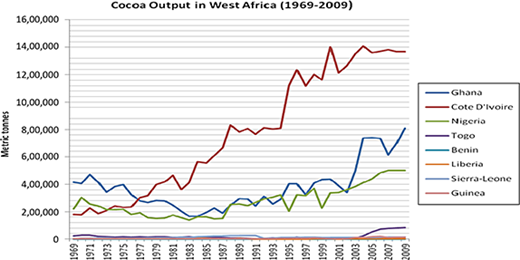
Figure 2 reports trends of cocoa production by the major West African producers from 1969 to 2009. Generally, while there has been an increasing trend of cocoa output among the major producers, the minor producers have had fairly constant production across the study period. The figure also shows dwindling occurrences along the production path of the three major producers, namely, Ghana, Cote D’Ivoire and Nigeria. In specific terms, the production trajectory of Cote D’Ivoire has witnessed increasing trend throughout the study period. Ghana, which was the leading producer among the countries in West Africa started experiencing low production from the early 1970s till 1984 when it started rising to date. Nigeria’s output was higher than that of Cote D’Ivoire in the early stages of the 60’s, but after 1970, the output started declining till the late 1980s when it started increasing again till date. Ghana and Nigeria have followed similar patterns of output growth over the years, except for quantity. An important feature on the graph is the precipitous fall that occurred in the 1983-1984 cocoa season among all the countries. This period earmarked the most torrid season in West Africa over the years.
The remaining five countries have had similar production levels throughout the study period except for fluctuations among them. The output of Togo has witnessed some episodic rise from 1984 to the present day.
2.4 Analysis of trends in cocoa output and selected climatic variables
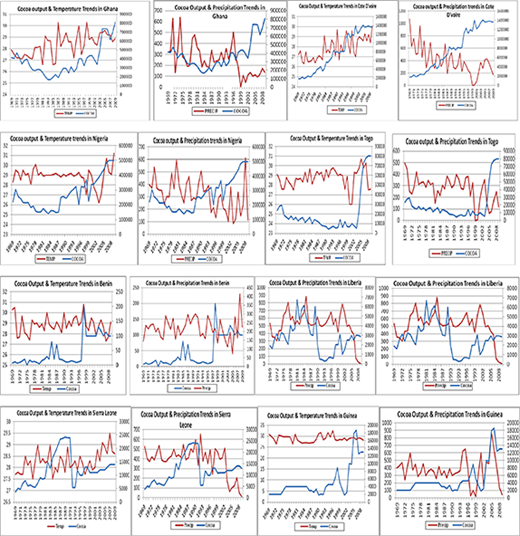
The variables under consideration were temperature and precipitation. The temperature and precipitation data used here are those of the cocoa-producing areas, instead of the country meteorological data. The graphs on all these countries indicate that temperature has been rising overtime. In terms of precipitation, there has been a declining trend throughout the study period for all the countries. Cocoa output, on the other hand, has been increasing across all the countries and over the study period. This is shown in the Appendix.
3. Literature review
3.1 Theoretical literature
There are four major theories that underpin climate change and crop production, namely, the Ricardian theory, crop yield response theory, the Agricultural Investment Portfolio Model (AIPM) and the Metaeconomics Theoretical Model.
The Ricardian theory is founded on Ricardo’s original observation that the value of land reflects its productivity. It is modeled in a cross-sectional fashion such that the technique enables the measurement of the determinant of farm revenue. The AIPM reflects farmer risk aversion of weather and leans on the Von Neumann–Morgenstern theory. The model assumes that farmers cannot insure against any risk ex ante and cannot perform any consumption smoothing ex post (Just and Pope, 1978; Antle et al., 1987 and 1989). The basis of the theory is that farmer utility depends on farm income, so that farmer consumption variability is isomorphic with farm profit variability. It, therefore, visualizes weather variables as risk to the farmer due to the nature of the uncertainties involved. The underlying precept of the metaeconomic theoretical model is on how much influence weather information forecasts have on decisions of farmers.
The crop yield response theory allows for weather influence upon crops in agricultural production analysis. This theory is based on the work of Angstrom (1936). The method combines precipitation and temperature into composite “aridity” indexes. The theory conceives that output is generally through a production function to land, labor and capital. However, the direct application of such a general function to agriculture neglects the existence of weather as an important exogenous factor. As a result, the theory considers rainfall, temperature and sun radiations, as well as many other weather factors as “noncost” inputs into the production process, especially when they are taken as deviations from average. The setup assumes a log-normal distribution of W such that in Cobb–Douglas specification the equation is written as: Equation 1
where, a is a constant term, P = output, L = l and, N = labor, K = capital, W = weather index; l, n, k and w are the coefficients of constant elasticity of output to each input factor. Under normal weather conditions, W = 1, and logw = 0.
The use of other functional forms is also explicit in the literature to capture climatic variables. In translog formation, the weather element is encapsulated in the xi input variables as: Equation 2
where P is output, xi and xj are the set of inputs including weather variables. Other applicable functional forms that fit into the crop response theory include quadratic, square root, Mitscherlich-Baule (or MB) as well as the linear and non-linear Von-Liebig functions. The rationale for choosing a particular functional form depends on the research questions and the underlying production processes to be modeled.
3.2 Empirical and methodological literature
At the microlevel, two methods of finding the impact of climate change on crop revenue, in general, are discernible. First, the Ricardian method (RM) regresses climatic variables such as temperature and precipitation on farm yields. It is a cross-sectional technique that measures the determinants of farm revenue. It is based on Ricardo’s original observation that the value of land reflects its productivity (Asafu-Adjaye, 2008). As cited by Seo et al. (2005), the RM accounts for the direct impact of climate on yields of different crops, as well as the indirect substitution of different inputs, introduction of different activities and other potential adaptation activities by farmers to different climates. Thus, the greatest strength of the model is its ability to incorporate the changes that farmers would make to fit their operations to climate change (Mendelsohn and Neumann, 1999). The major flaws are:
crops are not subject to controlled experiments across farms;
it does not account for future change in technology, policies and institutions;
it assumes constant prices which is really not the case with agricultural commodities, as other factors determine prices; and
it fails to account for the effect of factors that do not vary across space such as CO2 concentrations that can be beneficial to crops (Kaiser et al., 1993).
This method has been extensively used in most studies in Africa to assess the economic impact of climate change on crop yields (De, 2009; Kabubo-Mariara and Karanja, 2007; Kurukulasuriya and Mendelsohn, 2008; Molua and Cornelius, 2007).
On the other hand, the Reduced Form Crop Model is a process-based model derived from a summary statistical estimate based on an agronomic model of crop growth coupled with a linear-programming model of the US farms (Mendelsohn and Neumann, 1999). It uses a combination of:
controlled experiments on specific crops grown in a field or laboratory setting under different climate scenarios such as temperatures, precipitations and or carbondioxide;
agronomic modeling; and
economic modeling to predict climate impact (Adams and McCarl, 1990).
The estimated changes in the experimental crops from the agronomic models are then entered into an economic model to predict crop choice, production and market prices (Seo et al., 2005). One major advantage of this method is that it directly predicts the way climate change affects crop yields, as it carefully requires calibrated controlled experiments. However, the disadvantages which limit its applicability to developing countries include amongst others:
agronomic estimates do not control for adaptation to changing climates; and
lack of sufficient controlled experiments to determine agronomic responses in several developing countries (Seo et al., 2005; Easterling, 1993; Rosenzweig and Parry, 1994; Kapetanaki and Rosenzweig, 1997; Kumar and Parikh, 2001).
Further, the translog functional form has been widely used in the methodological literature to assess the impact of climate change on crop yields. Belanger et al. (2000) compared the performance of three functional forms (quadratic, exponential and square root) to the translog in assessing crop yield and concluded that although the quadratic form is the most favored in agronomic yield response analysis, it tends to overstate the optimal input level and thus underestimating the optimal profitability. Other studies that have reached similar conclusions include Bock and Sikora (1990), Angus et al. (1993) and Bullock and Bullock (1994). Most studies, therefore, prefer the application of the translog in assessing crop yield. It is usually of the form: Equation 3
ɛi ∼ N(0, σ2) where q is the yield (kg/ha), xi are the variable inputs (fertilizer, labor and seed) and z is a vector of productivity shifters such as land husbandry practices (i.e. weeding and date of planting) as well as rainfall inputs. The most important aspect of the use of translog production function in crop yield studies is that it allows for the incorporation of climatic variables as direct inputs into the production process. The methodological literature identifies two key reasons for the choice of the translog over the other functional forms as:
it is the best investigated second-order flexible functional form and certainly one with the most applications; and
it is convenient to estimate and has been proved to be a statistically significant specification for economic analysis as well as a flexible approximation of the effect of input interactions on yield.
Three major methods are discernible in the literature. These are the questionnaires and interview approach, general circulation model and cocoa physiological simulation model and correlation analysis method. With regard to the questionnaire approach, a research work focused on the effect of climate change on cocoa yield in Cocoa Research Institute of Nigeria, Nigeria, was undertaken by Ajewole and Sadiq (2010). The effect of two major weather parameters, rainfall and temperature, were evaluated on cocoa yield over ten years. The methodology adopted was a questionnaire approach to selected cocoa farmers in the catchment area. Secondary data were also used to augment the primary data collected directly through questionnaires and interview of farmers.
Oyekale et al. (2009) researched on the effects of climate change on cocoa production and vulnerability assessment in Nigeria. The focus of their work was on seedling mortality, production and processing of cocoa. Questionnaire method of data collection and direct interview were used on cocoa farm households in the study area. A combination of various analytical tools was used for the analysis which included descriptive statistics, principal component analysis (PCA) and Tobit model (TM). The PCA tool was used to derive an index of vulnerability to climate change based on farmers’ responses relating to experience of seedling mortality due to drought. This method which is similar to ordinary least square regression ensures that an index of vulnerability is computed from all the climatic variables. The TM, on the other hand, was used to estimate the responsiveness of yield of cocoa crops under the study to changes in climatic variables. The positive part of this study is that relative humidity was observed as one of the climatic variables possibly due to the aspect of the seed vulnerability in the study.
Factors that influence the supply and demand of cocoa produced were identified and researched. The variables included climate, micro-economic policy, global trading environment and developmental assistance, among others. The factors were grouped into: climatic, price and population changes for cocoa produce demand and population, weather and level of mechanization. The flaws in these studies are that they are localized in scope with maximum length among them covering a period of ten years, on one hand, and a year each respectively in the others, which by definition do not adequately reflect the effects of climate change on perennial tree crops like cocoa. For example, which year’s climatic impact is being assessed, as the impact of climate change on tree crops may not be instantaneous but may have lag effects (Guan, 2006). Studies on the general circulation model and cocoa physiological simulation model have also been observed in the methodological literature. Methods that rely on the General Circulation Models in conjunction with Simple Climate Models. This study is also limited by coverage and period covered.
The SUCROS-Cocoa model, on the other hand, is a physiological simulation model for cocoa that calculates growth and production of cocoa plantations, with or without water limitation. SUCROS-Cocoa is largely based on the SUCROS and INTERCOM models. SUCROS models are physiological crop growth simulation models that calculate leaf-based light interception and photosynthesis, maintenance respiration, biomass growth and crop production in time, and have been applied mainly for annual crops. The INTERCOM model is derived from SUCROS and produces similar output, but for situations with several competing species: multiple crops, crops and weeds, crops and shade trees. The theoretical background on these models is cited by Costinot (2009). On the use of the correlation analysis method, Lawal and Emaku (2007) evaluated the effect of climate changes on cocoa production in Nigeria. Rainfall, temperature and relative humidity were evaluated on cocoa yield and black pod disease incidence over 20 years. These variables were subjected to regression analysis and ANOVA to establish the type and strength of relationship and effect of the parameters on yield and black pod disease incidence (F-test). The interest of the study was more on establishing correlation and the strength of these variables in determining yield.
In a recent study, Ofori-Boateng and Insah (2011) examined the impact of climate change on cocoa production in Ghana, Nigeria and Cote D’Ivoire from 1969 to 2009. They used a translog production function based on agronomic ideas. An Engle–Granger Error Correction Technique (ECM) was used for the estimation. Their findings revealed that the two climatic variables, temperature and precipitation, have various degrees of impact on cocoa output in the selected countries. Further, the ECM showed different speeds of adjustment to long-run equilibrium for the different countries. Furthermore, Nkamleu et al. (2010), in their study on West and Central Africa, applied the metafrontier function technique to investigate productivity potentials and efficiencies in cocoa production. The functional form chosen for the stochastic frontier function for all the countries was the translog form. In their model, four inputs were included. Their methodology used a decomposition result involving both the national production frontiers and the metaproduction frontier. This enabled the estimation of national technology gap ratios. Their findings revealed that technical efficiency in cocoa production is globally low, and technology gap played an important part in explaining the ability of cocoa sector in one country to compete with cocoa sectors in other countries in the West and Central Africa region.
4. Theoretical framework and methodology
4.1 Model specification
The theoretical framework leans on the crop yield response theory and uses transcendental logarithms (translog) function which descends from the flexible functional form of the production theory. The crop yield response theory allows for weather influence upon crops in agricultural production analysis. Angstrom (1936) combined precipitation and temperature into composite aridity indexes. Oury (1965) consolidated the ideas of the earlier studies and used a Cobb–Douglas specification where weather variables were considered as additional input into the production process. Lau (1986) has also used the translog functional form for crop yield response analysis. The model is specified as: Equation 4
where, Y is the output of cocoa from the West African Region, and xi are the vector of inputs comprising both growth and facilitating inputs. In specific terms, xi is given as: Equation 5
where, Lit = labor input to the production of cocoa in country i and in time t (effective labor in Agric is used in the respective countries). Kit = capital input to the production of cocoa (fertilizer import for cocoa is used as a proxy). Tit = an exogenous temperature growth input for cocoa growth in country i and in time t. As stated earlier, temperature acts on the physiology of the cocoa tree which could increase or reduce its growth. Pit = refers to an exogenous precipitation growth input for cocoa production in country i and in time t. Precipitation acts on the rooting system of the cocoa tree which can improve or reduce growth of the tree.
By substituting equation (5) into equation (4), we get: Equation 6
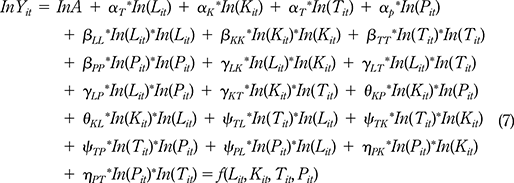
The translog production function is a second-order approximation to an unknown aggregate production function. In the spirit of Christensen et al. (1973), using Taylor Series to derive a four input aggregate translog production function results in[1]:
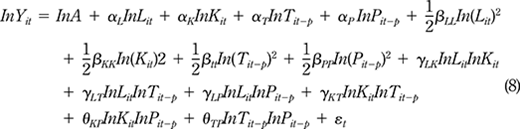
By imposition of the symmetry condition and introducing standard distributed lags[2] based on Guan’s assertion of 2006, we arrive at the following estimable equation as:
4.2 Data description and sources
Temperature and precipitation data were sourced from the FAOSTAT for selected cocoa producing areas across West Africa. In this respect, both yearly mean temperature and precipitation were used for the analysis. Because the effect of climate change is about extreme, maximum and minimum temperature and precipitation of these mean dataset, respectively, were sourced as well. It is important to state here that only the mean and maximum dataset of the cocoa-producing areas were used for data analysis and not country-wide data set.
Cocoa production (output) data were equally sourced from the FAOSTAT. At this site, one can find several cocoa products such as processed, semi-processed, chocolate and cocoa butter, as well as volumes of raw cocoa beans produced as annual production data. This study used the annual production data on cocoa beans in metric tonnes.
Fertilizer import data were also sourced from FAOSTAT data base. Varieties of fertilizers are also listed in this site, but this study considered the NPK imported for the countries under study. From the agronomic literature, NPK is mostly used for cocoa production than any other fertilizer and so it was a better proxy for capital.
Data on active population in agriculture as a proxy for labour input were sourced from the African Development Indicators. Active population in agriculture was used as a proxy for labor in cocoa production for the respective countries under study.
5. Presentation and analysis of results
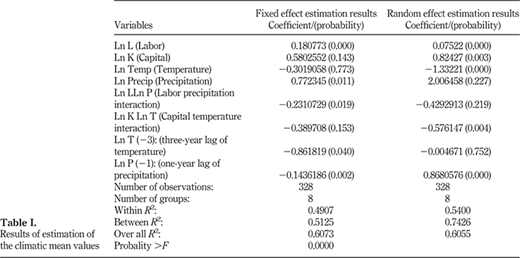
Two separate regressions were estimated, utilizing two data sets (mean and maximum). The interpretation of the results relates to the fixed effect results. The results had different regression coefficients for temperature and precipitation. Temperature was insignificant with the use of the mean data set and had an elasticity of −0.30. This suggested that, in absolute terms, temperature had no substantial effect on cocoa output in the sub-region. Viewing this result from statistics, one can easily conclude that the absolute low elasticity of −0.30 was an indication that it was barely supporting cocoa growth in the region. In addition, bringing the negative coefficient into perspective implied that temperature had a marginal negative effect on cocoa production in the sub-region. However, in line with the background of the study and the science behind tree crops indicate that the daily requirement of temperature for cocoa is within a range of 8°C for effective photosynthesis. Against this background, one can conclude, therefore, that the effect of temperature was within the milieu of cocoa production in the sub-region. The results are shown in Table I.
This could be the reason for the increasing growth of cocoa in this region than any part of the world. Unlike temperature, the mean data set showed that the regression coefficient of precipitation was positive and significant. The elasticity of precipitation was 0.77 and higher than that of temperature. This indicated that precipitation in the sub-region was contributing immensely to cocoa production. In addition, the lag and interaction effects of these climatic variables had a lot of interesting results. For example, while the responsiveness of cocoa production to a year lag of precipitation was positive on cocoa production, that for three years lag of temperature was negative in West Africa.
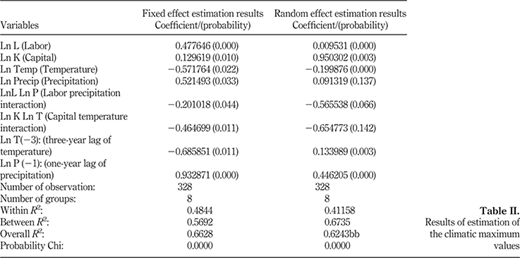
The use of the maximum data set yielded different results for both temperature and precipitation. This sharply indicates that the data set one uses determines the result that could emerge for the analysis. The import inferred here is that this data set mirrors the various extreme events over the historical study period. These results are shown in Table II.
The scientific reports that temperature would be increasing while precipitation would be decreasing makes the maximum data set very important for a study of this nature. The result for temperature indicated a negative elasticity of 0.57 and was statistically significant. The size in this result was larger than the previous estimated result when the mean data set was used. This was a clear indication that the responsiveness of cocoa production to temperature increases in the region is detrimental. In other words, the extreme temperature events recorded denoted a drift away from the expected temperature range for effective cocoa production in the sub-region. Precipitation, on the other hand, had a positive significant elasticity of 0.52, but this figure is a reduction when compared to the use of the mean data set result above. What could be gleaned from this result is that falling precipitation reduces its impact on cocoa production in the sub-region.
The elasticity of a three-year lag of temperature was a negative coefficient of 0.69. It was statistically significant which suggested that the responsiveness of cocoa output to temperature lingers up to the third year. One-year lag of precipitation had a positive elasticity of 0.93 which showed that previous year’s precipitation substantially promoted cocoa output in the sub-region. The intuition drawn from this result of lag effects is an indication that climatic variables do have both instantaneous and lingering effects contemporaneously. It is also worth stating that the lag effects were even larger than the instantaneous effects. The interaction effects of climatic variables and the other leading variables in the model also gave some impressive results. For example, labor and capital were significant in cocoa production. More so, their interactions with the climatic variables showed significant support for cocoa production in the region.
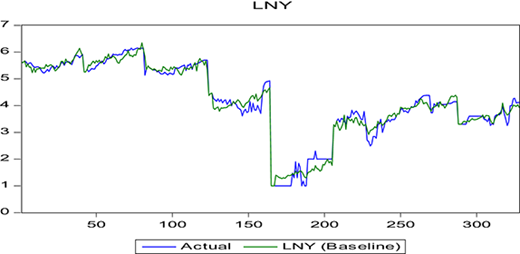
With the simulation results, an in-sample simulation was used to track the ability of the model to replicate historical records and for short-run forecasting. This is shown in Figure 3.
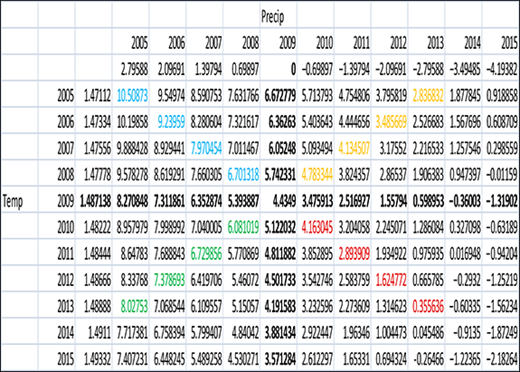
Based on its strong predictive power, an out-sample simulation was carried out, utilizing plausible scenarios from various scientific reports. The basic scenarios were then used to create various sensitivity combinations of temperature and precipitation on cocoa output. The combinations were six and their results are as follows.
The first scenario result indicated that decreasing temperature and increasing precipitation would lead to an increase in cocoa output. However, the rate of change takes the form of increases, becomes constant and diminishes, suggesting that extreme weather condition that would lead to temperature declining with increasing precipitation would only lead to transitory increases in cocoa output which would eventually peter out. The second scenario result implied that with constant temperature at the 2009 historical value and with falling precipitation, cocoa output would have a continuous decline. This suggested that the blend of these climatic variables as inputs is essential. This substantiates the findings of Lawal and Emaku (2007) that a combination of optimal temperature, minimal rainfall and relative humidity gives a better yield. The third scenario encapsulates a falling trend in both temperature and precipitation. In such a case, cocoa output declines. The description is that, a falling temperature and a falling precipitation do not augur well for cocoa production in the sub-region.
Furthermore, the fourth scenario examined a constant precipitation and falling temperature which result in increasing cocoa output over the period. However, the rate of change of the output growth was very marginal. What this result means is that pegging precipitation at its 2009 historical data and envisioning a declining temperature will bring about increases in cocoa output. The expected rate of change is woefully inconsequential for the sub-region. Scenario five unfolds instances where temperature rises with increasing precipitation. In such instances, cocoa output increases. The anticipated increases are, however, at a diminishing rate. This picture suggests that rising temperature in the presence of increasing precipitation could only be viewed as a transitory event for the cocoa industry in West Africa.
Finally, scenario six is the most plausible trajectory of climate change on cocoa output. In other words, this scenario is the most probable among all the unpleasant scenarios, and this mirrors the current state of the event according to the IPCC (2007), UNDP (2009) and other scientific reports. It foresees a rising temperature and a falling precipitation. The result indicated that cocoa output would fall depending on the actual rate of the fall and rise in the trajectory of these variables. This result is grim and suggests that cocoa output in the sub-region faces serious threat in the nearest future if nothing is done to mitigate or adapt to climate change. Figure 4 shows these scenario analysis.
6. Conclusion and recommendations
The two most important variables that determine climate change are temperature and precipitation. Furthermore, the lag effects of temperature and rainfall and their interaction with other variables indicate that both precipitation and temperature are relevant in cocoa production. Their current impacts are not harmful to the cocoa industry. However, increases in the size of the coefficients in the case of temperature and decreases in the case of precipitation indicate a bleak future for the cocoa industry in West Africa. Given the trajectory of the expected increasing temperature and declining precipitation, cocoa production is most likely to suffer production declines in the future. The summary of the simulation mirrors the results of the maximum dataset. Therefore, it is crucial for the authorities to develop adaptation strategies for the cocoa industry. Investment in irrigation infrastructure to enhance cocoa output in periods of low precipitation is relevant in this regard. In addition, the establishment of cocoa shades on their farms is required to buffer temperatures to improve cocoa yield.






References
Further reading
Appendix
About the authors
Kenneth Ofori-Boateng holds a PhD in Economics from the Department of Economics, University of Ibadan, under the collaborative PhD Programme for Sub-Saharan Africa, sponsored by the African Economic Research Consortium (AERC). Before Joining the AERC programme, he was the administrative officer for the Ghana Wildlife Society (GWS). He had previously held the position of Administrator in the City of London Business College (Accra) and a Teaching Assistant in the Kwame Nkrumah University of science and Technology (KNUST), Kumasi, Ghana. He has also worked for the Youth Development Foundation and British Aid Working for Ghana. He is the country representative of the African youth federation. He is affiliated to the Centre for Economic and Allied Research in Nigeria, Research gate and has extensively taught economics in some private institutions such as the University of Applied Management, Ghana campus.
Baba Insah obtained both first and master degrees in economics from the Kwame Nkrumah University of Science and Technology, Ghana, West Africa. During bachelors, he obtained a first class honors. In 2012, he was awarded a PhD in Economics by the University of Ibadan with sponsorship from the African Economic Research Consortium (AERC). His field of specialization is public sector macroeconomics. His thesis research is on fiscal sustainability. His publications have covered fiscal policy, money demand, seigniorage and climate change. Currently, he is the Dean of the School of Business, Wa Polytechnic, Ghana, West Africa.
Notes
In translog derivation, the * for pedagogical reasons reflect the interactions of the variables rather than just multiplication.
The agronomic literature (Guan, 2006; Dell et al., 2009) points out that perennial tree crops (like cocoa) may not have instantaneous temperature and precipitation effects.

