


– This paper aims to show why very little progress was made in arresting climate change. Managing climate change is one of the greatest challenges humanity has encountered in the 21st century. Responding to this greatest challenge, the United Nations has organized numerous climate change conferences. Four agreements (United Nations Framework Convention on Climate Change [UNFCCC], Kyoto, Copenhagen and Doha) have emerged in the process of developing a potential international climate change policy but failed to produce any ambitious agreement to arrest climate change.
– The pledges made by Conferences of the Parties (COPs) to reduce the greenhouse gases (GHGs) are contextualized with the ever increasing emissions of GHGs by exploring the databases of UNFCCC, International Energy Agency (IEA), Energy Information Administration (EIA) and the Netherlands Energy Assessment Agency (NEAA) for this study.
– However, GHGs have continued to rise and no globally binding agreement is seen to be forthcoming. Quantified targets to address the problem have yet to be agreed while major emitters remain free riders. This paper argues that the state-centric negotiating framework and the principles of the climate change negotiations were the main reasons for the inadequate outcomes leading to the continuing rise in emissions.
– This is an original research. It has presented the overview of climate change agreements, finds the problems and presents a way forward. The research is useful for governments of the world, climate negotiators, students of climate change, researchers, NGO communities and every single human being who understands that managing climate change is not only complex but also extensive.
Introduction
International climate change negotiations have been on-going since the 1992 Earth Summit in Rio de Janeiro, yet global greenhouse gases (GHGs) have increased by one-third since the adoption of United Nations Framework Convention on Climate Change (UNFCCC) in 1992. The Kyoto Protocol, a legally binding treaty adopted in 1997 and effective since 2005 included quantified emissions targets for industrialized countries. The Bali Roadmap in 2007 promoted an ambitious climate agreement at the 15th meeting of the Conferences of the Parties (COP-15) in Copenhagen, to follow the Kyoto Protocol, but without success. Consultations between the USA (USA), Brazil, China, South Africa and India (hereafter, BASIC), produced the last minute Copenhagen Accord which was not adopted at the final plenary session.
The Durban Agreement 2011 envisaged the adoption of a global climate treaty by the end of 2015 for implementation in 2020, including reduction targets for countries that had previously blocked international climate protection agreements, such as India, China and the USA, and a 2°C limit on the global temperature increase. The Doha Climate Gateway 2012 extended the Kyoto Protocol for a second commitment period and opened discussions for a new potentially binding agreement expected to be agreed by Paris, 2015. However, no concrete steps toward abating GHGs have been taken at any of these agreements to match the goal of 2°C limit, a temperature deemed necessary to avoid potential climate catastrophes (World Bank, 2012; IPCC, 2007).
Grubb (2011), Helm (2009) and Vogler (2011) have argued that climate change negotiations have offered little in reducing GHGs. “The lack of progress has been attributed to the problems evident in international system, procedural problems of negotiations and characteristic problems of climate change” (Pandey, 2012, p. 274). There are a wide range of issues that influence the roles of states at climate negotiations (Victor, 2011; Downie, 2011; Pandey, 2012). This paper argues that the inability of negotiations to redefine or modify the climate change principles and the state-centric negotiating framework are central to the failure in developing the climate change agreement required to arrest climate change.
The quantified targets to limit temperature increase below 2°C are ambitious, and so are the proposals to finance and deploy technology deployment to developing countries for continuing their economic growth by adopting low carbon technology. The pledges made by COPs to reduce GHGs are contextualized with the ever increasing emissions of GHGs, by exploring the databases of UNFCCC, International Energy Agency (IEA), Energy Information Administration (EIA) and the Netherlands Energy Assessment Agency (NEAA) for this study. The first section of this paper briefly outlines the developments of major climate change agreements. The second section focuses on GHG emissions data, highlighting the urgent need to respond to the problem, and the next three sections argue that the current state-centric UNFCCC framework and principles have not helped develop the climate change agreement needed to reduce the emissions of GHGs to limit temperature below 2°C. The sixth section examines the state-centric interests of major emitters (the USA + BASIC) and debates whether they can contribute a way forward, followed by the conclusion.
Climate change agreements
The UNFCCC (hereafter the Convention) was established at the Earth Summit in Rio de Janeiro in 1992 with the ultimate objective of stabilizing GHG concentrations in the atmosphere at a level that would prevent dangerous anthropogenic interference with the climate system. It recognized that addressing climate change required the widest possible cooperation by all countries for there to be an effective and appropriate international response, in accordance with the principles of common but differentiated responsibility (CBDR), historic responsibility and the social and economic conditions. The Convention also referred to financial mechanisms, insurance and technology transfer from developed countries to developing countries, and it recognized the importance of inter-generational equity calling for the protection of a “global climate for present and future generations of mankind” and included voluntary approaches for emission reductions, which parties soon realized were inadequate for the stabilization of GHGs (UNFCCC, 1992, p. 2).
The Kyoto Protocol, adopted in 1997, came into force in February 2005 and set up the emissions trading scheme, clean development mechanism and joint implementation for addressing GHG emissions both nationally and internationally. It set emissions targets for industrialized countries, in an effort to lower emissions below 1990 levels (Chasek et al., 2010). Although industrialized countries were charged with reducing emissions by 5 per cent below 1990 levels between 2008 and 2012, global GHG emissions has been growing at alarming rates 2010 onward (IEA, 2012). Few countries are on track to reduce their emissions to a level that will limit global warming below levels considered dangerous by the scientific community. The USA did not ratify the Protocol and criticized it as unfair and ineffective, as it did not require developing countries to take action to limit their emissions.
More than 115 heads of government, and many other representatives, arrived in Copenhagen for COP-15 with the hope of sealing a deal to replace the Kyoto Protocol. With no agreement in sight a political agreement was sought through consultations among the USA and the BASIC countries. The resulting Copenhagen Accord proposed voluntary targets for the parties, but its voluntary bottom up approach and its lack of legal standing within the UNFCCC process did not meet the ultimate objective of the Convention to stabilize GHGs. Copenhagen pledges are far less ambitious than the overall goal of emissions reduction (IEA, 2010; UNEP, 2010). Later climate change conferences broadly updated secondary issues.
Although the European Union (EU) was able to keep the Protocol alive through the Doha climate negotiations, several countries, including Japan, Russia, Canada and New Zealand, renounced the second Kyoto Protocol. They argued it was meaningless to take on new targets when emerging economies from developing countries had none (Doherty and Lewis, 2012). The USA and others refused to accept the extension of Kyoto, and China and India would not make any binding commitments. Thus, while the Kyoto Protocol was salvaged in Doha, its future was fragile.
In Doha, negotiators agreed to come up with a new treaty by 2015, to be put in place by 2020. To make it work, the treaty will need to be legally binding and include at least all the major emitters, and an effective penalty for countries that do not meet emission-reduction targets – something the USA and BASIC countries have so far refused to support. In preparations for the 2015 climate agreement, the Bonn conference held in June 2013 did not turn out to be promising (IISD, 2013a). In Bonn, the Subsidiary Body for Implementation (SBI) could not move forward, as Russia, Ukraine and Belarus blocked the negotiations. The protest was the result of the decision-making process of the 2012 Doha round of negotiations, where amendment to the rules of the Kyoto Protocol for a second commitment period was adopted against their objections. There has been a constant procedural problem of the UNFCCC’s state-centric decision-making procedures. In Bonn 2013, Tuvalu’s delegate, acknowledging these shortcomings, pointed this to be “supreme irony, of using procedure to make the process even worse” as “deliberately crashing a car to show that the seatbelts don’t work” (IISD 2013a, p. 17).
Despite some progress achieved under different agenda items such as REDD+[1] in the Subsidiary Body for Scientific and Technological Assessment (SBSTA), many delegates expressed fears that if the SBI impasse extends to Warsaw, SBSTA’s work will be substantially affected (IISD, 2013a). Although some progress was made under the second meeting of the Ad hoc Working Group on the Durban Platform for Enhanced Action (ADP2), it was stuck in neutral and characterized by “marathon sessions,” and “talk shops” where “previous discussions were rehashed” (IISD, 2013a, p. 18; UNFCCC, 2013). These talk shops have not been able to identify how to avoid surpassing the 2°C temperature increase limit by making decisions in a transparent and participatory way. These indicate that it will not be an easy task for ADP to gain a climate momentum, and another climate conundrum which might result in Paris 2015 degenerating into the kind of last minute scramble that made the Copenhagen Summit 2009a debacle.
The UNFCCC history shows that neither voluntary nor legally binding measures have been able to address the problem of climate change so far. There has been little progress in the international climate change negotiations (Helm, 2009; Depledge and Yamin, 2009; Ghosh and Woods, 2009; Volger, 2011) and the lack of progress reveals that the parties are not serious, provided the limitation of the state-centric framework and principles of climate change negotiations, leading to the perennial problem of a “you first attitude”, as developing countries decline to make any commitments until the industrialized countries start to cut their emissions and vice-versa.
Increased GHG emissions
The IEA (2011) predicted that under current policies, carbon dioxide (CO2) emissions will continue to rise, leading to an emissions trajectory consistent with a longer term global temperature increase of more than 3.5°C by 2035. It noted how the dynamic of energy markets is increasingly determined by countries outside the Organization for Economic Cooperation and Development (OECD) which account for 90 per cent of population growth, 70 per cent of the increase in economic output and 90 per cent of energy demand growth over the period from 2010 to 2035. The IEA (2012) noted that the growth in oil consumption in emerging economies, particularly for transport in China, India and the Middle East, more than outweighs reduced demand in the OECD, pushing oil use steadily higher in the future. It reasoned that the world is failing to put the global energy system onto a more sustainable path to meet the 2°C target. The age of fossil fuel is far from over and little has been achieved in containing global emissions through the international climate change negotiations and its policies.
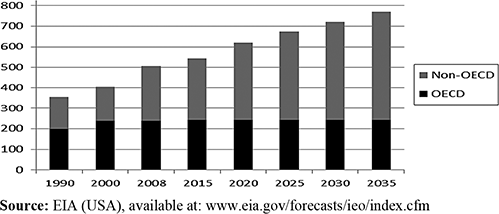
Victor (2001) stated that emissions from the developing world were rising rapidly and likely to exceed those from the industrialized nations. Since 1997, China and India have consistently relied on fossil fuels, seriously increasing their emissions. China now rates as the world’s number one emitter and India the number three emitter, and, together with Brazil and South Africa, they have received serious calls for reducing their emissions. The EIA (2011) reported energy use in non-OECD countries increased by 85 per cent compared with an increase of 18 per cent in the OECD countries. Figure 1 shows the rapid rise of GHG emissions shifting from developed countries to developing countries. Emissions were greater in developed countries from 1990 to 2000 but from 2008 the emissions rate of developing countries is rapidly increasing and future projections are for it to continue to rise.
The NEAA reports that CO2, “the main cause of global warming – increased by 3 per cent in 2011, reaching an all-time high of 34 billion tonnes in 2011” (NEAA, 2012, p. 6). It reported that the top five emitters in 2011 were China (29 per cent), the USA (16 per cent), the EU (11 per cent), India (6 per cent) and the Russian Federation (5 per cent), followed by Japan (4 per cent). China is now well within the 6 to 19 tonnes/person range spanned by major industrialized countries. Global energy consumption grows by more than one-third over the period of 2035 with more than 60 per cent accounted for by China, India and the Middle East (IEA, 2012).
The World Bank, taking a risk-based approach, postulated that:
A 4°C world would be one of unprecedented heat waves, severe drought and major floods in many regions, with serious impacts on ecosystems and associated services. However, with action, a 4°C world can be avoided, and we can likely hold warming below 2°C (World Bank, 2012, p. xiii).
However, the World Bank (2012) further pointed out that, although the global community is grappling with the challenge of climate change, scientists agree that countries’ current UNFCCC emission pledges and commitments would most likely result in 3.5-4°C warming. And the longer those pledges remain unmet, the more likely a 4°C world would become. However, the rising public interest, undivided attention, energy and the momentum that persisted during Copenhagen 2009 has since dissipated at a time when climate change stakes have become so high. China and the rest of the developing world, right behind the West, have continued to burn fossil fuels in business-as-usual, rendering the 2°C limit unachievable. Fast trains, hybrid cars, compact fluorescent light bulbs, carbon offsets and more only are not enough, a global climate momentum is required to meet this borderless challenge, raising the question of whether the United Nations (UN) decision-making process based on narrow interest of national sovereignty is up to the challenge.
The UN decision-making and the UNFCCC
The UN was established to maintain international peace and security and to this end, it is based on the principles of the sovereign equality of all its members (United Nations, 1945). It is a long-established state-centric top-down decision-making approach in tackling global issues has been taken for granted and has practiced because the UN was established. The post-Westphalian order of state-centric international politics is founded on the idea of sovereignty, assuming it has delivered and will continue to deliver solutions to emerging global problems from peace, security to environmental threat such as climate change (Bauman, 2012). The politics of climate change has been predominantly state-centric (The Guardian, 21 December 2009; Zurn, 2004). The issue of sovereignty has been referred in almost every document of UNFCCC. BASIC countries, including Russia, together they are termed as BRICS[2], have remained firm on their sovereign right to development and their economic interests. The preamble of the Convention, the Kyoto Protocol and Article 5 of Copenhagen Accord reaffirm the foundations of the UN charter and national sovereignty (UNFCCC, 1992, 1998, 2009).
In contrast, ecological, environmental and climate change issues are borderless, and do not respect state-centric sovereignty. These are functional challenges requiring a functionally based response as articulated by David Mitrany, “not how to keep nations peacefully apart but how to bring them actively together” (Mitrany, 1946, p. 7). Functionalists argue that it is possible to bypass the political rivalries of nation-states by building habits of cooperation in non-political economic and social spheres to address global problems (Karns and Mingst, 2010). However, this functional approach has not made its way through international climate change governance and the governments are caught in the continued state-centric framework of the UN system. Hurrell and Kingsbury questioned:
[Whether] a fragmented and often highly conflictual political system made up of over 170 sovereign states[…][can] achieve the high (and historically unprecedented) levels of cooperation and policy coordination needed to manage environmental problems on global scope? (Hurrell and Kingsbury, 1992, p. 4).
Bauman (2012) reasoned that the kind of international politics the UN promotes and practices is not much of a step on the road towards solving global problems like climate change. Indeed, the continuous failure of UNFCCC negotiations over these years testified to the inadequacy of a state-centric approach even while acknowledging that there are a range of other issues that influence climate negotiations. The primary cause of the Copenhagen debacle of 2009 was the state-centric national interest in the guise of sovereignty. The trend features in current negotiations and is expected to continue in future negotiations as the preparations process of sealing a new treaty in Paris 2015 is being debated by Russia, Ukraine, Belarus including the USA and the BASIC countries (IISD, 2013b).
Climate change framework
The 1992 Convention adopted procedural rules for a consensual approach in reaching decisions and agreements, which has often given the veto to a country. Sebenius wondered whether “the complexities of a universal process” in climate negotiations would “threaten endless delay and impasse” (Sebenius, 1991, p. 144). Victor (2006) and Hass (2008) have questioned whether a global approach was the best way to fight climate change, arguing that with around 20 major emitters accounting for more than 80 per cent of global emissions, an agreement among these countries could quickly respond to global emissions reductions, rather than among more than 190 countries. However, it is not the small emitters that are currently slowing the international climate change negotiations although a global regime may not be the right answer, but in practice is “a political necessity” (Depledge and Yamin, 2009, p. 451).
Negotiations among only major emitters’ neglect the main victims of climate change simply because of their low emissions, their limited leverage and weak power, but such analysis falls short in limiting temperature as indicated by science. Consensus-based decision-making has clearly been obfuscated by the large number of parties and their state-centric decision-making framework. The state-centric consensus-based decision-making procedure received considerable criticism in the aftermath of the UNFCCC, the Kyoto Protocol and the Copenhagen Accord (Duvash and Rajamani, 2010), and concerns were raised in Cancun 2010, Doha 2012 and Bonn 2013.
Principles of climate change negotiations
The central principles of international climate change negotiations are CBDR, historical responsibility and equity. Although the Durban text of 2011 did not spell out these principles explicitly, they apply to the climate change issue and to other environmental issues. Article 3.1 of the Convention states:
The parties should protect the climate system for the benefit of present and future generations of humankind, on the basis of equity and in accordance with their common but differentiated responsibilities and respective capabilities (UNFCCC, 1992, p. 4).
According to CBDR the developed countries should take the lead in combating climate change with developing countries following suit as they address their issues of economy and development.
Historical responsibility is based on past contributions to global warming. The Convention’s preamble notes that the developed countries, recognizing their historic responsibility, should lead and contribute more in combating climate change (UNFCCC, 1992). The Convention aims to address the issue of fairness with the concept of historical responsibility by placing the bulk of liability on those who have contributed most to, and benefited from, the build-up of carbon in the atmosphere. The differing capacities and needs of nation-states also underpin the notion of equity. Industrialized countries have the technical and economic capacity to address climate change, both through mitigation and adaptation, whereas developing countries may not (McManus, 2009).
The principle of CBDR gets complicated when the relationship between national CO2 emissions and the national share of global population is examined. While CBDR, historical responsibility and equity have remained at the centre of climate change negotiations, these have also led to a clear division of developed and developing countries into Annex I and Non-Annex I which has been “the regime’s greatest weakness” because of the “the persistence of dysfunctional North-South Politics” (Depledge and Yamin, 2009, p. 443). Further, it has divided the developed countries between the EU and the USA (Bodansky, 2010). The EU pushed for strong emission reductions targets through domestic measures, but the USA pushed for unrestricted market-based mechanisms including emission trading among many other differences. Bodansky (2010) argues the split between the USA and EU at negotiations is more serious than the split between developed and developing countries.
The on-going debate on climate change negotiations through the establishment of the Convention to COP-18 to Bonn 2013 demonstrate that this division is unlikely to disappear soon. India has made it clear that all negotiations need to keep the principles of the Convention intact. At Doha, the Indian lead negotiator Mira Mehrishi reinforced that “India’s firm commitment to the principles of equity and the need for adequate funding for the developing countries to address climate change impacts” (Menon, 2012, para. 5). China’s climate envoy Xie Zhenhua reiterated:
Climate change is due to unrestricted emissions by developed countries in their process of industrialisation. Developing countries are the victims of climate change. If we want to devise a long-term goal on emissions reduction by 2015, it is inevitable that we will have to find a way to allocate emissions. But these allocations must be equitable. It’s very important therefore to talk about equity (Cited in Hickman, 2012, p. 2).
This is the minimum threshold for developing countries including China and India for climate change negotiation. In Bonn 2013, India and China underscored that progress on a 2015 agreement necessitates an increase in Annex I ambition and should be based on CBDR (IISD, 2013b). In contrast, according to BBC News, Todd Stern, the special climate envoy of Obama, said, “I will block this. I will shut this down” on the issue of the compensation mechanism (Harrabin, 2012, para. 10). In June 2013, Bonn, the USA, noted “addressing mitigation through nationally determined contributions with rules that provide for transparent MRV but are flexible enough to be applicable to all” and suggested “further work on, among other things, rules that can be applicable to all and evolve with experiences gained” (IISD, 2013b, p. 1).
Canada, Japan, Russia and New Zealand declared they would not take quantified targets unless major emitters from developing countries were bound by quantified emissions targets. New Zealand’s Climate Change Minister, Tim Groser, said:
There is no question of withdrawing, the issue was always different: where would we take our next commitment – under the Kyoto Protocol or under the Convention, with the large majorities of economies? We have decided that it is in New Zealand’s best interests to do the latter. (Cited in Three News, 9 November 2012, para. 7).
The EU also dismissed the poor countries’ argument that the West created the climate problem and that the West should fix it. The EU’s climate commissioner, Connie Hedegaard, noted that the EU was responsible for just 11 per cent of global emissions and that it could not solve global warming without the help of those emitting the other 89 per cent (The Hindu, 26 November 2011). The recurring question is how these contrasting state-centric positions of the parties come to the terms with reducing the global GHG emissions.
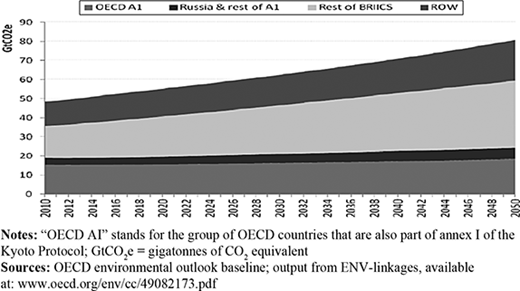
The OECD reported that, in the coming decades, “increasing emissions will also be caused by high economic growth in some of the major emerging economies” (OECD, 2012, p. 5). Figure 2 shows the emerging picture of GHG emissions in the future. The OECD and Russian federation emissions are likely to stabilize at the current levels or there may be a slight decrease whereas the emissions from the BRICS, excluding Russia, are significantly increasing and emissions may rise in the rest of the developing world. The United Nations Development Programme (2013) affirmed that the global South had risen and wanted more representative institutions than the existing one dominated by the West. In response to the backdrops of the World Bank and International Monetary Fund, the BRICS’ Leaders agreed to the establishment of a New Development Bank in March 2013 (BRICS, 2013). There have been five BRICS summits so far, and this is often viewed as BRICS solidarity vs the West, but this solidarity is also compromised by the fact that China and Russia have strong UN involvement, and often compete with each other economically and regionally. Yet, the agreement to establish a BRICS’ bank shows that these countries are interested in creating institutions that better serve their interests and perhaps the next climate crisis will encourage them to establish or support ongoing climate negotiations.
The United Nations Development Program (UNDP) (2013) report reasoned that the global South has risen at an unprecedented speed and scale and the rise of the South is providing both opportunities and challenges for formidable problems such as the management of the global climate challenge in an increasingly interconnected world. If BRICS are the new leaders of the South, despite the living standards in these countries lagging far behind the developed world, their rising middle class and resource competition will cause acute environmental pressures (Wilson et al., 2010). The question is whether BRICS is just following the business as usual so as to be treated like Western countries, alienating the rest of the South, or they can add possibilities for appropriate climate responses. The reference of the rising South, the BRICS, is to suggest the future areas of research in climate change dimension, which is beyond the scope of this paper to consider. However, the following section will show their (Russia excluded) specific interests in climate negotiations.
Interests of major emitters: a way forward?
The IPCC’s Fourth Assessment Report notes that warming of the climate system is unequivocal, that global atmospheric concentrations of GHGs have increased markedly as a result of human activities since 1750 and that the “global increases in carbon dioxide concentration are due primarily to fossil fuel use and land use change, while those of methane and nitrous oxide are primarily due to agriculture” (IPCC, 2007, p. 2). “The world is not on track to meet the target agreed by the governments to limit the long term rise in the average global temperature to 2 degrees Celsius” (IEA, 2013, p. 9). The pledges and commitments made under the Copenhagen Accord to reduce emissions “collectively fall short of what would be required to put the world onto a path to achieving the Accord’s goal of limiting the global temperature increase to 2°C” (IEA, 2010, p. 53). The commitments proposed under the second round of the Kyoto Protocol, which covers only 15 per cent of total global emitters are nontangible. The IEA warns that under current policies, “the long term average temperature increase is more likely to be between 3.6°C to 5.3°C” compared to pre-industrial levels” (IEA, 2013, p. 9). Thus, limiting global temperature below 2°C requires at least developed countries, and major emitters from developing countries commit to binding targets to ensure intergenerational equity. However, developing countries need to continue their economic growth to pull millions of poverty-ridden people out of poverty so it should not be at their economic cost. If the developed world fulfils the promises of mitigation pledges, finance and technology transfer and major emitters from developing countries take binding targets, the goal to limit temperature increases below 2°C could be achieved. However, whether emerging economies and the USA and the rest of the developed world are willing to take up this challenge and give leadership to climate negotiations is far from clear.
Indeed, more recent climate negotiations tracking are shifting from the debate of the USA and EU and developed and developing countries to the USA and BASIC countries. Together, the USA, China and India are responsible for more than 51 per cent of global emissions (NEAA, 2012). Because of Copenhagen 2009, the BASIC countries have cooperated on international climate change governance to present a counterproposal for more obligations on rich countries to cut emissions. Hallding et al. (2010) argue that two factors explain why these four BASIC countries are cooperating together. The first is their G-77 membership where they have played key roles and formed a common identity. The second is their increasing political and economic rise, triggering concerted efforts by developed countries to impose an obligation for quantified GHG emissions targets on emerging economies. In fact, their cooperation on climate change negotiations is their high dependence on fossil fuels’ energy and their specific interests.
Although the BASIC countries are working together on the issue of climate change, they are four separate entities with different national interests and policy priorities, which lead them to be partners on some issues but not on others (Hallding et al., 2010). They have differing views on the understanding of “equity”. For India, which has a much lower per capita than the other three, “equity” is framed in per capita terms, combined with the principles of historical responsibility and the capacity to pay. For Brazil and China, which have higher per capita emissions than India, the emphasis is on historical responsibility for GHG emissions as the key underlying principle. Another important difference is whether all major emitters should be subject to legally binding emissions reductions in a future climate agreement. In Cancun, South Africa and Brazil hinted that they would be open to legally binding targets for major developing countries. India hinted at the possibility of accepting legally binding commitments but China remained unwilling to discuss the prospect of mandatory reductions.
The lack of a single policy proposal suggests that it is difficult for them to reach a single climate negotiating position yet BASIC countries argued that extending Kyoto was a legal obligation, not a bargaining tool to pull further concessions from developing countries. BASIC’s fifteenth Ministerial meeting held from June 26-28, 2013 in South Africa reaffirmed that:
Durban Platform is by no means a process to negotiate a new regime, nor to renegotiate, rewrite or reinterpret the Convention, and that future agreement will be built on institutions and mechanisms, including the work carried out by Parties under the Bali Road Map in accordance with its principles and provisions (DEA, 2013, p. 1).
The USA and other members of the Umbrella Group such as Canada, New Zealand, Japan and Russia have indicated that any new legally binding instrument, if and when it becomes necessary, must incorporate symmetrical climate mitigation commitments, at least in form, for all significant emitters. The climate positions of the BASIC countries will find such equilibrium unpalatable. Copenhagen could be a timely reminder for Paris 2015, as China, India and Brazil did not reciprocate any compromise but asserted their freedom of development regardless of environmental impacts (Dimitrov, 2010; DEA, 2013), on the one hand, and, on the other hand, the major emitters from the Umbrella Group who clarified that they would not make any commitments unless emerging economies bind themselves.
Michael Grubb (2011) argued that there needs to be a vision of something that could start to solve the problem. Currently, there is a state-centric impasse with the developing countries calling for a reduction of 45 per cent by 2020 for industrialized countries, but they and the G-77, headed by China, refuse to accept long term reduction obligations (Ekardt et al., 2009). In contrast, industrialized countries are asking for reduction obligations from the newly emerging economies. If no flexibility is shown by the parties, there will be another gridlock. To arrest the increase in global temperature requires flexibility and serious commitments from all countries in climate change negotiations and governance. Real vision, creativity, leadership and mutual understanding of the difficulties of making and implementing climate policy are required to lead the world toward a more prosperous, sustainable and energy-secured future for present and future generations. Obama’s recent speech (Bloomberg News, 26 June 2013) on domestic climate policy, and the huge domestic greening efforts of China are welcomed, but without serious commitments, any agreement could result in false promises or be overtaken by economic and developmental interests, such as have been seen in the rapid increase in carbon emissions from many advanced and emerging economies. Achieving the UNFCCC’s ultimate objective of stabilizing the GHG concentrations in the atmosphere at a level that would prevent dangerous anthropogenic interference with the climate system needs the participation of both the industrialized countries and the major emitters from developing countries. The principles of CBDR and historical responsibility, as they are, do not contribute much to the pragmatic measures necessary to mitigate emissions by breaking the gridlock.
Conclusion
Climate change agreements have delivered very little so far. The only binding agreement was the Kyoto Protocol but it has made little difference to climate change. The future of a climate change agreement that can arrest climate change looks unlikely and “If we do not change the direction soon[…]we will end up where we are heading” (IEA, 2012, p. 39). Without a fundamental rethink and redefinition of the principles of climate change negotiations and the appropriate use of the framework, and discard of the “consensus veto politics”, it is unlikely there will be real, serious and sustained progress.
The principle of CBDR has been central to climate change negotiations, but it needs to be reframed and redefined because even if all the industrialized countries commit to emission reduction targets by 100 per cent, the global emissions will still keep rising unless the major developing country emitters commit to mitigate GHGs. As long as precision is not made on current principles of UNFCCC, parties will use “you first” attitude. Energy efficiency is important but not enough. The global warming crisis requires global solutions. To achieve a 2°C-3°C limit increase will require a radical transformation in energy production and consumption and climate leadership from major emitters. Further research is required on how the emerging economies of the South can bring more opportunities and challenges to global problems such as climate change.
Addressing the problem of climate change requires states to undertake four measures:
reframe and redefine the debate of CBDR to ensure all industrialized nation-states and major emitters from developing countries commit to quantified emission reductions;
include individuals as a unit of analysis along with nation-states for multiple approaches;
developed countries should deploy the available low carbon technology to developing countries because the enemy is the “intensity of carbon” that causes developing countries to emit many times more than advanced countries; and
respond seriously to climate change to ensure a better future and prosperity for our children and grandchildren. By themselves, agreements and smiles at negotiations cannot arrest the problems of climate change.
References
About the author
Chandra Lal Pandey is a PhD candidate at the University of Waikato. His research project is on “International climate change governance: issues of democracy, institutions and the media”. Prior to his PhD studies, he worked as a Research Fellow and a Lecturer at various academic institutions. His research interests include environmental/climate change politics/policy/security, natural resource management, food security and other issues of non-traditional security. Chandra Lal Pandey can be contacted at: pandeycl@gmail.com
The author would like to thank Dr. Alan Simpsom for his insightful comments and suggestions throughout the preparation of this article.
Notes
REDD+ refers to reducing emissions from deforestation and forest degradation and includes the role of conservation, sustainable management of forests and enhancement of forest carbon stocks.
The acronym BRICS includes Brazil, Russia, India, China and South Africa. See for details: www.brics5.co.za/

