


– This paper aims to examine state adoption of climate action plans (CAPs) and investigates the factors driving the adoption of these climate policies in the states.
– The framework that is formulated to explain the state climate actions involves four dimensions: climate risks, climate politics, climate economic and climate policy diffusions. These hypotheses are tested with event history analysis on a panel data set on 48 US continental states from 1994 to 2008.
– This paper found empirical evidence to support climate politics, economics and policy diffusion explanations. It also found that climate risks are not taken into account in states’ climate actions. A comparison is conducted to compare the differences in state and local climate policymaking.
– The paper investigates the motivations of state governments in adopting CAPs, and makes comparisons with local climate strategies. It contributes to academic understanding of the multilevel governance of climate protection in the USA.
Introduction
In an age of emerging impacts on the natural environment and human society from global climate change, sub-national governments, including state, county and city governments in the USA, have taken the lead in meeting the challenges of climate change and sustainability (Rabe, 2007; Drummond, 2010). Rabe’s Statehouse and Greenhouse: The Emerging Politics of American Climate Change Policy documents that state governments are the places where dynamic climate policy actions are being undertaken. In the past few years, much empirical work has investigated why local governments take actions to mitigate and adapt to climate change, but few studies examine the forces underlying state government’s actions for climate protection. State and local governments are subject to different constraints in their policymaking processes, thus assuming the same dynamics for climate policymaking in state and local governments may lead to faulty conclusions.
State and local governments are all subnational governments with key roles in climate mitigation and adaptation. In the context of the USA, state and local governments are characterized by different financial conditions and political dynamics, leading to potentially different patterns in efforts to address climate change. In terms of financial conditions, local governments have a less robust tax base than state governments, and have undergone more severe financial distress in the wake of the recent financial crisis. With regard to political competition, state politics are more partisan than local politics. In the climate policy arena, the politicization of the climate change issue has made it increasingly difficult to make progress in policy adoptions and innovations at the state level. In light of these differences between state and local governments, do state governments behave differently from local governments in engaging climate protection?
This paper addresses this question by examining state adoption of climate action plans (CAPs), and the factors driving the adoption of these climate policy plans in the states, and compares the differences in state and local climate policymaking. The framework that we formulate to explain the state climate actions involves four dimensions: climate risks, climate politics, climate economics and climate policy diffusion. We measure, test and evaluate factors related to each of the four dimensions with our empirical models, and compare the relative importance of each factor in explaining climate actions of state and local governments. There are several potential academic contributions of this paper. First, this paper presents a theory-based study of CAP adoption at the state level. Previous literature on CAPs are mostly focused on local governments. Second, extant research does not compare the different dynamics of climate policymaking process at state and local levels. This paper is the first effort to systematically compare different levels of climate governance.
The paper proceeds as follows. First, we discuss the contents and importance of CAPs in the US states. Second, we critically review the current literature on state and local climate actions. Then we present our framework for state climate policy adoption. The hypotheses are tested using event history analysis (EHA) with a panel data set of the 48 contiguous states from 1994 to 2008. The results confirm the hypotheses related to climate policy diffusion and climate politics. We conclude with a discussion on the differences in climate policymaking and implementation in state and local governments.
State CAPs
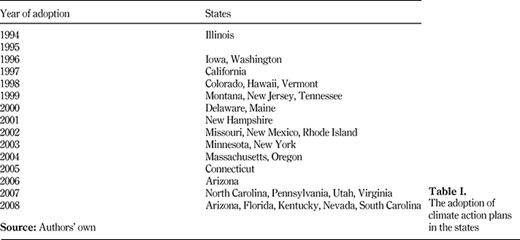
By 2008, 33 states had adopted CAPs in various forms, as reported in Table I. In general, a CAP includes the following elements:
an inventory of greenhouse gas (GHG) emissions for a base year;
estimates of GHG reductions from the actions taken in the plans;
estimated costs of CAP measures;
GHG emissions reduction targets; and
a set of policy recommendations for different sectors, including electricity, residential, commercial and public buildings, transportation and industries.
For example, Massachusetts adopted its CAP in 2004 with the joint efforts of 15 state agencies. In this plan, Massachusetts set its GHG emission targets as reduction of emissions to 1990 level by 2010 and 10 per cent below the 1990 level by 2020. The plan also specified a policy for renewable energy deployment by requiring a 1 per cent annual increase of renewable energy portfolio with an emphasis on wind energy. Additionally, it also required that the state implement a vehicle emission standard similar to that adopted in California, and adopt Leadership in Energy and Environmental Design basic standard for state government buildings. In addition to these core elements, some states also include sections on the science of climate change, the expected impacts from global climate change as well as funding sources for climate-related government expenditures (Drummond, 2010). Another important aspect is that states conduct follow-up reporting on their CAPs with different frequencies.
State CAPs have the following characteristics that distinguish them from other single-purpose policy instruments. First, it forms the foundation of climate policies in a state, by conducting the emissions inventory, estimating GHG reductions from potential measures and related costs and educating citizens and policy makers. Second, CAPs are comprehensive in their content and specific in formulating plans of actions to reduce GHG emissions. Third, they are politically visible and under public scrutiny, and are frequently updated with more ambitious GHG reduction goals and more stringent standards. As depicted by Rabe, the state CAPs:
[…] provided an empirical foundation for much subsequent state policy activity and also served as an initial opportunity to bring together constituents from diverse state agencies, industries, universities, and advocacy groups to meet and consider climate change as a state policy issue (Rabe, 2004, p. 19).
These state CAPs, together with local CAPs, are labeled “first generation” plans that “lack the strong actions and political and institutional commitment needed to mitigate emissions” (Wheeler, 2008, p. 488). CAPs are sometimes cast as symbolic rather than substantive policies. Empirical evidence shows that state CAPs do have moderate and measurable impacts on GHG emission reductions (Drummond, 2010), with an estimated overall reduction of one half metric ton per person per year. This evidence refutes the argument that CAPs are merely symbolic. The climate policy planning process itself signals substantive climate protection commitment from the state governments.
When examining the history of climate policy development in the states, we find that these state-level CAPs lead to later adoption of region-wide GHG plans, for example Regional Greenhouse Gas Initiative and Western Climate Initiative (Rabe, 2007). This means that the states that took climate actions likely gained experiences from formulating and implementing their own CAPs, and reinforced their commitments to climate protection with interstate collaborations (Yi and Feiock, 2012; Coley and Hess, 2012).
CAPs are different from other specific policy instruments such as renewable portfolio standards (RPS), vehicle emission standards and building codes. A state might adopt RPS, vehicle emission standards and building codes for different purposes, such as interstate economic competition, energy security and economic savings (Rabe et al., 2005). By contrast, a policy document labeled “Climate Action Plan” represents both symbolic and substantive commitments to climate protection.
If CAPs do represent a substantive commitment to climate protection, then it begs the question that why some states adopt CAPs, while others do not. It is this question that this paper seeks to answer.
State and local climate actions: a review
Many studies have investigated the reasons underlying national government’s commitment to climate actions (Dolsak, 2001, 2009; Orr, 2006). Even though national governments’ involvement in international climate policies exhibits different dynamics compared to state and local governments’ climate actions, these studies emphasize the roles of domestic air pollutions and organized interest groups in determining national commitment to climate actions.
State-level studies of climate action are also abundant, including the adoption of RPS (Lyon and Yin, 2010; Matisoff, 2008; Yi and Feiock, 2012), net metering (Stoutenborough and Beverlin, 2008), the impact of RPS on renewable energy development (Carley, 2009), green jobs (Yi, 2013, 2014) and the impacts of state CAPs on carbon emissions (Drummond, 2010). However, policy instruments like RPS and net metering are mixed-purpose instruments that not only target climate change, but also economic growth and energy supply diversification, with their impacts limited to the electric utilities sector. State CAPs are climate-focused, comprehensive and economy-wide policies. Factors driving CAP adoptions could be totally different from those affecting renewable energy policy instrument adoptions.
Rabe (2004, 2007) explained that state actions on climate change are driven by three set of factors: politics, economics and mechanics. He provided examples, cases, stories and analysis for state-level climate policies, supporting the influence of these factors, but the hypotheses he proposed have not been subjected to rigorous empirical tests. The framework we advance in this paper explicitly tests Rabe’s prediction that states facing high climate risks are not quite responsive to climate change, and tests the hypothesized effects of climate politics as well.
Research that addresses local climate protection actions is also rapidly evolving. Betsill (2001) first studied the adoption of CCP (Cities for Climate Protection) programs among local governments in the USA. She emphasized that local government’s decision to adopt climate policies was driven by localized policy benefits such as air pollution reduction and economic benefits. The factors that are identified to influence local climate policy adoptions include cost savings (Kousky and Schneider, 2003; Lindseth, 2004), community wealth (Brody et al., 2008; Tang and Brody, 2009; Tang et al., 2009) and economic development opportunities (Kousky and Schneider, 2003; Lindseth, 2004; Engel, 2006; Engel and Orbach, 2008; Bae and Feiock, 2013). Policy co-benefits such as air quality reduction, public health protection and traffic congestion alleviation are also found to be important (Kousky and Schneider, 2003; Lindseth, 2004). In terms of climate politics, policy entrepreneurs (Kousky and Schneider, 2003; Engel and Orbach, 2008; Feiock and Bae, 2011), political will (Betsill, 2001; Bassett and Shandas, 2010) and state mandates (Berke et al., 1996) are found to be significant drivers of climate policy adoptions. The list also includes climate risks variables like coastal distance, population density and hazard damage (Brody et al., 2008; Zahran et al., 2008), and climate stress variables such as light transportation, emissions per capita and carbon-intensive industry (Brody et al., 2008; Tang et al., 2010). Additional variables of relevance to climate policy adoptions include neighbor influences (Engel, 2006; Krause, 2011), municipal-owned utilities (Krause, 2011), fiscal stress (Sharp et al., 2011) and local political institutions (Krause, 2011; Sharp et al., 2011). Other studies have also tried to explore the effectiveness of CAPs (Stone et al., 2012; Baker et al., 2012).
Another relevant stream of literature is on the local adoption of sustainability policies and initiatives. Spurred by the seminal work of Kent Portney’s Taking Sustainable Cities Seriously (Portney, 2003), numerous studies were conducted to examine factors contributing to the adoption and implementation of sustainability policies (Conroy and Iqbal, 2009; Saha and Paterson, 2008; Lubell et al., 2005; Lubell et al., 2009; Fitzgerald, 2010; Krause et al., 2015).
The discrepancies in the progress of research between state and local climate policies are very significant. The literature on local climate policies is developing very rapidly, while the studies on state climate policies are much less frequent. While some scholars explain the motivations of “state and local climate actions” together (Engel, 2006; Engel and Orbach, 2008), it needs to be acknowledged that state and local governments operate in different institutional environments and are faced with different political, economic and environmental constraints. Thus, it is theoretically important to examine the mechanism for state climate actions, and compare it with that of local climate actions.
Theoretical framework
State actions to combat climate change do not occur in vacuum, and different states respond to different incentives when adopting climate protection plans. CAPs might be adopted as a policy response to climate risks and impacts, or as a compromise of interest group politics, or as a product of rational calculation of economic costs and benefits, or simply as a reflection of policy learning and emulation among the state governments. Therefore, our discussion on the state adoption of CAPs focuses on risks, politics, economics and policy diffusion.
Climate risks
Given the global nature of climate change, it would be irrational for any US state or any nation in the world to take unilateral actions to reduce GHG emissions. Even though the impacts of climate change such as sea level rises and frequent extreme weather events are happening locally, the global impacts of possible losses of human lives, land, properties and destruction of ecosystem should not be ignored. Although local mitigation efforts are not likely to be efficacious, the risks of exposure to the consequences of climate change may possibly lead to policy responses from governments. In some empirical work on local climate policy adoptions, climate risks have proven to be an important factor in driving local climate protection actions (Zahran et al., 2008; Brody et al., 2008). In the state climate policy literature, the impact of climate risks on the state climate protections remains untested. A brief overview of the adoption of the CAPs in the states reveals that many coastal states like Florida, Texas and Louisiana are laggards in CAP adoptions, which corroborates Rabe’s observation that states with high vulnerability to climate change may not respond to such risks (Rabe, 2007). By contrast, some other coastal states are taking aggressive actions to mitigate climate change, for example New Jersey and California. Therefore, the impact of climate risks on states’ responses is unclear:
H1. The level of climate risks is not associated with a state’s adoption of CAP.
Climate politics
Legislative professionalism measures the level of professionalism of state legislative officials (Squire, 1992, 2007). Previous evidence shows that higher level of legislative professionalism is associated with higher likelihood of environmental program adoptions (Ringquist, 1993). Even though a state CAP is not necessarily passed in the form of legislation in a state, the initiation of a state CAP cannot escape from the influence of the state legislature. State legislatures influence the development of CAPs in various ways. In some states, legislatures support CAPs by appointing a CAP working team. State legislatures can also impose negative influence on the CAPs by preventing the inclusion of substantive measures in the CAPs. We expect that the levels of professionalism are associated with understanding and accepting the reasoning underlying the scientific arguments regarding climate change. A more professional legislature tends to learn from the scientific evidence, while a less professional legislature may approach this policy issue from a more ideological stance and impose pressure on the drafting of state climate actions.
A citizen ideology index measures the mean position of citizens on the liberal-conservative continuum (Berry et al., 1998). It is generally argued that the liberal ideology is associated with green policies and renewable energy programs (Stoutenborough and Beverlin, 2008; Matisoff, 2008; Yi and Feiock, 2012). This is especially true for climate change policies, as climate change is highly politicized in the context of American national and state politics. The stance taken by liberals and conservatives on the issues of climate change is almost dichotomous. Liberals tend to believe the science of climate change and argue for policies to prevent its disastrous consequences, while conservatives are less likely to acknowledge the existence of climate change or support climate mitigation efforts. However, the way citizen ideology influences climate actions is much more nuanced. As shown in Kwon (2013) and Kwon et al. (2015), California has been at the forefront of climate change initiatives for many years, led by a Republican governor, even though the state is very liberal in general. Nevertheless, at the aggregate level, ideological propensity of the governor and the legislators shapes the support of renewable energy laws and climate policies (Coley and Hess, 2012). Therefore, we expect that citizen and government ideology can be an important predictor of state climate policy adoption.
The influence of interest groups could be essential in climate policy development. Advocacy from environmental groups can greatly enhance the salience of climate change issues in state political agenda and media attention. The influence of interest groups could be essential in developing climate mitigation strategies. Without strong support from the renewable energy industry, state climate policy could be merely symbolic. Benefiting from tax incentives and rebate programs, renewable interest groups are engaged in lobbying activities to substantiate climate policies (Yi, 2014; Yi and Feiock, 2014). For example, RPS was strongly advocated by the American Wind Energy Association. We expect that the more active the environmental interest groups are in a state, the more likely it is that the state will adopt a CAP.
In the USA, the government is divided into three branches (legislative, executive and judicial) at both federal and state levels. The division of power among the branches could potentially lead to inefficiencies and lack of productivity in passing legislation and opportunities for one branch to block climate actions of others. It is likely that states where each branch of government belongs to a different party will have more difficulty approving CAPs. But as argued by Mayhew (2005) and Binder (1999), divided governments are no less productive compared with unified governments. Given the empirical results by Mayhew (2005) and Binder (1999), we hypothesize that the presence of divided government has no impact on the adoption of CAPs in the states:
H2. The more professional the state legislature, the more likely the state will adopt a CAP.
H3a. The more liberal the citizen ideology in a state, the more likely the state will adopt a CAP.
H3b. The more liberal the government ideology in a state, the more likely the state will adopt a CAP.
H4. The more the environmental interest groups in a state, the more likely the state will adopt a CAP.
H5. Whether a state is governed by a divided government has no impact on the adoption of CAP.
Climate economics
CAPs impose costs on the state economy, and GHG emission reduction targets will introduce costs on traditional industries that rely heavily on carbon-intensive electricity generation. GHG emissions can be categorized into five interrelated non-mutually exclusive sections: electricity emissions, residential emissions, commercial emissions, transportation emissions and industrial emissions (Drummond, 2010). In electricity generation, policy instruments, such as RPS, net metering, feed-in-tariff and tax incentives, are included in the state CAP to reduce emissions by stimulating renewable energy generation. In the residential and commercial sectors, measures like retrofitting, demand-side management and energy efficiency grants and loans could be used to reduce emissions. Vehicle fuel efficiency standards could be adopted to reduce emissions from the transportation sector. All these climate protection measures are costly. Electricity is more expensive to generate from renewable sources than from traditional energy sources like coal and natural gas (Sims et al., 2003). Energy efficiency measures generally require support from government-funded incentives. The higher the per capita GHG emissions in a state, the more dependent a state is on the traditional carbon-based economy, and the more resistance a state will meet to adopt a CAP.
Electricity is not bounded by political jurisdictions. Some states generate more electricity and export it to other states, while some states are net importers of electricity. The concentrated interest of electric utilities may be more intense in states that are exporters of electricity than the importer states. In a state with substantial electricity imports, resistance to the CAP from the carbon-based industries and utilities are not expected to be as intense as that from a state that generates excess electricity:
H6. The higher the per capita carbon dioxide emissions in a state in a year, the less likely a state will adopt a CAP in that year.
H7. The more a state relies on external imports of electricity in a year, the more likely a state will adopt a CAP in that year.
Climate policy diffusion
States also adopt CAPs under the influence of neighboring jurisdictions. The process through which one jurisdiction’s policy decisions are influenced by other governments is called policy diffusion. Much theoretical and empirical work has been done to study the diffusion of various policies in the nations, states and cities (Berry and Berry, 2007; Kwon et al., 2009). The mechanisms of policy diffusion involve both competition and learning (Berry and Berry, 1990; Shipan and Volden, 2006). In the context of climate policy adoptions, the economic competition can occur among the states when some states want to gain “first-mover” advantage over others and influence future national policies. California’s legislation to restrict carbon emissions from vehicles has gained California the national leadership in this policy arena (Rabe, 2007). The potential stimulation of renewable energy technology and industries is another area of intense economic competition among the states.
Policy learning can also occur when states observe the climate actions of other states and learn from other states’ practices and experiences. Climate policy is politically risky, especially when ideological debates are involved in this arena. Learning from other states’ success can significantly reduce the political risks involved in the adoption of CAPs. Regardless of the specific mechanisms at work, state CAPs are anticipated to be adopted in response to the decisions of other states:
H8. The higher the percentage of neighboring states that have already adopted CAPs in a given year, the more likely a state will adopt a CAP in that year.
Research design and methods
Our explanation for state adoption of CAPs is tested by EHA. To test the hypotheses, we develop a panel data set for the 48 continental states from 1994 to 2008, with 720 observations. The final number of observations reduces to 546, because observations were dropped out of the risk set after the adoption of CAPs.
The dependent variable measures whether a state adopts CAP in a given year, with a binary indicator of whether the state has CAP in a given year, with 1 indicating a state adopts CAP in that year, and 0 indicating a state has not adopted such a policy. CAPs are not of equal quality among the states, in that some states adopt CAPs for symbolic purposes, while other states use the plans for substantive climate protection commitment. To reduce measurement errors, we differentiate CAPs with emission targets from those without. By 2008, four states have adopted CAPs, but without GHG emission reduction targets. These states are coded 0, as we consider CAPs without GHG emission reduction targets as symbolic actions. The data were coded from Wheeler (2008), supplemented by data from US EPA Web site.
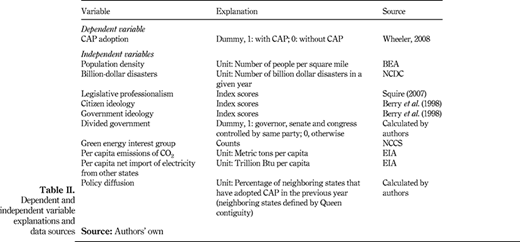
Climate risks have been measured in different ways in the literature. For example, Zahran et al. (2008) measure climate risks with precipitation, eco-sensitive zones and coastal areas. Given the limitations of a local-level data source, the above measures are the best available at that level. At the state level, however, it is possible to construct better measures that can capture the “risk” aspect of the climate situation in a state. We use the yearly occurrence of disasters that cause more than a billion-dollar loss to measure climate risk in a state. This is a more direct measure, because experiences with the consequences of these large-scale disasters are more likely to lead people to think about the underlying links between disasters and climate change. The data on billion-dollar disasters were gathered from the National Climate Data Center.
High-density urban environments can have a significant environmental impact or ecological footprint, and thus are often used to capture the problem severity of climate-related stress (Daley et al., 2013). If the government is responsive to citizen needs, states with higher population density are more likely to adopt CAPs. Population density data were collected from the Bureau of Economic Analysis.
The legislative professionalism indicators were gathered from the state-level data set of State Politics and Policy Quarterly, and extrapolated to the recent two years. A comprehensive citizen and government ideology index was constructed by William Berry and Richard Fording. Updated measures were extracted from Fording’s University of Kentucky data archive Web site. The green energy interest group variable is measured by the number of renewable energy non-profit organizations in a state for a given year, which is coded from the database of National Center for Charitable Statistics (NCCS). The data on carbon dioxide emissions and electricity imports were gathered from Energy Information Administration (EIA). Divided government was calculated by authors based on data collected by Klarner (2003).
To measure policy diffusion effects, we calculated the percentage of neighboring states that have adopted CAP in the previous year for the 48 contiguous states. Neighbors are defined by queen contiguity, which means that states that share boundaries or vertices are treated as neighbors. A summary of the measures and data sources is presented in Table II.
Our explanations for CAP adoption are tested by five EHA models. We use logit as the link function of the EHA models. The model assumes the underlying hazard is flat with respect to time after controlling for the covariates in the model (Box-Steffensmeir and Jones, 2004). A second issue with the analysis is how to correct standard errors for the repeated measurements across the states. Time dependence generally results in underestimation of standard errors (Beck and Katz, 1997). Two measures will be adopted simultaneously to account for the temporal dependence. First, we will correct the standard errors by applying robust standard errors clustered on the unit of analysis (state). Second, following Beck et al. (1998), we first create temporal dummies for each period and then use cubic spline smoothing functions to smooth the temporal dummies. Three equally spaced splines will be created and then incorporated into the model. In this way, the temporal dependence can be tested and controlled.
Results
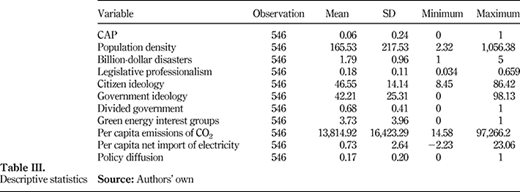
Descriptive statistics shown in Table III reveal interesting aspects of the data set for this study. An average state experiences 1.79 billion-dollar disasters between 1994 and 2008. An average state was under divided government for 68 per cent of the time between 1994 and 2008, with 3.7 green energy interest groups located in that state. There are wide variations among states in per capita carbon emissions, with a large standard deviation of 16,423.29, compared with the mean of 13,814.92 metric tons per capita.
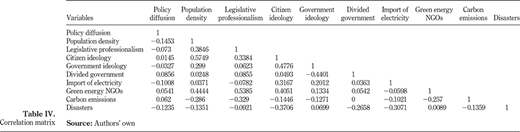
Before we estimate the series of EHA models, we checked correlations among variables to determine if there is evidence to indicate multicollinearity problems in the regressions. As shown in Table IV, high correlations were not present and most coefficients are very low. The highest correlation reported is between population density and citizen ideology, with a coefficient of 0.57.
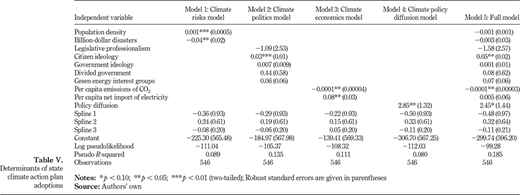
The results of the models are presented in Table V. The first model is the climate risks model, which estimates the impacts of climate-related risks on the decisions to adopt CAP. In this model, two variables are included: billion-dollar disasters and population densities. The second model estimates the effects of political variables, legislative professionalism, citizen ideology, government ideology, green energy interest groups and divided government, on the use of CAP in the states. In the third model, the climate economics model, only variables that measure the cost of climate policies are included. In the fourth model, only the diffusion effects of the CAP adoption are examined. Our final model incorporates all the climate risks, politics, economics and diffusion variables. In all five models, we include three equally separated splines to control for temporal dependence.
The first explanation examined is climate risks, as presented in Column 1 of Table V. In this model, we find that the coefficient of billion-dollar disaster is negatively significant, indicating that states that suffer most from climate-related events are less likely to have CAPs. In Model 5, taking into account other covariates, we find that the coefficients of the climate risks variables are insignificant. This is consistent with our observations, as well as previous studies, that many southern and coastal states are laggards in climate protection actions, even though they are extremely vulnerable to climate impacts.
The second set of variables relates to the climate politics explanation. In Model 2, the coefficient of citizen ideology is positively significant at the 0.01 level, indicating that states with a more liberal orientation are more likely to adopt a CAP. This result is robust in Model 5, except that the significance level drops slightly from 0.01 to 0.05. However, we do not find statistically significant results for the other four politics variables:
legislative professionalism;
government ideology;
green energy interest groups; and
divided government across the two models.
This means that the extent of the professionalism of legislature is not related to CAPs, but it does not refute the fact that state legislatures play a key role on climate policies. The insignificance of interest group variables might indicate that policy change comes from outside of the policy subsystem, a fact we will discuss later in examining the impact of policy diffusion. The insignificance of the divided government variable confirms the findings by Mayhew (2005) and Binder (1999) that divided governments are no less productive than unified government in making legislations.
The third set of variables is climate economics variables. Model 3 estimates how cost considerations play a role in the decisions made by policy makers for climate protection. Consistent with our hypothesis, the coefficient of per capita carbon emissions is negative and significant in Model 3, which means that if policy makers foresee that a CAP will impose cost on carbon-based industries, they would more likely choose to avoid such a policy if their states are more heavily reliant on carbon-based industries. The effect of this variable is robust, as the coefficient has the same magnitude, sign and significance level in Model 5. The coefficient of per capita net import of electricity is significant and positive, consistent with our hypothesis. This means that a state with more electricity imports has fewer obstacles to making commitments to climate mitigation, and thus is more likely to adopt a CAP. But this variable fails to achieve significance in the final model.
The fourth model examines the policy diffusion effect. The coefficient of diffusion variable is positive and significant, indicating that if a state has more neighbors that already adopted CAPs, it is much more likely to adopt a CAP. The effect of the diffusion variable is robust, and the coefficient is also positively significant in the final model, even after controlling for other factors influencing state adoption of CAPs.
In summary, we find that the effects of three variables are robust and consistent with our hypotheses in all five models: citizen ideology, per capita emissions of carbon dioxide and policy diffusion, consistent with our expectations. As anticipated, we do not find significant influence from climate risks.
State and local climate policy adoption research: a discussion
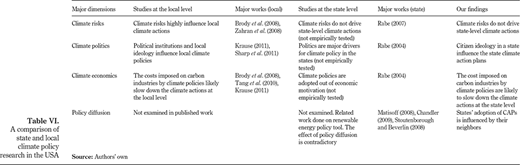
To what extent do factors influencing climate actions differ at the state and local levels? To answer this question, we need to reexamine the literature on state and local climate actions, and compare it with the findings we report here. In the local climate action literature, many variables were argued to be important, as described in our literature review. To meaningfully compare between the state and local levels, we group the variables into four categories identified in our analysis: climate risks, climate politics, climate economics and policy diffusion. We can then compare state- and local-level climate policy research across these four categories. Although this is not a comprehensive or exhaustive list, it provides a useful framework for the purpose of meaningful comparisons.
Table VI provides a brief summary of extant research on state and local climate actions, together with the results from this analysis. We find that climate politics and climate economics are at work at state and local levels, and the salience of political and economic costs are confirmed in our analysis. The diffusion of climate policies is not fully tested in previous studies. Thus, our finding of significant climate policy diffusion among the states constitutes a unique contribution to the literature.
For climate risks, extant literature indicates that local governments are quite responsive to climate risks (Brody et al., 2008; Zahran et al., 2008), while state governments are much less responsive to such factors (Rabe, 2007). As indicated in our analysis, the probability of state adoption of CAPs is not associated with the level of climate risks.
The divergent paths taken by state and local governments in response to climate risks have several implications. First, state and local governments adopt climate policies for different purposes. Local governments are more likely to emphasize the impacts of climate change, but state climate actions are more influenced by other political and economic factors. Second, the fact that state governments are unresponsive to climate risks suggests that local governments could play a valuable and complimentary role in climate policy action. In states lacking state-level climate actions, local governments could fill the void. Furthermore, there might be synergies between the roles of state and local governments. State governments might do a better job in pursuing policies that impose less political and economic costs. Local governments, being more familiar with local climate conditions, could do a better job in designing policies that meet local needs. This is evident in the area of climate adaptation. The fact that state and local governments have different motivations supports the argument that a multilevel governance structure is needed to successfully mitigate and adapt to climate change.
Conclusions
The study of state climate actions has not attracted as much attention as international, national or local climate actions. Many studies treat state and local governments as entities with similar motivations in adopting climate policies. This study challenges this assumption by enhancing our empirical understanding of the mechanisms of state climate actions, and comparing the factors driving state and local adoption of CAPs. We look at four dimensions that affect state decisions on climate protection: climate risks, climate politics, climate economics and climate policy diffusions. With a panel data set from 1994 to 2008, we estimate a series of event history models. The results show that citizen ideology, per capita carbon emissions and policy diffusions are important predictors for states’ choice of climate policies.
More importantly, we find that state and local governments adopt climate policies for different purposes, and synergies between the roles of state and local governments should be achieved for successful climate mitigation and adaptation. Future research could be directed at investigating the impacts of state and local CAPs. Several studies have analyzed the impacts of CAPs at the local level, and further research is needed to study the economic, environmental and political impacts of CAPs at the state level and investigate the interactions among state and local CAPs in influencing emission reductions.
References
About the authors
Dr Hongtao Yi is an Assistant Professor of energy policy in John Glenn School of Public Affairs at The Ohio State University. His research interests include environmental policy, energy policy and policy process. His works appear in Energy Policy, Review of Policy Research and Policy Studies Journal. Hongtao Yi is the corresponding author and can be contacted at: yi.201@osu.edu
Dr Richard C. Feiock is the Jerry Collins Eminent Scholar & Augustus B. Turnbull Professor of Public Administration in Askew School of Public Administration and Policy at Florida State University. His work appears in leading scholarly journals of political science, public administration and urban affairs.

