


– The purpose of this paper is to shed light onto the policy context of mainstreaming community-based adaptation (CBA) in Nepal. Scaling up CBA needs strong policy support.
– The content and processes of Nepal’s development policies and climate change policies and programmes were examined. The policy analysis was supported by a literature review, review of policy documents and interviews and discussions undertaken with policy-makers, practitioners and communities.
– Findings show that despite a lack of clear focus on climate change, the decentralization provisions and bottom-up practices within Nepal’s development policies and plans could be the entry points for mainstreaming CBA. However, experience shows that decentralization alone is insufficient because it benefits only a few institutions and individuals, while marginalizing the real beneficiaries. One of the policy conditions to mainstreaming CBA in development is to ensure that there are specific provisions for decentralization and inclusive devolution that can provide power and authority to local institutions and communities to make independent decisions and benefit the needy. There should also be mandatory legal provisions, endorsed by a country’s government, for an inclusive, citizen-centric, participatory and bottom-up policy-making process that involves the most vulnerable households and communities.
– This paper is of relevance to policy-makers and practitioners in Nepal seeking to make informed policy decisions on effectively mainstreaming CBA into development. The analysis provided of the synergy and trade-offs within existing policy provisions and processes can be used to guide the government and stakeholders in Nepal and other least developed countries (LDCs) in creating favorable national- and local-level policies and action plans.
1. Introduction
Climate change poses great challenges for the livelihoods of the rural poor in developing countries, because of their high dependency on natural resources and limited capacity to adapt (Smit and Pilifosova, 2003; Ayers and Forsyth, 2009). Adaptation has emerged as a strategy to assist vulnerable populations to respond to the impacts of climate change (Ayers, 2011a). As adaptation to climate impacts is “local”, localized adaptation measures are, therefore, crucial to any endeavor to reduce vulnerability (Agrawal, 2008). Community-based adaptation (CBA) to climate change has emerged as a strategy in least developed countries (LDCs) to address climate risks and the vulnerability of poor households and communities (Huq and Reid, 2007). CBA is defined as a strategy that aims to build the resilience of households and communities to better adapt to both variability and changes (Ayers and Dodman, 2010).
At an operational level, CBA has emerged as a means of linking climate change adaptation with other development priorities and goals. CBA aims to address the underlying development concerns that render people vulnerable to climate change (Ayers and Forsyth, 2009, p. 24). The past decade of work on CBA has focused on piloting and learning lessons from community-focused adaptation initiatives implemented in specific localities and communities in some LDCs. Academics and practitioners argue that the learning of CBA should now be scaled up in other areas and taken into account by government institutions (Reid et al., 2010).
However, challenges remain, mostly with respect to finding policy measures that can enable smaller and location-specific CBA projects to be effective and sustainable. Reid et al. (2010) argue that it is important to find practical ways to “scale up” project-based initiatives and to find better ways to draw out and communicate lessons from CBA more widely. The issues around scaling are also highlighted by Ayers (2011a), who argues that despite the potential of CBA in operationalizing local inclusiveness, scaling up the initiatives to climate policy is problematic because little attention is paid to the local policy-making context of adaptation. Similarly, Ensor and Berger (2009) highlight the challenges around CBA due to the lack of a conducive policy environment and support from the government to scale up adaptation successes.
One prerequisite for mainstreaming CBA in development is to have a favorable policy that recognizes community-driven adaptation initiatives and enhances local partnership and ownership (Dodman and Mitlin, 2013; Huq and Ayers, 2008; Forsyth, 2013). Partnerships and the involvement of multiple agencies are also important in climate change policy formulation because of the need to address diverse issues related to both mitigation and adaptation (Bizikova et al., 2012; Pinkse and Kolk, 2012). To make participatory policies supportive to mainstreaming CBA, policy provisions, such as decentralization and devolution, are relevant because they allow local institutions and stakeholders to make decisions independently. According to various scholars (Agrawal and Ribot, 2000; Capistrano and Colfer, 2005; Ribot, 2006; Tacconi, 2007), decentralization is a promising approach for increasing the adaptive capacity of communities at the local level because it addresses the concerns of local communities directly and involves them in decision-making.
Mainstreaming into development policies and planning has emerged as a policy approach for scaling up CBA (Ayers and Forsyth, 2009). The concept of “mainstreaming” is becoming increasingly relevant in climate policy and in countries’ responses to climate change. Statements on adaptation within the 2006 policy document of the United National Framework Convention on Climate Change (UNFCCC) spell out the need to enhance the strategic coordination and synergy of local-level adaptation priorities and national policies and plans (Ayers et al., 2013). Mainstreaming climate change adaptation in policy and development strategies means incorporating climate change adaptation elements and issues into existing policies and efforts (Schipper, 2004, p. 71). The recent policy decisions of the National Adaptation Programme of Action (NAPA) and National Adaptation Plan (NAP) under the UNFCCC have also urged developed countries to support the governments in LDCs and developing countries to devise policy and legal measures to ensure climate change is well integrated into their development policies and plans (Ayers et al., 2013).
However, the early lessons of mainstreaming climate change adaptation in developing countries show that although mainstreaming looks promising, it is theoretically vague, complicated in practice and challenging to promote and achieve (Gupta et al., 2010). There is also inadequate understanding among policy-makers in LDCs of exactly what CBA mainstreaming means and how to incorporate climate change adaptation into development policies and strategies. As CBA has only been locally tested, there is a lack of evidence and discussion about how it can support the mainstreaming of climate change at a larger and more sustainable scale and contribute to this policy discussion and dialogue (Reid et al., 2009).
The literature on climate change adaptation further stresses the need to carry out country-specific studies to determine the relevance of different approaches and methods used in mainstreaming CBA in LDCs. Several authors have highlighted the need to carry out further research to better understand how mainstreaming could happen practically in the developing country context (Klein et al., 2007; Lasco et al., 2009) and address practical issues of how to promote the integration of climate change adaptation in development planning and policy processes (Ayers et al., 2013; Gupta et al., 2010). In addition, there is little understanding at the national level in Nepal and other LDCs of ways in which existing development and climate change policies could contribute to scaling up and mainstreaming CBA.
This paper aims to fill these research gaps by analyzing climate change and development policies to determine the appropriate policy context and environment for scaling up and mainstreaming CBA in Nepal. The aim is to investigate and outline the type of policy process and content required for mainstreaming CBA in the country’s development planning processes. The paper specifically seeks to answer the following questions:
Q1. Are there any explicit references to mainstreaming CBA in current development and climate policies of Nepal?
Q2. Is there future scope within the current development and climate policies to mainstream CBA?
Q3. Does the policy formulation process impact the implementation and scaling up of CBA?
Nepal was selected as the case study for the policy analysis because the country is currently in the process of mainstreaming climate change adaptation in development. As one of the most climate-vulnerable countries, the government of Nepal and stakeholders have started to explore ways to create synergy among policies and harmonize national and local responses on climate change and development. The findings of this paper add value to the ongoing policy debate and discussion on what kind of policies are favorable for CBA mainstreaming.
2. Research methodology
The methodology approach used for the policy analysis reported in this paper capitalizes on the existing literature on public policy analysis. Public policy analyses with regard to climate change and other disciplines, such as health, emphasize looking at the content as well as the process of policy-making. For example, Lasco et al. (2009) used two approaches in assessing how far climate change has been integrated into major development plans and programmes of the Filipino Government, examining policy and programme documents and interviewing people to map their perceptions of the process of making policies and their overall content. Similarly, Walt and Gilson (1994) proposed a “Policy Analysis Triangle” to think more systematically about the multitude of factors (content, process, context and actors) affecting policy and the interrelations among these factors.
There are advantages to using the policy analysis triangle model for the research reported in this paper. This analytical approach brings a new dimension to analyzing climate change policy, namely, an actor-oriented perspective, which places a particular emphasis on the views of those who are impacted by the policies and those involved in making them. In particular, this entails analysis at three different levels – the policy itself, that is the written text; the process that led to the policy (how policy-making was carried out); and then, a brief analysis of the actors involved in formulating the policy.
The data collected in this research come from various sources. A total of 17 policy-makers were interviewed and one multi-stakeholder focus group discussion was convened between December 2011 and March 2012. The policy respondents included six representatives from government, three from donor organizations, three from civil society, two from the private sector and three academics and researchers who were directly involved in or concerned with climate change and development policies. A total of 28 practitioners were also interviewed, representing both government and non-government sectors. Interviewees in the practitioners’ category, referred to here as development professionals, included a total of ten government officials, eight officials from community-based organizations and ten staff of non-governmental organizations (NGOs) and development professionals employed in a CBA project. These interviews were followed by one multi-stakeholder brainstorming discussion involving practitioners and communities at the district level. In addition, nine focus group discussions were carried out with communities at the local level.
The participants for the interviews and focus group were selected using different sampling techniques. The policy-makers and practitioners were selected by purposive sampling, mostly identified based on their institutional engagement and experiences in climate change adaptation. Most of the selected participants were directly or indirectly involved in a climate change adaptation agenda and implementation of policies and programmes at the national level. At the community level, nine community forestry user groups of the Bangesal and Dhungegadi Village Development Committees (VDCs) of Pyuthan district in Nepal were invited to participate in the research. These specific community groups were consulted based on their experiences as some of the pioneers in piloting a climate change adaptation project in Nepal that focused on mainstreaming climate change. The data derived from interviews and focus group discussion were coded and analyzed using the NVivo and Microsoft Excel software programs.
In addition, a review of available studies was another important source of data. Previously published studies on climate change adaptation policy in Nepal were reviewed to evaluate climate change and development policies and relevant documents, such as Nepal’s Interim Development Plan, the NAPA document, the framework of the Local Adaptation Plan of Action (LAPA), climate change policy and selected development policies on forestry, agriculture and health.
3. Findings
3.1 Provisions and scope within policies and plans for mainstreaming CBA
This section of the paper evaluates the current development and climate policies of Nepal and analyzes the future scope within these policies for mainstreaming CBA. In light of the evidence presented in this section, it is argued that mainstreaming CBA requires policies that have provisions to decentralize and devolve power and authority to local institutions. Policies that are accountable to people and communities are significant to mainstreaming CBA because they link local adaptation needs with national policies and plans. Further, linkages between local and national institutions provide greater access to finances and technology for supporting local community adaptation needs.
3.1.1 Provisions within development and climate change policies and plans for mainstreaming CBA.
The findings of the analysis of the agriculture policies of Nepal (Agriculture Policy, 2004 and Agro-Biodiversity Policy, 2006) reveal that they fail to address issues of climate change. These documents only make references to the extreme weather conditions and disasters caused by natural events, such as droughts, flooding and landslides. Similarly, the Forest Sector Policy does not mention climate change (Government of Nepal, 2000, p. 14), and the Disaster Risk Management Strategy acknowledges climate change only with reference to natural disasters (Government of Nepal, 2009, p. 2). It was also found that the Sustainable Development Agenda for Nepal (SDAN) prioritizes climate change mitigation and risk reduction over adaptation. The policy provisions discussed earlier in this paragraph show that development policies are more inclined toward infrastructure development than addressing the livelihoods of marginalized and vulnerable communities.
The policy analysis shows that the previous Three Year Interim Development Plan (2007-2010) document was the first to make reference to climate change (Government of Nepal, 2007). This was continued in the recent Three Year Interim Plan (2010-2013), where more specific provisions were made for climate change adaptation (Government of Nepal, 2010). The 2010-2013 Three Year Interim Plan is regarded by the majority of policy-makers interviewed in this research as the most progressive development plan in Nepal’s history, in that it is more inclined to address the issue of climate change. Analysis of this plan shows that the background section refers to addressing the worldwide problem of climate change (Government of Nepal, 2010, p. 2). Although the development strategy of the plan does not refer to the issue, for the first time, the priority section of the plan states, “attention will be paid toward minimizing the impacts of climate change by protecting environment and availing opportunities” (Government of Nepal, 2010, p. 18). The policy text analyzed here suggests that climate change is being categorized in the “environment” rather than the “development” box. This treatment of climate change as entirely an environment issue might in the future pose challenges to linking poverty with climate change vulnerability.
Similarly, the recent Three Year Interim Plan (2010-2013) specifically addresses climate change as a major development issue and outlines an action plan devised to address it. For the agriculture sector, the plan identifies weather variability and climate change impacts as some of the challenges in the sector (Government of Nepal, 2010, pp. 86-87). The section on sector strategies (under 6.4) states that “Agricultural bio-diversity will be conserved through promotion of climate change adaptation-related technologies in agriculture” (Government of Nepal, 2010, p. 87). The plan also makes specific reference to climate change in the forestry sector strategy, highlighting the establishment of a climate change section (Government of Nepal, 2010, p. 100). The specific provisions within this interim plan are an opportunity to influence the sector to revisit its past policy and make it more resilient to climate change impacts.
Analysis of Nepal’s climate change policy shows that the Government of Nepal has made a good start in strengthening its national readiness in terms of implementing climate change priorities. The policy acknowledges the potential threat of climate change to society and the livelihoods of people. Similarly, it stresses the need to adapt climate-friendly practices, stating:
[…] it is equally necessary to make the country’s socio-economic development climate-friendly, and to integrate climate change aspects into policies, laws, plans and development programmes, and implement them (Ministry of Environment, 2011a, p. 4).
The policy text states the necessity of addressing development challenges, revealing that the issue of climate change needs to be addressed to retain development progress.
The vision within this climate change policy specifies the linkages between climate change and development. A study by Bird (2011) reveals that Nepal’s climate change policy reflects the national vision with regard to climate-friendly socio-economic development, which emphasizes both adaptation and mitigation practices. Similarly, the policy sets a quantitative target to achieve its outcome and refers to the formulation and implementation of a low-carbon economic development strategy that supports climate-resilient socio-economic development (Ministry of Environment, 2011a, p. 5). However, there are issues about the adaptation approaches used in climate change policies. This policy is more inclined to risk reduction than addressing the key drivers of vulnerability of communities.
Nepal’s NAPA (Ministry of Environment 2010) is more specific to the agenda of mainstreaming. The present analysis shows that the NAPA stresses the importance of building synergy with development sectors. The document’s guidelines state that NAPAs are a means of prioritizing urgent and immediate adaptation actions. A text search query carried out using the qualitative analysis software NVivo showed that mainstreaming is mentioned 11 times across the whole NAPA document. Mainstreaming climate change is stated six times, with a focus on mainstreaming within national development. The document also highlights its importance, envisioning that “mainstreaming climate change into national development agenda will contribute to poverty reduction, livelihood diversification and building community resilience” (Ministry of Environment, 2010, p. 7).
A focus on climate change adaptation and development interfaces is evident in the NAPA document, which includes a section entitled “National development planning as a framework for climate adaptation” (Ministry of Environment, 2010, p. 3). This section discusses Nepal’s development planning process and its responses to climate change issues (Ministry of Environment, 2010, p. 4). Furthermore, the document expresses the view that an isolated approach to NAPA formulation will not warrant a swift and well-coordinated follow-up after the process is over (Ministry of Environment, 2010, p. 5).
Analyses of the NAPA by Ayers (2011b), Roberts (2011) and Helvitas (2011) found that the document is very specific to CBA mainstreaming because it recognizes the need to integrate local adaptation needs and particularly addresses the needs of vulnerable households. The analysis in the current research supports the finding that the NAPA is strategically designed to address climate change and development issues, outlining the nexus between adaptation and development. The section “National development planning as a framework for climate adaptation” (Ministry of Environment, 2010, p. 3) discusses Nepal’s development planning process and its responses on climate change issues. In addition, the stakeholders interviewed argued that the NAPA has potential for promoting mainstreaming and benefiting vulnerable households.
The analysis of the LAPA framework indicated that this document has a greater emphasis on linkages with development policies. The stated objective of the LAPA is to ensure that the process of integrating climate change resilience from local to national planning is bottom-up, inclusive, responsive and flexible (Ministry of Environment, 2011b, p. 5). Further, the background section (Ministry of Environment, 2011b, p. 1) states that it was designed to effectively implement climate change policy and the NAPA. The framework text clearly states the link between the LAPA and national climate change policies. It communicates the spirit of the LAPA in supporting decentralized adaptation planning and addressing issues about implementation by overcoming barriers to targeting and reaching the most vulnerable areas of communities (Ministry of Environment, 2011b).
Most of the policy-makers interviewed for the current study revealed that the specific focus of mainstreaming, which focuses on linking local level priorities in the national-level development plans, is reflected in the LAPA document. The framework introduction discusses the inter linkages of climate change adaptation and development and the impact of climate change on socio-economic development. Likewise, the framework recognizes that climate change vulnerability is context-specific, varying from place to place. It further emphasizes the need for mainstreaming local adaptation priorities within local development planning and processes (Ministry of Environment, 2011b, p. 5). According to the majority of the policy-makers (95 per cent) and practitioners (87 per cent), this promotion of linking with local planning processes could be a strategic entry point for mainstreaming climate change adaptation.
The majority of policy-makers interviewed expressed that the LAPA framework, as it stands, is based on the principle of decentralization of power to local institutions to promote climate change adaptation. The framework also states that it was developed based on bottom-up, inclusive, responsive and flexible principles to capture the scale and magnitude of climate change adaptation. It also outlines key processes, including integration and mainstreaming local-level adaptation priorities within local, regional and national development plans and adopting the spirit of decentralization policies (Ministry of Environment, 2011b, p. 4). Furthermore, mainstreaming within the LAPA framework seems to be guided by a step-wise procedure of influencing development plans and policies (Ministry of Environment, 2011b, p. 11). This provisioning provides more scope for linking communities with institutions and policy processes at the national level because it clearly links the different levels of institutions.
3.1.2 Scope within the policies to mainstream CBA and challenges.
According to Huq and Ayers (2008, p. 52), sustainable development will enhance the adaptive capacity of vulnerable households. Bird (2011) argues that although there is no national legislation in the development sectors in Nepal that explicitly addresses the regulatory response to climate change, there are various development acts related to environmental concerns that are of relevance to climate change strategy.
The findings of this research also show that there are entry points within development policies that favor mainstreaming climate change adaptation. In 1999, the Government of Nepal launched the Local Self Governance Act to decentralize and devolve decision-making authority to the local government. Moreover, this act has given ample recognition of the participation of international/non-governmental organizations (I/NGOs) and community-based organizations (CBOs) in service delivery to the local people (Government of Nepal, 1999). Kanel and Kandel (2004) also argue that policies that are more downward or grassroots oriented have more significance for empowering local communities and institutions. For example, The Master Plan for Forestry Sector, 1989 and the Forest Act, 1993 of Nepal set good examples in promoting decentralized management of forest resources in Nepal.
Similar views were expressed by policy-making respondents in this research, who argued that good development practices are successful in addressing poverty and environment issues where community-led practices of resource management have contributed to improve livelihoods and protect forest resources, which can make climate change adaptation more effective because it is based on experiences of practice by communities and stakeholders. This is important because a community-based approach has the potential to deliver an enabling policy environment through established mechanisms: enhancing social networks and focusing on the processes of engagement – participation, equality and respect – that respond to local interests (Ensor and Berger, 2009, p. 1).
Among the current development and climate change policies, the LAPA is instrumental to CBA mainstreaming because it recognizes local institutions and their role in adaptation. According to the majority of the participants interviewed, policy-makers are seeking a decentralized mechanism and framework like the LAPA to govern climate change adaptation and development. Other research carried out in Nepal also supports this argument that the framework has potential for mainstreaming climate change adaptation in development. Oxfam (2011, p. 25) and Huq and Reid (2014) argue that the LAPA framework in Nepal is one of the most significant mechanisms for scaling up community-based approaches and integrating top-down and bottom-up approaches to mainstreaming climate change in development planning. A review of climate change policy carried out by Helvitas (2011, p. 16) states that “the existing draft LAPA framework promises to be more inclusive, comprehensive and, more importantly, community centric”.
Despite their potential, there are trade-offs within Nepal’s development and climate change policies that could act as a barrier to mainstreaming CBA in development. Experience shows that there are challenges in putting the policies into practice. Besides this, the majority of policies fail to provide benefits to the communities, as, in the process of implementation, they are often centralized and fragmented (Devkota, 2007). Experience with other development policies of Nepal have shown that decentralization attempts were not successful because the power and authority was too centralized and the decentralization programmes were not implemented.
The problems with development policies are related to the existing contradictory provisions within such policies and the hurdles in translating them into practice. Although there is progress being made in formulating decentralized policies in Nepal, the majority of the development policies have been criticized for their failure to implement and specifically address issues being faced by poor and marginalized households and communities. This entails that the current modality of implementing policies in Nepal is not in favor of mainstreaming CBA because of the gap between the intent of policies and the process of translating those policies into action.
The majority of the respondents in the present study argued that the decentralization policies of local government benefited only the powerful individuals and political parties and further marginalized the poor and vulnerable households. The focus group discussions with communities also revealed that decentralization policies failed to provide full authority and power to the local institutions. On the contrary, the power and resources were centralized within a few institutions and powerful individuals. Another issue of policy ineffectiveness as evident in the findings of this research relates to the approach that current development policies take toward addressing climate change issues. Most of the policies are biased against the poor because they place a greater emphasis on hard measures, such as increasing technology and infrastructure, rather than on attending to livelihoods. The findings indicate that in the current policy environment, there is little chance that poor and vulnerable households will benefit.
In summary, the findings of this research show that the major sector development policies and plans with respect to agriculture, health and forestry should take into account the lessons of past failures and adopt more inclusive, transparent and locally accountable mechanisms for mainstreaming climate change adaptation. According to most of the policy respondents, the decentralization has to be associated with full devolution of power and authority to local community-based institutions in making decisions about local development and specifically target vulnerable households.
3.2 Process adopted and actors engaged in policy-making
This section of the paper discusses the process adopted in the design of development and climate change policies. It specifically looks at the lessons learned in the policy formulation process and its relevance to mainstreaming CBA. It is argued that adapting a participatory and inclusive process in the design of policies holds significance for mainstreaming CBA because it generates national and local interest and actions on climate change and helps to bridge the gap between national priorities and local needs.
The evidence in the literature shows that centralized policy-making is problematic in that it fails to ensure ownership by a wide range of stakeholders. Although Nepal is moving toward decentralization, it is still constrained by a lack of will from central-level actors to include stakeholders at the local level. Although the policy-making process tends to be more community oriented in some cases (such as with forest policies), there seems to be less cross-institutional learning among government agencies and little interest in ensuring that policy-making is inclusive.
The analysis shows that the recent Three Year Interim Plan (2010-2013) was prepared with the involvement of government stakeholders only. Although the process of consultation for this interim plan looked far more participatory compared to those used in formulating past development policies and plans, it was evident that participation and consultation was still centralized and limited to a few organizations and individuals. The interviews with policy-makers revealed that during preparation of the Three Year Interim Plan, consultations increased in number only; consultations were not more inclusive or wider in scope.
Collins and Ison (2009) argue that the participation of citizens, groups, organizations and businesses is now essential for tackling climate change effectively at different levels, including the local. However, the findings in this paper show that exclusion was also an issue in the formulation of the climate change policy in Nepal. The process of preparing Nepal’s climate change policy was not accepted by Nepali institutions working on climate change because it excluded major actors in the policy process. More than 90 per cent of the policy respondents expressed their dissatisfaction with this process of climate change policy formulation.
The literature also shows a critical gap in the preparation of climate change policy in terms of the exclusion of major stakeholders like communities (Helvitas, 2011). The policy-makers and practitioners interviewed for the present research argued that although consultation was carried out, it was limited to a few invited organizations and focused in the regional centers only. According to them, the preparation process did not allow for the participation of a diverse group of people and communities (Interviews with policy-makers, December 2011-March 2012).
The contribution of all stakeholders is necessary to improve policy processes and the outcomes of climate change and development policies (Mohammed, 2013). The findings of this research show that three quarters of the respondents at the practitioner level (21 out of 28) were either not aware of the policy-making process or felt that it was exclusionary (Table I). The practitioners concerned focused on the process adopted by the climate change policy-making team. They felt that major stakeholders were either not on the scene or not fully engaged in the drafting process. Likewise, the findings show that the households and local community groups at the research sites were also not aware of the climate change policy.
Contrary to the centralized policy-making discussed above, there is evidence showing that a multi-stakeholder and decentralized consultation process has been successfully used in Nepal. Researchers who analyzed Nepal’s NAPA process and approaches found that these were highly participatory and inclusive (Ayers, 2011b; Bird, 2011; Helvitas, 2011; Regmi and Subedi, 2011; Roberts, 2011). Watts (2012) argues that the NAPA has been effective because it incorporated a wide consultation process, has strong government ownership and took into account lessons learned from other countries. Similarly, Ayers’ (2011b, p. 4) comparative analysis of the NAPAs of Nepal and Bangladesh suggests that Nepal took a more inclusive approach to its preparation and that this was a result of the choices around how to “do inclusiveness” that were in turn influenced by the historical and political contexts within which these decisions were made.
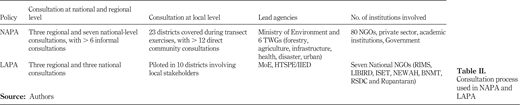
The review of the NAPA for the current research concurs that a wide range of stakeholders were involved in the process. A total of 80 institutions were directly engaged in the preparation process and input was sought from more than 300 institutions. Similarly, according to the majority of the policy-makers and practitioners, the process of developing the NAPA engaged a diverse group of stakeholders, including institutions such as government, donors, I/NGOs, academic and research institutions and the private sector (Table II).
Most policy-makers revealed that different approaches were adapted to engage multiple stakeholders in the NAPA preparation process. The process involved the formation of different sectoral thematic working groups (TWGs) led by government sectoral ministry and included representation from a wide range of stakeholders and, in some cases, community members. For example, the working group on Agriculture and Biodiversity included representatives from the community. The work of the TWGs was supported by a wider reference group. Consultation on the document involved the public, grassroots organizations and policy-makers.
Similarly, a diverse range of stakeholders was involved in the policy-making process in the case of LAPA. The LAPA document states that the LAPA framework is the outcome of input from various stakeholders, including the government and non-government sectors. It also refers to adapting a participatory policy-making process for the LAPA design process (Ministry of Environment, 2011b). A review of the LAPA framework shows, under the background section (Ministry of Environment, 2011b, p. 1), that it was developed based on the experiences of pilot activities carried out by the Ministry of Environment with support from the Department for International Development (DFID) and with the engagement of selected NGOs at the local government and national levels.
The document further reveals that piloting the LAPA mobilized local government structures, such as VDCs and District Development Committees (DDCs) in testing tools, approaches, processes and technologies related to climate change adaptation. LAPA also used the decentralized development framework of the government to develop adaptation plans and integrate climate change adaptation within the development planning process. For example, Rupantaran Nepal, one of the partners in piloting the LAPA, supported communities and local stakeholders to develop adaptation plans and later integrate climate change adaptation within the local planning process. According to majority of the policy-makers, this process of engaging local stakeholders in the design of a framework is unique in this case of policy design in Nepal, as it ensured local and national ownership of the LAPA framework.
Regmi and Subedi (2011) argue that the LAPA framework gives priority to vulnerable communities to take the lead in local adaptation. It is regarded as an innovative approach to decentralizing adaptation. There is evidence to show that a large number of community-based organizations and vulnerable households were involved in the LAPA framework development process (Rupantaran, 2012). The LAPA framework document indicates that wide consultation was undertaken in its development. An intensive piloting exercise was carried out in different parts of Nepal, engaging local government, NGOs and communities. Table II above, derived from the LAPA document, shows that besides piloting, the government organized three regional- and three national-level consultations to seek input into the framework.
From the above analysis of the process and actors involved in producing the LAPA, it can be argued that inclusive participation was considered important for enhancing national ownership of the policy document. The majority of policy preparation in Nepal takes place behind “closed doors”, and policy-makers often ignore the significance of engaging citizens in the process. However, in the cases of the NAPA and LAPA, more than 92 per cent of policy-makers and 89 per cent of practitioner respondents said that policies that are prepared by engaging a wide range of stakeholders and where sufficient time is devoted to the consultation process increase the sense of ownership among national actors, compared to policies prepared behind closed doors.
The analysis in this section of the paper revealed that the policy-making process is important to both shape the policy direction on mainstreaming as well as to ensure national ownership. From the findings, it can be concluded that the inclusive policy-making process empowers citizens and, thus, contributes to effectively mainstreaming CBA in development. There is a large body of knowledge outlining the significance of participatory policy-making and participatory spaces in policy design. According to Hoppe (1999), a participatory approach to policy-making is strategic and significant because of its vital contribution to implementing participatory democracy and community-driven development. Brockhaus and Kambiré (2009) argue that if participation is not guaranteed, then reform processes will be isolated and far from local needs and realities.
4. Discussion
The aim of this paper was to fill the knowledge gap in CBA mainstreaming by investigating the policy context of implementing climate change adaptation in Nepal. The findings of this research show that in Nepal, policies and plans prepared by involving multiple institutions, and particularly local communities and stakeholders, address mainstreaming of a climate change adaptation agenda more specifically than policies designed centrally and limited to a few agencies and individuals. Including different multi-stakeholder mechanisms creates new spaces and invites meaningful stakeholder participation in the policy-making process. This newly created space, according to Cornwall (2004), is important for redefining the relationship and responsibilities between the citizens and state and will lead to more effective and efficient policy.
In terms of policy content, the findings in this paper show that most of the major development policies/plans and climate change policies that were analyzed emphasize the need to integrate and mainstream climate change and development. Similarly, past development policies (forestry, agriculture), because of decentralization and the community-focused elements within them, had the potential to mainstream CBA in development. The experience of community-based approaches to environment and natural resource management in Nepal indicates that involving the local level has proven to be far more effective than centralized, top-down control in terms of linking environment, development and poverty issues (Khadka et al., 2012).
However, the findings of the research presented here illustrate that there are key challenges for implementing decentralization policies in Nepal. Experience shows that even where participatory and decentralized processes are used, such as with Nepal’s forest policies, the NAPA and LAPA, exclusion of vulnerable, marginalized local communities and citizens remains an issue. Without the involvement of decentralized institutions, local development planning and the use of participatory approaches, policy implementation is not likely to be successful (Adhikari and Taylor, 2012; Kok et al., 2008). This is true in the case of climate change adaptation where most of the action is focused more on households and communities. Finan and Nelson (2009) also argue that promoting active, participatory adaptation may require significant changes in tradition and shifts in power relationships. This implies that we need to reform current institutional structures to make structures more responsive to the needs of vulnerable households. Locally accountable structures empower local households and communities and, thus, increase their ownership of national policies and programmes.
The findings contribute to the body of knowledge in CBA and support the argument that a participatory process and decentralization provisions alone are not sufficient for mainstreaming, as they cannot guarantee the inclusion of households and communities in the process. For participation to be transformational, it must be seen as a form of citizenship in which political processes are institutionalized and people can hold others to account (Mohan, 2007). Cornwall and Gaventa (2000) further argue that “the people” or “the poor” are neither passive beneficiaries nor consumers empowered to make choices, but are agents: the “makers and shapers” of their own development. The local government and political parties should closely work with local citizens in shaping local and national policies. Space for citizen engagement and change, as argued earlier, is an important aspect of participatory policy-making, as it leads to constructive citizen engagement.
The findings further entail that even decentralization does not guarantee the translation of policies into meaningful action. According to Mansuri and Rao (2012, p. 178), decentralization can create perverse outcomes for the poorest and most vulnerable groups when local structures are not accountable to communities. Most of the policy-makers interviewed in this research suggested the need to shift toward devolution. Devolution is a process of providing full authority and power at the local level to empower vulnerable households and local communities and institutions to take decisions and adapt practices that favor the inclusion of households and communities in the process (Litvack et al., 1998). According to the findings, inclusive decentralization and devolution are needed to create a policy environment that facilitates CBA mainstreaming.
In terms of the policy implications for Nepal, this paper argues that mainstreaming of CBA can be facilitated with policies that:
have clear provisions and content for linking climate change and development;
have decentralized and devolved policy provisions that grant more authority and decision-making power to the local institutions;
adopt more of a climate resilient development and vulnerability reduction perspective; and
ensure multi-stakeholder, inclusive and participatory approaches to both policy design and implementation.
An implication of this is that Nepal should formulate an overarching, integrated and locally accountable climate change and development policy that can successfully scale up and mainstream CBA in development. The current development and climate change policies should be harmonized and this can be achieved by revisiting or even formulating a new integrated climate change and development policy for Nepal. The findings of this paper will provide useful insights for other LDCs who are in the process of devising policies and legal instruments to mainstream CBA in development.
5. Conclusion
This paper analyzed the scope and potential to mainstream CBA into development by examining the climate change and development policies and plans of Nepal. From the findings, it can be argued that development and sectoral policies in Nepal need to be revisited in the context of CBA. Although some decentralized policies are relevant, the findings also suggest that policies that favor decentralization only are not enough to mainstream CBA in development. Decision-making is still controlled by the center and is influenced by very few institutions and individuals at the local level. The findings show that to effectively integrate CBA into development, there is a need to have an integrated and overarching policy that is based on inclusive devolution. Inclusive devolution is necessary because it builds local ownership of policy implementation, addresses power imbalances at the local level and ensures equitable benefit sharing at this level.
This paper also examined the policy-making process of development and climate change policies of Nepal. The analysis showed that policy-making processes that were centralized and limited to only a few agencies at the centre, as in the case of development and climate change policies, lacked national- and local-level ownership of the policies. In contrast, the policies that adapted wider consultation of stakeholders, as in the case of the LAPA and NAPA, had more ownership and recognition at the local and national levels. However, the active involvement of citizens in policy-making was lacking in all the analyzed policies in Nepal. The analysis therefore supports the argument that inclusive and citizen-centric policy-making processes are crucial to mainstreaming CBA into development.
In conclusion, this paper argues that an integrated and overarching climate change and development policy and framework is needed for Nepal to connect and align the international, national and local priorities and goals. This integrated policy framework, as argued in this paper, should be prepared through:
creating meaningful spaces for inclusive citizen participation; and
reflecting the spirit of decentralizing and devolving power and authority to local institutions.
The finding of this paper provide a useful lesson for Nepal and other LDCs who are in process of devising policy and legal instruments to mainstream CBA into development.
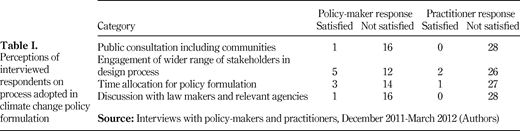
Perceptions of interviewed respondents on process adopted in climate change policy formulation
Perceptions of interviewed respondents on process adopted in climate change policy formulation
References
Further reading
About the authors
Bimal Raj Regmi is a Doctoral Student at Flinders University, Australia. He has more than 15 years of professional experience in climate change and natural resource management and an in-depth knowledge of international and national policies and programmes related to climate change mitigation and adaptation. Bimal Raj Regmi is the corresponding author and can be contacted at: regm0003@flinders.edu.au
Cassandra Star teaches in the Graduate Program in Public Administration in the Department of Politics and Public Policy at Flinders University, Australia. Dr Star has been engaged in research and study of global environmental issues for the past two decades. Her interests span government, business and community engagement with these issues from both cooperative and conflictual perspectives.
The authors wish to thank Prof Susanne Schech and Emily Collins for providing valuable input to strengthen the paper. The article could not have been developed without the support of the respondents, particularly the policy-makers, practitioners and communities interviewed in Nepal.

