


Stakeholder consultation and participation are central to the climate change policymaking process. The purpose of this paper is to assess the level of stakeholder participation in the Ghana National Climate Change Policy. It examines the actors in the policy space and the negotiations and tradeoffs made during the policymaking process. Finally, it outlines the steps undertaken to make the process participatory and consultative.
A qualitative method has been used for this paper. The research design involves a review of relevant literature on Ghana’s climate change regime, meeting reports and key informant interviews.
The findings indicate that the processes the policy underwent had extensive stakeholder participation. An uptake of evidence was from existing impact and vulnerability assessments, the first and second communication to the United Nations Framework Convention on Climate Change (UNFCCC), scientific and research documents and expert knowledge. Key actors were identified and involved right from the beginning of the policymaking process. Although stakeholder participation was time-consuming, expensive and elongated, the policy process was vital for buy-in and ownership. The results also identified the need to include more stakeholders at the sub-regional levels in policymaking.
The study is the first of its kind detailing stakeholder participation in the climate change policy process in Ghana. It forms a good basis for comparative studies with similar policies in other countries. Thus, this paper fills an identified gap of the need to document climate change policymaking processes.
1. Introduction
The International Panel on Climate Change (IPCC) estimates that the African continent will experience an increase in mean surface air temperature of 3-4°C for the period 2080-2099 compared with the 1980-1999 period under a mid-range emission scenario. (Christensen et al., 2007; Simonis, 2011). There are uncertainties that influence climate change projections and their consequences. Dessai and Hulme (2004) identify three types of uncertainties applicable within the context of climate change:
epistemic (related to the incomplete knowledge of climate-related variables and processes);
natural stochastic (related to the chaotic nature of the climate system); and
human reflexive (related to the part human behaviour plays in the climate change problem).
However, what is certain is that the rate of human-induced climate change is projected to increase, with serious consequences on natural habitats and on the people who depend on these habitats for sustenance and livelihoods (Christensen et al., 2007). Sub-Saharan Africa is considered to be the most vulnerable region to future and current climate variability (Wossen et al., 2014).
According to Schipper (2006), the original intention of the United Nations Framework Convention on Climate Change process was to reduce the source of climate change rather than adapting to the changes. However, there is an increasing shift from impacts/mitigation to vulnerability/adaptation, especially among the Non-Annex 1 countries, and this is often reflected in climate change policies. Indeed, a challenge in developing a suitable climate change policy is developing one that is “a socially and economically justifiable mix of mitigation, adaptation and development” (Klein et al., 2005). Deciding which direction to go requires stakeholder participation and consensus.
Policymakers, researchers and stakeholders continue to search for ways to address the myriads of climate concerns (Berrang-Ford et al., 2011). Climate change decision-making is complicated by the scientific uncertainties, the long time frames for impacts to occur and the global natural of the problem (Tompkins and Adger, 2005). Apart from its crosscutting nature, the uncertainties pose serious challenges in developing climate change policy (Dessai et al., 2004; Simms and Reid, 2005; Tol, 2003). There are also other issues such as lack of capacity, lack of funding, lack of communication and effective coordination of existing climate-related initiatives and increasing social stresses such as poverty and health-care issues, which have affected the mainstreaming of climate change into development activities (Magrath, 2006; Michaelowa and Michaelowa, 2007; Schneider, 2002; Roux et al., 2006; Waldman, 2005; World Bank, 2008). To deal with these issues, the current policy systems are shifting towards recognising the contributions of a broader range of expertise by involving key stakeholders (Griffin, 1999).
One way to tackle the diverse and sometimes even conflicting interests is to set up dialogue processes that enable all interested parties to participate, including government, private sector and civil-society representatives (Ellis et al., 2013). Stakeholder participation helps to reduce conflict and encourage consensus formation in the policy system (Connick and Innes, 2001). It also helps to identify policy gaps and the key actors and plays an important role in improving accountability (Jones et al., 2008). Stakeholder participation typically involves the use of participatory processes to incorporate diverse opinions and to ground decisions in relevant, feasible and implementable advice (Jones et al., 2008; Culyer and Lomas, 2006). In climate change policymaking, stakeholder participation ensures that climate information is available to relevant users, and that local needs are integrated into climate policies. As reiterated by Westerhoff and Juhola (2010), because most climate adaptation research and policy formulation often occur on national scales, local governments often depend on national governments for financial resources, as well as for information on changes in climate and relevant policy.
Ghana is located in one of the world’s most complex climatic regions, affected by tropical storms, and the influence of the Atlantic Ocean and the Sahel. The direct manifestations of climate change in Ghana include increased temperatures and rainfall variability, including unpredictable and extreme events, sea-level rise and loss of carbon sinks [Ministry of Science, Technology and Innovation (MESTI), 2013]. Various models and projections have shown conclusions that vary, which create uncertainty about the future scale and impact of climate change [Ministry of Science, Technology and Innovation (MESTI), 2013]. What is consistent however are the clear signs of climate change that confirm Ghana’s vulnerability (Government of Ghana, 2011; Ardey-Codjoe and Owusu, 2011). The climate scenarios for the country show clear signals of warming: an increase of 1°C has been observed over the past 40 years (1960-2000). Projected estimates are 0.6, 2 and 3.9°C by 2020, 2050 and 2080, respectively (Government of Ghana, 2011). However precipitation may increase or decrease. In addition, Ghana contributes an estimated 24Mt carbon dioxide to the global greenhouse emissions, which is relatively small compared to the global average and emissions from other large developing countries. Yet, the country has the potential to grow over the coming years under business as usual development pathways (Government of Ghana, 2011).
The current impacts and responses to climate shocks vary across diverse socio-economic groups, geographic locations and seasons of the year. This is a dynamic situation, with some people moving up and down the poverty “ladder” as their circumstances change. It is the poorest and most vulnerable group that bears the brunt of climate change, especially because of their high dependence on the natural environment (Government of Ghana, 2012; Lawson et al., 2012; Lawson and Bentil, 2014). In view of the implications and the potential impacts of climate change especially for the poor and the vulnerable, the development of a climate change policy has been described as a moral issue and not only a developmental one.
Although Ghana has produced many policy documents, the policy processes are often not well documented. This paper focuses on the policy processes of the Ghana National Climate Change Policy (NCCP), which was approved by the Cabinet in 2013 and was officially launched in 2014. Having established how vital stakeholder participation is to the policy process, its main aim is to examine the key actors in the policy space as well as the negotiations and tradeoffs made during the policymaking process. It highlights processes followed to ensure that the climate change policy for Ghana is participatory and comprehensive. The results provide valuable lessons for other countries, especially those countries developing or about to develop their climate change policies.
2. Methodological approach
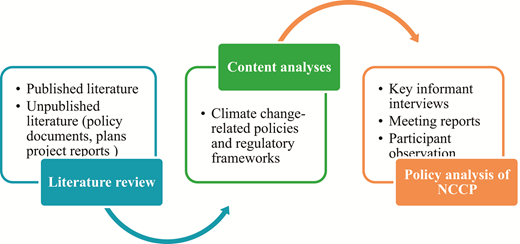
The paper uses a qualitative case study approach (Ragin and Becker, 1992). Due to the nature of the study, a multi-pronged method involving three main steps was adopted. The first step was a preliminary desk study based on the analysis of existing literature on the policymaking at various levels. Information was collected from published journal articles, reports, internet sites and other academic and scientific literature. The second step was content analyses of relevant national strategies and some policy evaluations. This activity drew on a diversity of resources, including:
existing climate change-related policies and regulatory frameworks from various sectors; and
reports by relevant ministries, departments and agencies (MDAs).
This method allowed a systematic examination of policies and regulatory frameworks by identifying sections of text that were related to aspects of climate change.
The third and final step was a policy analysis, which focused on the policymaking processes of the NCCP at various levels, on policy style and detail (Dovers, 2005), identifying challenges and best practices. Most of the information was obtained from unpublished meeting reports from the various stakeholder meetings facilitated by a team of researchers at the Institute for Environment and Sanitation Studies, University of Ghana, and participant observation. Key informant interviews were conducted with 15 climate change and environmental policy actors at various scales including policymakers, scientists and researchers and representatives of some non-governmental organisations (Figure 1).
3. Identifying the need for a national policy on climate change
Ghana ratified the United Nations Framework Convention on Climate Change (UNFCCC) on the 5 September 1995 and subsequently the Convention entered into force in Ghana on 6 December 1995. At its 25th sitting (26 November, 2002), the Parliament of the Republic of Ghana passed a resolution to ratify the Kyoto Protocol. The final document of ratification was deposited at the United Nations Headquarters in New York in March 2003, thus allowing Ghana to accede to the Kyoto Protocol and hence becoming a party to it (Government of Ghana, 2011). Since then, the Government of Ghana has played an active role in the international climate negotiations. In 2000, Ghana published the first National Communication, which was followed by the second National Communication in 2010. Ghana also developed a list of 55 Nationally Appropriate Mitigation Actions (NAMAs) in 2010 following its association with the Copenhagen Accord. Thirty-six of the 55 NAMAs were incorporated into Ghana’s current development plan, the Ghana Shared Growth Development Agenda (Government of Ghana, 2011). Currently, Ghana is preparing its third National Communication to the UNFCCC.
In 2009, the development of the National Climate Change Adaptation Strategy (NCCAS) began. The strategy has the broad aim of ensuring consistent, comprehensive and targeted approaches to increasing climate resilience and decrease vulnerability among Ghanaians (Government of Ghana, 2011). The NCCAS is driven by the following principles:
adaptation strategies must be looked at in the broader context;
stakeholder participation is fundamental;
key focus areas are poverty reduction and sustainable development;
long-term impacts must be the focus when considering adaptation measures; and
gender sensitivity and reducing vulnerability must be a central consideration.
The threats and opportunities climate change present to the country are discussed in Ghana’s Medium Term Plan, the Ghana Shared Growth Development Agenda (GSGDA) 2010-2013 (Government of Ghana, 2010a, 2010b). The GSGDA II (2014-2017) contains adaptation strategies under the accelerated agriculture transformation and sustainable natural resource management theme (Government of Ghana, 2014). The process for the preparation of the GSGDA II was generally participatory using Cross-Sectoral Planning Groups (Government of Ghana, 2014).
There have also been a number of sectoral instruments dealing with climate change issues. However, the greatest step the country took towards the development of a climate change policy was the development of the discussion document, “Ghana Goes for Green Growth” in 2010. The document which was prepared with support from the Climate and Development Knowledge Network, was developed to provide the much-needed strategic direction, as well as to coordinate the national framework to address issues of climate change.
4. Taking steps towards a climate change policy
Various models have been developed to describe the policy processes. Two of such models are the linear model and the structural model (Boateng, 2006). According to Boateng (2006), the underlying assumptions of the linear model are:
policymakers approach issues rationally;
each logical stage of the process is followed;
all relevant information is carefully considered before decisions are made;
unsuccessful policy is caused by lack of political will, poor management or shortage of resources; and
assumption of a straight timeline suggests implementation as achievement of policy objectives and hence the end of the process.
The limitation of the linear model is that the policy process is a complex system of overlaps, interactions, interdependences and discontinuities over time (Dudley, 1984; Keeley and Scoones, 1999). This implies that there might be time overlaps in the policy process. Hence, the assumption of a straight timeline may not be wholly true. On the other hand, the structural model sees the policy process as a sequence of stages in the development and pursuit of goals, beginning with thought, moving through action and with solution (Boateng, 2006). The following assumptions are made with the structural model:
policy as exercise of authority to achieve collective purpose;
policy as the pursuit of goals;
policy process as a sequence of stages in development and pursuit of these goals;
stages as a circle not a line; and
circle implies natural progression from one stage to the next.
Both models begin with a problem to be addressed. The problem must be substantial and may be put into the public domain for debate and consensus building (Boateng, 2006). This will be followed by the choice of the how the problem is going to be solved. Then the selected choice is implemented. This would commonly be followed by an evaluation to assess the performance of the policy. The trialogue model found in Turton et al., (2007) illustrates the importance of developing a close working relationship between government, science and society actor clusters. It also shows that the interfaces between the different clusters require different type of communication strategies. According to Sutcliffe and Court (2005), different types of evidence are often needed for different parts of the policy process, with the policy process ideally involving different stages: agenda setting, formulation, implementation and evaluation.
Whilst it is certain that most of the drivers of climate change are anthropocentric (Speth, 2008), there has been a lot of discussion on the extent of certainty required by policymakers to make decisions and policies. Policymakers need to make decisions that will have far-reaching and often irreversible effects on both environment and society (Grubb, 2004; Huq et al., 2006). The next sections detail the NCCP policy process which began with a problem to be addressed.
4.1 The policy formulation process
Article 2 of the Kyoto Protocol to the UNFCCC mandates countries to implement and further elaborate policies and measures in accordance with their national circumstances. With evidence from existing models/scenarios, facts and data, the attention of policymakers in Ghana was drawn to the reality that immediate action was needed with regard to climate change. For example, parliamentarians and policymakers attending a national science-policy dialogue which was organised by the global change SysTem for Analysis, Research and Training (START) and the University of Ghana in 2009, made some recommendations on how to strengthen the science-policy interface in Ghana (Mensah et al., 2009). These included the need to:
identify linkages between researchers, policymakers and the end-users;
create platforms for regular dialogue between the research community, policymakers and end-users;
develop research themes that address policy concerns;
build the climate change capacity of all stakeholders, especially among policymakers and researchers; and
create a permanent lobby group in the parliament for science and climate change issues.
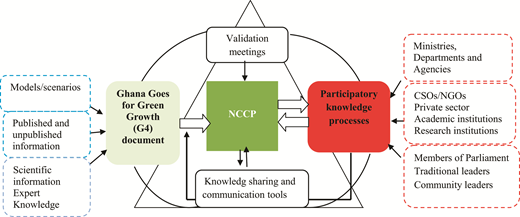
In 2010, the Ghana Goes for Green Growth (G4) discussion document was developed through an extensive review of evidence from policy documents, research and project reports and a series of stakeholder consultations and workshops. The workshops were organised by the Ministry for Environment Science, Technology and Innovation (MESTI) for high-level expert groups drawn from the National Climate Change Committee, academia, government, civil society, industry, private sector, the donor community and various organisations (Government of Ghana, 2010b). These participatory processes were aimed at involving key actors in the drafting of the G4 document. Months of meetings, research and discussions were used to develop the framework, background and content, as well as methodology, for the discussion document. The G4 discussion document had three objectives:
low carbon growth;
effective adaptation to climate change; and
social development.
Achieving these objectives depended on seven systemic pillars:
governance and coordination;
capacity building;
research and knowledge management;
finance;
international cooperation;
communication; and
monitoring and reporting
The G4 discussion document complemented and enhanced the strategic objective of the GSGDA I (2011-2013), which was to foster high and equitable levels of growth going towards middle-income status. The information in the document was well packaged which made it attractive and easy to understand and was praised nationally and internationally (Roux et al., 2006).
4.2 Negotiating stakeholder participation
Stakeholder participation not only ensures that the voices of various stakeholders whose interests may stand opposed to each other are heard, but it also builds consensus amongst all stakeholders, including the non-dominant ones (Jones et al., 2008; Boateng, 2006). It also helps to identify policy gaps and key actors, and improves accountability. The process of including key actors in the policy process involves extensive negotiations to ensure that a wider group of relevant stakeholders, not just the most influential and affluent, are included.
Negotiating stakeholder participation in the climate change process can be a daunting task. Its multi-sectoral nature and the growing number of actors make stakeholder consultations expensive and time-consuming. In addition, different stakeholders have different degrees of engagement in the climate change discourse and operate at different scales. As one key informant who works with a civil society organisation (CSO) mentioned that it was important to have the right mix of stakeholders in a room, “otherwise the dominant voices would dictate the direction of the discussions”.
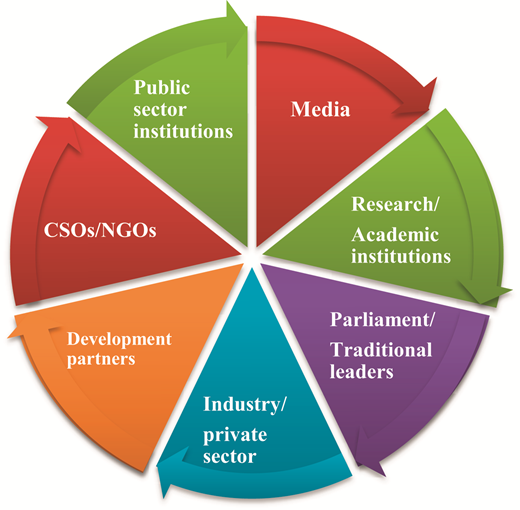
A strategy used by MESTI and the NCCP facilitation team was to have groups with similar interests meeting together. For example, separate consultations were held for stakeholders from academia, civil society, parliament, the private sector and traditional authorities, local government leaders and so on. A final validation meeting brought together a wider group of stakeholders to solicit further inputs and ensure that there was an uptake of the key issues into policy. Participatory tools used included workshops; peer review sessions; solicitation of recommendations; direct interviews and input into the document, presentations and websites.
During the latter part of 2010 and most part of 2011, in response to the need to develop a comprehensive climate change policy, the G4 document was subjected to extensive stakeholder consultations in both the northern and southern sectors of the country (Figure 2). The G4 document served as the framework for the draft policy document. Stakeholders consulted included the general public (through a national stakeholder’s workshop); non-governmental and civil society organisations; traditional authorities; and the metropolitan, municipal and district chief executives, community leaders, researchers, members of parliament, as well as high-level experts [Ministry of Science, Technology and Innovation (MESTI), 2013] (Table I). This was to ensure that the draft policy considered a wide spectrum of scientific and local knowledge (Godfrey et al., 2010; Roux et al., 2006). During the public consultations, a knowledge-sharing component was always included in the programme.
Groups targeted during the stakeholder consultations for the G4 discussion document
| No. | Groups consulted |
|---|---|
| 1. | The general public (through a national stakeholders workshop) |
| 2. | Non-governmental organisations (NGOs)/civil society organisations (CSOs) – southern sector coordinated by Friends of the Earth (FOE) |
| 3. | CSOs–northern sector, coordinated by CARE |
| 4. | Chiefs and Queen Mothers |
| 5. | Metropolitan, municipal and district chief executives (MMDCES)–southern sector |
| 6. | MMDCES northern sector |
| 7. | Media |
| 8. | Parliamentary select committees on environment, science and technology and lands and forestry |
| 9. | Research and academia |
Throughout the policymaking process, there were negotiations and tradeoffs. For example, during the stakeholder consultations there were comments on the mitigation focus of the draft policy document, which led to a re-ordering of the objectives (Box 1).
Some comments from the G4 stakeholder consultations
The document needs to explain why Ghana is described as a net emitter in the G4 document.
Include gender issues in the policy document.
Include linkages between the NCCPF and the NCCAS.
Include a discussion of the NAMAs developed for the country.
Include discussions on climate change financing.
Include a dissemination strategy.
Highlight the linkages between climate change and health
Explain green growth further to draw the linkage to all aspects of the pillars in dealing with the climate change
Link objectives to the vision of the country. The objectives should be as follows:
effective adaptation to climate change;
social development; and
low carbon growth;
Link climate change and waste management especially plastic waste management in Ghana.
Anticipate possible shifts and changes in the local and global policy negotiation world, outside the world of climate change.
Include alternative livelihoods in the policy development.
Source: NCCP facilitation team reports
The CSO/NGO communities also questioned the emphasis on low carbon growth arguing that the document needed to clearly mention that adaptation was the priority issue for Ghana. Among others, they recommended that:
Climate change information should be broken down for effective dissemination at the grassroots’ level.
Climate change research should be highlighted in the policy.
Human rights concerns should be included in the policy document, as some climate change projects such as REDD+ and biofuels sometimes lead to human rights’ abuses.
Environmental sustainability should be included as one of the supporting pillars.
Mitigation should be separated from low carbon growth.
As one key informant mentioned, prioritising mitigation instead of adaptation was “an externally driven climate change agenda”. In November 2011, a number of experts from some climate change-related sectors, researchers, scientists, some members of the National Climate Change Committee and policymakers were brought together to incorporate the relevant recommendations and comments from the various stakeholder consultations into the draft NCCP. They were also tasked to develop the terms of reference for the development of the policy document. At this meeting, five priority sectors for the NCCP were selected based on information from vulnerability, adaptation and mitigation assessment reports, the first and second National Communications submitted to the UNFCCC and the Ghana Shared Growth Development Agenda (GSGDA I), as well as expert knowledge. The priority sectors were:
energy (industry and transport);
agriculture and fisheries management;
land use, land use change and forestry (LULUCF);
waste; and
social development (livelihood, health, early warning systems, water, research and awareness, environment and sanitation).
The final draft of the NCCP addressed the four major areas of concern in relation to climate change and climate variability in Ghana:
increasing greenhouse gas emissions and loss of carbon sinks;
increased temperatures;
rainfall variability leading to extreme unpredictable events; and
sea-level rise.
The final policy objectives were:
adaptation;
social development; and
mitigation
The seven systemic pillars were:
governance and coordination;
capacity building;
science, technology and innovation;
finance;
international cooperation;
information, communication and education; and
monitoring and reporting.
The draft policy prioritised five main policy themes:
agriculture and food security;
disaster preparedness and response;
natural resource management;
equitable social development; and
energy, industrial and infrastructural development;
The NCCP has also identified ten policy focus areas for addressing Ghana’s climate change challenges and opportunities. Each of these focus areas has a number of specific programmes for addressing the critical policy actions necessary to achieve the desired objectives [Ministry of Science, Technology and Innovation (MESTI), 2013] (Table II).
The NCCP policy themes, focus areas and number of programmes
| Policy theme | Focus area | No. of programmes |
|---|---|---|
| Agriculture and food security | Climate-resilient agriculture and food security systems | Eight |
| Disaster preparedness and response | Build climate-resilient infrastructure | Seven |
| Increase resilience of vulnerable communities to climate-related risks | Six | |
| Natural resource management | Increase carbon sinks | Five |
| Improve management and resilience of terrestrial, aquatic and marine ecosystems | Four | |
| Equitable social development | Address impacts of climate change on human health | Six |
| Minimise impacts of climate change on access to water and sanitation | Nine | |
| Address gender issues in climate change | Four | |
| Address climate change and migration | Six | |
| Energy, industrial and infrastructural development | Minimize greenhouse gas emissions | Seven |
From September to October 2012, the draft NCCP was again subjected to rigorous validation, with validation meetings held all over the country for stakeholders from research and academia, MDAs, the private sector, CSOs/NGOs, development partners, high-level experts and parliamentarians and other key sectors for further comments before submission for Cabinet approval (Figure 2). This process ensured that the policymaking process was not dominated by any single group and helped to facilitate research uptake in the policy process (Peha, 2001; Jones et al., 2008; Weingart, 1999). Again comments were received on how to improve the policy document. Hence, at every stage of the policy document, a feedback mechanism ensured that stakeholders could influence the policy process (Box 2) (Figure 3).
Some comments from the NCCP validation workshops
How does the “green economy” feature in the policy?
Include the vulnerabilities of physically challenged and contribution of e-waste to emissions.
Include specifics (causes and impacts) of climate change in local context for Ghana.
Amend: “Ghana has also just changed its status from a net carbon sink to a carbon source”.
Represent scientific data in boxes without much text.
Insert a box on water, food security and energy (with text on health impacts, etc.).
A paragraph in text to incorporate specific government response to climate change
Include sentence on status of climate change (CC) finance in Ghana.
Link policy to international demand and processes and contribution to addressing climate change in line with international community process.
Include human induced impacts in the overview.
Include vulnerabilities of physically challenged, contribution of e-waste to emissions.
Source: NCCP facilitation team reports
The advantages of the stakeholder engagements were that because the stakeholders came from various sectors and networks at various levels, most of them had access to information and data that were not always readily available to the facilitation team. For example, traditional authorities and local community leaders were important sources of local knowledge.
The policy recommends that a Multi Donor Budget Support should be used as a mechanism to mainstream the policy into the sectoral programmes and actions for implementation by the various MDAs [Ministry of Science, Technology and Innovation (MESTI), 2013]. Private-sector investments are also important when considering improving investment and financial flows to address climate change, as they constitute a significant share of investment and financial flows (UNFCCC, 2007). Accordingly, the NCCP makes provision for the necessary actions on adaptation and social equity that are needed for:
[…] national development to support Ghana in harnessing the opportunities from low carbon growth, and to integrate climate change into the main planning processes at national, regional, district as well as sector Ministries, Departments and Agencies operational levels. It promotes the understanding of climate change issues among policymakers and implementers across all sectors.
This helps to integrate the climate change agenda into policies and interventions at all levels and across the high-risk sectors [Ministry of Science, Technology and Innovation (MESTI), 2013]. It projects the delivery of Ghana’s vision of a climate resilient and climate compatible economy – an economy that takes advantage of the opportunities presented by addressing climate change and, simultaneously, reduces the impact of climate change on the people of Ghana [Ministry of Science, Technology and Innovation (MESTI), 2013].
4.3 Meeting international standards
One challenge in developing a suitable climate change policy is producing one that is “a socially and economically justifiable mix of mitigation, adaptation and development” (Klein et al., 2005). Ghana has a wholistic response to climate change. The NCCP covers adaptation, social development and mitigation. According to Kaijage (2012), climate change policies should, among others:
[…] show how financing can be done, source of fund, directives for use, monitoring and evaluation. It should integrate climate change adaptation measures in other long term planning for example through other development policies, address specific sectors sensitive to climate change such as water resources, forest sector, ecosystems, agriculture and health.
The draft policy was developed in comparison with other relevant sectoral policies, as well as with the climate change policies from other countries. The NCCP acknowledges that to deliver on its processes, plans, strategies and approaches Ghana:
[…] must fulfil to the fullest extent possible, all its commitments under the United Nations Framework Convention on Climate Change, which would include participating in negotiations on various aspects of the Convention, its protocols, and articles, which address national issues relating to climate change and development [Ministry of Science, Technology and Innovation (MESTI), 2013].
The policy states that Ghana will collaborate with other regional and international bodies with supporting agendas in climate change and sustainable development, as well as endeavour to ensure that all stakeholders and all sectors are adequately informed on climate change and its implications. This way, stakeholder involvement and participation will be “appropriately coordinated to ensure efficient use of resources and create positive synergies” [Ministry of Science, Technology and Innovation (MESTI), 2013]. Specific actions and tasks, as well as estimated timelines and budgets, have been identified for each policy objective as part of the process in NCCP Phase II. It details the mainstreaming process, sector budgeting and monitoring and evaluation and outlines financing mechanisms and strategies for the effective implementation. Phase II further elaborates the mainstreaming of the strategies into thematic programmes and actions for national policy planning and budgeting. These include, among others:
identifying the targets of the mainstreaming process;
evaluating the impacts of climate change on socio-economic, sectoral and local development strategies and plans;
evaluating the awareness and capacity for mainstreaming in the context of the theme;
evaluating possible impacts (both negative and positive) of the mainstreaming process; and
developing strategies and mechanisms for mainstreaming in thematic areas, including financial, economic and policy aspects.
There is also a Phase III of the NCCP, which constitutes the final component of the process, and will be prepared by MDAs identified as leads for specific actions. The lead MDA will develop detailed time-bound and costed implementation plans that would be linked to their operating strategies and work plans [Ministry of Science, Technology and Innovation (MESTI), 2013]. Furthermore, the NCCP recommends the creation of an inter-ministerial oversight committee which could create linkages with the implementing entities with the Ministry of Environment, Science, Technology and Innovation as the coordinating ministry. Some have suggested that the creation of a national climate change commission to serve as an intermediary institution that would also give legal backing to the various climate change programmes (Cash et al., 2003).
Finally the facilitating team remained neutral serving only as facilitators of the process and ensuring that all stakeholders and actors had a voice (Lackey, 2006). The draft policy was reviewed by external reviewers of international repute before being finalised and submitted to Cabinet.
5. Conclusions: evidence, learning and policy choices
Stakeholder participation involves extensive negotiations to include the right actors in the policymaking process. This case study which has looked at the policy process of the Ghana NCCP raises a number of key issues about evidence-based policymaking and the level of stakeholder consultation needed for a climate change policy. The paper has presented the actors, negotiations and trade-offs involved in the NCCP process. Uptake of evidence was from existing impact and vulnerability assessments, the first and second communications, expert knowledge and other scientific and research documents (Keely and Scoones, 1999). Local knowledge was from local and traditional leaders as well as from other stakeholders with in-depth local knowledge. To avoid developing a policy document that is perceived as being largely donor-driven or government-owned, key actors were identified and involved at the very beginning of the policymaking process.
The analyses have shown that although stakeholder participation can be time-consuming, expensive and might even elongate the policy process, it is vital for buy-in and ownership. Early engagement helped to improve the process and the outcome of the NCCP. The presence of feedback loops meant that stakeholders and key actors were able to influence the policy process at every stage. The facilitation team was also able to make critical adjustments during the process.
Whilst global climate models are important for bringing attention to the climate change issue, local responses require local actor engagement and locally specific data (Westerhoff and Juhola, 2010). Downscaling from national scenarios to address local situations is often complex and can generate challenges for local policy interventions (Hahn et al., 2009). Delivering complex change along with much uncertainty and in a more hostile climate puts a premium on “quality knowledge for integrated and timely decision-making” (ADF, 2010). Because the effects of climate change are experienced locally in communities, a lot more effort is needed to include various social groups at local levels in policymaking. It is important that a dissemination plan be put in place for the NCCP. Awareness-raising programmes are important in framing the climate agenda and in influencing public and political perceptions of climate change. Appropriate communication tools include radio and television programmes, road shows, dissemination workshops, durbars and literature in forms that are easily understood. Beyond access to information, an awareness of the climate change issue forms an important prerequisite for climate information to be incorporated into decision-making (Westerhoff and Juhola, 2010). This also means that researchers have the responsibility of improving the availability and dissemination of their research.
The study of the NCCP process has highlighted the need for capacity building among the various stakeholders (Jones et al., 2008; Scott, 2006). For example, there is the need to build capacity and strengthen the UNFCCC National Focal Point for Ghana, strengthen human resources and skills in meteorology for climate change monitoring and strengthen skills of policymakers at all levels to mainstream climate change in other key sectors. Whilst the NCCP for Ghana is integrated into the national developmental agenda, implementation will depend on policymakers at the national, regional and local levels.
The development of climate change policies in many developing countries is often limited by the technical or institutional capacity of the responsible government bodies (Ellis et al., 2013). One way to overcome this is to encourage or facilitate solutions led by civil society (Ellis et al., 2013). Finally, adequate scientific or technical expertise to interpret the information and to incorporate the information into decision-making processes is lacking, especially at the sub-regional levels. Collaboration between sub-national and national governments, as well as with researchers for the implementation of climate change strategies, can be facilitated through appropriate platforms to identify, dialogue and negotiate climate-related issues (Adu-Boateng, 2015).
The author would like to thank the Ministry of Environment, Science, Technology and Innovation, as well as the Ghana NCCP facilitation team. The team was led by Prof Chris Gordon who is the current Director of the Institute for Environment and Sanitation Studies, College of Basic and Applied Sciences, University of Ghana, Legon.

