


The purpose of this paper is to measure Chinese industries’ eco-efficiency during 2006-2013. The Chinese industry attained rapid achievement in recent decades, but meanwhile, overconsumption of energy and environmental pollution have become serious problems. To solve these problems, many research studies used the data envelopment analysis (DEA) to measure the Chinese industry’s eco-efficiency. However, because the target set by these works is usually the furthest one for a province to be efficient, it may hardly be accepted by any province.
This paper builds a new “closest target method” based on an additive DEA model considering the undesirable outputs. This method is a mixed-integer programming problem which can measure the ecological efficiency of provinces and more importantly guide the province to perform efficiently with minimum effort.
The results show that the eco-efficiency of Chinese provinces increased at the average level, but the deviations remained at a larger value. Compared to the “furthest” target methods, the targets by the approach proposed by this study are more acceptable for a province to improve its performance on both economy and environment counts.
This study is the first attempt to introduce the closest targets concept to measure the eco-efficiency and set the target for each provincial industry in China.
1. Introduction
Since China began the “Reform and Opening” policy in 1978, China’s economy has experienced significant development. China’s gross domestic product (GDP) grew from RMB 365.02bn in 1978 to more than RMB 63tn in 2014. Since 2010, it has maintained the title of being the second largest economy in the world, following the USA (Zhang and Da, 2015). Meanwhile, its industrial GDP increased from RMB 160.29bn in 1978 to RMB 22812.29bn in 2014. However, rapid industrialization and inefficient environmental supervision have resulted in many environmental issues, such as depletion of energy resource, degradation of environment and environmental pollution (Han et al., 2015; Zhe et al., 2016). In the past, owing to China’s weak environmental regulations, some developed countries transferred their pollution-intensive enterprises to China. In recent years, the Chinese Government has increasingly shown concerns in these environmental problems. Many environmental regulations have been published to promote clean production technologies and to reduce pollutions so as to create sustainable development of the economy and environment (Li and Lin, 2016).
However, because of missing professional evaluation of ecological efficiency (i.e. eco-efficiency) and scientific environmental targets for efficiency improvement, industries in China still show the tendency of high energy consumption and thus give rise to a high pollution industry. Therefore, it is urgent to measure the ecological efficiency and set the benchmark for industries. Ecological efficiency can comprehensively reflects the operational situation of an industry because it considers both economic factors and environmental factors in the efficiency evaluation system, which is also called environmental efficiency (Song et al., 2012; Fang et al., 2013). In this paper, data envelopment analysis (DEA) approach with the closest target approach have been applied to measure the eco-efficiency and set environmental targets for the industry’s performance improvement.
DEA, as a non-parametric programming technique, has become increasingly popular in evaluating the performance efficiency of a set of homogenous decision-making units (DMUs) (An et al., 2016; Li and Lin, 2016). So far, it has been widely applied in evaluating the eco-efficiency (Färe et al., 1989; Tone, 2004; Leleu, 2013; Zhou et al., 2012). Song et al. (2012) reviewed the DEA models for eco-efficiency when considering a system as a “black box”. In that review, eco-efficiency evaluation methods are classified into three categories according to their ways for addressing the undesirable outputs. In fact, several other methods should be added now. One is slacks-based measure (SBM) approach, which deals with undesirable outputs through its slacks (Tone, 2004). This method can simultaneously measure the inefficiencies in both inputs and outputs. It breaks through the traditional method of radial measure of efficiency improvement, but meanwhile, it is not suitable for the output-orientation case or input-orientation case where the main target is to produce the maximum outputs or consume the minimum inputs. Another one is weak disposability assumption which is based on Färe et al. (1989), and undesirable outputs are treated in their original forms under this assumption. Several works have been developed in this direction (Leleu, 2013; Zhou et al., 2012; Miao et al., 2016). Another group of approaches treats pollution as a free disposable input (Hailu and Veeman, 2001; An et al., 2017). Each method has its own strengths and weaknesses. All of these can be used to address the undesirable outputs as long as they reflect the meaningful economic trade-offs among undesirable outputs, desirable outputs and inputs, that is, one cannot reduce undesirable outputs for free (Liu et al., 2010). Whether one should assume a strong disposability or a weakly disposability in a DEA model will be much dependent on the nature of the applications that it handles.
However, the previous studies almost set the “furthest” target for a DMU to reach the ecological efficient while measuring the eco-efficiency (one exception is An et al., 2015), especially no work exists in a network system framework. Thus, the benchmark (target) may not be easily acceptable by the DMU. Recently, some developments focus on finding the “closest” target so that the DMU under evaluation can achieve efficiency with the “least” effort. The idea behind the closest targets is that the closer targets suggest directions of improvement for inputs and outputs of the inefficient units that may lead them to be efficient with less effort. There are two ways for finding the closest targets. One is minimizing the selected distance. Frei and Harker (1999) gave the closest targets by minimizing the Euclidean distance or weighted Euclidean distance to the efficient frontier; for more extensions in this direction, see Baek and Lee (2009), Amirteimoori and Kordrostami (2010), Aparicio and Pastor (2014a). Gonzalez and Alvarez (2001) gained the relative targets by minimizing the sum of input contractions required to reach the frontier of the technology. Portela et al. (2004) applied directional distance function approach to determine the targets for the DMUs. Jahanshahloo et al. (2012) conducted a DEA method to obtain the minimum distance of DMUs to the frontier by ||•||1. Briec and Lemaire (1999), and Briec and Leleu (2003) used Hölder distance functions to obtain the evaluated DMU’ minimum distance to the frontier. Ando et al. (2012) pointed out that the least distance measures based on Hölder’s norms meet neither weak nor strong monotonicity on the strongly efficient frontier and they provided a method to guarantee that the function is a weak monotonicity. To realize the strong monotonicity, Aparicio and Pastor (2014b) provided a solution for output-oriented models based on an extended production possibility set which is strongly monotonic; Fukuyama et al. (2014) used the least distance p-norm inefficiency measures that satisfy strong monotonicity over the strongly efficient frontier to obtain the targets for the DMUs. The other category is minimizing (or maximizing) the efficiency measure. Silva et al. (2003) maximized the BRWZ measure proposed by Brockett et al. (1997) to obtain the closest targets. Aparicio et al. (2007) and Aparicio and Pastor (2013) proposed several mathematical programming problems to find the closest targets where the efficiency measure (such as range-adjusted measured, Russell measure, SBM) was chosen as a criterion of similarity. These programming problems can be easily solved and it can guarantee the evaluated DMU to reach the closest projection point on the Pareto-efficient frontier.
To fully measure the inefficiency and set the closest target for a DMU to be efficient, in this paper, we propose a new closest target method for obtaining the eco-efficiency and the closest target of the evaluated DMU. In the following section, we will briefly introduce the previous closest target method and several traditional models. Then, in Section 3, our method, based a two-stage network structure system is proposed. In Section 4, the closest target method is applied to 30 Chinese provinces for eco-efficiency measurement and efficiency improvement. Section 5 concludes with a summary of the findings, and some suggestions for extensions.
2. Traditional additive model and the closest target
In this section, we first introduce SBM based on the additive DEA model, and then show Aparicio et al.’s (2007) approach which finds the closest targets. As two representative approaches in DEA for measuring efficiency and finding the closest targets, these two approaches have been largely studied and extended.
Considering that we have n DMUs, and each DMUj (j = 1,…, n) uses m inputs to produce s outputs which are denoted by (Xj, Yj), j = 1,…, n. It is assumed that Xj = (x1j,…, xmj) ≥ 0, Xj ≠ 0, j = 1,…, n, and Yj = (y1j,…, ysj) ≥ 0, Yj ≠ 0, j = 1,…, n. The additive DEA model under variable returns to scale is shown as follows:
where λj stands for unknown variable (often referred to as “structural” or “intensity” variables) for connecting the input and output vectors by a convex combination. Denote be an optimal solution of the additive DEA Model (1). When the optimal value for DMU0 is equal to zero, then the DMU0 is efficient; otherwise, DMU0 is inefficient. It should be noted that this model is different from the SBM model whose objective function is: (Tone, 2001).
Definition 1. The production possibility set is:
By Definition 1, we can character the efficient frontier of the PPS, ∂(T), which consists of the non-dominated points of T, as:
or:
in a multiplier form with input and output weights (Ruiz et al., 2014).
Denote the set of efficient points in the PPS by E. The following theorem from Aparicio et al. (2007) provides a useful characterization of ∂(T), which will be used in the formulation of our cost-minimizing target setting model:
Theorem 1:
where M is a big positive quantity.
Proof. The proof is similar with Aparicio et al. (2007). We omit it here.
Theorem 1 shows that the points on a Pareto-efficient face of the technology, which dominate the evaluated unit (Xo, Yo), can be expressed as a combination of extreme efficient units lying on the same efficient face of the production possibility set. More importantly, the set of infeasible points in which the minimum distance to the Pareto-efficient frontier is attained can be represented by a set of linear constraints. Then, by applying Aparicio et al.’s (2007) mADD model on the additive measure, we can find the closest target for inefficient DMUo.
3. New closest target method for a system with undesirable outputs
Assume that n DMUs will be evaluated. Each of them uses inputs to produce desirable outputs while generating undesirable outputs. The notations are given as follows. xij is the ith input of the production system j, yrj is the rth desirable output and zpj is the pth undesirable output of the production system j. Taking an industry system as an example, labors, capital stocks and the energy consumption are used to produce the GDP while producing industrial wastes. Then, we give the definition of production possibility set about the above structure system.
Definition 2. The production possibility set for the production system is defined as follows:
where λj stands for unknown variables (often referred to as “structural” or “intensity” variables) for connecting the input and output vectors by a convex combination. ensures the production possibility set is under the variable returns to scale.
In Definition 2, undesirable outputs are treated as inputs, which is similar to the way of Liu and Sharp (1999). The efficient DMUs always wish to minimize desirable inputs and undesirable outputs, and to maximize desirable outputs and undesirable inputs. As Liu et al. (2010) pointed out, if one only wishes to investigate operational efficiency from this point of view, there is no need to distinguish between inputs and outputs, but only minimum and maximum.
According to the closest target method, the following additive DEA model considering the undesirable outputs is first used to find the efficient DMUs:
where , and are the slacks of the ith input, the rth desirable output and the pth undesirable output of DMU0, respectively. Assume is an optimal solution of the additive Model (4). Then, similar to the work of Chen et al. (2012), based on the results of the additive Model (4), we use the SBM as the classical eco-efficiency for DMU0, which can then be computed through Model (5).
When the optimal value of Model (4) is equal to zero, DMU0 is classical ecological efficient, otherwise, it is classical ecological inefficient. It is clear that classical ecological efficiency of a DMU calculated from Models (4) and (5) is based on the furthest targets (maximum input and output slacks) for the DMU to be efficient.
Denote the set of all classical ecological efficient points in the PPS Teco by Set H. By Definition 2, we can similarly character the efficient frontier of the PPS, ∂(Teco), which consists of the non-dominated points, as:
or:
in multiplier form with input and output weights.
Different from Model (4), based on the set H, we built the following closest target model to measuring the eco-efficiency of each DMU and meanwhile find the closet target for it to be efficient:
, and are the slacks of the ith input, the rth desirable output and the pth undesirable output of DMU0, respectively. M is a big enough positive quantity. Constraints (8.1)-(8.4) are used to calculate the slacks to the linear combination of extreme efficient units and dominate DMU0. Constraint (8.5) are constraints corresponding to the multiplier formulation of the additive DEA model but only considering the restrictions for the efficient DMUs in set H, which ensure that we consider all the hyperplanes such that all the possible points in Teco lie on or below these hyperplanes. Constraints (8.6)-(8.8) are the key conditions that determine which DMU is actively a peer for the evaluation of DMU0. If λj > 0, then bj = 0 and dj = 0. Thus, if DMUj participates actively as a peer, then it necessarily belongs to the hyperplane . If λj = 0, then dj ≥ 0, which indicates DMUj, is not a peer for evaluating DMU0.
Considering the constraints of Model (4) and Model (8), the following theorem can be easily derived. We state without proof Theorem 2.
Theorem 2. The optimal value of Model (8) must not be larger than that of Model (4).
Denote be an optimal solution of the closest target Model (8). Then, the closest target for DMU0 is:
for i = 1,…, m and r = 1,…, s, where and are optimal solutions to mixed-integer linear programming [Model (8)]. The eco-efficiency for DMU0 based on the closest target can be obtained by computing the following formula:
It should be noted that DMU0 is ecological efficient if and only if all slacks , , in Model (8) are zero, that is, ρeco = 1.
Theorem 3. If a DMU is classical ecological efficient, the DMU must be an ecological efficient.
Proof. According to the definition of classical ecological efficient, an optimal slacks (, , ) in Model (4) for a classical ecological efficient DMU must be zero. From the constraints of Model (4) and Model (8), we can find slacks (, , ) for the classical ecological efficient DMU in Model (4) which maximize the slacks and must be a feasible solution of Model (8) which aims to minimize the slacks. As the constraints of , and , the optimal slacks in Model (8) must be equal to zero too. Thus, the DMU must be ecological efficient.
4. Application to the Chinese provincial industry
In this section, the eco-efficiency of industrial production systems with the closest targets of 30 provinces or municipalities in China are investigated, excluding Tibet because many data are missing there.
4.1 Data and variables’ selection
Based on the existing literature (Bian and Yang, 2010; Shi et al., 2010; Goto et al., 2014; Wu et al., 2015), the following input and output variables are selected. Inputs in the industrial system are labors, capital stocks and energy consumption. “Labors (LAB)” refers to the average number of employees per year as per statistics. As there are no capital stocks (CS) statistics about industry in China, changes in fixed capital investment can closely convey changes in capital stock assuming a constant depreciation rate as Shi et al. (2010) suggested. The amount of fixed capital investment is used to represent the amount of capital stocks, which is commonly used by some authors (Ng and Chang, 2003; Shi et al., 2010; Bian and Yang, 2010; Wu et al., 2015). “Energy consumption (EC)” refers to the amount of standard coals consumed by the province or municipality (Bian and Yang, 2010). According to Chinese reports, energy consumptions in an industry accounts for about 70 per cent of the total energy consumptions (www.china-esi.com/pat/60893.html). “Industrial GDP (IGDP)” is commonly selected as a desirable output for efficiency measurement of industry (Wu et al., 2013). “Industrial solid wastes (ISW)”, “industrial waste water (IWW)” and “industrial waste gas (IWG)” are selected as the undesired outputs (Wu et al., 2015). “Industrial solid wastes” refer to the total amount of solid wastes that were produced including hazardous waste, smelting slag, fly ash, slag, coal gangue, tailings, radioactive waste and other waste; “industrial waste water” refer to the total volume of waste water discharged in industry; “industrial waste gases” refer to the total amount of industrial waste gas emission which include sulphur dioxide, nitrogen oxides, smoke and dust and others. All data were collected from the China Statistical Yearbook, China Environment Yearbook covering the years of 2007-2014[1]. The units of LAB, CS, ISW, IWW, IWG and IGDP are 1,000 persons, RMB 1bn, 10,000 tons of standard coals, 10,000 tons, 10,000 tons, 10,000 tons, RMB 1bn. The descriptive statistics and the test of the variables are shown in Table I.
Descriptive statistics and test of inputs and outputs during 2006-2013
| Mean | SD | 1 | 2 | 3 | 4 | 5 | 6 | 7 | |
|---|---|---|---|---|---|---|---|---|---|
| 1.LAB | 2099.8 | 1740.1 | 1 | ||||||
| 2.CS | 3637.25 | 3266.36 | 0.70** | 1 | |||||
| 3.EC | 8712.01 | 27229.3 | 0.77** | 0.82** | 1 | ||||
| 4.ISW | 8085.97 | 7422.51 | 0.22** | 0.55** | 0.64** | 1 | |||
| 5.IWW | 77589.4 | 65955.6 | 0.77** | 0.63** | 0.70** | 0.20** | 1 | ||
| 6.IWG | 16905.1 | 13247.1 | 0.54** | 0.77** | 0.85** | 0.83** | 0.53** | 1 | |
| 7.IGD | 6144.7 | 5631.88 | 0.9** | 0.85** | 0.88** | 0.36** | 0.77** | 0.69** | 1 |
Notes:
**Shows significance at the 0.05 level;
**shows significance at the 0.01 level
To save the space, we show the trend of mean and standard deviation of these variables in Figures 1 and 2, instead of their descriptive analysis for each year. It can be seen from Figure 1 that the mean values of labor force, capital and industrial energy consumption increased year by year, which means that each province increased its industrial investments. Industrial GDP increased gradually which reflects the development of the industrial economy. The figures also show that industrial solid wastes and industrial waste gas gradually increased, while the industrial waste water decreased in these years. Figure 2 illustrates the standard deviations (i.e. SD) of all the seven variables. The deviation of these variables except industrial waste water all increased. The results from Figures 1 and 2 imply that the increasing investments in industry stimulated the development of industry. Meanwhile, the industrial solid waste and industrial waste gas increased. It was interesting that the industrial waste water decreased in these years which may be caused by the government’s policy on the treatment of waste water.
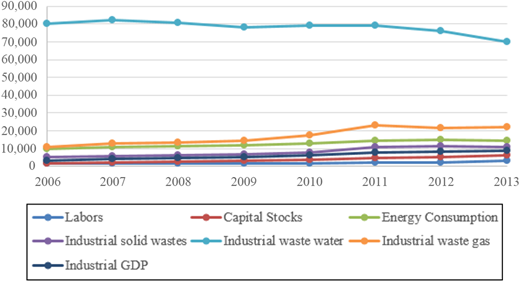
Mean value of these variables in 2006-2013
Mean value of these variables in 2006-2013
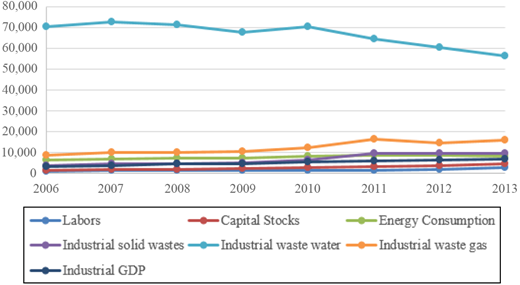
Standard deviation value of these variables in 2006-2013
Standard deviation value of these variables in 2006-2013
Furthermore, to analyze the trends of provinces’ eco-efficiencies from a larger-scale viewpoint, we divide the 30 provinces into three regions based on geographical characteristics, natural conditions, resource structures, economic development and similarity of social structures (Li and Lin, 2015). This division is common in China, and each region possesses greater technological heterogeneity caused by the geographical barriers associated with the spread of technology (Oh, 2010). The detailed division is shown in Table II.
Three administrative regions
| Region | Administrative regions |
|---|---|
| Eastern China | Beijing, Tianjin, Hebei, Liaoning, Shanghai, Jiangsu |
| Zhejiang, Fujian, Shandong, Guangdong, Hainan | |
| Central China | Shanxi, Jilin, Heilongjiang, Anhui, Jiangxi, Henan, Hubei, Hunan |
| Western China | Sichuan, Chongqing, Guizhou, Yunnan, Shaanxi, Gansu |
| Qinghai, Ningxia, Xinjiang, Guangxi, Inner Mongolia |
4.2. Empirical analysis
Considering each province in each year as a DMU, the classical ecological efficiency of each province can be derived by using Model (4) and Model (5), as shown in Table III.
Classical ecological efficiencies of province
| 2006 | 2007 | 2008 | 2009 | 2010 | 2011 | 2012 | 2013 | |
|---|---|---|---|---|---|---|---|---|
| Beijing (E) | 0.9678 | 0.8864 | 1.0000 | 0.9989 | 1.0000 | 1.0000 | 1.0000 | 1.0000 |
| Tianjin (E) | 0.6528 | 0.7148 | 0.9937 | 0.9631 | 1.0000 | 0.8059 | 1.0000 | 1.0000 |
| Hebei (E) | 0.4553 | 0.5573 | 0.9838 | 0.7167 | 1.0000 | 1.0000 | 0.8982 | 1.0000 |
| Shanxi (C) | 0.3298 | 0.3516 | 0.4236 | 0.3639 | 0.4802 | 0.6628 | 0.4976 | 0.4514 |
| Inner Mongolia (W) | 0.3007 | 0.3874 | 1.0000 | 1.0000 | 1.0000 | 1.0000 | 1.0000 | 1.0000 |
| Liaoning (E) | 0.3430 | 0.3851 | 0.5431 | 0.6569 | 0.9651 | 1.0000 | 1.0000 | 0.9136 |
| Jilin (C) | 0.3736 | 0.4533 | 0.5934 | 0.6966 | 1.0000 | 1.0000 | 1.0000 | 0.9873 |
| Heilongjiang (C) | 0.6100 | 0.5856 | 0.5523 | 0.4285 | 0.6535 | 0.8530 | 0.7461 | 0.6879 |
| Shanghai (E) | 0.9184 | 0.8546 | 1.0000 | 0.9490 | 1.0000 | 1.0000 | 0.9967 | 1.0000 |
| Jiangsu (E) | 0.7394 | 0.8388 | 1.0000 | 1.0000 | 1.0000 | 1.0000 | 1.0000 | 0.9820 |
| Zhejiang (E) | 0.5988 | 0.6599 | 0.7500 | 0.7492 | 0.8392 | 0.9341 | 0.9619 | 0.9864 |
| Anhui (C) | 0.3571 | 0.3834 | 0.4724 | 0.5135 | 0.7543 | 0.9140 | 0.9748 | 0.8319 |
| Fujian (E) | 0.7022 | 0.6596 | 0.6590 | 0.6449 | 0.7556 | 0.8488 | 0.8849 | 0.9696 |
| Jiangxi (C) | 0.4533 | 0.4945 | 0.5170 | 0.5882 | 0.8621 | 0.9117 | 0.9495 | 0.9914 |
| Shandong (E) | 0.4838 | 0.5765 | 0.7835 | 0.8397 | 0.9340 | 0.9167 | 0.9159 | 0.9482 |
| Henan (C) | 0.4271 | 0.4993 | 0.6996 | 0.7032 | 0.9125 | 0.8694 | 0.8594 | 0.7769 |
| Hubei (C) | 0.4260 | 0.3876 | 0.4636 | 0.5061 | 0.6056 | 0.5988 | 0.7925 | 0.6637 |
| Hunan (C) | 0.4609 | 0.4151 | 0.4933 | 0.4935 | 0.6375 | 0.7513 | 0.8732 | 0.8985 |
| Guangdong (E) | 0.9775 | 0.9927 | 0.9986 | 0.9308 | 0.9927 | 1.0000 | 1.0000 | 1.0000 |
| Guangxi (E) | 0.3750 | 0.4285 | 0.4887 | 0.4776 | 0.7466 | 1.0000 | 1.0000 | 0.8293 |
| Hainan (E) | 1.0000 | 1.0000 | 1.0000 | 0.8641 | 1.0000 | 1.0000 | 1.0000 | 0.9376 |
| Chongqing (W) | 0.3453 | 0.3453 | 0.3795 | 0.4931 | 0.6203 | 0.5399 | 0.5854 | 0.6992 |
| Sichuan (W) | 0.3715 | 0.3345 | 0.3948 | 0.4379 | 0.6032 | 0.7466 | 0.8372 | 0.9603 |
| Guizhou (W) | 0.3955 | 0.4463 | 0.4846 | 0.4181 | 0.4223 | 0.3432 | 0.3676 | 0.4437 |
| Yunnan (W) | 0.3589 | 0.3400 | 0.3662 | 0.3427 | 0.4216 | 0.3802 | 0.3910 | 0.4025 |
| Shaanxi (W) | 0.4686 | 0.4137 | 0.4856 | 0.4861 | 0.6981 | 0.8794 | 1.0000 | 0.8284 |
| Gansu (W) | 0.3834 | 0.3794 | 0.3773 | 0.3504 | 0.4610 | 0.3887 | 0.3595 | 0.3356 |
| Qinghai (W) | 1.0000 | 1.0000 | 1.0000 | 1.0000 | 1.0000 | 0.6601 | 0.6585 | 0.8759 |
| Ningxia (W) | 0.4077 | 0.4651 | 0.5512 | 0.4632 | 0.4308 | 0.6023 | 0.4784 | 0.4282 |
| Xinjiang (W) | 0.4438 | 0.4774 | 0.6730 | 0.4576 | 0.6776 | 0.6666 | 0.3809 | 0.3379 |
| Average | 0.5376 | 0.5571 | 0.6709 | 0.6511 | 0.7825 | 0.8091 | 0.8136 | 0.8056 |
E, C and W in parentheses of the first column refer to the eastern, central and western regions, respectively. The provinces in a certain year having the efficiency of 1 are efficient which are signed in bold. It can be found that the number of efficient provinces in 2011 and 2012 are the maximum, followed by 2010, while there are only two efficient provinces in 2006 and 2007. Besides the efficient provinces, we can find that most inefficient provinces performed well in 2010, 2011, 2012 and 2013. Moreover, the average efficiency of these provinces had gradually increased during 2006 to 2013, which indicates that China had made some achievement on improving the environment. To clearly see the difference, the average efficient value of 30 provinces in each year is calculated and shown in the last row of Table IV.
Classical ecological efficiencies of three regions
| 2006 | 2007 | 2008 | 2009 | 2010 | 2011 | 2012 | 2013 | |
|---|---|---|---|---|---|---|---|---|
| Eastern | 0.6845 | 0.7128 | 0.8500 | 0.8159 | 0.9361 | 0.9588 | 0.9715 | 0.9639 |
| Central | 0.4297 | 0.4463 | 0.5269 | 0.5367 | 0.7382 | 0.8201 | 0.8366 | 0.7861 |
| Western | 0.4475 | 0.4589 | 0.5712 | 0.5449 | 0.6335 | 0.6207 | 0.6058 | 0.6312 |
It can be seen from Tables III and IV that the classical eco-efficiency of Chinese industries has become better in these years. Dividing these provinces into three regions by Table II, the classical ecological efficiencies of these three regions are given in Table IV. It can be seen that Eastern China’s industries performed the best, followed by Central China’s industries, and Western China’s industries performed the worst in recent years. This is because Eastern China is more attractive than other regions to skilled laborers and qualified enterprises. Many skilled laborers in Central and Western China go to Eastern China for work. Moreover, with regard to the development of transportation in China, the disadvantage of location for Central and Western China, especially Western China, is increasingly obvious. Based on these results, we suggest that the Chinese Government should focus on the increasing differences among regions and take measures to address them.
In details, Central China’s industry and Western China’s industry performed similarly in 2007 to 2009, but after 2009, Central China’s industries improved more greatly than Western China’s industry. These results indicate that the location has a big influence on the classical ecological efficiency. Furthermore, the classical ecological efficient provinces are determined in Table IV which will be used in Model (8) for forming the efficient set H so as to obtain the closest target and eco-efficiency for each province, which are shown in Table V.
Ecological efficiencies based on the closest target method
| 2006 | 2007 | 2008 | 2009 | 2010 | 2011 | 2012 | 2013 | |
|---|---|---|---|---|---|---|---|---|
| Beijing (E) | 0.9678 | 0.9495 | 1.0000 | 0.9989 | 1.0000 | 1.0000 | 1.0000 | 1.0000 |
| Tianjin (E) | 0.9774 | 1.0000 | 1.0000 | 0.9988 | 1.0000 | 0.9603 | 1.0000 | 1.0000 |
| Hebei (E) | 0.6171 | 1.0000 | 0.7039 | 0.9276 | 1.0000 | 1.0000 | 0.8982 | 1.0000 |
| Shanxi (C) | 0.6625 | 0.7223 | 0.8003 | 0.8047 | 0.6232 | 0.8167 | 0.8469 | 0.6720 |
| Inner Mongolia (W) | 0.7108 | 0.8442 | 1.0000 | 1.0000 | 1.0000 | 1.0000 | 1.0000 | 1.0000 |
| Liaoning (E) | 0.5880 | 1.0000 | 0.9171 | 0.9105 | 0.9651 | 1.0000 | 1.0000 | 0.9175 |
| Jilin (C) | 0.8033 | 0.8553 | 0.8943 | 0.9165 | 1.0000 | 1.0000 | 1.0000 | 0.9873 |
| Heilongjiang (C) | 0.7987 | 0.8512 | 0.9235 | 0.9360 | 0.9858 | 0.9735 | 0.9406 | 0.6879 |
| Shanghai (E) | 0.9533 | 0.9770 | 1.0000 | 0.9882 | 1.0000 | 1.0000 | 0.9787 | 1.0000 |
| Jiangsu (E) | 0.8965 | 1.0000 | 1.0000 | 1.0000 | 1.0000 | 1.0000 | 1.0000 | 1.0000 |
| Zhejiang (E) | 0.8094 | 1.0000 | 0.8631 | 0.8401 | 0.8756 | 1.0000 | 1.0000 | 1.0000 |
| Anhui (C) | 0.7878 | 0.8307 | 0.8897 | 0.8738 | 0.9339 | 0.9140 | 0.9748 | 0.8319 |
| Fujian (E) | 0.7575 | 1.0000 | 0.8218 | 0.8259 | 0.8637 | 0.8662 | 0.8849 | 0.9696 |
| Jiangxi (C) | 0.7238 | 0.7569 | 0.7622 | 0.7558 | 0.8621 | 0.9117 | 0.9495 | 0.9914 |
| Shandong (E) | 0.8963 | 1.0000 | 0.9676 | 0.9607 | 0.9340 | 0.9167 | 0.9159 | 1.0000 |
| Henan (C) | 0.8393 | 1.0000 | 0.9609 | 0.7978 | 0.9678 | 0.9612 | 0.9613 | 0.8605 |
| Hubei (C) | 0.7640 | 1.0000 | 0.8483 | 0.8829 | 0.7803 | 0.9406 | 0.9608 | 0.9448 |
| Hunan (C) | 0.7520 | 1.0000 | 0.8530 | 0.7345 | 0.9332 | 0.9817 | 0.9693 | 0.9824 |
| Guangdong (E) | 1.0000 | 1.0000 | 0.9986 | 0.9369 | 0.9927 | 1.0000 | 1.0000 | 1.0000 |
| Guangxi (E) | 0.7780 | 0.7963 | 0.8558 | 0.8605 | 0.8953 | 1.0000 | 1.0000 | 0.9443 |
| Hainan (E) | 1.0000 | 1.0000 | 1.0000 | 0.9635 | 1.0000 | 1.0000 | 1.0000 | 0.9376 |
| Chongqing (W) | 0.7007 | 0.7510 | 0.8049 | 0.8340 | 0.9587 | 1.0000 | 0.9952 | 0.9575 |
| Sichuan (W) | 0.7103 | 1.0000 | 0.7974 | 0.8187 | 0.9354 | 0.9880 | 0.9767 | 0.9603 |
| Guizhou (W) | 0.6537 | 0.6773 | 0.7843 | 0.7586 | 0.7604 | 0.8108 | 0.8545 | 0.7158 |
| Yunnan (W) | 0.7351 | 0.7461 | 0.7859 | 0.7808 | 0.8551 | 0.8096 | 0.8194 | 0.8534 |
| Shaanxi (W) | 0.7834 | 0.8108 | 0.9087 | 0.9471 | 1.0000 | 1.0000 | 1.0000 | 0.8829 |
| Gansu (W) | 0.7942 | 0.8548 | 0.8874 | 0.8593 | 0.8970 | 0.8785 | 0.8437 | 0.3901 |
| Qinghai (W) | 1.0000 | 1.0000 | 1.0000 | 1.0000 | 1.0000 | 0.8289 | 0.8036 | 0.8759 |
| Ningxia (W) | 0.6982 | 0.7515 | 0.7862 | 0.7557 | 0.6728 | 0.7574 | 0.8110 | 0.8151 |
| Xinjiang (W) | 0.8873 | 0.9047 | 0.9513 | 0.8780 | 0.9604 | 0.9412 | 0.8876 | 0.6469 |
| Average | 0.8015 | 0.9027 | 0.8922 | 0.8849 | 0.9218 | 0.9419 | 0.9424 | 0.8942 |
From Table V, we can see that the average ecological efficiency of these provinces’ industries based on closet target method is larger than the average classical ecological efficiency. Briefly, ecological efficiency hereafter all refer to the ecological efficiency based on the closet target method without special explanation. From other points, the results indicated that the ecologically inefficient provinces can use the closest target method that requires fewer efforts than the classical method. From these results, we can also find that the performance in 2010, 2011 and 2012 is much better than that in other years. By using our model, the closest targets for each province achieving efficiency can be obtained. Analogously, we show the eco-efficiency of three regions in Table VI.
Ecological efficiencies of three regions
| 2006 | 2007 | 2008 | 2009 | 2010 | 2011 | 2012 | 2013 | |
|---|---|---|---|---|---|---|---|---|
| Eastern | 0.8534 | 0.9769 | 0.9273 | 0.9343 | 0.9605 | 0.9786 | 0.9731 | 0.9808 |
| Central | 0.7664 | 0.8771 | 0.8665 | 0.8378 | 0.8858 | 0.9374 | 0.9504 | 0.8698 |
| Western | 0.7674 | 0.8340 | 0.8706 | 0.8632 | 0.9040 | 0.9014 | 0.8992 | 0.8098 |
Compared to the classical ecological efficiency, we find that the ecological efficiency based on the closest target method was steadier and the difference among three regions was smaller. The results indicated that the closest target for each province to be efficient was steadied. Thus, the targets were more easily accepted by the province because they put similar efforts in each year for improving performance. However, we can clearly see that the average efficiencies had increasingly improved in these years.
Because the analysis of target setting for all eight years is similar, here, we only show the closest targets of the provinces in 2008 for illustrating our approach. It should be noted that the results in other years can be also obtained by Model (8).
The provinces in bold were all ecologically efficient. They included: Beijing, Inner Mongolia, Shanghai, Jiangsu, Hainan and Qinghai. These provinces did not need improvement. It can be found that more than half of these are well-developed, such as, Beijing, Inner Mongolia, Shanghai and Jiangsu. They did well in economic development. Hainan and Qinghai are tourist provinces. They did well in environmental protection. Except these areas, to be ecological efficient, other provinces need to reduce their inputs (labors, capital stocks and energy consumption) or decrease their undesirable outputs (industrial solid wastes, ISW; industrial waste water, IWW; industrial waste gas, IWG) or increase their industrial GDP. Taking Hebei as an example, it should decrease the number of labors to 1,309.4 units (about 34.05 per cent reduction), maintain the capital stocks at 4,735.25 units, reduce the energy consumption to 17,631.02 units (about 27.51 per cent reduction), industrial solid wastes to 17,426.37 units (about 11.85 per cent reduction), industrial waste water to 39,344.55 units (about 67.53 per cent reduction), industrial waste gas to 23,766.7 units (about 36.72 per cent reduction) while maintaining the industrial GDP at 7,967.62 units. Other provinces can use similar ways to improve their eco-efficiency to be efficient. It should be noted that with our approach, we can not only decide the benchmark for the evaluated provinces to be efficient with the least efforts but also determine the eco-efficiencies of the provinces. Thus, our approach is attractive for guiding the local governments to develop related economic and environmental policies. For example, if the aspect of energy consumption is weak, the governments should publish some policies to stimulate the firms to use high technology to increase the utilization ratio of energy and save energy consumption in real production.
5. Conclusions
Many previous works have been conducted on the ecological efficiency evaluation of the Chinese industry; meanwhile, the benchmarks for the Chinese industry are determined, such as Bian and Yang (2010) and Chen and Jia (2017). But the benchmarks by these methods are usually set by the furthest targets for each Chinese industry to achieve efficiency. In this paper, to make the industry efficient with fewer efforts, we applied the closest target method in the DEA to measure eco-efficiency and set benchmarks.
The results show that the average eco-efficiencies of Chinese provincial industries gradually increased during 2006-2013. This indicated that China had made some achievement in protecting the environment and building a harmonious society, where economy and environment develop coordinately. The industry in Eastern China performed the best, followed by Central China, and Western China performed the worst. Compared with the classical eco-efficiency, eco-efficiency based on our closet target method of each province was larger because the efforts (improvement) made for achieving efficiency for the province by our method were fewer. Moreover, we find that all eco-efficient provinces are highly developed provinces with a big economy, such as Beijing, or tourist provinces with fine environment, such as Hainan. Other efficient provinces can learn from these provinces to develop policies according to their economic and environmental situations.
The targets based on our method
| Labors | Capital | EC | ISW | IWW | IWG | IGDP | |
|---|---|---|---|---|---|---|---|
| Beijing (E) | 1402.4 | 386.05 | 6327 | 1157 | 8367 | 4316 | 2198.49 |
| Tianjin (E) | 941.2 | 1506.8 | 5364 | 1479 | 20433 | 6005 | 3533.86 |
| Hebei (E) | 1309.4 | 4735.25 | 17631.02 | 17426.4 | 39344.55 | 23766.7 | 7967.62 |
| Shanxi (C) | 1398.7 | 1868.89 | 9754.55 | 8644.8 | 41150 | 19348.4 | 3919.80 |
| Inner Mongolia (W) | 797.7 | 2863.11 | 14100 | 10622 | 29167 | 20190 | 3798.6 |
| Liaoning (E) | 1837.9 | 4833.11 | 14595.04 | 15841 | 83073 | 34966.4 | 6735.74 |
| Jilin (C) | 795.4 | 2733.89 | 6217.28 | 3415 | 26080 | 6155 | 2686.98 |
| Heilongjiang (C) | 1719.2 | 1514.08 | 8968.13 | 4472 | 25256.5 | 7796 | 3927.58 |
| Shanghai (E) | 1597.1 | 1427.69 | 10207 | 2347 | 41871 | 10436 | 5784.99 |
| Jiangsu (E) | 3719.6 | 8342.44 | 22232 | 7724 | 259999 | 25245 | 15068.98 |
| Zhejiang (E) | 3239 | 4267.02 | 14883.42 | 3785 | 96414.7 | 17633 | 10359.77 |
| Anhui (C) | 853.5 | 2960.14 | 8325 | 7569 | 48982.1 | 15749 | 3487.53 |
| Fujian (E) | 1856 | 2035.03 | 8254 | 5371 | 38485.2 | 9150 | 4755.45 |
| Jiangxi (C) | 811.4 | 2545.97 | 5383 | 3024.57 | 34848.7 | 7456 | 2766.93 |
| Shandong (E) | 4877.8 | 7854.87 | 24630.25 | 12988 | 176977 | 33505 | 16102.19 |
| Henan (C) | 2672.5 | 5422.37 | 16871.56 | 9557 | 133144 | 20264 | 9546.08 |
| Hubei (C) | 1605.9 | 2352.25 | 9978.00 | 5014 | 46487.5 | 11558 | 4330.20 |
| Hunan (C) | 1644.4 | 2268.60 | 9424.39 | 4520 | 42051.6 | 9249 | 4280.16 |
| Guangdong (E) | 4980.3 | 3902.74 | 20886.60 | 4287.8 | 119989.1 | 20510 | 17254.04 |
| Guangxi (E) | 959.4 | 1541.62 | 6497 | 5417 | 27755 | 11643 | 2627.39 |
| Hainan (E) | 149.6 | 119.49 | 1135 | 220 | 5991 | 1345 | 321.18 |
| Chongqing (W) | 765.3 | 1390.36 | 4599 | 2311 | 29512 | 7351 | 2036.40 |
| Sichuan (W) | 1739.5 | 2879.31 | 11407.21 | 9237 | 38305.9 | 12997 | 4922.84 |
| Guizhou (W) | 376.1 | 794.79 | 4701.65 | 3240.5 | 11695 | 6842 | 1242.56 |
| Yunnan (W) | 553 | 1306.62 | 5516.08 | 3989.01 | 32600.1 | 8316 | 2056.95 |
| Shaanxi (W) | 1205 | 1679.40 | 7417 | 6121 | 28538.4 | 9706 | 3293.95 |
| Gansu (W) | 395.3 | 806.23 | 4083.81 | 3141.42 | 16405 | 5685 | 1221.66 |
| Qinghai (W) | 146.8 | 297.21 | 2279 | 1337 | 7098 | 3237 | 442.85 |
| Ningxia (W) | 185.5 | 398.59 | 2150.51 | 1143 | 11913 | 3159.15 | 490.14 |
| Xinjiang (W) | 625.8 | 1142.18 | 5004.15 | 2438 | 22875 | 6154 | 1790.7 |
Note
The data are available in website http://tongji.cnki.net/kns55/navi/NaviDefault.aspx

