

There is plenty of room at the bottom, R.P. Feynman
Article Type: Editorial From: International Journal of Clothing Science and Technology, Volume 25, Issue 5
Introduction
In 1959 Richard P. Feynman with his famous talk "There is plenty of room at the bottom" predicted that one day we will be making things at the atomic level. And since these small things will build upwards we will be able to make them more precisely and control what we want them to do. This prediction became true at the turn of the century with the onset of nanoscience and technology and the rest is history. Nanotechnology deals with the design, characterization, production, and application of structures, devices, and systems by controlled manipulation of size and shape at the nanometer scale (atomic, molecular, and macromolecular scale) that produces structures, devices, and systems with at least one novel/superior characteristic or property. The most important characteristic of materials that are produced from nanotechnology is that they have bigger surface/volume relation desirable for many applications. Another important characteristic is related with quantum physics because nanotechnology allows us to make materials in one dimension (nanowires), in two dimensions (nanotubes) or in all three dimensions (nanoparticles), very desirable in products related with industrial uses.
"Top down" techniques, produce very small structures from larger pieces of material. They may also be constructed by "bottom up" techniques, atom by atom or molecule by molecule. One way of doing this is self-assembly, in which the atoms or molecules arrange themselves into a structure due to their natural properties, for example from polymer solutions you can produce nanofibers by using an electric field which splits the polymer drop into millions of tiny fibers.
Growth and markets
The global market for nanofiber products is worth $101.5 million. The market is forecast to grow at a 37.2 per cent compound annual growth from 2015 through 2020, reaching nearly $2.2 billion in total revenues by 2020. The mechanical/chemical sector is estimated to be worth $1.4 billion (2020), electronics which is the fastest growing segment expected to be worth $323 million (2020) (Figure 1).
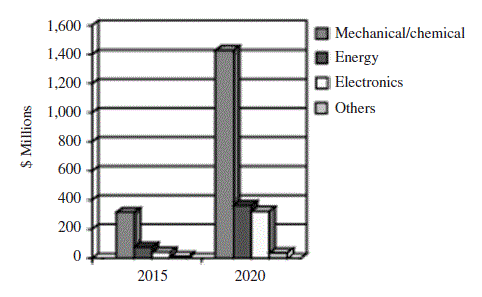
Figure 1 Global market for nanofiber products, 2020
The use of nanofibers in electronics to enhance the strength, thermal resistance, and reactivity of new devices has seen an increase in market growth. Nanofibers are also used for, electromagnetic interference (EMI) shielding, heat regulation and as conductors, in carbon based nanofiber products. Nanofibers are effective filtration materials used in air, gas, and water. By facilitating high flow rate (Stylios and Yousef, 2013) alumina type of nanofibers enhances filter performance by being able to trap the finest impurities without blockage. Nanofiber filters are also user in car engines.
But other main markets for polymer nanofibers are also composites and textiles. One of the mainstream consumer sectors that has benefited from nanotechnology is the high performance apparel. They can be used from raw material to the finishing of the fabric imparting high potential for growth. The types of nanomaterials found in textile end use are; manoparticles 40 per cent, nanofibers 22 per cent, nanocomposites 12 per cent, nanotubes 7 per cent, nanocapsules 4 per cent, nanoemulsion 3 per cent, etc. Polymer based nanofibers account for the main market revenues for nanofibers, in many sectors. Carbon and cellulose nanofibers are finding end uses across a number of industries including electronics, composites, energy (batteries, catalysts and fuel cells), medicine and life sciences in drug delivery, tissue engineering, wound dressing, implants and in li-ion batteries which is another fast growing market sector. Other markets are aerospace and aviation, cosmetics and plastics.
Main industrial players
Key industrial players in this market include Ahlstrom Corp., Donaldson Co. Inc., E. I. du Pont Nemours and Co., Hollingsworth and Vose Co., Johns Manville, Kuraray Co. Ltd, Mitsubishi Rayon Co. Ltd, Teijin Fibers Ltd, Toray Industries Inc., Argonide Corp., Biomers, C-Polymers GmbH, Carbon NTand F 21, Catalytic Materials LLC, Catalyx Nanotech Inc., Clearbridge Nanomedics, Electrovac AG, Espin Technologies Inc., Esfil Techno AS, FibeRio Technology Corp., Finetex Technology, FutureCarbon GmbH, Grupo Antolin, Hemcon Medical Technologies Inc., Hills Inc., Irema-Filter GmbH, Japan Vilene Co. Ltd, Kertak Nanotechnologies S.R.O., Metpro Corp., Nanofiber Solutions, NanoMas Technologies Inc., NanoTechLabs Inc., Nanoval GmbH and Co. KG, Pyrograph Products Inc., Shenzhen Nanotech Port Co. Ltd, SNS Nanofiber Technology LLC, US Global Nanospace Inc., and Elmarco, whilst leading application developers include NEC and Asahi Kasei.
The applications of nanofibers are still in their infancy and the market capitalisation primitive, if we consider that nanoyarns are still to come in the play.
G.K. Stylios
Editor-in-Chief
References
Stylios, G.K. and Yousef, I. (2013), "The filtration of technical fabrics", paper presented at Istanbul Technical Congress, 29 May-1 June

