

Arguing for manufacturing in post industrial economies with special reference to the UK
Article Type: Editorial From: International Journal of Clothing Science and Technology, Volume 21, Issue 4
In reading this title you think, what have I got to do with what seems to be an economist’s topic. You are right, but do not judge me on economic models in which I would fail spectacularly, but on my observations, fears and anticipations, which stem from experiences of active involvement with industry over the last 25 years. Fortunately these views are shared by an increasing number of colleagues in academe and industry, unfortunately not by civil servants.
I accept that the cause of this recession is attributed to the supply of money or to the “credit crunch” as it is widely stated, and we have all experienced the ease of obtaining credit over the last twenty years or so. I have understood how the financial institutions to a larger extend, allowed by government, inflated our assets; housing, stocks and shares in order to inscribe in us the false sense of security, so that we could borrow more and hence financial institutions and government succeed in the prosperity for their top management and in the re-election of government. The same crisis is also seen to a larger extend in most of the industrialised countries, the flagship of which are the UK and the USA, which have been proudly promoting freedom of self governing of their financial companies. And because the world is now a large village the domino effect is affecting the globe, industrial as well as developing countries.
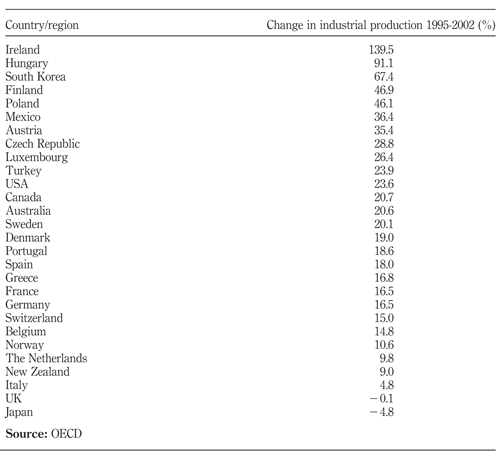
Table I
Now that we have come to this state of affairs, we look at solutions and it is here that I disagree with what is offered as a helping hand to combat this recession. As I am more familiar with the UK let us examine what is happening here. Unfortunately the figure below shows UK’s rather desperate picture.
Between 1995 and 2002 when industrial production in the UK fell by 0.1 per cent in the Eurozone it was increasing by 16.6 per cent (Table I).
As a mater of fact the textile and garment manufacturing industry’s decline between 1986 and 2002 was dramatic and it is clearly shown in Table II below.
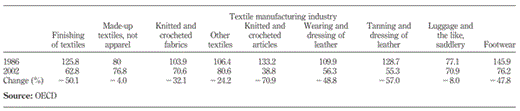
Table II
The UK wants wealth creation, but misunderstands that the main contributor is neither banking nor services, but its manufacturing industry. The problem started in 1970s; it became worse in 1980s and has reached the state of no return at the turn of the century in the year 2000. In fact even the unregulated rapid increase of admissions of young people to our universities was done without any planning with respect of wealth creation, but I speculate that it was a mere correction of the unemployment statistics in the false premise that the services will continue to absorb those graduates. In fact MBA courses have contributed in the creation of risk takers that would enable financial institutions to invent scrupulous activities hidden under signatures of carrying degrees from purposely branded prestigious university schools. Of course, now directors of those prestigious schools state that they could not see what was coming so they could teach those graduates alternative “safer”economic models. In my own mind they were either funded by the same financial organisations to absorb the graduates that they wanted; in other words to create people to work within scripts already written for them, or possibly they were incompetent teachers and educators, comfortably hidden behind large grants provided easily by the financial institutions that they served and their actual research and scholarship was an opportunistic, ill defined pushing of prescribed research rather than pushing the real frontiers in their discipline. Whichever the reason these directors should now be sacked and those schools rewrite their syllabus.
But let us come back to wealth creation and the UK. The term “de-industrialisation”was one that has been frequently used in the early 1980s. The government of those times was advocating that the UK should opt-out of manufacturing and that it should adopt a post-industrial society with whatever the meaning and the unthought-of consequences; of course, this was done with clear thinking of the benefit of the few, I hasten to add.
Look where we have come to now. In any human endeavour over the centuries services have been there to push the wealth around, whether this wealth is little or a lot. Without manufacturing to make something so the value of this something can create new money and then for the banks and services to push it around, what else can it be? This small island has limited growing capacity over its large population; so agriculture cannot be sustained, what is underneath its soil (mining) and sea (oil) are almost dried up, so what are we left with?Manufacturing which has disappeared! And here is where the UK differs from every other developed country.
If the government provides huge loans boasting that in this way it will enable the kick start of lending for housing, for retailing, for tourism, etc. cannot they see that they are reinventing the same conditions that brought about this crisis, only with some hysterisis, and that next time when money will dry up government will have no more money to lend and then we will have a fiscal caesurae, which will bring about social unrest, no law and order and all consequences of a bankrupt state. I am concerned that in any of government measures there is nothing about infrastructure to increase or bring back our manufacturing industry. Where can our unemployed find employment again? In the services which are disappearing fast or in banking that is shrinking back to the levels of the 1970s? Look at the decline of UK manufacturing jobs between 1997 and 2002. In manufacturing jobs, between 1997 and 2002:
Spain up 500,000.
Italy up 400,000.
France up 146,000.
Germany up 116,000.
UK down 580,000 (EU Commission).
Italy, Germany and France give more than double their state aid to manufacturing than UK (Figure 1).

The UK in my understanding is right to be asking for a worldwide concerted action in providing loans but in its implementation it is desperately wrong,because the USA, Germany, France, Japan and other major economies have manufacturing that can make goods which will allow them to make money, the UK has not. We have now invented “quantitative easing” because we do not have manufacturing to make money and the government has already started printing money out of thin air. If you were to talk about this even a year ago they would lock you in a mental institution!
I am not an economist but anybody with common sense can see this problem and since textiles and clothing are and always have been one of the pillars of a manufacturing economy, I want this industry and manufacturing at large to come back to the UK.
Editor-in-chief
George K. Stylios

