Context, content and commitment in student venture processes
Introduction
This special issue focuses on students creating real ventures in universities. The students are nascent entrepreneurs with limited experience in carrying out most of the tasks of developing their ventures for the first time (Haneberg and Aaboen, 2020). The special conditions of being students who create real ventures deserve more scholarly attention. Similar to all entrepreneurial activities, student entrepreneurship involves a process, which occurs in interaction with its overall context (Haneberg, 2019; McMullen and Dimov, 2013; Welter, 2011) and the potential support offered to student entrepreneurs through educational courses, programmes and initiatives available in universities. Previous research has primarily considered how student entrepreneurship facilitates education, entrepreneurial outcomes and the development of entrepreneurial ecosystems (Gabrielsson et al., 2020; Wright et al., 2017). This special issue focuses on student entrepreneurs, their entrepreneurial practices, student entrepreneurship and the factors that are crucial for the continuous action in student ventures. This issue's articles thereby extend previous research by exploring the continuous action stemming from the interplay among the student entrepreneurial process, its context and entrepreneurship education. This issue's contributors and editors aim to strengthen student entrepreneurship as an interesting, important and distinctive focus of researchers and practitioners. We conclude this guest editorial piece by suggesting questions and topics for further research, along with a set of implications for practice.
Setting the stage for this special issue
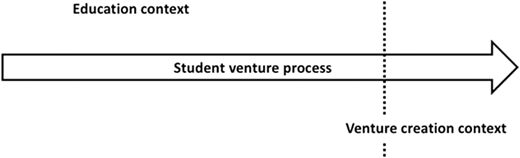
This section sets the stage for this special issue by providing a brief overview of the interplay between the entrepreneurship education context and the student venture process, as well as between the venture creation context and the student venture process. The venture creation context includes extracurricular initiatives and the entrepreneurship ecosystem in the university. As illustrated in Figure 1, the student venture process is a result of the interplay among the process, the context and the education.
The interplay between the entrepreneurship education context and the student venture process
The literature about entrepreneurship education includes descriptions of programmes and their initiations (e.g. Harmeling and Sarasvathy, 2013; Pardede and Lyons, 2012; Phan, 2014; Stone et al., 2005). The most common focus in entrepreneurship education is the evaluation of programmes and courses. The programmes and courses tend to be described as “about”, “for”, “through”, “in” or “embedded” entrepreneurship to specify the learning approach and objectives (Hannon, 2005; Pittaway and Cope, 2007; Robinson et al., 2016). The learning approaches vary from classroom lectures where the students are passive to approaches where the students are self-driven, and the programmes may have an impact on the students in learning to become entrepreneurs or entrepreneurial, as well as the context, for example, when a new venture has been started (Aadland and Aaboen, 2018). Most of the programmes described and evaluated in the entrepreneurship education literature focus on ventures as projects in courses or on courses that prepare students for creating ventures rather than real venture creation conducted by students. A few studies on entrepreneurship education focus on venture creation programmes (e.g. Lackéus and Williams Middleton, 2015; Rasmussen and Sørheim, 2006; Haneberg and Aadland, 2020) that facilitate students' learning. The venture creation programme literature builds on the growing consensus that entrepreneurship is best learned by doing it (Timmons, 1986) and that involvement in entrepreneurial endeavours fosters an authentic experiential learning process (Aadland and Aaboen, 2020). Hence, student entrepreneurship is considered a state-of-the-art pedagogical approach to entrepreneurship and enterprise education (Lackéus and Williams Middleton, 2015; Neck and Corbett, 2018). While previous research has demonstrated the benefits of student venture creation for student learning and investigated how the student venture may be utilised as a learning vessel, less attention has been paid to how learning activities facilitate the continuous action of the student venture.
The interplay between the venture creation context and the student venture process
The literature on new venture creation in universities has witnessed a shift in focus to the inclusion of external factors (Autio et al., 2014), the context (Welter, 2011) and processes (Fayolle et al., 2016; McMullen and Dimov, 2013). The shift is connected to “the contextual turn in entrepreneurship” (Gaddefors and Anderson, 2019, p. 160). Existing research has broadly examined how different facets of the context, such as institutional (Lang et al., 2014; Urbano and Alvarez, 2014), historical (Wadhwani et al., 2020), social (McKeever et al., 2014) and spatial aspects (Müller and Korsgaard, 2018), shape entrepreneurial action. However, previous studies on venture creation in universities have tended to focus on venture creation conducted by university employees (e.g. Lamine et al., 2016; Siegel and Wright, 2015) rather than by students. Student entrepreneurship and student venture creation have only received limited scholarly attention (Bergmann et al., 2016; Beyhan and Findik, 2018; Boh et al., 2016). For instance, previous studies on student venture creation have had a firm-level focus where commercial outcomes of student entrepreneurship have been assessed, often to evaluate the effectiveness of programmes and initiatives to support university entrepreneurship (Åstebro et al., 2012; Beyhan and Findik, 2018; Gianiodis and Meek, 2020; Sørheim et al., 2021). Other studies have regarded the facilitation, teaching or resources that support students' entrepreneurial activities in higher educational institutions (Haneberg and Aaboen, 2020; Pittaway and Cope, 2007; Preedy and Jones, 2015; Rasmussen and Sørheim, 2006). A learning focus has been dominant in the growing number of studies on extracurricular initiatives for student entrepreneurship (Claudia, 2014; Haneberg and Aaboen, 2021; Pittaway et al., 2011), whereas another research focus regards individual student entrepreneurship as a means to an entrepreneurial career as such (Merida and Rocha, 2021; Nabi et al., 2010; Rae and WoodierHarris, 2013). In other words, the student entrepreneurship literature connected to the venture creation context has a narrower scope compared with the general discussions on the contextualisation of entrepreneurship, and many issues remains to be discovered. Figure 1 illustrates the student venture process stemming from its interplay with the education context and the venture creation context.
Papers in this special issue
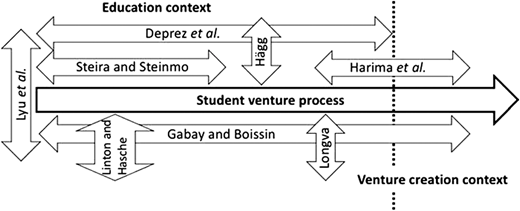
The papers included in this special issue provide insights into the student venture process and its connection with the education context and the venture creation context from different perspectives. In Figure 2, the papers that contribute with processual findings are denoted with horizontal arrows, while the papers that primarily focus on how the process and context influence each other are denoted with vertical arrows.
Steira and Steinmo (2021) present a real-time study that reveals patterns in the development of new venture teams in venture creation programmes that are effective for student learning. In total, three key phases of new venture team development are identified: (1) establishing a foundation for collaboration through mutual understanding and psychological ownership; (2) structuring the teamwork by distributing tasks, establishing decision-making routines and creating joint commitment and (3) adapting to internal and external changes. Steira and Steinmo (2021) suggest that educators pay attention to these phases and ensure that the students complete the three phases to improve their learning from their venture creation. Hägg (2021) delves even further into improving student learning from the student venture creation process by suggesting that educators facilitate student reflection through an entrepreneurial diary. According to Hägg (2021), the interplay between action and reflection enables the students to develop self-awareness about their learning but requires a highly rigorous systematic process, which is challenging yet rewarding for both educators and students. Deprez et al. (2021) argue that intrapreneurial student venture processes are facilitated by assigning smaller tasks to the students and enabling them to observe the situation, while direct communication of intrapreneurial expectations may have a paralysing effect on students. Hence, Steira and Steinmo (2021), Hägg (2021) and Deprez et al. (2021) all argue in favour of structured facilitation of student venture creation processes to improve student learning.
Harima et al. (2021) confirm the sentiments regarding the opportunities for educators to improve student learning, for instance, by mentioning that educators' guidance positively influences task feasibility and performance. However, Harima et al. (2021) also argue that many student venture processes are terminated at the end of course modules because the students tend to procrastinate when they no longer have access to constant feedback and milestone setting. Moreover, the entrepreneurial passion tends to “reverse”, motivation is lost and the team's reason for existence disappears when there is no more feedback. In other words, while facilitation from educators may enhance student learning during a course, continued student venture creation after the course may be hampered by intensive direct facilitation during the course. Gabay and Boissin (2021) also focus on the continued action in the student venture creation process and argue that it is connected to the students' commitment. There seems to be three thresholds of commitment. The first is the mobilisation of the social network, the second is financial investment and the third is irreversibility, where the students invest much of themselves and the project becomes an important part of their lives. There is no significant relation between the students' commitment profiles and their personal characteristics, but the completely committed tend to have invested more time in their projects, borrowed money, recruited employees, bought equipment and signed contracts with other organisations. Linton and Hasche (2021) particularly emphasise the importance of the motivation for the student venture creation process to come from the students themselves. Based on their study's results, Linton and Hasche (2021) show that when the motivation comes top-down from the university management, the students feel lost in terms of what to do in their ventures, as well as the part that they are supposed to play in their new venture teams, and the roles of supporting actors become unclear, resulting in tensions. Thus, educators and other actors may be able to improve student learning through facilitation, but the continued student venture creation seems to be connected to the students' commitment and motivation.
For the student venture creation process to proceed, many resources are needed. According to Longva (2021), the internal ecosystem elements that the student entrepreneurs identify and develop as part of their education allow them to start building social networks that provide access to professional knowledge, advice, identity building, social support and recruitment. Later in the process, it becomes important to obtain industry knowledge, financial support and validation of their ideas from actors such as industry incubators and the public support system outside the protected university environment. However, as discussed by Lyu et al. (2021), there must be a fit between the education context and the venture creation context. When education designs are adopted without adjustments to the local culture and context, it becomes difficult for both educators and students to engage in the learning processes and entrepreneurial activities. Hence, the contributors to this special issue propose that student venture creation processes be based on student motivation, which may be improved through careful facilitation that fits the context.
Discussion
The papers included in this special issue undoubtedly continue an important trend in society's increasing focus on student entrepreneurship and entrepreneurship education. Educational, extracurricular and co-curricular offerings in entrepreneurship aid industry, higher educational institutions and the students themselves in creating innovative solutions and ventures for the future. This special issue illustrates how the context, educational influence and the individual students themselves all serve as actors and catalysts for entrepreneurial behaviour. However, similar to any other mixture, the right combination is needed to accelerate and foster student entrepreneurship efforts.
Content
While the development in the literature on entrepreneurship education has moved towards an advocating trend for student-centred and authentic learning, it is timely to engage in investigations and discussions of such designs and their impacts. Questions regarding the level of guidance, stakeholder involvement, mandatory assignments, assessment procedures and educational design are ready for investigations, and building the right combination requires an understanding of the different factors' influences on student entrepreneurs. Educators in higher education should not assume that the introduction of experiences alone will lead their students to success. The opposite is not the case, either, but as previous research has elegantly stressed, experiences themselves are not necessarily sources of experiential learning (Kolb and Kolb, 2005; Pittaway et al., 2015). Reflection is central in the experiential learning theory, but knowing what to focus on in an uncertain and perhaps new situation is challenging for students with limited experience. Students therefore need guidance in their reflective activities. Hägg (2021) therefore points to an understudied issue with high impact and importance for students' learning in entrepreneurship education. Entrepreneurship education should neither foster experiences alone nor solely keep a know-what attitude towards the topic but promote a balance between them and aid the students in their efforts, including training in how to use experience as a source of learning through reflection.
However, while experience should be a source of learning, it is also clear that individual students' point of departure, for instance, regarding their attitude and prior knowledge, has an impact on their gains from venturing activities. Deprez et al. (2021) find that students with a lower entry level of self-efficacy need a different type of guidance and support in the educational situation. Educators' failure to recognise individual differences could therefore hinder their students' optimal learning, despite the small effort required for an effective and individually adapted learning situation. For instance, ensuring that the tasks are manageable and do not cause cognitive overload appears to be vital for some students. This is an issue that has also been discussed in previous research – whether students should be provided with a foundation of the topic in focus before more complex learning situations are introduced (e.g. Aadland and Aaboen, 2020; Robinson et al., 2016). Steira and Steinmo (2021) also add to this discussion by showing that students need to go through the necessary steps in their teamworking activity to enable optimal collaboration. Hence, letting students receive guidance could also be beneficial for the learning situation. Ensuring that the students understand their tasks and the areas on which they need to focus could be effective, especially if they have varying levels of prior knowledge and experiences (Deprez et al., 2021). For instance, if educators closely support students in their work, at least in the beginning of the educational offerings, this might be a good strategy to ensure that students build the confidence to become more autonomous and develop self-efficacy.
Commitment
Educators should also be safe ports when uncertain situations occur, guiding students in their focus and efforts, thus enabling them to learn from their activities. As in the case of any other port, students should be able to anchor when a storm occurs, meaning that educators, mentors and support systems should be able to aid students even after formal curricular activities have finished. Educators and higher educational institutions have a responsibility to ensure that students do not carry too much risk in their efforts (Nab et al., 2010) and that their work, investment and energy are not wasted due to uncertainties, which often could be solved with a small discussion, questions and answers or support from the faculty. Harima et al. (2021) put this issue on the agenda when their study's results, where graduates lack support and guidance, show that this might hinder the continuation of the students' venturing activities. Giving students support and guidance in their transition from more simulated curricular activities (cf. Pittaway and Cope, 2007) to post-graduation, real-world entrepreneurial efforts could therefore bring fruitful results. How such efforts and transitions could be designed and implemented deserves more space in the literature.
Students might lose their motivation to continue their entrepreneurial efforts, especially if the educational effort or context is developing a reputation for being a time-limited effort without a plan for continuation. Building and developing a commitment and a positive attitude towards entrepreneurship might take time, especially for students with lower levels in the beginning and if the activity is mandatory. Therefore, building and maintaining a positive environment, with support and guidance for the students, could be beneficial. While many of the contributors to this special issue mention motivational factors, such as ensuring student ownership (e.g. Steira and Steinmo, 2021), Gabay and Boissin (2021) point to different commitment profiles. Through an understanding of how students' commitment could be influenced, educational institutions may adapt their efforts such that talented students could stay motivated and develop and maintain value and learning. Nevertheless, students should be guided with care. Linton and Hasche (2021) illustrate that students being guided and “controlled” by mentors or educators could lose their motivation and interest. This especially applies if the feedback is unclear and adds to the discussion on the ownership of the idea, the process and eventual outcomes. However, since not all students will become entrepreneurs, and others just need a light push to flourish, it is vital to find the correct balance between controlling and aiding the students in their work.
Context
Although many of the contributors to this special issue point to students' and educators' collaboration and how the two groups can create value together, Linton and Hasche (2021) also initiate a discussion on the involvement, utilisation and adaption of the context in the students' venturing process. Previous research on the topic has illustrated how universities, educators and students could benefit one another through incubation and knowledge transfer in venturing activities (Ollila and Williams Middleton, 2011). However, lacking good collaboration with a knowledge transfer office or missing a possibility to let students work in an incubator shows the need for local adjustments in initiatives related to student venturing. Longva (2021) investigates how the entrepreneurial ecosystem in the university influences student entrepreneurship. One of her concluding remarks refers to the important interplay between curricular and co-/extracurricular activities for students. Longva (2021) therefore adds to the discussion by stressing the importance of the context when initiating new student efforts. As such, the formal institutional offerings, for instance, a technology transfer office, might not be sufficient for a good venturing context for the students. Some initiatives require an ecosystem where students play a central part, are supported beyond the formal activities and engage with other students but can also obtain support from industry, mentors and the faculty if needed. As such, some initiatives cannot be transferred from one context to another if some support functions in student clubs or similar groups are missing. This also applies to educational offerings, as presented by Lyu et al. (2021), where culture and context need to be taken into consideration.
While the papers in this special issue have different foci and points of departure, their common denominator is that diverse educational offerings, contexts and students require varying designs, approaches and follow-up procedures. Giving students the foundation and support to develop their entrepreneurial knowledge and insights appears important, but it should also be noted that students with higher levels of entrepreneurial knowledge, attitude or interest need other educational influences than easy and simple tasks, directions and orders, or pre-assigned objectives. Overcontrolling the educational activity could therefore be demotivating for students and as such work against its purpose. Providing the students with possibilities to immerse themselves in their topics of interest or in the case of students who have faced challenges, guiding them towards solutions, without creating a strict standardised educational design for all students, appears to be crucial. The same applies to the involvement and utilisation of the context. While some educational efforts flourish in a certain context, educators and higher educational managers should be careful in uncritically adopting efforts from one context to another.
Conclusions and further research
With this special issue, we have put the spotlight on student entrepreneurs and student entrepreneurship. The contributors have investigated several aspects that influence the process of venturing by students, spanning from the students themselves to their contextual situations. This special issue therefore points to several important topics and provides varied and multifaceted views on student entrepreneurship, while illustrating the complexity involved in initiatives for student entrepreneurship in higher education. Fostering engagement and student venturing, with its possibilities for long-term value creation for society, requires an intertwined ecosystem, including support from the faculty, peers and other stakeholders.
We contribute to the student entrepreneurship literature by shedding light on individual students and how they need guidance in some situations but need space to flourish in other circumstances. Students also need an enhanced awareness of their own activities and processes when working on venturing efforts. Lacking the ability to reflect and knowledge about which topics to reflect on could hinder students in their venturing activities (cf. Hägg, 2021). We have also contributed to the understanding of the educational setting and the roles of social networks and stakeholders in academia and industry (Gabay and Boissin, 2021; Gianiodis and Meek, 2020; Haneberg and Aaboen, 2020; Longva, 2021). Initiating venturing activities among students cannot be fruitful unless the students obtain the necessary support in the entrepreneurial ecosystem (Wright et al., 2017). Students need a safe port and support in a positive environment. The context of student entrepreneurship (cf. Beyhan and Findik, 2018) is therefore a particular topic to which this special issue contributes, in terms of not only how students interact with and utilise the environment but also how specific initiatives from one context may not necessarily fit in other contexts.
The crucial points raised in this special issue also have implications for practice. Entrepreneurship educators and others involved in entrepreneurship support systems in universities should evaluate and reflect on their roles in and their offered support for student entrepreneurship. Some students need extra motivation and support to conduct their entrepreneurial activities, while others will be held back and feel limited by the same support. The need may also change in different phases of the process. It is also important for educational institutions, including the faculty and mentors, to critically adapt and assess their initiatives for student entrepreneurship.
Further research
While the contributors to this special issue offer significant insights into the topic of student entrepreneurship, they also introduce several questions and topics for further research. We especially encourage researchers to continue focusing on the process of student entrepreneurship. We ask the scholarly community to address the following aspects:
Content. The contributors have shown that structured facilitation of the student venture creation process may improve student learning but may also cause the students to discontinue their ventures at the end of the module or become confused and overwhelmed. How educators can recognise and understand the students' current competence levels, as well as how the educators' efforts can be implemented in and adjusted to the learning situation, is an underexplored topic that should be tackled in future research.
Commitment. Gabay and Boissin (2021) have found that continuous student action seems to be connected to student commitment and thus a key concept for student venture creation. Researchers should therefore investigate this topic further, understanding student commitment and motivation. For instance, they could examine student motivation not only in extracurricular activities but also in a curricular setting, such that educators could develop initiatives that would enhance learning and value creation without pushing students' efforts too far. Furthermore, the contributors have shown that the educators' commitment seems to be of importance so that they may continue to be safe ports for students throughout the process and also for graduates. How to develop commitment among educators, as well as synergies between the commitment of educators and of students, may therefore be a fruitful avenue for further research.
Context. In this special issue, the authors stress the importance of the context for student venture creation and simultaneously emphasise the problems that may arise when attempting to organise or adopt ecosystem initiatives in an inorganic way. Future researchers should explore and investigate how different contextual factors influence extracurricular, co-curricular and curricular activities. Longva's (2021) work should be a source of inspiration in this endeavour. Researchers should therefore continue the exploration of the different parts of venturing activities among students in higher education to understand how the context, educational support and individual students themselves influence their learning and progress.