This study aims to determine how personal and environmental factors reflecting feasibility (entrepreneurial self-efficacy and perceived financial support, respectively) influence the effort made by nascent entrepreneurs in the process of venture gestation. Moreover, it explores the mediating role of goal commitment, defined here as the level of determination to achieve the objective of creating a new venture.
Based on a sample of 151 successful nascent entrepreneurs from the Panel Study of Entrepreneurial Dynamics (PSED II), this study first analyzes the role of the two types of feasibility perceptions and goal commitment as antecedents of nascent entrepreneurial efforts. Second, the indirect effect of perceived feasibility through goal commitment on these efforts is explored.
The results show that goal commitment directly affects nascent entrepreneurs' entrepreneurial effort. At the same time, self-efficacy influences effort indirectly through goal commitment, suggesting its self-regulatory role. These results contribute to a better understanding of the cognitive mechanisms supporting entrepreneurial effort in nascent entrepreneurs who have completed the venture creation process.
These findings can be valuable for designing programs and policies that promote economic growth through entrepreneurship and new venture creation by providing key insights into the importance of self-efficacy and determination in sustaining efforts during start-up processes.
This study introduces a new approach to understanding nascent entrepreneurial effort by examining the effect of feasibility perceptions through the mediating role of goal commitment.
1. Introduction
New venture creation is a long and complex process in which the entrepreneur must overcome many obstacles (Reynolds and White, 1997; Carter et al., 1996), often requiring significant resources (Kessler and Frank, 2009), and a high level of personal involvement and effort (Vilanova and Vitanova, 2020; Hopp and Sonderegger, 2015). The evolution and progress of new venture creation processes are thus critically dependent on the nascent entrepreneur's effort (Laffineur et al., 2020; Vilanova and Vitanova, 2020) and, more importantly, on the pursuit of effort over time (Edelman and Yli-Renko, 2010). Therefore, to understand why and how nascent entrepreneurs achieve entrepreneurial success, that is, complete the gestation process and create their new ventures, it is essential to focus on the unremitting effort required in the start-up project and the key factors and mechanisms driving this effort. In previous literature, entrepreneurial effort in the new venture creation process has been conceptualized as the cumulative number of activities that nascent entrepreneurs have conducted (Edelman and Yli-Renko, 2010; Vilanova and Vitanova, 2020).
Prior literature has paid growing attention to the role of subjective antecedents in the determination of efforts, specifically feasibility beliefs (Simarasl et al., 2024; Vilanova and Vitanova, 2020; Davidsson, 2015; Dimov, 2010; De Clercq et al., 2009). Although feasibility is considered a key facilitator of new venture creation, as it sustains and fuels nascent entrepreneurs' disposition to act and persist in gestation activities, the mechanisms underlying the relationship between feasibility perceptions and effort are still understudied (Vilanova and Vitanova, 2020).
In addition to feasibility, individuals' goal commitment emerges as a key variable in the study of entrepreneurial effort (De Clercq et al., 2009). Commitment has been defined as the level of determination applied to achieve a specific goal (Locke and Latham, 2002). In the context of new venture gestation, Hopp and Sonderegger (2015) claim that commitment sustains entrepreneurs' attitudes to confront the obstacles encountered during the start-up process. At the same time, previous studies have proved the importance of feasibility perceptions in shaping nascent entrepreneurs' commitment (e.g. De Clercq et al., 2009).
Drawing on expectancy theory and goal-setting theory, the present study offers a framework for analyzing the entrepreneurial effort of successful nascent entrepreneurs, considering the conjoint effect of feasibility and goal commitment. On the one hand, feasibility is related to expectancy (Steel and König, 2006), which refers to the belief that the effort invested in a given task will lead to a successful outcome (Bandura, 1986). On the other hand, according to the goal-setting theory (Latham and Locke, 1991), the commitment toward challenging goals will extend effort over time. Previous literature has employed these two theories to explain how goal commitment influences individual behaviors such as effort (e.g. Przepiorka, 2017; Klein et al., 1999) and particularly to support the relationship between feasibility and goal commitment among nascent entrepreneurs (De Clercq et al., 2009). These authors emphasize that perceptions of feasibility (specifically, entrepreneurial self-efficacy and the availability of public and private financial support) play a crucial role in determining goal commitment. However, there is no evidence of how the relationship between entrepreneurial self-efficacy and goal commitment influences nascent entrepreneurs' efforts in the process of new venture creation. Building on previous evidence that goal commitment serves a self-regulatory function in human behavior (Locke and Latham, 2002), this study proposes that goal commitment mediates the relationship between feasibility perceptions and nascent entrepreneurial efforts. Therefore, the main objective of this study is to determine how perceived feasibility (approached by entrepreneurial self-efficacy as personal feasibility and by the perceived availability of external financial support as environmental feasibility), influences the efforts made by nascent entrepreneurs, considering the mediating role of individuals' goal commitment. Advancements in this line of research will provide new insights into the mechanisms that support nascent entrepreneurial effort, considering goal commitment as a central cognitive factor.
This study makes several significant contributions to the field of entrepreneurship. Firstly, it extends and refines the existing research on feasibility perceptions in the new venture creation process by clarifying the underlying mechanism through which these perceptions translate into action—specifically, the connection between goal commitment and the effort exerted during the gestation process. From a practical standpoint, this research clarifies the microfoundations of new venture emergence by deepening our understanding of the factors influencing the efforts of nascent entrepreneurs who have completed the process and achieved venture creation. Although our findings are based on successful nascent entrepreneurs, our conclusions about cognitive self-regulatory mechanisms may offer valuable insights for policymakers looking to foster entrepreneurial activity.
Following the introduction, the second section introduces and justifies the theoretical framework and the development of the hypotheses. The data, sample, and methodology are presented in section three. Section four reports the main results of the study. The fifth section discusses the results, along with their implications, limitations, and directions for future research. Finally, the main conclusion is outlined in the sixth section.
2. Theoretical framework and hypotheses development
The theoretical framework in this study comprises the expectancy theory (Vroom, 1964) in conjunction with arguments drawn from the goal-setting theory (Locke and Latham, 1990), as these two theories provide a conceptual framework to examine the commitment and behavior of nascent entrepreneurs (De Clercq et al., 2009).
Expectancy theory suggests that people act based on their belief in how likely their efforts will lead to a successful outcome (Vroom, 1964). The theory has been extensively applied in the entrepreneurship domain, specifically in studying motivations for venture start-up (Manolova et al., 2008), growth aspirations of entrepreneurs (Estrin et al., 2022), or the influence of feasibility on entrepreneurial intentions (Fitzsimmons and Douglas, 2011). Given that this theoretical lens enables a better understanding of the motivational dynamics behind start-up processes (Edelman et al., 2010) and provides a comprehensive framework for analyzing the antecedents of venture emergence (Gatewood et al., 2002), it is still applied in the recent literature on nascent entrepreneurship, including research on gender differences in the growth expectations of nascent entrepreneurs (Martiarena et al., 2023) and on the effects of feasibility beliefs on new venture emergence (Han et al., 2022).
Regarding the conceptualization of expectancy in prior literature, many previous studies have focused on entrepreneurial self-efficacy as a key feasibility factor (Fitzsimmons and Douglas, 2011; Bulanova et al., 2016; Vilanova and Vitanova, 2020; Krueger and Brazeal, 1994). However, Vilanova and Vitanova (2020) emphasized the necessity of considering environmental factors reflecting feasibility. Within this line of thought, the present research draws on the approach from De Clercq et al. (2009), according to which nascent entrepreneurs' feasibility is reflected both by entrepreneurial self-efficacy (personal factor) and the availability of external financial support (environmental factor). On the one hand, the entrepreneur's belief in their own abilities and skills enhances their effort and therefore the likelihood of creating the new company (Vilanova and Vitanova, 2020). On the other hand, the perception of having access to appropriate and sufficient financial resources in venture gestation processes is crucial to the effort they invest in these processes (Warhuus et al., 2021; Hechavarria et al., 2016).
In addition to the arguments based on expectancy theory, goal-setting theory (Locke and Latham, 2002) provides valuable insights into analyzing nascent entrepreneurial processes (e.g. Hechavarria et al., 2012; Hopp and Sondereger, 2015). Goal commitment is generally acknowledged as the level of determination toward the achievement of a particular objective (Locke and Latham, 2002). Within entrepreneurship literature, it is considered a key element in explaining the individual effort (Uy et al., 2015). More recently, Gabay-Mariani et al. (2023) argued that entrepreneurial effort and long-time persistence occur only in the presence of commitment. In line with this, Valéau et al. (2024) suggested that initial and long-term commitments are crucial for entrepreneurial persistence. In relation to feasibility and specifically in studies of nascent entrepreneurship, the commitment to the objective of creating a new venture has been proven as heavily dependent on perceptions of goal feasibility (De Clercq et al., 2009). Given the interrelationships between feasibility and commitment and of both with entrepreneurial effort, goal-setting theory offers a lens to understand better individuals' cognitive self-regulatory mechanisms (Bandura and Locke, 2003; Locke and Latham, 2002) and serves as an adequate complementary framework for expectancy theory in explaining the entrepreneurial effort of nascent entrepreneurs.
2.1 Perceived feasibility and entrepreneurial effort
In creating a new company, the business idea to be implemented is usually perceptual in nature, being supported, above all, by the entrepreneur's belief about the feasibility of the venture's outcomes (Dimov, 2007). Perceptions of feasibility are frequently defined in entrepreneurship literature as the entrepreneur's perceived ability to successfully perform business activities (Krueger and Brazeal, 1994) or their belief in being in possession of the precise capabilities, skills, and means to start a new business (Kariv et al., 2025). This conceptualization of feasibility equates with entrepreneurial self-efficacy (Fitzsimmons and Douglas, 2011; Dimov, 2010).
New venture creation requires high self-confidence in one's capacities and abilities to carry out the diverse tasks and actions (Cassar and Friedman, 2009; Townsend et al., 2010; Cardon and Kirk, 2015), to face future challenges, and to persist despite possible setbacks and obstacles (Markman and Baron, 2003). Entrepreneurial self-efficacy (Chen et al., 1998) enhances the effort made by an entrepreneur to execute the necessary actions (Shane et al., 2003). Previous literature (Laffineur et al., 2020; Hopp and Sonderegger, 2015; Hechavarria et al., 2012; Renko et al., 2012; Manolova et al., 2008) has thus evidenced that the confidence of nascent entrepreneurs in their abilities and skills helps to maintain the effort in the process of new venture creation.
Based on these arguments, the following hypothesis is therefore proposed:
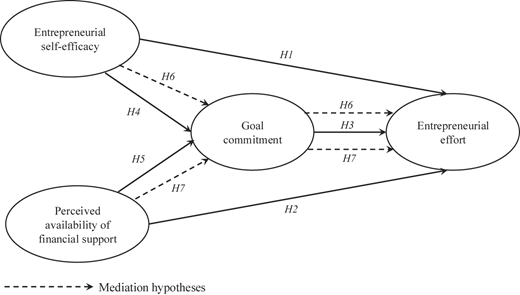
Entrepreneurial self-efficacy is positively associated with nascent entrepreneurial effort.
The entrepreneurial process takes place within a given context (Ferreira et al., 2023), and therefore, the perceived feasibility of a business project depends not only on perceptions about personal abilities and skills but also on perceptions of the environment (Vilanova and Vitanova, 2020). According to Davidsson (2015), when a business idea is evaluated, it is necessary to consider not only entrepreneurial self-efficacy but also the perceived favorability of environmental conditions. Therefore, to better approach the perceived feasibility of a business project, it is important to take into account not only personal factors but also contextual ones, particularly the availability of external financial resources (De Clercq et al., 2009).
The acquisition of financial resources plays a fundamental role in business gestation (Warhuus et al., 2021; Hechavarria et al., 2016). The lack of finance is often one of the main difficulties that nascent entrepreneurs face (Mergemeier et al., 2018). Those starting a new business are vulnerable to financial constraints and require substantial external financing to sustain the start-up process (Frid, 2014). Entrepreneurial effort significantly depends on the availability of financial resources, especially when the project is ambitious (Bowen and De Clercq, 2008). Therefore, an environment in which investors, governments, and other relevant ecosystem agents support entrepreneurial efforts by facilitating access to financial resources, would ultimately favor the creation of new companies (Hopp and Stephan, 2012; Edelman and Yli-Renko, 2010).
Acknowledging thus the importance of external financial support in determining the level of effort invested in new venture gestation processes, the following hypothesis is proposed:
The perceived availability of financial support is positively associated with nascent entrepreneurial effort.
2.2 Goal commitment and entrepreneurial effort
According to goal-setting theory, an individual will sustain effort toward goal achievement for a longer period as their commitment to the goal increases (Locke and Latham, 2002). Strong personal commitment is thus of vital importance in determining the amount and duration of effort invested, and therefore the probability of the goal being achieved, especially when it presents significant difficulty (Locke and Latham, 1990; Klein et al., 1999), as may be the case in business start-up (Uy et al., 2015).
In the framework of new venture creation, the degree of commitment determines the effort invested in the process (Hopp and Sonderegger, 2015). A highly committed entrepreneur is more likely to overcome the challenges and persist in the business endeavor, being less discouraged by irregularities in start-up progress (Uy et al., 2015) and thus reducing the likelihood that nascent entrepreneurs disengage from the process (Khan et al., 2014). Davidsson and Gordon (2016) found that the greater the commitment to the goal of creating a new company, the higher the persistence. In summary, entrepreneurs who are highly committed to the goal of creating a new venture are more likely to overcome the challenges of this process, exert significant effort, and persevere (Dimov, 2010).
In view of these considerations, this study proposes the following hypothesis:
Goal commitment is positively associated with nascent entrepreneurial effort.
2.3 Perceived feasibility and goal commitment
Given the determinant role of goal commitment in the effort exerted in the process of business gestation, it is important to understand what factors can promote or inhibit that commitment. Perceptions of feasibility seem to play a relevant role, as most people prefer to address feasible objectives (Oettigen et al., 2009), which in turn leads them to make a firm commitment toward these goals (Oettingen et al., 2001). Specifically in the framework of nascent entrepreneurship, De Clercq et al. (2009) argue that the individual's commitment to new venture creation depends on perceptions of its feasibility, both in the personal and environmental dimensions.
Regarding personal determinants, Latham and Locke (1991) claimed self-efficacy as one of the main factors that strengthen commitment. Individuals with high self-efficacy tend to set more ambitious targets and are more strongly committed to achieving them (Locke and Latham, 2002). Nascent entrepreneurship studies have evidenced a positive relationship between individuals' self-efficacy and their level of commitment to the goal of new venture creation (De Clercq et al., 2009; Hopp and Sondereger, 2015).
Therefore, this study hypothesizes that self-efficacy positively relates to goal commitment:
Entrepreneurial self-efficacy is positively associated with goal commitment.
As for the environmental dimension of feasibility, Locke and Latham (2002) argued that monetary incentives are very important in determining the level of goal commitment. In relation to this, De Clercq et al. (2009) corroborated that the perceived availability of external financial support influences nascent entrepreneurs' commitment to the goal of venture creation. When nascent entrepreneurs perceive available financial resources as insufficient, their determination to pursue the start-up objective is likely to decrease, as the required effort is perceived as unlikely to yield satisfactory results. On the contrary, when a favorable perception of financial support (public or private) is expected, nascent entrepreneurs are more likely to anticipate success (De Clercq et al., 2009), giving rise to their expectation of goal achievement and, hence, to their level of goal commitment.
In view of the foregoing, the following hypothesis is proposed:
The perceived availability of financial support is positively associated with goal commitment.
2.4 Mediation: perceived feasibility, goal commitment, and entrepreneurial effort
As described above, entrepreneurial self-efficacy and perceived availability of financial support may promote or inhibit the nascent entrepreneur's commitment to the goal of starting a business (De Clercq et al., 2009). In turn, this commitment determines the effort made in the business gestation process (Hopp and Sonderegger, 2015). As observed by Latham and Locke (1991), self-regulation is implicit in goal-setting theory, since the goals established by an individual do not drive performance by themselves, requiring additionally a certain degree of commitment to support and foster those actions directed towards the goals. Drawing on expectancy theory, De Clercq et al. (2009) argue that nascent entrepreneurs' expectancies, conceptualized as perceived feasibility of goal attainment, are key determinants of their commitment to achieving set objectives; this commitment, in turn, encourages greater effort (Hopp and Sonderegger, 2015).
In relation to personal feasibility, Bandura and Locke (2003) point out that favorable individuals' perceptions of self-efficacy influence perseverance, by operating in concert with goal setting within a socio-cognitive system of self-regulation. This regulatory mechanism might be the key to sustaining efforts directed to achieve goals (Bandura, 1991; Bateman and Barry, 2012). Individuals with high self-efficacy set higher goals and are simultaneously more committed, employing more effective strategies to sustain effort during task execution (Locke and Latham, 2002). Within the framework of the present study, it is therefore of interest to examine whether nascent entrepreneurs' commitment constitutes a self-regulatory mechanism that explains the effort they invest as a function of their entrepreneurial self-efficacy. Therefore, goal commitment is proposed as the mechanism through which entrepreneurial self-efficacy stimulates effort throughout the start-up process.
According to this, the following hypothesis is proposed:
Goal commitment positively mediates the relationship between entrepreneurial self-efficacy and entrepreneurial effort.
According to goal-setting theory, monetary incentives affect performance by impacting commitment (Locke and Latham, 2002). In this respect, De Clercq et al. (2009) argue that as the nascent entrepreneurs' perception of the availability of external financing is higher, they will be more strongly committed to the objective of venture creation. At the same time, this commitment will lead to an increased level of effort devoted to the start-up process (Hopp and Sonderegger, 2015). Mirroring the logic for self-efficacy, this environmental type of feasibility can also operate jointly with goal commitment in activating the self-regulation process explained above (Bandura, 1991), serving as the sustaining mechanism supporting nascent entrepreneurial effort.
Hence, it is suggested that the perceived availability of financial resources indirectly influences entrepreneurial effort through goal commitment. Accordingly, it is thus hypothesized that:
Goal commitment positively mediates the relationship between the perceived availability of financial support and entrepreneurial effort.
Figure 1 illustrates the relationships described above.
3. Methodology
3.1 Sample
The data for this empirical analysis were obtained from the Panel Study of Entrepreneurial Dynamics (PSED II), a research program developed in the United States to enhance understanding of the business start-up process by providing systematic data on the early stages of entrepreneurial activity and the mechanisms underlying nascent entrepreneurship (Reynolds and Curtin, 2008; Reynolds, 2017). PSED II began in 2005 and comprises a cohort of 1,241 nascent entrepreneurs who were followed prospectively through five annual follow-up interviews, allowing entrepreneurial activities and outcomes to be observed as they unfolded over time.
Although the PSED II data are not contemporaneous, their relevance is not tied to the specific historical context in which they were collected. As Hopp et al. (2024) argue, the age of a dataset does not inherently limit its usefulness when the research objective is to examine entrepreneurial processes rather than to describe current entrepreneurial conditions. The longitudinal and prospective design of the PSED II enables the analysis of within-entrepreneur dynamics across the entire venture gestation period, a feature that remains difficult to replicate with more recent cross-sectional or short-panel datasets.
This longitudinal depth is particularly relevant today, as many central mechanisms of entrepreneurship, such as cognitive drivers of action, cumulative effort, persistence, and the transition from nascent activity to venture creation, are processual in nature and unfold over extended periods. While newer datasets may better reflect contemporary technological or institutional environments, they rarely offer comparable temporal coverage for systematic examination of these mechanisms. Accordingly, the PSED II remains widely used in contemporary entrepreneurship research (e.g. Crawford et al., 2024; Colombo et al., 2024; Faridian et al., 2025). Moreover, the PSED II is particularly well-suited to examining how entrepreneurs' cognitive capital relates to outcomes in the nascent entrepreneurial process (Alomani et al., 2022). Its longitudinal structure allows baseline cognitive drivers to be linked to subsequent cumulative effort and venture creation outcomes across the full gestation period, supporting the suitability of the PSED II for addressing the research questions and for contributing to theory development in entrepreneurship research.
For the present research, the initial sample of 1,241 nascent entrepreneurs was subjected to various selection criteria. In the first step, nascent entrepreneurs who actively participated in the start-up process were selected, specifically those who had previously carried out at least two activities involving business creation (Reynolds, 2018). At this point, the risk of semi-survivor bias (Gartner and Carter, 2003) arose, a condition that may occur when nascent entrepreneurs have been engaged in business start-up processes for a long period, and consequently cannot be compared with those with less time and experience in the gestation process. To avoid this bias, following the approach described by Lichtenstein et al. (2007) and Honig and Hopp (2019), only those whose first business gestation activity occurred within the 24 months preceding the initial interview, which took place in 2005, were included in the study sample. Finally, given that this research focuses on the effort made by nascent entrepreneurs who successfully completed the process, that is, who achieved the goal of venture creation, the sample includes only those who had created a new company during the five-year lifetime of the PSED II project. After applying all phases of this selection process, the final study sample consisted of 151 nascent entrepreneurs.
Main characteristics of the sample are presented in Table 1. At the individual level, considering sex, 63.6% of participants were male, and 36.4% were female. As for the level of education, 45.1% had a university education, 18.5% had secondary education, and 9.9% had higher professional training. Regarding prior experience, 49.0% had previous experience in company creation, while 80.0% had past experience in the industry of the nascent venture. At the firm level, regarding sectoral activities, 85.4% of the nascent ventures corresponded to services, 9.3% belonged to the secondary sector, and 5.3% were classified as primary activities. As for the number of owners, 46.0% intended to carry out their project alone, without being part of a team. With regard to other market factors, 57.0% considered that they were offering a new product or service, and 33.1% perceived a high level of competition in their market.
3.2 Measures
The dependent variable (entrepreneurial effort) is measured as the total number of activities performed by the nascent entrepreneur during the start-up process, in line with previous studies on nascent entrepreneurship using PSED II data (Vilanova and Vitanova, 2020; Renko et al., 2012; Hopp and Sonderegger, 2015). This cumulative variable captures the breadth of start-up activities across the entire venture gestation process, in contrast to the independent variables, which were measured at an early stage and serve as predictors of subsequent effort.
All independent variables are measured on a 5-point Likert scale with values ranging from 1 (strongly disagree) to 5 (strongly agree). Entrepreneurial self-efficacy is assessed according to the scale proposed by Schjoedt and Craig (2017), based on the PSED II items Y6, Y7 and Y8. However, measurement validation analysis led us to exclude one of the items (Y8) due to cross-loading issues with the goal commitment construct, resulting finally in a scale with two items: Y6 “Overall, my skills and abilities will help me start this new business”, and Y7 “My past experience will be very valuable in starting this new business”. The perceived availability of financial support is measured with the items proposed by De Clercq et al. (2009), who considered two types of external financial support: public (P7 “State and local governments in your community provide good support for those starting new business”), and private (P8 “Bankers and other investors go out of their way to help new businesses get started”). Following previous studies (Hopp and Sonderegger, 2015; Khan et al., 2014), goal commitment is assessed on a two-item scale, Y9 “There is no limit as to how long I would give maximum effort to establish this new business”, and Y10 “My personal philosophy is to ‘do whatever it takes’ to establish my own business”.
This study included a set of control variables. First, following Cassar and Friedman (2009), it has been considered a set of sociodemographic variables: sex (dichotomous variable with the values 1 for male, and 2 for female), age (continuous variable) and education (ranging from 1 primary education to 7 postgraduate degree). Second, according to Cerqueti et al. (2020), whether the entrepreneur is the only owner or there is an entrepreneurial team might determine the amount of effort invested in the start-up process, consequently, it was considered the number of owners. Third, the duration (in months) of the nascent entrepreneur's involvement in business gestation was included since this factor is considered of crucial importance (Reynolds, 2007; Reynolds and Curtin, 2008; Hechavarria et al., 2012). Fourth, some sectoral and market factors are relevant. In this vein, a high level of competition has been described as potentially adverse for venture gestation (Khan et al., 2014), therefore, it was included the perceived level of competition in the sector, assessed in three levels, i.e. high, medium, and low. Additionally, those entrepreneurs who introduce pioneering and innovative products are more likely to express extreme certainty about their prospects for success than those seeking incremental innovations (Johnson et al., 2008); according to this, product novelty has been considered, measured in three levels by approaching whether all, some or none of the consumers consider this product new. In another vein, prior industry experience (in years) (Hopp and Sonderegger, 2015) and entrepreneurial experience (number of companies created previously) were included, as previous experience may influence the level of persistence presented by the nascent entrepreneur (Tietz et al., 2018), and hence the effort made. Finally, following Reynolds et al. (2004), it was considered the type of economic activity undertaken, with the inclusion of dummy variables for primary, secondary, and tertiary sectors (with secondary as the reference category).
3.3 Statistical technique
The evaluation of the measurement model and the testing of study hypotheses were performed using the variance-based SEM technique and the partial least squares (PLS) estimation method, with the statistical software package SmartPLS 3 (Ringle et al., 2015). PLS is highly suitable for the purposes of this research, given the test of simultaneous equations and the small sample size (Hair et al., 2021). The model was estimated using the PLS path modeling algorithm, with a maximum of 300 iterations and a stop criterion of 1 × 10⁻⁷. Missing data were handled using mean replacement. To test the significance of path coefficients and indirect effects, we applied a bootstrapping procedure with 5,000 subsamples, using the Bias-Corrected and Accelerated (BCa) Bootstrap for the confidence interval method with a two-tailed significance level of 0.05.
4. Results
Table 2 displays descriptive statistics and correlations, showing that entrepreneurial effort is positively correlated with entrepreneurial self-efficacy (p < 0.05). Concerning the control variables, entrepreneurial effort is also correlated with the level of education (p < 0.01), prior entrepreneurial experience (p < 0.05), and the size of the start-up team (p < 0.05). On the other hand, entrepreneurial self-efficacy presents a positive correlation with goal commitment (p < 0.01).
Model quality was assessed using standard evaluation criteria, including the reliability of the measurement model, which was evaluated using Cronbach's alpha and composite reliability (CR). The average variance extracted (AVE) was used to test for convergent validity (Table 3). The discriminant validity of the measures was also proved (Table 4). Conjointly, these analyses show that the model's reflective constructs obtain satisfactory values in all these criteria (Hair et al., 2021), thus confirming the reliability, convergent validity, and discriminant validity of the measurement model.
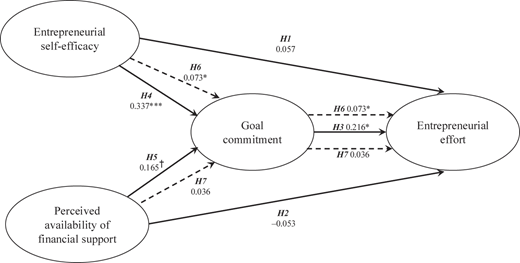
Figure 2 shows the results of the direct effects, also summarized in Table 5. According to these results, neither entrepreneurial self-efficacy (B = 0.057, n.s.) nor the perceived availability of financial support (B = −0.053, n.s.) are related to entrepreneurial effort, leading thus to a lack of evidence for hypotheses H1 and H2. Goal commitment is significantly related to entrepreneurial effort (B = 0.216; p < 0.05), which provides evidence for hypothesis H3. Finally, while entrepreneurial self-efficacy is positively related to goal commitment (B = 0.337; p < 0.001), perceived availability of financial support shows only a quasi-significant relationship (B = 0.165, p < 0.1). Therefore, hypothesis H4 is supported, with no evidence found for hypothesis H5.
The mediating effects were also tested (Table 6). To test the significance of the indirect effects (A→B→C), a bootstrapping procedure has been performed in SmartPLS (Hair et al., 2021). The results show that entrepreneurial self-efficacy has a positive and significant indirect effect on entrepreneurial effort through goal commitment (B = 0.073, p < 0.05), providing evidence for H6. However, the expected indirect effect of the perceived availability of financial support is not statistically significant (B = 0.036, n.s.), leading to a lack of support for H7. In addition, we examined the three fundamental paths involved in each of the mediation effects: (1) the association between the independent variable and the mediator (A→B), (2) the mediator and the dependent variable (B→C), and (3) the independent and dependent variables (A→C). This information is summarized in Table 6. Regarding H6, entrepreneurial self-efficacy is significantly associated with goal commitment (B = 0.337, p < 0.001), and in turn, goal commitment significantly relates to entrepreneurial effort (B = 0.216, p < 0.05). However, the direct path from entrepreneurial self-efficacy to entrepreneurial effort is not significant (B = 0.057, n.s). These results suggest full mediation in the relationship between entrepreneurial self-efficacy and entrepreneurial effort through goal commitment (Baron and Kenny, 1986; Zhao et al., 2010). As for H7, the direct path from perceived availability of financial support to goal commitment is significant at 10% (B = 0.165, p < 0.1), while the direct path to entrepreneurial effort remains non-significant (B = −0.053, n.s). Although goal commitment is significantly associated with entrepreneurial effort (B = 0.216, p < 0.05), there is no support for accepting full mediation, and consequently, the overall indirect effect of perceived support through goal commitment is not statistically significant.
As for the control variables included in the model, we found significant direct effects on entrepreneurial effort for level of education (B = 0.256, p < 0.01) and number of owners (B = 0.180, p < 0.01), with prior entrepreneurial experience showing a quasi-significant relationship (B = 0.124, p < 0.1).
Finally, regarding model fit, SRMR, R2 values, path coefficients, and their level of significance were used to measure the explanatory power and structural quality of the model (Chin, 2010). First, the SRMR value is 0.05, far below the recommended limit (less than 0.08, Hu and Bentler, 1999). Regarding the level of variance explained, the analysis shows an R2 value of 0.194 for entrepreneurial effort and 0.136 for goal commitment, which, according to Falk and Miller (1992), are good, considering that the study focuses on individual behavior (Hair et al., 2013). Moreover, this value is in line with the findings of previous studies of entrepreneurial effort by nascent entrepreneurs (e.g. Renko et al., 2012). Finally, path coefficients of around 0.2 are considered economically significant (Benítez-Amado and Ray, 2012). In summary, the values obtained for these goodness-of-fit indicators suggest that the proposed model has good overall explanatory power and satisfactory structural properties. Furthermore, multi-collinearity issues in the model can be disregarded, as the variance inflation factors (VIFs) are far below 10 (Hair et al., 2021).
5. Discussion
This study aims to enhance our understanding of a critical stage in the entrepreneurial process, specifically new venture gestation. It provides new insights into how perceived feasibility affects nascent entrepreneurs' commitment to starting a business and the effort they invest in this process. Moreover, the research clarifies the relationships among perceptions of feasibility, goal commitment, and entrepreneurial effort that drive entrepreneurs to complete the gestation phase of the firm successfully, within a sample of nascent entrepreneurs who achieved venture creation.
The results of the research did not confirm the existence of a direct relationship between entrepreneurial self-efficacy and entrepreneurial effort (H1). This implies that the effort to start a business is not directly driven by the belief of having the capabilities to start a business. Previous studies on nascent entrepreneurship have also found no empirical support for the impact of perceived self-efficacy on the continuation of the entrepreneurial process. For example, Hechavarria et al. (2012) found no evidence that entrepreneurial self-efficacy positively influenced the likelihood of nascent entrepreneurs persisting in their project to create a new company, compared to quitting. Moreover, Renko et al. (2012) found no significant relationship between skill expectancy and entrepreneurial effort.
However, there is evidence that goal commitment positively affects entrepreneurial effort (H3) and that it also has a mediating effect between entrepreneurial self-efficacy and entrepreneurial effort (H6). These results show the relevant role of commitment to the objective of venture creation in order to sustain the effort during the gestation process. In addition, it shows that although entrepreneurial self-efficacy does not directly influence the entrepreneurial effort made by nascent entrepreneurs, it does so indirectly through goal commitment. These results represent an important contribution to the literature on nascent entrepreneurship, given that although the relationship between entrepreneurial self-efficacy and nascent entrepreneurial effort seems to be unclear, the findings do establish and prove the key mediating role of goal commitment. In other words, entrepreneurial self-efficacy may be channeled into entrepreneurial action and effort through goal commitment, which operates as a self-regulatory mechanism.
Commitment to the goal of creating the business, understood as determination towards that achievement, is positively influenced by entrepreneurial self-efficacy (H4). This is in line with previous research suggesting that commitment to new venture creation depends on entrepreneurs' perception of their abilities and knowledge (De Clercq et al., 2009) and corroborates the view that self-efficacy plays an important role in reinforcing goal commitment (Bandura and Locke, 2003; Locke and Latham, 2002).
Regarding the perceived availability of financial resources, the research results have found neither a direct relationship with entrepreneurial effort (H2) nor an indirect relationship through commitment to the goal (H7). First, this highlights the greater influence of the entrepreneur's self-efficacy over the perception of available financial resources in the decision to persist in the effort of venture creation. While self-efficacy is likely a relatively timeless personal driver, perceptions of financial feasibility may be more context-dependent, which could help explain their weaker role. Moreover, this could be especially true in the context of successful founders, who may have persisted in the gestation process until completion, regardless of funding feasibility perceptions. On the other hand, the operationalization of the financial feasibility variable aggregates public and private funding availability, which may have masked opposing effects and thus contributed to the lack of empirical support. In relation to that, De Clercq et al. (2009) show a positive effect of private financial support and a negative impact in the case of public funds on goal commitment in nascent entrepreneurs. This suggests that the perceived availability of financial resources may have varying effects on the commitment to starting the business. Therefore, further studies are needed to investigate this relationship in more depth.
5.1 Theoretical implications
From a theoretical perspective, this study enables a better understanding of the nascent entrepreneurial process by analyzing the cognitive mechanisms involved in determining the effort made by entrepreneurs. According to the results and in line with some authors (e.g. Renko et al., 2012), the direct relationship between entrepreneurial self-efficacy and entrepreneurial effort has not been statistically confirmed. However, this study offers insights into the implicit self-regulatory mechanisms that favor this relationship, in which commitment emerges as a fundamental aspect in explaining the effort put in the venture gestation process. More specifically, goal commitment helps founders focus attention on core tasks, persist through setbacks, and maintain motivation during periods of slow or uncertain progress, thereby translating cognitive beliefs into cumulative entrepreneurial action. Locke and Latham (2002) argue that the concept of self-efficacy from social-cognitive theory (Bandura, 1977, 1989) is important in goal-setting theory (Latham and Locke, 1991), since the connection that it establishes with commitment constitutes a self-regulatory mechanism that explains the effort invested in the execution of tasks (Bandura and Locke, 2003). In relation to the latter, and with the aim of exploring the mechanisms that explain effort in those entrepreneurs who have successfully completed the creation process, the present study determines that entrepreneurial self-efficacy influences the effort invested through the self-regulatory element exerted by goal commitment.
In this respect, too, Van Eerde and Thierre (1996) have highlighted the importance of using both expectancy theory and goal-setting theory to explain certain behavioral patterns, as is the case of goal commitment (e.g. De Clercq et al., 2009). In this study, the above theoretical postulates are transferred to the field of nascent entrepreneurship by corroborating the hypothesis that the relationship between entrepreneurial self-efficacy and goal commitment of nascent entrepreneurs constitutes a self-regulatory mechanism that explains the effort invested in venture gestation processes.
5.2 Practical implications
This research focuses on the mechanisms that explain the effort of entrepreneurs who have successfully established a new company. From a practical perspective, these results have policy, educational, and social impact implications in promoting entrepreneurship and economic development. Entrepreneurship education from early stages should strengthen self-efficacy, thus fostering greater commitment to the entrepreneurial process. By developing these qualities early on, individuals are more likely to persist in their goals, overcoming challenges with dedication, discipline, and perseverance. Additionally, these people may also inspire others and create a lasting impact on their projects and communities.
From a practical standpoint, the results suggest that support programs for nascent entrepreneurs may be more effective when they focus on reinforcing commitment during the early stages of venture gestation. More concretely, training initiatives aimed at strengthening entrepreneurial self-efficacy among nascent entrepreneurs at different stages of the start-up process are revealed as necessary to maintain a commitment to the venture creation goal, and this, in turn, may encourage efforts into firm emergence. Accordingly, programs that emphasize skill development, mentoring relationships that provide ongoing feedback and encouragement, and goal-scaffolding can help entrepreneurs translate confidence into sustained effort over time. As levels of entrepreneurial self-efficacy can be modified and enhanced through institutional actions (Boudreaux et al., 2019), this objective should be maintained and reinforced in the political agenda across various settings, such as universities, business incubators, and acceleration programs.
Second, according to our results, the existence of private and public funding does not have a direct effect on the effort devoted by nascent entrepreneurs to the completion of the gestation process and seems to be insufficient to maintain their determination to set up a business. This finding may challenge the assumption that increasing access to financial resources or highlighting funding opportunities will automatically translate into greater entrepreneurial engagement or effort. While access to funding remains a critical component of new venture viability, our results suggest that it may not directly motivate effort in the early stages of venture gestation. This result offers a particularly relevant perspective in the context of early-stage grant programs, such as “pitch and win” competitions, where the emphasis is placed on financial incentives rather than the development of key cognitive skills, like belief in one's entrepreneurial capabilities or long-term goal commitment. Therefore, in these contexts, policymakers and practitioners might consider placing more focus on promoting mentorship programs or peer learning communities as ways to reinforce nascent entrepreneurs' confidence and determination, thereby fostering entrepreneurial action, rather than emphasizing financial incentives alone.
5.3 Limitations and future research
Like any research, this study is not exempt from limitations. The data refers to the period 2005–2011, as it is determined by the timeframe in which the PSED II project was conducted. Despite this, PSED II remains, to date, the only comprehensive dataset dedicated to monitoring nascent entrepreneurial processes from a dynamic perspective (Alomani et al., 2022). Although the PSED II remains widely used in recent research (e.g. Colombo et al., 2024; Crawford et al., 2024), future research could consider using more contemporary samples. In line with this, and given the period during which the data were collected, the PSED II does not capture recent technological developments such as crowdfunding or the use of cryptocurrencies, nor other modern financial sources such as angel investors, all of which have lowered traditional barriers to financing (Warhuus et al., 2021). Therefore, the study may limit the generalizability of findings related to perceived financial feasibility to contemporary settings. Moreover, although the activities in which effort is invested during the start-up process may be conceptually similar over time, the PSED II design does not address newer forms and formats (Warhuus et al., 2021), such as digital lean experimentation or platform-based venture launching (Camps et al., 2026; Sánchez-García et al., 2025; Bejjani et al., 2023). Future research may therefore consider these emerging dynamics in the conceptualization of nascent entrepreneurial effort and in the evaluation of how the external financial resources shapes specific aspects of the venture gestation process.
Although one might expect that greater external funding would increase the commitment of nascent entrepreneurs and hence their efforts, these relationships are not significant in this research. As noted in the discussion section, the focus of this study on successful nascent entrepreneurs, together with the use of an aggregate operationalization to conceptualize and measure this variable, may help explain this null finding. In addition, the financial context prevailing at the time of data collection, as well as the potential varying relevance of financial feasibility across industries, may constitute further explanations for the lack of empirical support for the environmental feasibility variable. Finally, our environmental feasibility variable refers only to the availability of financial resources, given the limitations of the PSED II data and following previous research (De Clercq et al., 2009). Accordingly, future research should examine this relationship in greater depth, for example, by developing more comprehensive measures of financial feasibility. Additionally, and in relation to this, the present study does not capture other relevant environmental feasibility dimensions such as regulatory context, access to networks, or technological infrastructure, which should be addressed in future research to better seize external feasibility in venture creation processes.
Furthermore, Marshall et al. (2020) argue that access to financial resources helps nascent entrepreneurs feel more confident in their abilities and skills to become successful entrepreneurs. In relation to this, the perception of a more resourceful environment may lead nascent entrepreneurs to feel more confident in their ability to access the essential resources for the success of their projects. This idea suggests complementarities and interrelationships between the two perceptions of feasibility, which could be explored in future research aimed at explaining commitment and effort among nascent entrepreneurs. To date, feasibility beliefs have been analyzed separately, which posits the interrelated view as a promising approach to provide a more complete understanding of the mechanisms underlying entrepreneurial behavior in the nascent phase of venture creation.
It should also be acknowledged that, as in most quantitatively oriented research, our measurement instruments are constrained by their operationalization and validation procedures, potentially resulting in some loss of measurement precision. In addition, with respect to the temporal measurement of our key variables, feasibility perceptions and goal commitment are measured at a single point in time, whereas entrepreneurial effort is captured as a cumulative measure across the venture gestation process. First, although our feasibility and commitment variables are approached as baseline factors —measured at an early stage of the start-up process and expected to shape subsequent cumulative effort— future studies on nascent entrepreneurial effort should account for potential fluctuations in self-regulatory processes and their outcomes over time in order to provide a more dynamic perspective of the key variables and mechanisms identified in the present study. Moreover, while the cumulative nature of the effort variable introduces a temporal dimension into the model, it constrains its interpretation to the breadth of activities undertaken rather than their depth or the time invested. Taken together, these considerations call for caution when interpreting our findings from a dynamic perspective.
Finally, this study examines entrepreneurial effort within a sample of nascent entrepreneurs who achieved venture creation. Future research may compare these mechanisms between successful nascent entrepreneurs and those who do not complete the new venture creation process, in order to get a deeper understanding of how this cognitive, self-regulatory process sustaining entrepreneurial effort may play a different role depending on the new venture gestation result.
6. Conclusion
The study of factors that determine the completion of venture creation processes has been extensively studied in entrepreneurship literature (Müller et al., 2023). However, the impact and interrelationships that individual and contextual factors have on these processes still require a great deal of research (Karpinskaia et al., 2023). From the individual level, this paper focuses on the perceptions of entrepreneurs and helps to understand how entrepreneurial self-efficacy may crucially determine the effort devoted to the entrepreneurial process through goal commitment. The research results suggest that the effort invested in the successful completion of the venture gestation process is based to a greater extent on the entrepreneurs' perception of their own capabilities than on the perceived availability of external financial resources. Furthermore, the findings confirm that entrepreneurs' commitment to create the company is a factor that explains the self-regulation of the effort during the start-up process. From the perspective of policy implications and given that business creation goals are frequently unfulfilled despite the public investments made, the insights from the present research can inform and guide policymakers in optimizing the allocation of resources for the promotion of entrepreneurial activity. In this sense, from the point of view of entrepreneurial education, it is important to identify and understand the self-regulatory mechanisms that implicitly explain the behavior patterns that foster success in future nascent entrepreneurs, as is the case with entrepreneurial effort.