


Introduction
In recent decades, the business environment has been characterised by, amongst other phenomena, the liberalisation of nations and their increasing participation in the global economy (Aulakh and Kotabe, 2008). With this increase in internationalisation (Rodrigues and Dieleman, 2018), the interest in the field of international entrepreneurship (IE) has grown (Buccieri et al., 2020; Etemad et al., 2021; Razavi Hajiagha et al., 2021). IE is a hybrid of internationalisation and entrepreneurship that involves making judgemental decisions about the coordination of scarce resources across international boundaries (Dana et al., 2009). Developing a model of the forces influencing the speed of internationalisation, Oviatt and McDougall-Covin (2005) define IE as “the discovery, enactment, evaluation and exploitation of opportunities – across national borders – to create future goods and services”. In other words, entrepreneurial activities in an existing organisation create a new business to access the global markets to promote internationalisation.
In the IE literature, scholars have focussed on factors that facilitate internationalisation: some on the country attributes (Bruton et al., 2008; Sadeghi et al., 2019b), others on firm attributes (Davcik et al., 2021; Zahra and Garvis, 2000) and still others who have identified individual attributes (Covin and Miller, 2014; Hutchinson et al., 2006). Those in the last group have devoted special emphasis on the importance of the entrepreneur in the international development of the ventures and explored entrepreneurs' general attitude, motivation, orientation, experience and network (Andersson, 2004). In this regard, the entrepreneur is seen as a proactive individual especially crucial for firms in the early phase of the internationalisation process, especially in growth-oriented industries. Literature emphasised the entrepreneurial behaviour of individuals such as involving risk-taking, innovativeness, international vision, motivations etc. which contribute as catalysts for internationalisation of firms (Jafari-Sadeghi et al., 2020; Oviatt and McDougall-Covin, 1997). For instance, motivation affects entrepreneurial behaviour in three harmonious manners: first, it influences the choice of the individual (whether to do an action) and on the priorities (e.g. the direction of the action); second, it influences the intensity of the action, based on the importance or value that the action has for the entrepreneur and third, it impacts the persistence of action, based on the clearness of the path to achieving this value (Braga et al., 2014; Sadeghi et al., 2019a).
Statistics of the submissions
In this special issue, we received a total number of 64 original submissions of which 10 were accepted (rejection rate 84, 13%). The included papers contribute to IE research from behavioural perspectives. Each paper makes unique additions to our theoretical and empirical understanding of the extent to which behavioural perspectives influence the operations of small internationalisers. This high level of interest in our call for paper highlights the importance of the topic and confirms that behavioural perspectives are our crucial elements to be considered when small and medium-sized enterprises (SMEs) intend to operate beyond national boundaries. In total, this special issue found interest from different locations on the planet as the diversity of submissions spread from 29 countries on diverse continents. Amongst accepted papers, 33 authors from 13 different countries have contributed to this special issue. Table 1 highlights the country of origin for the submissions in this special issue.
Manuscript accepted by the country of origin
| Country/Region | Accept | Reject | Total | Accept ratio |
|---|---|---|---|---|
| Australia | 0 | 1 | 1 | 0.00% |
| Brazil | 0 | 1 | 1 | 0.00% |
| Canada | 2 | 2 | 4 | 50.00% |
| China | 1 | 6 | 7 | 14.29% |
| Finland | 0 | 2 | 2 | 0.00% |
| Ghana | 0 | 1 | 1 | 0.00% |
| India | 0 | 8 | 8 | 0.00% |
| Indonesia | 0 | 1 | 1 | 0.00% |
| Iran | 1 | 2 | 3 | 33.33% |
| Ireland | 0 | 2 | 2 | 0.00% |
| Israel | 0 | 1 | 1 | 0.00% |
| Italy | 0 | 1 | 1 | 0.00% |
| Kenya | 0 | 1 | 1 | 0.00% |
| Korea | 0 | 1 | 1 | 0.00% |
| Lebanon | 1 | 1 | 2 | 50.00% |
| Malaysia | 0 | 2 | 2 | 0.00% |
| Mexico | 0 | 1 | 1 | 0.00% |
| The Netherlands | 0 | 1 | 1 | 0.00% |
| Norway | 0 | 1 | 1 | 0.00% |
| Oman | 0 | 1 | 1 | 0.00% |
| Pakistan | 0 | 1 | 1 | 0.00% |
| Spain | 0 | 2 | 2 | 0.00% |
| Thailand | 0 | 1 | 1 | 0.00% |
| Turkey | 0 | 2 | 2 | 0.00% |
| United Arab Emirates | 0 | 2 | 2 | 0.00% |
| The United Kingdom | 3 | 3 | 6 | 50.00% |
| The USA | 2 | 2 | 4 | 50.00% |
| Vietnam | 0 | 2 | 2 | 0.00% |
| Zimbabwe | 0 | 1 | 1 | 0.00% |
| Total | 10 | 53 | 63 | 15.87% |
Contributing papers
These 11 papers in this special issue address 4 main research themes: (1) individuals' behaviour towards entrepreneurial internationalisation; (2) women in international SMEs; (3) international entrepreneurship in shock, uncertainty and crisis and (4) SMEs' behaviour in the international context (Figure 1).
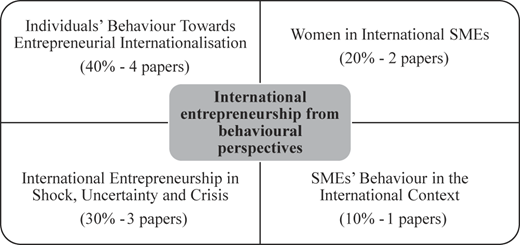
Theme 1. Individuals' behaviour towards entrepreneurial internationalisation
The first theme sheds the light on the impact of individual behaviour and characteristics of entrepreneurs in their international journey. Although it reflects the significant role of SME managers in the decision to expand beyond national boundaries (Jafari-Sadeghi, 2021), more investigation is required to explore international entrepreneurial characteristics that drive entrepreneurs into international markets. As such, four papers in this issue focus on the individual-level factors.
In the paper entitled “A personal values view of international entrepreneurial intention”, Ammeer et al. (this issue) use a multi-group analysis to model various dimensions of personal values as predictors of entrepreneurial internationalisation. In this regard, they have taken advantage of cross-sectional data and employed a sample of 504 students spread across 6 universities in the context of Mauritius. The findings of structural equation modelling highlight that IE is positively associated with openness to change and self-enhancement whilst its relationships with self-transcendence and conservation are found to be insignificant. Their multi-group analyses stress that there are significant and meaningful variations in the individual correlations across ethnic and gender groups. The practical contributions of this research posit that universities need to focus on the international entrepreneurial behaviour of students (as prospective international entrepreneurs) to contemplate social and personal antecedents.
In their research about “Causal modelling of failure fears for international entrepreneurs in tourism industry: a hybrid Delphi-DEMATEL based approach”, Hashemi et al. (this issue) disentangle the concept of the fear of failure in the context of IE. Building on the expert-based data, authors explore various types of fear that play as mental barriers for entrepreneurs to exploit international opportunities. In this regard, the authors concentrate on the tourism industry in the emerging economy of Iran. Hence, they filter the top strongest types of fear by Delphi synthesis, which is later analysed by the decision-making trial and evaluation laboratory (DEMATEL) method to identify their importance and ranking. The findings highlight that “fear of losing credit” and “unclear situation” drive the “fear of future”, as it is justified by both the Iranian culture and the ambiguity about the future of the tourism industry in Iran. Furthermore, using a sample of 92 small ventures in the USA, Di Gregorio et al. (this issue) explore the international business opportunity recognition and development. In the paper entitled “International business opportunity recognition and development”, authors draw on entrepreneurial judgement perspective and propose a framework that incorporates three inclusive sets of drivers such as international experience, social networks and a proactive mindset. As such, they argue that such factors drive entrepreneurial judgement towards international business opportunities through the identification of both first-person and third-person opportunities.
In the paper “How does international entrepreneurial orientation influence firms' internationalization? – An exploration with Indian software product entrepreneurs”, Vrontis et al. (this issue) proposed a multi-perspective framework to explore different determinants that the IE decision. They argue that the unfavourable economic and political situation led to the low level of international entrepreneurial intention amongst Lebanese. That is, building on the sample of 150 young Lebanese entrepreneurs, they used structural equation modelling to disentangle what drives young individuals to undertake their first international business venturing experience. Their findings suggest that entrepreneurial intention is driven by the context and the motivation of youth. However, they found that professional experience and risk awareness are most likely to make a negative impact on entrepreneurial intention, whereas education and social norms are found to have insignificant impacts.
Theme 2. Women in international SMEs
Another important theme of research in this special issue highlights the contributions of females. Two papers in this special issue touch on this important topic.
Wang et al. in “The female director and firm's international entrepreneurship” focus on the differences in the international decision-making amongst male and female entrepreneurs. As such, they take advantage of the neo-institutional theory and entrepreneurial decision-making and examine the link between SMEs' intensity of IE and female directors as well as the moderating role of state ownership and ownership concentration. The synthesis of the data from Chinese SMEs between 2009 and 2018 reveals that women-managed SMEs are less likely to go internationally. They also found that ownership concentration and state ownership respectively weaken and strengthen the relationship between the intensity of IE and female directors.
In their paper “Careers of commercially successful female entrepreneurs in the context of underdeveloped markets and weak institutions”, Sarpong et al. (this issue) explore the extent to which female entrepreneurs undertake strategies to start their desired career in weak institutional environments and underdeveloped markets. In doing so, they rely on the qualitative research design about a total number of 20 female entrepreneurs in Nigeria. Thus, their findings reveal that the desirable career of female entrepreneurs in an under-developed context is characterised by heterogeneous characteristics, which determine the reason for starting and exiting entrepreneurial activities. They are “Grace under pressure” in the process of decision-making, “Observing and playing business”, a hook to the “Pierian spring” of entrepreneurship and traipsing the “path less travelled”. In doing so, they shed the light on the successful experience of female IE in under-supported contexts.
Theme 3. International entrepreneurship in shock, uncertainty and crisis
The third theme of this special issue deals with articles about the behavioural perspectives of entrepreneurial internationalisation during the crisis, shock and high levels of uncertainty. The recent COVID-19 pandemic highlighted the necessity of entrepreneurs' appropriate reaction to the uncertainty as necessary for the survival of the fragile SMEs (Riahi Dorcheh et al., 2021; Thukral, 2021). This special issue includes three papers that discuss the behavioural aspects of IE against shocks, uncertainty and crisis.
In this regard, in their paper entitled “The impact of the international crisis on the entrepreneurial intentions of refugees”, Welsh et al. explore the entrepreneurial intention amongst individuals under crisis. They focus on the Syrian refugees in Jordan as well as Jordanians who intend to start a venture during the COVID-19 pandemic. They found that entrepreneurial intention is related to the tolerance for risk and self-efficacy as well as net desirability for self-employment. Also, their findings highlight that the Jordanian citizens and Syrian refugees are significantly different regarding self-efficacy and risk-taking.
The paper “The malleability of international entrepreneurial cognitions: a natural quasi-experimental study on voluntary and involuntary shocks” by Clark et al. explores the durability of international entrepreneurial cognitions during the COVID-19 crisis. By focussing on psychological dynamics underpinning, they investigate the extent to which advanced business education influences the extent of international entrepreneurial-orientation disposition and entrepreneurial intentions. They focus on the pre- and post-COVID-19 panel and take advantage of the OCEAN personality assessment to identify the idiosyncratic cognitive impact of the COVID-19 crisis. Their findings suggest that when entrepreneurs perceive high levels of COVID-19 psychological impact, they tend to be less proactive and risk-taker, whereas the low levels of psychological impact constitute higher international entrepreneurial orientation disposition through business education. Thus, the empirical analysis of this paper provides insights on the resilience of entrepreneurial dispositions under planned (voluntary) intervention as well as unplanned (involuntary) externally induced shock.
Razavi Hajiagha et al. in “International entrepreneurial startups' location under uncertainty through a heterogeneous multi-layer decision-making approach: evidence and application of an emerging economy” stress that science and technology parks suffer from limited capacity which makes them fragile under uncertainty. They suggest certain locational characteristics to select the “best location” for international entrepreneurial pharmaceutical start-ups in the context of high pressure such as the COVID-19 crisis by using a combination of the Delphi approach and the multi-criteria decision-making (MCDM) method to calculate the score and ranking of each alternative location for international start-ups.
Theme 4. SMEs' behaviour in the international context
The last theme of this special issue discusses the entrepreneurial behaviours of international small firms. The liability of the smallness makes SMEs highly dependent on the central decision-makers (Jafari-Sadeghi et al., 2021). Hence, the behaviour of SMEs reflects the behaviour of entrepreneurs.
Crick and Crick in “Coopetition and international entrepreneurship: the influence of a competitor orientation” build on the stakeholder perspective of resource-based theory and shed the light on the complexity of the performance-enhancing nature of competition amongst small internationalisers. Focussing on the wine industry, the research collects primary data from semi-structured interviews with international entrepreneurs in New Zealand. The paper explores the role of “competitor orientation” when decision-makers deal with their short-term weaknesses and strengths, long-run strategies and capacities and potential competitors. The authors propose a 2 × 2 matrix that incorporates a narrow vs augmented product portfolio and low- vs high-export intensity to choose alternative coopetition business models.
Concluding remarks
This special issue widens our understanding of the extent to which the behaviour, actions and entrepreneurial intention of SMEs' central decision-makers impact their cross-border activities. It is a collection of prominent articles highlighting various aspects of international entrepreneurial behaviour in four themes such as (1) individuals' behaviour towards entrepreneurial internationalisation; (2) women in international SMEs; (3) international entrepreneurship in shock, uncertainty and crisis and (4) SMEs' behaviour in the international context. Given that SMEs are highly dependent on the individual-level micro-foundations (Glavas and Mathews, 2014), understanding how and under what conditions their managers successfully drive small ventures towards international markets. This is yet an ongoing debate in the IE literature; however, we believe that the published articles explore crucial dimensions of the topic, and we thank them for their precious contributions to this special issue.

