


This paper investigates how to embrace an “either/and” logic, borrowed from the Yin-Yang epistemological system, to provide a different perspective to the entrepreneurial orientation (EO) research and reframe its paradoxes and dilemmas.
The study adopts the duality map for paradox management, a tool designed to recognize and measure the threshold as a range within which opposite elements can be properly balanced for a healthy tension, to show that the apparently contradictory poles of the EO construct can co-exist within the same organization depending on specific situations, contexts and time.
By using duality maps as working models, the study shows that, in real life, the apparently contradictory poles of the EO construct co-exist in a healthy tension within the same organization and are managed in a constant process of dynamic balancing over time.
The present paper contributes to the EO research by providing a different perspective to the EO concept, thus filling the gap on how to go beyond the traditional polarized (“either/or”) paradigm that has dominated the EO literature since its origins.
EO is dominated by a polarized view that sees opposites as sharp dichotomies. However, the complexity and variability of today’s interconnected world are pushing scholars to move from this hegemonic Western perspective by adopting different cultural and philosophical approaches able to balance the inherent duality of the EO concept.
Introduction
Most parts of the main theories in the organization and management fields have been dominated by Western cultural, philosophical and research perspectives (Barkema et al., 2015; Jing and Van de Ven, 2014; Luo and Zheng, 2016). This epistemological system and its attempts to firmly establish simplicity and certainty as a way to reduce complexity and volatility have resulted in the dramatic advances in modern sciences throughout the Western world (Li, 2016). This helps explain, at least in part, why, despite the tremendous internationalization of economic activities and ideas of the last decades, management and organization scholars have mostly used a Western lens to describe and examine business phenomena around the world.
Nonetheless, complexity and volatility have surged at a staggeringly pace in today’s interconnected world. This has generated paradoxes and dilemmas that the Western approach alone is not sufficient to manage anymore (Li, 2016; Luo and Zheng, 2016). Hence, in the last few years, the calls to go beyond this dominant view and integrate different institutional, cultural and philosophical traditions in a multi-perspective approach have increased exponentially (e.g. Barkema et al., 2015; Fang, 2012; Li, 2016; Luo and Zheng, 2016; Tsui, 2007). In this context, the Eastern epistemological wisdom of Yin-Yang balancing has arisen as a fundamental perspective to better understand the paradoxes and tensions of today’s complex and competitive business environments (e.g. Fang, 2012; Faure and Fang, 2008; Li, 2016; Pauluzzo et al., 2018).
The Yin-Yang epistemological system emphasizes the interdependence of “opposing voices” and supports their reconciliation to create a dynamic unity (Chen, 2002). Hence, it offers a different view compared to the traditional Western approach that considers paradox as being characterized by distinctive and exclusive opposites (Chen, 2008; Chen and Miller, 2010; Poole and Van de Ven, 1989; Smith and Lewis, 2011). Indeed, the Western system rests on the Aristotelian formal logic, which considers mental opposites as mutually exclusive discrete categories and rejects paradox in a sort of “explicit dualism” (“either/or” logic) (Brenner, 2008; Li, 2012). Similar to this system, the Hegelian dialectical logic temporarily tolerates opposite elements and paradox, but it eventually denies them through a “sublation” process, according to which contradictory elements are both preserved (“both/and”) and abolished (“either/or”), in a dialectical spiral that leads to an “implicit dualism” (“both/or” logic) (Brenner, 2008; Smith and Lewis, 2011). Both Aristotelian and Hegelian logics reject the eventual possibility of paradox (Li, 2016). Hence, we need a system able to appreciate and accommodate it in order to reach a holistic understanding of our complex reality. By considering the co-existence of opposite elements, the Yin-Yang balancing can thus reframe paradox from a negative problem to a positive solution, since it views the opposite sides of any paradox as a partial tradeoff/synergy within a range of holistic and dynamic balancing (“either/and” logic) (Li, 2012; Luo and Zheng, 2016).
The Yin-Yang perspective has been widely applied to different concepts in the field of business strategy and management, from quality management (Pina e Cunha et al., 2002), to knowledge management (Chae and Bloodgood, 2006), conflict management (Du et al., 2011), power and trust relationships (Horak and Long, 2018), strategy (Chin et al., 2018) and ambidexterity (Jiang et al., 2021; Tang et al., 2021). In this regard, among the different theories developed by the strategy and entrepreneurship literature in the last decades, entrepreneurial orientation (EO) appears to be one of the few examples of stabilized concepts in the management field (Basso et al., 2009). EO represents a traditional North-American construct, introduced in Canada (Khandwalla, 1977; Miller and Friesen, 1982; Miller, 1983) and then developed in the USA (Covin and Slevin, 1989; Lumpkin and Dess, 1996). Since then, further studies have mostly strung along this dominant approach. However, in the last few years, the interest in moving from the hegemonic North-American perspective to reconceptualize EO and embrace different socio-cultural views has increased steadily (e.g. Gupta and Gupta, 2015; Wales et al., 2019). The EO concept would benefit from the adoption of alternative theoretical cultural and contextual approaches able to reveal the different configurations of the EO dimensions and how they can be differentially related to performance (Kraus et al., 2018; Rauch et al., 2009).
This study addresses this issue by using the epistemological system of Yin-Yang balancing to show that the apparently contradictory poles of the EO construct can co-exist within the same organization depending on specific situations, contexts and time. In particular, the study adopts Li's (2016) duality map for paradox management, a tool designed to recognize and measure the threshold as a range within which the opposite elements can be properly balanced for a healthy tension. A conceptual framework of the research process is reported in Figure 1.
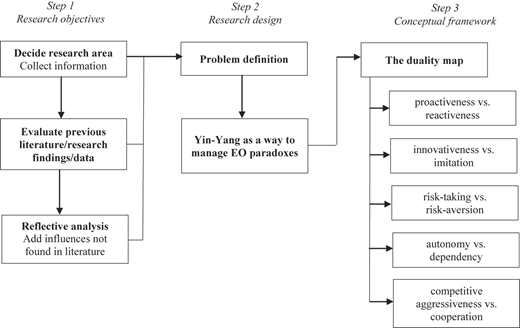
The current paper is structured as follows. The first section examines the epistemological system of Yin-Yang balancing as a way to provide an alternative to the Western logic systems in the area of management. Next, the study describes the evolution of the EO concept, questioning its dominant North-American perspective. Then, the paper discusses how the Yin-Yang balancing can be applied to the EO concept to solve paradoxes and dilemmas that may arise within and outside the organization’s boundaries. The concluding section considers the implications and limitations of this study and the need for further research.
Theoretical background
The evolution of the entrepreneurial orientation concept
Since Mintzberg's (1973) classic study on the modes of strategic decision-making, the first conceptualizations of EO have been based on a dualistic view, according to which entrepreneurial firms have been rigidly and persistently opposed to non-entrepreneurial (often called conservative) firms (Khandwalla, 1977; Miller, 1983; Miller and Friesen, 1982). According to this approach, the term “entrepreneurial” only refers to those firms that simultaneously show innovativeness, risk-taking and proactiveness. Conversely, following the same polarized framework, a non-entrepreneurial firm “innovates very little, is highly risk averse, and imitates the moves of competitors instead of leading the way” (Miller, 1983, p. 771).
Consistent with this dualistic approach, Covin and Slevin (1989) conceptualized and operationalized EO as a basic, one-dimensional strategic orientation. This approach implies that only those firms that show high scores in all three EO subdimensions can be defined as entrepreneurial. However, even though it is possible that a firm would reveal an attitude that combine innovativeness, risk-taking and proactiveness, these dimensions can vary independently of each other in a specific context over time and be differentially related to performance (Basso et al., 2009; Lumpkin and Dess, 1996).
In an attempt to provide more conclusive findings, Lumpkin and Dess (1996) replaced the terms “posture” or “style” with “orientation” when referring to the entrepreneurial attitude of a firm, thus switching the concept of EO from a static to a dynamic state. Using “orientation” instead of “posture” means changing the way entrepreneurial behavior is conceived and implies that organizations are capable of behaving in a certain manner and thus adapting to a specific context (Basso et al., 2009). Lumpkin and Dess (1996) also expanded the number of dimensions of EO by adding competitive aggressiveness and autonomy. Such an interpretation of the construct leads the authors to re-evaluate the one-dimensionality of EO. Entrepreneurial firms can combine the five dimensions of EO that can vary independently of each other according to specific environmental and organizational characteristics. Lumpkin and Dess’s conceptualization is thus similar to other multidimensional constructs based on a bipolar vision of the corresponding factors (Covin and Wales, 2012). As a consequence, each of the five subdimensions of EO can vary from a low to a high degree, and entrepreneurial firms are those able to reach a higher level of at least one of the five EO dimensions.
Recently, other conceptualizations of EO have been proposed. Anderson et al. (2015) suggested that EO is a multidimensional construct characterized by two non-interchangeable dimensions: entrepreneurial behaviors and managerial attitude toward risk. Lomberg et al. (2017) focused on the bilaterally shared effects of the EO dimensions, arguing that the variations in firm performance can be explained by the covariation of only two of the dimensions (i.e. proactiveness and risk-taking, innovativeness and proactiveness, or innovativeness and risk-taking). In particular, risk-taking could even negatively affect firm performance when it is unrelated to proactiveness or innovativeness. Moreover, the authors highlighted the contextual nature of the EO–performance relationship, suggesting that the relative importance of each EO dimension and the importance of their shared effects may vary across different industries. Linking proactiveness and innovativeness, independently of the risk-taking dimension, Rosenbusch et al. (2013) revealed that the degree of EO itself may be dependent on the business environment and that environmental munificence, dynamism, and complexity affect EO and, in turn, firm performance. Wales et al. (2020) proposed a conceptualization based on multiple levels of analysis, which suggests that EO is the strongest when three manifestations of the concept are thematically aligned: top management style, organizational configuration and new entry initiatives. Other studies have also investigated EO and specific combinations of its dimensions through fuzzy-set Qualitative Comparative Analysis (fsQCA). For instance, Lisboa et al. (2016) stressed that firms can simultaneously present high levels of innovativeness and/or proactiveness and relatively low levels of risk taking. Such variances can support not only discovery-led activities but also incremental types of innovation. In the same vein, Kollmann et al. (2021) argued that, for non-digital startups, different combinations of EO dimensions can lead to product/service innovation. Hence, an EO dimension that is a present condition in one path to product/service innovation might be an absent one in another causal path.
These attempts represent important alternatives to the original unitary conceptualization of the construct (Covin and Wales, 2019) and have the merit of considering how specific combinations of EO dimensions can affect performance-related outcomes and how these combinations vary depending on the context. Nonetheless, they do not diverge from the traditional polarized approach. Table 1 provides a brief review of the main contributions of the EO literature.
Main contributions of the entrepreneurial orientation literature
| Authors (Year) | Focus | Contribution |
|---|---|---|
| Mintzberg (1973) | Strategic decision-making | Bold decisions are taken by a powerful decision-maker |
| Khandwalla (1977) | Strategic decision-making | The entrepreneurial management style refers to bold, risky and aggressive decision-making |
| Miller and Friesen (1982) | Entrepreneurial versus conservative strategic behavior | Entrepreneurial firms innovate and take considerable risks |
| Miller (1983) | Entrepreneurship as a firm-level process | Entrepreneurial firms act on innovation, proactiveness, and risk-taking simultaneously |
| Covin and Slevin (1989) | EO as a strategic posture | Behavior is the central and essential element in the entrepreneurial process |
| Lumpkin and Dess (1996) | Clear distinction between EO and entrepreneurship | EO is a multidimensional construct encompassing five independent factors (addition of autonomy and competitive aggressiveness) |
| Lee and Peterson (2000) | Cultural approach to entrepreneurship | (National) cultural characteristics affect the development of EO |
| Rauch et al. (2009) | Meta-analysis of the EO–performance relationship | EO–performance is robust to different operationalizations of key constructs and of similar magnitude in different cultural contexts |
| Hansen et al. (2011) | Cultural approach to entrepreneurship | Cross-national equivalence on the three-factor scale |
| Rosenbusch et al. (2013) | EO environmental antecedents | Environmental munificence, dynamism, and complexity are crucial antecedents of EO and firm performance |
| Gupta and Gupta (2015) | Contextual approach to entrepreneurship | Contextual features across countries influence entrepreneurial tendencies |
| Anderson et al. (2015) | Nomological error in the EO literature | EO consists of two non-interchangeable dimensions (entrepreneurial behaviors and managerial attitude towards risk) |
| Lisboa et al. (2016) | EO as a combination of dimensions | Firms can simultaneously present high levels of innovativeness and/or proactiveness and relatively low levels of risk taking |
| Lomberg et al. (2017) | EO–performance relationship | Bilaterally shared effects of the EO dimensions and contextual nature of the EO–performance relationship |
| Wales et al. (2020) | EO as a multifaceted organizational attribute | EO is manifest as an organizational attribute through entrepreneurial top management style, organizational configuration, and new entry initiative-based phenomena |
| Kollmann et al. (2021) | EO as a combination of dimensions | An EO dimension that is a present condition in one path to product/service innovation might be an absent one in another causal path |
Questioning the dominant North-American perspective on entrepreneurial orientation research
The hegemonic influence of the North-American perspective on EO research has been recently criticized by Gupta and Gupta (2015, p. 114) who suggested that it just captures “the values rooted in popular American history, described in folklore, literature, symbols, media, and polemics produced over three centuries, celebrating the domination and conquest of the unchartered frontier by enterprising actors who took great risks in the face of seemingly insurmountable challenges”.
The growing popularity of entrepreneurship worldwide has also increased the interest in better understanding how EO functions and can be used in different international and socio-cultural contexts (e.g. Galbreath et al., 2020; Kropp et al., 2008; Martens et al., 2016; Wales et al., 2019). In this vein, several scholars have examined the role played by EO and its subdimensions in different cultural settings (e.g. Engelen, 2010; Hansen et al., 2011; Lee and Peterson, 2000; Shinnar et al., 2012; Swierczek and Thanh Ha, 2003; Tan, 2002). All these studies shared the traditional dominant conceptualization of EO and confirmed its measurement invariance in other cultural contexts.
Other scholars have highlighted the opportunity to extend the scope of EO by considering other aspects and dimensions that could affect the development of the construct in diverse cultural environments (Martens et al., 2016). As stated by Lumpkin and Dess (1996), EO dimensions and outcomes are believed to vary with reference to specific contextual features. Organizational and environmental factors have thus a potential impact on EO. In this regard, Gupta and Fernandez (2009) suggested adding other subdimensions to better fit the cultural and entrepreneurial background of Turkey and India. Covin and Miller (2014, p. 28) argued that “being entrepreneurial in an international entrepreneurship context implies the presence of entrepreneurial dimensions not currently acknowledged or emphasized in the EO conversation”. Wales et al. (2019) highlighted that other conceptualizations of EO, such as a Confucian Asian or a Middle-Eastern one, can potentially provide a more precise description of being entrepreneurial oriented in specific socio-cultural contexts. These studies represent a valid challenge to the dominant status quo. However, they are still firmly grounded in the polarized approach based on the separation of the opposite dimensions as sharp dichotomies, which has dominated the EO literature since its origins. This means that, regardless of whether these dimensions can vary independently of each other or not, firms are considered entrepreneurial only when they show high scores in at least some of the EO subdimensions.
The present study suggests switching from this dominant “either/or” system to embrace an “either/and” logic according to which the apparently contradictory poles of each EO dimension can co-exist and are managed in a constant process of dynamic balancing that strives to reach harmony in duality. More specifically, firms can adapt their EO portfolio according to specific situations, context characteristics and changes over time, thus managing the dilemmas and perceived paradoxes that can arise from the simultaneous existence of the different poles of each dimension. According to this view, the term “entrepreneurial” does not merely refer to those firms that simultaneously or independently show the three/five EO subdimensions but to those firms that are able to balance the inherent paradoxes and dilemmas of EO by integrating and managing seemingly opposite elements. The epistemological system of Yin-Yang balancing can reframe this paradox from a negative problem to a positive solution (Faure and Fang, 2008; Li, 2016; Luo and Zheng, 2016), thus providing a different perspective to the EO research able to increase the understanding of this North-American concept through the lens of the Eastern philosophy of wisdom.
The Yin-Yang perspective as a way to manage entrepreneurial orientation paradoxes
Thanks to its holistic and dynamic nature, the Yin-Yang balancing carries a long-term perspective that firms can adopt to solve paradoxes and dilemmas that may arise within and outside the organization’s boundaries (Fang, 2012). Reaching such a dynamic equilibrium of opposing forces allows individuals, groups and firms to be more flexible and resilient, fosters learning and creativity, and helps improve team effectiveness as well as organizational performance (Lewis and Smith, 2014; Pidduck and Zhang, 2022).
Derived from the I-Ching (the Book of Changes) and rooted in Chinese traditional philosophies, the system of Yin-Yang balancing suggests that the universe and all its phenomena are shaped by the continuous interplay of Yin and Yang, two opposite yet interdependent cosmic energies. The Yin-Yang balancing can be visually represented by a circle divided into two equal halves by a curved line, one side of which is black (Yin) and the other white (Yang). Yin is associated with traditionally female traits such as softness, femininity, darkness and submissiveness, while Yang represents traditionally male traits such as strength, energy, masculinity and dominance (Jing and Van de Ven, 2014). Within each half, there is a “seed” of the opposite element, which, together with its adjacent section, identifies an overlapping “grey” area with a blend of Yin and Yang (Li, 2016). These dual forces are co-dependent and complement each other in a process of constant change and transformation. As Ji et al. (2001, p. 450) put it, “when Yin reaches its extreme, it becomes Yang; when Yang reaches its extreme, it becomes Yin. The pure Yin is hidden in Yang, and the pure Yang is hidden in Yin”.
The Yin-Yang epistemological system follows a holistic and dynamic structure (Li, 2016), according to which the conflicting yet complementary elements/values co-exist and mutually transform into each other in an organic and unified whole (Li, 1998; Tian, 2002). These tenets can be transposed into three types of operating mechanisms (Li, 2016): the asymmetrical balancing, for which the opposite elements/values exist simultaneously with distinctive yet integrative roles; the transitional balancing, according to which these elements/values tend to reverse their respective roles; and the curvilinear balancing, in which these elements/values are both complementary and conflicting in relative terms.
This relationship with partial tradeoffs and synergies between opposite elements/values is strictly related to the concept of paradox. Paradox is characterized by “the simultaneous presence of contradictory, even mutually exclusive elements” (Cameron and Quinn, 1988, p. 2). Scholars usually differentiate between paradoxes and dilemmas. While paradoxes persist and are impervious to resolution (Smith, 2014), dilemmas comprise tradeoffs that are resolved with “either/or” decisions (Cameron and Quinn, 1988). In this regard, the Yin-Yang balancing fully embraces paradox recognizing that individuals as well as organizations are both Yin and Yang, black and white (Faure and Fang, 2008). The Yin-Yang balancing, by considering opposites as partially conflicting and partially complementary (Jing and Van de Ven, 2014), implicitly adopts an “either/and” approach that contrasts both the “both/and” logic that treats opposites as fully complementary without conflict, and the “either/or” system that views opposites as fully conflicting without complementarity (Li, 2016). In this context, while management scholars have traditionally adopted a tradeoff (“either/or”) perspective to such tensions, and the paradox research have used an integrative (“both/and”) approach (Poole and Van de Ven, 1989; Schad and Bansal, 2018; Sheep et al., 2017; Smith and Lewis, 2011), the Yin-Yang balancing is the only epistemological system rooted in an “either/and” system which provides a transparadoxical perspective according to which the polar opposites are in fact the very substance of a state of wholeness (Chen, 2002, 2008).
The significance of the Yin-Yang perspective can also be portrayed when we compare it to the notion of ambidexterity. The ambidexterity approach (Birkinshaw and Gupta, 2013; O'Reilly and Tushman, 2013) has received considerable attention as a way to manage the exploration-exploitation trade-off in the organizational setting (March, 1991; Raisch et al., 2009). Ambidexterity is the organization’s ability to simultaneously perform both exploration and exploitation (Gupta et al., 2006). Nonetheless, reconciling exploration and exploitation is not an easy task (Jiang et al., 2021). Scholars have suggested different methods to enable organizational ambidexterity, of which most are related to structural and contextual approaches (O'Reilly and Tushman, 2013). Structural ambidexterity refers to the joint presence of explorative and exploitative units within the same organization (Tushman and O'Reilly, 1996), while contextual ambidexterity relies on building a context or a culture able to help individuals choose how best to divide their time between exploration and exploitation (Gibson and Birkinshaw, 2004). However, both structural and contextual ambidexterity fail to thoroughly explain the coexistence of trade-off and synergy as the duality required for the balance between exploration and exploitation, since they try to solve paradox by separating mental opposites spatially (structural ambidexterity rooted in the “either/or” frame) or by integrating them through the rejection of their inherent conflict and trade-off (contextual ambidexterity rooted in the “both/or” frame) (Li, 2014).
In this regard, Li (2019) argued that, while the Yin-Yang balancing is different from structural ambidexterity, it is compatible with contextual ambidexterity. Moreover, all ambidexterity solutions comprise, explicitly or implicitly, a combination of separation at the micro-level and integration at the macro-level. Nonetheless, this view does not consider that the two frames can be both trade-off and synergy, thus neglecting the curvilinear relationship between exploration and exploitation (Li, 2014). In support of this perspective, Jiang et al. (2021) applied the Yin-Yang philosophy to paradoxical cognition and showed that the Yin-Yang paradoxical cognition, through its duality, holism, and dynamism, enables organizational ambidexterity, thus helping managers cope with the exploration-exploitation tension. Similarly, Tang et al. (2021) suggested that the ambidextrous strategic orientation requires a balance between soft (Yin) and hard (Yang) elements in organizations. This is also consistent with March's (2010) view, who highlighted that either exploration and exploitation alone is not enough. In the same vein, the Yin-Yang epistemological system can be used to manage the paradoxical nature of the EO construct, since EO favors opportunity exploration and exploitation (Miller, 1983). In this respect, the current study applies a “duality map”, following the four-step procedure developed by Li (2016).
The duality map to manage the entrepreneurial orientation paradoxes
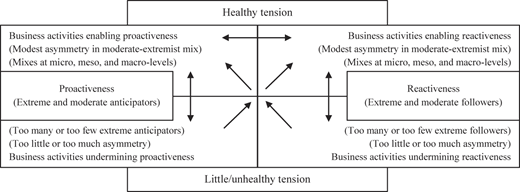
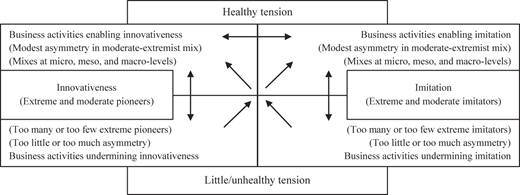
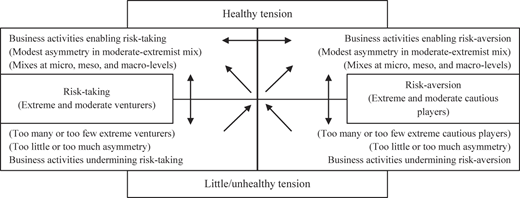
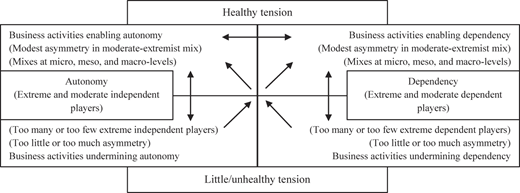
Based on the polarity map (Johnson, 2014), the duality map (Li, 2016) adopts the Yin-Yang epistemological system to interpret and measure the relationship between the opposite poles of managerial paradoxes. The duality map is based on four different, but interconnected, elements/levels. The first level comprises the two poles of the paradox (e.g. proactiveness and reactiveness, innovativeness and imitation, risk-taking and risk-aversion, autonomy-dependency, competitive aggressiveness and cooperation). These two opposite elements represent the root elements, or the “extremist groups” of the map, which highlight the conflict and tradeoff between the opposite sides, thus reflecting the “either/or” logic.
The second level, also called micro-level, consists of two “moderate groups”. While the extremists have an exclusive focus on just one side of the map, the moderates have a relatively greater focus on one of the two sides, but considering both poles as necessary and crucial. The two moderate groups suggest the complementarity and synergy between the opposite sections, thus reflecting the “both/and” logic. Hence, each side of the paradox can be divided into extremist and moderate groups.
The third level (meso-level), which includes the combinations of extremist and moderate groups within each pole, and the fourth level (macro-level), which involves all the potential combinations of the four groups, represent the “either/and” logic, which balances the “either/or” and the “both/and” systems to reach a holistic and dynamic view of the managerial paradox.
The horizontal divide between left and right sides of the map represents the interconnections between the opposite poles at the macro-level in terms of tradeoffs/synergies. The vertical divide between upper and bottom sides reflects the interactions between opposites at the macro-level from a little/unhealthy tension (too few/too many extremists) to a healthy tension (moderate asymmetry that enhances synergy between the opposite poles). In other words, an unhealthy tension emerges when both elements/values are pursued with the same strength or when only one of them is pursed at the expense of the other, while a healthy tension occurs when the opposite elements/values are pursued with moderately asymmetrical intensity. Taken as a whole, the extremist groups consider the opposite poles as clashing goals/values that require a tradeoff toward an unhealthy tension, while the moderate groups see the opposite parts as complementary goals/values that demand synergy toward a healthy tension.
It is worth noting that tension, dynamic shift and balance represent three main tenets of the duality map. Indeed, a limited degree of tension is deemed necessary to reach harmony and avoid that one of the elements/values can become too dominant. Nonetheless, the divide is not symmetrical and a shift along the horizontal as well as the vertical divide can always occur. Hence, following the Yin-Yang balancing, the balance between the two opposite sides of the map is asymmetrical (the dynamic balance between left and right sides), curvilinear (the dynamic balance between upper and bottom sides) and transitional (the diachronic transition from an asymmetrical balance to the opposite one).
Proactiveness versus reactiveness
According to the traditional conceptualizations of EO, entrepreneurial firms are those that are proactive and do not act in response to environmental pressures (Miller and Friesen, 1982). They try to act in anticipation of future problems, needs or changes by creating or managing situations rather than just responding to them after they have happened (Lumpkin and Dess, 1996; Rauch et al., 2009). Proactiveness thus involves determining the appropriate actions that are required to anticipate competitors’ actions and potential reactions.
In this context, the duality map can provide a new perspective by balancing individuals and organizations which adopt a proactive approach as anticipators and those which prefer a reactive approach as followers. In other words, proactiveness and reactiveness always co-exist within the same organization in a constant relationship of conflict and complementarity. In specific situations, contexts and time organizations can adopt a more proactive or a more reactive behavior in order to take advantage of particular opportunities or to respond to competitors’ moves.
The traditional “either/or” logic of EO sees proactiveness and reactiveness as conflicting elements without considering the role played by moderate groups within the organization and the temporal transition from one asymmetrical balance to its opposite. Consistent with the mechanisms of Yin-Yang balancing, organizations can pursue both proactive (entering new markets, anticipating change and competitors, intentionally creating change) and reactive goals (responding to competitive threats, political changes, unexpected situations, such as the coronavirus disease 2019 [COVID-19] crisis, following key customers in new markets or competitors to prevent them from gaining dominant positions) with a moderate asymmetrical intensity. For instance, while airline companies are reacting to the global pandemic, they become proactive in their innovation in cleaning and providing touchless check-ins (see Figure 2).
Innovativeness versus imitation
Miller and Friesen (1982) argued that entrepreneurial firms innovate boldly and regularly. They do not act in response to contextual pressures and do not imitate the moves of other firms. According to the traditional view, entrepreneurial firms show willingness to engage in product and market innovation following a path made of novelty, creativity and experimentation (Lumpkin and Dess, 1996; Miller, 1983).
Contrary to this “either/or” system, the Yin-Yang balancing suggests that innovativeness and imitation represent two opposite poles that always co-exist in each individual and organization. According to the tenets and operational mechanisms of Yin-Yang balancing, enhanced EO (healthy tension) can be reached thanks to the good balance between pioneers and imitators. Innovations (new or improved products/services, production/delivery approaches, organizational or marketing strategies) can be highly productive, although risky, solutions. However, organizations should also recognize the impossibility of sustaining innovative leadership and the danger of an unbalanced dedication to innovativeness (Levitt, 1966). No single organization has the resources (e.g. financial, managerial and inventive) to always beat the competition and lead the innovative efforts of an entire industry. Hence, a more balanced view is needed to show that each organization is forced by contextual pressures to consider imitation as one of its survival and growth strategies. In this respect, several companies constantly move in-between the innovativeness/imitation poles. Instagram, Xiaomi, FedEx and Starbucks are just few examples of such companies. Some of them started with disruptive innovations, but then imitated their competitors to improve their products or service, while others began their development path by imitating global leaders, but then evolved into something different, showing to be innovative in their own right (see Figure 3).
Risk-taking versus risk-aversion
As argued by Rauch et al. (2009), risk-taking represents the firm’s propensity to venture into the unknown and/or commit significant resources to ventures in uncertain contexts. Risk-taking is among the dimensions studied in more depth in the EO literature (García-Villaverde et al., 2018), since starting a new business and working to achieve successful and sustainable results usually require initiative, creativity and personal risk-taking (Lumpkin and Dess, 1996). Risk is part of entrepreneurial ventures and involves uncertain situations and potential obstacles that could affect firm’s finances and stability. Market characteristics, technological changes, competitors’ actions increase the uncertainty that firms must face in today’s business world. These changes are fast, pervasive and unpredictable. Hence, trying to predict their evolution has become a harder task for firms.
However, firms usually have a multilevel posture toward risk. It depends on different internal and external forces that can promote risk-taking or risk-aversion within the organization. Excessive risk-taking can lower performance in some contexts (e.g. Lisboa et al., 2016; Lomberg et al., 2017; Lumpkin and Dess, 1996). Individuals and organizations’ tendency to take risk can vary from firm to firm and over time within the same organization. For instance, as firms grow larger, their management can fall into the trap of maximizing only shareholders’ short-term return on investment. They can thus decide to focus on a repeatable and scalable business model and become more risk-averse (Funston and Wagner, 2010). When firms spend time, resources and efforts on gaining market shares, customers, revenues or reputation, they can become more conservative and less risk-tolerant.
In this context, the Yin-Yang balancing helps illustrate that, even though firms could have a particular attitude towards risk, this can be adjusted over time when specific events or different contexts alter individual and organizational perceptions. This multilevel approach towards risk suggests that any firm can move from the risk-taking pole to the risk-averse pole (see Figure 4).
Autonomy versus dependency
Lumpkin and Dess (1996) suggested that a firm, to be successful, needs autonomy to make decisions and to proceed with actions independently. It can provide the members of the organization with the flexibility to develop and encourage entrepreneurial initiatives and improve existing business practices. Hence, in the traditional EO conceptualization, autonomy has a central role in identifying opportunities and leveraging the firm’s strengths.
In this regard, the evolutionary path of several organizations, from small and medium-sized enterprises (SMEs) to large companies, highlights the necessity of a healthy tension between autonomy and dependency. For example, entrepreneurial firms, and in particular SMEs, may be dependent on financial, advisory or business support, since they are usually constrained by limited financial resources, reluctance to establish relations with new partners, limited access to market-specific knowledge and managerial capabilities, resistance to change of entrepreneurial leadership and conservative attitude (Fernández and Nieto, 2005; Gomez-Mejia et al., 2010). Fast-growing companies may need external capital injections (e.g. angel funding or venture capital) to innovate, invest in workforce skills training or expand overseas. Even large enterprises may be dependent on government’s economic decision-making, such as in the “dependent entrepreneurship” of South Korean chaebols, the family-controlled diversified industrial conglomerates (McNamara, 1990) or on other sources of elite power, such as in the US (Mills, 1956). Hence, according to the Yin-Yang epistemological system, dependency and autonomy poles can jointly support firms’ entrepreneurial efforts and become key contributors to firms’ growth in different stages of their development (see Figure 5).
Competitive aggressiveness versus cooperation
As argued by Lumpkin and Dess (2001), competitive aggressiveness refers to how firms react to competitive trends and demands already present in a specific market. It is characterized by a strong offensive posture to overcome competitors and a reactive response to defend the firm’s market position and its existing resources from potential threats (Lumpkin and Dess, 2001). For instance, the definition of ambitious market-share goals to be pursued with a price cutting strategy when entering new markets, the decision to increase the investment in product quality and distribution, or the introduction of competing brands and cross-parry strategies represent examples of such an aggressive behavior (Wales et al., 2019). However, Chen (2008) criticized the conventional Western approach that considers competition and cooperation as independent opposites and suggested focusing on the complexity and richness of their interplay.
In this context, the adoption of an approach based on the Yin-Yang balancing allows to stress the interdependency and interpenetration between competitive aggressiveness and cooperation with partial tradeoffs and partial synergies (Mattsson and Tidström, 2015). Inter-organizational coopetition (Dagnino and Padula, 2002) between companies that interact with the partial congruence of interests (e.g. cooperation in knowledge exploration and competition in knowledge exploitation) or intra-organizational coopetition between individuals or functional units within the same organization (Tsai, 2002) represent examples of such a healthy tension between opposing elements. Similarly, several entrepreneurial firms in Scandinavia adopt an approach in which stakeholder engagement, “jointness” of interests, cooperative strategic posture and rejection of a narrowly economic interpretation of the firm are clearly co-mingled (Strand and Freeman, 2015). According to this view, the focus on competition rather than cooperation is mistaken (Freeman et al., 2010), since Scandinavian firms tend to implement a value creating strategy based on stakeholders’ cooperation that results in superior value creation (Strand, 2013). In this regard, Mattsson and Tidström (2015) highlighted that the Yin-Yang balancing is fundamental to understand how the mutual influence of competitive and cooperative processes can affect market dynamics (see Figure 6).
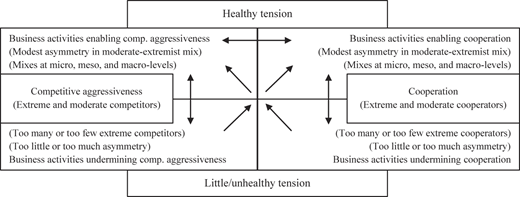
The duality map for the balance between competitive aggressiveness and cooperation
The duality map for the balance between competitive aggressiveness and cooperation
Discussion
The current study proposes to switch from the dominant “either/or” system to embrace an “either/and” logic, borrowed from the Yin-Yang epistemological system, according to which the apparently contradictory poles of the EO dimensions co-exist within the same organization and are managed in a constant process of dynamic balancing over time. By stressing the interdependence of “opposing voices” and promoting their reconciliation to create a dynamic unity (Chen, 2002), the Yin-Yang balancing provides a different perspective compared to traditional Western philosophies which see paradox as being characterized by distinctive and exclusive opposites (Chen, 2008; Chen and Miller, 2010; Poole and Van de Ven, 1989; Smith and Lewis, 2011).
Table 2 summarizes the analysis provided in this paper. In comparing the five dimensions of EO with their opposite poles, the study reconciles the EO dilemma and dismantles the trap of the polarized approach that has dominated the EO literature since its origins. In order to be considered entrepreneurial oriented, firms do not have to constantly show high scores in some of the EO subdimensions, rather to accept and balance the co-existence of their seemingly opposite poles that can be seen as continuums in the development of an entrepreneurial behavior over time. Each potential paradoxical element may become more salient within the organization, while other elements may be temporarily restrained to be stimulated in other situations, contexts and time. Even though a growing number of Western scholars have recognized the salience of paradox as well as the flaw of the “either/or” logic (e.g. Poole and Van de Ven, 1989; Schad and Bansal, 2018; Sheep et al., 2017; Smith and Lewis, 2011), they have not move beyond the separation-integration circle as their attempts to resolve paradox, so Yin-Yang balancing has the unique potential to provide a geocentric (East-meeting-West) meta-system (Li, 2016).
The reconciliation of the EO dilemma
| Dilemma | Either/or logic (only tradeoff without synergy) | Both/and logic (only synergy without tradeoff) | Either/and system (reconciliation) (both tradeoff and synergy yet asymmetrical, transitional and curvilinear in balancing) |
|---|---|---|---|
| Proactiveness versus Reactiveness | Either anticipators or followers in each aspect/stage as conflicting for tradeoff. Anticipate competitors’ actions and reactions or dealing with problems as they come up | Both anticipators and followers in each aspect/stage as complementary for synergy. Anticipate competitors’ actions and reactions and dealing with problems as they come up | Either anticipators and followers in a balance between both elements as a pair in each aspect/stage as partially conflicting and partially complementary in balancing. Balancing proactive and reactive poles to anticipate potential issues through predictive behavior and to act quickly and effectively when unanticipated events occur |
| Innovativeness versus Imitation | Either pioneers or imitators in each aspect/stage as conflicting for tradeoff. Focus on novelty, creativity, experimentation or focus on imitative equivalents of other firms’ innovations | Both pioneers and imitators in each aspect/stage as complementary for synergy. Focus on novelty, creativity, experimentation and focus on imitative equivalents of other firms’ innovations | Either pioneers and imitators in a balance between both elements as a pair in each aspect/stage as partially conflicting and partially complementary in balancing. Managing innovation and imitation to seek out opportunities for innovation, recognizing that it is in some way limited and that firms need imitation as a survival and growth strategy |
| Risk-taking versus Risk-aversion | Either venturers or cautious players in each aspect/stage as conflicting for tradeoff. Propensity to venture into the unknown or attempt to lower uncertainty when exposed to the unknown | Both venturers and cautious players in each aspect/stage as complementary for synergy. Propensity to venture into the unknown and attempt to lower uncertainty when exposed to the unknown | Either venturers and cautious players in a balance between both elements as a pair in each aspect/stage as partially conflicting and partially complementary in balancing. Reconciling the risk-taking/risk-aversion dilemma to seize opportunities, bearing in mind that this attitude can be adjusted when contingencies change individual and organizational perceptions |
| Autonomy versus Dependency | Either independent or dependent players in each aspect/stage as conflicting for tradeoff. Capacity to act or function independently or external influences affect firm’s key decisions | Both independent and dependent players in each aspect/stage as complementary for synergy. Capacity to act or function independently and external influences affect firm’s key decisions | Either independent and dependent players in a balance between both elements as a pair in each aspect/stage as partially conflicting and partially complementary in balancing. Balancing autonomy and dependency to jointly support firms’ entrepreneurial efforts during the different stages of their development |
| Competitive aggressiveness versus Cooperation | Either competitors or cooperators in each aspect/stage as conflicting for tradeoff. Propensity to challenge competitors or propensity to act together for a common purpose or benefit | Both competitors and cooperators in each aspect/stage as complementary for synergy. Propensity to challenge competitors and propensity to act together for a common purpose or benefit | Either competitors and cooperators in a balance between both elements as a pair in each aspect/stage as partially conflicting and partially complementary in balancing. Managing competitive aggressiveness and cooperation to challenge competitors and interact with partial congruence of interests |
The polarized view that separates entrepreneurial from non-entrepreneurial, often called conservative, firms, has been embraced by the management literature as a dogma. Consequently, this inherent dogmatism has hindered the efforts to clarify what this “tendency” really means and how to effectively evaluate it. In this context, even though it is possible that a firm would reveal a posture that combine all the EO subdimensions or at least some of them, it is hard to conceive that it will show an entrepreneurial behavior during its entire life span. It seems more reasonable to assume that the entrepreneurial tendency of a firm could change and that a firm could balance (or learn how to balance) the co-existence of proactiveness, innovativeness, risk-taking, competitive aggressiveness and autonomy with their opposites within the organization. The Yin-Yang epistemological system helps highlight how, in real life, firms can actually move along the entrepreneurial/conservative continuum and adapt their behavior in a flux of constant transformation and interpenetration.
Conclusion
Research implications
The present paper contributes to the EO research by providing a different perspective to the EO concept, thus filling the gap on how to go beyond the traditional polarized (“either/or”) paradigm which has dominated the EO literature since its origins. Even though the calls to integrate different institutional, cultural and philosophical traditions in a multi-perspective approach have increased exponentially to face the complexity and ambiguity of today's interconnected world (e.g. Barkema et al., 2015; Fang, 2012; Gupta and Gupta, 2015; Li, 2016; Luo and Zheng, 2016; Tsui, 2007; Wales et al., 2019), the proposed solutions are still firmly grounded in the polarized approach, which considers “entrepreneurial” only those individuals and organizations which show high scores in at least some of the EO subdimensions. This perspective is closely related to the Western philosophical foundations, which see mental opposites as mutually exclusive discrete categories that reject paradox in a sort of explicit dualism (Aristotelian formal logic), or only temporarily tolerate opposite elements and paradox, eventually denying them through a “sublation” process in which contradictory elements are both preserved and abolished in a dialectical spiral that leads to an implicit dualism (Hegelian dialectical logic) (Brenner, 2008; Li, 2012; Smith and Lewis, 2011).
Following the recent attention given to the study of East Asian, mainly Chinese, philosophies, cultures and traditions, as well as their influence on international business and managerial issues (e.g. Fang, 2012; Faure and Fang, 2008; Jiang et al., 2021; Li, 2016; Pauluzzo et al., 2018; Tang et al., 2021), the present study adopts the epistemological system of Yin-Yang balancing to show that conflicting yet complementary elements/values are co-dependent and mutually transform into each other in an organic and unified whole, following a process of constant change (Li, 1998; Tian, 2002).
Indeed, recent contributions have argued that particular combinations of EO dimensions can affect performance and vary depending on the context, in an attempt to go beyond the traditional unitary conceptualization of the construct (Anderson et al., 2015; Kollmann et al., 2021; Lisboa et al., 2016; Lomberg et al., 2017; Rosenbusch et al., 2013; Wales et al., 2020). However, these efforts do not diverge from the original polarized approach. In this regard, even the ambidexterity concept, which tries to solve paradox by separating mental opposites spatially or by integrating them through the rejection of their inherent conflict and trade-off, fails to consider the coexistence of trade-off and synergy (Jiang et al., 2021; Li, 2014; Tang et al., 2021). The Yin-Yang balancing can thus represent a fundamental system to reframe the paradoxes arising from the EO concept, since it views the opposite sides of any paradox as a partial tradeoff/synergy within a range of holistic and dynamic balancing (Li, 2012; Luo and Zheng, 2016).
The current paper highlights that embracing the different and opposite dimensions of the EO construct does not necessarily mean being less entrepreneurial oriented. Rather, this entrepreneurial tendency should be carefully examined whenever the organization faces specific situations and contextual features. Entrepreneurs and managers do not lose their entrepreneurial spirit when they show lower scores of proactiveness, innovativeness, risk-taking, competitive aggressiveness and autonomy, since being entrepreneurial truly means balancing the simultaneous existence of these complementary and conflicting elements which tend to reverse their respective roles according to the ever-changing conditions of the environment. In other words, the holistic and dynamic nature of the Yin-Yang philosophy can integrate these opposite elements and balance the inherent duality of the EO concept.
Compared to the original (Covin and Slevin, 1989; Khandwalla, 1977; Lumpkin and Dess, 1996; Miller and Friesen, 1982; Miller, 1983) and modern conceptualizations of the EO construct (Anderson et al., 2015; Kollmann et al., 2021; Lisboa et al., 2016; Lomberg et al., 2017; Rosenbusch et al., 2013; Wales et al., 2020), the present study provides an alternative perspective able to address the paradoxes arising from the EO dimensions and dismantle the trap of the polarized approach that has dominated the EO literature since its origins. Responding to the calls to move from the hegemonic North-American perspective and adopt different theoretical cultural and contextual approaches able to reveal the different configurations of the EO dimensions (e.g. Gupta and Gupta, 2015; Kraus et al., 2018; Rauch et al., 2009; Wales et al., 2019), the current analysis thus represents a first attempt to show that, through the integration of the Yin-Yang balancing, organizations can actually manage the opposite elements that characterize the EO construct in a constant process of dynamic balancing over time, according to which each potential paradoxical EO dimension can be temporarily promoted or restrained.
Practical implications
The current study has significant implications for entrepreneurs and practitioners. The complexity and uncertainty of today’s business world have severely affected entrepreneurial ventures’ ability to tackle current and future challenges. Individuals and organizations need a holistic comprehension of complex realities that the Western approach alone is not sufficient to provide anymore (Li, 2016; Luo and Zheng, 2016). The paradoxes and dilemmas generated by this situation can be managed thanks to a geocentric (East-meeting-West) meta-system (Li, 2016) able to blend Eastern and Western philosophies and approaches to paradox. In this context, Li's (2016) duality map for paradox management is believed to represent a powerful tool to address the issues of paradoxical organizations’ life. More specifically, the duality map, showing the positive and negative aspects of the EO co-existing opposites, is able to provide entrepreneurs and practitioners with a paradoxical lens needed to face the challenges of today’s interconnected world.
Limitations and future research directions
Given the approach used in this study to describe a conceptualization of EO able to accommodate and appreciate its paradoxical nature, there are inherent limitations which require discussion. First, the present paper adopted the Yin-Yang balancing as the only epistemological system that can truly reconcile Western “either/or” and “both/and” logics and integrate them into a geocentric meta-system able to provide a holistic comprehension of complex realities, since it views the opposite sides of any paradox as a partial tradeoff/synergy within a range of holistic and dynamic balancing (Li, 2016; Luo and Zheng, 2016). However, since each epistemological system has its specific strengths and weaknesses, it is unrealistic to assume that the Yin-Yang balancing is flawless (Li, 2016). Other philosophies, cultures and traditions could be integrated into the system, thus enhancing its multi-perspectival nature. Hence, it is believed that more improvements can be obtained by the evolving East-meeting-West research trend (Barkema et al., 2015; Chen and Miller, 2010; Li, 2016). Second, as suggested by Li (2016), the current knowledge about the system is still immature. After recognizing the centrality of paradox in management research and embracing the unique value of Yin-Yang balancing to paradox management, there is still the need to refine the duality map and use it for more managerial paradoxes. In particular, the lack of empirical investigations results in certain limitations in the methodology of concept analysis. Hence, the main future research challenge is to test the duality map in practical terms to show the centrality of the Yin-Yang balancing in this geocentric system and its ability to absorb the intrinsic “either/or” logic of the EO concept and explain its holistic, dynamic and duality issues.

