Although succession research in family businesses has advanced considerably in recent decades, studies focusing on daughters as successors remain limited and fragmented. This study aims to synthesize and systematize existing research on daughters' pre-decision succession process.
A systematic literature review based on 27 peer-reviewed articles published between 2005 and 2025 and indexed in Scopus and Web of Science was conducted. The review first mapped the theoretical frameworks, methodological approaches, and geographical contexts applied in the field. Using inductive content analysis, the literature was then structured into four thematic clusters: (1) societal and cultural context to female succession, (2) family pressure and expectations, (3) competency and leadership identity and (4) commitment and legitimacy perception.
The review conceptualizes daughters' succession as an iterative pre-decision process in which self-perceived successor viability, externally attributed legitimacy and gendered opportunity structures interact over time. The synthesis shows that enabling mechanisms such as early inclusion, mentoring or education may strengthen daughters' succession trajectories. At the same time, constraining mechanisms such as sexism, male-successor preference or parental gatekeeping may delay, redirect, contest, or undermine these trajectories.
Beyond categorizing existing research, this study provides an integrative enabling-constraining process framework of daughters' pre-decision succession. It differentiates women's participation in family-firm leadership from daughters' recognition as dynastic successors and highlights how successor viability and legitimacy are recursively constructed across societal, familial, individual and stakeholder levels.
1. Introduction
Research on family business succession has generated extensive knowledge about succession planning, successor attributes, transfer arrangements, and post-succession outcomes (Ip and Jacobs, 2006; Kubíček and Machek, 2019, 2024; Howorth and Discua Cruz, 2024). Much of this work, however, begins from the point at which a potential successor has already become a candidate. This tells us more about how successors are selected, prepared, and evaluated than about how particular family members come to be regarded – and regard themselves – as viable successors in the first place (Hytti et al., 2017; Lyons et al., 2024; McAdam et al., 2021). This limitation is especially consequential for daughters, whose exclusion from succession may occur long before a formal choice is discussed or observable.
Gender scholarship has challenged the assumption that succession constitutes a neutral process of identifying the most capable family member (Byrne et al., 2021). Nelson and Constantinidis (2017) conceptualize gender in family firms as socially constructed through organizational practices, familial expectations, and broader institutional norms. Aldamiz-Echevarría et al. (2017) similarly show that succession remains embedded in assumptions associating continuity, authority, and ownership with men. Studies such as Ahrens et al. (2015), Gimenez-Jimenez et al. (2021), Soost and Moog (2021), and Urban and Nonkwelo (2022) indicate that these assumptions can privilege sons even where daughters possess comparable qualifications. This systematic exclusion is particularly visible in traditional sectors where the belief in a “natural” male successor remains a dominant norm, and favoritism toward male employees can function as a direct threat to a daughter's position (Glover, 2014). This systematic preference is further challenged by Soost and Moog (2021) whose empirical findings refute the “female underperformance hypothesis” by demonstrating that female successors achieve revenue parity with their male counterparts. From this perspective, succession does not merely transfer managerial authority. It reproduces – or potentially challenges – gendered understandings of lineage, leadership, and legitimate family membership.
At first glance, this interpretation appears difficult to reconcile with research portraying family firms as comparatively accessible environments for women. Andersson et al. (2018) report that women are more likely to occupy leadership positions in family firms than in non-family firms, while Campopiano et al. (2017) emphasize the flexibility, relational proximity, and trust-based arrangements that can facilitate women's participation. Yet this apparent inclusiveness does not necessarily extend to dynastic succession. Hamilton and Ruel (2025) suggest that holding a formal leadership position does not automatically translate into recognition as a legitimate transgenerational successor. McAdam et al. (2021) likewise show that women in family firms may remain subject to heightened scrutiny even after assuming substantial managerial responsibility. Byrne et al. (2019) and Mussolino et al. (2019) further direct attention to the lineage expectations, identity negotiations, and legitimacy judgments through which successor status is constructed. Taken together, these contributions indicate that leadership participation and dynastic succession follow related but distinct logics: daughters may manage, contribute to, and even lead the family firm without being positioned – or positioning themselves – as rightful successors. This lack of recognition is often rooted in a “disharmony within harmony,” where significant perception gaps exist between incumbents—who often prioritize hard competence—and successors-to-be—who place higher value on personality traits when defining legitimacy (Udomkit et al., 2022).
This distinction also explains why findings on women leaders and entrepreneurs cannot be transferred directly to daughters in transgenerational succession. Unlike professional managers or de novo entrepreneurs, daughters' occupational choices are intertwined with family membership, childhood socialization, parental expectations, sibling relationships, inheritance norms, and the symbolic continuity of the family line. Vera and Dean (2005), e.g. highlight the importance of father–daughter and mother–daughter relationships, sibling dynamics, work–family tensions, and gender stereotyping. Overbeke et al. (2013, 2015) show how gendered beliefs shape both others' assessments of daughters and daughters' own perceptions of leadership suitability. Mussolino et al. (2019) emphasize the identity work involved in negotiating family and leadership roles. These studies shift attention from the final succession decision toward the less visible processes through which daughters are encouraged, tolerated, overlooked, or discouraged as potential successors.
Existing reviews have made important contributions to organizing this literature but have not fully captured these early process dynamics. Wang (2010) situated gender within the broader field of family business succession at a time when the relevant literature remained relatively dispersed. Nelson and Constantinidis (2017) subsequently developed a gender-sensitive account of women's positions in family firms and foregrounded structural and cultural constraints. Kubíček and Machek (2019) integrated gender-related factors into a broader synthesis of succession antecedents, events, and outcomes, while their later review documents the continuing prevalence of male-successor preference (Kubíček and Machek, 2024). Maseda et al. (2022) offer a bibliometric map of research on women in family firms, whereas Boukhabza and Ouhadi (2024) emphasize the dynamic and iterative character of succession trajectories. These reviews provide valuable foundations, but their broader scope does not specifically explain how daughters become – or fail to become – conceivable and legitimate successors before formal selection occurs.
The unresolved problem is therefore not simply a shortage of evidence that daughters encounter gendered barriers. Rather, literature lacks an integrated explanation of how such barriers are produced and translated across levels and over time. Research on cultural norms and institutional conditions is only loosely connected to studies of family expectations and parental gatekeeping (Boukhabza and Ouhadi, 2024). Work on education, external employment, and competency development (Boukhabza and Ouhadi, 2024; Kubíček and Machek, 2019) is rarely integrated with research on leadership identity and self-perceived suitability. Studies of daughters' intentions and commitment, in turn, are often separated from research on the legitimacy attributed by family members, employees, and other stakeholders (Assenmacher et al., 2025; Boukhabza and Ouhadi, 2024). This thematic fragmentation is accompanied by a temporal emphasis on observable selection decisions or realized succession outcomes. This is theoretically consequential: without integrating structural constraints, relational interactions, identity formation, and legitimacy attribution, literature cannot adequately explain why apparently qualified daughters continue along a succession path, enter it only belatedly, or disengage before any formal decision is made.
To address this limitation, we conceptualize daughters' succession as a gendered pre-decision process. The pre-decision succession process refers to the formative and often prolonged period before formal successor selection in which daughters' succession intentions, self-perceived viability, leadership identities, developmental opportunities, and externally attributed legitimacy are constructed and negotiated (Assenmacher et al., 2025). It is an analytical phase rather than a clearly bounded chronological stage. It may begin through childhood socialization and early involvement in the family firm and continue through education, external employment, informal succession conversations, and the gradual acceptance – or denial – of organizational responsibility. During this process, gendered expectations may shape which opportunities daughters receive, how their competencies are interpreted, whether they are encouraged to imagine themselves as successors, and whether relevant audiences recognize them as legitimate candidates. The process may consequently reinforce a succession trajectory, delay it, redirect it, or bring it to an end without an explicit rejection ever occurring.
A systematic literature review is particularly appropriate for examining this process because the relevant evidence is distributed across heterogeneous theoretical traditions, methods, national contexts, and analytical levels. The purpose is not to estimate the prevalence or causal magnitude of individual factors. Instead, the review critically synthesizes recurring interpretations, reported experiences, and cross-study patterns to identify the mechanisms and relationships through which daughters' succession trajectories are formed. Integrating these dispersed insights makes it possible to move beyond an inventory of antecedents toward a process-oriented explanation of how societal and cultural norms, family influence, competencies and identity formation, commitment, and legitimacy attribution interact over time.
Accordingly, this study asks: Which factors shape the pre-decision succession process of daughters in family businesses, and how do these factors interact over time?
The study makes three contributions. First, it differentiates women's participation in family-firm leadership from daughters' recognition as dynastic successors, thereby clarifying why daughters constitute a distinct analytical category within gender and entrepreneurship research. Second, it integrates societal, familial, individual, and stakeholder-level insights into a process framework that shows how succession viability is recursively constructed rather than objectively given. Third, it identifies the mechanisms through which daughters' succession trajectories may be reinforced, delayed, contested, or abandoned before formal selection, thereby providing a more dynamic basis for future research on gendered transgenerational succession.
2. Conceptual background
The introduction has positioned daughters' succession within the debates on gender and family business succession and has identified the lack of an integrated understanding of how potential successors emerge before formal selection. Against this background, the purpose of this section is not to provide another review of the relevant literature but to clarify the central concepts that guide the analysis: dynastic succession, gendered legitimacy, successor viability, and the pre-decision succession process.
2.1 Dynastic succession as a gendered legitimacy process
Dynastic succession differs from women's participation in family-firm leadership. Leadership participation refers to the assumption of managerial responsibility, influence, or formal authority within the organization. Dynastic succession, by contrast, entails recognition as the person entitled and expected to carry the family firm into the next generation. It combines managerial responsibility with ownership expectations, family membership, intergenerational continuity, and the symbolic reproduction of the family line. This broader meaning follows from the distinctive overlap of family, ownership, and business systems in family firms (Chua et al., 1999; Tagiuri and Davis, 1996) and from the understanding of succession as a social and symbolic process through which continuity and family identity are reproduced (Suess-Reyes, 2017).
This distinction is conceptually important because managerial involvement does not necessarily imply recognition as a successor. Hamilton and Ruel (2025) suggest that holding a formal leadership position does not automatically translate into recognition as a legitimate dynastic successor. Similarly, McAdam et al. (2021) and Mussolino et al. (2019) show that substantial managerial involvement may coexist with continued scrutiny or uncertainty concerning women's successor status. A daughter may therefore occupy a senior position, contribute substantially to strategic decisions, or exercise informal leadership without being regarded as the rightful next-generation leader (Achtenhagen et al., 2017; Campopiano et al., 2017). Conversely, family membership and lineage expectations may allow other family members to be considered possible successors before they have demonstrated equivalent managerial competency (Byrne et al., 2019; Gimenez-Jimenez et al., 2021). Dynastic succession is thus not based solely on observable qualifications. It also depends on socially constructed judgments about who belongs in the successor role and whose claim to that role is considered appropriate.
The concept of legitimacy captures this social dimension of successor recognition. Legitimacy refers here to the socially attributed appropriateness and rightfulness of a person's claim to succeed the incumbent generation. It is relational rather than an intrinsic characteristic of the potential successor. Studies of daughters' succession show that recognition is conferred, withheld, or contested through interactions with parents, siblings, employees, business partners, and other stakeholders (Duran-Encalada et al., 2021; Hytti et al., 2017; Urban and Nonkwelo, 2022; Vera and Dean, 2005). These audiences may apply different criteria and may not reach the same judgment. A daughter can therefore be recognized as a capable manager by employees while remaining excluded from dynastic consideration within the owning family. Conversely, family endorsement – particularly endorsement by the incumbent father – may provide an important legitimacy signal to organizational and external audiences (Duran-Encalada et al., 2021; Hytti et al., 2017; McAdam et al., 2021). However, this legitimacy is also shaped by mothers, who exercise “hidden power” as silent gatekeepers, influencing daughters' succession paths through lifelong socialization (Cosson and Gilding, 2021). Moreover, maternal influence can create a “mother's shadow”—a stable power hierarchy that persists even after retirement and hinders a daughter's progression toward independent authority (Ferrari, 2019; Haberman and Danes, 2007).
Gender shapes this process because it influences the standards through which successor claims are interpreted. Nelson and Constantinidis (2017) conceptualize gender in family firms as socially constructed through organizational practices, family expectations, and institutionalized norms. Aldamiz-Echevarría et al. (2017) similarly emphasize that succession remains embedded in gendered assumptions concerning leadership and family roles. Gender is therefore not treated here merely as an individual demographic attribute or as one isolated barrier among others. Rather, it operates as a social ordering principle that informs expectations about authority, inheritance, commitment, caregiving, and continuity (Byrne et al., 2021; Chadwick and Dawson, 2018; Nelson and Constantinidis, 2017). Such assumptions can affect which family members are initially imagined as possible successors, which developmental opportunities they receive, how their behavior is evaluated, and whether equivalent qualifications are interpreted in equivalent ways (Ahrens et al., 2015; Byrne et al., 2019; Overbeke et al., 2013).
This perspective also distinguishes competency from legitimacy. Competency concerns the personal knowledge, experience, and skills relevant to leading the business. Legitimacy concerns whether relevant audiences regard a person's assumption of the successor role as appropriate and credible. The two may reinforce one another but need not coincide. Education and external work experience may strengthen daughters' perceived credibility, particularly among employees and external stakeholders (Duran-Encalada et al., 2021; Vera and Dean, 2005). However, the reviewed literature also suggests that daughters may be required to demonstrate their capabilities repeatedly and initiate visible strategic projects before receiving recognition comparable to that more readily accorded to male successors (Ghamgui et al., 2025; McAdam et al., 2021; Urban and Nonkwelo, 2022). Demonstrated competency can therefore strengthen legitimacy, yet gendered expectations may discount the value of that competency. Similarly, dynastic belonging may confer an initial claim to succession without guaranteeing recognition as a capable leader. Understanding daughters' succession consequently requires examining how competency and dynastic legitimacy are related rather than assuming that the former automatically produces the latter.
2.2 The pre-decision formation of successor viability
To analyze how daughters enter, continue, or withdraw from succession trajectories, we distinguish legitimacy from perceived successor viability. Successor viability refers to the perceived feasibility and suitability of a person becoming the next-generation leader. Whereas legitimacy concerns the social acceptability and rightfulness of a successor claim, viability concerns whether succession appears possible, realistic, and sustainable. This distinction is consistent with studies showing that succession intentions develop through daughters' assessments of their own capabilities and role fit as well as through evaluations made by family members and other stakeholders (Brophy et al., 2023; Clinton et al., 2024; Lyons et al., 2024; Overbeke et al., 2015).
Viability has both self-attributed and externally attributed dimensions. Self-perceived viability refers to whether daughters regard succession as a realistic and personally compatible option for themselves, including their perceived capacity to lead, their sense of fit with the successor role, and their belief that succession can be reconciled with their personal and professional aspirations. Studies drawing on self-efficacy and perceived behavioral control indicate that confidence in one's capacity to lead is associated with stronger succession intentions, while such confidence is itself shaped by parental feedback, mentorship, education, and organizational experience (Clinton et al., 2024; Duran-Encalada et al., 2021; Lyons et al., 2024; Overbeke et al., 2015).
Externally attributed viability refers to whether family members and other stakeholders regard the daughter as sufficiently capable, committed, available, and suitable to become the successor. Such assessments are shaped by family endorsement, access to meaningful organizational responsibilities, observed performance, and conformity with prevailing expectations of leadership (Hytti et al., 2017; McAdam et al., 2021; Sentuti et al., 2024; Vera and Dean, 2005). Importantly, the standards applied to daughters may themselves be gendered. Traits such as relationality, consensus orientation, or caution may be interpreted as valuable leadership resources in some settings but as evidence of insufficient authority or entrepreneurial ambition in others (Byrne et al., 2019; McAdam et al., 2021; Overbeke et al., 2015). This ambiguity in assessment can be mitigated through inclusive interactions, such as those found in father-daughter dyads, which often prioritize collaboration and shared meaning over competitive exclusion (Haberman and Danes, 2007). Furthermore, the interpretation of such “gendered” traits is shifting; character attributes like tenacity and patience are increasingly recognized as professional competencies that establish a daughter's viability based on character and experience rather than gender alone (Ramadani et al., 2017).
Self-attributed and externally attributed assessments can converge or diverge. A daughter may perceive herself as qualified but receive little recognition from family gatekeepers et vice versa. Research on identity work and father–daughter relations illustrates how daughters' own succession orientations develop through the interpretation of support, resistance, role expectations, and organizational experiences (Mussolino et al., 2019; Sentuti et al., 2024). Such discrepancies matter because succession trajectories depend neither exclusively on individual intention nor solely on family selection. They develop through interaction between daughters' self-understandings and the expectations and judgments of others.
The pre-decision succession process denotes the formative period in which these perceptions emerge and are negotiated before a formal successor is selected. It is an analytical phase rather than a clearly bounded chronological stage. Boukhabza and Ouhadi (2024) emphasize the dynamic and iterative nature of succession trajectories, while Byrne et al. (2019) and Nelson and Constantinidis (2017) draw attention to the prolonged and frequently implicit gendered processes through which potential successors are positioned. The pre-decision process may begin through childhood socialization, early exposure to the firm, informal conversations, and observations of how responsibilities are distributed within the family (Humphreys, 2013; Hytti et al., 2017; Vera and Dean, 2005). It may continue through education, external employment, entry into the family business, and the gradual acceptance or denial of organizational responsibility (Duran-Encalada et al., 2021; Overbeke et al., 2013, 2015).
The process ends when successor selection becomes explicit, although experiences formed during the pre-decision period may continue to shape later transfer and leadership processes. During this period, daughters may self-select into or out of succession, while family expectations, perceived competency, and legitimacy claims are repeatedly reinforced, negotiated, or undermined (Akhmedova et al., 2020; Assenmacher et al., 2025; Ghamgui et al., 2025; Mussolino et al., 2019; Xian et al., 2021).
Conceptualizing this period as a process has four implications. First, successor formation is temporal. Experience at one point can condition later opportunities and interpretations. Early involvement, parental encouragement, and access to meaningful organizational roles may support the development of business knowledge, psychological ownership, self-efficacy, and affective commitment (Gimenez-Jimenez et al., 2021; Humphreys, 2013; Lyons et al., 2024; Overbeke et al., 2015). By contrast, daughters are frequently described as entering the business later than sons or initially being allocated non-strategic roles, which may restrict their access to tacit knowledge and reduce their visibility as potential successors (Hytti et al., 2017; Overbeke et al., 2013). Early inclusion may therefore make a daughter more visible as a potential successor, whereas prolonged exclusion from meaningful roles may reduce both competency development and the perceived plausibility of succession.
Second, the process is recursive. External recognition may strengthen a daughter's confidence and commitment, which may in turn encourage further involvement and reinforce others' perceptions of her viability (Gimenez-Jimenez et al., 2021; Lyons et al., 2024; Overbeke et al., 2015). The opposite dynamic is also possible: restricted involvement may weaken self-perceived viability and subsequently confirm gatekeepers' prior assumptions that the daughter is not interested or suitable (Brophy et al., 2023; Hytti et al., 2017). Identity construction, family endorsement, competency development, and legitimacy attribution should therefore be understood as mutually influencing processes rather than as independent antecedents.
Third, the process spreads across multiple levels. Societal and institutional gender norms shape family expectations; family interactions influence access to developmental opportunities; organizational audiences interpret daughters' conduct and capability; and daughters themselves make sense of these experiences. Nelson and Constantinidis (2017) emphasize the socially and institutionally embedded character of gender in family firms, while studies across different national and sectoral contexts show that the meaning of appropriate female leadership varies with cultural norms, industry structures, and family arrangements (Akhmedova et al., 2020; Maciel et al., 2020; Xian et al., 2021). No single level therefore provides a sufficient explanation of succession trajectories.
Fourth, daughters retain agency within these structures. They may accept, reinterpret, negotiate, resist, or withdraw from the expectations directed toward them. Mussolino et al. (2019) and Sentuti et al. (2024) portray daughters as actively engaging in identity work rather than simply absorbing externally imposed roles. Hytti et al. (2017) likewise show that daughters may conceal their leadership ambitions, adapt their positioning, or wait for an opportune moment to claim greater influence. Disengagement should consequently not be treated automatically as an absence of ambition or commitment. It may also represent a response to restricted opportunities, conflicting role expectations, or the anticipated costs of pursuing legitimacy in a context in which successor status remains contested (Brophy et al., 2023; Hytti et al., 2017; Xian et al., 2021).
From this perspective, the pre-decision succession process can produce different trajectories. It may generate increasing involvement and recognition, delayed or conditional entry, continuing ambiguity, active contestation, or withdrawal before formal succession is discussed. The analytical task is therefore not only to identify factors associated with daughters' succession but to understand how these factors become connected through mechanisms of socialization, opportunity allocation, interpretation, identity formation, endorsement, and legitimacy attribution.
The distinctions developed in this section serve as sensitizing concepts for the review rather than as predetermined coding categories. They provide a common analytical vocabulary for comparing heterogeneous studies but do not define the thematic structure of the findings in advance. Consistent with the inductive approach adopted in this review, the analytical categories were developed through engagement with the content of the selected studies rather than imposed deductively before the analysis (Hayoz et al., 2025; Thomas and Harden, 2008). The concepts of dynastic legitimacy, successor viability, and pre-decision process subsequently support the interpretation and integration of the emergent findings.
3. Methodology
3.1 Research design and literature collection
As a structured and methodical approach to reviewing existing research, ensuring transparency, reproducibility, and objectivity (Paul et al., 2021), an SLR follows predefined criteria for identifying, evaluating, and synthesizing studies, allowing for a rigorous and unbiased assessment of the literature (Massaro et al., 2016). The primary goal of an SLR is to provide a comprehensive and unbiased reflection of existing research, avoiding selection bias (Henry et al., 2016). By systematically including all relevant studies, rather than relying on selective sources, the method enables researchers to identify patterns, trends, and research gaps (Boukhabza and Ouhadi, 2024).
An SLR follows a structured and reproducible process, making it particularly suitable for examining fragmented and multifaceted research areas (Kraus et al., 2020). This is especially relevant to the study of transgenerational succession in family businesses, in which daughters' succession trajectories are shaped by multiple, interdependent factors, including family dynamics, gendered expectations, competency development, and legitimacy perceptions (Kubíček and Machek, 2019). While recent research has increasingly addressed daughters' succession, existing studies tend to examine these factors in isolation or focus on specific phases of the succession process. As a result, the cumulative state of knowledge remains unclear. In this context, a systematic literature review is particularly suitable to consolidate the existing evidence, assess the current state of the field, and integrate dispersed findings into a more coherent and process-oriented understanding.
With Scopus and Web of Science as acknowledged literature databases (Baas et al., 2020; Pranckutė, 2021), this study seeks to ensure comprehensive coverage of relevant research. Given the niche nature of this study, both databases were used to minimize the risk of overlooking relevant studies.
To ensure a systematic and comprehensive search, key search strings were developed based on three primary conceptual groups: family business, succession, and daughters. Boolean operators were applied to refine the search strategy. The family business group included terms such as “family business*” OR “family firm” OR “family enterprise” OR “family company” OR “family owne*”. The succession group incorporated terms like succession OR successor OR generation*. The daughter group included daughter OR “female successor*” OR “women successor*”. These search strings were combined to maximize the retrieval of relevant studies while filtering out unrelated literature.
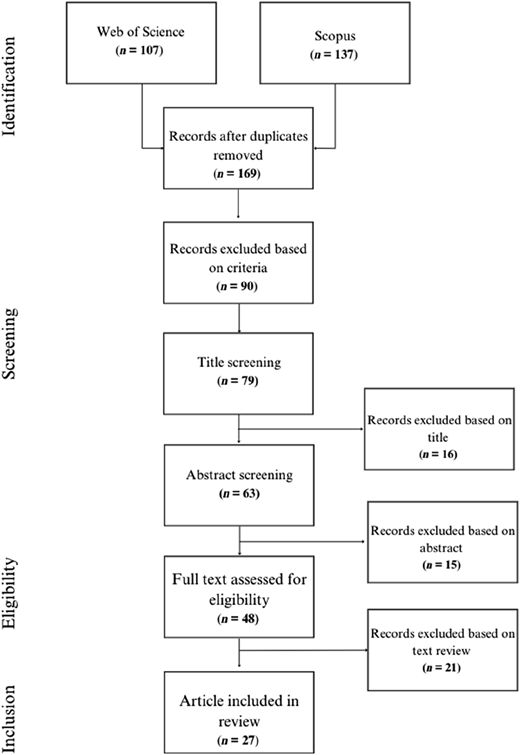
According to the PRISMA flow diagram in Figure 1, the initial search yielded 244 records (107 from Web of Science and 137 from Scopus). After removing duplicates, 169 unique records remained. These were then assessed based on predefined inclusion and exclusion criteria, which ensured that only peer-reviewed journal articles published in English between 2005 and 2025 were considered, thereby explicitly excluding non-empirical articles, peer-reviewed book chapters, edited volumes, and conference proceedings (Genç and Bada, 2010; Jackson and Kuriyama, 2019). The review period was anchored in 2005 following Vera and Dean (2005) influential and widely cited study on daughters in family business succession. Their work introduced key analytical categories such as the father–daughter and mother–daughter relationship, perceptions of successor viability, sibling rivalry, work–family conflict, and gender-based stereotyping. Beyond addressing existing gaps, their original contributions expanded the research agenda by identifying new influencing factors that have shaped subsequent studies over the past decades. By relying on peer-reviewed sources, this study ensures that the selected literature has undergone rigorous evaluation, reducing the risk of methodological inconsistencies and unreliable findings (Steer and Ernst, 2021). Following this step, 90 records were excluded based on these criteria, leaving 79 articles for title screening, where 16 additional studies were removed for lack of relevance. The remaining 63 records underwent abstract screening, resulting in the exclusion of 15 more studies. The final 48 full-text articles were then reviewed for eligibility, with additional exclusions made due to limited access (n = 5), insufficient emphasis on the succession process (n = 5), lack of focus on daughters as successors (n = 6), redundancy or outdated content (n = 2), an exclusive focus on post-succession dynamics (n = 1), methodological limitations (n = 1), and a focus on forced succession (n = 1).
Ultimately, 27 articles, spanning the period from 2005 to 2025, were included in the final review, forming the core dataset for this study. The papers in this final set are marked with an asterisk (*) in the references.
3.2 Data analysis
A systematic data analysis was conducted to provide a structured foundation for the follow-up steps. The analysis followed a two-step approach: first, documenting the characteristics of the selected studies, and second, analyzing their content to identify key themes. The second step focused on the content analysis of the studies. An inductive approach was applied (Hayoz et al., 2025; Thomas and Harden, 2008), implying that themes emerged during the review rather than being predefined. Only content directly influencing the succession process before the decision-making phase was considered for categorization. Articles were grouped based on shared thematic focus, even if their conclusions differed. The identified themes included being considered a viable successor, sibling rivalry, employees' influence, the father-daughter and mother-daughter relationship, motivation and commitment, family dynamics, social aspects, gender bias, family firm characteristics, human capital, involvement in the family business, and identity work and leadership style. Since a large number of categories emerged, broader thematic groups were created by combining topics that overlapped at similar stages of the succession process. These final higher-level categories are societal and cultural barriers, family expectations and influence, competency and leadership identity, and daughter's commitment and stakeholders' legitimacy perception.
4. Descriptive overview
4.1 Publication dynamics and applied methods
The selected studies cover 21 years of research (2005–2025). To identify broader trends rather than annual fluctuations, the paper groups the data into four-time spans. This approach reduces the impact of external factors that may cause year-to-year variations, providing a clearer picture of long-term developments.
An initial increase in publications is evident from the first to the second time span, reflecting foundational research efforts. However, publication activity remained relatively stable during the periods 2011–2015 and 2016–2020, with no substantial growth in output. The most significant rise occurred in the most recent period (2021–2025), during which the number of published articles doubled compared to the previous span. This sharp increase highlights the growing academic interest in the topic and relevance.
In terms of applied methods, approximately two-thirds of the articles employ qualitative methods, which are well-suited to capturing the complexity of the subject matter. Most qualitative studies rely on in-depth, semi-structured interviews. These studies are typically conducted within specific national contexts.
In contrast, nine quantitative studies use surveys as the primary data collection method. Three of these (33.3%) are based on the Global University Entrepreneurial Spirit Students' Survey (GUESSS) dataset, with sample sizes ranging from 7,798 to 21,261 participants. The remaining studies target diverse groups with sample sizes ranging from 50 to 804 participants. Notably, one study requires both daughters and fathers to complete the questionnaire, offering a dyadic perspective.
An exception is the mixed-methods study by Akhmedova et al. (2020). This approach remains underrepresented in literature, despite its potential to systematically analyze complex phenomena by combining qualitative depth with larger sample sizes (Boukhabza and Ouhadi, 2024).
4.2 Geographical focus
The selected studies show a strong regional focus on Europe, North America, and Asia, with Africa, Australia, and the Middle East marginally represented and South America entirely absent. Within Europe, France, Germany, Ireland, and Italy are the most studied countries, while the USA dominates in North America. In Asia, China receives the most attention, whereas key economies such as India remain underrepresented. Approximately 11% of the studies take a global perspective, mainly through the GUESSS survey, while the rest focus on specific national contexts.
This geographical distribution shows that research on daughters as successors in family businesses is mainly concentrated in Western economies. The limited focus on emerging markets, where family businesses play a crucial role, represents a significant research gap, as traditional family business structures in those countries could uniquely influence succession dynamics (Sentuti et al., 2019). As Massaro et al. (2016) suggest, understanding the geographical focus of research is key to identifying underrepresented areas and examining cultural models, traditions, and social behaviors impact succession, especially in emerging economies.
5. Findings
The following findings, with a particular focus on the pre-decision phase, synthesize recurring interpretations, reported experiences, associations, and points of divergence across the final set of articles. Because a substantial proportion of these studies adopts qualitative and interpretive research designs, the themes should not be read as estimates of prevalence or as evidence of universally valid causal relationships. Where appropriate, we therefore distinguish between qualitative accounts, quantitative associations, context-specific findings, and the theoretical interpretations advanced by the reviewed authors.
Rather than conceptualizing succession as a linear or event-based transition, the findings highlight it as a dynamic and iterative process shaped by multiple interrelated determinants operating at societal, family, and individual level.
The following subsections synthesize the literature along four analytical dimensions that consistently emerge across prior studies: (1) societal and cultural context, (2) family pressure and expectations, (3) competency and leadership identity, and (4) daughters' commitment and perceived legitimacy. Together, these dimensions capture the key forces shaping daughters' succession trajectories in family businesses. Subsequently, Section 5.5 integrates the identified dimensions into a dynamic process model that summarizes and systematizes the reviewed literature.
5.1 Daughter succession: societal and cultural context
This subsection addresses societal and cultural context as an overarching layer in the conceptual model, shaping all other determinants of daughters' succession trajectories. Within the reviewed literature, barriers to female succession in family businesses were among the most frequently examined determinants. Despite the global recognition of these challenges, regions deeply influenced by cultural and traditional norms, such as Africa and Asia, are described in several studies as presenting greater resistance to daughters assuming leadership roles (Azad-Honari et al., 2025; Ramos et al., 2024; Urban and Nonkwelo, 2022). In these societies, daughters face particularly significant barriers rooted in family expectations, with studies consistently portraying them as caregivers rather than leaders (Gimenez-Jimenez et al., 2021; Overbeke et al., 2013; Urban and Nonkwelo, 2022). According to Social Role Theory, this bias stems from the tendency to link leadership qualities, such as assertiveness, predominantly to men, thereby constructing the successor role as a male-coded domain (Clinton et al., 2024). Studies drawing on this perspective therefore interpret this perception as limiting their opportunities to take over leadership positions in family businesses (Akhmedova et al., 2020).
Literature regards the limited opportunity for daughters to gain business experience or education as a key reason for this inequality (Urban and Nonkwelo, 2022). Several qualitative studies report that daughters received fewer or later opportunities to acquire business experience than male relatives (Halkias et al., 2010; Urban and Nonkwelo, 2022). Azad-Honari et al. (2025) interpret unequal inheritance provisions in the Iranian context as restricting daughters' economic resources and potentially weakening their successor claims. Additionally, in guanxi networks, female business leaders often struggle to maintain strong personal connections due to gender discrimination by their male counterparts (Deng, 2015). Taken together, these contributions suggest that cultural, legal, and network-based mechanisms can jointly constrain daughters' succession viability.
Despite these significant barriers, some daughters in family businesses obviously manage to gain business experience. However, even in countries with higher gender equality, as measured by the Gender Gap Index, this experience often has less impact on succession intentions compared to their male counterparts (Clinton et al., 2024). Clinton et al. (2024) interpret this discrepancy as evidence of enduring gender-specific stereotyping: social role theory suggests that patriarchal values undermine daughters' perceived leadership legitimacy, thereby complicating succession despite adequate skills and knowledge (Akhmedova et al., 2020; Clinton et al., 2024). This suggests that, while some daughters may have access to business experience, societal norms still undermine its effectiveness in enabling them to take on leadership roles. Moreover, empirical evidence suggests that in regions where women enjoy higher social status, female successors face less pressure that could lead to problematic practices such as earnings manipulation, highlighting how societal recognition and gender equality norms can mitigate barriers to leadership (Weng et al., 2025). This finding points to cross-context variation in how strongly gender norms translate into succession-related pressures.
Conversely, where traditional expectations prevail, they contribute to the invisibility of daughters as viable candidates (Brophy et al., 2023). From a gender theory perspective, daughters must navigate a complex state of heightened invisibility or exclusion, especially when male successors are present, making their path to legitimacy a constant struggle of balancing visibility without disrupting dominant male leadership norms (Brophy et al., 2023). In many family businesses, decisions about succession are shaped by cultural traditions, such as primogeniture, where firstborns, especially sons, are favored (Gimenez-Jimenez et al., Urban and Nonkwelo, 2022). This assumption stems from the belief that men inherently possess leadership abilities, while daughters are more often seen as caregivers (Gimenez-Jimenez et al., 2021; Overbeke et al., 2013; Urban and Nonkwelo, 2022). As Overbeke et al. (2013) highlight, these socially constructed beliefs categorize women as “communal” (nurturing) and men as “agentic” (decisive), a background identity that implicitly guides how gatekeepers assess competencies and how daughters view their own potential. In many cases, even less qualified male relatives are preferred as successors, resulting in weak nepotism (Ahrens et al., 2015). When both sons and daughters are present, a male successor is chosen in 81.2% of cases (Ahrens et al., 2015). If no male successor, such as a son, is available, the family may instead emphasize the son-in-law as a suitable successor, sidelining the daughter (Deng, 2015), or even prioritize male employees over the daughter, a favoritism that functions as a direct threat to her position and future legitimacy. In countries such as China and Sri Lanka, Confucian and other cultural values are reported to reinforce expectations of male leadership (Ramos et al., 2024; Xian et al., 2021). Xian et al. (2021) describe how daughters in their Chinese cases negotiated Confucian expectations associating family authority and continuity with men.
Overbeke et al. (2015) portray overt and subtle sexism as influencing how daughters' suitability for succession is interpreted. Across the qualitative accounts examined by Overbeke et al. (2013, 2015) and Duran-Encalada et al. (2021), gendered expectations are described as affecting both gatekeepers' assessments and daughters' own perceptions of leadership suitability. These studies therefore interpret sexism not only as interpersonal discrimination but also as a potential mechanism through which successor invisibility and self-exclusion are reproduced.
Contrary to many studies, Deng (2015) found that gender differences in succession had a lower impact in China and suggested that the reduced availability of male heirs under the one-child policy may have contributed to greater consideration of daughters in some Chinese families. However, scholars such as Halkias et al. (2010) argue that male-oriented leadership still predominates in many Asian countries, which continues to affect women's opportunities for succession in family businesses. Xian et al. (2021), however, found that Confucian family values continued to reinforce male-dominated leadership structures despite signs of social change. Taking together, these contributions indicate ongoing tension between signs of contextual change and the persistence of gendered succession norms.
5.2 Daughter succession: family pressure and expectations
The model component “Family Pressure & Expectations” addresses how intra-family dynamics shape daughters' succession intentions in the pre-decision phase. Family pressure and expectations are identified in the reviewed studies as playing a role in shaping daughters' potential for succession in family firms. Azad-Honari et al. (2025) portray the family as a potential professional refuge that may shield daughters from some forms of external discrimination and support the development of skills and legitimacy. This supportive dynamic is conceptualized in the literature as a manifestation of affectual and associational solidarity. Drawing on Intergenerational Solidarity Theory, Gimenez-Jimenez et al. (2021) interpret emotional bonds and frequent interaction as conditions that may strengthen psychological ownership and make succession more conceivable to daughters. Humphreys (2013) and Hytti et al. (2017) trace these influences to childhood and adolescence and associate early family experiences with daughters' later leadership aspirations. Particularly in countries with significant gender gaps, family support has been shown to be most influential in helping daughters develop succession visions (Clinton et al., 2024). Parents' acknowledgment of the importance of their encouragement in supporting future female leaders is highlighted as crucial for daughters to pursue leadership roles in the family business (Clinton et al., 2024). In these families, daughters are more likely to be encouraged to develop entrepreneurial self-efficacy and affective commitment toward the business (Lyons et al., 2024). Collectively, these studies suggest that family support can function as a counterweight to broader societal barriers. This support helps in the development of the next generation of female leaders (Duran-Encalada et al., 2021; Hytti et al., 2017).
Family dynamics also emerge across literature as crucial to succession planning. Families with strong relationships, regularly engaging with each other, are found to agree more on succession planning and successor selection (Urban and Nonkwelo, 2022). Early involvement in the family business and the creation of a shared vision between parents and children are repeatedly identified as significant for preparing the next generation for leadership (Humphreys, 2013; Overbeke et al., 2015). Theoretically, this consensus is interpreted as “consensual solidarity”—an agreement on values and beliefs that motivates children to join the firm and gives meaning to their embeddedness in the family legacy (Gimenez-Jimenez et al., 2021). Open communication about the shared vision and succession options is emphasized as not only essential for daughters in preparing for their succession but also as reflecting the quality of the relationship between predecessors and the daughter (Overbeke et al., 2015).
Across several qualitative studies, the father–daughter relationship is positioned as an important, but context-dependent, influence on daughters' succession trajectories (Humphreys, 2013; Sentuti et al., 2024). The quality of this relationship often reflects the daughter's personal experience of the succession process, with strong harmony or significant discord influencing the course of the transition (Humphreys, 2013). Fathers, as key decision-makers in many family businesses, are portrayed as playing a crucial role in either supporting or hindering their daughters' leadership aspirations (Mussolino et al., 2019; Sentuti et al., 2024). Several studies associate paternal recognition and active mentorship with stronger succession orientations and greater access to leadership opportunities (Duran-Encalada et al., 2021; McAdam et al., 2021; Smythe and Sardeshmukh, 2013). A positive and professional father-daughter relationship is associated with an environment where daughters feel empowered to step into leadership roles and take on business responsibilities (Deng, 2015; Smythe and Sardeshmukh, 2013; Vera and Dean, 2005). Mentorship emerges as an important resource for enhancing daughters' opportunities for succession (McAdam et al., 2021). Daughters who receive guidance, encouragement, and mentorship from their fathers are more likely to view themselves as future leaders of the business and develop the necessary skills and confidence for leadership (Akhmedova et al., 2020; McAdam et al., 2021).
Nevertheless, when fathers fail to acknowledge their daughters' abilities, express doubts about their potential to lead, or do not offer support, daughters are reported to face significant barriers in being recognized as successors (Overbeke et al., 2013, 2015). Hytti et al. (2017) suggest that the absence of active mentoring and guidance may make it more difficult for daughters to imagine themselves as future successors. Following the framework of the Theory of Planned Behavior, this lack of validation undermines a daughter's “perceived behavioral control” and weakens her overall intention to lead, as she internalizes the gendered biases of the family gatekeeper (Overbeke et al., 2013). In addition to the father, other family members, especially male relatives, are found to reinforce traditional gender biases, discouraging daughters from succession (Overbeke et al., 2013).
Fathers' expectations regarding leadership qualities are often shaped, according to prior research, by traditional gender roles (Overbeke et al., 2015). Some fathers expect qualities such as assertiveness, rationality, and competitiveness in their daughters, which studies link to an increased likelihood of succession (Byrne et al., 2019). Others, however, impose rigid stereotypes about leadership roles, creating additional challenges for daughters attempting to establish themselves as successors (Sentuti et al., 2024). The literature thus presents fathers as actors who may either foster daughters' leadership development or restrict their opportunities, depending on the support they provide (Mussolino et al., 2019). Using Contest Theory, Ahrens et al. (2015) conceptualize predecessor gender preference as a “contest-constraining rule” that can advantage male heirs even where daughters possess comparable or greater human capital.
The reviewed studies offer divergent accounts of maternal influence. Maciel et al. (2020) and Ramos et al. (2024) report that daughters were more likely to be considered as successors in family firms led by women. Vera and Dean (2005), however, describe cases in which mothers were less supportive of daughters' succession. The available evidence therefore does not indicate a uniform maternal effect; instead, it suggests that maternal influence may depend on the mother's organizational role, family relationships, and the wider succession context.
5.3 Daughter succession: competency and leadership identity
The model component “Competency & Leadership Identity” examines how skills, experience, and identity work influence daughters' perceived viability as successors. Several reviewed studies associate daughters' perceived successor viability with the development and recognition of relevant skills, industry knowledge, and professional experience (Clinton et al., 2024; Ghamgui et al., 2025; Humphreys, 2013; Ramos et al., 2024). Unlike their male counterparts, daughters are frequently reported to face higher skill expectations, requiring them to demonstrate greater levels of human capital before they are perceived as legitimate successors (Ahrens et al., 2015). Drawing on the Theory of Planned Behavior, Clinton et al. (2024) and Duran-Encalada et al. (2021) interpret elevated qualification expectations as potentially affecting daughters' perceived behavioral control and confidence in pursuing succession. Several studies further suggest that this necessity for enhanced qualifications is shaped by structural barriers and gendered leadership norms, which influence how daughters construct their leadership identity and establish their position within the business (Ghamgui et al., 2025; Humphreys, 2013).
Several studies portray external work experience as one resource through which daughters may develop competency and strengthen their perceived credibility as potential successors: Halkias et al. (2010), Smythe and Sardeshmukh (2013), and Vera and Dean (2005) associate prior external employment with greater industry knowledge, managerial experience, and professional credibility. Drawing on Strong Structuration Theory, Ghamgui et al. (2025) interpret external human capital as a potential resource for agency through which daughters may challenge or modify structures that have restricted their organizational roles. This experience is further reported to help mitigate family tensions, as it demonstrates professional skills and reduces resistance from employees and other family members (Halkias et al., 2010). Furthermore, parents seem to be more likely to view their daughters as capable successors when they observe their achievements in external workplaces, even in traditionally male-dominated industries (McAdam et al., 2021; Vera and Dean, 2005). Evidence from Chinese family firms examined by Weng et al. (2025) suggests that external experience and formal qualifications may reduce, although not necessarily eliminate, the pressure on daughters to demonstrate their legitimacy. Drawing on identity theory, these external accomplishments help align the daughter's self-relevant meanings with the normative expectations of the successor role, thereby reducing potential identity conflicts between her familial and professional identities (Azad-Honari et al., 2025; Weng et al., 2025).
In addition to external experience, several studies discuss early exposure to the family firm as a potential condition associated with the development of attachment and succession intentions: participants' accounts in these studies associate childhood exposure to business conversations, meetings, and part-time work with later attachment to the firm and leadership aspirations (Deng, 2015; Humphreys, 2013; Smythe and Sardeshmukh, 2013). Within Socialization Theory, this immersion is understood as shaping the “pathways” to leadership through early social relationships and power interactions that guide daughters toward specific leadership roles (Akhmedova et al., 2020). While some studies suggest that early exposure alone is sufficient to foster succession motivation (Clinton et al., 2024; Ramos et al., 2024), Gimenez-Jimenez et al. (2021) explicitly challenge this assumption, arguing that this is not necessarily the case. They emphasize that affective commitment to the business is essential for translating early exposure into a genuine succession intention. Despite these potential benefits, Overbeke et al. (2013) show that daughters are often introduced to the family business later than their male siblings, limiting their ability to acquire tacit knowledge at an early stage. Hytti et al. (2017) report cases in which sons received informal mentoring and early leadership exposure, whereas daughters entered later or were initially assigned less strategic roles. This may result in daughters entering the family business through basic operational positions, from which they must then progressively prove their competency to advance (Azad-Honari et al., 2025).
Beyond competency and business exposure, leadership identity construction is highlighted in the literature as an essential part in succession. Azad-Honari et al. (2025) and Hytti et al. (2017) suggest that daughters' self-positioning as leaders may precede, accompany, or be reinforced by recognition from family members, employees, and external stakeholders. Identity Work Theory helps explain this dynamic and fluid process, suggesting that daughters actively “repair” and “maintain” their identities through self-related accounts to meet the conflicting demands of their multiple social roles (Sentuti et al., 2024). Nevertheless, this process is frequently described as complicated by role-identity conflicts, as daughters must reconcile the traditional expectations associated with their role as daughters with the authoritative and strategic qualities required for business leadership (Hytti et al., 2017). Drawing on Identity Theory, Azad-Honari et al. (2025) interpret increasing professional-role salience as potentially intensifying the identity work required to negotiate family and work expectations.
These challenges are shown to manifest differently across cultural contexts (Xian et al., 2021). In the Western cases examined by Hytti et al. (2017), daughters are portrayed as actively constructing leadership identities to gain recognition. In the Chinese cases examined by Xian et al. (2021), participants additionally described tensions between expectations of obedience and care and leadership ideals emphasizing authority and decisiveness. Xian et al. (2021) interpret tensions between daughter and leader identities as potentially weakening the legitimacy attributed to the women in their cases. In this context, narratives may become essential tools for “identity construction”, allowing daughters to give meaning to temporal events and negotiate their role within a plot that includes the father as an indispensable partner in their identity development (Sentuti et al., 2024).
The reviewed qualitative studies describe several positioning strategies through which daughters respond to contested successor roles. Some choose to align themselves with their fathers' leadership style, adopting traditional entrepreneurial norms to gain credibility (McAdam et al., 2021; Mussolino et al., 2019; Sentuti et al., 2024). Others differentiate themselves by establishing their own leadership approaches (Mussolino et al., 2019; Sentuti et al., 2024). In some cases, daughters conceal their leadership ambitions, waiting for an opportune moment to assert themselves, rather than openly challenging existing power structures (Hytti et al., 2017). This strategy is interpreted as allowing them to gradually gain influence while avoiding direct resistance from family members and employees (Hytti et al., 2017). Hytti et al. (2017) argue that assessments of daughters' leadership ability are influenced by less visible power structures, stereotypes, and assumptions about legitimate successor characteristics. McAdam et al. (2021), Mussolino et al. (2019), and Sentuti et al. (2024) report cases in which alignment with assertive and traditionally masculine leadership norms appeared to support recognition as a capable leader.
Another key factor affecting daughters' succession prospects identified in empirical studies is the specific industry in which the family business operates. Empirical research indicates that the level of acceptance for female successors varies across industries. While the service sector is generally described as providing more opportunities for women, male-dominated fields like construction pose additional challenges (Akhmedova et al., 2020; Maciel et al., 2020). Furthermore, smaller family businesses are reported to be more flexible and open to female succession than larger, more traditional firms (Maciel et al., 2020). Maciel et al. (2020) also indicate that the likelihood of women becoming successors increases with each generation. Taken together, these findings suggest that while current challenges persist, the future of female succession in family businesses is becoming more promising.
5.4 Daughter succession: commitment and legitimacy perception
This subsection synthesizes how the reviewed studies describe daughters' motivations and commitment, their self-perceived capability to pursue succession, and the legitimacy attributed to them by family and organizational stakeholders. While these constructs are frequently discussed together, the reviewed evidence does not establish a uniform sequence or causal relationship between them. Motivation emerges across studies as an integral driver in daughters' decisions to take on leadership roles within the family business. To conceptualize these drivers, Anthropological Theory distinguishes between extrinsic rewards, intrinsic satisfaction, and ethical motivation (Akhmedova et al., 2020). Akhmedova et al. (2020) and Deng (2015) describe cases in which daughters interpreted succession as a moral responsibility connected to the preservation of the family and its business legacy. Akhmedova et al. (2020) associate intrinsic motivations with stronger emotional attachment to the family business and interpret such attachment as extending involvement beyond a purely instrumental career choice. Extrinsic motivations, such as financial security or career advancement, are acknowledged by Akhmedova et al. (2020) and Ramos et al. (2024) but generally portrayed as potentially less enduring than intrinsic or ethical motivations.
Ramos et al. (2024) emphasize the individualized character of daughters' motivations and show that similar family or career conditions may be interpreted differently by different daughters. For some, the opportunity to help the family and ensure the continuity of its legacy emerges as a central motivating force (Deng, 2015; Vera and Dean, 2005). In the cases discussed by Akhmedova et al. (2020), some daughters described succession in terms of service to the family and responsibility for long-term continuity. These studies suggest that ethical motivation may combine a desire to contribute to the business with a perceived responsibility toward the family.
Beyond motivation, several studies use commitment to explain why daughters' succession orientations may persist, change, or remain ambivalent over time. Drawing on Commitment Theory, Otten-Pappas (2013) portrays affective commitment as one basis on which succession intentions may become more enduring. Lyons et al. (2024) and Gimenez-Jimenez et al. (2021) associate early exposure and parental support with the development of emotional attachment to the family business. Drawing on Social Cognitive Theory, Lyons et al. (2024) interpret parental emotional support as a condition that may strengthen confidence and emotional attachment to the family business. In contrast, normative commitment, driven by a sense of duty or obligation, may arise when no other successor is available or when a family crisis, such as the death of the incumbent, necessitates their involvement (Otten-Pappas, 2013; Overbeke et al., 2013). Additionally, calculative commitment, based on weighing the personal and professional benefits of leadership, may initially motivate daughters but typically evolves into a stronger emotional commitment over time (Otten-Pappas, 2013). The reviewed accounts indicate that affective, normative, and calculative commitment can coexist. Their relationship may be reinforcing, conflicting, or change over time, depending on daughters' experiences and perceived freedom of choice.
Several studies associate daughters' self-efficacy with their willingness to consider succession as a feasible option. Lyons et al. (2024) associate early exposure, education, and mentoring with stronger self-efficacy and succession intentions. Overbeke et al. (2015) suggest that confidence in one's leadership capability may encourage daughters to pursue leadership roles. The study does not, however, establish that self-efficacy alone leads to successful succession. Drawing on the TPB, Clinton et al. (2024), Duran-Encalada et al. (2021), and Lyons et al. (2024) interpret confidence in one's ability to lead as a form of perceived behavioral control associated with stronger succession intentions. Because the reviewed studies do not uniformly observe completed succession behavior, this relationship should not be interpreted as a direct causal pathway to actual succession. The studies by Lyons et al. (2024), McAdam et al. (2021), and Overbeke et al. (2015) suggest that limited support and mentoring may make it more difficult for daughters to develop confidence in contexts in which female leadership is contested. Taken together, these studies position self-efficacy as one resource that may help daughters navigate succession-related challenges. Our synthesis interprets self-efficacy as partly socially reinforced rather than exclusively individual. It may support daughters' efforts to claim a leadership role, but it does not by itself ensure that this claim will be regarded as legitimate.
A crucial component of daughters' succession into leadership roles is the perception of legitimacy by external stakeholders. Multiple studies emphasize that, unlike their male counterparts, daughters often must prove their leadership abilities to be recognized as legitimate successors (Halkias et al., 2010; Urban and Nonkwelo, 2022; Vera and Dean, 2005). This perceived legitimacy appears to be shaped by family members, employees, and business partners, with family endorsement, particularly from fathers, frequently identified as a key signal reinforcing daughters' successor status (Hytti et al., 2017). Nevertheless, Duran-Encalada et al. (2021) and Ghamgui et al. (2025) report differing stakeholder reactions, ranging from support and mentoring to skepticism concerning daughters' authority and competency. Ghamgui et al. (2025) describe daughters using modernization projects as one strategy for demonstrating strategic capability and strengthening legitimacy claims. Furthermore, education and external experience are vital in helping daughters gain more credibility (Duran-Encalada et al., 2021). Daughters who acquire formal qualifications or work experience outside the family business tend to overcome resistance from external stakeholders more easily and are better positioned to take on leadership role (Duran-Encalada et al., 2021; Vera and Dean, 2005). These findings position legitimacy not as a given status but as an outcome of ongoing social negotiation.
5.5 Integrative synthesis: a proposed enabling-constraining process model of daughters' succession
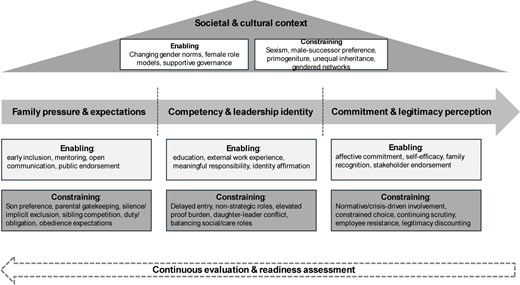
Building on the four analytical dimensions identified above, Figure 2 integrates the reviewed findings into a process-oriented framework of daughters' pre-decision succession. The framework distinguishes the overarching societal and cultural context from three interrelated process domains: family pressure and expectations, competency and leadership identity, and commitment and legitimacy perception. Within each domain, the model differentiates between potentially enabling and constraining mechanisms.
This distinction is important because the constraining dimensions identified in the reviewed literature do not operate exclusively at the societal or cultural level. Societal and cultural conditions include sexism, male-successor preference, primogeniture, unequal inheritance, and gendered networks. Other constraints emerge within the succession process itself. At the family level, these include parental gatekeeping, implicit exclusion, sibling competition, duty, obligation, and expectations of obedience. Within competency and identity formation, delayed entry, non-strategic roles, elevated proof burdens, daughter–leader conflicts, and the balancing of social and care-related roles may restrict daughters' development and positioning. Within the commitment and legitimacy domain, normative or crisis-driven involvement, constrained choice, continuing scrutiny, employee resistance, and legitimacy discounting may weaken or complicate recognition as a successor. Figure 2 therefore does not subsume all negative dynamics under a single contextual category but locates them within the domains in which they are reported to operate.
The model does not imply a uniformly positive or strictly linear progression. Enabling mechanisms such as early inclusion, mentoring, education, meaningful responsibility, affective commitment, and stakeholder endorsement may strengthen daughters' perceived readiness and recognition. Constraining mechanisms may instead delay, redirect, or undermine these developments. The continuous evaluation and readiness-assessment loop represents the possibility that experiences and assessments arising in one domain feed back into the others. For example, stakeholder recognition may reinforce family endorsement and self-efficacy, whereas continuing scrutiny or restricted responsibility may weaken commitment and leadership identity. The horizontal arrangement of the three domains should therefore be understood as an analytical ordering rather than as a fixed sequence of stages.
Overall, the framework conceptualizes daughters' pre-decision succession as an open-ended process in which enabling and constraining conditions may coexist and interact. It represents an author-led synthesis of recurring patterns across the reviewed studies rather than an empirically tested causal model. Its proposed relationships consequently provide a basis for future longitudinal research into how daughters' succession trajectories are reinforced, delayed, contested, or abandoned over time.
6. Discussion
This review addresses the fragmentation of research on daughters' succession by integrating previously dispersed findings into a process-oriented account of the pre-decision phase. Rather than treating societal conditions, family expectations, competency development, leadership identity, commitment, and legitimacy as independent determinants, our synthesis proposes that they may become connected through iterative and context-dependent relationships. The discussion develops three principal insights: the distinction between self-perceived viability and externally attributed legitimacy, the temporal and recursive character of daughters' succession trajectories, and the coexistence of enabling and constraining mechanisms across societal, family, individual, and organizational levels.
A particularly striking insight emerging from this study is the role of perceived viability as a successor in determining whether daughters actively pursue leadership roles. While much of the literature has emphasized external evaluations of legitimacy and capability (e.g. Brophy et al., 2023; Clinton et al., 2024; Duran-Encalada et al., 2021; McAdam et al., 2021; Vera and Dean, 2005), this study highlights that self-perception operates as a critical pre-decision mechanism shaping whether daughters pursue succession at all. This finding extends gender role theory by showing how gendered expectations are not only imposed by family and institutional contexts but also internalized, leading some daughters to self-exclude from succession paths even in the presence of support (Brophy et al., 2023).
From an identity work perspective, this suggests that daughters' leadership identities are shaped not only through interaction with others but also through ongoing internal sensemaking processes regarding role fit and legitimacy (Sentuti et al., 2024). Emotional support from parents, particularly fathers, strengthens daughters' self-efficacy and facilitates the internalization of leadership identities, thereby increasing perceived viability (Lyons et al., 2024; Overbeke et al., 2015). Therefore, these insights refine existing theories of gendered succession by shifting attention from formal selection decisions to earlier phases of identity formation and self-legitimation in the succession process.
A second key theoretical insight concerns the lack of temporality in much of the existing literature on daughters' succession. While the reviewed studies identify numerous factors influencing succession, many implicitly treat succession as a static or event-based outcome, rather than as a process unfolding over time. For example, Otten-Pappas (2013) focuses on commitment without considering how it develops in interaction with legitimacy perceptions or leadership identity, while Akhmedova et al. (2020) examine family barriers and motivation without addressing how competency development shapes succession trajectories over time. Similarly, Sentuti et al. (2024) emphasize the father–daughter relationship but do not integrate how broader family dynamics or external influences evolve across the succession process. Even studies that incorporate multiple elements, such as early exposure and mentorship (e.g, Gimenez-Jimenez et al., 2021), tend to stop short of tracing how these factors translate into daughters' changing roles and intentions over time. This approach lacks temporal sensitivity and limits existing explanations of gendered succession, as it obscures how early experiences condition later perceptions of viability, commitment, and legitimacy. Our synthesis suggests that succession intentions are shaped through iterative and cumulative processes, in which family support, identity work, and recognition reinforce or undermine each other over extended periods. This temporal blind spot also has implications for identity work and institutional perspectives, as gendered norms and expectations are reproduced gradually through repeated interactions rather than imposed at a single decision point. By foregrounding temporality, this review refines existing theories of daughters' succession by demonstrating that inclusion and exclusion are not momentary outcomes but processual effects emerging long before formal succession decisions are made.
A further theoretical insight from this review concerns the role of societal and cultural norms in shaping daughters' succession opportunities. While gender equality has progressed globally, deep-seated traditions continue to affect leadership transitions in many cultures. Most studies focus on general societal norms rather than examining region-specific cultural constraints in depth (e.g. Byrne et al., 2019; Hytti et al., 2017; Smythe and Sardeshmukh, 2013). Our synthesis suggests that cultural expectations regarding gender and leadership function as informal institutions that structure both family-level decision-making and daughters' self-perceptions of legitimacy. The reviewed studies indicate substantial cross-national variation in how these institutionalized norms operate. Research from contexts such as Sri Lanka, Mexico, China, and South Africa illustrates how deeply embedded cultural expectations continue to privilege male succession, even where formal gender equality has improved (Deng, 2015; Duran-Encalada et al., 2021; Ramos et al., 2024; Urban and Nonkwelo, 2022; Xian et al., 2021). From a gender role theory perspective (Brophy et al., 2023), these findings highlight how culturally specific constructions of femininity and leadership shape daughters' perceived suitability as successors. Importantly, Deng (2015) demonstrates that external policy changes may temporarily alter succession outcomes by reducing the availability of male heirs, yet such shifts do not necessarily dismantle underlying gendered institutions. These insights extend existing research by highlighting that cultural context is not a passive backdrop but an active force in shaping gendered succession pathways over time.
Another challenge in theorizing female succession lies in the highly individualized nature of succession experiences. Findings often reflect context-specific family dynamics rather than generalizable patterns. This helps explain why some studies (e.g. Deng, 2015; Smythe and Sardeshmukh, 2013) report predominantly positive father–daughter relationships, while others highlight substantial tensions that hinder succession (e.g. Overbeke et al., 2013).
Similar ambiguity emerges with regard to maternal influence. While some studies suggest that mothers positively support daughters' leadership transitions (Maciel et al., 2020; Ramos et al., 2024), others report the opposite effect (Vera and Dean, 2005), underscoring the context-dependent nature of maternal roles. Importantly, these discrepancies should not be interpreted as contradictory evidence but rather as reflecting the relational, situational, and subjective character of succession processes. From a theoretical perspective, this reinforces the need for integrative frameworks capable of linking individualized family experiences with broader patterns of gendered succession.
7. Conclusions
7.1 Limitations
First, the findings are based on 27 studies and are therefore contingent on the chosen inclusion and exclusion criteria. Second, the geographic scope is also inherently limited, as certain regions are underrepresented in the selected studies. Third, the study is restricted to articles retrieved from Scopus and Web of Science, which may have resulted in the omission of relevant studies indexed in other academic databases. Lastly, the study focuses solely on the pre-decision phase of succession for daughters, which limits the understanding of the decision-making process and the overall success rate of the succession.
7.2 Implications
The findings highlight the importance of awareness in family businesses regarding daughters as potential successors. Based on these findings, families should acknowledge their role in shaping the succession process and take early action to prepare and position their daughters accordingly. This includes fostering a strong and communicative relationship, providing mentorship, and integrating daughters into the family business at an early stage. Early exposure to business operations and leadership responsibilities not only strengthens daughters' skills and legitimacy as successors in the eyes of the family and employees but also enhances daughter's self-awareness and confidence in their leadership potential. By perceiving themselves as legitimate successors, daughters can effectively navigate the challenges of succession and establish themselves within the company.
Beyond individual businesses, promoting daughters as successors has broader societal implications. As previously mentioned, women are more likely to lead in family businesses than in non-family firms. Increasing the visibility of successful female successors could pave the way for greater acceptance of women in leadership positions. As daughters demonstrate their ability and willingness to lead, they serve as role models, challenging traditional gender norms and encouraging broader female participation in business leadership.
7.3 Future perspectives
While qualitative research has been valuable in exploring the complexity of gendered succession processes, larger and more diverse sizes would allow generalizability. On the other hand, many quantitative studies rely on the same dataset, such as GUESSS, indicating a lack of diverse quantitative data sources. To build a more comprehensive knowledge base, mixed-method approaches could be encouraged, combining qualitative depth with quantitative validation. For instance, qualitative comparative analysis, as applied by Akhmedova et al. (2020), has proven effective in capturing succession dynamics. Expanding this approach could offer new insights into the interplay of multiple influencing factors.
Additionally, longitudinal studies could provide a more accurate picture of the succession process. Most existing studies rely on retrospective accounts, which may be affected by recall bias, as daughters might no longer accurately remember early experiences. Tracking daughters' involvement in the family business over time would enable researchers to analyze how exposure, decision-making, and family support evolve in real-time. Moreover, future research could approach succession as an iterative process and provide a more accurate picture of how these factors evolve and influence each other over time, rather than treating them as isolated elements.
A geographical shift in research focus could enhance understanding of succession in contexts where traditional norms exert a strong influence. Regions such as Africa and South America remain underrepresented in the literature, yet examining family businesses in such settings could offer deeper insights into how cultural traditions shape daughters' access to leadership roles.
Finally, while prior research has devoted considerable attention to father–daughter relationships, the role of mothers in succession processes remains insufficiently explored. As more daughters emerge as potential successors, future studies could examine how mother–daughter dynamics shape leadership socialization, commitment, and identity formation over time. This perspective becomes increasingly relevant as today's daughters transition into leadership roles and later assume responsibility for intergenerational transfer themselves.
To further advance theory on daughters' succession in family businesses, future research could address the following questions, derived from the findings of this review:
How do daughters' perceptions of succession viability develop over time, and how do early family interactions shape later leadership intentions?
How do family pressure and expectations interact with skill development and leadership identity across different phases of the pre-decision succession process?
Under what conditions does external work experience strengthen daughters' legitimacy within the family firm, and when does it fail to translate into succession opportunities?
How do different forms of commitment (affective, normative, calculative) evolve throughout the succession process, and how do they influence daughters' persistence or disengagement from succession paths?
What role do mothers play in shaping daughters' readiness for succession?