Communication has long been identified as an integral element that defines healthcare's quality operations and patient safety. This study focuses on the patient and healthcare staff interaction during COVID-19 and the investigation of communication aspects affecting safety and quality of care, as collected from the National Inpatient Experience Survey (NIES) in Ireland from 2017 to 2019 and 2021 to 2022.
This is a secondary analysis study of quantitative data based on the most recent questionnaire from the NIES. In total, 61,100 patients in Irish hospitals answered to the questions of this survey over the five-year period, with a response rate ranging from 41% to 51%.
Most of the communication questions exhibited statistically significant differences when comparing the COVID-19 to the pre-pandemic period. As per the study's participants, there were more aspects of communication that deteriorated during the mandatory mask-wearing period than those who saw improvement. Also, certain aspects of communication were identified to be more frequently related to other aspects of communication, and these are trust, time, involvement, details of operations/procedures and details of diagnosis/treatment/instructions. Regarding the genders, female patients exhibited a stronger interest in more communication questions and appeared less satisfied than males. Also, younger patients appeared less satisfied with their interaction with healthcare staff.
Further research on patient-healthcare staff communication barriers is needed, especially in high-pace and noisy units and when measures such as mask wearing in extensively used. Evidence-based research should be able to update processes, education and training and/or create new technology to overcome these communication barriers and prepare for a possible new pandemic.
Introduction
Cases of patient harm with high media exposure, involving increasing numbers of affected individuals, have been making headlines globally. Healthcare, as a highly regulated and complex environment, requires the use of multiple communication channels among the different stakeholders. Communication has been recognised to be a major contributor to human error, having a grave impact on patient safety, as it has been identified to be a causal factor of 70% of adverse events in healthcare (Guttman et al., 2021), as it is vital in ensuring quality and safe care, while it is a vehicle for further improvements (Agarwal et al., 2010).
Aviation has been the first industry to regulate and implement communication (as part of its human factors policies and guidelines) into its operations and education. In the aviation sector, there is research activity specifically on staff communication (Chatzi et al., 2020; Newman and Scott, 2023) with studies indicating that effective communication techniques are integrated into both initial and ongoing training for employees, and these techniques are connected to their safety practices on the job (Karanikas et al., 2018). Since aviation has been serving as an exemplar industry for healthcare, regarding quality and safety (Sameera et al., 2021), multiple efforts have been made in enhancing communication among healthcare workers as well.
Research on how HPCs communicate with each other and the impact on safety and quality has only recently started to emerge. Communication is a multifactor platform that provides many opportunities for errors. As a process, communication is defined as “the act or process of using words, sounds, signs, or behaviour to express or exchange information or to express thoughts, feelings, etc., to another person” (Merriam-Webster, 2025), with humans engaging with it since birth. However, in healthcare, critical information is constantly being exchanged between HPCs and patients, and the effectiveness of this process will distinguish whether it is lifesaving or life-threatening. When considering the human element within communication, the patient’s health literacy, their cultural understanding and the language barriers are factors that can affect effectiveness (Ratna, 2019). It is critical for HPCs to be educated/trained in good communication strategies with patients (Ratna, 2019) along with known environmental factors that can also affect communication (e.g. noise).
In this line of research, the importance of communication lies on the grounds that non-efficient communication among groups of HPCs have been linked to worse interdisciplinary collaboration (e.g. nurse-physician) and more clinical errors; factors that lead to low quality of services (Raeissi et al., 2024). This interdisciplinary perspective has led to the realisation that communication has long been an integral element that defines healthcare's quality operations and patient safety. Therefore, within the frame of healthcare's education and training, communication has been enhanced with the use of multiple different methods and techniques, such as Situation–Background–Assessment–Recommendation (SBAR) (Yun et al., 2023), Teams Strategies and Tools to Enhance Performance and Patient Safety (STEPPS) (Alsabri et al., 2022; Brooks et al., 2022) and Crisis Resource Management (CRM) (Alsabri et al., 2022). However, as with any system, the evaluation of its effectiveness is crucial. Within healthcare, patients (as being the primary system's users) are very important in being part of such an evaluation. Therefore, patients' feedback on healthcare communications would be an excellent step towards the system's evaluation and a relevant contribution towards patient safety.
Aim
Communication is linked to healthcare's quality operations and patient safety. This study aims to focus on patients' insights (the end users of the healthcare system) on the communications they experienced during their hospital stay to evaluate communication factors influencing patient safety and quality of care. For this purpose, a quantitative analysis of survey's items that were on communication has been conducted on the data collected from the NIES in Ireland from 2017 to 2019 and 2021 to 2022. The national surveys' findings are covered in these surveys' respective annual published findings during these years.
Methodology
Ireland's National Inpatient Experience Survey (NIES) initiative enables inpatients to share their experiences with public healthcare. This national survey is a collaboration between the Department of Health, the Health Information and Quality Authority (HIQA) and the Health Service Executive (HSE) in Ireland. The survey was first conducted in 2017 and has been repeated annually ever since, except for the year 2020. In total, 61,100 participants/patients in Irish hospitals answered the questions of this survey over the five-year period, with response rates ranging from 41% to 51% (2022 N = 10,904, 2021 N = 10,743, 2019 N = 12,343, 2018 N = 13,404, 2017 N = 13,706).
This is a secondary analysis study of quantitative data based on the more recent questionnaire of the NIES; full questionnaire items can be found in this link (Department of Health, 2022). Participants were patients of Irish hospitals, invited after their discharge, to self-complete a questionnaire with 64 multiple/Likert scale and 3 open-ended questions. The questions have been selected from an international validated question bank, created from Picker Institute (Jenkinson et al., 2002). The questionnaire was organised into eight aspects of care: “Relating/Supporting”, “Informing/Explaining”, “Values, Preferences, and Needs”, “Physical Comfort”, “Continuity/Transition”, “Access to Care”, “Pandemic” and “Overall Experience”. This categorisation follows the framework outlined in the NPE Survey Technical Report 2017; Department of Health (2017). The questions that constitute the “Pandemic” section were added to the questionnaires only in 2021 and 2022. Moreover, Question 59: “Thinking about your overall care, if you wanted to give feedback or make a complaint, did you know how and where to do so?” was only answered in 2021 and 2022.
Results
The analyses presented in this study were conducted using R version 4.4.2 (R Core Team, 2024).
Reliability of the questionnaire
Each section's reliability was evaluated using Cronbach's alpha as an indicative measure of internal consistency, with results ranging from 0.471 to 0.810. It should be noted that variations in Likert scales across questions within sections may affect the accuracy of these values. Regarding the sections “Access to Care” and “Overall Experience”, which contain only one and two questions, respectively, Cronbach's alpha is not applicable since it requires multiple items to provide a meaningful assessment. Sections “Physical Comfort” (0.581) and “Pandemic” (0.471) showed low Cronbach's alpha values. This suggests that these sections may not reliably measure their intended constructs.
Trend analysis
To understand how patient experiences in relation to patient safety have evolved, a trend analysis of all the communication-related questions was conducted for the years 2017–2022. Given the ordinal nature of the Likert scale data, the non-parametric Kruskal–Wallis test was employed to compare the distributions of responses across the different years, identifying any statistically significant changes. The Kruskal–Wallis test was used as a preliminary step to identify questions with significant variations across years.
The questions shown in Table 1 have p-values less than 0.05, thus providing sufficient evidence to reject the null hypothesis, suggesting that at least one year differs in response distribution.
Regression analysis
Since the Kruskal-Wallis tests indicated significant variations, linear regression analysis was conducted for all these questions. Thus, the regression analysis was the main analytical method to pinpoint specific year-to-year differences. The earliest available year was used as the reference point, against which other years were compared. Here, we focus on presenting the practical implications of the regression analysis for the questions where significant differences were identified.
Improvement (2018 through 2022)
From 2017 to 2022, a steady improvement in providing written post-discharge instructions (Q43) was observed, especially from 2019 onward. The 2022 data show a notable increase, reflecting hospitals' growing focus on providing resources to support patients' recovery at home.
The analysis indicates that the percentage of patients receiving clear instructions on who to contact (Q49) showed a slight improvement in 2021 but remained relatively unchanged in 2022.
Improvement (2018 and 2019) followed by deterioration (2021 and 2022)
There is a downward trend in responses for the years 2018 and 2019 compared to 2017, thereby a slight improvement in patient communication with doctors and nurses in the emergency department (Q3) and for patient's family to have the opportunity for communication with doctors (Q27). Conversely, there is a significant increase in responses for 2021 and 2022, which is concerning as it reflects worse outcomes in these years.
The declined scores in 2018 and 2019 suggest improvements in patients' ability to receive understandable answers from doctors (Q20), as lower scores reflect better outcomes. The increased scores in 2021 and 2022 suggest a slight deterioration in patient experiences, with the increase in 2022 being statistically significant.
The analysis shows a significant improvement in patients’ feeling they had enough time to discuss their care with doctors (Q21) in 2019, following a borderline improvement in 2018. No significant change was observed in 2021, while 2022 showed a borderline decline. Overall, there was an improvement in 2018–2019, with a slight potential decline in 2022.
Regarding patients receiving answers that they could understand from nursing staff (Q22), while the Kruskal-Wallis test showed significant differences in responses across years, the regression analysis did not reveal any statistically significant changes compared to the baseline year of 2017. The slightly declined scores observed in 2018 and 2019, suggest a small improvement in patients' ability to receive understandable answers from nurses (Q23), although these changes are not statistically significant. The slight increases in 2021, and 2022 indicate a minor deterioration in patient experiences, although neither is statistically significant. When asked if they got the opportunity to talk to a nurse, the analysis indicates no significant changes in 2018 and 2019. However, in 2021, there was a significant decline, which continued into 2022.
No change (2018 through 2022)
The results indicate that patient involvement in care decisions (Q24) remained largely unchanged from 2017 to 2022. This suggests that hospitals have maintained a consistent approach to patient involvement, but there is no evidence to suggest significant improvements or declines.
There was no significant change in 2018 and 2019 in the information that patients received on their condition or treatment (Q25). However, the results in 2021 and 2022 showed a slight decline in the amount of information provided, although these changes were not statistically significant.
No change (2018 and 2019) followed by improvement (2021 and 2022)
In 2018, there was no significant change in patients' ability to find staff to discuss worries (Q28). However, in 2019, there was a significant improvement. This trend reversed in 2021 with a sharp decline, continuing into 2022, though less severe.
In 2018 and 2019, there were no significant changes in patients' confidence and trust in hospital staff (Q29), in staff introducing themselves (Q14), in patients' perceptions of whether doctors or nurses in the emergency department explained their condition and treatment understandably (Q4) and in patients' understanding of their diagnosis (Q26). In 2021, there was a significant positive shift, indicating an improvement in patient trust, which continued into 2022.
Deterioration (2018 and 2019) followed by improvement (2021 and 2022)
In 2018, there was a significant decline in the extent to which doctors or nurses provided family members with the necessary information to help care for patients (Q48). However, this decline stabilised in 2019, with no significant change observed. For Q13, the decline in the proportion of patients who observed staff wearing name badges, indicating a decrease in this aspect of hospital practice, was significant for 2018 and 2019. A substantial improvement occurred in 2021, followed by a positive trend in 2022 for both questions.
Deterioration (2018 through 2022)
The years 2018 and 2019 saw significant declines in the level of medication explanations (Q44), their medication side-effects (Q45), their danger signals after discharge (Q46), in patients' perception of staff answering questions about operations or procedures in a way they could understand (Q37), in patients reporting insufficient time spent on explaining post-discharge care (Q42), in patients' ability to understand test results (Q33), treatment explanations to patients (Q34) and the risks and benefits of procedures (Q36), with no improvement observed in 2021 or 2022. This suggests a sustained decrease in communication about test results, treatment and risks/benefits during this period.
In Table 2 there is a summary of all communication questions and their improvement, deterioration or no change results at the relevant period.
Impact of COVID-19 measures on healthcare communication
The Mann-Whitney U test was conducted to compare survey responses from two distinct periods: 2017–2019 (pre-COVID-19) and 2021–2022 (COVID-19). The analysis aimed to explore whether the COVID-19 pandemic and associated measures, such as mandatory mask-wearing, affected perceptions of communication in healthcare settings.
The analysis revealed statistically significant differences for most questions between the two periods. Specifically, strong evidence of change was observed for responses to questions Q3, Q4, Q13, Q20, Q21, Q22, Q23, Q24, Q25, Q26, Q27, Q28, Q29, Q34, Q43, Q45, Q46, Q48 and Q49, as indicated by adjusted p-values below the threshold of 0.05. However, for Q24 and Q25, even if the analysis here indicated a statistically significant difference, the regression analysis indicated no significant change over the years. Moderate differences were observed in responses to Q33, Q36 and Q37, highlighting less pronounced yet notable shifts in experiences during the pandemic. Conversely, some questions, such as Q14, Q42 and Q44, exhibited no significant differences, suggesting that certain aspects of healthcare communication remained stable despite the disruptions caused by the pandemic.
Correlations
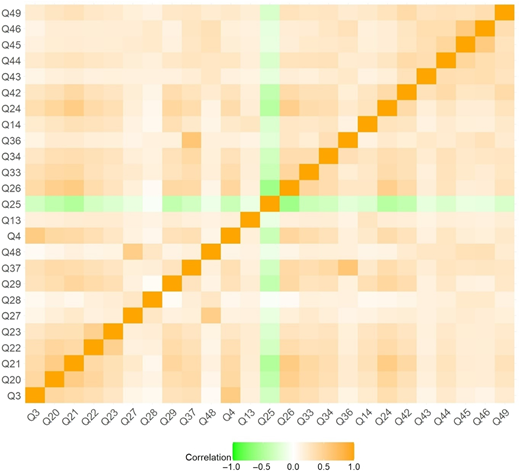
We used Spearman correlation analysis to explore relationships among survey responses. This method is well-suited for non-parametric data, as it captures monotonic relationships without requiring linearity or normality. Figure 1 illustrates a heatmap of Spearman correlation coefficients, with warm tones indicating strong positive correlations (+1), cool tones strong negative correlations (−1) and neutral tones for weak or no correlations (0).
To better understand the correlations between the survey questions, the significant correlation pairs were discretised into two categories: (a) Pairs where both questions are from the same section, thus expected to show a more reasonable and intuitive correlation due to their thematic similarity; (b) Pairs where the questions belong to different sections, providing deeper insights into unexpected relationships between different aspects of the survey. Significant correlations were identified using two criteria: a p-value of less than 0.05, indicating statistical significance and a correlation coefficient exceeding 0.3 (in absolute terms), reflecting a moderate to strong relationship. Of the 312 significant correlation pairs, 99 were within the same section (a), while the remaining 213 represent cross-sectional correlations.
Of the 213 cross-sectional correlations, certain questions appear more frequently than others. These questions are: Q21, on patients' satisfaction of allocated time to discuss care and treatment with a doctor (N = 23), Q29, on patients' confidence and trust towards treating hospital staff (N = 22), Q24, if patients were involved in their care to their satisfaction and Q38, if patients were told beforehand how they would feel after an operation (N = 18), Q26, if diagnosis was explained adequately and Q42, if the care plan was explained adequately before exiting hospital (N = 17), Q39, if patients were given adequate explanation on the outcome of their procedure (N = 16), if patients were given understandable answers from doctors (Q20) and nurses (Q22) to their questions (N = 15), Q25, the amount of information provided on their condition (N = 14), Q4 if patients were given understandable explanations to their condition from doctors and nurses at the emergency department (N = 13), Q37, if patients had their questions answered on an operation beforehand (N = 12), Q35, if patients had their treatment's risks and benefits explained beforehand (N = 11) and Q33, if a doctor or nurse explained test results adequately (N = 10).
Gender
To explore gender differences in survey responses, logistic regression analyses were performed for each question, with gender as the independent variable. “Male” served as the reference group, and “Female” was the comparison group. Although an “Other Gender” category was included in the questionnaire, no participants selected this option. Statistical significance was assessed using a p-value threshold of 0.05, and odds ratios were used to evaluate the strength of associations. The analysis identified significant gender differences in responses to several questions (except for Q24 and Q37), with females more likely to select higher response categories (negative responses) to the questions in Table 3.
Age group
The regression analysis results reveal significant relationships between the age group variable and the response outcome. Specifically, older respondents are slightly more likely to give positive responses to Q20, Q23 (especially those 66+ for this question) and to Q22 regarding their interactions with different groups of HCPs. In Q28, they are more likely to talk to HCPs about concerns, to feel they received adequate care information (Q25), to report receiving explanations about treatment (Q34), risks/benefits before operations (Q36) and to report receiving adequate responses from staff before operations (Q37). Moreover, older individuals are more likely to receive information about medication side effects (Q45), danger signals (Q46) and who to contact if worried (Q49). For Q21, they are less likely than younger individuals to feel they had enough time to discuss care with their doctor and to involve family members in doctor discussions (Q27). Older respondents are less likely to report staff wearing name badges or introducing themselves (Q13, Q14). Also, they are less likely to report having clear communication about test results (Q33), while younger individuals are more likely to do so.
Q29 shows that older individuals have lower trust in HCPs, with confidence decreasing with age. In Q42, older individuals report less time spent on health and care explanations compared to younger individuals. For Q48, younger individuals are more likely to report that their family receives all necessary care information.
Discussion
Past research has revealed that post-discharge care (especially from the emergency department) is an area for concern (Engel et al., 2012; Slater et al., 2017). Patients have demonstrated a lack of knowledge that varies within the different domains of post-discharge care, from a very modest 3% (medication and diagnosis) to an astonishing 80% (home care instructions) and 79% (return instructions) (Engel et al., 2012). In our study, from 2017 to 2022, data showed steady improvement in written post-discharge instructions, especially from 2019 onward. A most notable increase in 2022 reflects hospitals' growing focus on providing resources to support patients' recovery at home, with this being a potential positive step towards patient safety and avoidance of patients’ re-admittance. However, our data on the danger signals that patients should be mindful of at home, after their discharge from the hospital, saw a significant decline in the years 2018 and 2019. Also, patients appeared dissatisfied with the time spent on explaining post-discharge care to them. Both areas did not show any improvement in 2021 or 2022. This suggests a sustained decrease in communication about specific aspects of post-discharge care during this period.
Emergency department environment is a unique in-hospital environment that poses many obstacles in clear and effective communication (noise, heavy traffic, lack of acquaintances, critical/rapid care, etc.) (McCarthy et al., 2013). Also, as a first line responding area for unplanned and emergency patient visits, the emergency departments are placed at the core of the hospital operations, as they are anticipated to process patients while avoiding deterioration and readmissions. As such, effective communication between patients and HCPs is crucial in achieving this goal (McCarthy et al., 2013). Literature has revealed valuable elements of this communication as being present in patients' experiences with emergency departments. These are their ability to talk to HCPs without being interrupted, being treated with respect and being talked to in a way that was completely understandable (McCarthy et al., 2013). However, encouragement from staff to ask questions and involvement of patients in the decision-making were among the elements that scored low among these patients (McCarthy et al., 2013).
In our study, there is a slight improvement in patient communication with doctors and nurses in the emergency department (for years 2018 and 2019, when compared to 2017). Conversely, there are significantly increased scores in responses for 2021 and 2022, which is concerning as it reflects worse outcomes in these years. As for patients' ability to receive understandable answers from doctors, it appears to be improved in 2018 and 2019, while a slight deterioration is observed in 2021 and 2022. Similarly, the slightly declined scores observed in 2018 and 2019 suggest a small improvement in patients' ability to receive understandable answers from nurses, although these changes are not statistically significant. The slight increases in 2021 and 2022 indicate a minor deterioration in patient experiences, although neither is statistically significant. When asked if they got the opportunity to talk to a nurse, the analysis indicates no significant changes in 2018 and 2019. However, in 2021, there was a significant decline, which continued into 2022. Also, on patients' satisfaction with whether they were involved in care decisions, it remained largely unchanged from 2017 to 2022. The hospitals' consistent approach to patient involvement provides no evidence to suggest significant improvements or declines. The years 2018 and 2019 saw significant declines in patients reporting insufficient time spent on explaining post-discharge care, in patients' ability to understand test results and treatment explanations to them, with no improvement observed in 2021 or 2022. This suggests a sustained decrease in these communications during this period.
Considering the 213 cross-sectional correlations and the frequency that questions appeared into these relationship pairs, we understand that certain aspects of the patient-HCPs communication appeared stronger than others. These communication aspects were:
Trust: patients' confidence and trust towards treating hospital staff. Trust is an integral part of effective communication. Trust is a trait that requires effort to be established and needs to be present among patients and HCPs for successful treatment. When developing or upgrading communication systems in healthcare, trust should be a core element and always catered for in the patient/HCPs relationship.
Time: the allocated time to discuss care and treatment with a doctor. Patients need to feel that a proper amount of time is allocated to their case, allowing them the space and time to take initiative and get involved in their care. As a resource, adequate time should be allocated to patient care, and if patients' insights provide feedback that existing time is not enough, steps should be taken to provide additional time.
Involvement: patients' involvement in their care. Besides time, patients need to be allowed the space and invitation to be involved in their treatment. It is the patients' health and well-being, and for any treatment plan to be successful, patients need to be involved and willing to participate throughout the process.
Details of operations/procedures: patients' prior information on how they would feel after an operation, and if they have their questions answered, as well as the risks/benefits of this operation and an adequate explanation of the outcome of this operation. Especially when invasive treatment is the designated route, patients feel stressed and vulnerable due to the unknown and scary nature of such treatments. Explanations on the details of the unfamiliar operation/procedure, with providing beforehand information on all aspects of the process, can take the stress away and place expectations at the right level.
Details of diagnosis/treatment/instructions: adequate explanation of diagnosis, care plan explained adequately before exiting hospital, understandable answers from doctors and nurses to patients' questions along with the amount of information provided on their condition (at emergency department and other hospital units) and if a doctor or nurse explained test results adequately. Again, medical language, jargon and technical terminology on diagnosis, prognosis and test results can pose stress and embarrassment to many patients. This is why patients always look for understandable ways to get informed on all these technical aspects of their condition and care.
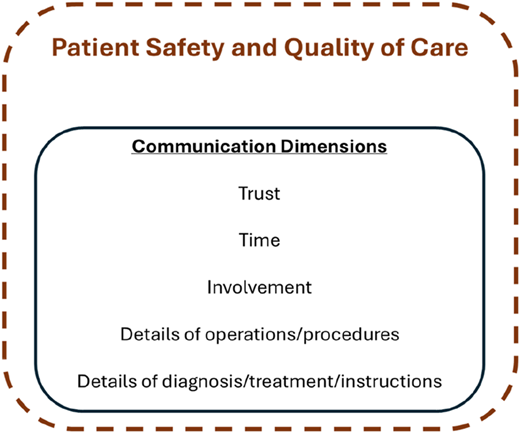
These elements can be visualised into a conceptual framework as shown in Figure 2. This framework illustrates how the identified key communication aspects – trust, time, involvement, details of operations/procedures and details of diagnosis/treatment/instructions – influence the overall effectiveness of communication between healthcare professionals and patients. Effective communication acts as a mediating factor that directly impacts patient safety and quality of care.
Communication during COVID-19 restrictions
During COVID-19 restrictions, such as mandatory mask wearing in Irish hospitals, have been implemented from 2020 until 19 April 2023. Therefore, survey results for years 2021 and 2022 correspond to the COVID-19 restrictions and mandatory mask wearing. During this time, mask wearing was required by HCPs and patients for prolonged periods. Literature has revealed several issues on the impact of mask wearing on the effectiveness of communication between HCPs and patients, especially the vulnerable ones (Marler and Ditton, 2021). Issues such as unrecognisable individuals [especially when HCPs were covered under Personal Protective Equipment (PPE)], lack of facial expressions that would enhance visual cues or lip-reading cues in the communication, and reduced voice volume while speaking behind the mask, appeared to impede effective communication among HCPs and patients (Lee et al., 2022; Marler and Ditton, 2021; Mheidly et al., 2020). These issues resulted in increased effort in listening, conversation cognition to sustaining the communication (Lee et al., 2022) while patients' trust and reluctance in requiring clarifications was ultimately impacted, leaving them more susceptible in guessing and jeopardising their good and therapeutic communication with HCPs (Marler and Ditton, 2021).
In our study, traits such as the amount of information patients received on their condition, the information on the medication they were to take home after discharge and HCPs introducing themselves to patients remained unchanged during the COVID-19 measures. However, the majority of the communication questions exhibited statistically significant differences when compared to the pre-pandemic period. As per our study's participants, there were more aspects of communication that deteriorated during the mandatory mask-wearing period (N = 13) than those who saw improvement (N = 9) (Table 1). However, if we consider years 2018 and 2019 (pre COVID-19), for this period, the trend was also inclined to the negative side of communication as more aspects of communication exhibited deterioration (N = 10) than improvement (N = 7), with the remaining seven communication aspects remaining stable (Table 1).
The aspects of communication that deteriorated during the COVID-19 period were: patients getting answers from emergency department and other hospital doctors and nurses that they could understand, patients receiving medicine information (to take home) and their side-effects, danger signals of their condition to watch after their discharge that they could understand, clarifications before a treatment/operation, on their risks and benefits and what would happen at the treatment/operation, adequate explanation of test results and the opportunity for family to talk to a doctor or for the patient to talk to a nurse. Our results are in agreement with past literature observations, as certain aspects of information about patients' condition and care do not seem to be communicated effectively to patients during this period (Lee et al., 2022; Marler and Ditton, 2021; Mheidly et al., 2020). Mask wearing is a reality for many specialised units within healthcare settings. The global mandatory mask wearing was an unprecedented measure that gave the opportunity to explore patient-HCPs communication issues on such a major scale. Preparedness for similar emergencies dictates evidence-based future practices and processes. For this purpose, further research is recommended into identifying the specific elements (barriers) that hinder the information from reaching the patients in a satisfactory way while under mandatory mask wearing. In this way, research will be able to update process and/or create new technology (such as online communication platforms, use of service robots etc.) to overcome these communication barriers.
The aspects of communication that improved during this time were: patients received written/printed information on what they should do and who to contact, if needed, after discharge, available staff to discuss worries, trust towards treating staff, HCPs wearing their name badges and introducing themselves before examining patients, providing family and carers all information to care for patients and giving understandable explanation of the condition at the emergency department and other units of the hospital. These results align with past literature as HCPs identifying themselves with name badges, and making themselves available to questions and clarifications and providing information at additional format (written), augment patient satisfaction and enhance rapport and trust (Marler and Ditton, 2021).
Gender
Past literature has revealed differences among males and females in their behavioural patterns on health-related information seeking. Females appear more motivated with clearer preference in searching for health-related information (Amante et al., 2015; Bidmon and Terlutter, 2015; Correia et al., 2024; Moradi et al., 2024; Zschorlich et al., 2015) and more willing to be better informed as patients (Bidmon and Terlutter, 2015). Our findings align with international trends, as female patient participants were more likely to be more critical of communication-related questions (N = 21) (Table 2), indicating lower satisfaction, whereas male participants were more negative in only 2 instances (N = 2).
Age
In general, older participants seem more satisfied than the younger ones on their interaction with HCPs during their hospitalisation. In past literature, similar observations have been made, with older patients exhibiting better scores in communication satisfaction, especially in the comprehensibility of the information they receive from HCPs (Trivedi et al., 2021). Older and younger patients have different expectations, as they experience their interaction with HCPs differently (Trivedi et al., 2021). Older patients have greater exposure/visits to hospital settings as the number of chronically and seriously ill is greater among this age group. This aspect makes the older group have greater familiarisation and therefore show greater overall satisfaction (Trivedi et al., 2021), with familiarity having been identified to augment patients' positive communication (Glos and Pinet-Peralta, 2021). Identifying and overcoming barriers for efficient communication among younger patients and HCPs could enhance their satisfaction and improve safety.
Conclusions
This study's results showed that the majority of the communication questions exhibited statistically significant differences when comparing the COVID-19 to the pre-pandemic period. As per our study's participants, there were more aspects of communication that deteriorated during the mandatory mask-wearing period than those who saw improvement. However, if we consider years 2018 and 2019 (pre COVID-19), communication did not appear to have overall negative results as more aspects of communication exhibited deterioration than improvement, with the other seven communication aspects remaining stable over this period.
COVID-19 mandatory measures posed more barriers for effective communication; however, the pre-COVID-19 period did not appear to show improvement for effective communication among patients and HCPs. Many specialised units within healthcare settings continue to operate with extensive mask wearing and have been doing that long before COVID-19. The global mandatory mask wearing has provided the opportunity to explore patient- HCPs communication issues on such major scale. Relevant results provide a great opportunity to identify the specific elements (barriers) that hinder the information from reaching the patients in a satisfactory way while under mask wearing. Beyond clinical implications, these findings have societal relevance, as they encourage communication practices that build patient trust, promote engagement and improve quality of life.
Implications for practice and policy
Regarding clinical practice, hospitals should prioritise structured communication strategies and invest in staff training to address gaps identified in patient feedback. Enhancing clarity in discharge instructions and improving patient involvement can reduce readmissions and associated costs, while fostering trust and satisfaction.
From a policy standpoint, these results provide evidence for integrating communication quality into national healthcare standards and accreditation frameworks. Policymakers should consider mandating minimum communication protocols, supporting digital tools and assistive technologies to overcome barriers in high-risk environments (e.g. during pandemics), and embedding patient feedback into continuous quality improvement systems. Furthermore, preparedness plans for future crises should include guidelines for maintaining effective communication under restrictive conditions, such as mask-wearing.
Strengths and limitations
The data used from NIES were not specifically designed to investigate/measure patients' communication preferences. However, we were able to identify many communication related questions that covered a variety of personal preferences and technical aspects of communication within healthcare settings in relation to patients' experiences. Also, results are related to the Irish public system and not the private sector, as participants came only from public hospitals.
Ethics approval and consent to participate
Not applicable as this is secondary data study.
We would like to thank Dr Conor Foley of Health Information and Quality Authority (HIQA) for providing access to the NIES data.