The adoption of the metaverse in supply chain management (SCM) presents transformative potential to address inefficiencies such as real-time visibility gaps, demand forecasting inaccuracies and stakeholder collaboration challenges. However, its adoption is hindered by multifaceted barriers that remain underexplored in the literature. This study systematically identifies, analyses and prioritizes 12 critical barriers to metaverse adoption in SCM.
This study uses an integrated methodology that merges a qualitative literature review with quantitative techniques, including “Interpretive Structural Modelling” (ISM) and “Cross-Impact Matrix Multiplication Applied to Classification” (MICMAC) analysis.
Key findings reveal that foundational barriers such as lack of standards and lack of infrastructure occupy the highest level in the ISM hierarchy, exerting significant influence over dependent barriers like real-time data integration and stakeholder collaboration. MICMAC analysis further classifies barriers into autonomous independent linkage and dependent categories, highlighting their dynamic interdependencies.
The study underscores the need for holistic strategies emphasizing technological readiness and ecosystem alignment to facilitate metaverse adoption. By offering a hierarchical framework and actionable insights, this study contributes to both academic discourse and practical implementation, aiding organizations in analysing the difficulties of metaverse integration for resilient, efficient and sustainable SCM.
1. Introduction
The complexities of supply chain management (SCM) are accelerating in an era defined by a surge in E-commerce, rapid growth in technology, and a continuous emphasis on efficiency (Luo, 2021). SCM are modern commerce’s backbone as they allow goods and services to traverse the globe, connecting producers, vendors and consumers in a delicate ballet of interdependence (Gölgeci et al., 2023). Yet those complex supply chain networks can be disrupted. In recent years, there have been a number of roadblocks across supply chains that will require some out-of-the-box solutions (D’Orazio, 2024; Matarneh et al., 2024; Ormond, 2015).
In SCM, real-time visibility is often a problem (Dolgui and Ivanov, 2022). Most traditional supply chain models tend to be highly complex, with many intermediaries involved and ensuring that the movement of goods is accurately and timely reported is often a struggle (Asante et al., 2023). This in turn affects decision-making and often results in inefficiencies in inventory management (Khan et al., 2022). One of the issues in SCM is the occurrence of inaccurate demand forecasting. Costly indeed, the inaccuracy in judgment of consumer demand could make a company incur extra overhead costs; essentially because it might understock or overstock (Syntetos et al., 2016). The major problem is the inability to make possible communication among the different stakeholders in the SCM for the purpose of ensuring proper coordination/synchronization of their various activities (Duong and Chong, 2020; Ozkan-Ozen et al., 2020). A further challenge of the traditional SCM is the threat of vulnerability to supply chain disruptions (Ivanov, 2020).
A new generation of SCM is required, as the limitations of traditional SCM have consistently been identified by academics (Atieh et al., 2025; Gaiardelli et al., 2021). observed that the need for disruptive solutions is undeniably clear and this has led to increased interest in how some of the challenges faced by SCM can be addressed, and the metaverse is one solution that has been proposed (Yaqoob et al., 2023). The term “metaverse” refers to “a collective virtual shared space that exists beyond the physical world” (Cheng et al., 2022), that is, it’s a seamless digital universe of interconnected virtual environments that is shared by users in a persistent online space, who can interact with each other as well as the computer-created environment in real time. Global supply-chain vulnerabilities laid bare by COVID-19, geopolitical shocks and the rapid rise of digitally native consumers have highlighted the urgent need for immersive, real-time decision environments that shrink information latency and improve collaboration (Mubarik and Khan, 2024). The metaverse promises exactly such an environment, yet its enterprise adoption lags far behind media hype. Understanding why firms hesitate is therefore not merely academic; it is a prerequisite for designing resilient, future-proof supply chains capable of coping with increasingly turbulent demand and sustainability pressures (Kareem et al., 2025; Sengupta et al., 2025). This study is motivated by that practical imperative: it seeks to illuminate the network of organisational and technological barriers that currently block the metaverse’s path from concept to operational reality in SCM. The technologies supporting the metaverse have been developing for decades. They are beginning to capture greater attention as augmented reality (AR), virtual reality (VR) and other digital technologies advance (Loureiro et al., 2020).
Several real-world implementations demonstrate how AR devices enhance supply chain efficiency. For example, DHL evaluated two commercial smart glasses, Google Glass and Vuzix® M100, in a warehouse setting, resulting in a 25% increase in operational efficiency (Kim et al., 2016). Boeing also tested Google Glass for wire harness assembly, reporting a 30% productivity improvement along with positive employee feedback (Tita, 2015). Further evidence comes from AR-based vision-picking trials at major corporations: DHL saw a 15% rise in productivity and 25% faster order processing, while Samsung recorded a 12–22% efficiency gain. Similarly, Coca-Cola observed a 6–8% performance boost and Intel achieved a 29% increase in speed (Husár and Knapčíková, 2021). These cases highlight both the potential and challenges of metaverse in supply chain.
Despite the potential of metaverse technologies to enhance visibility, responsiveness and collaboration in SCM, the transition toward their integration faces significant challenges. While prior studies have explored metaverse applications in specific domains such as transportation (Deveci et al., 2024) or gaming (Loureiro et al., 2020), the literature on the structural and organizational challenges in SCM remains underdeveloped. Most existing research addresses individual barriers (e.g. lack of standards, technological immaturity) in isolation, without analysing how these barriers interact systemically to prevent metaverse adoption (Bag et al., 2023; Butt et al., 2025; Ooi et al., 2023). This gap in understanding the interdependencies among barriers, particularly in the context of SCM, limits the development of comprehensive adoption frameworks.
Therefore, this paper addresses the following research questions:
What are the key barriers to adopting the metaverse in SCM?
How do these barriers interact with each other, and which barriers hold the most influence in adoption processes?
In order to answer the above research questions, this study identifying and analysing the barriers to adopt the metaverse in SCM. Supply chain may face multifaceted challenges ranging from technological complexities and infrastructure requirements to concerns related to data security and workforce adaptation, that needs careful analysis and strategic solutions. This study delves into the key barriers that hinder the seamless integration of the metaverse into supply chain processes and provides a comprehensive exploration of these challenges and potential pathways to overcome them.
This study contributes to the existing literature by developing a hierarchical model of inter-barrier relationships using interpretive structural modelling (ISM) and cross-impact matrix multiplication applied to classification (MICMAC). These methods enable a structured analysis of both direct and indirect relationships among 12 identified barriers. Prior studies on metaverse adoption in supply chains have typically identified challenges in a descriptive manner, such as categorising benefits and barriers (Queiroz et al., 2023) or emphasizing single dominant constraints like technological infrastructure (Bag et al., 2023). However, these works fall short of explaining how barriers interact systemically. The present study addresses this gap by applying ISM and MICMAC analysis to map the interrelationships among twelve identified barriers. In doing so, it develops a hierarchical model that distinguishes foundational drivers from dependent and linkage barriers. This causal mapping offers actionable prioritization for practitioners and extends theory by revealing the structural dynamics of barrier propagation contributions that go beyond existing descriptive or isolated analyses.
The rest of this paper is structured as follows: Section 2 presents a detailed literature review on metaverse applications in SCM and barriers to adoption. Section 3 outlines the research methodology, including the ISM and MICMAC approaches. Section 4 presents the findings and analysis, while Section 5 discusses the theoretical and practical implications of the study. Finally, Section 6 concludes the paper by summarizing key insights, outlining limitations and proposing future research directions.
2. Literature review
2.1 Literature review on metaverse in SCM
The integration of the metaverse into SCM stands as an emerging change necessitating a significant transformation of traditional business processes. Though sparse, a preceding body of research has shown promise for the application of metaverse technologies in SCM. Specifically, Dolgui and Ivanov (2023) contribute a detailed analysis of the transformative potential of the metaverse on SCM. Authors provide a six-dimensional framework for the metaverse-based SCM integrated with all major socio-technological dimensions by reporting the current state-of-the-art from a systematic literature review. Authors considered emerging research areas, focusing on the visibility driven by metaverse, digital collaboration, computational foundation for big data analytics, connectivity and proximity, Internet of Everything, the convergence of business, experiences and people. Following several trends on the theory of acceptance model, networking theory perspective and metaverse characteristics, Chen et al. (2023a, b, c) present the conceptual framework for understanding. Using data collected from 209 Chinese manufacturers, the study conducted “covariance-based structural equation modelling”. The study reveals that performance expectancy, supportive conditions and the development of initial trust among supply chain partners significantly influence the intention to adopt the metaverse, ultimately contributing to improved supply chain resilience. It points to sensorimotor feedback in metaverse adoption, which influences behavioural expectations and becomes a mediator between trust establishment and behavioural intention. Chen et al. (2023a, b, c) focus on supplier behaviour to explore the implications of implementing metaverse in the semiconductor SCM for the green procurement public policy. A conceptual framework is developed, and it is tested using “structural equation modelling” (SEM) with the dataset obtained from 251 Chinese semiconductor manufacturers. The meta-analytic findings indicate that metaverse is likely to trigger collective behaviour among suppliers. A bandwagon effect would be formed in which suppliers would be encouraged to engage proactively with the green procurement public policy. This eventually would lead to the establishment of green purchasing standards in the industry and operational enhancements across the supply chain.
The study by Deveci et al. (2024) provides insight for the integration of the metaverse in urban transportation. The study identifies twelve criteria among managerial decisions, safety measures, user expectations, and urban mobility facets to assist decision-making, which are verified and synthesized to rank three alternatives, while the research states that focusing on particular age categories can ease the metaverse’s integration into urban mobility. The study Pamucar et al. (2023) explores the potential of integrating sharing economy transportation applications with metaverse technology to enhance environmental sustainability. In the study, a multiple criteria decision-making model was used to analyse three metaverse integration alternatives. While the study, Rani et al. (2023), investigates the sharing economy and how it has impacted urban mobility and the transport sector, the paper aims to assess and to prioritize metaverse integration options for the sharing economy, which is subject to multiple criteria decision-making within more flexible and uncertain environments.
On the other hand, Deveci et al. (2023) contribute a decision support system for efficient and orderly analysis and ranking of sustainable urban transportation in the metaverse. The proposed hybrid decision-making framework combines blockchain technology and metaverse; and represents the solution to the transportation problem for smart cities. The model is implemented for the Istanbul city transportation system, such that it provides the solution of a complex problem, involving various performance-influencing factors and input uncertainties.
2.2 Literature review on barriers to adopt metaverse in SCM
The proliferation of metaverse in SCM is not going unnoticed. Various research articles are discovering their relevance and importance for drastically improving operational efficiencies and decision-making. Nevertheless, the numerous barriers to the benefits of metaverse adoption as reported in various literature cannot be ignored. Ooi et al. (2023) explore the transformative potential of metaverse for operations and SCM and engineering management. However, challenges including data privacy, security and ethical concerns about disruptive technologies such as metaverse are also suggested. Further, Queiroz et al. (2023) explore the early-stage development of the metaverse in organizations and supply chains. They conducted a comprehensive analysis by mapping 15 benefits and 15 challenges of metaverse adoption in SCM. The study involved a survey-based empirical study with 150 experts from over 12 countries with expertise in metaverse technologies. The findings reveal how metaverse adopters and non-adopters are similar and different in SCM as well as the urgent need for research that delves into the developing interplay of the metaverse and SCM. In this vein, Vyas et al. (2023) investigate how big data analytics and metaverse technology are shaping the future of supply chain traceability in the fashion and retail industries. The authors build on contemporary business models in fashion and retail to provide insights into the rise of the metaverse and what it means for SCM.
A study by Njoku et al. (2023) investigates the potentials and barriers of metaverse integration into digital transportation systems. The study explains the metaverse ideas and features and describes how they solve three primary challenges as “vehicle fault detection and repair”, “testing new technologies” and “anti-theft systems”. Additionally, Bag et al. (2023) explore the adoption of metaverse into an organizational SCM system. It discusses the primary barrier for metaverse adoption is the technological infrastructure, and states that through SEM and artificial neural network (ANN) modelling, the technical limitations can be evaluated. The author supplies both practical solutions and theoretical advancements for successful metaverse integration.
Based on the above reviews, 12 barriers to adopt metaverse in SCM have been identified and are discussed below in Table 1.
While the literature acknowledges several challenges in metaverse integration across sectors, there is a paucity of research on how these barriers collectively behave in SCM settings. For example, studies such as (Queiroz et al., 2023; Ooi et al., 2023) have identified privacy, standardization and cost-related challenges. However, little attention has been paid to the structural hierarchy of these challenges or how they interdependently influence SCM environments. Moreover, no existing research offers a validated prioritization model that can inform SCM decision-makers about where to intervene first. This paper fills this void by presenting a holistic framework that captures both the nature of barriers and their interrelationships. By doing so, it extends earlier findings and addresses the limitations of prior research that treats metaverse challenges as standalone issues.
3. Research methodology
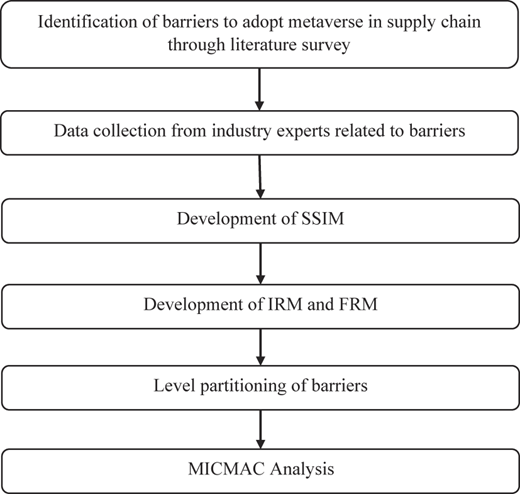
This study employed a structured research methodology to explore and understand the challenges associated with implementing the metaverse in SCM. A multi-methods approach was adopted, integrating qualitative insights from literature analysis with quantitative data techniques ISM and MICMAC analysis. The methodology was structured into three key phases: (1) identification of barriers, (2) data collection and validation and (3) ISM and MICMAC analysis. Each phase is described in detail below and is presented in Figure 1.
3.1 Phase 1: Identification of Barriers
A comprehensive literature review was done to identify potential barriers to metaverse adoption in SCM. Research articles were reviewed based on snowball sampling to identify the barriers to adopting metaverse in supply chain. Twelve barriers were identified and discussed in Table 1.
To identify the list of barriers, a systematic review was performed from Scopus database. Several keywords were considered (“metaverse” AND “supply chain*” OR “logistics” OR “operations”) for collecting articles pertaining to the topic. A total of 55 research articles were collected from Scopus database under management category and then using manual screening 18 relevant articles were considered for identifying barriers of metaverse in supply chain and logistics. The considered 18 articles were presented in Table 1.
3.2 Phase 2: Data Collection and Validation
The identified barriers were validated through expert consultations. A panel of 7 experts, including supply chain managers, metaverse technology developers and academic researchers was assembled to assess the relevance and completeness of the barriers. The data were collected in a consensus opinion from all the experts.
3.3 Phase 3: ISM and MICMAC analysis
To analyse the interrelationships among the identified barriers, ISM methodology was applied. The steps included (Sushil, 2012):
3.3.1 Structural Self-Interaction Matrix (SSIM)
Experts evaluated the contextual influence between pairs of barriers (e.g. “Barrier A influences Barrier B”) using variables V, A, X and O. where V represents row barrier has impact on column barrier, A represents column barrier has impact on row barrier, X represents both row and column barrier impact each other, O represents no impact on any barrier. The SSIM is presented in Table A1.
3.3.2 Initial Reachability Matrix (IRM)
The SSIM was transformed into a binary matrix (Table A2) to map direct and indirect relationships, which is presented as IRM.
3.3.3 Final Reachability Matrix (FRM)
Transition rule is applied to IRM to generate FRM (Table A3). The transitive rule states that if A drives B and B drives C, then indirectly A drives C.
3.3.4 Level partitioning
Barriers were hierarchically levelled based on their driving power and dependence (Table 2).
3.3.5 MICMAC analysis
Barriers were classified into four categories as shown in Figure 2.
The rationale for adopting ISM and MICMAC methods stems from the nature of the research objectives. Since the study seeks not only to identify barriers but also to understand their hierarchical structure and driving-dependence power, ISM offers a well-established approach for structuring such complex problems. ISM facilitates the formulation of a multilevel decision hierarchy, which aligns well with our aim of prioritizing interventions in metaverse adoption. MICMAC analysis complements ISM by categorizing the barriers based on their influence and dependence, providing actionable insights for both researchers and practitioners. These methods have been successfully applied in technology adoption and supply chain studies, making them a robust fit for addressing the research questions.
4. Analysis and results of ISM and MICMAC
4.1 Delphi study
A Delphi study was conducted to validate the identified barriers through a panel of seven experts, including supply chain managers, metaverse technology developers and academic researchers. The Delphi method was selected because of its iterative nature, which allows the refinement of expert opinions through multiple rounds of discussion and feedback. The experts were presented with the initial list of 12 barriers derived from the literature review in the first round. They were asked to assess the importance of each barrier and to propose any other obstacles that could have been missed.
The expert panel consisted of seven professionals with a balanced mix of academic and industry backgrounds. Three were senior SCM managers in manufacturing firms actively exploring metaverse technologies; Two were academic researchers with expertise in digital transformation and ISM methodology; and the remaining two held consulting roles in emerging technology implementation. All experts had over seven years of domain experience, and three had previously participated in similar interpretive modelling studies. This heterogeneity helped ensure diverse perspectives and rigorous conceptualization of inter-barrier relationships.
The experts’ feedback was gathered and processed to develop a modified list of barriers. The experts continued to discuss the interdependencies and relative importance of each barrier in subsequent rounds to achieve consensus. The experts validated the final set of barriers through this iterative process to ensure they accurately captured the challenges of adopting the metaverse in SCM. The Delphi study both verified the strength of the identified barriers and demonstrated their practical value, which served as a basis for the subsequent ISM and MICMAC analyses. The collaborative method ensured that the barriers were complete, clear and reflected actual operational challenges.
4.2 ISM analysis
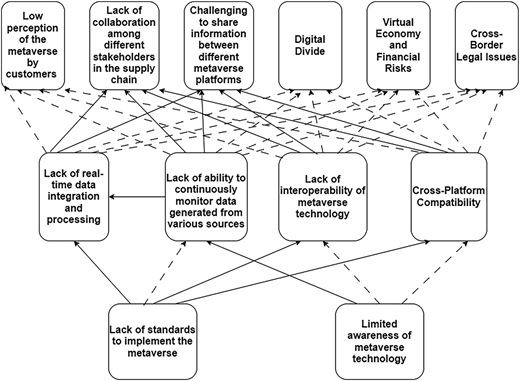
The ISM methodology was used to investigate the relationships between the barriers to metaverse adoption in SCM. The collected data are presented in the form of SSIM as shown in Appendix table A1. From SSIM, the IRM (Appendix Table A2) and the FRM (Appendix Table A3) were developed to show the relationships between the barriers. The level partitioning process (Table 2) grouped the barriers into hierarchical levels based on their influence and dependence as shown in the ISM model (Figure 2).
The ISM model reveals a multi-tiered structure where barriers at higher levels (e.g. Level 3) are foundational and exert significant influence over those at lower levels. For instance, “Lack of standards to implement the metaverse” (B3) and “Lack of infrastructure to adopt the metaverse” (B4) emerged as the most influential barriers, occupying the highest level in the hierarchy. These barriers are critical as they form the base for other challenges, such as interoperability issues and data integration problems, which are positioned at lower levels.
The model also highlights the interconnected nature of the barriers. For example, “Lack of real-time data integration and processing” (B1) and “Lack of collaboration among stakeholders” (B6) are influenced by higher-level barriers like B3 and B4, while simultaneously affecting other barriers such as “Low perception of the metaverse by customers” (B5) and “Digital divide” (B9). This interdependence underscores the complexity of addressing these challenges in isolation.
4.3 MICMAC analysis
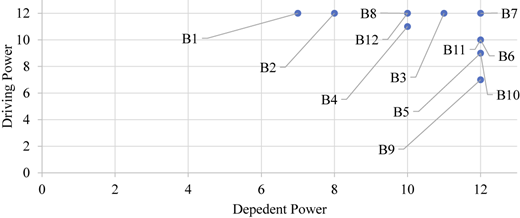
MICMAC analysis was performed to categorize the barriers into four groups according to their driving power and dependence (Figure 3).
4.3.1 Autonomous Barriers (Quadrant I)
These barriers have weak driving power and weak dependence. In this study, none of the barriers fell into this category, indicating that all identified challenges are interconnected and play a role in the system.
4.3.2 Dependent Barriers (Quadrant II)
These barriers have weak driving power but strong dependence. Examples include “Low perception of the metaverse by customers” (B5) and “Virtual economy and financial risks” (B10). These barriers are influenced by others but have limited ability to influence the system independently.
4.3.3 Linkage Barriers (Quadrant III)
These barriers have strong driving power and strong dependence, making them unstable. “Lack of real-time data integration” (B1) and “Lack of collaboration among stakeholders” (B6) are examples. Addressing these barriers requires careful consideration due to their ripple effects on the system.
4.3.4 Independent Barriers (Quadrant IV)
These barriers have strong driving power but weak dependence. “Lack of standards” (B3) and “Lack of infrastructure” (B4) are prominent in this quadrant. They are key drivers of the system and must be prioritized for effective mitigation.
The MICMAC quadrant map (Figure 3) reveals that barriers “Lack of standards” (B3) and “Lack of infrastructure” (B4) exert high driving power with low dependence, validating them as root causes whose mitigation yields the greatest systemic leverage. In contrast, “Low perception of the metaverse by customers” (B5) and “Virtual economy and financial risks” (B10) exhibit strong dependence but negligible driving power, classifying them as symptomatic barriers likely to dissipate once foundational issues are addressed. Linkage barriers “Lack of real-time data integration” (B1) and “Lack of collaboration among stakeholders” (B6) warrant careful handling because any intervention affecting them reverberates bidirectionally through the system, potentially triggering new constraints if not synchronised with infrastructure upgrades. The absence of autonomous barriers indicates a tightly coupled ecosystem in which even seemingly minor issues are entangled with broader technological and organisational contexts. This granular view equips managers with a sequenced action plan: start with standards and infrastructure (Quadrant IV), stabilise real-time data integration and collaboration (Quadrant III), and finally address customer perception and financial-risk concerns (Quadrant II).
5. Discussion
The implementation of metaverse in SCM has the potential to solve existing inefficiencies, but its implementation faces numerous obstacles. This study found 12 critical barriers, which were analysed through ISM and MICMAC methodologies to create a hierarchical structure that showed foundational barriers controlling the behaviour of other barriers. The findings agree with and improve existing research findings by delivering detailed information about SCM metaverse adoption obstacles.
The ISM model showed that “Lack of standards to implement the metaverse” (B3) and “Lack of infrastructure to adopt the metaverse” (B4) were the most influential barriers. The findings of (Dolgui and Ivanov, 2023) match this research because they emphasized the requirement for standardization to achieve interoperability and scalability in metaverse-enabled SCM systems. Small and medium enterprises (SMEs) encounter infrastructure deficits as their main obstacle to adoption according to (Bag et al., 2023) because they do not have enough resources to implement advanced technologies, including VR/AR and blockchain. The absence of universal standards makes data integration across platforms more difficult because it creates compatibility problems (Yaqoob et al., 2023). The findings confirm Proposition 1 by showing that adoption faces at least one barrier, but B3 and B4 represent essential barriers.
The MICMAC analysis grouped the barriers into dependent, linkage and independent categories. The two independent barriers B3 and B4 demonstrated high driving power but weak dependence, thus establishing their fundamental position. B1 “Lack of real-time data integration” and B6 “Lack of collaboration among stakeholders” emerged as linkage barriers because they displayed robust interdependencies. Real-time data synchronization is essential for metaverse applications, yet (Chen et al., 2023a, b, c) found that siloed systems and poor stakeholder coordination frequently prevent its implementation (Patel et al., 2012). emphasized that virtual workspaces require collaborative platforms, yet their effectiveness depends on resolving fundamental challenges related to infrastructure and standards.
The dependent barriers “Low perception of the metaverse by customers” (B5) and “Virtual economy and financial risks” (B10) arise from both foundational barriers and linkage barriers. The insufficient infrastructure (B4) and standards (B3) indirectly affect customer awareness and technological maturity, which leads to scepticism according to (Ooi et al., 2023; Queiroz et al., 2023) established a link between virtual economy financial risks and the early development of metaverse technology, which supports Proposition 3 regarding the impact of combined barriers on adoption.
The digital divide (B9) together with cross-platform compatibility issues (B12) create additional obstacles to adoption (Njoku et al., 2023). showed that digital access disparities prevent smaller players from entering metaverse ecosystems, which intensifies existing inequalities. According to (Rani et al., 2023) platform fragmentation stands as the primary barrier because proprietary technologies create problems for interoperability. Decentralized virtual environments face an additional challenge from cross-border legal uncertainties (B11) which (Deveci et al., 2024) stated acts as a barrier for worldwide SCM.
A comparative study of the present study with other previous studies is also presented in Table 3.
Compared with prior research, our study advances the field in two ways. First, whereas earlier work catalogued barriers descriptively, the present research unveils the causal architecture that links them, thereby showing why certain obstacles persist despite isolated interventions. Second, by integrating ISM and MICMAC, we provide a quantitatively grounded prioritisation scheme that managers can operationalise, something absent from purely survey or interview-based studies.
5.1 Theoretical implications
The research results from this study generate substantial real-world and theoretical effects for implementing metaverse technology in SCM. Organizations that want to adopt metaverse technologies can use the identified practical barriers to develop an implementation plan, starting with standardization gaps and infrastructure limitations and moving towards real-time data integration and stakeholder collaboration challenges. The adoption of metaverse systems will improve through investments in expandable digital infrastructure, together with advocacy for common metaverse protocols that resolve compatibility problems. The establishment of awareness and training initiatives will reduce stakeholder knowledge deficits, which results in better perceptions and increased willingness to use metaverse applications. Blockchain-enabled platforms provide secure and transparent transaction solutions that facilitate the creation of collaborative frameworks that enable information sharing and supply chain partner coordination (Ud Din et al., 2023).
The findings of this study extend the literature on metaverse adoption by offering a structured hierarchy of barriers and revealing how foundational elements, such as lack of standards and inadequate infrastructure, cascade into other barriers such as resistance to change or regulatory issues. While past studies have identified barriers individually (Queiroz et al., 2023), they have not articulated the interdependencies that shape organizational readiness. This research contributes to technology adoption theory by introducing a multi-tiered model of constraint propagation within the context of emerging technologies in SCM. The study’s integration of ISM and MICMAC demonstrates how barrier dynamics can be mapped in a systemic and interpretable way, enabling better theoretical modelling of digital transformation resistance. By integrating ISM’s hierarchical logic with MICMAC’s dependency profiling, this research extends technology-adoption theory from a flat list of determinants to a multilevel causal architecture. It demonstrates that barrier salience is endogenous: the perceived importance of a barrier shifts once its upstream drivers are neutralised. This dynamic perspective advances current metaverse literature, which predominantly treats barriers as static and independent, and offers a transferable methodological blueprint for future studies of complex, emergent technologies.
5.2 Practical implications
From a managerial standpoint, the results provide a diagnostic tool for SCM leaders planning to adopt metaverse technologies. The prioritization of barriers suggests that addressing foundational issues, like interoperability standards and network infrastructure, can alleviate downstream challenges such as user resistance or cost concerns. The MICMAC classification offers practical guidance on where policy intervention or investment should be targeted for maximum impact. Policymakers can also use these findings to develop supportive regulatory frameworks and incentives aimed at removing high-driving-power barriers. Overall, this study helps organizations structure their implementation roadmaps with informed sequencing of actions.
Industry leaders are already taking steps to address some of the foundational barriers identified in this study. For instance, Walmart has invested in blockchain technology to enhance real-time data integration (B1) and interoperability (B12) within its supply chain, enabling seamless tracking of products from manufacturer to store shelves (Kumar et al., 2024). Similarly, Maersk partnered with IBM to develop TradeLens, a blockchain-based platform that improves stakeholder collaboration (B6) and standardizes data sharing across global supply chains (Dadsena et al., 2024). In the automotive sector, BMW utilizes AR for virtual training and simulation, mitigating infrastructure limitations (B4) and enhancing workforce readiness (Ciprian Firu et al., 2021). These examples demonstrate that targeted investments in technology and cross-industry partnerships can effectively overcome critical barriers, providing a roadmap for other organizations aiming to adopt metaverse solutions in SCM.
For practitioners, the combined ISM–MICMAC framework functions as a diagnostic dashboard. Firms can simulate “what-if” scenarios, for example, evaluating whether investing in cloud-edge infrastructure (B4) will sufficiently lower customer scepticism (B5) to justify marketing spend. Policymakers may likewise prioritise drafting interoperability standards (B3) over offering short-term adoption subsidies, given the former’s outsized systemic influence. Consultants implementing digital-twin roadmaps can phase interventions according to the barrier hierarchy, ensuring that high-dependence issues are tackled only after root causes are resolved, thereby conserving resources and maximising adoption momentum.
6. Conclusion
The adoption of metaverse in SCM offers revolutionary opportunities to solve existing problems related to real-time visibility limitations and demand forecasting errors and stakeholder coordination issues. The research identifies 12 critical barriers that prevent metaverse adoption through systematic evaluation to establish a hierarchical model that demonstrates their relationships. The research implements ISM and MICMAC analysis to show that Lack of standards to implement the metaverse (B3) and Limited awareness of metaverse technology (B4) form the base of the hierarchy since they directly impact Lack of real-time data integration and processing (B1) and Lack of collaboration among different stakeholders in the supply chain (B6) as dependent barriers. By identifying 12 critical barriers and analysing their driving and dependence powers, the study offers a novel hierarchical understanding of how these barriers influence metaverse adoption. The findings contribute to theory by extending the adoption literature with a systemic view of constraint propagation. Practically, the study provides managers and policymakers with a roadmap to address high-leverage barriers first, enabling a more effective implementation strategy.
Despite its contributions, the study is not without limitations. The reliance on expert opinion, though appropriate for ISM, introduces subjectivity. Future studies could adopt quantitative methods such as DEMATEL or fuzzy-TOPSIS to validate these findings across broader samples or sectors. Further research might also explore the dynamic evolution of these barriers over time as the metaverse ecosystem matures.
Future research could extend this framework to specific industries such as pharmaceuticals, automotive or retail, where the barrier dynamics may differ. Longitudinal studies could explore how barrier hierarchies evolve as technological familiarity increases. Mixed-method approaches combining ISM with system dynamics or agent-based modelling may reveal how interventions at different levels affect overall adoption rates over time. Further, linking enablers to the existing barrier structure could provide a dual-perspective view on metaverse diffusion strategies.
The supplementary material for this article can be found online.