This study aims to gain the perception of Selangor’s disadvantaged women on the Sharīʿah (Islamic law) rules on two micro-equity financing instruments, namely, muḍārabah (profit sharing) and mushārakah (profit-and-loss sharing) (M&M).
A survey was carried out in the rural area of Selangor district in Malaysia by administering a self-generated structured questionnaire. A total of 330 completed questionnaires were retrieved from the members of an Islamic microfinance institution (IsMFI), namely, Amanah Ikhtiar Malaysia (AIM). The data were analysed by using structural equation modelling.
The female borrowers of AIM perceive the Sharīʿah rules of M&M requiring high moral and ethical values and diligent repayment performance. They are aware of some other underlying provisions such as business liquidation, share transfer, information discloser and business termination. The overall findings of this study suggest that the perceived Sharīʿah rules are akin to those that are commonly used in general partnership businesses between Muslims. It also indicates that disadvantaged entrepreneurs would accept the rules that are easy to comprehend as well as favourable to their interests. It further suggests that respondents’ experiences of microfinance and business operation do not have a significant influence on their perception of M&M instruments.
This study was limited to Selangor. So, the perception of Muslim women surveyed may not represent the views of all women in Malaysia. However, it can offer a primary understanding of the said issue.
The findings of this study can help IsMIFs take initiatives to offer M&M as micro-equity finance to poor women entrepreneurs.
So far, limited studies have been carried out on M&M-based microfinancing. This paper offers new insights presenting disadvantaged women entrepreneurs’ perception of these financing instruments.
Introduction
The profit-and-loss sharing (PLS) approach is the distinct characteristic of Islamic finance. This feature fundamentally differentiates the Islamic financial system from the debt-based conventional system (Mallinckrodt et al., 2016). Malaysia is one of the most successful countries in the world in terms of having a flourishing Islamic banking and finance industry. However, two main PLS products, namely, muḍārabah and mushārakah (M&M), are scarcely offered by Islamic banks (Chong and Liu, 2009; Sapuan, 2016). In particular, the application of M&M in Islamic microfinance is said to be totally absent (Rozzani et al., 2017; Usman et al., 2017). It is worth mentioning that the Malaysian microfinance industry is practising Islamic microfinance solely by offering qarḍ ḥasan (interest-free loan) by charging a certain administrative fee on top of the loan (Abdullah et al., 2019). Several studies pointed out that Islamic financial institutions (IFIs) are reluctant to offer these instruments because of the issues of credit risks, moral hazard, agency problems and the discretionary power of clients (Akin et al., 2016; Mili and Abid, 2017; Fianto et al., 2018; Bello et al., 2020).
In the muḍārabah contract, the Islamic microfinance institution (IsMFI) as the rabb al-māl (capital provider) contributes capital to start a commercial venture and the client, who is the mudarīb (manager), takes sole responsibility to manage the business (ElGindi et al., 2009). According to the Sharīʿah (Islamic law), the rabb al-māl can receive a mutually agreed share of the profit at the end of the business cycle; but if the business incurs any loss, this party must bear the full amount of the loss (Iqbal and Mirakhor, 2011). However, there is a provision that if the financial loss happens because of the mudarīb’s misconduct or negligence, the rabb al-māl is authorized to impose the loss on the mudarīb (Khan, 2008b). On the other hand, in the mushārakah contract, both parties are entitled to be business partners by contributing capital and managerial efforts. They mutually share the business’ output, whether it is profit or loss (Iqbal and Mirakhor, 2011). In both partnership agreements, the client is mainly responsible for managing the business.
Similar to other financing contracts, the primary concern in the M&M agreement is to identify appropriate clients. Muḍārabah is a trust-based agreement and mushārakah needs capital participation. In this regard, it is important to consider certain attributes that clients should possess. It is also necessary to ascertain the amount of the capital for the proposed business and define the ratio of PLS. These provisions depend on the mutual agreement between the parties involved (Jais et al., 2020).
M&M instruments must be used for commercial or productive purposes with no financial speculation (Khan, 2008a). No ḥarām (Islamically impermissible) businesses, such as gambling, prostitution, pork breeding and selling of alcohol, can be conducted by using these funds (Kamla and Alsoufi, 2015). An unethical mudarīb may hide business-related information or overspend on business operations or under-report the profit to gain a higher share than that stipulated in the agreement (Abdul Rahman and Dean, 2013). To resolve such ex-post hazards, a proper monitoring mechanism needs to be put in place. Furthermore, to protect the investment and prevent financial risk, specific rules need to be exercised (Rosly, 2005; BNM, 2010). Hence, the setting up of a control mechanism is necessary, as will be detailed later.
Sharīʿah-based rules have been specified to regulate M&M partnerships (BNM, 2007, 2010, 2012, 2015). Any IsMFI having the infrastructure and necessary resources can offer these instruments to poor entrepreneurs. Presumably, lack of knowledge about clients’ perceptions is one of the factors that hinders IsMFIs from offering these instruments. An empirical study suggests that the acceptance of any financial product largely depends on the clients’ understanding of the associated rules and attributes of that product (Kalra et al., 2015). Therefore, it would be worth exploring clients’ perception of M&M to anticipate the applicability of M&M instruments.
Customers’ experiences impact on their understanding of products’ attributes (Chahal and Dutta, 2015). In this light, clients’ experiences of microfinance presumably impact on their understanding of M&M. Clients with business experience are more interested in receiving capital from formal sources (Levie and Autio, 2013). In this case, they generally give priority to products’ attributes to select the suitable product (Krishnan et al., 1999). Hence, business experience would have impact on their perceptions as well.
The above discussion raises the following two research questions:
How do Malaysian underprivileged Muslim women entrepreneurs perceive the Sharīʿah rules of M&M financing?
Do entrepreneurial women’s experiences of microfinance and business impact on their perceptions of M&M financing?
In light of these questions, the objectives of this research are stipulated as follows:
To explore the perception of Sharīʿah rules of M&M financing by underprivileged Muslim women entrepreneurs in the State of Selangor, Malaysia.
To determine whether entrepreneurial women’s experiences of microfinance and business have an impact on their perceptions of M&M financing.
The next section discusses the Sharīʿah rules for M&M. It is followed by a discussion of the methodology adopted to conduct this study. The following sections then demonstrate the results, discuss the findings and conclude the study.
Sharīʿah rules for muḍārabah and mushārakah
Both IFIs and their customers are obligated to follow the Sharīʿah guidelines when dealing with any Islamic financial instrument. Notably, there is no published Sharīʿah guideline in Malaysia for operating M&M-based microfinancing. For this reason, this study has chosen the general Sharīʿah rules prescribed by Bank Negara Malaysia (BNM, 2007, 2010, 2012, 2015) for Islamic banking and finance operations. In this case, the basic Sharīʿah rules have been chosen considering their appropriateness and adaptability to the architecture of M&M microfinancing. The authors’ discretion could be considered as a limitation of the study. In particular, this study adopted specific Sharīʿah principles that can presumably help identify the appropriate clients, determine the share of profit and loss while allocating the required amount of capital, monitor the business operations and control the risks under M&M. These Sharīʿah rules for operating M&M are discussed further.
For the operational ease of microfinancing, this study prefers the restricted muḍārabah (muḍārabah muqayyadah) to the unrestricted muḍārabah (muḍārabah mutlaqah) contract. Unrestricted muḍārabah does not allow the rabb al-māl to interfere in the operations of the business. Restricted muḍārabah, on the other hand, offers options to impose terms and conditions for business operations. Besides, unrestricted muḍārabah is somewhat difficult for the financing institution to manage (Ibrahim, 2013). Muzāraʿah (sharecropping partnership), which is another type of muḍārabah financing, is also disregarded in this study. This financial tool is suitable for the agricultural sector, which is not covered by this study.
In terms of the mushārakah agreement, this study chose shirkat al-milk (partnership of ownership) and shirkat al-amwāl (partnership for undertaking work) and does not consider shirkat al-wujūh (partnership of creditworthiness) and shirkat al-aʿmāl (service partnership). Shirkat al-milk is a type of joint ownership by two or more people of a particular property. This shirkah (partnership) is used for purchasing and owning equipment or assets jointly. In shirkat al-amwāl, the involved parties invest some capital in a commercial enterprise. These two types of partnership seem more viable for the institutional practice of Islamic microfinancing. On the other side, in shirkat al-aʿmāl all partners render services to earn fees. For practising shirkat al-wujūh, no financial investment is required. Partners purchase the commodities on a deferred price and sell them for spot payment. This study also deliberately excluded musāqāh, which is another type of mushārakah that deals with orchard financing (Tamanni and Liu, 2017). However, it considers mushārakah mutanāqiṣah (diminishing partnership), which is another type of mushārakah contract in which the client initially enters into a joint-partnership with a lease-rental agreement with the view to owning a commercial enterprise, property or equipment. After paying the lease rentals the client owns the property (Abdullah et al., 2019).
The selected parameters for operationalizing M&M-based Islamic microfinancing are as discussed further:
Identification
For the purpose of identification, this study selected a set of rules based on scholars’ opinions and BNM rulings. ElGindi et al. (2009) and Dezső and Loewenstein (2012) suggested trustworthiness, diligence, good reputation in business dealings, good credit history and good ethics to be basic conditions when considering clients for M&M financing. Ahmad (2016) emphasized transparency as the main condition for entering into the M&M agreement. ElGindi et al. (2009) highlighted good morals whereas Rulindo and Mardhatillah (2011) emphasized religiosity. BNM (2007, 2010) emphasized the trait of abiding by rules.
In this light, clients of M&M should be selected based on:
trustworthiness;
transparency;
good morals;
religiosity;
good ethics;
good reputation in business dealings;
good credit history;
diligence; and
the trait of abiding by rules.
Measurement
In terms of measurement, this study selected a number of Sharīʿah rules such as capital sharing, PLS and ownership of the business/asset (upon paying the lease-rental of the tangible asset under mushārakah mutanāqiṣah contract) as stated further:
The IsMFI (rabb al-māl) provides full amount of the capital to the mudarīb (client) and the client is responsible for managing the business (in the muḍārabah contract).
Profit is distributed on an agreed sharing ratio between the partners (in M&M).
Both parties participate in the capital and manage the business (in mushārakah).
Loss is measured in proportion to the share of capital (in mushārakah).
Capital can be “financial capital” or “goods” (in M&M).
By paying back the full price/capital to the financing institution, the client can own the entire business/asset (in mushārakah mutanāqiṣah).
The capital-sharing ratio must be defined based on mutual agreement (in mushārakah).
The profit-sharing ratio must be defined based on mutual agreement (in muḍārabah and mushārakah).
If any loss occurs because of the misconduct of the mudarīb, it must be borne by the mudarīb; otherwise, the total loss will be borne by the financing institution (in muḍārabah).
Upon termination of the joint business agreement, the total asset will be turned into cash and be distributed among the partners (in mushārakah).
In terms of partnership transfer, the accrued profit or loss in a previous contract must be distributed to the previous partner (in mushārakah; i.e., in case a member has left the partnership).
If any loss occurs upon termination of the partnership, the loss shall be borne by the partners according to the proportion of their capital (in mushārakah).
Loss of capital in the course of the venture is recognized as capital impairment (in M&M) (BNM, 2007, 2010, 2012, 2015).
Monitoring
Disclosure of business information is one of the most important issues in monitoring. Proper information sharing can protect the investment as well as build trust between the mudarīb and the rabb al-māl. Though the general principle of muḍārabah financing does not allow the rabb al-māl to interfere in the business operations, in restricted muḍārabah contracts, the rabb al-māl can impose legitimate conditions that must be mutually agreed (Ibrahim, 2013). It is worth noting that the rabb al-māl cannot interfere in the mudarīb’s activities, but this party can monitor the business to prevent information asymmetry as well as credit risk (Sapuan et al., 2012).
For the purpose of monitoring the M&M-based business, the prescribed Sharīʿah rules of BNM (2007, 2010, 2012, 2015) are:
disclosing the market information;
disclosing the business information;
disclosing the production process;
disclosing the production cost;
disclosing the financial report;
regular auditing;
disclosing the cost of marketing and promotion; and
joint management.
Controlling
To control business risks in mushārakah financing, joint management is prescribed as the most effective method. The partners possess the right to amend the policy to take a timely decision. But, for muḍārabah investment, where only one party is responsible for business management, this study has chosen termination of the contract as a measure of controlling business risks. The selected Sharīʿah rules for controlling business risks in mushārakah are:
participation of the Microfinance Institution (MFI) in business decision-making;
the MFI may employ a manager to manage the business;
the MFI can employ a third-party organization to manage the business; and
business policy can be mutually amended.
And for both M&M:
The business contract can be terminated at any time upon mutual agreement.
If the business encounters unexpected loss, the partnership contract can be terminated.
If the agreed time-period of the business is over, the MFI can terminate the business.
If the business becomes complicated, the MFI can terminate the business.
If a considerable amount of capital gets impaired, the MFI can terminate the business.
If the client dies, the MFI can terminate the business (BNM, 2007, 2010, 2012, 2015).
Disadvantaged women in Malaysia
The incidence of absolute poverty is almost absent in Malaysia, with the figure being 0.4% in 2016 (Department of Statistics, 2019). However, evidence is apparently visible of poor and relatively poor persons (Nair and Sagaran, 2015). The bottom 40% of the population shares only 16.8% of national income, the middle 40% shares 37.4% and the top 20% shares 46.1% of income (Department of Statistics, 2019). These statistics prove the existence of a huge income gap and disparity among Malaysians.
Women are presumably more deprived of income opportunity and are more prone to poverty and vulnerability than men. According to the Department of Statistics (2019), the gender gap index of Malaysia is 0.711, which shows that the gender inequality gap is 0.289. The score for educational attainment is 1.054. It indicates that women surpassed men in terms of educational attainment. Further, the economic participation and opportunity index stands at 0.727 and political empowerment at 0.106. Men are reported to be more privileged than women in terms of economic participation and empowerment. In other words, the statistics highlight that women in Malaysia are underrepresented in the job-market.
Being “socially disadvantaged” is defined as “a range of difficulties that block life opportunities and prevent people from participating fully in society” (Vinson et al., 2007, p. 1). Disadvantaged people commonly experience exclusion, anxiety and low self-esteem because of having limited access to resources and less control over life (Wilkinson and Marmot, 2003; Ebert et al., 2011). The term “disadvantaged women” generally refers to widows, single mothers, abused or abandoned women and women with incapacitated husbands living on marginal income and uncertainty (Women of Will, 2019). As the gender gap index suggests, Malaysian women are less active in economic activities compared to men. This phenomenon is higher in rural areas (Hirschman, 2017). Women living in villages are mostly homemakers. They lack the needed resources to generate income and get less opportunities to access the labour market. They are more likely to be poor (Masud et al., 2018). Besides, occupational segregation and wage discrimination between men and women are also vivid in the labour market (Ismail et al., 2017). Evidence suggests that Malaysian women sometimes leave their jobs for homemaking and taking care of children. Cultural norms also prevent Muslim women from working on an equal footing with men (Miles, 2016). Thus, many women in Malaysia, particularly in rural areas, are deprived of opportunities and economic benefits, hindering their contribution to the economy.
This study particularly focuses on examining disadvantaged Muslim women entrepreneurs in rural areas, notably in Selangor State, and discussing their perceptions of equity-microfinancing.
Review of past studies
Islamic microfinance is at an early stage of operation and the practice of M&M is very limited; hence, the number of published literary works is also limited. This section reviews the recently published relevant literature on M&M-based microfinancing.
Abdullah et al. (2019) recently carried out an empirical study on Yayasan Usaha Maju, Amanah Ikhtiar Malaysia (AIM) and Tabung Ekonomi Kumpulan Usaha Niaga. They unearthed that these institutions are practising Islamic microfinance to a limited extent by using the qarḍ ḥasan instrument with a certain charge as an administrative fee. They made constructive arguments on how to integrate M&M instruments within the context of microfinance. They recommended that M&M would diversify the product portfolio of IsMFIs while highlighting the main tenets of Islamic finance.
Fianto et al. (2018) concluded from scrutiny of two years of panel data that equity microfinance and debt-based microfinance both have significant positive impact on rural household income in Indonesia. But Warninda et al. (2019) found that mushārakah is riskier than the muḍārabah instrument in the Middle East, South Asia and Southeast Asia. However, some empirical studies contradict their findings, showing that muḍārabah financing is riskier than mushārakah financing (Said et al., 2013; Louhichi and Boujelbene, 2016). In this vein, Smolo and Ismail (2011) argued that mushārakah is the more suitable instrument for microfinancing, as involving parties mutually contributes goodwill, cash or other forms of assets and share the profit/loss upon agreement. Abedifar et al. (2013) showed that the principal-agent conflict increases the monitoring cost in M&M financing. They underscored that equity financing outperforms debt-based financing.
Rahman and Nor (2016) conducted an empirical study in Malaysia to look into the obstacles that hinder the applications of M&M financing. They outlined four major barriers such as the high risk of investment, difficulty of selecting appropriate partners, creditworthiness of the partner and lack of capital security. Similarly, a few other studies concluded that because of the possibility of information asymmetry, moral hazard, adverse selection and costly monitoring, PLS financing is riskier (Beck et al., 2013; Louhichi and Boujelbene, 2016). Aman and Ullah (2016) mentioned the same issues and challenges that MFIs are facing in practising M&M financing in Pakistan. On the other hand, El-Komi and Croson (2013) introduced very interesting outcomes that suggest clients who are engaged in M&M contracts are more likely to comply with the terms of their financing than those in interest-based agreements.
In view of the limited studies carried out on M&M financing, this paper offers new insights by presenting disadvantaged Muslim women entrepreneurs’ perceptions of these financing instruments. The Muslim women surveyed were, however, restricted to the rural area of Selangor State in Malaysia.
Methodology
The quantitative research method was adopted to conduct this study. The survey technique was used to achieve high external validity and generalizability (Creswell and Creswell, 2017). A structured questionnaire was administered in 2015 in Cheras, Selayang and Gombak in Selangor State to collect the data. A total of 330 completed questionnaires were collected from an equal number of respondents in the three regions by means of the stratified convenient sampling technique. All the respondents were Muslim women and represented members of an IsMFI, namely, AIM. AIM is the largest MFI providing Islamic microfinance across Malaysia. This organization basically offers qarḍ ḥasan (benevolent loans) as microloans (Saad, 2012; Alam et al., 2015). All the members of AIM are economically disadvantaged but possess the necessary business skills.
The data were analysed by using descriptive and inferential statistics. Exploratory factor analysis (EFA) and confirmatory factor analysis (CFA) were adopted followed by structural equation modelling (SEM). In this regard, a software package, SPSS®AMOS (21) was used.
Model fit indices
The Chi-square (CHIN/DF) was chosen as the primary fit index (Moss, 2016). A non-significant chi-square indicates a good model fit (Barrett, 2007). But this index can be affected by the sample size and the size of correlations of the model. Besides, it assumes multivariate normality (Hooper et al., 2008; Kenny, 2015). Considering all the possible sensitivities of Chi-square, this study adopted some other fit indices, such as goodness of fit index (GFI), adjusted goodness of fit index (AGFI), comparative fit index (CFI), root mean square residual (RMR), Tucker Lewis index (TLI), normed fit index (NFI), root mean square error of approximation (RMSEA) and p of Close Fit (PCLOSE) (Hu and Bentler, 1999; Schermelleh-Engel et al., 2003; Kenny, 2015).
Population and sampling
The members of AIM were chosen as the population for this study because AIM is the only MFI providing financial services to disadvantaged rural people who are basically running small businesses for their livelihood. A great majority of the members of AIM are women (Saad, 2012). AIM is currently serving 379,824 members through 134 branches all over Malaysia (AIM, 2019). The key rationales for choosing AIM’s members are:
ease of reaching disadvantaged women;
respondents have knowledge of microfinance; and
members of AIM are engaged in business.
The sample size of this study fits the sampling criteria of factor analysis and SEM. Factor analysis requires at least 300 samples whereas SEM needs more than 200 samples (Kenny, 2015). By reaching 330 (n) successful respondents, this study achieved the required sample size.
Data analysis and findings
Descriptive statistics were used to describe respondents’ socio-demographic information and inferential statistics were used to answer the research questions. It is worth mentioning that all the missing values were replaced with the nearby “median”, as the missing value is unaccepted in SEM analysis (Allison, 2003).
Socio-demographic information
About 19.1% (n = 63) of the respondents were of young age, 72.1% (n = 238) of middle age and the rest, 8.8% (n = 29) were senior citizens. Most of the respondents were married (79.3%, n = 270), only 3.9% (n = 13) were single (never married), 7.3% (n = 24) widowed, 6.1% divorced and 0.9% (n = 3) separated. The majority of respondents were actively running businesses (66.9%, n = 221) while only 15.8% of them were housewives (passively involved in business activities). About 7.3% of the respondents were earning salaries by engaging in formal jobs and 10% were involved in other types of income-generating activities [1].
In terms of economic status, evidence of the absolute poor, with income below RM 700 [2], was almost absent (only 0.6%). However, 21.1% (n = 40) of the respondents were poor with income between RM 751 and RM 1,700; 38.5% (n = 127) had low income between RM 1,701 and RM 2,500; and 48.8% (n = 161) had middle income between RM 2,501 and RM 5,550 (Sabri and Zakaria, 2015; EPU, 2016). Almost every respondent had received formal education. Only two respondents reported not having academic literacy. However, 69.4% (n = 229) of them had sijil pelajaran malaysia certificate, 8.2% (n = 27) sijil tinggi persekolahan malaysia, 7% (n = 23) bachelor’s degree, 1.5% (n = 5) post-graduate degree and the remaining 9.7% of the respondents (n = 32) obtained “Form 3” and diploma courses.
Exploratory factor analysis
Maximum likelihood and oblique rotation (promax) methods were used for EFA (Costello and Osborne, 2005). By this technique, four factors were formed while correlations among the observed variables were measured (MacCallum, 2009). These factors were:
identification (I);
measurement (M);
monitoring (MO); and
controlling (C).
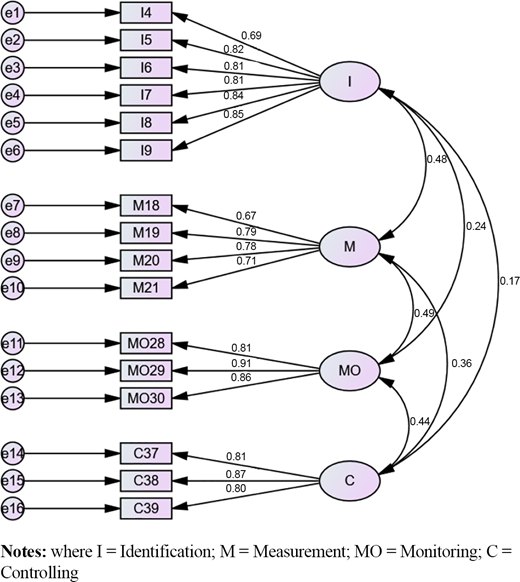
These factors (latent variables) were created with the items (observed variables/Sharīʿah parameters) that scored high factor loadings/standardized regression weights (β) (Brown, 2009). The factor of identification (I) was represented by six observed variables (I4, I5, I6, I7, I8 and I9); measurement (M) by four (M18, M19, M20 and M21); monitoring (MO) by three (MO28, MO29 and MO30); and controlling (C) by three variables (C37, C38 and C39).
Kaiser–Meyer–Olkin measure and goodness of fit tests
The Kaiser–Meyer–Olkin (KMO) measure of sampling adequacy statistic was 0.862, which is significant [recommended value is ≥ 0.6 (Neill, 2008)]. The Bartlett’s test of sphericity was also significant (χ2 [3214.157] by the degree of freedom 120, at p < 0.05). This implies that the observed variables under each factor were not identical. According to the goodness-of-fit test statistics, the overall model was statistically fit (χ2 = 192.92 at p <0.001).
Factor correlation matrix and reliability
The factor correlation matrix table (Table I) shows that all the factors were positively correlated with the values being less than 0.5. This implies that the latent variables were intercorrelated but did not pose any multicollinearity or singularity problem (Field, 2000).
The values of Cronbach alpha (α) suggest strong coherence and reliability of the items. As all the values of alpha (α) are above 0.70, all items (observed variables) are reliable and consistent (Costello and Osborne, 2005; Lavrakas, 2008). Table II displays the summary of the EFA.
Scree plot
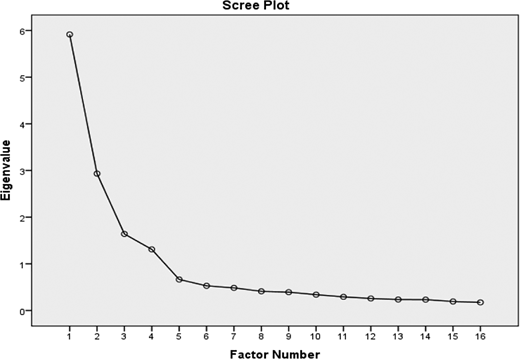
The scree plot (Figure 1) exhibits the eigenvalues in a descending order. The upward trend of the plot indicates the higher eigenvalues of significant factors (Vogt, 2005).
The values of the first four factors are immediately above the Eigenvalue 1 (cut-off point ≥1) and from the fifth factor, the line of the plot goes almost horizontally (<1). Hence, the minimum eigenvalue of each factor is >1, which is acceptable (Costello and Osborne, 2005). Therefore, all four factors are worth keeping.
Confirmatory factor analysis
According to the pattern matrix table (in EFA), a measurement model is built. This model leads to conduct the CFA as well as determine the consistency with observed variables.
Figure 2 is a measurement model based on the output of the EFA. The model fit indices show CHIN/DF = 2.601 at p < 0. 001. RMR value is 0.071 [recommended value is 0.05-0.08 (Hu and Bentler, 1999)]. The values of GFI and AGFI are 0.913 and 0.880, respectively [recommended value for GFI is >0.95 (Shevlin and Miles, 1998) and AGFI is >0.90 (Kline, 2005)]. The value of CFI is 0.950, which is significant [recommended value is >0.90 (Hu and Bentler, 1999)]. Furthermore, TLI is 0.939 and NFI is 0.922, which are significant (Kenny, 2015). On the other hand, RMSEA is >0.05 (0.070) and PCLOSE is <0.05 (0.001), which are not significant (Kenny, 2015). Thus, the model cannot be considered perfectly fit with the data, but it can be further improved by reducing less significant items (items bearing standardized regression weight [β] below < 0.7).
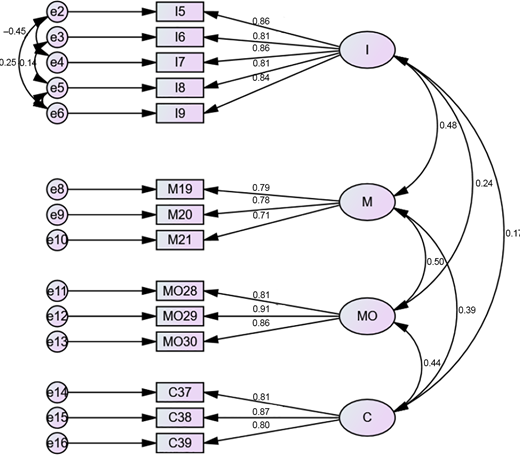
Figure 3 is a re-specified model built after reducing two items I4 and M18 with beta (β) value <0.7. The model fit indices suggest CHIN/DF = 1.443, which is significant at p < 0.05. Besides, RMR value is lower than the previous model (from 0.071 to 0.058). The values of GFI and AGFI improved slightly (0.961 and 0.939 accordingly) and reached the cut-off point. The value of CFI improved from 0.950 to 0.989 and reached the cut-off point (Hu and Bentler, 1999). Furthermore, TLI is 0.985 and NFI is 0.966, which are significant as well (Kenny, 2015). RMSEA and PCLOSE values are significant, representing 0.037 and 0.919, respectively (Kenny, 2015). Thus, this model can be considered as a fitted model. Items with the statistically significant standardized regression weight (β) are presented in Table III.
Construct validity
The convergent validity and discriminant validity are measured to examine the reliability and traits of correlations among the variables (Brown, 2000). The convergent validity shows the extent to which a measure is related to other measures in the same construct while discriminant validity defines the level of correlations among the variables by measuring the different traits. The low correlations among the variables indicate the existence of discriminant validity (Cramer, 2004; Salkind, 2010).
Table IV shows that the composite reliability (CR) for each factor is higher than 0.8 (recommended >0.7), the average variance extraction (AVE) is higher than 0.5 and the maximum shared variance (MSV) and average shared variance (ASV) are lower than the AVE (Hair et al., 2010). Besides, the value of Cronbach alpha (α) is >0.8 (George and Mallery, 2016). This implies that all the factors have achieved reliability and convergent validity.
Table V displays that the square root of AVE for each construct is higher than the inter-construct correlations (Hair et al., 2010). This implies that the discriminant validity is adequate for the constructs.
Overall, the results of the inferential statistics suggest that the observed variables (Sharīʿah parameters) have high standard regression weight (β > 0.7) at p < 0.001. All latent variables have achieved reliability and convergent validity. Besides, discriminant validity is adequate for the construct. Therefore, these findings can be considered valid and representative.
Discussion
Table III demonstrates the significant Sharīʿah rules perceived by Malaysian poor women entrepreneurs. This finding suggests that the female members of AIM understand the normative rules of the partnership business. It also reflects their inclination to the common rules of MFIs. For instance, under the factor “identification”, the parameters with high factor loadings are: “good ethics”, “good reputation of business dealings”, “good credit history”, “diligent repayment” and “being rule abiding”. Understandably, these parameters are commonly given consideration in business partnerships. Besides, Islamic codes of behavioural conduct also suggest Muslims abide by the aforesaid rules. It can also be assumed that the respondents might learn these rules from AIM, as AIM provides clients with training on entrepreneurship, business management and ethical conduct. Furthermore, they might learn from their experiences of being in partnership businesses.
In terms of “measurement”, respondents seem pragmatic in selecting the Sharīʿah rules. They understand the rules of “business liquidation upon termination”, “previous financial loss or gain goes to the former partner in case of share-transfer” and “upon termination, the loss is shared proportionately with the capital participation”. Apparently, these are the common practices in almost every partnership business. As all the respondents are involved in running businesses, they might have experienced such rules from their regular business dealings.
Under the factor “monitoring”, the significant parameters are “revealing production processes”, “revealing production cost” and “revealing marketing and promotional cost”. These findings indicate the open-mindedness of Malaysian entrepreneurial women to the partnership business.
In the case of “controlling”, Sharīʿah rules such as “business termination if it is complicated”, “business termination if the contractual period is over” and “business termination if the capital is impaired” seem well comprehended by the respondents. They presumably understand these rules because they run their own businesses or based on prior experiences. These outputs also indicate that respondents possess enough professionalism and they have a rational understanding of partnership agreement.
Furthermore, this study examined the moderating effects of experiences of microfinance and business of the members of AIM to understand whether the variations of these attributes impact on their perceptions of M&M. The output of multi-group moderation is reported further (Table VI).
Findings from the group moderation analysis (Table VII) suggest that the variations of microfinance experience and business experience have trivial effects on clients’ perceptions of M&M financing. Differences in microfinance experience negatively impacts only on one parameter (I6) of the factor “Identification”. On the other side, differences in business experience negatively impacts three parameters (I6, I7 and I9) of the same factor. These two moderating variables have no impact on the rest of the parameters of other factors. So, it can be concluded that in the case of offering M&M products, MFIs need to pay less or no attention to the levels of clients’ business experience and microfinance experience.
In a nutshell, the overall findings suggest that the members of AIM in Selangor comprehend the Sharīʿah rules that are easy to understand and commonly practised in the general partnership business. Some of the Sharīʿah parameters (Table 3) with high factor-loading (standardized regression weight, ß) reflect respondents’ inclination to the rules that reserve their interest (for instance, the rules under the factor “measurement”, “previous loss or gain goes to the former partner in case of share transfer” and “proportionately loss-sharing upon termination in mushārakah contract”). Further, the group moderation suggests that in terms of the impact of business experience and microfinance experience, AIM’s members can be treated equally without considering the length of their experience with microfinance and business.
Conclusion
Conventional microfinance was initiated with the purpose of alleviating poverty by providing financial services to the disadvantaged and the non-bankable (Le, 2017; Mia, 2017). However, several empirical studies pointed out that the excessive interest [3] charged by MFIs is one of the major barriers in poverty alleviation (Roberts, 2013; Nanayakkara and Stewart, 2015; Islam et al., 2018; Khazanov et al., 2018). Besides, most of the MFIs overly stress on loan repayments while they barely consider whether the borrowers are capable of using the loans for income generation (Chowdhury and Mukhopadhaya, 2012; Islam et al., 2018).
Islamic microfinance could be considered as an emerging social welfare market niche as well as an alternative form of ethical financing and investment (Bello et al., 2020). Hence, the PLS approach of Islamic microfinance can be regarded as a viable and better alternative to serve the Muslim poor. Profit sharing can substitute for interest while mutual management can be expected to enhance the profitability and growth of the business. On the other hand, the provision that the IsMFI share financial loss might encourage clients to undertake risky ventures or rejuvenate non-performing businesses. Thus, M&M can contribute to institutional sustainability and growth while scaling up the income of poor entrepreneurs.
In a nutshell, this paper presents clients’ perceptions of Sharīʿah rules of M&M financing. Respondents perceive that M&M-based business dealings require sound moral values as well as repayment performance. They understand the underlying provisions of business liquidation, business termination and share transfer. They also understand the major Sharīʿah rules of information disclosure where they have to reveal the production process and production and marketing costs. On the other hand, they are less aware of the elements of transparency and trustworthiness. Respondents seem unaware of the provision of owning assets through mushārakah mutanāqiṣah. Though they understand some rules of monitoring, they have a negative attitude towards revealing market information and to being under joint management and regular auditing.
This output may assist IsMFIs to modify the underpinning rules of these instruments to get better acceptance by poor entrepreneurs. Presumably, a proper understanding of these products could motivate this group of people to accept Sharīʿah rules as well as to be involved with M&M financing. It is obvious that respondents cannot properly comprehend many vital rules of “measurement”, “monitoring” and “controlling”. In this regard, MFIs may offer training programmes to enhance clients’ understanding and entrepreneurial skills. Besides, some parameters may have to be modified so that they are well adapted within the context of microfinance. Hence, further research is needed to better understand microfinance clients’ perception of the different modes of M&M financing as well as of Sharīʿah rules. Besides, suitably modified Sharīʿah rules can bring greater efficiency to IsMFIs while being more friendly to clients.
This research was funded by the Institute of Research Management & Monitoring (Institut Pengurusan & Pemantauan Penyelidikan) of University of Malaya (UM). Grant No: UM.TNC2/IPPP/PPGP/638/PPP.
Notes
Formal jobs included: cashier, nurse, manager, clerk, school bus driver, cook, baker, shop assistant, retiree, school teacher, supervisor, sales assistant, admin assistant and sideline manager. Other income-generating activities included: tailor, consultant, house agent, wedding planner, dealer, promoter, SPA therapist, designer, craftsman financial advisor, contract driver.
RM 4.25 = US$1.
The usual interest rates charged by prominent MFIs are: Grameen Bank, Bangladesh (20%); Banco Sol, Bolivia (47.5%-50.5%); Bank Rakyat, Indonesia Unit Desa (32%-43%); Badan Kredit Desa, Indonesia (55%); and FINCA Village banks (36%-48%) (Morduch, 1999; Jarrow and Protter, 2018).