


This paper aims to address the financial reporting dimensions of intangible assets with specific reference to International Accounting Standards (IAS) 38 as well as relevant International Financial Reporting Standards (IAS 38 exclusion) that are embedded within intangible assets. These have implications for Islamic financial assets with identifiable and measurable intangible components.
The study uses the qualitative research method by way of interviews followed by focus group discussions with professional accountants/accounting academics and Sharīʿah scholars/advisors from academia, the industry and regulatory bodies. Analysis of relevant literature is made to understand the subject matter and Sharīʿah-related issues.
The study observes that the accounting dimensions of tangible assets are generally consistent with Sharīʿah requirements. However, significant variation arises when the dimensions of intangible assets are represented in financial assets.
The paper presents an exploratory in-depth analysis within the context of intangible assets as specified in IAS 38.
The paper elucidates the comparative accounting dimensions and Sharīʿah requirements in reporting financial assets.
Introduction
The Sharīʿah requirements regarding the transferability of intangible assets include a clear transfer of title and the need for the asset to adhere to Sharīʿah-compliance requirements, which include avoidance of gharar (uncertainty), maysir (gambling) and concealing knowledge. The avoidance of gharar is twofold: parties must know exactly what the product is as well as its precise value. However, Khattak et al. (2015) found that there is a lack of clarity with regards to rights and remedies associated with intangibles in some Islamic jurisdictions.
Bouheraoua et al. (2013) have also found important Sharīʿah issues related to intangible assets such as gharar fāḥish (excessive uncertainty) in the identification and determination of the intangible assets due to their non-physical attributes and the probabilistic nature of their future benefits. They have identified two Sharīʿah views on this issue. One view does not recognize probable future economic benefits until they actually exist, to ensure the protection of property and avoid disputes among the contracting parties. The other view recognizes probable future economic benefits when the probability of their existence is preponderant.
The involvement of intangible assets in the structuring of Islamic financial products has raised emerging pertinent reporting issues of substance and form of the financial transactions. The financial reporting issues present in the accounting of intangible assets require specific accounting policies and treatment that consider Sharīʿah requirements on permissible, measurable, separable and tradable dimensions. This study intends to explore the reporting dimensions of intangible assets in accordance with International Financial Reporting Standards (IFRS) and the relevant Sharīʿah requirements.
Objectives of the study
To confirm and seek the consensus of expert opinions for the purpose of facilitating the formulation of appropriate policy and effective strategy for reporting intangible assets in the Islamic financial services industry, the principal objectives of the study are designed as follows:
to highlight issues on specific financial reporting requirements on intangible assets as specified in IAS 38 Intangible Assets and relevant standards (IASB, 2016) with reference to Islamic financial transactions; and
to elicit professional accounting and Sharīʿah expert opinion and views on the risk exposures of adopting financial reporting requirements of financial assets as economic consequences of Islamic financial transactions.
Research methodology
This study adopts a multi-method approach of content analysis of IAS 38 as well as interviews and focus group meetings with professional accountants, accounting academics and Sharīʿah scholars/advisors. Figure 1 highlights the multi-method approach.
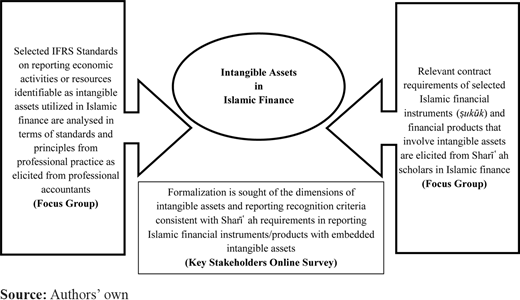
A critical review of IAS 38 was done to highlight the pertinent dimensions of intangible assets as specified by the standard. This is followed by an in-depth interview of an audit partner familiar with Islamic banking and finance as well as two separate focus group discussions with professional accountants and accounting academics followed by regulators and Sharīʿah academics/scholars/advisors with significant engagement in the Islamic financial services industry in Islamic banking, takāful and Islamic capital markets. Similar interview/focus group questions were disseminated. Additional clarifications were sought from Sharīʿah focus group members to facilitate better understanding of the accounting requirements and issues.
The interview and focus group discussion responses were articulated into relevant themes to highlight particular dimensions and issues on reporting intangible assets in the Islamic financial services industry.
Findings from interviews and focus group discussions
Based on the themes derived from interviews and focus group discussions, the responses are elicited and summarized as follows:
Asset as economic resource and its value as economic consequence to investors
Both the accounting and Sharīʿah focus groups recognize assets as economic resources and acknowledge that the primary reporting purpose is to provide information to both investors and creditors and indirectly to stakeholders. Hence, economics precedes social choice in reporting based on the economic consequences in terms of asset valuation.
Intangible as non-physical substance from accounting and Sharīʿah perspectives
Intangible as a concept in accounting and Sharīʿah is agreed on by members of both focus groups to represent non-physical substance. However, variations arise in terms of application of the intangible concept as an asset. Sharīʿah scholars view financial and monetary assets as intangibles.
Importance of possession and control of intangible assets
Both the accounting and Sharīʿah focus groups agree on the importance of possession and control of the asset (māl). The Sharīʿah focus group distinguishes an asset (māl) from ownership (milk) as represented and agrees that in essence, property fulfills both conditions. In accounting representation, assets include both equity and liability (obligations) claims. Hence, net assets as residual claims are proximate to investors’ interest (ownership). This is consistent with computation of net worth in zakāh (almsgiving), which is represented by net assets.
Separable as a pertinent dimension to identify an intangible asset
The process of identification of the intangible component relates to peculiar technical or legal constructs or specifications such as recipe, patent, etc. Both focus groups agree on the need for such constructs or specifications to be identifiable. However, for the identifiable component to be reported as an intangible asset, “separable intangible component” as a dimension becomes critical. In any case, it is initiated by a management decision to identify it as a separate component and is subject to whether it is separable from tangible assets. The materiality of the intangible component is highlighted as one of the possible considerations for the need to separate.
Transferable as a pertinent dimension to recognize an intangible asset
The transferable dimension of the intangible component is pertinent to enable recognition of a separable intangible component as an intangible asset. This is significantly deliberated in both focus groups to consider both dimensions peculiar to intangibles if reported as a separate tangible asset balance sheet item.
Contractual right represents both separable and transferable dimensions
In the final analysis, due to the focus of financial reporting, the economic consequences of transactions representing contractual rights and obligations, both the accounting and Sharīʿah focus groups agreed that contractual rights are paramount to recognition. These will be consistent with representing both separable and transferable dimensions. In Sharīʿah, both rights (ḥaqq) to the asset (māl) and rights to usufruct/beneficial use of the asset (manfaʿah) are recognized. In the case of usufruct, the right to benefit could be attached to a tangible asset and hence recognized from the reporting of tangible asset lease value. On the contrary, if the intangible asset is a significant separable and transferable component, both the rights to possess, control and benefit as an asset (māl) as well as rights to usufruct (manfaʿah) should be reported separately from tangible assets. Sharīʿah-compliance tests on the permissibility of activities, legitimacy and validity of contracts as well as the avoidance of usury and gharar would then be consistently applied to both the tangible asset and its intangible component or asset.
In a separate discussion of financial instruments as investments or receivables and not intangibles, the Sharīʿah focus group deliberated on the essence of intangibles being represented as monetized assets. Some ṣukūk issuances comprise a material (i.e. substantial) intangible component, but it is represented as financial instruments and not intangible assets. This raises an accounting issue because financial instruments are covered by IFRS 9 Financial Instruments, whereas intangibles assets are covered by IAS 38. Hence, the intangible component in such ṣukūk issuances may not be sufficiently disclosed in the financial statements. However, the Sharīʿah scholars based their judgment exclusively on the relevant ṣukūk information memos, which only highlight the intangible component at the issuance stage (for initial recognition). Subsequent measurement and disclosures only relate to contractual rights to receive, or obligations to disburse, cash flows as per the financial instrument standard. Both focus groups deliberated the question of whether additional disclosures on the intangible component that impacts the value of financial securities should be part of risk reporting and hence be advocated.
Measurable value with certainty and management option/choice for cost or valuation model
On initial and subsequent measurement of tangible and intangible asset value with certainty, both the accounting and Sharīʿah focus groups acknowledged the economic consequences of valuation of investors and creditors’ interest. Supplementary information on the value of assets in the interest of third parties or stakeholders needs to be presented as separate disclosures. The choice of subsequent fair value measurement method(s) may require Sharīʿah scrutiny, especially on intangible assets affecting other external third-party interests.
Sufficiency of intangible presentation and disclosure as per IAS 38
IAS 38 only provides specific guidance on the presentation and disclosure of intangible assets. If the intangible components of a tangible asset are not treated separately, then they lack specific guidance under this standard. Hence, management discretion whether to quantify intangible assets raised concerns on the implications of social choice relating to public or stakeholder interest. The choice of reporting something as an intangible component in disclosure notes or as an intangible asset presented in the balance sheet item needs to be substantiated. Furthermore, risk-based and Sharīʿah-compliant disclosures on intangible assets as well as material intangible components of tangible assets are lacking. This is especially so in the issuance of financial instruments such as shares or ṣukūk. The risk characteristics of an intangible asset, or the intangible component of a tangible asset, may change over its lifecycle. This may pose challenges in reasonable valuation and disclosure, which in turn substantively complicate periodic monitoring of Sharīʿah compliance.
Conclusion
This paper concludes an interesting phenomenon on how professional accountants apply the provisions of IAS 38 and its exclusion on intangible assets and the views of Sharīʿah scholars’ in line with related requirements in Islam. The professional accountants’ views appear to be premised on economic choice consideration. In other words, they are investor-centric. Sharīʿah scholars, on the other hand, are concerned with the social choice consideration of compliance and stakeholder interest. Though both accountants and Sharīʿah scholars agree on the key dimensions of intangible asset reporting, variations arise due to a broader perception of intangible assets as including financial instruments and monetized assets. The central concern is the effect of this treatment on the contracting parties who rely on the sufficiency of the information disclosed for their informed decisions. Economic decision usefulness as propagated by the financial reporting standards in reporting intangible assets would require additional disclosures on the intangible component of tangible assets in terms of Sharīʿah compliance and risk-based disclosures.
This is based on commissioned research for the International Shari’ah Research Academy for Islamic Finance (ISRA).

