This paper aims to provide insights into the link between sustainability, technology and Industry 4.0 (I4.0). The authors explore the reasons behind and ways by which digital solutions are implemented within the Swedish fashion industry. The authors demonstrate how I4.0 technologies are used in practice to enable a shift from mass production to mass customisation and mass personalisation, addressing sustainability issues such as overproduction.
The study follows an exploratory qualitative case study design, comprising 15 fashion retailers working with personalised solutions and two tech firms working with developing recommender services. A total of 19 interviews were carried out with representatives from fashion firms and tech firms active in the development and implementation of digital solutions for mass personalisation within fashion production. In addition, observations have been conducted online, mainly via firm websites, to complement the interview material.
The findings show that the development of sustainable innovation in the fashion industry through digitalisation is largely dependent on cooperation with external actors to access the knowledge necessary for innovation through I4.0. At the same time, the findings indicate the various ways in which successful implementation of digitalisation in fashion can contribute to more sustainable practices at a wider scale.
Due to traditionally unsustainable practices, the fashion industry faces great challenges in moving forward. I4.0 has in this context been held forward as a potential successful route for changing production as well as consumption patterns. The authors contribute to further the understanding of how innovative change in traditional industries with unsustainable practices can be promoted and understood.
Introduction
The violation of six out of nine planetary boundaries indicates that there is an urgency in the shift towards more sustainable production and consumption (Richardson et al., 2023). The fashion industry has in this regard been highlighted as problematic due to current production and consumption patterns (Wulff, 2024). While changes can be observed, the fashion industry is still argued to not do enough to deal with the negative impact created by its operations (Buchel et al., 2022). The UN Sustainable Development Goals have created a movement of initiatives at the industry and policy level aiming at creating necessary change, something that requires radical shifts in relation to traditional means of operation (Brydges, 2021). Such radical shifts imply a need for innovation and entrepreneurship in moving towards creative destruction for renewal in the economy (Fagerberg, 2003). Innovation can here take many different forms (e.g. process, product and service), be either incremental or radical, and relies on collaborative efforts between various forms of actors and areas of knowledge (Salter and Alexy, 2014). Innovation is a key component for speeding up the process towards sustainable transition by challenging the current state and exploring new innovative ways of operating for industries to evolve into a new state (Schumpeter, 1934). In this regard, the combination of innovative action from both incumbents and entrepreneurs has been highlighted as being of great importance for the development of industries through innovation (Buenstorf, 2016; Klepper, 2002).
To address the problem of overproduction in the fashion and textiles industries, retailers are making use of new technology to enable a shift from mass production to mass customisation and personalisation (Casciani et al., 2022). The development is part of Industry 4.0 (I4.0), which enables made-to-measure (MTM) solutions at a scale (Aheleroff et al., 2021; Wang et al., 2017). While customisation is about increasing the selection of choices for the customers, personalisation is about market-to-one solutions (Tseng et al., 2010).
Research aim and research question
The aim of this paper is to show how I4.0 technologies drive sustainable business solutions in the fashion industry. I4.0 technologies are argued to already having an impact, but little is still known as to how this is taking place in practice (Bertola and Teunissen, 2018; Nouinou et al., 2023).
To explore this topic, we focus on fashion firms in Sweden that are expanding the use of mass customisation and personalisation, moving towards I4.0 (Büchi et al., 2020). Sweden is an interesting empirical context in that the country has a long tradition within the fashion industry, moving from historically being a point of production, to in modern day being home to some of the more successful fashion firms in the world (Hauge et al., 2009). Sweden is further known for its innovative spirit, consecutively ranking as one of the top nations in the world in terms of innovation [World Intellectual Property Organization (WIPO), 2024], and taking a leading role in relation to sustainability measures (Brydges, 2021). These combined characteristics create good grounds for exploratory research to understand more about sustainable transition through innovation in fashion.
To address this aim, the following research question was formulated:
How have Industry 4.0 technologies enabled fashion firms to work with clothing personalisation and customisation in the Swedish fashion industry?
We recognise that the use of I4.0 technology to drive a sustainable transition in the fashion industry is an on-going trend also in other countries (Akram et al., 2022; Bertola and Teunissen, 2018). The lessons learnt can thus be transferred to other empirical settings as well, thereby contributing to more generalisable knowledge. Our research contributes with insights on how the fashion industry can transform from within and build more sustainable business practices with the help of technology. We render insights on which technologies are used, how personalised clothing can be understood as sustainable, and how technology and digitalisation support this kind of development.
Theoretical framing
While research on sustainable innovation is constantly growing, the field is still in its infancy (Afeltra et al., 2023). Ghobakhloo et al. (2021, p. 4239) define sustainable innovation as referring to “renewing or improving products (including physical goods and services), processes, and technologies to deliver sustainable economic productivity and contribute to environmental preservation and societal development”. Extant literature primarily addresses aspects of internal-managerial perspectives, while also pointing towards the importance of better understanding external relational, and performance evaluation aspects (Cillo et al., 2019). A wider scope can however be observed, not least when taking into consideration the broader definition of sustainability as including environmental as well as economic and societal aspects (Afeltra et al., 2023). In relation to this overall discussion on the role and importance of sustainable innovation per se, a subset of said literature is more specifically addressing if and how digitalisation can be a driver behind these necessary changes in making industry in general more sustainable (Lu et al., 2023). While the research shows promise of this development, much remains unexplored, not least in more explicitly being able to show the link between the digitalisation as such and the consequent sustainable development through innovation (Guandalini, 2022).
Sustainability through digitalisation – Industry 4.0 as a route forward
I4.0 is held forward as having potential for achieving long-term sustainable development if handled and implemented in a responsible manner. At the same time, the increased digitalisation that follows puts new demands on industry as well as society in terms of competences needed as well as skills made obsolete as an effect of changed means of operations, not least within more traditional industries (Ghobakhloo, 2020). Furthermore, micro-, small- and medium-sized enterprises have been shown to have lower levels of adaptability to digital technologies even if such adaptions could render positive outcomes for business model innovation within the firm (Coco et al., 2024). In this regard, it is of importance to understand how firms acquire the knowledge needed to develop such innovative practices (Metcalfe, 2002). Here, a combination of the existing knowledge present within the firm with its abilities and strategies to search for new knowledge serve as crucial components (Gifford et al., 2022).
Previous research on I4.0 technology has focused on several aspects of its links to sustainability, including consumer (Jain and Gandhi, 2021), marketing (Thakur et al., 2025) and management perspectives (Khan et al., 2024). While digital technologies are held forward as potential enablers of sustainable change, not least in relation to innovation, it is also argued that this link is not inherent but rather dependent on the specific implementation (Beier et al., 2022). This standpoint is further apparent in relation to I4.0 specifically, with extant research pointing towards inconsistency in its link to sustainable development (Beltrami et al., 2021; Dieste et al., 2024). This points towards the need for further empirical evidence of the role of I4.0 for sustainability, as well as whether sustainable transition is what drives I4.0 adoption or rather that the adoption is what facilitates sustainable innovation.
Industry 4.0 as applied to the fashion industry
Within fashion design research, digital technology has been explored and promoted to alter garment construction and consequent production, showcasing how these new approaches also can optimise production processes by for example reducing waste (McQuillan, 2020), as well as creating better fits based on body features (Lindqvist, 2015).
The sustainability effect of customisation and personalisation does require some level of nuance. On the one hand, some researchers argue that it does not solve the issue of overconsumption in that the use and lifespan of such garments do not exceed that of those produced according to the traditional mass-production logic (Maldini et al., 2019). At the same time, exploratory studies have shown that firms are able to optimise their production processes by implementing these types of strategies, not least from the perspective of decreasing inventory and offering higher customer satisfaction through better garment fit (Longo et al., 2021). Todeschini et al. (2017) argue that sharing consumption can mitigate environmental impacts associated with large scale production. Similarly, MTM clothes, based on made-to-order logic, can also mitigate environmental impact associated with large scale production. Even at scale, MTM is associated with a reduction of waste in production as well as an abolishment of unsold stock, and thus addresses the problem of discounts leading to both overproduction and overconsumption (Wulff, 2024). While an increasing number of examples of firms applying these processes are appearing within the fashion industry (Casciani et al., 2022), it is still evident that a more general shift is lagging (Bertola and Teunissen, 2018; Nouinou et al., 2023).
The rise of e-commerce in fashion retail has introduced new challenges, particularly the inability for consumers to try garments before purchase – one of the leading causes of product returns (Lasserre et al., 2020). To address this, size recommendation systems have been developed to predict fit and reduce return rates (Guigourès et al., 2018). Recommendation systems collect user and product information to recommend items that match user needs (Johti and Sulthana, 2021). However, these systems face persistent challenges, including inconsistencies in sizing across brands, the subjective nature of fit and data inaccuracies (Deldjoo et al., 2023). Furthermore, current systems often struggle to consider personal style and overall garment fit, highlighting the need for more personalised and context-aware recommendations (Vecchi et al., 2017). While users have generally found recommendation systems easy to use and are open to reusing them (Vecchi et al., 2017), future research is needed in areas such as forecasting, ethics, privacy and adversarial robustness to enhance the effectiveness and trustworthiness (Deldjoo et al., 2023).
The proposed changes for fashion fall well within the realm of the discussions around sustainable innovation through digitalisation (Guandalini, 2022). While extant research has focused on the potential of digital innovations for the development of the design and production process within the fashion industry (Casciani et al., 2022; Lindqvist, 2015; McQuillan, 2020), little has been explored regarding the internal processes for implementing these changes from a traditional fashion industry logic to that of I4.0 (Longo et al., 2021). Extant research has shown that it here is important to better understand the ways by which the firm acquires new knowledge and access to scientific and technological advancements to foster its own innovation processes (Gifford et al., 2022). At the same time, the fashion industry is held forward as facing potential trouble due to a mismatch between the digital innovations available and the knowledge and skills possessed by those working within the firms (Nouinou et al., 2023), pointing at the importance of better understanding how this transition can come in place.
Research design and methods
Given the exploratory format of our study, a case study design was used (Yin, 2018). We seek to build insights into theoretical findings with regards to the implementation and use of I4.0 technologies in promoting sustainable transition within the fashion industry. We do so by focusing on the case of mass customisation and personalisation practices in Swedish fashion firms. As stipulated above, Sweden is an interesting empirical setting in which to observe these changes due to its long tradition within fashion and textiles, combined with the country’s high levels of innovative practices. In observing cases within this context, the purpose of the study is to gain valuable insights on how these changes can be obtained, knowledge that is of importance for further studies and implementation of new sustainable practices within the fashion industry globally. For this reason, we used qualitative research methods, primarily interviews and online observations (Charmaz, 2014; Gioia et al., 2013).
Pilot study
To assure academic rigour, a pilot study was carried out (Goffin et al., 2019). Firstly, we appointed a reference group for the project, which assisted in identifying the key challenges. Three firms with different characteristics were identified and made partners in the project:
a traditional shirt firm that also include MTM services;
a women’s shirt retailer, that offer alternative size ranges (including cup-size selection); and
a tech firm working with a large retailer in offering custom-made shirts at scale in a pilot project on the German market.
Two of the three partner firms were later interviewed for the project. Secondly, we arranged two workshops with representatives from firms, industry associations and academia, to gain insights into their experiences in working with customised and personalised fashion. The workshops were important in identifying key issues in working with personalised and customised fashion.
Data collection
Actors working within mass customisation and personalisation in fashion were identified and selected through theoretical sampling (Eisenhardt and Graebner, 2007). The criteria for being included in the study were:
firms working with mass customisation and/or personalisation in fashion;
applying innovative strategies/work in their approach to fashion;
working with or implementing I4.0 logic in their operations; and
active within the Swedish fashion industry.
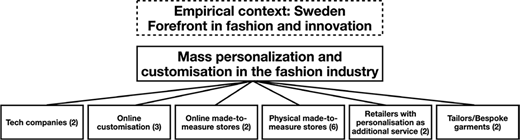
As the number of actors working with this innovative strategy is still low in comparison to more conventional firms, the number of potential respondents was limited. Respondents were recruited from Swedish fashion firms and technology providers at the forefront of personalisation and customisation. The sample included tech firms supplying recommendation systems, fashion retailers applying such solutions, businesses founded on personalisation and those integrating it as a complement to their core offerings. To ensure a broad perspective, both traditional tailors and start-ups were also included. This was to ensure a wide range of firms working with customised and personalised clothing, rendering a list of 40 potential firms. Based on an initial analysis of the firms’ activities and profiles, some were excluded from further inclusion based on criteria of scope of firm operations; whether the firms were still active; and their use of technology. This resulted in a final list of 17 firms that were considered relevant to the research project, and who were consequently contacted for interviews.
A total of 5 out of 17 firms worked in, or were targeted towards, womenswear. This made it possible to also account for any potential differences in practices between womenswear and menswear.
Figure 1 below gives an overview of the firms included in the study:
In total, 19 interviews were carried out, where two were follow-up interviews. All respondents were informed about the research project, allowed to ask questions and agreed to participate. All interviews were held in Swedish, with 17 being held digitally via Zoom and two being conducted in person. All interviews were recorded and transcribed. Table 1 below gives an overview of the interviews.
The interviews followed a semi-structured format, applying a conversational approach (Charmaz, 2014). An interview guide was used to ensure that there was cohesion between the different interviews and that the same overarching questions were addressed, while follow-up questions were included that added additional data. Hence, although the interview guide revolved around personalisation and customisation, due of the exploratory nature of the research design and interview guide, I4.0 technology emerged as a key aspect of personalisation and customisation. Table 2 gives an overview of the interview guide.
We conducted initial analyses of the interviews continuously during the time of data collection, and data saturation was considered to have been achieved in that no new themes arose in the analysis of the last interviews (Saldaña, 2021).
As a complement to the interviews, observations were made online, predominantly on the firms’ websites. The observations were carried out by carefully examining the content to build a deeper, complementary understanding of the firms included in the study. For each observation, notes were taken for usage in comparison with interview data. The communication on the websites enhanced the understanding of the firms’ practices, as well as how they communicated their business idea towards the customers and visitors on the websites. The observations further enabled us to contrast and compare the findings from the interviews, in the sense of how the firms portrayed themselves and their actions in an interview setting, with the more publicly communicated image of its operations towards customers.
Data analysis
The interviews were analysed using the software NVivo. All transcripts were uploaded to the software and later coded into categories. The coding was performed with an abductive approach, where theories were blended with the material to make sense of the fieldwork (Eisenhardt and Graebner, 2007; Gioia et al., 2013). The coding was primarily performed by one of the authors and discussed continuously with the other as to validate the results and increase reliability of the process (Saldaña, 2021).
An initial coding of the material was carried out to explore and identify key topics in the data (Gioia et al., 2013; Saldaña, 2021). Based on the initial coding, we identified the use of I4.0 technology in the fashion industry as a key theme. In addition, we recognised that this was from the fashion and tech firms’ perspective, respectively, which is important to bear in mind in analysing the results.
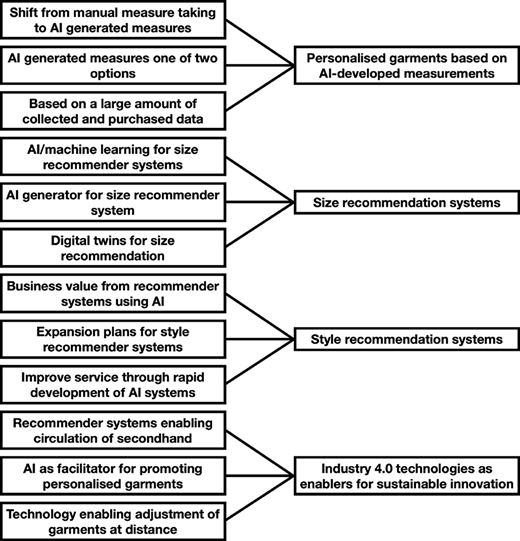
Once we identified I4.0 technology as a key theme, we applied line-by-line coding of the data related to this specific focus, as to define the actions on which the data rest, comparing data with data and identifying gaps (Charmaz, 2014; Saldaña, 2021). The interviews were reviewed with a specific focus on technology, by identifying passages where keywords were used, such as artificial intelligence (AI), algorithms, technology and digital. Using thematic coding, codes were constructed based on both the theoretical concepts and the fieldwork consecutively (Saldaña, 2021). Based on this, themes could then be derived in analysing and comparing the different interviews. Figure 2 below gives an illustration of the coding process.
This moving back and forth between the fieldwork material and the predefined codes was a fruitful way to make use of the richness of the material, while keeping a strong focus on certain points of interest. Once we had carried out the line-by-line coding, we moved into categorising the data. This resulted in four categories specifically focusing on I4.0 technology:
personalised garments based on AI-developed measurements;
size recommendation systems;
style recommendation systems; and
I4.0 technologies as enablers for sustainable innovation.
With a focus on I4.0 technology, it became evident that the tech firms provided more forefront insights on the development of digital innovation. The interviews with the fashion firms complemented this view by showcasing how and in what way these technologies were adopted and created innovative changes in their means of operating. As such, our data gives a complementary image of the development and application of I4.0 technology in the fashion industry.
Results and analysis
As stated above, based on the empirical material, four themes have been identified as particularly important in relation to our research question.
Table 3 below gives an overview of our results in relation to these themes.
Below, we go through and analyse each of these themes one by one.
Personalised garments based on artificial intelligence-developed measurements
Several of the informants gave accounts of using computer software and algorithms to cater to their customers’ needs. For example, online retailers of MTM solutions used AI to create individual patterns for garments. The machine was trained to calculate a good fit based on the information given, as described by one of the respondents:
We somehow want to get the measurements in, and we have simplified it so much that we have trained an algorithm, an AI, on our satisfied customers. Then we ask questions to figure out what measurements should be on the garment […] In the past, we worked with body measurements, but now we go directly to garment measurements. […] Then we ask several questions, like how old you are, how tall you are, how much you weigh and what shoe size do you have? This is followed by some additional questions, like how you want it to fit, the garment, a bit of posture, and whether you prefer a certain collar size and so on. To make it as easy as possible, so you can do it without having to get out a tape measure. It is easy to answer the questions (Founder, MTM online 2).
In addition, technological advancements such as laser cutting machines and computer-aided design were used to improve production efficiency. This is in line with McQuillan (2020), who argued that digital technology can be used to optimise production processes. Our results add to the discussions on sustainable innovation through digitalisation (Guandalini, 2022). Our analysis implies that making use of AI in the interface between the firm and the consumer can have more profound implications also on consumer behaviour. The firms offered the opportunity for consumers to cocreate the products, by inserting their personal information on the website. In terms of sustainable innovation, the consumers are then engaged in the solutions to a greater degree.
Several of the fashion firms used algorithms to create personalised garments. In short, the customer is asked to fill in details, such as height, weight and age online. The firms then make use of machine learning to develop product measurements that fit the specific body shape of the customer:
We’ve gathered a large amount of data that we’ve both acquired ourselves and through customers. We’ve actually measured their bodies but also bought in data through a third party. Having bought a large volume of data and via regression analysis, you calculate with certain variables, create an algorithm and calculate the probability of a body measurement of breasts or whatever it may concern (Founder, MTM online 1).
Hence, to train the machine, the firm made use of data from their customers but also from other data sources. This resulted in a larger basis of data for calculating personalised garment measurements. Previous studies have looked at the integration of AI in garment fit, but then only at generic algorithms in developing a product platform for customised underwear (Longo et al., 2021). This suggests that making use of algorithms to personalise garments can be regarded as taking it one step further with the potential of a larger impact on the industry.
To train the algorithms, certain information is required:
It is easy to test and train algorithms to understand which questions, and which variables we can take in, and we have decided that age, height, and weight are crucial. That people appreciate their body shape in different ways in response to the fact that I am this and not that, rather than saying that I am exactly this big across the chest. These types of fairly easy and intuitive answers we can ask a customer for, lift into these calculations and get a fantastically fine precision as an outcome (Founder, MTM online 1).
The use of algorithms enabled the firm to offer products with a personalised fit, without customers having visited a physical store nor reported on each body measurement. As such, technology can create new opportunities for personalised garment production. As stated by one of the firms:
Before our tailors handcraft your piece, our algorithm uses a decade’s worth of sizing data to make sure it fits you right. Hard to believe, easy to prove (Firm webpage).
The production of personalised garments depended on self-assessment made by the customer, by providing personal details and preferences for fit. This further complicated the process, as details could be filled out incorrectly. This falls in line with Longo et al. (2021), who compared self-measurement and professional measurement. To overcome this problem, one of the respondents described how they take this into account in training the algorithm as well:
Then we train AI with the customers’ input in that way […] Generally speaking, all customers are a bit cautious when they fill in their weight or lie about their weight. It affects the honest one, unfortunately (Founder, MTM online 2).
Hence, to ensure that the products delivered to the customer come with a good fit, the firm made modifications to the AI model, that also considered that customers at times filled in, for example, a more modest weight in their self-assessment. Some of the firms complemented the online purchase with a fitting, which could be done either digitally or in a physical store. The fitting also provided the firm with information on the accuracy of the final product. One firm described the process of ordering garments on their website, making it evident also to the customer how algorithms are used to generate a tailormade skirt through their guide “find your size”. The firm claimed an accuracy of 95%, offering return free of charge if the customer was unsatisfied with the fit. This could be seen as a common procedure for firms only offering online service, pointing to the difficulty of taking measurements if not trained in how.
Size recommendation services
One of the key challenges in product personalisation is to offer customers a personalised experience and to suggest relevant products, where size and fit recommendations are still underdeveloped, since data are both sparse and noisy (Lasserre et al., 2020). To overcome this challenge, one of the tech firms made use of digital twins to develop recommendations to the customer. The body was divided into three parts: upper body, lower body and feet. Each part was then matched based on purchase history. Instead of buying a certain size based only on previous purchases, the system considers the purchases and experiences of other customers, leading to a more accurate recommendation and hopefully, also less returns. To reduce returns is one of the main purposes of recommendation systems in the fashion industry, making it a core aspect to address (Deldjoo et al., 2023; Guigourès et al., 2018).
One of the firms in our study had developed their own size recommendation software. The software was used mainly for standard sizes, with some modification aspects:
We have an AI generator that helps with size selection and so, when you choose to buy […] if you are a new customer, you can still get help through the site, to find your size […]. We’re getting better and better, but in the beginning, it was difficult and came with a lot of uncertainties (Supply chain director, shirt firm 1).
The respondent described a learning curve in working with the new technology. If the training of the AI generator has shortcomings or does not perform as wanted, there are certain risks with using the technology:
If you make a slim fit or contemporary fit, and at the same time you want to change the measurements, there’s a risk that the shirt won’t fit anyway. Then it becomes a negative experience for the customer […] It is always better if you have tried in store first, and therefore there are still perhaps some restrictions on what measurements you can change yourself on the site (Supply chain director, shirt firm 1).
The respondent described the complexity of including personal measurements in the calculations, which made the use of the technology even more complicated. While previous studies on usage of size recommendation systems showed that participants find them easy to use (Vecchi et al., 2017), including personal measurements makes the service more difficult. Moreover, since not only size but also fit matters to the customer, this also needs to be considered when personalising size recommendations (Vecchi et al., 2017). For personalised clothes this effect can be even larger, as the expectancy of a good fit is often higher on MTM clothes compared to off-the-rack clothes. The firm in our study saw how they could overcome this challenge by encouraging customers to make their first purchases in-store for professional measure-taking according to the firm’s standard and later do re-purchases online.
However, not all firms have this option, as many nowadays are online based. This is also where most problems with returns are found. Hence, for online based firms, sizing and fit can still come with challenges and consequent returns. The more sophisticated and accurate the models become, the less this will have a negative impact in terms of return rates (Deldjoo et al., 2023).
Style recommendation systems
As a critique to how current product recommendations are based mainly on image recognition, one of the tech firms developed an alternative algorithm, based on style rather than visual similarity:
At the beginning of the AI era, it was very much based on image recognition, and it still is. If you’ve looked at something, you’ll most probably get visually similar items as recommendations. But just because I'm looking at a red shirt, it’s not necessarily a red shirt that I'm looking for, but it’s probably rather a certain style that I see in this shirt. Then I’d rather view things in the same style, but also things that complement this red shirt in a similar style. […] So that was really the basic idea, to use style and not visual similarity (CEO, tech firm 2).
Style recommendations have been studied from a computer vision research perspective, where focus has been on determining category and attributes, or determining the degree of similarity to other products (Deldjoo et al., 2023). However, while such studies have focused on matching existing shopping baskets or wardrobes of customers, the technical solution provided by the tech firm in this study relied on information that was provided by the customer itself, where the customer was asked questions on style preferences. The firm started with a Business-to-Consumer platform but later changed into a software-as-a-service (SaaS) model, selling software or licenses to retailers. Previous studies mention similar solutions indicating that this is a rising phenomenon also in other parts of the world (Johti and Sulthana, 2021). However, while Johti and Sulthana (2021) focus on the technological aspects of the service, little is mentioned on the relational aspects of the business and how to promote the product to users. The sales pitch that the tech firm in our study used to the retailers was statistics on how conversion rates increase, but also how it contributes to a better customer experience. The service then becomes a competitive advantage in attracting customers to the retailer’s website. In this sense, it becomes apparent that there are also business opportunities in recommendation systems. When promoted to retailers, the monetary value seems to be in focus, rather than the environmental gains. Instead, the arguments used for promoting the services are rather counter-productive when it comes to environmental benefits, as they focus on how to increase sales and conversion rates.
Current technological developments have made it possible to work with big data, but the expectation is for upcoming technology to enable even more efficient solutions. As put by one of the tech firm founders:
In that sense, it hasn’t been effective, but technology has made it possible to develop this with small means. You couldn’t do that, for example, five years ago. Then, of course, we are now looking at how last year’s technological development can also benefit us, where we can train the model in a completely different way than we have been able to before, for example by generating our own images to train the model instead of sorting them manually. To take shortcuts in how we build the model. There is a lot of newer technology that has become available in the last year (CEO, tech firm 2).
Besides improving the personalisation of the recommendation systems, the data sets can give insight into the structure of fashion styles, social group preferences and how trends develop across time and location (Deldjoo et al., 2023). This opens for new innovations to be developed within the fashion industry and beyond.
As the system only requires visual content and no other types of metadata, the service can enable other types of sustainable fashion businesses, such as second-hand platforms and rental clothes services:
Currently we only work with firms that sell newly made clothes, but we are in dialogue with several persons, who sell on the second-hand market and that is something we would very much like to get into […]. There are also not as many solutions that can handle the second-hand market. We have a unique AI model that reads only on images, we do not need any other metadata from the products, which makes it very suitable for the second-hand market (CEO, tech firm 2).
Besides the second-hand market, there is potential for using the technology in rental services, where different products are put together into a set of clothes packages, that are delivered to the customer monthly:
There we would have fit in very well also that you could have your style on file, get monthly news recommended, ‘This is what you can rent now in your style’, and also subscription boxes (CEO, tech firm 2).
However, the respondent noted that these types of fashion businesses have had difficulties, especially on the Swedish market. There are some firms that still provide these types of services to the customers, but in those cases, the selection of clothes is often made manually. To make use of AI models for this type of service to a greater extent could thus make the rental market more efficient and cost effective.
Industry 4.0 technologies as enablers for sustainable innovation
Technology played a central role in the potential for innovation and providing personalised clothes, making these solutions more accessible to the industry. This can enable more efficient ways of working, shifting focus from mass production towards mass customisation and personalisation. As phrased by one of the firms on their webpage:
We like to describe ourselves as a tech firm that does custom clothing. Using advanced technology and algorithms, we provide you with the fit of a lifetime (Firm webpage).
Another firm described itself as where “technology meets fashion”, providing the following description of their business:
[Firm name] excels at the intersection of technology and fashion. Each garment carries a digital ID that offers insights into the manufacturing process, care instructions, repair options, and even rewards for sustainable choices. This enables you to easily create, optimize, and keep track of your long-term wardrobe (Firm webpage).
One firm focused on facilitating the technological aspects to fashion manufacturers and retailers. The clients are both textile producers and retailers, and the firm make claims to be in the forefront in using AI and algorithms to generate custom-made shirts. Not needing to take measures at home, can be seen as a way to facilitate the buying process for the consumer. The advantage with MTM online, as proposed by the firm is that “brands can shorten lead times at flexible order quantities so they can produce based on actual market demand instead of notoriously unreliable forecast”. This is in line with Longo et al. (2021, p.17), who argue that I4.0 technology is key in “transforming traditionally low-tech industry into a data-intensive industry”. Hence, the technological solutions enable the brands to leave forecasting models behind and instead focus on made-to-order solutions.
Although several attempts have been made to improve fashion recommendation systems, there are still challenges to overcome (Guigourès et al., 2018). The system used by the tech firm in this study was based on machine learning and AI. Technology is trained to consider several parameters, to make the recommendation as accurate as possible. The CEO of the tech firm described how he thinks that technology has been a game-changer for this type of personalised service:
Product data is in general very hierarchical. For example, we have tops. A T-shirt is a top. A T-shirt is either long-sleeved or short-sleeved. It comes in these types of models, these colours, and with these prints. So, it all becomes very hierarchical. But here [using this system], it becomes more of a data lake (CEO, tech firm 1).
The technology enabled the firm to classify the data in a different way, which is not only dependent on a text-based classification system. According to Deldjoo et al. (2023), input information can be image, image and text or body and face. By moving beyond text-based information, the firm managed to overcome issues in building hierarchically coded recommendations. This way of operating further facilitated a wider use of the technology to not only comprise the production and sales of newly produced garments, but also as a solution for second-hand products to be more easily resold. As the individual products already have a purchase history, the information needed would be the name of the brand and the model of the garment due to the inconsistency in sizing between different brands and local sizing systems (Deldjoo et al., 2023).
Our analysis shows that actors lacking technological solutions for their businesses faced severe challenges in scaling. One of the founders of an MTM store described how each pattern was adjusted and cut by hand separately, which was a time-consuming activity:
I know the technology, so I know what can be done, but I can’t do it myself and then it’s so frustrating to stand there and cut and realise that this is so damn easy to just cut with a laser (Founder, MTM in store 3).
Having the right technology at hand, both in terms of software and hardware would have facilitated the work significantly. Although technology can facilitate a quick and smooth customer interaction, there is a risk of losing trustworthiness in the product and the firm when shifting to online solutions. To overcome this effect, one of the firms working with online personalisation included questions less relevant to the final fit of the product, to give the impression that all aspects were considered and to build trust in the product and the firm.
Hence, technology played a large part in the potential for a transition towards sustainable innovation. This is in line with Bertola and Teunissen (2018), who argue that new ways of production and consumption come with an expectation to radically transform all key industrial systems. Our results further enhance this line of reasoning, where the firms that made use of more technological solutions also appeared to have greater growth potential. Through online sales, firms could reach a wider range of customers in different geographical settings. Also, by using algorithms and AI, the firms could create better fits. The use of this type of technology facilitated the customer journey online, as the customer did not need to know their specific body measures, which can be a complicated endeavour.
Many of the firms worked on their communication of the product and service offerings, where several connected the idea of customised and personalised garments with the ideals of a better industry from an environmental point of view. One of the firms framed their business idea in contrast to traditional retailing as follows:
Say goodbye to mass-produced clothing and hello to clothing made by you, for you. We make sure you feel as good as you look wearing custom-made clothing true to your unique fit and style. Don’t let your clothing decide who you are; decide it for yourself (Firm webpage).
Furthermore, the firm articulated that nothing had been produced in advance, but only upon request, indicating that they thus reduce overproduction. Bertola and Teunissen (2018) highlight a more radical shift in the industry, driven by young designers and entrepreneurs, who can more quickly implement new ideas than large incumbents. Since overproduction is one of the main challenges of the fashion industry (Wulff, 2024), there are great gains in addressing this aspect. However, as discussed by Maldini et al. (2019), personalised fashion does not have an impact on overconsumption per se. Hence, the largest potential with the use of I4.0 technology for personalisation is in terms of revolutionising production patterns (Bertola and Teunissen, 2018), and reducing environmental impact by eliminating overproduction (Wulff, 2024).
Discussion and conclusion
Our study contributes to the discussion of the role of technology for sustainable innovation towards mass personalisation in fashion (Bertola and Teunissen, 2018). Our results showcase how external knowledge can be internalised into the firms and through this process lead to innovative practices (Gifford et al., 2022). While previous literature has mainly addressed internal-managerial perspectives for sustainable innovation (Cillo et al., 2019), this study contributes with examples of new actors aiming to lead the way for disruption of the current fashion industry by introducing a new way of working with personalisation and customisation. While the idea of tailormade clothes stems from traditional clothing production, our results imply that I4.0 enables this shift to take place at scale. As part of this technological development, traditional fashion companies are being challenged by sustainability-driven startups and are responding by integrating new technologies. Our study demonstrates how various types of actors in the fashion industry use these technologies for personalisation and customisation, indicating a general trend towards more personalised fashion.
Our study suggests that the current situation is acting as a catalyst for change, where innovators who make use of this momentum can be successful in establishing new positions in the evolving market (Buenstorf, 2016; Schumpeter, 1934). By examining diverse actors in the fashion industry, we illustrate how sustainable innovation is pursued through multiple approaches, ranging from Business-to-business technologies that reduce returns and support informed consumer choices, to on-demand production models that address overproduction, and premium or customised services that target overconsumption. These varied strategies reveal both the breadth of sustainable innovation and the greater scalability facilitated by I4.0 technologies, while highlighting technology gaps as barriers to growth for others.
Personalised and customised fashion reduces the need for overproduction and seasonal discounting, thereby addressing both overproduction and overconsumption (Wulff, 2024). Hence, changing current ways of producing towards personalised and customised products and services can contribute to environmental preservation and thereby be seen as sustainable innovation (Ghobakhloo et al., 2021).
Moreover, we have observed how both traditional tailor stores make use of technology to a greater extent, but also how new business practices have arisen through I4.0 technologies. As such, our study demonstrates how technology can enable sustainable innovation, that has the potential to accelerate a shift in the fashion industry towards more sustainable production and consumption. Our results indicate the intricate play between different actors in adopting new technology in traditional industries to scale up new innovative solutions for more sustainable practices (Büchi et al., 2020; Buenstorf, 2016). We thereby contribute with insights on the link between I4.0 technologies and sustainable development through innovation (Guandalini, 2022).
Practical implications
Our study has several practical implications for sustainable fashion: integrate I4.0 tools: established fashion firms can invest in digital design, AI-driven customisation and automation to stay competitive and comply with evolving European sustainability regulations; influence consumer behaviour: startups can develop strategies such as education campaigns, incentive programmes or community-driven initiatives to shift shopping habits towards personalised and sustainable fashion; secure profitability in scaling: both startups and incumbents can refine pricing models, explore subscription services or optimise production processes to maintain margins in personalised offerings; build trust in data handling: firms offering personalisation can implement transparent privacy policies, strong encryption and third-party audits to address ethical concerns around consumer data; and develop after-service models: firms can introduce repair, adjustment or garment upgrade services to extend product lifecycles and improve the sustainability of personalised fashion.
Limitations and future research
A limitation with our study is that personalisation and made-to-order mainly addresses issues of overproduction (Longo et al., 2021; Wulff, 2024), while less is known about the consequences on overconsumption. While there is an expectation that personalised clothing will reduce consumption, due to better fit and higher prices, extant research shows that personalised clothing not necessarily is used more or for longer (Maldini et al., 2019). Hence, while sustainable innovations introduced through I4.0 practices have potential to also reduce overconsumption, future research is advised to further investigate the usage of this type of garments and whether there are signs of also changing consumption habits. Our recommendation is therefore to clarify the dual role of personalisation in production and consumption to design empirical studies that directly measure consumption changes linked to personalised fashion.
In addition, our study is limited by indications that personalised fashion currently targets men more than women, which may restrict its transformative potential. In addition, due to limited scope and empirical material, our study does not address ethical concerns linked to AI, nor the training and development required for SaaS-based MTM platforms. Future research should therefore investigate gender dynamics in adoption, as well as ethical, technological and organisational requirements for scaling personalised fashion sustainably.
Acknowledgements
The authors gratefully acknowledge the financial support provided by the funding agencies. The authors also extend their sincere thanks to the firm representatives who generously shared their time and expertise during the interviews. Finally, the authors appreciate the valuable comments and suggestions from the reviewers, which have been highly helpful in the development of this article.