The purpose of this study was to explore mathematics teachers’ instructional decision-making processes that arise from their professional noticing of learners’ mathematical thinking within the Lesson Study (LS) context.
This interpretivist qualitative case study involved nine purposively selected mathematics teachers. Data were collected through observation and unstructured interviews. Observation was done during the lesson presentation and post-lesson reflection stages of LS. Unstructured interviews were used during the post-lesson reflection stage.
Although mathematics teachers were able to notice aspects of learners’ mathematical thinking, the manifestation thereof was often at a superficial level. Consequently, the instructional decisions teachers made tended not to adequately address learners’ mathematical thinking. In addition, their reflection was merely superficial and hence their proposed instructional decisions were also not optimal to develop and enhance learners’ mathematical thinking.
Although the purpose of this article was to explore mathematics teachers’ professional noticing during teaching and their subsequent instructional decisions, not observing the lesson planning process may have deprived us an opportunity for deeper understanding of minutiae of the lesson presented. For instance, we probably would have understood the motive for the LS team’s selection of instructional activities, i.e. numeric patterns.
Notwithstanding the importance of professional noticing in the education context, it has not been adequately explored, especially in South Africa, to gain insights into mathematics teachers’ instructional decision-making in the LS setting. The findings from the current article, therefore, cast light onto the affordances of teachers’ professional noticing during teaching for effective instructional decisions. The findings could be an inflection point for future studies towards improving teachers’ professional noticing abilities to enhance learners’ mathematical thinking in the LS context. Findings from this study suggest that mathematics teachers must be intentional with their noticing by using purposeful activities, which will enable them to effectively notice learners’ mathematical thinking and make fitting instructional decisions. We recommend further research on a framework or guideline on the attributes of purposeful instructional activities.
Introduction
Research on mathematics teachers’ professional noticing has progressively increased over the past decade (Bastian et al., 2024). Consequently, mathematics teachers’ professional noticing is considered an emerging field that is in a stage of developing more subtle models that explain how teachers notice learners’ mathematical thinking (Jazby, 2024). Current comprehension of professional noticing is largely shaped by Goodwin’s (1994) professional vision conceptualisation and Mason’s (2002) discussion of the relationship between what teachers notice and how they teach. Goodwin (1994) argued that members belonging to a particular profession develop their own ways of seeing and making sense of events. Thus, teachers as members of the teaching profession also develop their own ways of seeing, deducing and comprehending classroom occurrences (Jarry-Shore and Borko, 2023). Mason (2002) pioneered intentional noticing, asserting that this type of noticing is typical of the mathematics teaching profession and is unlike the everyday noticing everyone does. Therefore, intentional noticing can happen when teachers have a good grasp of what they are teaching (mathematics content) and teach it in a way that enables intentional noticing.
As research on professional noticing matures, professional noticing tends to assume different perspectives (Jazby et al., 2023). However, there is consensus among researchers that professional noticing comprises three attributes: (a) identifying situations that elicit learners’ mathematical thinking and attending to their problem-solving strategies, (b) interpreting and reasoning about these situations and (c) making instructional decisions to respond in a way that aligns with learners’ current mathematical thinking (Jacobs et al., 2010; Khoza, 2023; Sekao, 2023). A triad process of identifying-interpreting-deciding can happen in action (during teaching) and on action (after teaching) (Bakker et al., 2022), which aligns with Schön’s (1992) reflection-in-action and reflection-on-action, respectively.
Biccard (2020) enlightens us that for teachers to achieve deeper and productive noticing, they ought to engage in collaborative, interpretive and expository discourses about what they have noticed. In fact, although Biccard’s study does not discount the importance of individual teachers’ noticing and solitary discourse to conduct reflection-in-action and make instructional decisions in real time during teaching, it also advocates for collaborative and interpretive discourses for reflection-on-action after the lesson is taught. Lesson Study (LS), the context which undergirds our study, affords teachers an opportunity for collaborative and interpretive discourse on what they have noticed during teaching, and to make instructional decisions for future improvement of the teaching practice. LS, jugyou kenkyuu in Japanese (Lewis, 2016), is a teacher-led model of professional development where a group of teachers collaboratively plan, teach, and reflect on a series of research lessons in order to refine practice (Sekao and Engelbrecht, 2022) through, inter alia, professional noticing. The term jugyou translates to instruction or lesson, whilst kenkyuu translates to research or study (Rolls and Seleznyov, 2020).
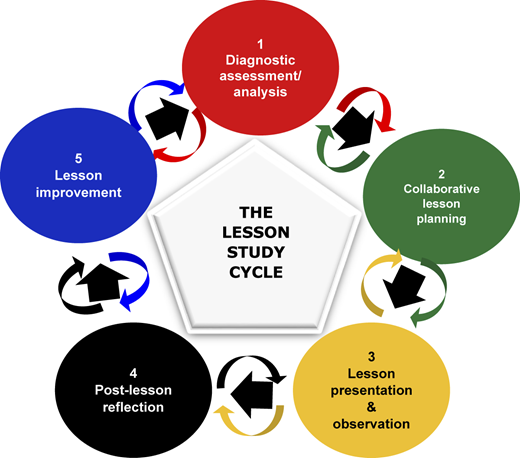
As LS gained global traction, it became inevitable that different countries would modify the Japanese LS model to suit their contexts better (Sakai et al., 2021). The LS variation predominantly used in South Africa, and which we used in the current study, is depicted in Figure 1.
Although professional noticing underscores a triad process of identifying-interpreting-deciding, Amador and Weiland (2015) alert us that noticing can be arduous for a teacher to do amid other classroom happenings. Khoza (2023) concurs that teachers, regardless of teaching experience, still find it hard to effectively practise professional noticing. In fact, teachers tend to dismiss or disregard learners’ classroom contributions, thereby denying learners an opportunity to access mathematics-in-the-moment (Moodliar and Abdulhamid, 2021). Dismissing or disregarding learners’ classroom contributions is diametrically opposed to what professional noticing advocates for. Based on our experience, dismissing or disregarding learners’ classroom contributions is also prevalent in South African mathematics classrooms, especially when teachers do not engage in collaborative practice with their colleagues. Consequently, there is value in teachers working together to professionally notice learners’ mathematical thinking (Planas et al., 2024). Amador et al. (2023) revealed in their study that teachers were able to collaboratively notice learners’ mathematical thinking more compared to when they practised noticing individually. LS therefore provides a rich context for collaborative teachers’ professional noticing.
Jacobs et al. (2024) argued that professional noticing is often overlooked because it takes place in the teacher’s mind and is therefore invisible to the human eye. However, in cases where the teachers are able to notice that learners are struggling with a mathematics concept, they tend to explain the correct procedure to the learners without using probing questions to elicit their mathematical thinking (Kilic and Dogan, 2022). The purpose of our article, therefore, was to explore mathematics teachers’ professional noticing of certain features of learners’ mathematical thinking, and the consequent instructional decisions they (the mathematics teachers) made within the LS context.
Instructional decisions as a consequence of teachers’ professional noticing
Teaching mathematics requires that teachers make some instructional decisions before, during and after the lesson (Yenmez, 2021). However, instructional decisions do not happen fortuitously; rather, they are the result of intentional professional noticing (Biccard, 2020). Lande (2015, p. 11) defines an instructional decision as “a choice or selected course of action pertaining to teaching and a reason as a statement that explains why that decision was chosen”. The use of the word “reason” in Lande’s definitions should be viewed as a “justification” for the instructional decision taken. Considering that learners may not necessarily build up the mathematical concepts correctly in their minds, and at the same pace, teachers should seize the opportunity to notice learners’ difficulties and make fitting instructional decisions (Oonk et al., 2020). However, despite numerous events happening in the classroom at once, teachers need to discern and pay attention to issues about learners’ mathematical thinking (Rooney and Boud, 2019). Essentially, over 2 decades ago, van Es and Sherin (2002) taught us that teachers must use their knowledge of their own classroom context to identify and select important issues to pay attention to during teaching because not all classroom occurrences are mathematically significant.
Determining what to notice can be a tricky undertaking for teachers. Rooney and Boud (2019) argued that a teacher’s noticing ability gets better with experience. However, while experience tends to improve teachers’ noticing ability (Suh et al., 2020), Khoza (2023) cautions us that even experienced teachers tend to miss noticing opportunities as they arise. Haverly et al. (2020) share a compelling different perspective by, instead of teachers’ experience, linking teachers’ noticing abilities with a good grasp of the content, which, in the context of our study, is mathematics content. Notwithstanding the aforementioned views, professional noticing is a skill that all teachers ought to possess and be proficient at (Gibson and Ross, 2016) because it has been found to be effective in improving the quality of instruction (Yun et al., 2024) and zooming in and comprehending learners’ mathematical thinking (Lee, 2018). A teacher’s instructional decision reflects their level of noticing learners’ mathematical thinking. Mathematical thinking is defined as using mathematical ideas, skills, procedures, methods and rational deductions to solve problems (Çelik and Özdemir, 2020). Focusing on such broad aspects can be difficult; however, the National Council of Teachers of Mathematics [NCTM] (2002) suggested five process standards of mathematical thinking, namely, problem-solving, connections, communication, representation, and reasoning and proofing.
If learners say things teachers did not anticipate during lesson planning (Chan et al., 2021), teachers need to think on their feet and make fitting instructional decisions (Gibson and Ross, 2016). Learners’ classroom contributions present a pivotal teaching moment (PTM) – an incident interrupting the flow of the lesson but affording the teacher an opportunity to change or modify learners’ mathematical thinking and understanding (Stockero and Van Zoest, 2013). It is therefore important for teachers to identify PTMs during a lesson and classify them as such.
Affordances of LS for professional noticing
LS is a teacher-led and practice-embedded development (Shuilleabhain, 2016) model emanating from Japan and has been practised for more than a century (Lewis, 2016). It was first implemented around 1872 (Makinae, 2010). LS involves having a group of mathematics teachers come together to collaboratively plan, teach and reflect on a lesson. According to Baptista et al. (2025), LS allow for the thorough collaborative discussion of teaching strategies for a mathematics topic, planning, teaching, and refining the lesson based on learners’ outcomes. LS emphasises skills such as collaboration, creativity, innovation, communication (Rosdiana et al., 2020) and critical thinking (Yeşilçınar, 2022), which are also part of the 21st-century skills (Dilekçi and Karatay, 2023). Although LS predates the 21st century, it is evidently relevant to the 21st-century teacher development practices (Sekao, 2023), which in turn can be used to advance quality education as outlined in the Sustainable Development Goal 4 (SDG 4) (Grobler and Dittrich, 2024).
In this article, we used the LS cycle, which is commonly used in South Africa (Figure 1), to explore the instructional decisions mathematics teachers made upon noticing certain aspects of learners’ mathematical thinking. In each stage of the LS cycle depicted in Figure 1, we demonstrate and elaborate on the affordances of LS for professional noticing.
Stage 1: Teachers are required to analyse learners’ responses from the diagnostic assessment to determine the goal of the research lesson. Alternatively, the goal of the research lesson could be informed by a topic that teachers find difficult to teach effectively (Sekao and Engelbrecht, 2022). Deciding on and knowing the goal of the research lesson is the foundation for thinking about and determining what needs to be noticed during lesson planning and lesson presentation, and what to reflect upon during post-lesson reflection.
Stage 2: Teachers collaboratively brainstorm and decide on the lesson outcomes and strategies to use during the teaching of the lesson. During brainstorming, teachers participate in the study of curriculum materials, which is known as kyozai-kenyuu (Lewis et al., 2012), to strengthen learners’ mathematical thinking. In the process, teachers develop purposeful instructional activities (Fujii, 2018) to achieve the lesson’s goal. This stage provides an opportune moment for teachers to discuss opportunities for professional noticing and possible instructional decisions.
Stage 3: One teacher from the LS team can offer to teach the lesson while other members observe the lesson, taking notes regarding learners’ thinking (Huang and Shimizu, 2016), guided by the observation tool tailored for the lesson. A knowledgeable other (KO), known as koshi in Japanese, such as a subject advisor, should be invited to observe the lesson and later share expert knowledge to improve teaching practice (Amador and Weiland, 2015). The teacher teaching the lesson should engage in in-action professional noticing and make instructional decisions instantly, i.e. he/she must seize the PTMs as and when they arise. Observers must also practise professional noticing as they are at a vantage point to notice more than the teacher offering the lesson (Sekao, 2023). The lesson presenter’s pedagogical practices when engaging with purposeful instructional activities serve as a catalyst for mathematical thinking, and subsequently, the quality of noticing. Pedagogical practices include, inter alia, between-desk instruction to identify purposeful solutions (kikan-shido) (Pjanic, 2014), whole-class discussion to refine learners’ mathematical thinking and ideas (neriage) (Fujii, 2016), and summarising and consolidating the lesson (matome) (Asami-Johansson, 2021).
Stage 4: The central aspect of reflection is the attainment of the lesson objectives or the lack thereof (Hervas, 2021), as well as learners’ thinking (Lewis et al., 2012). In addition, the LS team reflects on what they noticed (reflection-on-action) and the effectiveness (or not) of the instructional decision they took before the lesson, and the teacher took during the lesson. The KO will then make final comments by sharing his/her knowledge and insights on the topic taught, guided by his/her observation during teaching, as well as drawing from the overall discussions by the LS team (Amador and Weiland, 2015).
Stage 5: All ideas and enhancement propositions are included in a report and are used to refine and improve the lesson. Although not a general requisite of LS, the LS team can choose to reteach the lesson employing variations such as another teacher teaching the lesson to a different group of learners (Hervas and Medina, 2020).
Theoretical frameworks
We used three theoretical lenses in this article, namely situated learning theory (SLT) to provide a theoretical basis for the implementation of LS; the FOCUS Framework for Productive Noticing (FFPN) to provide a theoretical basis for professional noticing; and Karatsioli et al.’s (2022) rubric to determine the level of teachers’ responses upon noticing learners’ mathematical thinking.
The SLT is ubiquitously used in studies and initiatives whose focus is on learning in the workplace (Jugdev and Mathur, 2013) or in the environment within which an individual participates (Loose, 2014; Bell et al., 2013). Lave and Wenger (1991) proposed two vital aspects of the SLT: legitimate peripheral participation (LPP) and community of practice (CoP). According to Dong et al. (2021), new members of a CoP learn through LPP. Lave and Wenger (1991) argued that LPP describes how new members of a profession acquire membership into the profession, and how the relationship between newcomers and old members of a profession contributes towards learning. In LS, new teachers get to collaborate with more experienced teachers, and through LPP, they get to hone and sharpen their skills regarding the teaching and learning of mathematics. Lave and Wenger (1991) defined a CoP as a system encompassing the relationships between people, activities and the world. Within the LS setting, teachers work collaboratively as a CoP to learn the art of teaching in a realistic context, i.e. the classroom. The two underpinnings of the SLT resemble key tenets of LS; hence, we employed the SLT to ground the implementation of LS.
The FFPN was developed within the LS setting to study the professional noticing of groups of mathematics teachers and to zoom in on the professional noticing of individual teachers (Choy, 2015). Consequently, the FFPN follows a photographic metaphor, which depicts mathematics teachers’ professional noticing from two perspectives: the wide angle (zoom out), which was employed to zoom out and view the overall development of teachers’ professional noticing during LS; and the close-up view (zoom in), which was employed to zoom into the professional noticing of an individual teacher across the three phases of a lesson (planning, teaching and reviewing) (Choy, 2015). The FFPN details the actions teachers take in the planning, teaching and reviewing phases of the lesson in order to productively notice learners’ mathematical thinking.
Choy’s FFPN is developed and based on Yang and Ricks’ (2012) Three-Point Template: The Key Point (KP) i.e. mathematical concept that is the focus of the lesson; Difficult point (DP) i.e. the difficulties learners face as they learn the Key point; and, Critical point (CP) i.e. what the teacher does to assist the learners overcome the Difficult point in order to learn the Key point. Choy then renamed KP, DP and CP as Concept, Confusion and Course of Action, respectively, and collectively referred to them as focal points of the FFPN. The three focal points are aligned to determine whether the teachers’ Course of Action fittingly addresses learners’ Confusions to successfully learn the Concept. Notwithstanding this background, in this study, we employed Choy’s (2015) FFPN.
In order to analyse the level at which teachers’ Course of Action(s) manifested, we drew from Karatsioli et al.’s (2022) rubric that details the characteristics of teachers’ responses upon noticing. According to Karatsioli et al. (2022), a teacher’s response (and hence Course of Action) in addressing learners’ mathematical needs must have one or more of the following four characteristics: consistency – how aligned is the instructional decision to the noticed episode; specificity – how specific and context specific a teacher’s response is; reification of pedagogical discourse (RPD) – how concrete the pedagogical discourse is in describing and interpreting the noticed episode and suggesting fitting actions; and reification of mathematical discourse (RMD) – how concrete the mathematical discourse is in describing and interpreting the underlying mathematical content and suggesting fitting actions. These four characteristics each have four levels, namely: Irrelevant, Superficial, Evolving and Multidimensional.
In light of the above argument, the FFPN aided us to gain insights into how mathematics teachers noticed learners’ mathematical thinking during the lesson presentation and observation, and post-lesson reflection stages of the LS cycle. In other words, we were able to see whether the teachers’ instructional decisions (Course of Action) upon noticing learners’ mathematical thinking were effective in helping learners overcome their mathematical Confusion(s) in an attempt to learn the mathematical Concept(s). In addition, we were able to determine the level of teachers’ Course of Action(s) using Karatsioli et al.’s (2022) rubric.
Methodology
Sampling and research design
The study took place at a school where a group of mathematics teachers was purposively selected based on their familiarity with and implementation of LS. In addition, convenience sampling was employed by virtue of the participants’ accessibility and willingness to participate in the study. The LS team, which constituted a single case under investigation, comprised nine (9) teachers from different local schools, which is typical of Circuit-based LS (Sekao, 2023). At the time of data collection, the LS team used School A as a venue for presenting the lesson. The lesson was taught to a Grade 7 class with twenty-eight (28) learners. We used the case study research design to gain an in-depth understanding of the phenomenon under investigation (Gustafsson, 2017), i.e. professional noticing of mathematics teachers and their instructional decisions. Case studies are by nature case-specific and therefore cannot be generalisable (Changyong, 2021). However, Bassey (2001) proposed a phenomenon of fuzzy generalisability that is applicable to case studies, according to which findings from a case study can be applied elsewhere under the same conditions and context. In line with this view, we explained our case thoroughly, providing the reader with the dynamics and context thereof under Data collection.
Research ethics
Before the collection of data, applicable ethical processes were followed. Firstly, ethics approval and an ethics clearance certificate were sought from the university we (the authors) are affiliated with. Secondly, permission to conduct the study was sought from the provincial education department under whose jurisdiction the participating schools belong. Lastly, teachers, learners and parents were informed about the study’s purpose and how data would be collected; subsequently, they gave informed consent for participation. Learners’ parents were not participating directly in the study; however, their consent was sought for the participation of their minor children. The principles of informed consent, voluntary participation, privacy (anonymity and confidentiality) and the right to withdraw from participating at any time were communicated to all the participants as well as the parents.
Data collection
Data were generated through observation (and video recording) to gain insights into teachers’ professional noticing and instructional decisions during and after the presentation of the lesson in its organic environment, i.e. the classroom. The observed episodes were guided by Choy’s FFPN, where we looked at the teacher’s Course of Action in assisting the learners overcome their Confusion(s) to learn the Concept. We were also interested in the level of their instructional decisions (Course of Action) in response to the noticed episodes (Karatsioli et al., 2022). In addition, we used unstructured interviews of the teacher who offered the lesson and the teachers who observed the lesson to corroborate the observed incidents of professional noticing, as well as to gain deeper insights into certain instructional decisions teachers made and the rationale thereof. Unstructured interviews are less formal, and they take place in a conversation-like manner between the researcher and the respondents, allowing the respondents to feel free to say anything they wish to say (Chauhan, 2022).
It is important to note that the LS team comprised teachers from various schools within proximity in the same district under the guidance of their mathematics subject advisor. This approach is typical of the circuit-based LS within the South African context (Sekao, 2023). The subject advisor introduced LS to several teachers as part of their professional learning communities’ practices. Additionally, our interest was in how teachers’ professional noticing of learners’ mathematical thinking manifests during teaching and reflection; as such, we were not part of the first two stages of LS (i.e. Diagnostic assessment/analysis and Collaborative lesson planning). This is also because, by definition, professional noticing is concerned with how teachers respond to learners’ mathematical thinking in the moment, i.e. during instruction (Jacobs et al., 2010; Zaragoza et al., 2023). Consequently, we did not perceive stages 1 and 2 of the LS cycle to have a significant contribution towards the purpose of this article; however, as articulated in Stages 1 and 2 under Figure 1, the processes of the LS cycle may significantly empower teachers to notice learners’ thinking during instruction.
Notwithstanding, the LS team implemented the entire LS cycle and decided to plan, teach and reflect on a Grade 7 lesson based on geometric and numeric patterns because, according to them, this is a topic that tends to present difficulties for learners in this grade. The topic of numeric and geometric patterns is prescribed in the mathematics curriculum in South Africa, and it emphasises describing and extending them (the patterns), subsequently generating and justifying the general rule (Department of Basic Education [DBE], 2011). Consequently, observation was done during the lesson presentation and observation, and post-lesson reflection stages, whilst unstructured interviews were conducted during the post-lesson reflection stage.
Data analysis
We drew from the model of thematic analysis proposed by Braun and Clarke (2006), which guides researchers to familiarise themselves with the data, generate codes and themes, and produce a report. Considering that our analysis was partly deductive with predetermined themes, the step of generating codes and themes was not entirely applicable. The predetermined themes, as informed by the FFPN, are noticing and instructional decisions in-the-moment and noticing and instructional decisions after-the-moment, where the focal points of Concept, Confusion, and Course of Action were revealed. These predetermined themes were necessitated by our interest in the lesson presentation and observation, and post-lesson reflection stages of the LS cycle. Additionally, the level of teachers’ responses upon noticing learners’ mathematical thinking was analysed using the rubric provided by Karatsioli et al. (2022). Considering that the actual noticed episodes could not be predetermined made room for inductive analysis.
Findings
In order to safeguard the identity of our participants, we assigned pseudonyms to them, such as T1 (Teacher number), L1 (Learner number 1), and so on. In presenting the data, there are instances where we quoted teachers and learners verbatim.
Teachers’ noticing and instructional decisions in-the-moment
In this section, we present our findings from the incidents that happened during the presentation of the lesson. We, therefore, report on the instructional decisions that teachers made upon noticing certain features in learners’ mathematical thinking, and hence, in-the-moment.
As stated earlier, the Concept that was being taught was numeric and geometric patterns. T1 started the lesson by asking learners to identify any patterns they could see in the classroom. L1 responded that the learners’ seating arrangement is five tables per group. L3 said “the tables”. T1 asked L3 if her answer was different from the answer provided by L1. Unsure and confused, L3 responded with “No”. However, T1 dismissively responded by saying “Okay” and proceeded with the lesson without asking L3 to clarify her answer (Course of Action). Evidently, T1 missed an opportunity to understand the learner’s thinking and therefore missed a PTM in this instance. Although T1 noticed that L3 had some confusion, her Course of Action was irrelevant within the consistent and specific noticing prescripts proposed by Karatsioli et al. (2022).
T1 then wrote the following three number patterns on the board as a way of testing learners’ prior knowledge. The teacher then asked the learners to extend the three patterns by three more terms:
;
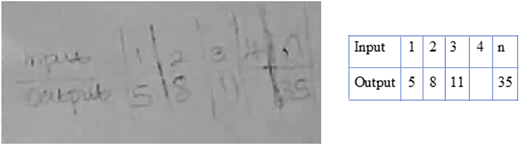
T1 invited learners to come to the front to complete the patterns on the board. The practice of calling learners to the board to give answers and explain their thinking is commendable because it allows learners to hone their mathematical thinking skills. The learners successfully extended the first and second patterns. However, L1 incorrectly extended the third pattern as follows: and explained how she extended the pattern thus: “To get the answers, I added 4,5,6,7,8 to all these (sic) previous terms each to get the next one.” L1 implied that she added 4 and 3 to obtain 7; 5 and 7 to obtain 12, and so on. Evidently, L1’s answer signified confusion because the differences between subsequent terms were incorrect. T1 noticed L1’s incorrect solution, and she decided to call upon another learner to assist L1 (Course of Action). T1’s action was superficial in consistency and specificity because it was positive and was done to assist L1. L2 extended the pattern in the following way: . L2 wrote the differences between subsequent terms as . Similar to L1, L2 was incorrect; however, he realised that his solution was incorrect and asked if he could redo it. In his second attempt, he wrote as the differences between subsequent terms, which were also incorrect, signifying another confusion. As L2 was grappling with solving the problem, our focus was on the decisions that T1 would make. Interestingly, and contrary to the prescripts of professional noticing, T1 opted to disregard L1 and L2’s attempts and proceeded with the lesson (Course of Action) by introducing the activity that characterised the actual lesson development (Figure 2). Drawing a table of input and output values on the board (see Figure 2 – redrawn alongside for clarity) allows learners to establish the functional relationship between the position of a term and its value. Using a table is another way of catering for the representation component of mathematical thinking. Notably, the pattern in Figure 2 is not any of the exercises that were given to the learners earlier, implying that T1’s Course of Action was irrelevant in consistency and specificity.
Based on Figure 2, T1 asked the learners to explain the rule for the pattern in their own words. The learners did not respond, so T1 decided to demonstrate to the learners how to find the general rule () of the pattern. T1 noticed that learners did not know the answer to her question, indicating Confusion; however, her Course of Action is neither consistent nor specific to the noticed episode because it does not assist learners to overcome their Confusion to learn the Concept. T1 wrote the following on the board:
At this point, T1 paused and asked the learners what the variable is. A random learner in the class said “3”, to which T1 responded, “Ahh, you are guessing”. L1 volunteered a different answer: “Ma’am, the variable is ”. Although T1 noticed that the learner who said the number 3 was the variable was confused about what a variable is, T1 did not use this opportunity to provide clarity. Instead, T1 asked the learners what the next step was from (typical of an inconsistent and nonspecific Course of Action), and the following conversation ensued:
L3:
T1: Plus?
L3: Minus
T1: Why are you saying minus? (Learners just mumbled).
L4: Because the 5 is big and the 3 is small. (Confusion)
T1: L4 is saying because the 5 is big and the 3 is small, is correct? (sic).
Learners (collectively): No!
T1: Okay, why? (Course of Action)
L1: We are saying negative because 5 is on the negative side. (Confusion)
T1: She’s correct?
L2: She’s almost there.
T1: Oh, you have the answer; okay, tell us.
L2: 3 was on the positive side, 5 was on the negative side, so we can’t add the numbers where the symbols are not the same; we have to multiply the negative plus … negative multiplied by positive equals to negative, so that is why we said 5 minus 3.
T1: No! Guys, when a number is on this side of an equal sign (indicating the right side of the equation: ), you want to take it this side (indicating the left), it’s going to change sign (sic). That’s why it’s no longer a positive 3, it’s a negative 3 because it was at that side, now it is … (using hands to indicate the movement). (Course of Action)
The above interaction between T1 and the learners vividly displays that firstly, learners were confused about what a variable is, and secondly, they did not know how to solve the algebraic equation. T1 did notice the difficulties learners had and made an instructional decision to re-explain the concept (Course of Action).
During the interview, T1 was asked what she thought went wrong with the third pattern () in terms of how learners responded. The question was based on the learners’ evident struggles to extend the pattern by three more terms. T1 indicated that learners were supposed to obtain the next three terms using the constant difference. She attributed learners’ difficulties in understanding patterns to the fact that the topic was new.
Teachers’ noticing and instructional decisions after-the-moment
Bakker et al. (2022) argued that noticing can take place after the moment, meaning after the lesson. In this section, therefore, we present findings of data collected during the post-lesson reflection. Data were collected through observation and unstructured interviews.
The LS team convened for the post-lesson reflection. T1 was the first to reflect on the lesson as per the prescripts of LS. T1, however, did not have anything to say besides expressing her disappointment with the learners and suggesting that perhaps the lesson was rushed due to time constraints. T1’s comment can be attributed to the irrelevant levels of consistency and specificity. During the interview, T1 was asked why she proceeded with the lesson upon noticing that L3’s answer was similar to L1’s. T1 indicated that she thinks some learners are just “too eager” to be involved in the classroom happenings, even when their contributions are not related to the content of the day. T1 further added that:
I think she raised her hand and then realised that when they are saying tables, then they realised after that ohh so and so spoke about tables, so that’s why she didn’t go further explaining the way they are arranged.
According to T1’s utterances, it is clear that she thought asking L3 if her answer was different from L1’s answer was enough to make L3 realise that L1 said the same thing. It must be noted that T1 did not offer L3 an opportunity to explain her thinking. T1’s Course of Action and response to the question were irrelevant in the consistency and specificity characteristics. Members of the LS team who observed the lesson also added their voices. For instance, T4 indicated that if a learner incorrectly answers a question, the teacher must not ignore the learner. Instead, the teacher must have ways to encourage the learners. In addition, T5 highlighted that perhaps the pattern activity was cognitively demanding for the learners, and suggested that in future, the LS team should work out and discuss the solutions to their planned instructional tasks.
T9 indicated that “learners were struggling, saying that when a number jumps an equal sign, automatically, it changes the sign.” T9 further suggested that additive inverses could have been used to explain that what happens on the left-hand side must also happen on the right-hand side. T9’s utterances can be deemed superficial under the RPD and RMD traits. T2 did not agree with the concept that a number “jumps” an equal sign and proposed that “transposing” is instead used. T2’s comment can be deemed superficial in both RPD and RMD. When T1 was asked to explain what a number “jumps” an equal sign means, the response was:
When we are talking about a negative number and a positive number, remember it’s where the integers comes (sic) in. Remember, the integers is also a new topic (sic) to them in Grade 7. These learners from the lower grades, if you subtracting a big number to a small number, is possible (sic). But if you’re subtracting a small number to a big number, is not possible (sic) for them! But after doing the integers, it’s where they can say it’s possible now because the answer can be in a negative number.
T1’s response is superficial in RPD and RMD. It must, however, be noted that T1’s comments are true because learners in lower grades are often told that you cannot subtract a “big” number from a “small” number. In other words, 3 minus 5 is not possible. However, this idea becomes invalid when learners are introduced to integers and the properties of whole numbers. On the same issue, T4 noticed that teaching this topic brought about “a lot of information” regarding what learners understand about other topics. He then recommended that in future, the LS team must consider “other things” that may emerge from other topics when planning their lessons. Phrases such as “a lot of information” and “other things” lack specificity in terms of the noticed episode. T4’s comments, therefore, are superficial in RPD and RMD.
In addition, T8 indicated that learners struggled with finding the general rule of the pattern and suggested that perhaps a different strategy could be used. T2 added to this idea and suggested that instead of using a formula, learners must be taught to multiply the constant difference by the position of the term and then see what they can add or subtract to obtain the value of the term. T2’s suggestion falls within the evolving level of both the RPD and RMD. T1, however, indicated that apparently, learners are struggling with the concept because it was the first time they were being introduced to patterns.
Discussion
This article has helped us to gain insights into the intricacies of teachers’ professional noticing of learners’ mathematical thinking during teaching and their subsequent instructional decisions. Professional noticing is a requisite skill for effective teaching as it ought to enable teachers to have their fingers on the pulse of the learning process. However, disregarding learners’ contributions contradicts the precepts of professional noticing. In fact, it is tantamount to a fierce disdain for learners’ thinking. Essentially, learners’ responses and classroom contributions during teaching have the potential to elicit their mathematical thinking and understanding (Khoza, 2023). Disregarding their classroom contributions tends to deny them access to and a deep understanding of the mathematical concepts being taught in the moment (Moodliar and Abdulhamid, 2021). In addition, learners are likely to be embarrassed, leading them to disengage in the classroom (Sekao, 2023). This scenario is also a missed PTM that the teacher could have used to change or modify how learners think about mathematics (Stockero and Van Zoest, 2013).
L2 wrote an answer on the board and realised that his answer was incorrect. T1 did notice this as well and granted L2 an opportunity to redo the activity. L2 then erased his response. Sekao (2023) argues that learners’ incorrect solutions on the board must not be erased from the board. Instead, a neat line must be used to strike through the incorrect answer so that when a correct answer is then written on the board, the learners can compare and contrast the two answers. We are of the opinion that T1 should have made this instructional decision. This would have helped T1 bring learners into the discussion through neriage (Fujii, 2016) and then to sum up the ideas in the activity through matome (Asami-Johansson, 2021). The activity given to the learners could not be solved, but T1 made an instructional decision to proceed with the lesson. Although we think that T1 should have provided clarity, the activity given to the learners did not address the lesson outcomes and was not grade-specific, therefore rendering it not purposeful (Fujii, 2018). This activity serves no purpose as teachers will not be able to notice learners’ mathematical thinking and achieve their set objectives.
One of the precepts of professional noticing is that teachers’ course of action should be consistent and specific to the noticed episode (Karatsioli et al., 2022). On the contrary, we noted a situation where pedagogical and content knowledge decisions were opposed to what was noticed. A case in point was the sudden introduction of the activity involving , which was unrelated to what learners grappled with. Our view is that this erroneous action by the teacher may not assist learners in gaining an in-depth understanding of the concept taught. This contradicts the focal points of the FFPN that suggest that teachers’ Course of Action ought to assist learners overcome their Confusion to learn the Concept (Choy, 2015). In fact, the third construct of professional noticing (i.e. deciding to respond) must be executed in alignment with learners’ current mathematical thinking (Jacobs et al., 2010).
The post-lesson reflection offered a platform for teachers to reify pedagogical and mathematical discourses (Coronado, 2023). It was intriguing that one of the pedagogical and mathematical discourses involved the use of “additive inverses” instead of the widely used and controversial idea that “when a number jumps an equal sign, it changes its sign”. Learners in Grade 7 have not yet been introduced to the idea of additive inverses in solving number sentences (DBE, 2011) and using the idea that a “number jumps” an equal sign has the potential to cause further confusion. This, in fact, compromises the RMD aspect of Karatsioli et al.’s (2022) rubric because it is not relevant to the noticed episode. If teachers have a good grasp of the curriculum policy, they would effectively identify and exploit a PTM whereby they make an instructional decision to modify their instruction to enhance learners’ mathematical thinking (Stockero and Van Zoest, 2013).
We also note that although exchanges in the post-lesson reflection were positive, they could have been more explicit about the idea of professional noticing, where teachers could reflect on the utility of their selected and implemented instructional tasks and how they assisted them to notice learners’ mathematical thinking. In fact, it is argued that reflection, especially in LS, can assist teachers to re-evaluate their teaching and learning beliefs. However, engaging in reflection superficially provides little opportunity for teachers to learn and grow professionally (Kager et al., 2024). Given the occurrences of post-lesson reflection in this study, our view is that directed and intentional post-lesson reflection can improve teachers’ professional noticing and suggest that further research is done on this.
Limitations
Although the purpose of this article was to explore mathematics teachers’ professional noticing during teaching and their subsequent instructional decisions, not observing the lesson planning process may have deprived us of an opportunity for a deeper understanding of the minutiae of the lesson presented. For instance, we probably would have understood the motive for the LS team’s selection of instructional activities, i.e. numeric patterns.
Conclusion
While LS provides an opportunity for teachers to collaborate, professional noticing offers them an opportunity to make informed instructional decisions. However, suitable instructional decisions can only be made by teachers after they notice aspects of learners’ mathematical thinking. It seems to be true that professional noticing has the ability to directly enhance the teaching and learning of mathematics. We contend that the purposeful activities teachers use can enable deeper noticing of learners’ mathematical thinking. In this study, there were instances where the activities used by teachers were not purposeful, thus limiting teachers’ ability to notice certain aspects of learners’ mathematical thinking. In fact, we argue that using activities that are not purposeful tends to misguide teachers in terms of what they notice regarding learners’ mathematical thinking and may result in instructional decisions that are not appropriately aligned with learners’ current mathematical thinking and understanding. It can be argued that poor instructional decisions may be attributed to low levels of RPD and RMD. Instructional decisions that are not appropriately aligned with learners’ mathematical thinking do not help learners overcome their confusion to learn the mathematical concepts.
The findings from the current article cast light on the affordances of teachers’ professional noticing during teaching for effective instructional decisions. This could be an inflection point for future studies towards improving teachers’ professional noticing abilities to enhance learners’ mathematical thinking in the LS context. In conclusion, we support T5’s view that the LS team should work out solutions to their instructional activities before they use them to teach. By doing so, the purposefulness of the instructional activities could be enhanced. Consequently, we recommend that future research focus on the development of a framework/guideline that explains or outlines features that characterise a purposeful activity to enable deeper noticing. Learners’ mathematical thinking must be the agenda for the implementation of LS, so that teachers may assist them to learn, understand and succeed in the subject.