


Purpose
Drawing upon the conservation of resources theory, the authors expected that daily micro-events, daily hassles and uplifts at work influenced well-being via work engagement at the daily level.
Design/methodology/approach
The authors conducted two diary studies. In study 1, 181 workers answered a daily questionnaire for four working days (N = 181 × 4 = 724). In study 2, 51 workers filled in a questionnaire for ten consecutive working days (N = 51 × 10 = 510).
Findings
In study 1, the results demonstrated that work engagement fully mediated the effects of daily uplifts on well-being and partially mediated the effects of daily hassles on well-being. The results of study 2 revealed a full mediation for both kinds of daily micro-events. Hence, daily uplifts stimulated work engagement, which, in turn, enhanced well-being, and daily hassles minimized work engagement and, consequently, well-being.
Originality/value
The relationships explored provide new theoretical elements for models that explain well-being.
Introduction
A working day is usually filled with positive and negative daily micro-events that have consequences on well-being and performance (Junça-Silva et al., 2020, 2022). Recent studies have emphasized the importance of these kinds of micro-events – named daily hassles and uplifts – in organizational contexts regarding diverse well-being indicators (e.g. job satisfaction; Junça-Silva et al., 2021), which makes it crucial to understand them as antecedents of well-being in work contexts (Taris, 2006; Taris and Schreurs, 2009). However, these studies have ignored the processes involved (Gross et al., 2011). Hence, there is a need to study processes that could explain the influence between daily micro-events (hassles and uplifts) and well-being (e.g. Junça-Silva and Silva, 2023; Landolfi et al., 2022) (see Figures 1 and 2).
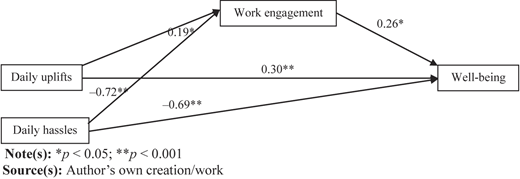
Coefficients representing effects of daily hassles and uplifts on work engagement and well-being
Coefficients representing effects of daily hassles and uplifts on work engagement and well-being
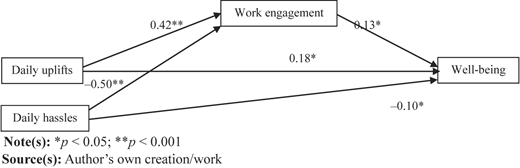
Coefficients representing effects of daily hassles and uplifts on work engagement and well-being (study 2)
Coefficients representing effects of daily hassles and uplifts on work engagement and well-being (study 2)
We argue that work engagement – defined as a positive, active, affective state characterized by vigor, dedication and absorption (Schaufeli and Bakker, 2004) – may play a role in that relationship. First, work engagement has been consistently linked not only to job characteristics, such as resources or demands, but also to affect at work (e.g. Bledow et al., 2011; Junça-Silva et al., 2017). Second, the conservation of resources theory (COR; Hobfoll, 1989) has a central tenet that emphasizes the motivational human nature in pursuing, acquiring, fostering and protecting personal resources. From the COR perspective, work engagement is a crucial resource that is responsible for performance and well-being improvements (e.g. Hobfoll et al., 2018). Accordingly, individuals tend to overweight resource loss and underweight resource gain. Hence, COR theory posits that work engagement may lead to decreased well-being when (a) work engagement (or one of its components) is threatened with loss, (b) when it is (indeed) lost or (c) when there is a failure to gain it following significant effort (Hobfoll et al., 2018).
Even though authors exploring the dynamics of daily micro-events at work emphasize the importance of capturing the transient character of those micro-experiences (e.g. Chacko and Conway, 2019; Ilies et al., 2007), most studies focused on daily micro-events have analyzed variance attributable to between-people fluctuations, and do not consider within-person variations produced along the day. Furthermore, most studies on work engagement have analyzed it as an outcome. However, some authors argued that work engagement is not only an outcome of diverse work characteristics but emphasized the importance of analyzing it as a process that might enhance positive outcomes in the workplace (e.g. De Carlo et al., 2014).
We aim to contribute to the literature in some ways. First, there is little research being done to explore how the transient character of daily micro-events has an immediate effect on attitudes (Healey et al., 2015; Junça-Silva et al., 2022), such as work engagement. In addition, there is a need for more research to understand how the positive and motivational character of work engagement influences well-being (Ilies et al., 2007). As Junça-Silva et al. (2017) highlighted, the relationship between daily micro-events work engagement and well-being is still to be proven at the daily level. Therefore, exploring work engagement as a daily process is in line with the call of diverse researchers (e.g. Braukmann et al., 2018).
Moreover, by using two diary studies to analyze within-person fluctuations in daily micro-events, work engagement and well-being, we answer specific calls to explore daily processes that may explain how daily micro-events affect well-being at the daily level (e.g. Junça-Silva et al., 2022). As such, identifying daily antecedents of well-being may help to clarify how well-being can be shaped by workers' daily micro-experiences. In addition, a within-person perspective brings light to the daily processes related to well-being.
At last, we contribute to the broader literature on daily micro-events at work (e.g. Junça-Silva et al., 2021). Although there are some studies about these kinds of events, most are explored under cross-sectional designs and only consider their affective nature, ignoring other work-related processes that may derive from them. Understanding if daily micro-events impact work engagement is crucial to gain further insight into their role in work-related attitudes, at the daily level of analysis. Last but not least important, it is crucial to pay attention to the workers' level of life satisfaction, since this is an indicator of mental health (e.g. Lombardo et al., 2018). It is even more relevant to pay attention to mental health in post-pandemic times, where a significant decrease in levels of mental health and happiness has been revealed (e.g. Junça-Silva and Silva, 2023). In addition, identifying the role of daily micro-events in life satisfaction can be a suitable management tool that contributes to increasing the levels of workers' happiness.
Hence, in line with the COR theory, we propose that workers' daily micro-events at work precede their daily work engagement which, in turn, relates to their well-being. To that end, we conducted two studies, one among part-time employees and the other among full-time employees.
Theoretical background on well-being at work
Subjective well-being is a multidimensional construct with two distinct components: life satisfaction (the cognitive component) and positive and negative affect (the affective component) (Diener, 1984). Accordingly, subjective well-being involves an evaluation of life circumstances consisting of cognitive assessments of satisfaction with life and the frequency of experiencing positive and negative affect (Diener et al., 1999, 2020). Hence, higher subjective well-being occurs when positive affect is frequently experienced, negative affect appears to be less frequent and when individuals are satisfied with their life (Deci and Ryan, 2008; Biswas-Diener et al., 2005).
An employee can be said to have low work-related well-being when he/she is unsatisfied with his or her job, is experiencing positive emotions infrequently and is experiencing negative emotions frequently in work contexts (Bakker and Oerlemans, 2011). To study subjective well-being at work, researchers have used diverse indicators, such as job satisfaction (Judge et al., 2001) and happiness at work (e.g. Diener and Biswas-Diener, 2008; Warr, 2018).
Empirical studies regarding the antecedents of well-being at work have often focused on job demands and resources that may decrease or increase well-being (e.g. Bakker and Oerlemans, 2011; Diener et al., 2020). When demands exceed or fall below resources, employees experience negative affect (e.g. strain) that hinder their well-being (Bakker and Demerouti, 2007). When demands match or slightly exceed resources, individuals experience positive affective states (e.g. pleasure, joy, energy) that contribute to their happiness (Warr et al., 2014; Waterman, 1993).
Daily micro-experiences in the workplace give rise to affective indicators that influence how individuals feel about work and life in general. The following section highlights how micro-affective experiences can influence well-being.
Daily micro-events at work: daily hassles and uplifts
Affective events theory (Weiss and Cropanzano, 1996) proposed that affective events trigger positive or negative affective reactions and that these will influence employees' work-related attitudes and behaviors in the workplace. In an extension of that, we assert that daily micro-events are what make the difference in employees' day-to-day lives, specifically about the consequent affective reactions and resulting attitudes (e.g. work engagement).
In the literature, daily micro-events have been identified as daily hassles and daily uplifts. Daily hassles are the tiny things that can somehow irritate or frustrate individuals at work (Lazarus, 1993; Junça-Silva et al., 2020). Examples of daily hassles can be a lack of supervisor support or having to deal with someone in a rotten mood. On the other hand, daily uplifts are positive micro-experiences arising from daily interactions in the workplace. Receiving positive feedback about one's performance or receiving support from a supervisor are examples of daily uplifts.
Those employees who experience daily uplifts, such as having peer or managerial support, are far less likely to experience negative affect and attitudes in the workplace (Junça-Silva et al., 2019; Sonnentag et al., 2010a, b). By contrast, employees who experience daily hassles, such as needing help that is not available, are likely to feel bad at work. Such events can influence a person's well-being (Fisher and Noble, 2004). Ivancevich (1986) demonstrated that the frequency and intensity of daily micro-events accounted for a significant proportion of the variance in diverse outcomes, such as job satisfaction. Thus, it seems likely that whereas employees experiencing daily uplifts at work would report higher levels of well-being, employees having to contend with several daily hassles at work would be unhappier (Junça-Silva and Rueff-Lopes, 2021).
The mediating role of work engagement between daily hassles and uplifts and well-being
Daily micro-events have an affective nature that will account for workers' attitudes at work (Weiss and Cropanzano, 1996). Work engagement is an attitude that may arise from these daily micro-events (Junça-Silva et al., 2017). Accordingly, we propose a mediating model in which the indirect effect of daily hassles and uplifts on well-being is spread through work engagement.
Work engagement is an active, positive affective state characterized by vigor, dedication and absorption (Schaufeli and Bakker, 2004). Engaged employees feel connected to their work (Kahn, 1990) and are highly energetic, self-efficacious individuals who exercise influence over events that affect their lives (Bakker, 2009). The positive affect experienced by engaged employees may serve to build personal resources such as energy.
A central tenet from the conservation of resources theory (COR) argues that individuals strive to maintain, acquire and protect resources from potential losses (Hobfoll, 2001). By protecting and acquiring further resources, such as work engagement (Hobfoll et al., 2018), individuals prevent resource loss and experience resource gains which, in turn, prevents emotional distress or exhaustion. The COR theory and some empirical demonstrations described that resources are vulnerable to situational factors such as managerial support, customer mistreatment and feelings of pride (Hobfoll et al., 2018). Notwithstanding, daily micro-events have been less studied under the COR lens even though their resource nature. We thereby argue that daily-micro events are situational factors that may be resource draining (daily hassles) or create positive spirals of resources (daily uplifts). Moreover, emotional exhaustion is usually the proximal outcome which increases when resources are threatened or lost and decreases when resources are gained (Hobfoll, 2001). Hence, from this perspective, when resources are lost, strain occurs and well-being decreases. When individuals are full of resources, they not only feel better but can also devote effort to obtain even more resources.
Empirically, some studies have demonstrated that work engagement can spur positive gain spirals that promote personal initiative at work (Bakker et al., 2012) and enhance well-being (Junça-Silva et al., 2017; Sonnentag et al., 2010a, b). Other studies have shown that work engagement was positively related to positive outcomes such as positive affect at work (Weigl et al., 2010), job performance (Xanthopoulou et al., 2009) and citizenship behavior (Griffin et al., 2010). Rich et al. (2010) suggested that engaged employees were more likely to experience positive, individual affective states, which influenced their overall well-being. These findings are consistent with the notion that work engagement builds personal resources than can promote positive outcomes, such as satisfaction and well-being.
Despite the existence of diverse studies exploring the link between daily uplifts to work engagement (e.g. Ouweneel et al., 2012; Salanova et al., 2011), little is known about the influence of daily hassles. Daily hassles are not compatible with being absorbed in an ongoing task, feeling vigorous at work and being dedicated to a task. According to Fredrickson et al. (2003), daily hassles interrupt the ongoing stream of action and lead to a “tightening” of mental processes. Thus, those experiences might be negatively related to work engagement. In a similar vein, Bledow et al. (2011) explored the functions of positive and negative affect on work engagement. They showed that negative affect is not compatible with work engagement in the short term. But more research is needed to support this point of view, especially in exploring within-person fluctuations.
The present study
Based on this rationale and according to the COR theory, we propose that when an uplift occurs, it may facilitate feelings of vigor, dedication and absorption (Sonnentag et al., 2010a, b), which, in turn, increases his/her well-being (Ouweneel et al., 2012). On the other hand, when daily hassles occur, work engagement will decrease (Bledow et al., 2011) and will lessen individuals' well-being.
While these relationships are examined at both the daily and individual levels, the main contribution of this study is its emphasis on the daily level. The diary design allows us to explore dynamic relationships between work-related micro-events and well-being. Diary studies permit researchers to explore experiences, analyzing how variations in the daily context, such as daily micro-events, may affect levels of well-being across days (Ohly et al., 2010). Diary studies can capture “life as it is lived” (Bolger et al., 2003). A clear advantage of a diary design is that, unlike surveys, the responses are less affected by retrospective bias; diary designs also have high ecological validity. Accordingly, we hypothesize that:
Work engagement mediates the positive relationship between daily uplifts and well-being at the daily level.
Work engagement mediates the negative relationship between daily hassles and well-being at the daily level.
We conducted two diary studies among employees from diverse job sectors; in the first study, the sample included part-time employees, and the second one resorted to a full-time employee sample. Part-time employees work less than 35 h per week, while full-time employees work at least 35 h per week (Li-Pang Tang et al., 2002). Hence, part-time employees spend less time of their week on the working settings when compared to full-time employees, which makes full-timers more prompt to experience both daily hassles and uplifts. Moreover, higher education students (i.e. youngers) are an important source of part-time employees (Larson and Ong, 1994). Furthermore, there are some studies who have demonstrated additional differences between part-time and full-time employees (e.g. Li-Pang Tang et al., 2002). For instance, full-time employees tend to be more satisfied with their job in general (Wheatley, 2017), their career and its security (Miller and Terborg, 1979). Further, they also evidence lower role strain, role conflict and overload than part-time counterparts. On the other hand, part-time employees tend to be more satisfied with the social context of the work and the working conditions in general, when compared to full-timers (Bennett, 1997). Following these differences, it is plausible to understand if the hypothesized model is different between part-timers and full-timers.
Study 1: a study with part-time employers
Method
We used a diary study approach to test the above-mentioned hypotheses. Further, to test the mediation, we used a multilevel modeling approach.
Participants and procedure
Participants in study 1 were part-time employees from diverse job sectors, including services (42%), administrative occupations (37%) and social work (21%). They were invited, via email, to participate in a study on “well-being at work,” A total of 253 workers answered our first email and volunteered to participate in the diary study. Those who agreed to participate received more specific information about the study, its anonymity and confidentiality, and were asked to complete a general questionnaire with socio-demographic information, and scales to measure daily work engagement and well-being.
In addition, they answered an online survey once every day (at the end of the day) for four consecutive working days. The survey assessed only daily micro-events (hassles and uplifts), work engagement and employees' subjective well-being. They had to answer every day until 6 pm.
Participants who completed all the questionnaires received a gift voucher (€10). Moreover, after finishing the study, all participants received information about the purpose of the study. The final sample comprised 181 participants (85 women and 96 men) who filled in a general questionnaire and a diary survey for four consecutive working days (N = 4 × 181 = 724 occasions). The mean age was 24.34 years (SD = 9.20). Regarding education, 11% held a university degree, and the remaining 89% had completed secondary education. Participants had different job positions including manager (14%), administrative employee (32%), operational employee (31%) and retailers (23%).
Measures
The diary surveys included measures to assess daily micro-events (hassles and uplifts), work engagement and subjective well-being. All the scales were adapted to the daily level and included items using the past tense, and all started with “today,”
Daily micro-events were measured using the scale of (positive and negative) daily micro-events developed by Oishi et al. (2007). The scale was adapted to the working settings and to the day level by adding “today” and “work” and including the past tense. It comprised a list of 26 daily micro-events; 13 were positive (e.g. “Today, I was complimented at work”) and the other 13 were negative (e.g. “At work, I said something to someone I deeply regretted afterward”). Participants were asked to indicate how many micro-events happened to them on that day at work. The daily positive and negative micro-event scores were computed by adding up the daily frequencies of the positive and negative micro-events. We also computed the average daily positive and negative micro-events. These showed there were individual differences in the chronic level of positive and negative micro-events (see Table 1 for descriptive statistics). Cronbach's α for daily uplifts was 0.77, and for daily hassles was 0.83.
Descriptive statistics and correlations between variables (study 1)
| Mean | SD | 1 | 2 | 3 | 4 | 5 | |
|---|---|---|---|---|---|---|---|
| 1. Daily uplifts | 6.07 | 2.38 | – | −0.13* | 0.19** | 0.34 | 0.03 |
| 2. Daily hassles | 2.45 | 1.73 | −0.12* | – | −0.52** | −0.31 | −0.05 |
| 3. Work engagement | 4.52 | 0.99 | 0.13* | −0.14* | – | 0.39** | 0.01 |
| 4. Well-being | 4.59 | 1.07 | 0.30** | −0.17* | 0.24** | – | 0.02 |
| 5. Time | – | – | 0.01 | −0.05 | 0.00 | 0.04 | – |
| 6. Age | 24.34 | 9.20 | −0.02 | −0.06 | 0.01 | 0.07 | −0.01 |
| 7. Gender | – | – | 0.00 | 0.00 | 0.04 | 0.03 | 0.00 |
Note(s): Correlations below the diagonal are person-level correlations (N = 181). Correlations above the diagonal are daily-level correlations (n = 724). *p <. 05; **p < 0.01
Source(s): Author's own creation/work
Work engagement was assessed using the short form of the Utrecht work engagement scale (Schaufeli et al., 2006). The scale comprised nine items distributed across the three dimensions: vigor (three items, e.g. “Today, at my job, I felt strong and vigorous”), dedication (three items, e.g. “Today, I was enthusiastic about my job”) and absorption (three items, e.g. “Today, I felt happy when I was working intensely”). Each item was rated on a 7-point scale ranging from 1 (never) to 7 (always). Cronbach's α was 0.89.
Subjective well-being (SWB) was measured with 5-item satisfaction with life scale (SWLS: Diener et al., 1985) which evaluated the quality of one's life. One example of the items is “today, my life was close to my ideal,” Items were scored on a 7-point scale, ranging from 1 (strongly disagree) to 7 (strongly agree). Cronbach's α was 0.86.
Control variables. We used time (from Monday to Friday) as a level 1 control variable, and age and gender as level 2 control variables. Time was used because it has been shown to influence how individuals answer to repeated measures and thus may bias their responses (e.g. Junça-Silva and Silva, 2021). Furthermore, the participants' age and gender may influence their affective responses (i.e. work engagement) and well-being (Huang et al., 2020).
Data Analyses
Given the hierarchical structure of our data, we used multilevel analysis (Bryk and Raudenbush, 1992). Multilevel analyses were used to test the hypotheses because they take the dependence of the observations on the day level into account. Specifically, days were nested in persons (Preacher and Hayes, 2008; Preacher et al., 2010). At level 1, we had repeated measures (four days; N = 724 occasions), whereas at level 2, we had individuals (N = 181). Daily-level variables were centered on the respective person mean, as recommended by Ohly et al. (2010). When the hypothesis concerns relationships entirely between level-1 variables, as in the current study, centering on the person-mean (which refers to the mean across days for each person) is most appropriate and useful for interpreting the results (Enders and Tofighi, 2007; Raudenbush and Bryk, 2002). Variation within persons (i.e. at level 1) refers to day-to-day deviations from individuals' average reports of the study variables (e.g. work engagement). For example, a significant within-person relationship between daily uplifts and work engagement would indicates that on days when an individual's daily uplifts were higher than normal, they reported greater work engagement. In other words, this relationship represents the average day-level relationship between daily uplifts and work engagement across individuals. In contrast, the between-person portion of the model represents the latent mean of participants' daily scores over the course of the week and refers to variation between individuals in the study. Moreover, centering on the person-mean removes all between-person variance in the model (Hox, 2002), resulting in level-1 scores that are uncorrelated with other level-2 variables (Enders and Tofighi, 2007). By implication, a model that examines the impact of a person-centered independent variable at level-1 on a dependent variable is not adjusted for variables at level-2 (i.e. control variables). This logic, then, precludes the use of level-2 control variables in a traditional sense unless there is a substantive interest in between-person effects (Enders and Tofighi, 2007).
To test the significance of the mediation effect, we followed the recommendations by Preacher and colleagues (2011) for testing lower-level mediation models in which all variables were assessed on level 1 (i.e. 1-1-1). In this analysis, the ability to partition the within- and between-person components of the model is advantageous in that it overcomes some key limitations of previous methods for examining indirect effects with multilevel data; specifically, these earlier methods tended to confound the within- and between-person variance by estimating a single mean slope (leading to a downward bias of the between-person effects; Preacher et al., 2010). Additionally, we used the bootstrapping approach as described by Preacher and Hayes (2008). This procedure applies a nonparametric resampling procedure, using adjusted percentile (asymmetrical) confidence intervals (CIs), to estimate the size of indirect effects. Plus, this strategy is mainly advantageous because it makes it possible to determine whether an indirect effect exists (Preacher and Hayes, 2008). All the analyses were performed using Mplus.
Results
A summary of descriptive statistics and correlations among all the present variables is shown in Table 1. We computed the correlations at a within-person level and a between-person level to study the average daily deviance from the persons. All were positively and significantly related to daily uplifts, and negatively and significantly related to daily hassles.
Variance decomposition
As a preliminary step to testing the study hypotheses, unconditional random coefficient models were run to calculate the relative within-person and between-person variance for each study variable. The intraclass coefficients (ICC) indicated that 41% of the variance in daily uplifts, 32% in daily hassles and 75% in work engagement occurred at the within-person level. In addition, subjective well-being showed 87% within-person variation. These ICC values indicated that each of the study variables exhibits variation at both the within and between-person levels, and supports the use of multilevel modeling.
Preliminary analyses
We checked the construct validity of the measures using multilevel CFA (MCFA), following the procedure by Hox (2010). In this model, items only loaded upon a single factor, factors were allowed to correlate and item residual variances were considered independent. The proposed model (model 1), distinguished between four factors at the within-person (i.e. occasion) level (daily hassles and uplifts, work engagement and well-being) and at the between-person level, achieved a good fit to the data: χ2 = 101.542, CFI = 0.99, RMSEA = 0.05, SRMR within = 0.03 and SRMR between = 0.04 (Bindl et al., 2022). In addition, in line with the recommendations of Hair et al. (2010), the average variance extracted (AVE) score was greater than 0.5 for each factor at each level, supporting convergent validity, and exceeded all squared correlations between that factor and any others at its level, thus supporting discriminant validity.
Additionally, the hypothesized model showed a significantly better fit than other alternative models, including combining well-being with work engagement on one factor (model 2), and daily hassles with daily uplifts on one factor (model 3) as well as combining all measures into one factor (model 4).
Finally, each of the multilevel measures showed high reliability for daily hassles: α = 0.83 and ω = 0.82; for daily uplifts: α = 0.77 and ω = 0.77; for work engagement: α = 0.89, ω = 0.88, and for well-being: α = 0.86 and ω = 0.87.
Hypotheses testing
The mediating role of work engagement between the link of daily uplifts and well-being
Hypothesis 1 stated that work engagement would mediate the relationship between daily uplifts and well-being. To assess the significance of the mediation, we followed the bootstrapping approach (Preacher et al., 2010). We found evidence of the indirect effect of daily uplifts on well-being via work engagement (0.14, 95% CI [0.005, 0.27]).
The mediating role of work engagement on the link between daily hassles and well-being
Hypothesis 2 stated that work engagement would mediate the relationship between daily hassles and well-being. We found evidence of the indirect effect of daily hassles on well-being via work engagement (−0.28, 95% CI [−0.46, −0.10]). Thus, there was support for this hypothesis.
Study 2: a study with full-time employees
Method
Participants and procedure
The participants in study 2 were full-time employees from an organization in the service sector who were invited to take part in a study on “well-being at work,” Overall, 82 workers volunteered to participate in the diary study. The procedure was like the previous study; however, we extended the period of collecting data from four to ten working days. We intended to explore whether the results found in study 1 was maintained over time. As such, employees who agreed to participate, answered an online survey once every day (at the end of the day, until 6 pm), for at least ten working days. The survey assessed daily micro-events, work engagement and employees' subjective well-being. Participants who completed all the questionnaires received a gift voucher (value of €20).
The final sample of this study comprised 51 participants (33 women and 18 men) who filled in a general questionnaire and a diary questionnaire for ten working days (N = 51 × 10 = 510 occasions). The mean age was 34.17 years (SD = 7.45). Their mean organizational tenure was 4.72 years (SD = 4.24), ranging from 1 to 13 years. Regarding the education levels among participants: 48% were university graduates, and 52% were graduates of high school.
Measures
The diary questionnaires included the same measures used in study 1. The Cronbach's alphas ranged from 0.75 to 0.88.
Control variables
We used the controls as we used in study 1 (i.e. time, age and gender).
Results
A summary of descriptive statistics and correlations among all the variables is presented in Table 2. We computed the correlations at the within-person and between-person levels. All were positively and significantly related to daily uplifts and negatively and significantly related to daily hassles.
Descriptive statistics and correlations between variables (study 2)
| Mean | SD | 1 | 2 | 3 | 4 | 5 | |
|---|---|---|---|---|---|---|---|
| 1. Daily uplifts | 1.65 | 0.74 | – | −0.18* | 0.28** | 0.33** | 0.04 |
| 2. Daily hassles | 0.56 | 0.38 | −0.29** | – | −0.50** | −0.34** | 0.02 |
| 3. Work engagement | 4.54 | 1.25 | 0.21* | −0.23* | – | 0.36** | −0.01 |
| 4. Well-being | 5.51 | 1.38 | 0.20* | −0.37** | 0.38** | – | 0.06 |
| 5. Time | – | – | 0.02 | −0.10 | 0.08 | 0.11 | – |
| 6. Age | 34.17 | 7.45 | −0.05 | −0.04 | 0.02 | 0.04 | 0.03 |
| 7. Gender | – | – | 0.03 | 0.00 | 0.01 | 0.05 | 0.02 |
Note(s): Correlations below the diagonal are person-level correlations (N = 51). Correlations above the diagonal are daily-level correlations (N = 510). *p <. 05; **p < 0.01
Source(s): Author's own creation/work
Variance decomposition
The intraclass coefficients (ICC) indicated that 57% of the variance in daily uplifts, 53% in daily hassles, 39% in work engagement and 46% in subjective well-being occurred at the within-person level. So, it appears relevant to perform within-person analyses of the relations among the variables.
Preliminary analyses
We followed the same steps as we did in the first study. The proposed model (model 1), distinguished between four factors at the within-person (i.e. occasion) level (daily hassles and uplifts, work engagement and well-being) and at the between-person level, achieved a good fit to the data: χ2 = 66.751, CFI = 0.99, TLI = 0.98, RMSEA = 0.06, SRMR within = 0.05 and SRMR between = 0.05 (Bindl et al., 2022). The hypothesized model showed a significantly better fit than other alternative models, including combining well-being with work engagement on one factor (model 2), and daily hassles with daily uplifts on one factor (model 3) as well as combining all measures into one factor (model 4). In addition, the AVE score was greater than 0.5 for each factor at each level, supporting convergent validity, and exceeded all squared correlations between that factor and any others at its level, thus supporting discriminant validity. Finally, each of the multilevel measures showed high reliability for daily hassles: α = 0.87 and ω = 0.86; for daily uplifts: α = 0.79 and ω = 0.80; for work engagement: α = 0.88, ω = 0.88; and for well-being: α = 0.85 and ω = 0.84.
The mediating role of work engagement on the link between daily uplifts and well-being
Hypothesis 1 stated that work engagement would mediate the relationship between daily uplifts and well-being. We found evidence of the indirect effect of daily uplifts on well-being via work engagement (0.15, 95% CI [0.12, 0.41]). Thus, there was support for the first hypothesis.
The mediating role of work engagement on the link between daily hassles and well-being
Hypothesis 2 stated that work engagement would mediate the relationship between daily hassles and well-being. Results showed a significant indirect effect of daily hassles on well-being via work engagement (−0.17, 95% CI [−0.36, −0.07]). Thus, there was support for this hypothesis.
Discussion
This study explores the role of work engagement as a mechanism in the link between daily micro-events and well-being, expanding the scope of research because until now work engagement had been explored mainly as an outcome variable of diverse antecedents, such as organizational practices (e.g. Alfes et al., 2013) or job resources (Xanthopoulou et al., 2009). As such, this research relates the more proximal effects of work engagement on well-being to more distal, situational antecedents (daily hassles and uplifts) and offers a novel mediation model that elucidates these effects at the daily level.
The present findings contribute to our understanding of the antecedents of well-being in the workplace. Specifically, the results of these studies suggest that daily uplifts are positively associated with well-being, while daily hassles are negatively related to it. Moreover, we show that work engagement mediates the effect of daily hassles and uplifts on employees' well-being. That is, daily uplifts stimulate work engagement, which, in turn, enhances well-being. On the other hand, daily hassles minimize work engagement and, consequently, well-being. Moreover, we provide evidence that is in line with recent studies showing that daily micro-events and work engagement can fluctuate within the same individuals (Nezlek et al., 2008; Junça-Silva et al., 2017).
Theoretical implications
This research adds a contribution to the study of how work engagement is related to daily micro-events and well-being. Specifically, results from studies 1 and 2 show that daily uplifts facilitate feelings of vigor, dedication and absorption at work at the daily level. As a consequence, higher levels of work engagement enhance the positive effects of daily micro-experiences for employees' well-being. Hence, daily uplifts benefit engaged employees which, in turn, may serve to build personal resources that can promote positive outcomes, such as well-being (Bakker et al., 2012). The COR theory may support this by considering work engagement as a crucial resource for workers' well-being. When workers are resourceful, they tend to feel happier and generate even more resources (Hobfoll et al., 2018).
Additionally, our results are in line with the studies and models that explain work engagement. For instance, the positive relationship found between daily uplifts and work engagement is consistent with Sonnentag and colleagues' proposal (2010), which stated that affective experiences are day-level proximal predictors of work engagement. Moreover, Junça-Silva et al. (2017) demonstrated that daily micro-events influenced affect and work engagement, and this, in turn, affected workers' well-being. However, this study only considered between-person variations. Chacko and Conway (2019) also showed that daily positive micro-events improved daily work engagement through the worker's expectations about the company.
Furthermore, this study includes daily hassles and as such expands the scope of research because until now state work engagement had been related exclusively to positive affective experienced due to its positive nature. The findings show that daily hassles impair feelings of vigor, dedication and absorption at work, which result in lower levels of well-being. That is, frequent daily hassles not only decrease their work engagement but also contribute to workers feeling worst at work, but also. This may be supported by the core tenet of the COR theory. Accordingly, individuals tend to overweight resource loss and underweight resource gains. Hence, daily hassles by their negative affective nature contribute to the workers' resource loss. When this happens, this appears to significantly damage the individual not only in what concerns work engagement but also in other relevant indicators, such as well-being.
Results from studies 1 and 2 are consistent with the notion that work engagement builds personal resources and promotes positive outcomes such as well-being (Bakker et al., 2012). In addition, the findings are consistent with the association between daily micro-experiences and work engagement (e.g. Miralles et al., 2015), in which a higher frequency of positive micro-experiences has been associated with more engaged employees. Likewise, our study adds an empirical contribution to the predictors of well-being since it considers the integration of work engagement as a consequence of daily micro-events and as an antecedent of employees' well-being in the workplace.
Overall, these findings suggest a link between daily micro-events and work engagement at the daily level, demonstrating a positive association with daily uplifts and a negative association with daily hassles. Thus, there could be an argument for both daily micro-events being included in future models of variables explaining work engagement.
Moreover, this is the first study that considers work engagement as an instantaneous mediator in the link between daily micro-events and well-being. This research also considers work engagement as a state similar to the states that the affective events theory (Weiss and Cropanzano, 1996) classifies as affective-driven behavior; for example, transient effort and helping behavior. Such states have the characteristic to be influenced by the affective experiences immediately produced by daily micro-events. From this investigation, in an ongoing manner, work engagement can be considered, in the future, as an affect-driven state when studying it under the affective events theory's approach.
Practical implications
This study offers important practical implications for both workers and organizations. Our findings contribute to understanding and identifying processes that can facilitate employees' well-being. In particular, these results highlight the importance of promoting work engagement in organizations on a daily basis, since we demonstrate that variables influencing work engagement, as well as well-being, change from day to day. That is, daily micro-events facilitate or hinder work engagement, which, in turn, influences employees' well-being (Junça-Silva et al., 2023; Rueff-Lopes et al., 2017). For instance, individuals who have higher levels of well-being and work engagement have better physical health (Leiter and Maslach, 2017; Salovey et al., 2000). These connections underscore the relevance of applying the findings from this research to increase well-being in the workplace. Hence, a focus on increasing the engagement of workers offers a point of intervention. For instance, encouraging workers to participate in off-work activities would assist in creating a sense of psychological detachment from work (Sonnentag et al., 2010a), thus reducing stress and enhancing work engagement. Higher engagement, in turn, would facilitate well-being and enhance job performance.
There is growing evidence linking poorer work engagement to poorer well-being (e.g. Lang et al., 2007). In light of these findings, organizations might benefit from actions that facilitate workers' well-being and, consequently, their performance. For instance, employers can increase job resources that promote work engagement such as leader and colleague support and job control (Xanthopoulou et al., 2008).
Plus, it is important to realize that interventions that take place on a daily basis could be essential to promote well-being and productivity within the workforce. Some events may require more attention to foster work engagement: for instance, when introducing new or complex tasks; when events encompass high adversity, mergers or other kinds of negative events; or where it might be necessary for employees to go beyond their average level of engagement. As such, interventions might be conceptualized as short- or mid-term programs, which would be more effective in such situations.
Additionally, our results show the importance of daily micro-events as antecedents of employees' work engagement. These kinds of micro-events matter because they can enhance or hinder vigor, dedication and absorption in the workplace. Thus, some variables that have been put forward as contributing to well-being in the workplace gain significance, such as receiving positive feedback about work, or an employee knowing what is expected from his/her performance or adopting a learning vision even when some negative feedback is received (Ohly and Schmitt, 2015). These daily uplifts could help to enhance work engagement in the organization, which, in turn, could improve employees' sense of well-being at work.
Moreover, considering our evidence that daily uplifts predict higher levels of well-being, if an organization would like to enhance well-being, it would be worthwhile to increase the likelihood of those events occurring at work on a daily basis. As suggested by Weiss and Cropanzano (1996), workplace characteristics are a key factor that predisposes the occurrence of certain types of daily micro-events. As a result, a job relatively enriched (task identity, skill variety, task significance and a supportive leader) might facilitate the occurrence of daily uplifts. For instance, it would be advisable to implement procedures that acknowledge employees' specific work-related goals, as well as their progress in those defined goals.
Limitations and future research
One limitation is the self-report nature of the data, which could be a source of measurement bias (Spector, 2006). However, as we used two diary designs to test our hypotheses, it decreases the source of bias. Ohly et al. (2010) argued that diary studies rely less on retrospective recall than regular surveys.
We cannot infer causal explanations from the findings of this study; that is why it is not firmly stated given all the variables were assessed at the same point of the day, and thus may have led to the common method bias. To state causality, these measures should be assessed at different points in time (e.g. Sonnentag et al., 2010a, b). Moreover, we considered daily uplifts and daily hassles as the only drivers of work engagement by not controlling for any daily work-related factors in the tested model which may create some source of bias in such a way that these effects may not hold with other daily-level control variables (e.g. job characteristics or job resources). Future studies should therefore consider job-related control variables to present spurious relationships.
Another limitation is the potential overlap between the mediator (work engagement) and the outcome (subjective well-being). Xanthopoulou et al. (2009) have shown that there is a reciprocal relationship between work engagement and personal resources (including measures of self-esteem and optimism, which are closely related to individuals' subjective well-being), indicating that a reversed effect of well-being on work engagement seems very plausible. However, to minimize the possible overlap between both concepts, we choose to assess only the cognitive component of well-being rather than the affective one. Moreover, the correlations between work engagement and well-being, despite being significant, appear to be moderated (r = 0.39 and 0.36 in studies 1 and 2, respectively). Moreover, the confirmatory factor analysis in which all the items were loaded in one single factor shows a poor fit when compared to the proposed model (χ2/df = 2.36; p < 0.001; CFI = 0.52; RMSEA = 0.13; χ2/df = 4.55; p < 0.001; CFI = 0.65; RMSEA = 0.17). Thus, for all these reasons, we consider that there is no conceptual overlap between the dependent and the mediator (Byrne, 2010). At last, we tested the reverse model, with well-being as a mediator between daily micro-events and work engagement, and it was not significant. Thus, the reversed model was not plausible.
We believe there is a promising avenue of research within the framework of affective daily events at work and its predictive power over diverse outcomes, such as well-being or performance. Future studies could, for instance, analyze to what extent there may be a “spillover” or a lagged effect, that is, analyze whether daily events have only a day-by-day effect or a day-to-next-day effect. Based on the literature review (e.g. Baumeister et al., 2001; Junça-Silva and Rueff-Lopes, 2020; Larsen, 2009), there may be differences in the effects of positive and negative micro-events. For instance, several studies have reported that negative micro-experiences have more impact rather than positive ones (e.g. Larsen, 2009). Plus, there may be differences depending upon the cognitive appraisal of such events (e.g. the importance appraised, the event's intensity and the rhythm of working life). A daily hassle may have little impact if it does not hinder an individual's goals (Junça-Silva et al., 2018a, b, 2019; Kiffin-Petersen et al., 2012). In this study, we analyzed the lagged effects of daily uplifts on day 1 predicting well-being on day 2. We did the same procedure for daily hassles, testing the effect of the first day on the well-being of the second day. When analyzing it, we found that the effect of daily uplifts and daily hassles on well-being becomes nonsignificant. This might be due to the period between data collections, that is, we only gathered data, both on studies 1 and 2, at the end of each working day. Thus, the time between data collection was, on average, 24 h. Further studies should analyze lagged effects of daily micro-events but address a smaller time lag between data collections. Additionally, including cognitive appraisals on the model would be insightful.
It should also be insightful to understand how cognitive appraisals of daily events are configured, and which are more likely to influence work engagement in organizations. For instance, some cognitive appraisals considered as relevant, such as the importance of agency or event (e.g. Kiffin-Petersen et al., 2012), could be included in the analysis to understand when they lead employees to feel more vigor, dedication and absorption at work. Plus, it could help understand better how and when daily events influence employees' well-being.
Considering these variables would help to understand, in depth, which factors contribute to creating work contexts that facilitate well-being in organizations.
Conclusions
The relationships explored in this study provide new theoretical elements that may extend previous models that explain employees' well-being, at the daily level. Moreover, the relationship found between daily micro-events and well-being indicates that work engagement is a mediator between such events and well-being, immediately. Specifically, daily uplifts enhance work engagement, and they, in turn, facilitate employees' well-being. Moreover, daily hassles decrease work engagement and, consequently, employees' well-being.
This paper forms part of a special section “Methodological Advances in HR Research”, guest edited by Dr Lin Xiu and Prof Thomas Lange.
Funding: This work was supported by Fundação para a Ciência e a Tecnologia, grant UIDB/00315/2020.
Compliance with ethical standards
Conflict of Interest: The authors declare that they have no conflict of interest.
Ethical approval: This article does not contain any studies with animals performed by any of the authors. Moreover, all procedures performed in studies involving human participants were by the ethical standards of the institutional and/or national research committee and with the 1964 Helsinki declaration and its later amendments or comparable ethical standards.
Informed consent: Informed consent was obtained from all individual participants included in the study.

