Africa is attracting growing research interest in operations and supply chain management (OSCM). However, the implications of Africa's contexts are understudied and need to be explored to refine and elaborate existing OSCM theories and concepts or develop new ones. This paper addresses these limitations while introducing IJOPM's Africa Initiative (AfIn), which seeks to provide a platform and support for Africa-based researchers and the broader OSCM community to advance OSCM research on and from Africa.
This paper draws on multiple streams of literature to disentangle and better understand African contexts and discuss how the continent's idiosyncrasies can enrich OSCM research. It then details the AfIn, including its motivation and objectives, the review process, and support mechanisms for researchers.
The paper sheds light on seven contextual factors that may influence OSCM research in Africa: (1) informal economy and organizations, (2) socio-cultural diversity and complexity, (3) traditional and survival-oriented cultures, (4) weak formal institutions with strong informal institutions, (5) population growth potential, (6) abundant resources with low outcomes and (7) high environmental constraints. Additionally, the paper provides insights into how these contextual factors underpin five OSCM themes through which future research can advance and shape OSCM theory and practice. These themes include: (1) serving consumer markets, (2) managing resources, (3) managing factor market rivalry, (4) managing environmental hostility and (5) managing institutions.
The paper provides a comprehensive and in-depth understanding of Africa's contextual idiosyncrasies and their implications for OSCM theory and practice. In doing so, it reveals intriguing, yet underexplored, OSCM phenomena about the continent while laying out actionable pathways through which research using African data can make novel theoretical contributions.
1. Introduction
Operations and supply chain management (OSCM) research has recently turned its attention to Africa for at least three reasons. First, OSCM knowledge from African contexts and perspectives remains relatively underdeveloped (Razak et al., 2024; Seuring et al., 2022). Second, Africa is gaining visibility and interest within the global OSCM community as it plays a vital role in global supply chains (SCs), thus offering numerous opportunities and challenges from both a theoretical and practical perspective. For example, many African countries possess abundant factor market resources, host vast consumer markets (Nachum et al., 2023), and are initiating and executing large infrastructure and industrialization projects (AfDB, 2022; Alade et al., 2022; Zhang and Lu, 2025) to position themselves as emerging players in global operations and SCs (UNCTAD, 2023a). At the same time, the continent faces significant challenges, including extreme poverty (World Bank Group, 2024), inadequate logistics infrastructure (Arvis et al., 2023), weak governance, and political and macroeconomic instability (Nachum et al., 2023). Third, Africa presents many underexplored, but vital, OSCM phenomena, particularly those shaped by its unique socio-cultural factors and informal institutions (Razak et al., 2024).
Emerging OSCM studies in Africa not only contribute to knowledge on how SC actors navigate challenges and opportunities in Africa, but also provide insights into OSCM decisions, strategies, practices, resources, capabilities, and their associated outcomes. These studies have particularly expanded the literature on: (1) the interface between institutions and OSCM (e.g., Chawana et al., 2024; Razak et al., 2024); (2) SC risks, disruptions, and resilience (e.g., Brennan et al., 2022; Dankyira et al., 2024); (3) indigenous and advanced technologies (e.g., Belhadi et al., 2024; George et al., 2022); and (4) environmental and social sustainability (e.g., El Baz and Laguir, 2017; Esangbedo et al., 2024).
Previous studies primarily focus on applying existing concepts and theories developed outside Africa and thus may fail to adequately account for some unique characteristics (as discussed in this paper). This research approach creates gaps (for theory and practice) in understanding the unique characteristics and complexities of African environments, and how these contextual factors can either inform new theoretical developments or refine existing concepts initially developed and tested based on other contexts. Addressing these gaps is central to defining and further shaping Africa's unique contributions to OSCM theory, practice, and policy. Doing so is also necessary for developing OSCM knowledge relevant to the continent (e.g., for educational purposes), and for promoting a more holistic development of the OSCM field—a continental shift is required. Furthermore, while OSCM research has the potential to provide valuable practical insights and solutions for addressing operations, SC, and societal challenges in Africa, such research must closely reflect the specific realities of operations and SCs in Africa.
Recognizing this need for Africa-focused empirical research, the International Journal of Operations and Production Management (IJOPM) launched the Africa Initiative (AfIn) in January 2025 to guide, promote, and facilitate the dissemination of OSCM research conducted on and about Africa. As part of this initiative, IJOPM has established a dedicated section for papers focused on and about African research. The AfIn also serves as a platform and support system for African-based scholars and the global OSCM community who wish to conduct research on and about Africa and/or utilize African datasets in their publications.
In this paper, we address two guiding questions: (1) What makes Africa unique from an OSCM research perspective?; and (2) What are actionable pathways for advancing OSCM research and practice on the continent? To address the first question, we analyze African contexts and their OSCM implications. Based on these analyses, we outline actionable pathways for advancing OSCM research on and about Africa, before introducing IJOPM's AfIn with its stated aim of supporting the growth of OSCM research across Africa.
2. African contexts
In this section, we address the question of what makes Africa unique from an OSCM research perspective. We first discuss the theoretical foundation underlying our analysis of this question before examining the distinctive African contexts.
2.1 Theoretical foundation
Scholars acknowledge that “context” matters for understanding and analyzing OSCM and its performance outcomes (Ralston et al., 2015; Roh et al., 2016). This view broadly reflects contingency theory, which assumes that there is no single best way to manage operations and SCs (Rehman and Jajja, 2023). From a contingency perspective, internal and external organizational contexts influence OSCM, and superior performance outcomes accrue to organizations that achieve a fit between these contextual factors and OSCM (Roh et al., 2016). This theory thus predicts that organizations would align their OSCM decisions and actions with relevant contextual factors (Roh et al., 2016; Sousa and Voss, 2008). Extant literature emphasizes that contingency theory is useful in settings where OSCM concepts and theories are underdeveloped (Sousa and Voss, 2008). It also allows researchers to explore and analyze the boundaries of established concepts and theories (Sousa and Voss, 2008). Accordingly, contingency theory motivates and informs our analysis of African contexts and their implications for OSCM practice and research.
The contexts of OSCM are multifaceted, encompassing both the internal and external environments of organizations (Oke and Nair, 2023; Sousa and Voss, 2008). These environments can be classified by levels of analysis (e.g., general/macro, aggregated, and task environments), elements (e.g., dependence, complexity, dynamism, munificence, and competition), and actors (e.g., market versus non-market actors) (Oke and Nair, 2023; Osborn and Hunt, 1974). Many contextual factors transcend national borders. Examples include task environment factors such as competition, uncertainty, and dynamism. Because our interest lies in contexts that distinctively shape OSCM in Africa, we focus on the continent's idiosyncrasies.
2.2 Unique contextual factors in Africa
To identify and discuss Africa's unique contexts, we draw on OSCM literature on Africa, complementary literature streams (e.g., international business, entrepreneurship, and organization studies) on Africa, and key publications that shed light on Africa and its organizational environments. Our assessment suggests that there is no straightforward answer to what makes African contexts distinct from the rest of the world. One reason is that many African countries share some characteristics (e.g., economic, infrastructure, and governance) with developing countries in other regions. Another is the considerable within-country and between-country variation across many contextual factors in Africa (Kamoche and Wood, 2023; Nachum et al., 2023). Our perspective is that to understand OSCM contexts in Africa and conduct meaningful and impactful research, one must first identify the continent's distinctive economic activities and organizations, before examining the general and task environments in which they are embedded. This is crucial, as OSCM is developed around economic and social activities and organizations (Caniato et al., 2023; Carter et al., 2015).
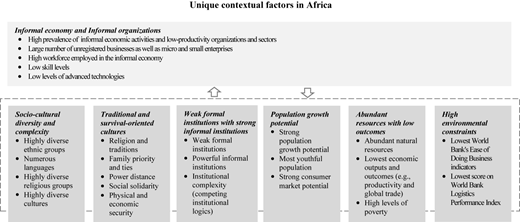
Our analysis of relevant literature suggests that, similar to other continents, informal economy and organizations are one of the important contexts for OSCM in Africa. As illustrated in Figure 1, we suggest that, as with formal economy and organizations, informal economy and organizations in Africa are embedded in and interact with six broader contextual factors: (1) socio-cultural diversity and complexity, (2) traditional and survival-oriented cultures, (3) weak formal institutions with strong informal institutions, (4) population growth potential, (5) abundant resources with low outcomes, and (6) high environmental constraints. These factors, while not exhaustive, are salient in shaping the contexts of OSCM in Africa. We discuss them in the following subsections before examining their implications for OSCM research and practice in Section 3.
2.2.1 Informal economy and organizations
Similar to other parts of the world, Africa possesses a mix of formal and informal economies and a range of organizations of all sizes (micro, small, medium, and large). However, compared to other continents, the informal economy is most dominant in Africa (AfDB, 2024), largely consisting of organizations engaging in lawful economic activities but without formal registration or licenses (Cruz et al., 2025). As of 2020, an estimated 244 million businesses operated in Africa. About 95% of these businesses were categorized as own-account organizations, mostly informal businesses in which the owner is the sole employee (Cruz et al., 2025). Also, according to the International Labour Organization (ILO), the informal economy accounts for 85.8% of Africa's workforce, which is significantly higher than in the Arab States (68.6%), Asia and the Pacific (68.2%), the Americas (40.0%), and Europe and Central Asia (25.1%) (ILO, 2018). The high level of informal employment in Africa remained largely stable between 2004 and 2024 (ILO, 2024).
Unsurprisingly, Africa's level of industrialization is the lowest globally (AfDB, 2024). Over 40% of economic activity occurs in agriculture, a sector that is around 60% less productive than the economy-wide average due to its largely subsistence nature (AfDB, 2024). Instead of shifting toward high-productivity industrial sectors, structural transformation in Africa has favored the growth of low-productivity, low-skilled, and low-technology sectors such as retail, craft, and personal services (AfDB, 2024).
Informal organizations provide essential products and services and often serve less privileged customer markets (e.g., low-income and rural customers). The activities of these organizations are also integral to the operations and SCs of formal medium-sized and large organizations across the continent. OSCM in Africa, therefore, is driven by and resembles the broader characteristics of an informal economy (Brennan et al., 2022). Recognizing these factors is crucial when designing and conducting OSCM research (Kull et al., 2018) in Africa, particularly because informal organizations often employ unconventional management practices and tools (Razak et al., 2024; Weiss et al., 2024). In essence, research on the operations and SCs of informal organizations in Africa is crucial since these organizations are widespread and make important socio-economic contributions. More importantly, the existing OSCM theories and concepts have largely been developed without accounting for the unique characteristics of informal organizations. This lacuna in OSCM research is vital to address, as these informal organizations are central to global SCs. The operations and SCs of informal organizations in Africa, as well as their interactions with those in the formal economy, provide valuable contexts for uncovering novel insights and/or refining existing OSCM concepts and theories.
2.2.2 Socio-cultural diversity and complexity
In terms of organizations' general environments, Africa's uniqueness partly lies in its social diversity and complexity, reflected in the numerous, heterogeneous, and interacting socio-cultural factors both within and across its countries (Nachum et al., 2023). The continent consists of 54 countries and ten non-sovereign states. The world's ten most culturally diverse nations, in terms of people, languages, and cultures, are all located in Africa, namely: Cameroon, Central African Republic, Republic of Chad, DR Congo, Kenya, Liberia, Madagascar, Nigeria, Republic of the Congo, and Uganda (World Population Review, 2024). Also, the continent is home to several thousand tribes and ethnic groups (Middleton et al., 2025), collectively speaking nearly a third of the world's over 7,000 languages (Eberhard et al., 2024). For instance, Nigeria alone has about 250 ethnic groups (Ayayi and Udo, 2025) and 520 indigenous languages (Eberhard et al., 2024). Similarly, Cameroon is home to about 250 types of indigenous populations and more than 200 types of indigenous languages (World Population Review, 2024). The continent is also characterized by highly multifaceted indigenous religions, each with distinct belief systems and teachings (Aina, 2018; Encyclopaedia Britannica, 2024).
Extant studies suggest that these socio-cultural factors and their associated demands do not occur in isolation; instead, they are intricately intertwined, making it challenging for organizations, particularly international ones, to navigate (Nachum et al., 2023). Diverse and complex socio-cultural populations may require organizations to serve consumers with highly varied needs and to engage with suppliers and institutional actors with different values and requirements. This demands culturally sensitive strategies and skills to manage potential conflicts and foster successful SC collaboration and coordination in Africa (Roehrich et al., 2025; Zhang and Lu, 2025).
2.2.3 Traditional and survival-oriented cultures
Africa has many national cultural values and country- or community-specific taboos, but its traditional and survival-oriented values stand out; they distinguish the continent from the cultural values of Europe, West and South Asia, as well as Latin and North America (Inglehart-Welzel World Cultural Map, 2023). World Values Surveys (2005–2022) analyzed in the Inglehart-Welzel World Cultural Map (2023) reveal that many African countries emphasize traditional over secular values and prioritize survival over self-expression values. These traditional values manifest in the continent's strong focus on religion, parent-child relationships, authority, and family ties, alongside a concern for physical and economic security, rather than modern or global values (Inglehart-Welzel World Cultural Map, 2023).
Given that cultural values shape organizational and inter-organizational values, objectives, and behaviors (e.g., Roehrich et al., 2025; Sarafan et al., 2020), organizations are expected to design, manage, and govern their operations and SCs with consideration for Africa's traditional and survival-oriented cultures in order to succeed. For example, Weiss et al. (2024) find that co-located urban repair organizations in Kenya adopt unique survival-oriented organizing mechanisms to thrive collectively. These mechanisms include fostering solidarity in business relationships, generating collective philanthropy to prevent personal hardship, and redistributing resources to avoid business failures. Also, in West African countries (e.g., Benin, Ghana, Nigeria, Senegal, and Togo), women traders elect “queens” to represent and advance their economic and collective interests (Achebe, 2020; Clark, 2010). These leaders are central figures who interact not only with their members but also with external stakeholders, including policymakers and regulators. They undertake a wide range of managerial roles, including coordination, governance, price setting, negotiation, conflict resolution, resource acquisition and allocation, market access facilitation, and risk management (Scheiterle and Birner, 2023). Extant literature suggests that these managerial roles of market queens are deeply entrenched in Africa's religious and cultural norms (Clark, 2010; Scheiterle and Birner, 2023).
2.2.4 Weak formal institutions with strong informal institutions
The nature and functioning of institutions in Africa exhibit some distinct characteristics. Institutions refer to the underlying assumptions, beliefs, and values that shape how organizations interpret reality, behave, and pursue their objectives (Freitas et al., 2025). They include formal institutions (e.g., laws, regulations, and associated actors like politicians and government agencies) and informal institutions (e.g., customs, norms, religion, and actors like chieftains, clan or family heads, and religious leaders) (Andoh-Baidoo et al., 2024; Freitas et al., 2025; Razak et al., 2024). Africa ranks lowest globally in the quality of formal institutions, including the rule of law, political stability, government effectiveness, and voice and accountability (Nachum et al., 2023). However, the continent, particularly in sub-Saharan Africa, has strong and influential informal institutional actors who derive normative and cultural-cognitive legitimacy from traditions, customs, and religion (Boso et al., 2023).
Traditional and religious leaders in Africa not only shape political and governmental processes but also influence consumer and organizational behavior (Boso et al., 2023). Although informal institutions may sometimes hinder the effectiveness of formal ones, they can also help address operations and SC challenges arising from weak formal institutions. For instance, traditional leaders influence consumer behavior through endorsements, facilitate access to critical resources such as finance and information, and help regulate product flows by curbing illicit trade (Boso et al., 2023). Additionally, research shows that chiefs, community elders, clan heads, and family leaders serve as third-party governance agents in agricultural SCs, helping to improve transparency (e.g., Razak et al., 2024). Furthermore, while regulations and policies may be weak, and industries and consumer markets may lack readiness regarding environmental sustainability values, informal institutional actors are noted to play crucial roles in determining the extent to which organizations pursue such values effectively within their operations and SCs (Andoh-Baidoo et al., 2024).
The interplay between Africa's weak formal institutions and strong informal institutions creates a distinctive and rich context for OSCM practice and theory (Andoh-Baidoo et al., 2024). To operate successfully in Africa, organizations must ensure that their operations and SC decisions (e.g., sourcing, product development, production, and distribution) take into account the requirements and influences of both formal and informal institutions, and develop cost-effective mechanisms to manage the conflicts and complexities that may emerge from the interaction between these institutions.
2.2.5 Population growth potential
Africa's population currently exceeds 1.5 billion people, accounting for approximately 18% of the global population and is ranked as the second most populous continent after Asia (Worldometer, 2024). With a fertility rate nearly double the global average, Africa has the strongest potential for population growth worldwide (Worldometer, 2024). This demographic profile positions Africa as a continent likely to experience sustained consumer demand across many sectors. This high consumer demand potential creates product development and market expansion opportunities for both international and local organizations. However, the effectiveness of organizations in pursuing these opportunities will depend on the extent to which their operations and SC strategies address low-income challenges in Africa (World Bank Group, 2024).
What makes Africa's population particularly notable is its youthfulness. The continent has the world's youngest population, with a median age of 19 years, compared to median ages ranging from 31 (Latin America and the Caribbean) to 43 (Europe) in other regions of the world (Worldometer, 2024). A strong population growth potential can expand Africa's workforce size in the coming decades. While other continents grapple with aging populations and labor shortages, Africa's youthful workforce represents a significant asset for industries (ILO, 2024). However, the continent currently experiences some of the highest rates of youth unemployment, and has a large proportion of workers employed in underpaid, precarious, and stressful conditions (ILO, 2024). Moreover, despite improvements in formal education (Adomako et al., 2024), the overall quality of human capital across Africa remains relatively low (Kamoche and Wood, 2023), particularly within OSCM job roles (UNCTAD, 2023a).
The workforce conditions in Africa have implications for OSCM. Given their high numbers, low skills, and limited job opportunities, Africa's youthful workforce faces the risk of exploitation in SCs due to their constrained options (ILO, 2024). This risk is further emphasized as many African countries have weak regulations (Nachum et al., 2023). This issue implies the need for a responsible OSCM to empower workers through training and development, reward and promote workers through fair and transparent systems, and improve conditions of service and workplace safety. Meanwhile, the high rate of graduate youth unemployment in Africa may lead to human capital flight—a situation in which skilled workers leave the continent in search of better opportunities abroad. If this phenomenon persists, it could erode the human resource opportunities available for operations and SCs in Africa. Government policy interventions (e.g., industrialization and regulations) are crucial for addressing this problem, but individual organizations that pursue responsible OSCM can also help retain, preserve, and expand human resource opportunities in Africa.
2.2.6 Abundant resources with low outcomes
Increasingly, Africa is viewed as a land of prospects and opportunities for business organizations (Nachum et al., 2023). The continent possesses the richest concentration of natural resources, including the largest global reserves of precious metals (WorldAtlas, 2018), and 65% of the world's uncultivated arable land (AfDB, 2023). Collectively, its natural resources are valued at approximately $6.2 trillion (AfDB, 2023). As highlighted in Section 2.2.5, low-cost human resources are abundant across many African countries and are expected to expand further given the continent's high population growth potential. In addition, African countries tend to have rich social capital from a variety of sources (e.g., local communities and political leaders), which is crucial for managing operations and SCs successfully (Boso et al., 2023; Razak et al., 2024).
The natural and human resource opportunities in African countries have important implications for global SC design and operations. The growing interest in Africa in the global OSCM community is largely driven by the interactions between these resource opportunities and emerging global disruptions (e.g., geopolitical tensions and trade wars). International firms are increasingly diversifying their sourcing, production, and sales activities into previously underexplored contexts such as Africa (UNCTAD, 2023b; United Nations, 2023). While these strategic responses contribute to resilient global operations and SCs, they can also create vulnerabilities for some local organizations in Africa. Local organizations, most of which are informal and small, often lack the requisite internal resources (e.g., financial, managerial, and technological) to compete with international organizations in factor markets to secure important input resources. Consequently, resource opportunities in Africa can simultaneously support and undermine resilient global operations and SCs: they can strengthen the resilience of international organizations, but may undermine the resilience of informal and small organizations that constitute the base of global operations and SCs. This situation underscores the need for local and international organizations to engage in mutually beneficial initiatives (e.g., collaboration) to thrive.
Prior studies suggest that many African countries experience a “resource curse”, a paradox in which countries rich in natural resources fail to achieve sustained economic prosperity (Weinthal and Luong, 2006). Many African countries struggle to convert their abundant natural resources into sustained economic growth and wealth due to poor governance, corruption, weak developmental policies, and ineffective resource management (AfDB, 2023). Therefore, it is unsurprising that many low-income or lower-middle-income countries are located in Africa (World Bank, 2024). Poverty, beyond income deprivation, is most prevalent in sub-Saharan Africa, where more than half of the population remains impoverished (World Bank Group, 2024). Additionally, Africa has the lowest labor productivity (Nachum et al., 2023) as well as the lowest GDP per capita (IMF, 2024). While effective government policy interventions are essential to address these contextual challenges, organizations seeking to tap into Africa's resource opportunities must understand and accommodate the realities of low labor productivity as well as low incomes. By implication, OSCM in Africa needs to balance the trade-offs between resource opportunities and the costs associated with low labor productivity and limited consumer purchasing power. Organizations should explore ways to enhance labor productivity (e.g., through human capital development and appropriate incentive systems) while designing and managing cost-effective and socially responsive operations and SCs that enable them to better serve broader low-income consumer markets.
2.2.7 High environmental constraints
Environmental constraints comprise factors within an organization's general environment that limit the achievement of operations or SC objectives (Oke and Nair, 2023). Many indicators suggest that organizations in Africa tend to encounter high environmental constraints. For example, Africa ranks the lowest on the World Bank's Ease of Doing Business indicators, such as the ease of starting a business, dealing with permits, registering property, getting electricity, obtaining credit, and enforcing contracts (Nachum et al., 2023). These indicators are particularly pronounced in sub-Saharan African countries (World Bank Group, 2020). Similarly, the 2023 World Bank Logistics Performance Index highlights that most low-performing countries across various indicators (e.g., customs, infrastructure, international shipments, logistics competence, tracking and tracing, and timeliness) are located in Africa (Arvis et al., 2023).
The simultaneous occurrence of these environmental constraints presents both challenges and opportunities for OSCM (Oke and Nair, 2023). For instance, limited and poor transport and communication infrastructure can hinder the effective applications of conventional OSCM practices (e.g., just-in-time operations) in Africa, suggesting that organizations may need to adopt innovative or contextually adapted practices to manage their operations and SCs effectively (Oke and Nair, 2023). High environmental constraints can induce chronic, small-scale SC disruptions (such as transportation and communication failures and energy shortages), increase operational costs, and limit operational/SC responsiveness. However, these same conditions may also encourage organizations to prioritize efficiency, resourcefulness, improvisation, and resilience-building within their operations and SCs (Kamoche and Wood, 2023; Oke and Nair, 2023). Organizations in Africa must therefore take into account and manage both the challenges and opportunities that the high environmental constraints in African countries present for their operations and SCs.
This section examined Africa's unique contextual factors and started to highlight how these factors may impact OSCM research and practice. It highlights the need to account for the continent's diverse economic, organizational, and institutional contexts. A defining feature is the dominance of the informal economy, where most businesses operate without formal registration but remain central to economic activity and OSCM practices. Africa's vast socio-cultural diversity and traditional, survival-oriented values shape consumer behavior and SC relationships, requiring culturally adaptive strategies. While formal institutions are often weak, strong informal institutions (e.g., traditional and religious leaders) play critical roles in governance and resource access. The continent's youthful, growing population may also present opportunities for consumer and labor market expansion and thus have a direct impact on SC structures and designs. However, challenges remain around purchasing power and human capital. Despite rich natural resources, poor governance may hamper value creation, and unfavorable business conditions constrain efficiency. These constraints, however, may foster resilience, improvisation, and innovative OSCM practices adapted to Africa's distinctive environment. The following section will unpack some fruitful, actionable pathways for OSCM researchers.
3. Actionable pathways for future research
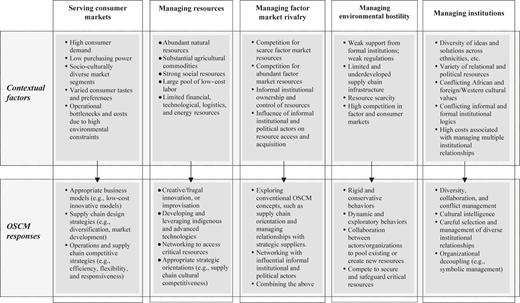
This section addresses our second question: What are actionable pathways for advancing OSCM research and practice in Africa? We answer this question by delving into the OSCM implications of the contextual factors presented in Section 2 and how they can inform OSCM research. Our perspective is that although each of the seven contextual factors can independently influence OSCM, they do not exist in isolation. In many cases, organizations confront multiple, interacting contextual factors, and their OSCM decisions and actions must be considered accordingly (Sousa and Voss, 2008). Our analysis, therefore, focuses on key OSCM themes, encompassing what to manage and how it may be done, and emerging from the interactions among relevant contextual factors. Reflecting on Section 2, we propose and discuss five OSCM themes for research: (1) serving consumer markets, (2) managing resources, (3) managing factor market rivalry, (4) managing environmental hostility, and (5) managing institutions. Figure 2 summarizes key contextual factors underlying each theme and their associated practical implications.
The proposed themes for OSCM research in Africa are not exhaustive but hold both practical and theoretical relevance. A primary objective of OSCM is to create and deliver products and services that maximize value for customers (Min et al., 2019). Thus, the first theme is concerned with how organizations serve African consumer markets. It covers both internal and customer-facing OSCM. The second and third themes recognize the centrality of resources to OSCM (Ralston et al., 2023) and focus on how Africa's distinctive resource contexts are managed. The third theme particularly covers supply-facing OSCM, which, together with theme one, allows us to offer a more complete discussion of the OSCM research pathways in Africa. The fourth and fifth themes address two broader and unique external environment conditions within which OSCM takes place in Africa. Our discussion of each theme prioritizes under-researched OSCM topics in Africa.
3.1 Serving consumer markets
Studies focusing on this theme are expected to explore and develop a contextual understanding of how organizations in Africa strategize and manage their operations and SCs to create and deliver value for specific consumer markets. Among other things, such studies can advance existing theoretical perspectives (e.g., contingency theory) on how contextual factors shape OSCM in the domains of product development, SC design, and operations/SC strategies and capabilities (Sousa and Voss, 2008). The extant literature has predominantly developed around task-environment contexts such as competition intensity, uncertainty, dynamism, and complexity (e.g., McKone-Sweet and Lee, 2009; Pagell and Krause, 2004; Rehman and Jajja, 2023). Beyond these factors, Africa presents underexplored contextual factors whose interactions offer many promising avenues for extending the extant literature. They include high population growth (driving consumer demand), low incomes (reducing purchasing power), socio-culturally diverse market segments (shaping varied consumer tastes and preferences), and high environmental constraints (creating operational bottlenecks and increasing costs of operations).
Africa's growing population implies expanding consumer demand for goods and services (Section 2.2.5), creating incentives for existing organizations to scale and diversify their operations, and for new local and international organizations to emerge (Adomako et al., 2024). The attractiveness of African consumer markets, however, largely depends on the speed and effectiveness of policy interventions in addressing not only poverty and low consumer purchasing power challenges (Section 2.2.6) but also broader external factors that hinder operations and SC efficiency. Specifically, limited logistics infrastructure (e.g., inadequate transportation and communication systems) (Section 2.2.7) and weak formal institutional support (Section 2.2.4) undermine organizations' capacity to manage efficient operations and SCs (Chakravarty, 2022). These factors often restrict organizations' ability to offer affordable products and services and can reduce their profitability. Additionally, unfavorable macroeconomic conditions (e.g., high inflation, volatile interest rates, and weak currencies (UNCTAD, 2025) intensify pressure on organizations to enhance operational efficiency and maintain competitive pricing. Future research should thus deepen understanding of how these contextual factors shape strategic and operational OSCM responses to consumer market requirements in Africa.
The extant literature highlights the significance of low-cost, innovative operations and SC practices in Africa. Chakravarty (2022), for instance, reveals how South Africa's medical device manufacturing sector leverages frugal innovations to succeed. The sector utilizes internal innovation capacities (such as R&D capabilities), manufacturing technologies, local product-testing facilities, and external partnerships to reduce costs while offering differentiated or cross-subsidized products suitable for an economically unequal population. Indigenous financial technologies (e.g., M-Pesa and MoMo) have also facilitated low-cost commodity transactions, enhancing product accessibility among rural and low-income groups (Oke and Nair, 2023). However, demand for these technologies remains limited in poor communities (Balasubramanian et al., 2023). Future research could further explore how organizations successfully develop and deliver low-cost, innovative products and/or services to underserved consumer segments, particularly focusing on low-income and rural populations.
In addition to pricing and efficiency challenges, Africa's extensive socio-cultural diversity (e.g., ethnicities and religions) within and across countries gives rise to highly varied consumer market segments, characterized by diverse tastes, preferences, and requirements (Section 2.2.2). This diversity can affect operations and SC strategies in industries such as retail, consumer goods manufacturing, and healthcare. For instance, manufacturers and retailers in sectors such as food, cosmetics, and apparel may need to tailor products to cultural and religious preferences, as well as adapt their business models to serve both urban and rural customers (Eloranta et al., 2021). Particularly in rural or low-income populations, cash-based transactions and physical retail channels are often preferred over digital payment platforms such as mobile money and digital banking services.
From an economic standpoint, however, flexibility and product customization strategies may appear less feasible for organizations targeting broader, underserved populations (e.g., rural communities or low-income and less-educated groups). Customization typically involves increased costs and comes with high prices, but low-income populations prioritize affordability over specialized or premium offerings (Kaplinsky and Kraemer-Mbula, 2022). While organizations could adopt focused strategies for specific market segments, they risk exacerbating inequalities by excluding vulnerable populations in need of essential products and/or services. Accordingly, we advocate for more research into how interactions among consumer characteristics in African markets influence organizations' operations and SC priorities and designs, as well as how organizations resolve trade-offs between pursuing economic goals (e.g., efficiency and profitability) and achieving social outcomes (e.g., consumer and community welfare).
3.2 Managing resources
The effectiveness of operations and SCs depends on diverse resources (e.g., input, facilitating, transformation, and output resources) and their management. The “managing resources” theme provides researchers with an opportunity to incorporate unique contextual factors to advance existing theorization of the roles of resources and resource management in operations and SCs. Existing resource-related theories are based on contextual considerations that may not fully accommodate the peculiar circumstances of organizations operating in Africa. For instance, the resource-based view is premised on contexts of organization-specific resource heterogeneity and idiosyncrasies (D'Oria et al., 2021); dynamic capabilities theory is situated in contexts of fast-changing environments (D'Oria et al., 2021); resource dependence theory is grounded in contexts of organizational reliance on external resources (Craighead et al., 2020); and resource orchestration theory is premised on contexts where organization-specific resources are interdependent, are used in the same or similar environments (e.g., competitive markets), and are subject to changes in the external environment (Sirmon et al., 2007). Organizations in Africa face these resource contexts, but are also confronted with other contexts. One such context, which we focus on, is the tension between the availability and scarcity of organization-specific and external resources. This resource tension context presents an avenue for scholars to extend resource-based theorization in OSCM.
Organizations across many African countries encounter significant disparities in resource availability, i.e., possessing abundant access to certain resources while lacking others (Sections 2.2.6 and 2.2.7). For example, many African-based organizations have plentiful access to natural resources (e.g., arable land, water, minerals) (WorldAtlas, 2018; AfDB, 2023), agricultural commodities (AGOA, 2024), abundant low-cost labor (ILO, 2024), and rich social capital from community and family networks (Kamoche and Wood, 2023; Razak et al., 2024). Conversely, these organizations often struggle to access formal institutional resources (e.g., information, finance, technical assistance from governmental and non-governmental agencies) and face limited availability of technology providers, logistics intermediaries, and reliable energy supplies (Adomako et al., 2024; AfDB, 2022). This situation often creates operational tensions that African organizations must manage effectively. For instance, organizations aiming to capitalize on abundant resources often incur additional costs to overcome the scarcity of other critical resources. Superior performance outcomes (e.g., competitive advantage and profitability) may thus lie in organizations' ability to cost-effectively resolve or manage the resource tensions their operations and SCs face.
International and local organizations possess distinct strengths and weaknesses in managing Africa's resource abundance-scarcity tensions. Large international organizations typically hold organization-specific advantages (e.g., advanced technologies, financial resources, and managerial expertise) that can resolve such tensions. However, they often experience a “liability of foreignness”, characterized by unfamiliarity with local institutional contexts, presenting additional challenges (Newenham-Kahindi and Stevens, 2018). By contrast, while local organizations in Africa may benefit from home-country advantages (e.g., familiarity with and knowledge of local contexts), they may lack the advanced technical and managerial capabilities needed to address resource-related tensions. Informal and small local organizations particularly face significant barriers in obtaining external financing, attracting competent managerial and operational personnel, and acquiring advanced operations and SC technologies (Kaplinsky and Kraemer-Mbula, 2022). Future research could thus develop insights into how international and local organizations successfully manage operations and SC-specific resource-related tensions.
Extant literature indicates that organizations dealing with scarce resources often adopt creative and frugal behaviors in operations and SCs (e.g., Kaplinsky and Kraemer-Mbula, 2022). However, they may struggle to replicate these behaviors when resources become abundant (Pati et al., 2018). Resource abundance sometimes triggers inefficient management behaviors (e.g., underutilization of resources) and stifles creativity (Pati et al., 2018). Therefore, OSCM research could further explore why organizations respond differently to resource scarcity and abundance in African contexts, as well as investigate the conditions under which some organizations struggle to effectively transform abundant resources into improved operational and SC outcomes.
SC cultural competitiveness, for example, is an important factor that may explain differences in how firms respond to resource conditions in Africa. SC cultural competitiveness is a boundary-spanning strategic orientation, reflected in the shared beliefs and values concerning how an organization and its SC members create and capture market value through learning, innovation, proactiveness, and risk-taking (Hult et al., 2007). This orientation can offer both strategic vision and motivation for SC actors to effectively mobilize, coordinate, and deploy resources in ways that improve the competitiveness of their operations and SCs (Schweiger et al., 2019). Where SC cultural competitiveness is lacking, organizations and their SC members may exhibit limited urgency to innovate, act proactively, and/or take risks in seeking new resources and deploying existing ones to be competitive.
Visibility paradox is another factor that can explain variation in how organizations, especially informal and small ones, respond to resource conditions in Africa (Nason et al., 2024). On the one hand, making an organization visible through growth-oriented operations and SC strategies can expand access to critical resources in factor and customer markets. On the other hand, such visibility is costly to the extent that it attracts resource-extracting demands, such as tax obligations, community donation expectations, and family-dependency burdens (Nason et al., 2024). Therefore, organizational effectiveness in searching for and acquiring scarce resources, or mobilizing and deploying abundant ones, to expand their operations becomes a matter of strategic choice, shaped by perceived visibility cost.
3.3 Managing factor market rivalry
The resource contexts in Africa (Sections 2.2.6 and 2.2.7), together with the continent's peculiar formal and informal institutional contexts (Section 2.2.4), also present unique factor market rivalry circumstances for advancing existing applications of factor market rivalry theory in OSCM (e.g., Ralston et al., 2023; Ellram et al., 2013). Factor markets are markets where organizations acquire resources (such as raw materials, intermediate goods, and services) required to achieve their strategic and operational goals (Ralston et al., 2023). Factor market rivalry refers to the degree to which organizations compete for these resources (Pulles et al., 2016). Typically, this rivalry intensifies when valuable or essential resources are scarce (Ralston et al., 2023). However, in Africa, such rivalry is notably prevalent even in resource-rich environments, such as natural resources and agricultural commodity markets (United Nations, 2023; UNCTAD, 2023b). In these markets, international organizations not only compete against each other but also with local organizations seeking the same resources (The African Climate Foundation, 2024). Yet, the dynamics of this competition, and the operations and SC strategies employed to manage it, are underexplored and offer opportunities for future research.
Extant OSCM literature emphasizes the importance of conventional concepts such as SC orientation and planning (e.g., Ralston et al., 2023) and supplier selection and relationship management (e.g., Pulles et al., 2016) for competing in factor markets. However, it remains unclear how these concepts manifest in African factor markets, what forms they take, and whether they are cost-effective in environments where formal institutions—such as regulations governing inter-organizational behaviors and transactions—tend to be weak, as is the case in many African countries (Nachum et al., 2023).
Resource ownership structures and institutional arrangements governing access to factor market resources in Africa may also be distinctive, raising questions about the adequacy and effectiveness of conventional operations and SC concepts for competing in these markets. For example, in minerals and mining sectors (e.g., the Democratic Republic of Congo, Ghana, Sierra Leone), local chiefs, clan leaders, and politicians wield considerable influence over resource access and control (Hofmann et al., 2018; Schleper et al., 2022). Organizations in these contexts must often cultivate informal relationships with influential actors to secure licenses (to operate) or access to mining sites (Asori et al., 2023; Maconachie and Conteh, 2021). However, these informal arrangements frequently conflict with formal institutions (regulatory agencies), undermining regulatory effectiveness and creating unfair competitive advantages (Wakenge et al., 2021).
Additionally, competing for factor market resources through informal institutions can be costly, especially if organizations must spend time and money to develop ties with multiple informal institutional actors (Boso et al., 2023). The costs and complexities of acquiring factor market resources through combinations of informal and formal institutions can limit an organization's ability to drive cost-effective operations and SCs. Along these lines, we encourage more research to explore the operations and SC implications of organizational responses to factor market rivalry in Africa. For example, one can expect that organizations will vary in the extent to which they combine conventional operations and SC strategies (e.g., SC orientations and collaboration) with formal and informal institutional ties as strategies for competing in factor markets. Research can analyze which combinations of these strategic responses are more or less effective in mitigating raw material shortages, reducing overall operational and SC costs, or enhancing operational and SC effectiveness and competitiveness.
3.4 Managing environmental hostility
Environmental constraints, resource competition, and weak formal regulatory conditions in Africa (see Sections 2.2.4, 2.2.6, 2.2.7, and 3.3) culminate in higher-order organizational contexts, such as environmental hostility, with important implications for OSCM. Environmental hostility refers to the extent to which organizational survival and growth are threatened by resource scarcity, competitive intensity, and restrictive environmental conditions (Kreiser et al., 2020). Environmental hostility in Africa manifests through growing competition in consumer and factor markets, low consumer purchasing power, underdeveloped human capital, limited financial markets, inadequate logistics infrastructure, and insufficient governmental support (see Sections 3.1–3.3). Particularly intriguing for OSCM research is the simultaneous occurrence of these diverse sources of hostility. Such contexts present fruitful avenues for advancing theories on the contradictory organizational behaviors that SC members exhibit when facing hostile environments.
Prior studies suggest many contradictory organizational behaviors that often emerge in hostile environments (Kreiser et al., 2020; Markman et al., 2016). Some organizations respond to hostile environments with rigid, conservative behaviors (e.g., emphasizing efficiency and exploiting existing capabilities), while others adopt dynamic, exploratory approaches (e.g., emphasizing innovation and new capability development) (Kreiser et al., 2020). Still, others exhibit either collaborative or competitive behaviors (Markman et al., 2016). Collaboration can enable organizations in hostile environments to pool and share resources (Weiss et al., 2024) and jointly innovate (Roehrich et al., 2025), whereas competitive behaviors can help organizations in such environments to secure and protect vital resources (Ralston et al., 2023). Future research exploring the contextual factors driving these contradictory behaviors in SCs in Africa (possibly from multiple theoretical perspectives) is encouraged.
For example, Ubuntu is one African concept that can be used to explain why collaborative behaviors emerge in SCs operating in hostile environments. Mangaliso (2001, p. 24) defines Ubuntu as “humaneness – a pervasive spirit of caring and community, harmony, respect and responsiveness – that individuals and groups display for one another”, arguing that it provides a basis for evaluating “good versus bad, right versus wrong, just versus unjust.” While some scholars have compared Ubuntu to other collectivist and relational concepts (e.g., guanxi, yongo, jeitinho, and blat) in the OSCM literature (Razak et al., 2024), Ubuntu appears distinct as it places greater emphasis on communal values and ethical principles (Kamoche and Wood, 2023). As such, it offers a broader framework for understanding not only collaborative actions and governance, but also moral and prosocial behaviors within SCs. For example, organizations guided by Ubuntu principles may share relevant resources with their SC members or support marginalized SC actors. In doing so, these organizations may not only pursue reciprocal benefits or relational rents but also act on ethical principles that emphasize doing good for others. We, therefore, encourage scholars to explore how Ubuntu and other African concepts offer a fresh perspective for understanding how organizations in Africa respond to environmental hostility. Moreover, comparing Ubuntu to related practices witnessed in other contexts (e.g., Toyota has practiced collaborative actions and information sharing for many years with their suppliers) will refine OSCM knowledge and insights.
Although collaboration may emerge in hostile environments in Africa, other studies highlight the prevalence of opportunism and exploitation in similar contexts. For example, adversarial behaviors have been observed in the relationships between purchasing clerks or licensed buying companies and cocoa farmers in Ghana (e.g., Amankwah-Amoah et al., 2018), as well as between food commodity intermediaries and farmers in Ethiopia (e.g., Abebe et al., 2016). These adversarial behaviors may be explained by conventional management theories emphasizing self-interest among SC actors (Weiss et al., 2024). Future research could offer valuable contributions by explaining the conditions under which SC actors shift between collaborative and competitive behaviors, or by providing an integrative perspective on the contradictory organizational behaviors that arise in hostile environments within and across different African countries.
3.5 Managing institutions
This theme encourages studies to focus on the intersections between Africa's unique institutional contexts, including socio-cultural diversity and complexity, traditional and survival-oriented cultures, and weak formal institutions with strong informal institutions, to advance the literature on the role of institutions in OSCM (Freitas et al., 2025). Prior studies from Africa have examined OSCM implications of key institutional concepts, such as institutional voids (e.g., El Baz and Laguir, 2017; Akenroye et al., 2023; Brix-Asala and Seuring, 2020), institutional logics (e.g., Chawana et al., 2024), and informal institutions (e.g., chiefs, community elders, clan heads) (e.g., Razak et al., 2024; Andoh-Baidoo et al., 2024). We contend that novel theoretical contributions can emerge from studies that explore the OSCM opportunities and challenges presented by the intersections between institutional contexts in Africa. Two institutional concepts that illustrate this situation, but are underexplored from an OSCM perspective, are discussed here: (1) institutional diversity, and (2) institutional complexity.
Institutional diversity in Africa is reflected in the multifaceted forces that interact within and between formal and informal institutions (Boso et al., 2023; Nachum et al., 2023). Such diversity can create both challenges and opportunities for managing operations and SCs. For example, engaging SC members from diverse ethnic and cultural backgrounds can expose organizations to novel ideas and solutions. However, such diversity may also hinder SC collaboration and coordination, as it can lead to anxiety, discomfort, and/or stereotyping in SC relationships (Jiang et al., 2011). Extant literature suggests that ethnic diversity in Africa can lead to relational conflicts, as well as project delays and failures (Zhang and Lu, 2025). Also, research suggests that dealing with diverse formal and informal institutional actors may help organizations to access distinct and complementary resources (e.g., relational, political, and informational resources) but can also be costly (e.g., it involves money and managerial time spent on building and maintaining relationships) (Boso et al., 2023). Therefore, managers must understand how to allocate attention effectively and configure relationships with diverse institutional actors to optimize operations and SC outcomes. Among other questions, future research could explore how, and under what conditions, different SC members address the potentially opposing effects of institutional diversity on their operational and SC performance outcomes.
Institutional complexity arises when organizations encounter often conflicting institutional logics, defined as the underlying principles that guide organizations in interpreting and acting within social contexts (Greenwood et al., 2011). In Africa, institutional complexity manifests in various ways. For instance, many African countries emphasize traditional and survival values over secular and self-expression values (Inglehart-Welzel World Cultural Map, 2023), which often conflict with the values of Western countries that dominate global SCs. These traditional and survival values, alongside widespread economic hardship, can lead local organizations in Africa to prioritize economic outcomes over Western-based logics embedded in operations and SC models and practices, which often stress environmental protection, equality, and inclusion. The effects of this institutional complexity can be particularly pronounced in SCs involving international and local organizations, as it may generate conflict over which objectives to pursue and how to achieve them. Cultural intelligence and conflict management skills are among the critical competencies required to deal with the adverse impacts of institutional complexity on SC relationships (Roehrich et al., 2025). Future research may examine the forms and effects of institutional complexity that organizations in Africa encounter in their SCs, and how they prioritize and address such challenges.
This section addressed the second research question by examining how Africa's unique contextual factors can inform and shape various OSCM themes and by positioning actionable research pathways. Table 1 provides illustrative research questions to serve as starting points rather than an exhaustive list.
4. IJOPM's Africa Initiative (AfIn)
We now turn our attention to how IJOPM's AfIn supports scholars in Africa and beyond in pursuing African-specific OSCM research opportunities and disseminating insights.
4.1 Motivation and objectives
Together with the former editorial team, the current Co-Editors-in-Chief (Co-EiCs) of IJOPM envisioned the AfIn to address concerns regarding the scarcity of OSCM knowledge originating from and about Africa. AfIn seeks to connect Africa-based OSCM scholars with colleagues from around the world to create meaningful engagement opportunities with IJOPM and the wider OSCM community. Specifically, the AfIn seeks to: (1) lead developmental initiatives for OSCM researchers based in or studying Africa; (2) provide a platform for scholarly connections, research dissemination, and empirical OSCM research on and about Africa; and (3) support the development and recognition of OSCM scholars in and from Africa. In what follows, we outline the provisions the journal has made to advance these objectives.
4.2 Supporting and upskilling OSCM scholars in Africa
Advancing OSCM research in Africa requires addressing specific challenges researchers face in conducting studies and publishing their findings. Many OSCM scholars based in Africa work in teaching-focused institutions, and OSCM remains underdeveloped across many African universities (with limited dedicated OSCM departments or research centers). Additionally, many institutions lack a culture that values, rewards, and provides sufficient resources for conducting impactful research and writing research manuscripts. While addressing these systemic issues requires long-term multi-stakeholder engagement, the AfIn plays a crucial role in seeking to further empower and support local OSCM scholars by enhancing their skills, experiences, and professional networks.
IJOPM's AfIn seeks to foster research and publication capabilities within Africa, facilitating local scholars' integration into the global OSCM community. We identify three groups of researchers contributing to OSCM research in Africa: (1) researchers based on the continent, (2) Africans living and working abroad, and (3) non-Africans conducting Africa-focused research. Collaborations within and among these groups are emergent, and we – the AfIn team – together with OSCM scholars seek to further support these collaborations. For instance, when receiving compelling research proposals and ideas, the AfIn will leverage academic networks to connect local and international researchers with shared interests. Additionally, the AfIn's manuscript development and review process emphasizes developmental guidance, improving both authors' and reviewers' research and editorial skills. Lastly, the AfIn will collaborate with local and international institutions to offer developmental workshops and community-building opportunities, thus advancing OSCM research on and from Africa.
4.3 The AfIn development and review process
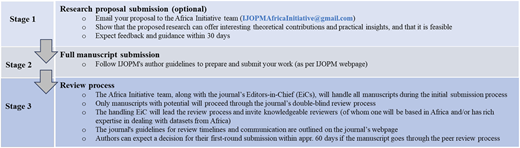
The AfIn operates as a dedicated, continuous manuscript section within IJOPM, one of the world-leading journals for empirical research in OSCM. It invites studies utilizing African datasets, or those combining African and international datasets, to provide comparative insights. All proposed research questions, and/or hypotheses, must align clearly with IJOPM's aims and scope (see the journal's website for further details). Authors can either submit a research proposal for preliminary feedback, or directly submit a fully developed manuscript via ManuscriptCentral (explicitly indicating in the cover letter that their submission is part of the AfIn). Figure 3 summarizes the AfIn manuscript development and submission process. In stage three, full manuscripts undergo the journal's rigorous and developmental review process.
4.3.1 Research proposal submission stage
In this optional stage, researchers submit their proposed studies to the AfIn team using a pre-designed proposal template, which can be accessed here or requested via email (ijopmafricainitiative@gmail.com). The AfIn team aims to provide detailed developmental feedback within 30 days of initial submission.
4.3.2 Full manuscript submission and review process stages
Authors should submit completed manuscripts via the journal's manuscript submission system (ManuscriptCentral), strictly adhering to IJOPM's manuscript preparation guidelines (available on the journal's website). Manuscripts that did not undergo the optional “proposal submission stage” are also welcome. All submitted manuscripts proceed through IJOPM's rigorous, double-blind, and developmental peer-review process. The AfIn team, in collaboration with the journal's Co-EiCs, handles manuscripts during the initial submission stage. Only manuscripts demonstrating high publication potential advance to peer review. A handling Co-EiC oversees the review process, selecting qualified reviewers, at least one of whom is based in Africa and/or possesses deep expertise with African research and datasets. Review timelines and communication protocols are detailed on IJOPM's website.
4.4 Practical suggestions for authors
This section provides practical suggestions for authors seeking to publish their research through the AfIn section. While not exhaustive, we discuss two key aspects: (1) generating and evaluating research questions, and (2) designing and executing appropriate research approaches.
4.4.1 Generating and evaluating research questions
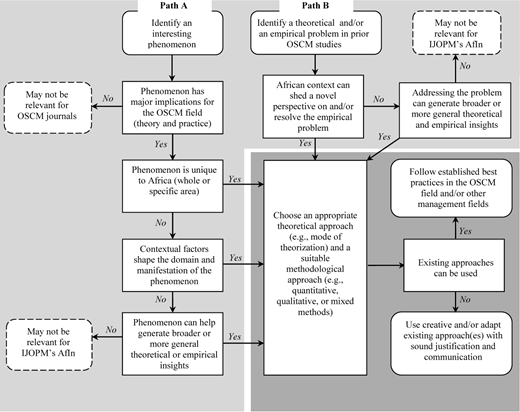
Section 3 presents several promising and actionable research pathways with illustrative research questions (Table 1). Authors may draw from these guiding questions and leverage insights from sections 2 and 3 to generate impactful and appropriate research questions. Authors may use one of the following two paths to generate and evaluate research questions that align with AfIn's interests as well as the aims and scope of IJOPM (Figure 4).
Path A involves identifying an interesting phenomenon with significant implications for OSCM theory and practice. If the phenomenon has significant implications for OSCM theory and practice (e.g., it challenges established understanding or practices), researchers should consider whether it is unique to Africa or specific to a particular geography, sector, or industry within the continent. The specific contextual factors that shape or explain the phenomenon need to be articulated and be part of the research framework. If no such uniqueness exists, authors should consider whether their theoretical and/or empirical approach to studying the phenomenon will change or improve existing understanding beyond the boundaries of their empirical setting.
Path B requires authors to identify a theoretical and/or empirical problem (or puzzle) in extant OSCM literature and examine whether incorporating context-specific variables from an African country (or countries) can provide novel perspectives and/or insights to the problem (or puzzle). Similar to Path A, if the context does not define and shape the problem, authors should consider whether their theoretical and/or empirical approach will provide contributions that extend beyond the boundaries of their empirical setting. Examples of theoretical problems that may interest researchers include: contradictions within a given theory or between theory and reality; conflicting or inconclusive theoretical perspectives; weak, poorly specified, or flawed assumptions underlying existing theories or concepts in the OSCM field; and the incompleteness of existing theories or concepts (e.g., Alvesson and Sandberg, 2011; Grant and Pollock, 2011). Empirical problems in extant literature that authors may want to address include inconsistent results, a lack of generalizability of results, measurement problems (e.g., discrepancies in existing measurement approaches) that call reported results into question, problems with causal inference (e.g., incorrect temporal ordering in the data or missing intervening variables), and other methodological and/or data problems that may call previous findings into question. As this list is non-exclusive, researchers can also formulate other research problem types or examples not mentioned here.
4.4.2 Designing and executing an approach to address research questions
Authors should ensure alignment between their research question(s) and/or hypotheses and their theoretical and methodological choices, demonstrating rigor, clarity, and transparency. Figure 4 illustrates the importance of aligning research question(s)/hypotheses with methodologies. For instance, research examining interactions within local communities, informal businesses, or SC networks may adopt qualitative methods (such as interviews, storytelling, ethnography, or field studies) to provide rich contextual insights (Brennan et al., 2022; George et al., 2022). Researchers following established methodologies should adhere closely to best practices (Sparrowe and Mayer, 2011; Aguinis et al., 2018). Alternatively, scholars may adopt innovative approaches specifically suited to their empirical contexts and research questions/hypotheses.
5. Conclusion
Africa faces complex operations and SC opportunities and challenges. Appreciating and fully accounting for unique African contexts can offer scholars opportunities to generate impactful insights to inform and advance academia, practice, and policy. Accordingly, in this paper, we examined where and how African contexts present promising opportunities to develop OSCM knowledge and practices both from and for Africa. Our discussion followed the contingency view that contexts are not only crucial for analyzing and understanding OSCM but also for designing research and generating contextual insights to elaborate existing theories or develop new ones (Sousa and Voss, 2008).
In terms of contribution, we advanced the limited understanding of African contexts from an OSCM perspective. Specifically, we shed light on seven unique contextual factors that shape OSCM in Africa: (1) informal economy and organizations, (2) socio-cultural diversity and complexity, (3) traditional and survival-oriented cultures, (4) weak formal institutions with strong informal institutions, (5) population growth potential, (6) abundant resources with low outcomes, and (7) high environmental constraints. We argued that the interactions among these factors are associated with five OSCM themes: (1) serving consumer markets, (2) managing resources, (3) managing factor market rivalry, (4) managing environmental hostility, and (5) managing institutions. Our discussion of these themes highlights many interesting but underexplored reserach avenues for future endeavors.
Insights from this paper underscored the need for managers, policymakers, and researchers to consider how a given contextual factor in Africa can both constrain and enable OSCM, how its influence may depend on other contextual factors, and how organizational responses to such factors may vary. We also highlighted that the complexities associated with managing operations and SCs in Africa often require a balancing act, frequently achieved through contextually situated and unconventional practices. These insights are important considerations for future research aiming to develop new OSCM theories and/or extend existing ones from an African perspective. Such studies must also recognize that interdependencies among contextual factors in African countries call for clearer articulation and greater specificity in theoretical analysis (e.g., in defining the nature and boundaries of predicted effects). Moreover, context-driven studies in Africa should balance the pursuit of comprehensive insights (involving multiple interdependent contextual factors) with the risk of reduced theoretical or analytical parsimony.
The many underexplored African contexts provide rich future research avenues through which scholars can articulate Africa's unique contributions to OSCM knowledge. Thus, although pursuing theoretical and empirical generalizations can be valuable and is encouraged, scholars should not lose sight of designing and conducting studies that demonstrate how African contexts enable important theoretical contributions as well as insights for managers, policymakers, and society. Such studies should be grounded in distinctive African contexts and explicitly incorporate them in their theorizations and empirical analyses.
In conclusion, this paper's insights lay a foundation for scholars to address concerns about Africa's underrepresentation in extant OSCM literature. We recognize that scholars based in Africa may possess a deeper and more timely understanding of African contexts, but they may require further upskilling and support to conduct and publish rigorous studies. Accordingly, we have discussed how IJOPM's AfIn provides such support for OSCM scholars and for the broader OSCM community. We believe AfIn represents a crucial step toward amplifying diverse voices and advancing innovative, contextually informed OSCM knowledge. We now call upon the OSCM community to support IJOPM's AfIn in achieving these vital objectives.
We would like to express our profound gratitude to the anonymous reviewers for offering developmental feedback to improve this paper.