This impact pathway paper develops an Operations and Supply Chain Management (OSCM) research agenda for addressing the grand challenge arising from increasing global displacement with a focus on managing service and support systems for people seeking refuge in Europe.
The developed impact pathways are informed by multi-disciplinary extant literature, secondary data sources, expert interviews, sandpit events, a panel discussion, and the authors’ field experience.
In this politicised and sensitive context, OSCM activities could be interpreted as protecting political interests over the preservation of human rights. Three pathways are developed to better address support challenges for people seeking refuge.
The proposed OSCM research avenues will inform decision-makers with solutions to address this grand challenge.
Given the misalignment between protection for people seeking refuge and the protracted nature of displacement, the legal, social, political, and operational interfaces deserve more research attention particularly given the allocation of European public resources. Goals include better policies and fit-for-purpose structures that deliver lasting solutions.
This article tackles a widely-recognised, yet underexplored, grand challenge that cuts across disciplines. A multi-disciplinary transformative research agenda is proposed for positive impact for those seeking refuge.
1. Introduction
Protracted humanitarian crises are on the rise as worsening climate change, rising unrest and conflicts fuel mass displacement across the globe. The number of forcibly displaced people has been on an upward trend for more than a decade, reaching an all-time high of 123.2 million people in 2024 (UNHCR, 2025a). Of these, 42.7 million people seek refuge from their home countries (UNHCR, 2025a). At this scale, displacement is arguably a “grand challenge” of our time (Ferraro et al., 2015; Mollenkopf et al., 2024; Van Der Giessen et al., 2022). The year 2024 may have offered a glimmer of hope in the number of refugee and internally displaced persons returns being the highest reported in 2 decades, but UNHCR still expresses concerns about “the inherent protection risks” and “longer-term sustainability” of current solutions to displacement (UNHCR, 2025a, p. 10).
Operations and Supply Chain Management (OSCM) research related to the plight of people seeking refuge remains scant (c.f., Oloruntoba and Banomyong, 2018; Seifert et al., 2023) and has yet to address the long-term implications of displacement beyond regions destabilised by conflict and political crises. For the European context in particular, contrary to models of support adopted close to the home regions, most services are provided under a public mandate – rather than through humanitarian (inter- or non-governmental) organisations – and the encampment model is not widely adopted. Political, legal, and public discourse have highlighted the challenges and controversies of designing and managing public service systems for people seeking refuge in this context (e.g. Boswell, 2000; Chetail, 2016; Fullerton, 2016; Mavelli, 2017). The OSCM discipline is well-placed to effectively contribute to addressing such grand challenges, including the impact of societal disruptions (e.g. Alexander et al., 2022; Kovács and Falagara Sigala, 2021) by transforming service systems to avoid individual tragedies while mitigating threats to the stability of social structures. For this to happen, there is a need for the field to develop a holistic understanding of the contextual issues – political, legal, and social – and how they interact.
From an OSCM perspective, actions taken by governments to manage the influx of people seeking refuge directly relate to managing supply and demand for different services in the host country. Despite its potential to contribute meaningfully to this endeavour, it is noteworthy that the OSCM function can be viewed as political in this setting. For example, Vianelli (2022, p. 41) argue that the reception of people seeking refuge has undergone “logistification”, arguing that “organisational and logistical concerns prevail over the care for those who are assisted, and reception is turned into a logistical matter of moving and accommodating asylum seekers” (p. 41). Equally controversial are the efficient measures of setting up detention facilities to hold arrivals for “processing” (Kotsioni, 2016) or outsourcing the asylum-application process to distant locations (The Lancet, 2022). In contrast, when the resources for service provision are shared with the public – as is the norm, e.g. local council and municipality services for housing and healthcare provision – tensions emerge. Notably, host communities increasingly perceive that their needs are subordinated to those of refugees; creating the potential for social unrest (e.g. Fomekong, 2021). Overall, a defining aspect of forced displacement is that Europe's migration policies are increasingly subject to politicisation and securitisation which have, among others, impacted public attitude towards people seeking refuge (Phillimore, 2020). Thus, an awareness of how OSCM activities are perceived and can be co-opted to achieve political goals becomes an important consideration at the onset of developing a research agenda for tackling the host of issues triggered by ongoing and increasing global displacement.
This impact pathway paper aims to outline an OSCM research agenda that will contribute to addressing the grand challenge of increasing global displacement in middle-to high-income countries. Grand challenges involve significant interconnections among various systems and stakeholders, and carry redistributive consequences for deeply entrenched interests (Ferraro et al., 2015). Thus, we focus on the European context and its stakeholder landscape to explore factors that have implications for existing OM approaches and require the exploration of new ways of thinking. To this end, our exploratory work merges insights from primary and secondary data sources with knowledge from the extant literature across disciplines (e.g. humanitarian logistics, justice OSCM, organisation studies, political science, and law) to identify the crucial features of the European context. Based on this work, we propose a cross-disciplinary agenda for developing solutions for the short, medium, and long-term.
2. The refugee protection regime and OSCM research
This section briefly introduces the key terms used in practice in relation to people seeking refuge. Given the legal and political complexity related to refugees and forced migration, Appendix I provides an overview of the relevant legal framework at European level. We also discuss the extant OSCM knowledge on the topic, reflecting on the unique contextual features of the European context that have been under-explored.
2.1 Background: people seeking refuge and the refugee protection regime
The definition of “refugees”, their rights and standards of treatment, are specified in the 1951 Refugee Convention and its 1967 Protocol. A refugee is defined (in Article 1) as a person who is “unable or unwilling to return to their country of origin owing to a well-founded fear of persecution for reasons of race, religion, nationality, membership of a particular social group, or political opinion” (UNHCR, 2010, p. 3). By laying down the minimum standard for treatment, the Convention protects refugees' rights to, for instance, access to court and travel documents, and fair treatment for the duration of displacement.
Most countries recognise the Refugee Convention and its Protocol; they are, therefore, mandated to uphold the rights of refugees and have a responsibility to facilitate the establishment of a new life in the host country for as long as necessary. However, because the refugee status must first be legally recognised in the host country, people seeking refuge may not enjoy the protection established in international treaties immediately on arrival (UNHCR, 2025b). Individuals must register their claim for asylum (hence, “asylum seekers”) and while their applications are being processed, they may be assigned to reception centres, and be granted limited access to work, education, and some social services. At present, individuals described as “climate refugees” or “economic refugees”, despite migrating for pressing reasons, do not qualify for such treatment as the drivers of displacement differ from what was set out in the Refugee Convention.
In this research, we adopt the term “people seeking refuge” to include all individuals fleeing their country of origin due to fear of persecution, regardless of their legal status in the host country, so in practice including asylum seekers and individuals whose refugee status has been determined by a host country or UNHCR. We will also use the term “refugee protection” to describe the services and support provided to people seeking refuge in host countries either on a voluntary or mandatory basis, in line with humanitarian principles and obligations according to international, European, or national law. Our use of the term “refugee protection regime” refers to the full set of rules, norms and practices that make up the ecosystem within which support and services are provided.
Though set with good intentions, the influx of refugees into Europe in 2015–2016 (often referred to as the European Refugee Crisis or Migration Crisis), laid bare the gaps in the existing (legal) frameworks. Several EU member states reportedly abandoned core obligations under international and EU law and the principles of solidarity and good faith (Byrne et al., 2020). More recently, multiple countries have introduced new, controversial policies and laws in the area of migration and border control. See, e.g. the introduction of a “pushback law” in Finland, making it possible to turn back asylum seekers at the border if their arrival could be considered to be part of “instrumentalised migration” (YLE News, 2025), and the UK plans to fast-track some asylum decision appeals, which have been argued to be discriminatory (Boffey, 2025).
Legal researchers taking critical perspectives have argued that refugee law has evolved into a framework of state control over people seeking refuge (Behrman, 2019), and that securitisation is eroding the status of the right to seek asylum (Farzamfar, 2021). In the public space, the framing around the arrival of people seeking refuge to Europe as a crisis has become increasingly common in discourse about migration governance at the European Union (EU) level. Arguably, this justifies the prioritisation of short-term solutions over long-term planning (Campesi, 2024). As crises driving displacement are protracted, the burgeoning needs related to this approach become apparent. For instance, pressure on public services mounts as people seeking refuge remain dependent on state support for basic survival years after entering the system.
2.2 Provision of services and support for people seeking refuge
Serving people seeking refuge entails a wide range of activities and processes, including relief aid, at different points in time from arrival at the host country. This (humanitarian) service provision context relates to several existing streams of literature within OSCM that can function as springboards for research on this grand challenge, such as humanitarian logistics, public service supply chain management (PSSCM), and social impact supply chain management (SISCM). To start with, the humanitarian logistics literature captures life-saving relief provided to people impacted by disasters. This literature typically focuses on international humanitarian organisations as the common setting is countries where (host) governments have limited capacity to cope (e.g. Frennesson et al., 2021; Kovács and Falagara Sigala, 2021). Tending to the needs of people seeking refuge has been identified as an important research avenue in humanitarian logistics and SCM (Oloruntoba and Banomyong, 2018), but the extant humanitarian OSCM literature tends to focus on the acute phase of displacement situations, often serving the needs of beneficiaries arriving in refugee camps (Adem et al., 2018; Koliousis et al., 2022), and/or on the activities of humanitarian actors (e.g. Piotrowicz, 2018). Seifert et al. (2023) take a slightly different approach to explore innovation in refugee camps as a solution to the reality that refugee crises tend to be protracted. Dube et al. (2016) explore how host governments in conflict and political crisis settings impact the logistics performance of international humanitarian organisations to protect their own interests. Their work shows that the emergent tensions can lead to tougher host government regulations or tactics that slow down humanitarian efforts. While the extant research sheds light on key factors to be considered in humanitarian operations, the European context significantly differs from these contexts. A key distinction is that, although international humanitarian organisations have recently intervened in high-income European countries to respond to acute needs of new arrivals (e.g. MSF, 2022), people seeking refuge tend to be served by public service providers who may use the same resources to serve others in the host community. The European context has received scant attention despite the well-documented challenges and controversies of designing and managing service systems (e.g. Chetail, 2016; Mavelli, 2017).
The public service supply chain management (PSSCM) research stream has emerged as valuable for analysing and enhancing the provision of essential services in complex, multi-actor settings. Defined as “a synchronised process of co-creating value in public administrative networks and ecosystems” (Sienkiewicz-Małyjurek and Szymczak, 2024, p. 1892), public service supply chains capture characteristics that set these supply chains apart from commercial ones, including being policy-bound, strictly regulated, and oriented toward societal needs under legal and financial constraints. The impact of an influx of refugees on public services have been studied, for instance, in the context of public health service providers in Bangladesh (Hasan et al., 2024) and the education system in Turkey (Demir et al., 2025). Results show that the influx of people seeking refuge can have both negative and positive outcomes, including accessibility, quality and infrastructure of the public service provision (Demir et al., 2025; Hasan et al., 2024). Yet, most empirical studies remain sector-specific or constrained to isolated cases, failing to account for the interdependencies among service domains. Moreover, few researchers have examined how to embed long-term integration objectives into supply chain structures that must also respond to short-term humanitarian imperatives. This signals a pressing need for a holistic research agenda that synthesises PSSCM with humanitarian logistics with a focus on the long-term implications of displacement.
Social impact supply chain management (SISCM) is a newer approach for addressing social challenges. SISCM is defined as how a social enterprise manages its supply chain to fulfil its social mission and achieve economic viability (Pullman et al., 2018). While a number of researchers from different fields have examined how work integration social enterprises create paths to employment for people seeking refuge (e.g. Barraket, 2014; Rivna and Gress, 2023) or help them with basic language and cultural skills during settlement (Kong et al., 2018), few have examined how these types of organisations function from an OSCM perspective. One exception is Longoni et al. (2019) who consider how a social enterprise can effectively work with other stakeholders in their supply chain (local municipalities and businesses) to integrate refugees into the local job market and communities through job training. We see several opportunities for SISCM to go further and consider many other needs beyond employment, particularly from the initial stages in support systems for people seeking refuge.
2.3 OSCM potential to contribute in this context
Recent research efforts in humanitarian, public service and social impact SCM offer useful conceptual tools, but their integration into refugee-related service design remains limited. Meeting the needs of people in potentially precarious conditions span acute (shelter, safety), short-term (asylum procedures, health care), and long-term (education, employment) service phases (Scholten et al., 2018) amid politically charged and legally constraining environments. Consistent with the OSCM literature's emphasis on inter-organisational collaboration (Pullman et al., 2018; Subramanian et al., 2022), refugee services and support systems offer a compelling context for significant OSCM contributions, as the management of these systems requires coordinated engagement among various stakeholders, including public authorities, NGOs, and civil society. Still, fragmented governance structures and policy misalignments often hinder service delivery and delay the delivery of long-term solutions. Subramanian et al. (2022) identify five domains – healthcare, education, employment, private support, and vulnerable refugee groups – where lack of coordination consistently undermines outcomes. These findings affirm that support systems for people seeking refuge must be resource-equipped and dynamically configured to respond to fluctuating needs, shifting policies, and diverse population profiles. The humanitarian OSCM discipline alludes to issues that make meeting the needs of people seeking refuge challenging to address, specifically, the volatility, complexity, and even hostility (Besiou and Van Wassenhove, 2020; Dube et al., 2016; Kovács and Falagara Sigala, 2021) that limit efficiency and shift decision factors beyond traditional OSCM concerns. Though PSSCM could help address the complexity and fragmentation often seen in refugee services by emphasising end-to-end integration, multi-actor coordination, and adaptive service delivery, there is a need to understand, and respond to, the aforementioned factors to achieve better outcomes. PSSCM also foregrounds public value, legal obligations, and accountability – principles that are central to designing equitable and effective refugee service ecosystems. There, however, needs to be an explicit acknowledgement of how tensions between interests (Dube et al., 2016) can supersede the realisation of outcomes that reflect these principles.
Overall, the review of the OSCM streams of literature reveals that conventional OSCM research holds potential to contribute with solutions to operational and supply chain problems in this setting, including delay reduction, process optimisation and redesign, and supply chain integration, coordination, and collaboration. However, while the areas of humanitarian, public service, and social impact OSCM are critical for managing the immediate needs of incoming displaced persons and their settlement, the integration of legal, political, and other social sciences research is essential to develop a holistic understanding of the European context and craft effective, long-term solutions. As legal frameworks and politics are slow to change, OSCM can, by adapting existing methods and approaches, engage with the unique contextual features to achieve more effective, efficient, and humane outcomes. However, without a shift in the underlying thinking and approaches to responding to movements of displaced people, the OSCM discipline might miss out on the opportunity to truly transform this setting and contribute to creating favourable outcomes for society (Mollenkopf et al., 2024).
3. Research approach
This research was sparked by the question “What would it take to avert another wave of a ‘refugee crisis’in Europe?” and initially informed by previous and ongoing research by the first three authors on humanitarian operations, public service supply chain management and interdisciplinary work at the intersections of law and OSCM. Europe was chosen as the research context, due to its geographical proximity to conflict areas, the experiences from different types of crises (stemming from a large influx of migrants) in recent years and increasing polarisation. Compared to low- and middle-income countries, Europe hosts a relatively low number of refugees (UNHCR, 2025a), while it should have the societal structures and resources in place to care for arriving refugees (Iglesias and Bermejo, 2025). Importantly, Europe is often depicted as having a strong human rights regime, with most countries being signatories to the European Convention on Human Rights. In the EU, the right to seek asylum is explicitly guaranteed by the Charter of Fundamental Rights of the European Union. That said, European states have not consistently succeeded in providing the services and support that refugees need, as previous peaks in asylum applications have resulted in overburdening of response and reception systems (e.g. ECRE, 2019). Notably, the number of asylum applications in EU countries increased significantly in 2022–2024 (Eurostat, 2025).
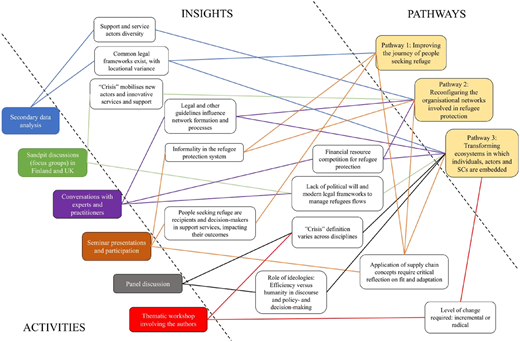
Building on these initial insights, several activities were conducted between August 2023 and October 2024 (see Table 1) leading to the identification of impact pathways presented in section 4 (see Table 2). The work focused on Finland, the Netherlands, Spain, and the United Kingdom. The initial research team (the first three authors) started with analysing secondary data and performing two focus group discussions followed by research seminars to reflect on emerging ideas and establish stronger connections among disciplines. They then conducted expert/practitioner interviews to gather in-depth insights on specific issues (e.g. processes for people seeking refuge and provisions within different legal frameworks at both UN and nation states level). Finally, findings were consolidated through a conference panel discussion and a thematic workshop involving the interdisciplinary group of authors of this paper. The insights from all these activities, summarised in Table 1, all contributed to arriving at the proposed research agenda. Figure 1 summarises the insights drawn from the activities and how these insights relate to the impact pathways presented in this paper.
4. Impact pathways for future research opportunities
To better understand and address the grand challenge of forced migration and its implications for destination countries, we must examine it from different lenses; the legal, political, economic, humanitarian, operational, and social dimensions all provide insights into the broader picture. In doing so, we propose that the OSCM field should explore some of the underlying elements of the challenge in the European context and, accordingly, adapt established methods and theories from our discipline. However, we should not stop there, as current structures do not sufficiently address underlying, long-term issues. Aiming for efficient, effective, and humane solutions that benefit both people seeking refuge and the communities that host them will entail going beyond a conventional OSCM perspective. The discipline must further explore how we transform the landscape gradually and radically. Grand shifts will require engagement at a deeper and wider level, as organisational roles, procedures, and performance levels are dependent on political choices, rules, and underlying values.
We propose three interconnected pathways for advancing research on refugee protection through the lens of OSCM. Each pathway builds on the previous by progressively expanding the unit-of-analysis and engagement with institutional, political, and societal dynamics. Together, they illustrate how the OSCM field can contribute to transforming the refugee protection regime – from improving service journeys, to reconfiguring inter-organisational networks, to reimagining the broader ecosystem in which these systems are embedded. The pathways encourage the adaptation, extension, and innovation of the OSCM toolkit. Each pathway is delineated by thematic areas and guiding research questions (see Table 2). We present each pathway below.
4.1 Pathway 1: improving the journey of people seeking refuge
The first pathway focuses on what the OSCM community can do now to facilitate a better journey for people seeking refuge by adapting the existing OSCM toolkit of methods, concepts, and theories. While some OSCM and migration studies have focused on physical journeys taken by people seeking refuge and other migrants (Prasad et al., 2023; Wycoff et al., 2025), far less attention has been paid to what may be termed the “virtual journey”: the web of service interactions and processes (Harvey, 2016; Tax et al., 2013) in the host country. In addition to enhancing the value of research contributions by considering contextual factors that affect physical migration across borders, there is a need to address the complex trajectories across different service sectors and support categories in host countries (e.g. who has access to what asylum procedures, health care services, legal support, education, work support and social services?). OSCM core concepts – such as process flows, design, and performance evaluation – offer valuable tools to design, manage, and evaluate service interactions to produce more efficient, effective, humane, and just outcomes for refugees and host communities alike.
Four core themes structure this pathway (see Table 2 for the related research questions). First, designing and managing journeys of people seeking refuge emphasises the need to understand and improve the flow of people through service systems – balancing personalisation with scalability and using operational frameworks to manage complexity and uncertainty driven by the social, political, and legal landscape. Second, the theme of value streams and performance reframes refugee protection as a series of interconnected value-creating processes. It invites researchers to assess how value is defined and performance measured, how contextual factors create bottlenecks, and how to improve outcomes for people seeking refuge and host communities subject to the contextual constraints. Third, client experience, agency, and participation emphasise the lived realities of people seeking refuge, highlighting the importance of recognising them as active agents within the system rather than passive recipients of services and support. This theme challenges prevailing paternalistic models in OSCM research and calls for participatory, human-centred approaches to understanding and resolving issues faced by people seeking refuge as they move through host country systems. Finally, legal, ethical, and justice considerations stress the normative foundations of refugee protection. This theme brings attention to questions on equity, procedural justice, and the responsibilities of institutions in ensuring rights-based and humane treatment across diverse legal and social contexts.
To address the relevant service processes through an OSCM lens, approaches such as service dominant logic, service ecosystem theory, and emancipatory approaches (i.e. non-mainstream approaches to OSCM) can be adapted to reconceptualise journeys of people seeking refuge as inherently improvised, with processes shaped, and co-produced, by institutional structures and individual sensemaking. The journeys of people seeking refuge intertwine with those of other migrants (including individuals in irregular situations), with different outcomes for sub-groups across legal contexts, locations, and over time (Atak and Crépeau, 2021). Some individuals are excluded from refugee protection altogether or voluntarily pursue alternative legal pathways, such as work permits. These dynamics call for theoretical frameworks that nuance the understanding of relevant factors for different sub-groups by addressing institutional fragmentation, asymmetry, and path dependency. Moreover, there is a critical need to explore how failures in refugee protection contribute to broader social risks, including human trafficking and modern slavery. This requires theoretical innovation and cross-disciplinary collaboration with, e.g. legal scholars and human rights experts, sociologists, and service management scholars.
While existing OSCM methods such as process mapping, value stream mapping, and constraint modelling offer useful starting points for immediate contribution by the discipline, they must be adapted for the public sector and service provision which are governed by different principles such as equity and social justice above profit and efficiency gains. This pathway simultaneously requires sensitivity to individual experiences and a deep awareness of legal-institutional variation. Methodological approaches range from individual level of analysis (e.g. individual narratives and life stories) to qualitative big data (e.g. court decisions in migration matters, institutional documents, and guidelines for servicing people seeking refuge). A process approach is well-suited to trace the dynamic, iterative, and uncertain nature of refugee journeys over time (Grimm et al., 2024, p. 3) and can uncover patterns across individual journeys while also revealing structural injustice and systemic design flaws.
Overall, by adapting the OSCM toolkit to the context of forced displacement, this pathway lays the foundation for a service-oriented and human-centred understanding of refugee experiences.
4.2 Pathway 2: reconfiguring the organisational networks involved in refugee protection
The second pathway switches focus from individual journeys to examine the inter-organisational interdependencies among networks that provide refugee protection. It addresses how networks – composed of a wide range of stakeholders including authorities and public actors at different government levels, local NGOs, international organisations, volunteers, and private sector providers – are configured, governed, and the implications for coordination. Some stakeholders perform statutory tasks and provide publicly funded services to people seeking refuge, others work on a voluntary basis (Garkisch et al., 2017; Scholten et al., 2018). Depending on how they are governed, these networks must translate policies into practice as they manage unpredictable inflows and seek to consistently deliver essential services such as housing, healthcare, and legal aid. Critical enablers for such networks include stakeholder engagement, continuity, and coordination, all of which improve timeliness in service delivery (Woldt et al., 2019). Yet, as recent crises have shown, these networks often struggle to adapt to volatile demand, fragmented mandates, and shifting political priorities. This pathway, thus, focuses on the design, emergence, and management of support networks for people seeking refuge as interconnected systems that must constantly update to changes in demand and supply factors.
Three thematic domains guide this pathway (see Table 2). First, the theme network coordination, characteristics, and governance explores how diverse actors interact across sectors and levels, including the formal and informal mechanisms through which coordination and authority are established. Second, emergence, scalability, adaptability, and flexibility examines how network structures respond to sudden or sustained changes in migration patterns, and how modular or flexible arrangements can enhance responsiveness. Third, supply chain outcomes and trade-offs invites inquiry into how different designs and alignments influence performance outcomes, such as efficiency, timeliness, and service coherence – while acknowledging that actors often hold divergent priorities and values.
Reconfiguring the organisational networks involved in refugee protection requires OSCM scholars to engage with cross-disciplinary approaches that bridge OSCM with fields such as public administration, political science, crisis governance, and organisational sociology. These networks' structures and functioning are shaped by the relationships, (joint) objectives, distribution of resources, and power among actors. All these aspects open avenues for OSCM research that span multiple disciplinary boundaries. For instance, engaging with publicness theory (e.g. Seepma et al., 2021) can help explore how public value is created across sectors involved in refugee protection, while the logic of tact (Kornberger et al., 2019) offers insights into how actors navigate ambiguous, high-pressure situations such as sudden refugee influxes or sudden policy changes that impose new constraints for service providers. Understanding these network dynamics requires moving beyond traditional OSCM theories focused on dyadic relationships or linear supply chains with commercial interests. This pathway would draw on theories that account for collective action in crises situations, distributed agency, institutional pluralism, and emergent system behaviour. Stakeholder theory can help capture the diversity of interests and influence within these networks (Freeman et al., 2007), while social network theory and actor-network theory provide tools for mapping relationships, roles, and flows of resources or information (Hald and Spring, 2023). Collective action theory and public governance theory shed light on how coordination occurs under ambiguity and fragmented authority, especially in crisis contexts (Kornberger et al., 2025; Osborne, 2006). In addition, complex adaptive systems theory can illuminate how network configurations evolve in response to feedback loops, environmental changes, and localised innovations (Anderson, 1999).
Addressing the topics of pathway 2 requires methodologies including network mapping, coordination audits, stakeholder salience analysis, and case-based comparisons across organisations and jurisdictions. Historical research through the analysis of institutional documents – such as policies, funding protocols, and procedural guidelines – can help uncover the constraints and practices that shape coordination and governance (Decker et al., 2023). Ethnography offers a powerful way to examine lived experiences, practices, informal structures, and meaning structures, capturing the nuances often missed in formal models or quantitative assessment (Watson, 2011). These tools offer new ways to evaluate supply chain alignment, actor dependencies, and governance effectiveness – highlighting a shift from isolated performance metrics to systemic learning for better coordination.
By extending OSCM through cross-field theoretical and methodological integration, this pathway enables a richer understanding of how refugee services are delivered at the network level and enables reconfiguration of the service landscape to better respond to contextual features that facilitate or inhibit coordinated service delivery. It positions OSCM as a boundary-spanning discipline capable of informing governance design, institutional collaboration, and multi-actor resilience attuned to complexity, grounded in real-world practices, and capable of addressing both the structural and human dimensions that impact inter-organisational collaboration.
4.3 Pathway 3: transforming ecosystems in which people, actors and chains are embedded
The third pathway takes a transformative step: it directly confronts constraining systemic issues that prevent the realisation of better overall outcomes. Political will, reflected in legal acts and government policies, determines the resources made available for institutional processes and to different actors, and, increasingly, shapes the demand for and quality of services (Alonso Calderón, 2022; Iglesias and Bermejo, 2025). In this context, concepts such as humanitarian crises, security threats, or housing and labour market challenges are strategic framings shaped by political discourse, public opinion, and media narratives. The OSCM community faces two main choices. The first is to lend its expertise to enable grand scale violations of human rights (Vianelli, 2022) by taking these aspects for granted, never questioning their social justice implications. The second is to contribute to shaking up the systems by confronting the severely constraining policies and regulations to facilitate the realisation of better social outcomes. The latter would best serve people seeking refuge and the host communities as the discipline has a long tradition in finding solutions to meet competing objectives.
To generate this transformation, the third pathway challenges OSCM scholars to radically rethink the ecosystem(s) in which journeys of people seeking refuge and service networks are embedded. Accordingly, it shifts focus to the broader ecosystem of (mixed) migration – shaped by laws, ideologies, public narratives, policy architectures and systemic power asymmetries and the direct implications of framing on the design, resourcing, and evaluation of OSCM-led interventions. If forced displacement is no longer a temporary emergency but a structural and ongoing reality, the refugee protection ecosystem itself must be reimagined – not simply reformed. This requires OSCM researchers to step out of the comfort-zone of the discipline (see, e.g. Helper et al., 2021) and engage with policy development, systems innovation, and power-laden institutional environments.
This pathway is structured around five key themes that together define the ecosystemic perspective (see Table 2). First, through ecosystem mapping, researchers can examine the interplay of formal laws, informal norms, and organisational routines that influence actor roles, dependencies, and service delivery. Second, the theme system change and innovation investigates how entrenched systems can evolve or be provoked to respond more effectively to dynamic migration patterns and societal needs. Third, power, ideologies, and inclusion interrogates who benefits from current structures, whose voices are excluded, and what values guide design and implementation decisions. Fourth, crisis discourse and management explores how particular events are framed as crises, and how this impacts OSCM through subsequent policy and public sentiment. Finally, institutional logics and paradoxes illuminate the tensions and trade-offs inherent in governance of refugee protection systems, especially where protection imperatives clash with national security agendas or administrative efficiency goals.
The complexity of refugee protection ecosystems demands an expansion of the OSCM theoretical repertoire and a departure from the stance of steering clear of value-laden discussions (cf. Helper et al., 2021). Existing frameworks must be complemented with insights from socio-legal studies, political science, and public governance. Within this ecosystem, services and support directed to people seeking refuge are nested in a web of overlapping, and sometimes conflicting, institutional logics. For example, while humanitarian organisations may operate according to values of impartial aid, national governments often prioritise accountability and political interests (Dube et al., 2016). Social service agencies may be driven by welfare-based logics but constrained by policies. These diverging logics affect how innovation and systemic change unfold. It informs the frameworks of rules and actions at different levels of decision-making (Osborne et al., 2022). Institutional theory can illuminate the competing value systems and decision-making frameworks that shape refugee protection (DiMaggio and Powell, 1983; Scott, 2014; Thornton et al., 2012). Paradox theory (at systemic level of analysis) helps navigate the persistent tensions between responsiveness and stability, efficiency and equity, or national sovereignty and human rights (Smith and Lewis, 2011). Moreover, OSCM can benefit from engaging critically with concepts such as policy development, systems thinking and radical change, to better understand and intervene in the broader architecture of refugee protection.
Methodologically, OSCM scholars must develop and adopt a new methodological toolkit (Cornelissen et al., 2024; Wieland et al., 2024) – one that embraces qualitative depth, reflexivity, and critical engagement. While Pathways 1 and 2 call for the mapping of processes and networks, Pathway 3 requires researchers to interrogate the systems of meaning, power, and values that underpin those structures. Discourse analysis (Hardy et al., 2020), can trace how competing crisis narratives legitimise certain policies while marginalising others. Reflexive and problematizing methods (e.g. Alvesson and Sköldberg, 2017) can help researchers interrogate their own position, assumptions, and the broader implications of their work within contested and politicised spaces (see Touboulic and McCarthy, 2020). OSCM should also dare to propose interventions: randomised controlled trials and action research (undertaken with great care) could enable small steps to transformation within the complex ecosystem. Importantly, this pathway also challenges OSCM scholars to shift from mapping existing structures and diagnosing operational failures to enabling systemic transformation through cross-disciplinary collaboration and socially engaged inquiry.
In sum, the strain on resources and systems that provide protection to people seeking refuge, along with deep-rooted political disagreements about migration, calls for science-based solutions that provide evidence for efficient, effective, and humane treatment of people seeking refuge from reception through to, where relevant, integration. In solidarity with other disciples, the OSCM field can make positive contributions to this end through myth-busting by showing the impact of transforming refugee protection systems and the underlying logics that mould them. Thus, OSCM can take a leading role in ensuring the wellbeing of people (Mollenkopf et al., 2024) and preventing the simultaneous collapse of social systems and social justice for people seeking refuge. Advancing OSCM research on refugee protection ecosystems entails exploring new objects of study and embracing unfamiliar epistemologies through interdisciplinary collaborations; it calls for a reorientation of the field's posture. The third impact pathway calls on OSCM scholars to reimagine their role not only as analysts of operational systems but as engaged contributors to systemic change. This entails commitment to epistemological openness, political awareness, and methodological pluralism. By embracing these qualities, OSCM researchers can better respond to the realities of forced displacement and help shape the institutional, social, and logistical systems that define one of the most urgent grand challenges of our time.
5. Conclusion
The question “What would it take to avert another wave of a ‘refugee crisis’ in Europe?” does not have a simple answer. The complexity is partly couched in the question: what constitutes a crisis, and how should it be prepared for, responded to, recovered from, and perhaps entirely avoided in the future? Undoubtedly, forced displacement is a grand challenge that persists, with continued implications for Europe and other host countries, no matter how migration is framed. It is – in itself – a complex, contextual, constructed and contested topic. Behind the numbers of people seeking refuge are individuals at risk of facing protracted suffering in the countries where they seek protection. There is an opportunity to change the narrative and trajectory we are on as humanity. This paper calls for OSCM researchers to engage with the refugee context in Europe, recognise the complex institutional landscape within which it is embedded, and engage meaningfully to effect change.
We identify three impact pathways for OSCM researchers that lead to short-term relief and long-term solutions. Pathway 1 offers immediate – albeit limited – relief through adapting the existing OSCM toolkit by responding to contextual factors that create friction and drive inefficiency in service provision. Often, the service channels are shared with host communities, leading to enhanced risk of “compassion fatigue” (Aldamen, 2023). Thus, responding to implications for wider society is crucial. Pathway 2 seeks further immediate gains by drawing from disciplines that are more advanced in their exploration, and understanding, of the implications of social, legal, and political factors to reconfigure systems of refugee protection. This enables a coming of age of the discipline of sorts, as research that embraces non-classical OSCM contextual features remains nascent (Bednarski et al., 2025; Dube et al., 2016; Pullman et al., 2023). Pathway 3 redirects efforts towards transforming the contextual systems that sustain the less-than-ideal conditions that fuel crises for people seeking refuge. We make a bold call for the OSCM discipline to join forces with researchers from other fields to conduct innovative research that will lead to the dismantling and resetting of underlying logics that drive socially destabilising and inequitable outcomes. To this end, OSCM researchers must earnestly reflect on the assumptions made – implicit or explicit – stemming from our disciplinary beliefs, traditions, and even funding sources when studying the European context and how those resonate with the proposed solutions. The risk of escalation also makes it imperative to unite forces with diverse research disciplines to create holistic, sustainable strategies. As social responsibility rises on the OSCM agenda, we envision that such research could promote peaceful and inclusive societies for sustainable development, provide protection for people seeking refuge and build effective, accountable, and inclusive institutions at all levels.
Two of the authors have changed affiliations after this work was completed. Dr Isabell Storsjö’s primary affiliation is the Finnish Environment Institute Syke, Helsinki, Finland. Dr Madeleine Pullman's primary affiliation is School of Business, Portland State University, Portland, OR, USA.
Lastly, we would like to thank the chairs of the EurOMA 2024 Annual Conference for facilitating the organisation of the plenary session “Refugee Crises: Identifying challenges and opportunities in operations and supply chain management”, and the guest editors and reviewers for their valuable comments.
Appendix Asylum regulations relevant for the European refugee context
International treaties and declarations.
Universal Declaration of Human Rights (Article 14), proclaimed by the United Nations General Assembly in Paris on 10 December 1948 (General Assembly resolution 217 A)
United Nations Convention relating to the Status of Refugees (“The Refugee Convention”), adopted by the General Assembly in Geneva on 28 July 1951
Protocol Relating to the Status of Refugees, adopted by the General Assembly, adopted by the General Assembly on 16 December 1966 (Resolution 2198 (XXI))
In addition, the European Convention on Human Rights, although not explicitly safeguarding the right to seek asylum, is argued to play a role for the refugees in Europe, through the interpretations by the European Court of Human Rights [1]
Legal instruments of the European Union
Building on the Refugee Convention, the EU has, over the past 25 years, developed its own body of rules, known as the Common European Asylum System (CEAS). The CEAS consists of a set of regulations and directives on standards for the qualification of third-country nationals or stateless persons as beneficiaries of international protection, a common procedure for international protection, standards for the reception of applicants, regulation of the European Union Agency for Asylum, border control and return.
Council Directive 2001/55/EC of 20 July 2001 on minimum standards for giving temporary protection in the event of a mass influx of displaced persons and on measures promoting a balance of efforts between Member States in receiving such persons and bearing the consequences there of
Regulation (EU) 2021/2303 of the European Parliament and of the Council of 15 December 2021 on the European Union Agency for Asylum and repealing Regulation (EU) No 439/2010
Directive (EU) 2024/1346 of the European Parliament and of the Council of 14 May 2024 laying down standards for the reception of applicants for international protection (recast)
Regulation (EU) 2024/1347 of the European Parliament and of the Council of 14 May 2024 on standards for the qualification of third-country nationals or stateless persons as beneficiaries of international protection, for a uniform status for refugees or for persons eligible for subsidiary protection and for the content of the protection granted, amending Council Directive 2003/109/EC and repealing Directive 2011/95/EU of the European Parliament and of the Council
Regulation (EU) 2024/1348 of the European Parliament and of the Council of 14 May 2024 establishing a common procedure for international protection in the Union and repealing Directive 2013/32/EU
Regulation (EU) 2024/1349 of the European Parliament and of the Council of 14 May 2024 establishing a return border procedure, and amending Regulation (EU) 2021/1148
Regulation (EU) 2024/1350 of the European Parliament and of the Council of 14 May 2024 establishing a Union Resettlement and Humanitarian Admission Framework, and amending Regulation (EU) 2021/1147
Regulation (EU) 2024/1351 of the European Parliament and of the Council of 14 May 2024 on asylum and migration management, amending Regulations (EU) 2021/1147 and (EU) 2021/1060 and repealing Regulation (EU) No 604/2013
Regulation (EU) 2024/1352 of the European Parliament and of the Council of 14 May 2024 amending Regulations (EU) 2019/816 and (EU) 2019/818 for the purpose of introducing the screening of third-country nationals at the external borders
Regulation (EU) 2024/1356 of the European Parliament and of the Council of 14 May 2024 introducing the screening of third-country nationals at the external borders and amending Regulations (EC) No 767/2008, (EU) 2017/2226, (EU) 2018/1240 and (EU) 2019/817
Regulation (EU) 2024/1358 of the European Parliament and f the Council of 14 May 2024 on the establishment of “Eurodac” for the comparison of biometric data in order to effectively apply Regulations (EU) 2024/1351 and (EU) 2024/1350 of the European Parliament and of the Council and Council Directive 2001/55/EC and to identify illegally staying third-country nationals and stateless persons and on requests for the comparison with Eurodac data by Member States’ law enforcement authorities and Europol for law enforcement purposes, amending Regulations (EU) 2018/1240 and (EU) 2019/818 of the European Parliament and of the Council and repealing Regulation (EU) No 603/2013 of the European Parliament and of the Council
Regulation (EU) 2024/1359 of the European Parliament and of the Council of 14 May 2024 addressing situations of crisis and force majeure in the field of migration and asylum and amending Regulation (EU) 2021/1147
Note
For further discussion, see Çalı, B., Bianku, L., and Motoc, I. (Eds) (2021), Migration and the European Convention of Human Rights, 1st ed., Oxford University Press, Oxford, available at: https://doi.org/10.1093/oso/9780192895196.001.0001