

1. The relevance of the supply chain finance literature
The studies on supply chain finance (SCF) can be traced back to the 1970s and have received more and more attention from the academic and business world over the past several decades (Chen et al., 2020; Milder, 2008, Yan et al., 2016). The economic depression of 2008 has hampered banks' willingness to grant new loans to borrowers and caused substantial increases in the cost of corporate borrowing (Ivashina and Scharfstein, 2010), thus generating a series of problems and leading firms to liquidity issues (Cornett et al., 2011). Consequently, to solve the liquidity issues, the buyers with substantial bargaining power in the supply chain tend to demand extended trade credits from their suppliers (Coulibaly et al., 2013). However, offering more trade credit further exhausts the suppliers' liquidity, especially small and medium enterprise (SME) suppliers, which usually lack access to financial resources due to their limited business scale and credit rating (Hasan and Cheung, 2018). Therefore, SME suppliers' cash-constrained status is exacerbated, posing obstacles to their daily operation (Lekkakos et al., 2016) and the efficiency of the supply chain as a whole (Wuttke et al., 2013). With the recognition that financial flow in the supply chain operations is of paramount importance and that the control of information and physical flow cannot further improve supply chain management (SCM) (Ali et al., 2018), academics and enterprises have a growing interest in SCF concepts and practices.
The key characteristic of SCF is that SCF integrates financial flows into the physical supply chain and can be regarded as an essential part of SCM (Stemmler, 2002). The principal aim of SCF is to align financial flows with product and information flows and eventually optimize cash flow management by implementing a broad range of solutions offered by financial or technology service providers (Lamoureux and Evans, 2011; Wuttke et al., 2013; Gelsomino et al., 2016; Jia et al., 2020a). The current research themes on SCF in the field of operations and production management (O&PM) are mainly centered around four major themes:
Buyer-led finance (e.g. reverse factoring). Small suppliers sometimes find it difficult to acquire financing for their operations, especially in developing countries. To reduce channel costs, large buyers begin to implement their own financing methods that intermediate between suppliers and financing institutions (Tunca and Zhu, 2017). This stream mainly considers the reverse factoring antecedents and barriers (Liebl et al., 2016), factors that influence results of reverse factoring (Dello Iacono et al., 2015), benefits of reverse factoring to supply chain performance (Lekkakos et al., 2016; Tunca and Zhu, 2017) and potential integration of reverse factoring with alternative solutions such as inventory financing or dynamic discounting (Gelsomino et al., 2019). This stream also extended in considering the supplier perspective in adopting reverse factoring solutions (Martin and Hofmann, 2019).
Supplier-led financing (e.g. trade credit). Supplier-led financing is usually a short-term loan between firms that is tied in both timing and value to the exchange of goods between them (Ferris, 1981). The role of trade credit in the global economy is extensive, thus it has received considerable attention in the SCF (Xu et al., 2018). This research category investigates aspects such as optimal trade credit terms (Kouvelis and Zhao, 2012; Li et al., 2019), impacts of trade credit on operational decisions (Robb and Silver, 2006) and overall benefits of trade credit to the supply chain (Devalkar and Krishnan, 2019; Luo and Zhang, 2012).
SCF risk management. Risk assessment and mitigation is another major concern in SCF literature. The risk of the transaction depends largely on the financial viability of the buying trading partner (Dyckman, 2011). Therefore, research studies within this aspect emphasize risk assessment against information asymmetry and moral hazards (Pfohl and Gomm, 2009) and supplier assessment to determine supplier default risk (Moretto et al., 2019; Zhu et al., 2019).
SCF-related stakeholders. The rapid development of information technology has enabled greater connectivity and information flows of different supply chain members and consequently, SCF solutions centered around information and financial flows have involved more and more stakeholders (Bals, 2019). This category addresses the role of different organizational functions within a firm in the implementation of SCF solutions (Caniato et al., 2019), the role of different supply chain actors participating in SCF (Silvestro and Lustrato, 2014) and the role of SCF on network performance (Carnovale et al., 2019).
Although the number of SCF-related literature has been increasing since the 2000s, compared with other topics in the SCM area, it is still under-researched and presents limited practical and theoretical implications (Caniato et al., 2019; Xu et al., 2018; Jia et al., 2020b). Several are the potential gaps related to SCF, such as a limited theoretical contribution or the presence of few empirical studies.
2. The role of digital transformation to boost supply chain finance
Among the potential SCF research opportunities to be explored, one of the most compelling ones, both from a practical and a theoretical point of view, is given the role that digital technologies could play to enable SCF solutions. Digital technology is regarded as one of the most essential and valuable directions, which is expected to significantly create more excellent organizational value through SCF activities (Caniato et al., 2019). In this digital and informational era, digitalization has already been regarded as a crucial trend for improving SCM (Liao et al., 2019), and some SCF theoretical papers or conceptual mathematical models based on digital technologies are also emerging recently. For example, Hofmann et al. (2018) discussed the potential application of blockchain in improving the visibility of the physical flow of goods in SCF; Choi et al. (2018) and Wang et al. (2016) argued the role of data analytics in reducing financial risk through improving the decision-making process.
However, current research studies on digital technology-enabled SCF are still fragmented since most of them are mainly devoted to proposing innovative SCF solutions enabled by one specific technique. Thus, there is a need to adopt an integrative view and systematically discuss the future development of SCF empowered by the interaction of different digital techniques. More importantly, this topic became especially relevant recently, as coronavirus disease 2019 (COVID-19) has pushed the adoption of SCF solutions to support financial flows along the supply chain. For example, the Notice on Responding to COVID-19 and Helping SMEs Resume Work and Production issued by the Ministry of Industry and Information Technology of China in February 2020 clearly stated: “Innovating financing products and services and actively promoting the use of SCF are critical to expand the financing supply for SMEs during the pandemic.” Consequently, these initiatives based on digital technologies are incredibly boosting.
Artificial intelligence, blockchain, smart contracts, electronic invoicing, the IoT and big data analytics are just some possible technological trends that could boost the adoption of SCF solutions, mitigating the related risk and exploiting potential benefits (Caniato et al., 2019). Innovative technologies might enable an extension of SCF solutions beyond a dyadic view, exploiting multi-tier applications of existing solutions or involving new actors (e.g. fintech players, logistics service providers, insurance companies, etc.). In this vein, a significant gap in the current literature is that digital transformation (DT)-enabled SCF practice is lacking since the current focus is still on the impacts of DT in operations and SCM, while SCF is not prioritized. Thus, future research needs to provide more empirical studies and build a general theory for digital SCF.
Besides, there is great potential in extending the research scope beyond a focus on reverse factoring and developing theoretical models considering implications for SCM of innovative solutions such as dynamic discounting, invoice auction, inventory financing, distribution finance, purchase order finance and several others. Currently, extant literature lacks theoretical support. Most SCF solutions are given based on conceptual papers, without the support of any managerial theory. It indicates that the topic is still at an early stage of development; thus, future research should involve appropriate theories into this area.
Finally, considering the coordination functions of SCF in the supply chain, further research is needed to investigate the potential connections between SCF and operations management topics and data. Through the exploitation of information technology, the combination of financial and operational performance of a company, measured by different actors in the supply chain, could allow the development of innovative models to improve the prediction of the probability of default of each actor of the supply chain and thus to support specific risk mitigation strategy.
Thus, this editorial aims to address those gaps by proposing some new research directions on digital techniques enabled SCF, to understand the role of DT in helping financial flow to integrate with other two types of flow within the supply chain. We hope this editorial will inspire scholars to advance a related theory and enrich practical implications by providing more empirical analysis (e.g. in-depth case studies, large-scale surveys and action research) in their future studies.
3. A research framework to classify new literature about SCF
As summarized above, there is a gap in understanding different DT-based applications' roles to foster integrated SCF solutions. Generally, there is an increasing number of studies proposing both conceptual and supply chain practices concerning one specific DT (Toorajipour et al., 2020; Chen, 2019; Hung et al., 2020), but few have focused on SCF solutions. Some supply chain enterprises and industries have done great practices. For example, one representative example is CITIC Phoenix Harbor Supply Chain Management Co., Ltd in Tianjin Free Trade Zone, China, which uses an inventory management platform enabled by BDT (Big Data Technique), BCT (Blockchain Technique) and IoT (ThePaper, 2020). Here, the core enterprises' dominant role has been decentralized, and SMEs are empowered to directly get supports from SCF, bypassing traditional core enterprises, which ensures adequate and stable supplies upstream. However, relevant empirical studies are lagging. In order to acquire general theories and practical implications, more research with empirical experiences is necessary to answer the following research question:
How do different DT-based applications help to foster SCF?
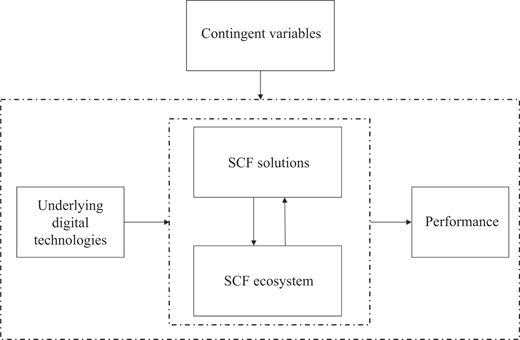
In order to classify the existing literature about SCF as well as the new contributions emerging with this special issue and to answer the previous research question, we designed an integrated research framework, considering five main variables, as depicted in Figure 1:
Underlying digital technologies
SCF solutions adopted
SCF actors part of the SCF ecosystem
Contingent variables pushing or impacting the use of SCF solutions
Performance metrics impacted by the SCF solutions.
3.1 Underlying digital technologies
DT is usually defined as the rapid adoption and application process of digital technologies in commercial environment (Kretschmer and Khashabi, 2020), which mainly refers to the significant changes in properties such as business operations, production processes, organizational frameworks and management concepts (Matt et al., 2015; Vial, 2019). As for the SCF area, enterprises and scholars mainly focus on those emerging digital technologies (e.g. blockchain, big data analytics, artificial intelligence and IoT) that open a whole range of innovative solutions, which dramatically affects the value creation processes and develops competitive advantages for the whole supply chain (Vial, 2019; Caniato et al., 2019). However, DT's role to empower SCF has not been thoroughly researched, which is precisely the goal of this special issue.
3.2 Supply chain finance solutions
The current academic literature is still debating about which are the solutions to consider under the SCF spectrum. SCF literature debates in the distinction between finance-oriented and supply chain-oriented perspectives (Gelsomino et al., 2016); some papers focus SCF just on short-term financing; still others extend this view by including also inventories and physical assets financing.
The new literature attempts to extend these preliminary views by presenting SCF as a combination of different solutions focused on account payables, account receivables and inventory (Gelsomino et al., 2016). Despite this approach, most academic contributions are still related to a single solution, and generally, this is reverse factoring.
In the literature, there are some preliminary attempts to combine different solutions simultaneously (e.g. Gelsomino et al., 2016) and some studies addressing the concurrent use of different solutions to finance the supply chain (Gelsomino et al., 2019).
A potential lever to investigate this perspective is related to DT, but this research stream is still underexplored in literature. In this special issue, the contribution of both well-known solutions (e.g. reverse factoring) and innovative solutions (e.g. Purchase Order Finance) will be investigated.
3.3 Supply chain finance ecosystem (SCFE)
Viswanadham and Samvedi (2013) explained the supply chain ecosystem as an ecosystem that “consists of the elements of the supply chain and the entities that influence the goods, information and financial flows through regulations, technology, management, etc.” Based on that, Bals (2019) initially proposed an SCFE framework, where SCF solutions are surrounded by information and financial flows between multiple stakeholders. Moreover, five major stakeholders, supplier, buyer, government, financial institution (commercial bank) and other solution providers (e.g. technology provider, logistics service provider and platform providers), were identified in SCFE. SCFE can help us provide research directions from a broader perspective and better understand how DT drives the financial flow among different stakeholders. Although the main stakeholders of the SCFE were already identified, these are evolving, and new actors are emerging. In this special issue, the role of some new actors was investigated.
Most current research studies choose one single view (e.g. supplier's view or SCF provider's view) to learn the effects of DT on the supply chain, which tends to generalize limited implications. However, there is a trend that the development of digital technologies is reshaping the overall supply chain ecosystem where SCF is embedded (Ng, 2014; Bals, 2019; Fairchild, 2005).
3.4 Performance
SCF solutions are implemented to optimize the performance of the single company and the overall supply chain. The current literature has raised potential benefits and performance improvement. Most of the literature is mainly focused on the impact on the cash-to-cash cycle, as consistent with SCF's definition.
In a broader sense, the literature has investigated the benefits from a strictly financial point of view; the benefits of SCF solutions derive mainly from the exploitation of differences in the cost of capital between different players in the supply chain (Pfohl and Gomm, 2009; Randall and Farris, 2009). A valuable framework on this behalf is the “SCF cube” (Gomm, 2010; Pfohl and Gomm, 2009), describing the positive impact of SCF on working capital in terms of volume, duration and cost of capital. The benefits of SCF solutions, however, are not limited to financial performance. A significant source of benefit for prominent supply chain players is the reduced risk of bankruptcy throughout the supply chain. Klapper (2005) points out that these solutions may allow high-risk suppliers to mitigate their credit risk level with that of their high-quality buyers, thus reducing their cost of debt and increasing their level of access to liquidity.
Other authors highlight the benefits associated with the involvement of financial institutions in SCF programs. In some solutions, such as factoring (i.e. firms sell their creditworthy receivables at a discount price and receive immediate cash) or those focused on securitizing asset-backed receivables, financial institutions usually carry the burden of collecting payments, in exchange for an increase in revenues (Palia and Sopranzetti, 2004; Tanrısever et al., 2012). Moreover, financial institutions can improve their risk-assessment process, especially regarding SMEs (Deakins and Hussain, 1994). The SCF approach might increase the information's availability and accuracy, thus supporting financial institutions in estimating a default probability tailored to the specific SMEs (Hofmann, 2005b). Finally, some authors state that supply chain links are strengthened through enhanced collaboration, visibility or automation that an SCF solution might entail (Hofmann and Belin, 2011; Lamoureux and Evans, 2011).
Some authors also extend the benefits of SCF to the internal processes of the companies. In particular, these benefits are connected with the use of digital technologies to foster SCF solutions. This literature stream mainly addresses the contribution of SCF to make processes faster and cheaper and enable innovative solutions that can involve more companies at lower costs (Caniato et al., 2019).
Some more recent studies focus on the support that SCF could provide in terms of sustainable performance metrics (Jia et al., 2020b).
This evolution in literature demonstrates a growing managerial relevance of SCF and broader contributions to performance. This special issue will contribute to this literature stream by presenting new areas of improvement that could be achieved thanks to the broader use of SCF solutions.
4. A new research agenda for SCF
This special issue contributes to the research gaps highlighted above through six papers.
In general terms, as presented before, the literature about SCF tends to be often conceptual, with limited empirical insights. This special issue provides an essential contribution in offering valuable and innovative empirical insights.
Also, the six papers offer innovative directions and essential contributions about the role that digital technologies could play in fostering SCF solutions.
The classification of the papers is summarized in Table 1.
Summary of the papers of the special issue
| Paper | Underlying technology | SCF solutions | SCF ecosystem | SCF performance | Contingent variables |
|---|---|---|---|---|---|
| Shou, Shao and Wang | Reverse factoring | Buyer | Operating performance | Chinese manufacturing firms | |
| Banerjee, Lücker and Ries | Digital technology | Reverse factoring | Supplier | Financial and nonfinancial performance | Program configuration |
| Wang, Yan, Chen and Xu | Joint investment activities | Industrial chain partners Financial service providers | Corporate financial performance | Network capability | |
| Zhang, Huang, Zhao and Ma | Information integration | Purchase order finance | Supply chain service provider Buyer | Product launch (success, speed, quality) | Social interaction Chinese smartphone industry Firm size |
| Lam and Zhan | IT capability | SCF initiatives | Service providers | Financial risk | Operational slack Political connection USA market |
| Song, Li and Yu | Big data analytics Digital platform | SCF solutions | Financial service providers | Supply chain credit risk | SMEs |
The paper by Yongyi Shou, Jinan Shao and Weijiao Wang “How does reverse factoring affect operating performance? An event study of Chinese manufacturing firms” is focused on the most studied SCF solution (reverse factoring) from the perspective of the most studied actors (the buyer). The elements of innovativeness of this paper are twofold: firstly, the paper is based on an event-study methodology, thereby introducing a comprehensive quantitative approach to SCF literature; secondly, the paper is innovative in terms of performance impacted by the use of SCF solutions. In particular, the paper investigates the impact on operating performance, demonstrating how much SCF has evolved toward a real managerial lever. The event study results indicate that reverse factoring positively affects buyer firms' operating performance in terms of cost efficiency and operating margin. Besides, both production and innovation capabilities positively moderate the relationship between reverse factoring and operating margin. However, neither of them moderates the relationship between reverse factoring and cost-efficiency.
The paper by Aneesh Banerjee, Florian Lücker and Jörg M. Ries “An empirical analysis of suppliers' trade-off behaviour in adopting digital supply chain financing solutions” is also focused on reverse factoring, but considering the buyer's counterpart, for instance, the supplier. This perspective is relevant for existing literature, as most of the current literature neglects the supplier's perspective and the reasons why they deny participation in SCF programs. The motivations are considered in terms of existing trade-offs between financial and nonfinancial performance indicators. The primary motivating parameters in guiding the choice are the program configuration and the adopted digital technology, respectively.
The paper by Liukai Wang, Ji Yan, Xiaohong Chen and Qifa Xu “Do network capabilities improve corporate financial performance? Evidence from financial supply chains” is mainly connected with the literature stream of financial supply chain management. The contribution to existing literature pertains to the willingness to consider joint investment between two relevant actors of the supply chain (industrial chain partners and financial service providers) to understand the impacts of corporate financial performance. The analysis is performed considering the impact that network capability plays in improving the performance, addressing and extending the importance of the SCF ecosystem.
The paper by Min Zhang, Qiuping Huang, Xiande Zhao and Lijun Ma “The impact of information integration on purchase order finance and new product launch: a case study” is contributing to SCF literature, considering an innovative SCF solution (Purchase Order Finance) provided by an innovative SCF lender (supply chain service provider). The paper investigates the contribution of information integration and social interaction between borrowers and lenders to understand how this impacts the adoption of POF (Purchase Order Finance) and other critical processes for the company, particularly the product launch. This paper is the first attempt to combine SCF with the innovative domain of product launch based on our knowledge.
The paper by Hugo K.S. Lam and Yuanzhu Zhan “The impacts of supply chain finance initiatives on firm risk: evidence from service providers listed in the US” contributes to SCF literature, offering a theory-testing approach to validate a significant performance impact, the financial risk. In particular, through an extensive quantitative study, the paper investigates how SCF initiatives reduce the financial risk for service providers and introduce some relevant and innovative moderators, such as IT capability, operational slack and political connection. Moreover, this paper contributes to the existing literature by considering the service provider's point of view.
The topic of risk is also covered by Hua Song, Mengyin Li and Kangkang Yu “Big data analytics in digital platforms: how do financial service providers customise supply chain finance?”. This paper contributes to the important debate about the supply chain credit risk and, in particular, aims at understanding how to improve the credit risk both for the financial provider and for the borrower. The paper's fascinating insight is that the considered borrower is an SME company, the typical actor of the supply chain that requires more support. In performing the analysis, the digital technologies' role is fundamental, and especially, the paper investigated how digital platforms and, more precisely, big data analytics contribute to that.
5. Conclusion
This editorial sought to provide some research directions regarding DT-enabled SCF, including solutions, the ecosystem's role, improved performance and considered contingent variables. We proposed a conceptual structure to the DT-enabled SCF discussion and extant research. In particular, this editorial may be the first paper that initially considers the impacts of DT adoption on the ecosystem of SCF. We aim to inspire scholars to either enrich or reposition their studies to make more contributions to the area of SCF in digitalization.

