

Omni-channel evolution: confronting the whats and hows editorial notes on the “advances in omni-channel special issue”
Omni-channel in a new era
Retail supply chains are experiencing a fast-forward evolution, surrounded by increasing technology motivations, market expectations and business environment uncertainties. Online retail and electronic commerce are not market winners any more, and the question for many retailers is not about “to be or not be” visible and active in multiple channels, but more concerning on how to be efficient and effective using a seamless omni-channel retail solutions (Melacini et al., 2018). Towards those goals, the literature has studied multi-channel systems from various structural and operational viewpoints, and led to the concept of omni-channel, which tries to integrate and synchronise products and information flows (Saghiri et al., 2017).
To realise the omni-channel, retailers have initiated various multi-channel business models and strategies such as home delivery, buy-online-pickup-in-store, reserve-online-pickup-in-store, third-party-location-pickup and ship-from/to-store (Hübner et al., 2016; Song et al., 2020). Implementing the omni-channel models has, however, faced challenges in inventory control, lot-sizing, stock-keeping points, delivery and pick-up scheduling, physical network design, resource planning, product return management, data visibility and integration, and customer involvement (Li et al., 2020; Mirzabeiki; Saghiri, 2020; Prabhuram et al., 2020).
The omni-channel body of knowledge is now moving to a new phase, where more risks and uncertainties are emerging in hybrid offline-online businesses, social and environmental concerns are increasing, product returns are complexified, and third-party logistics are getting momentum in omni-channel systems. This new phase needs omni-channels to revisit their value chains and introduce new product-service/physical-virtual systems to manage the new trends and their emerging challenges – as well as opportunities.
In view of the key points, mentioned above, this special issue is very timely addressing the latest progresses and advances in omni-channel research and practice. An earlier special issue of International Journal of Physical Distribution and Logistics Management (IJPDLM) on omni-channel (2018, Volume 48, Issue 4) provided a strong platform for the research on omni-channel logistics. IJPDLM has been also leading the publication of advanced research on omni-channel and presented more papers than other journals in this field (Cai and Lo, 2020). Pursuant to that, the papers of this issue broaden the omni-channel logistics perspective, and provide useful insights, which will be applicable for both practitioners and academics.
Contributions to the special issue
The papers of this special issue address some of the key and advanced issues in the omni-channel theory and practice. The first paper, “Warehouse Configuration in Omni-Channel Retailing” (Kembro and Norrman, 2020), explores the emerging roles of warehouses in the omni-channel context. Case studies of Swedish retailers in three sectors (fashion, consumer electronics and DIY/construction material) show they address challenges due to an increase in the number, variation and frequency of flows passing through omni-channel warehouses by constantly reconfiguring omni-channel warehouses. Customer-oriented picking zone is replaced by either integrated and standardised process and system or time-differentiated packing. Distribution centres are integrated with other stores and hubs while the degree of automation is being increased supported by an increase requirement in the integrity of master data. Warehouses can effectively contribute to the complex sorting and order fulfilment operations of omni-channels, where items are kept and shipped in single and multiple packs. Data automation systems are also studied to emphasise the importance of integration and visibility of information flows for the omni-channel system. The case companies have recognized the need for “smart” integration of various warehousing systems such as ERP, WMS and WCS.
The second paper, “How Logistics Service Quality and Product Quality Matter in the Retailer–Customer Relationship of food drive-throughs” (Kaswengi and Lambey-Checchin, 2020), focusses on the Buy-Online-Pickup-In-Store (Click and Collect) model. In the grocery retail sector, drive-through pick up is thought to increase customer satisfaction through offering convenience. Based on a dataset of grocery drive-throughs in France, the paper shows logistics service quality and perceived product quality are effective drivers of omni-channel consumer satisfactions. Moreover, drive-through convenience is shown to complement the positive effects of both the perceived quality of service and the perceived quality of fresh products on satisfaction, leading to a higher purchase incidence in drive-throughs. The paper addresses an important gap about the role of logistics services in omni-channel systems, and builds a good ground for future studies on the grocery omni-channel retail.
The third paper, “Examining Retail Business Model Transformation: A Longitudinal Study of the Transition to Omnichannel Order Fulfilment” (Davis-Sramek et al., 2020), studies the transitions in the retailers' supply chain strategies, and discusses how retailers have moved towards fulfilment channels integration to achieve the omni-channel system. By studying retailers offering a variety of products, i.e. footwear, sporting goods, home/office suppliers, home improvement, pharmacy and discount stores, the paper identifies various approaches, adopted by retailers to re-design and re-structure their order fulfilment processes, and discusses the impacts of the retailers' logistics capabilities and specific supply chain arrangements. The longitudinal data show retailers in many sectors have progressed towards store-integrated fulfilment and DC-integrated fulfilment – from experimental fulfilment and DC-dedicated fulfilment. The paper offers insights into how retailers overcome existing structural barriers in omni-channel order fulfilment using various approaches to integrate ICTs, channels, stores and DCs.
Transition and transformation are common themes in this special issues. Learning how retailers address various problems to achieve advances in omni-channel retail and shopping experience requires a shift in the research. In terms of methodology, the papers of this special issue employ a diverse range of methods including multiple-case-study, survey and longitudinal research. The studies are based on the data that have been collected from various industries including fashion, consumer electronics, grocery, pharmaceutical, home improvement, office supplies, sporting goods and footwear, representing a number of international firms and some particular companies in the USA, France and Scandinavia. Partly driven by the past special issues of IJDPLM, this shows an encouraging in the maturity in omni-channel research.
Recommended research directions
Amongst others, technology offers a great opportunity to further advance omni-channel retail and shopping experience. The technological advancements, which are generally labelled as Industry 4.0 these days, have considerable impacts on structure and performance of omni-channel systems. While conventionally moving towards a proper omni-channel retail had major difficulties in capturing, integrating and sharing data across multiple channels, emerging and expansion of advanced sensors, Cyber-Physical Systems (CPSs), 5G technologies, augmented reality, Internet-of-things (IoT), big data analytics (BDA), Physical Internet, cloud computing and cloud-based systems have been revolutionising the implementation of omni-channel ideas and concepts.
New omni-channel systems can greatly benefit from real-time big data, widely collected through autonomous CPSs and connected via IoT. The omni-channel information flows can be then effectively analysed via BDAs and cloud-based systems, and support new products flows in contemporary Physical Internet Systems. This new structure is visualised in Figure 1, where the omni-channel physical and virtual systems are fully synchronised and integrated in the new Industry 4.0 ecosystem.
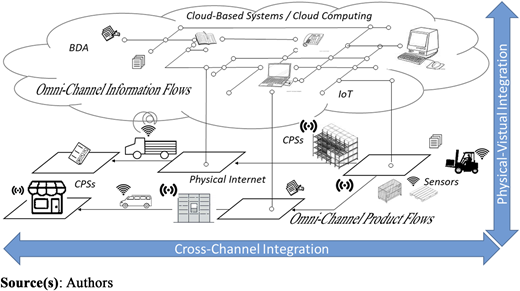
Industry 4.0 technologies, enabling the omni-channel physical and information integrations
Industry 4.0 technologies, enabling the omni-channel physical and information integrations
In view of the discussions above, we believe there are needs and several opportunities to explore the omni-channel system design and implementation in the era of Industry 4.0. The list, below, summarises some research directions and ideas for future research, out of many:
How do advanced sensors and shape recognition technologies enhance product flow visibility in order fulfilment processes?
Can 5G technology change the electronic data interchange (EDI) amongst different players in the retail supply chain?
How can CPS and IoT systems really be implemented in complex omni-channels?
Do omni-channels need to go through fundamental changes and re-engineering projects to be ready for Industry 4.0 technologies?
How do new consumer touchpoint technologies affect the omni-channel's performance?
What does the omni-channel retail learn from Industry 4.0 best practices in other sectors?
Where can cost-benefit analyses be positioned in coupling Industry 4.0 and omni-channel?
Are the conventional definition and understanding of integrations relevant to Industry 4.0 technologies in the omni-channel context?
How does Industry 4.0 make omni-channel supply chains more resilient?
Are Industry 4.0-equiped omni-channels are more sustainable?
The authors want to thank all contributors to this special issue, particularly the reviewers, who have spent a significant amount of time to provide the authors with their very useful comments and evaluations. The authors are grateful to the editors of International Journal of Physical Distribution and Logistics Management, the past editor Professor Alexander Ellinger, and the current editor in chief Professor Chee-Yew Wong for providing the authors' the opportunity to create this special issue. Finally, the authors appreciate the excellent support of the journal's editorial office for their valuable support throughout the review process.

