Although there is growing research on the relationship between servant leadership and job performance, limited research examined conditions under which servant leadership is more effective. The purpose of this paper is to investigate whether employee-oriented human resource policy is shaping the relation between servant leadership and job performance.
Empirical research was carried out among 263 organizations operating in Poland. To verify formulated hypotheses, statistical reasoning with moderator was made using model 1 of SPSS Macro Process.
The present study has proved that employee-oriented human resource policy may act as a moderator between servant leadership and job performance strengthening this relation. Integrating human resource policy with leadership is important to reach a better understanding of how human resource and leadership can influence employee performance.
The current study provides a practical implication for organizations to train managers with leadership skills to improve the job performance of their employees.
1. Introduction
People are the most important asset in the organization. Therefore, scientists are trying to find factors that help employees achieve better performance. The type of leadership plays an important role. Their skills, behaviors and attitudes determine the effectiveness of work performed by employees in the organization (Leroy et al., 2018). Throughout the decades, different leadership styles have emerged. The studies moved toward a strong emphasis on the interaction between leader and followers (Avolio et al., 2009). Among many follower-oriented styles, the authors distinguished transformational, ethical, authentic, servant, shared, empowered, spiritual and leader–member exchange (LMX) leadership (Graham, 1991; Leroy et al., 2018). All leadership styles aim to influence employee behavior. However, to understand how individuals are motivated, it is necessary to focus on factors which provide insight into motives that influence employee behavior. It corresponds to the servant leadership where concern of followers’ needs and interests are priority.
Servant leadership is a people-centered leadership approach with a focus on the personal development and well-being of followers (Liden et al., 2008). It creates better relationships, helps to deal with the challenges of modern organizations and creates a workplace with a culture of empowerment.
As the literature concerns many factors which enable leaders to enhance employee job performance, there is one gap tackled enough yet. It is a role of human resource management (HRM) in the organization to support leaders in performing their role toward employees effectively (Leroy et al., 2018).
HRM is a comprehensive approach to the employment and development of people. It is responsible for employee experience during the entire employment lifecycle, starting from recruitment and selection of the right employees to employee termination. Managers bring on board new employees, train and develop them, assess their talent through performance appraisals and reward them accordingly (Obedgiu, 2017). Managers are also involved in resignations and dismissals.
HRM shapes organizational leadership and culture. The HRM field takes a macro-level approach describing how people should be treated in the organization (Leroy et al., 2018). HRM involves the application of policies and practices in the fields of organization design and development, resourcing (workforce planning, recruitment, selection and talent management), learning and development, human capital management, performance and reward, employee relations and employee well-being (Armstrong and Taylor, 2014). These policies and practices are integrated with HR strategies and aligned with business strategy.
HRM includes initiatives associated with people management in the organization. Implementing HRM methods is somehow dependent on attitudes or skills of the individual leader, therefore, leaders play a crucial role in enacting HRM practices (Leroy et al., 2018). They are involved both as deliverers and as drivers of HR policies. There are different tools which allow managers to enhance employee performance, however, proper HR context looks at particular processes in the organization that may influence employees systematically. The employee-oriented HR approach supports the achievement of organizational goals and equally builds relationships based on trust, openness and personal fulfillment of employees for their better performance. Therefore, the aim of the article is to verify whether employee-oriented HR policy strengthens the influence of servant leadership on job performance. Fulfilling this aim will allow us to conclude if employee-oriented HR policy creates the larger organizational context in which leaders can operate to influence employees.
2. Servant leadership
In the literature, there are three phases of the research on servant leadership. The first one, based on the work of Spears (1996), focused on the conceptual development of servant leadership. In the second phase, researchers focused on development of the scale to measure servant leadership and relations between servant leadership and its outcomes. Currently, we are in the third phase of the research on servant leadership which focuses on understanding the antecedents, mediating relations and boundary conditions of servant leadership (Eva et al., 2019).
Since the pioneering work of Graham (1991) laid a foundation for development of the theory of servant leadership, there has been continuous advancement of research in the field. Researchers differentiated servant leadership from other forms of leadership (Peterson et al., 2012; Hoch et al., 2018) and cross-disciplinary research advanced the theory of servant leadership, however, there is still a lack of clarity in the field (Eva et al., 2019).
Servant leadership has been distinguished from other leadership styles (Stone et al., 2004; van Dierendonck, 2011). Servant leadership is focused more on the needs of followers than transformational leadership. The priority of servant leaders is to develop their followers in different dimensions, while transformational leaders develop followers for better organizational achievements (van Dierendonck, 2011). Servant leadership also differs from authentic leadership. Servant leaders are authentic because their self-awareness comes from the need to serve others, not just from the need to be authentic, as demonstrated by authentic leaders. Finally, stewardship is incorporated into servant leadership more than into ethical leadership.
The most comprehensive definition of servant leadership has been presented by Eva et al. (2019). The definition is based on three features, namely the motive, mode and mindset of the servant leader. First, the motive underlines personal motivation of taking up a leadership responsibility of the development of followers. Leaders provide multidimensional opportunities for growth, including psychological, emotional, and ethical well-being, maturity and wisdom. Such an attitude requires maturity and strong character. Second, the mode is manifested through giving the priority to followers needs, their interests and goals above own. Leaders understand the background, values, beliefs of the followers, hence perceiving each follower as an individual with specific desires, goals and strengths. The last feature, the mindset of the servant leader, refers to the movement from self-orientation toward concern for others within a larger organizational community (Eva et al., 2019).
To analyze specific behaviors of servant leaders, it is important to mention personality that may predict their effectiveness. Research has shown that servant leadership is related to agreeableness, introversion (Hunter et al., 2013), low narcissism (Peterson et al., 2012), high mindfulness (Verdorfer, 2016), emotional intelligence (Barbuto et al., 2014) and strong sense of confidence (Eva et al., 2019).
In this study, four key attributes of servant leadership are proposed, based on the original scale developed by Liden et al. (2008): focus on the needs of followers, inspire and motivate employees by providing meaning and challenge to the task, encourage employees to question assumptions, reframe situations, approach situations from a new perspective and promote employee personal development tailored to individual needs.
The concept of servant leadership is derived from social-based theories (Eva et al., 2019) based primarily on reciprocity. Followers feel obligated to behave positively toward leaders who support their growth and development. Moreover, followers transform their mindset in a long-term perspective, and supported by their leaders can become servant leaders themselves. Bandura (1997), the author of social learning theory, stated that leaders are role models. Followers find leaders credible, hence, by observation, emulate their behaviors and attitudes. Social-based theories explain how servant leaders enhance followers’ performance (Liden et al., 2014).
2.1 Servant leadership and job performance
The most significant focus of research of the current phase of the study of servant leadership is on its results. One of the most obvious is a positive relation between leader behavior and follower outcomes. Research has distinguished behavioral outcomes of followers, such as organizational citizenship behavior (Liden et al., 2008), helping behavior (Neubert et al., 2016), proactive behavior (Bande et al., 2016). Servant leadership is also positively associated with job-related outcomes, including employee engagement (van Dierendonck et al., 2014), job satisfaction (McCann et al., 2014), motivation to work (Mayer et al., 2008), employee well-being (Gotsis and Grimani, 2016) and employee commitment (Miao et al., 2014).
The most significant relationship of servant leadership is on followers' performance (DeRue and Myers, 2014; Epitropaki et al., 2017; Liden et al., 2014, 2015; Schwarz et al., 2016; Mcquade et al., 2020; Awan et al., 2012; Ugurluoglu et al., 2018). An organization needs highly skilled and job-performing employees to achieve its goals, deliver quality products and services, and build its competitive advantage (Sriviboon, 2020). Hence, there is no doubt that leaders have a significant impact on employees' behaviors and attitudes.
There are many interpretations of job performance in the literature. Schmitt and Chan (1998) refer job performance to the knowledge and skills necessary to complete certain tasks and the level of an employee's motivation to work. Campbell (1990) emphasizes that job performance is not the outcome of an action, but the action itself. Later studies examined job performance in terms of both the behavioral aspect and the outcome aspect (Roe, 1999; Jex, 1998). Hence, job performance is understood not only as a direct result, observable behavior, but also as an effect of work determined by behavior (June and Mahmood, 2011). Borman and Brush (1993) defined job performance as a set of behaviors that helps employees to perform their tasks and provide long-term work, and it seems to be the most relevant definition. Therefore, keeping employees' job performance is the most important task for managers (Kwahk and Park, 2018). In this paper, job performance will be understood based on four aspects: task proficiency, task meticulousness, work discipline, and work improvement and readiness for innovation (Ali-Hassan et al., 2015; Kwahk and Park, 2018).
Liden et al. (2015) indicated three features explaining how servant leadership relates to performance at the individual level. First, empower followers and bring out their potential to enhance job performance by providing support. Second, leaders prioritize follower needs above their own interest; hence, employees engage themselves to perform job duties effectively. Third, leaders express concern also for society outside the company; hence, followers admire them for these extra efforts. It shows how servant leadership is linked to job performance through role modeling (Schwarz et al., 2016). Servant leaders also enhance employee job performance by engaging and developing them, discovering their potential. The behavior of servant leaders increases the motivation of employees to work; hence, their commitment increases (Krog and Govender, 2015) and results in better work results. As explained by social-based theories, servant leaders influence followers’ behaviors and attitude through role modeling (Eva et al., 2019). Servant leaders also mobilize followers to become leaders themselves, hence leading them to higher work performance.
This is why it is so important for the manager to be able to realize what factors determine a decrease in employee performance. Therefore, in light of the above, the following hypothesis may be formulated as follows:
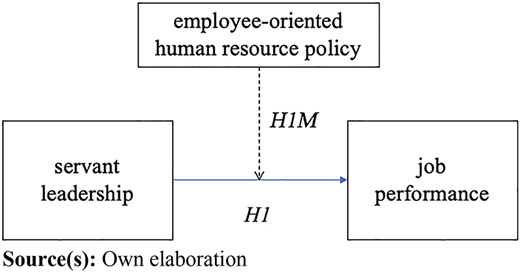
There is a positive relation between servant leadership and job performance.
3. Employee-oriented human resource policy
The study of servant leadership goes beyond a simplistic relationship with job performance. Researchers try to understand how servant leadership influences employee behavior. It seems to be important to indicate factors that will allow servant leadership to enhance employee performance. There are indications that the influence of servant leadership on job performance is moderated by other factors. These factors are related to leaders, such as perception of trust in leader trust (Amir, 2019), others are related to team and organization, such as team strength and effectiveness (Hu and Liden, 2011) and organizational support (Amir, 2019). However, there is still a lack of research on how human resource practices can influence the path by which servant leadership predicts its outcomes.
The changing trend in HRM is increasingly focused on the importance of employees in the organization. It shows managers that employees are becoming the key to the success of the organization (Sriviboon, 2020). Therefore, managers should focus on creating an environment that allows employees to develop their potential. For this reason, HRM researchers are increasingly focusing their attention on creating a human resource policy focused on employees.
HR policy is defined as the system of coordinated, long-term activities aimed at forming highly capable employees achieving the goals of the organization. HR policies provide generalized guidelines on how HR managerial issues should be dealt with. HR policies are presented as various HRM solutions, including recruitment and selection, training and development, work conditions, performance appraisal, compensations and rewards (Demo et al., 2012). The HRM is yet to be a new concept of managing people in the organization, nevertheless, it is necessary to understand HRM evolution.
Managing people at work began at the time of the Industrial Revolution in the late XVIIIth century. The Industrial Revolution era brought a large number of workers. However, workers were not considered a source of competitive advantage. In order to manage people in factories, centralized work with control systems was implemented. Scientific management in the early of the XXth century conceptualized by Taylor implemented a scientific approach to personnel function, such as scientific selection techniques or structured rewards. The main focus was on increasing the productivity of the employees. Taylor believed that there was only one way to organize the work efficiently. It has been demonstrated by job specialization (Marciano, 1995). People were trained to become experts in one particular component of the job. The scientific management stage contributed to the development of performance management programs.
Taylor's movement was formalized by Mayo during the 1930 and 1940s, who considered organization a social system, not just a formal system. He revealed that employee productivity was affected not only by job design or rewards, but also by social factors, including informal groups, motivation, employee satisfaction and proper leadership style. It led to implementation of training programs, emphasizing support and concern for workers (Marciano, 1995). Hence, Mayo is known as the father of the human relations movement. That was also the beginning of the behavioral approach to employees, which was continued by Abraham Maslow, David McClelland and Max Weber. They gave importance to motivation, leadership and workforce productivity. From this, the HRM function came to life and growing professionalization of the role has been observed.
After war, there was a flood of returning soldiers, often unskilled; hence, employers began to focus on the importance of personnel function. It resulted in increased welfare services, recruitment, trainings, however, personnel management (PM) was still dominated by administrative rules and performed by personnel administrators.
The term HRM was coined by Drucker (1954). He stated that employees possess a quality that is not present in other resources, and hence managers should motivate workers, challenge and develop them. Next, Miles (1965) showed that managers use the human relations model of managing their employees. Similarly, McGregor considers employees as individuals demonstrating an interest in their welfare and happiness (Gupta and Prasad, 2011). Employee productivity and satisfaction can be improved by worker participation and use of their resources (Marciano, 1995). In the 1980s, the concept of human resources practices (Wright et al., 2004; Delery and Roumpi, 2017) became a critical concern. It led to a change in management style, namely HRM.
It can be concluded that the HR function evolved from PM, including payroll and benefits administration, to HRM initiatives, such as acquisitions, talent management, succession planning, industrial relations, diversity and inclusion.
However, significant for the development of the theory and practice of people management in the organization were two model concepts of HRM developed in the United States, the Michigan model and Harvard model. Both models integrated HRM with the overall strategy of the company and its organizational structure (Armstrong and Taylor, 2014). Since then, the concept of strategic HRM (SHRM) has received a great deal of research attention (Stanton and Nankervis, 2011).
The HRM evolution shows the transition from PM to HRM philosophy linked to organizational strategy, however, PM philosophy may be still observed in organizations aimed at maximizing employees’ productivity and efficiency (Monks et al., 2013). HR philosophy drives HR policies based on these philosophies. HR policies are described as efficient practices determined in the context of a particular organization (Huselid, 1995) and may vary among organizations. HR policy describes how people are employed and managed in organizations. It is manifested in an organizational approach to the following practices: recruitment and selection, training and development, work conditions, performance appraisal, compensations and rewards (Demo et al., 2012).
The employee-oriented approach emerged from the HRM philosophy built on the assumption that the nature of a human is the development of a lifetime. HRM duties are performed by management staff who handle all aspects of employee work and are responsible for creating employee experience during the entire employment cycle (Armstrong and Taylor, 2014). Therefore, managers contribute to the development of HR practices that align with the overall organization's strategy. They analyze how HR practices, such as attracting the right candidates, the recruitment process, bringing on board, constant development and performance evaluation, can solve organizational problems and contribute to organizational performance (Ludwikowska, 2021).
3.1 Employee-oriented human resource policy as a support for servant leadership
The development of SHRM aimed to place HR practices as a determinant of improving organizational performance through people.
There are several models exploring the relationship between HRM practices and organizational strategic objectives to improve performance (Soo-Hoon, 2021). In the extent literature, two approaches to the strategic perspective of HRM emerged, namely the best-practice model and the best-fit model (Malik, 2018). The best-practice approach emphasizes the universality of a set of best HR practices, including career paths, trainings to provide skilled and motivated employees, appraisals, employment security, participation and profit sharing (Colbert, 2004; Soo-Hoon, 2021), irrespective of the context in which will be implemented. It assumes that adopting them in any situation is the best way to achieve highly effective performance. This universalistic approach assumes that adopting best practices enhances organizational performance (Soo-Hoon, 2021). It states that best practice leads to the best result, which should be effective in any business context. Such bundles of HRM practices, known as high-performance work system (HPWS) (Boxall and MacKy, 2009), improve employee teamwork and translate into organizational efficiency (Soo-Hoon, 2021). HPWS aims to enhance employee performance and facilitate their motivation and skill enhancement to influence organizational performance. However, they enhance the organizational performance when they are consistent with each other (Huselid, 1995; Stanton and Nankervis, 2011).
On the other hand, the best-fit approach relies on contingency theory (Gurbuz and Mert, 2011) assuming that organizations vary with context and circumstances because they operate in a different environment (Armstrong and Taylor, 2014; Malik, 2018). The best-fit model considers numerous mediating or moderating factors affecting the final set of HRM practices, such as strategy, size of the organization, technology, sector, location and nature of work (Iqbal, 2019). It aims to achieve the best fit between these factors. It assumes that HR practices evolve in line with organization maturity, and at each stage of growth, the demand for HR practices will be more or less emphasized.
Both models are criticized in the extant literature and require clarification (Becker and Gerhart, 1996). Criticism towards best-practices refers to limited agreement on what constitutes the best-practice system and HPWS (Boxall and Purcell, 2000). Some researchers claim that the best-fit approach has more relevance to the organizational performance rather than the best-practice model (Armstrong and Taylor, 2014), however, with some reservations. It is said that both models are not mutually exclusive (Becker and Gerhart, 1996), and they may be combined to provide a more holistic approach (Stavrou et al., 2010).
Such a holistic approach was presented by Huselid (1995). He introduced two frameworks explaining the different mediators that associate HRM with performance. First, the ability–motivation–opportunity (AMO) framework shows that HRM practices that improve abilities, motivation and opportunities mediate the relationship between an HPWS and organizational performance (Soo-Hoon, 2021). The second, the resource-based view (RBV), explains that only HRM practices that bring rare, valuable, inimitable human resources to the organization enhance the competitive advantage of the organization. However, both approaches are also criticized, as they do not relate to the external environment.
Scholars have yet not reached an agreement regarding the best definition of SHRM (Wright and McMahan, 1992) nevertheless, there is a collective agreement that it involves designing and implementing internally aligned HRM practices (Huselid et al., 1997) which will have a much greater ability to explain variation in organizational performance than single HRM practices taken in isolation (Delery, 1998).
HR policy can provide information on the context in which leadership can be executed effectively (Leroy et al., 2018). That context may be defined by serving culture, which has been distinguished as the mechanism through which servant leadership influences individuals outcomes (Liden et al., 2014). Leaders create a serving culture by enhancing follower engagement and modeling desired organizational behaviors. Therefore, employee-oriented human resource policy may strengthen the influence of servant leadership on job performance.
Integrating HR policies with leadership is important to come to a better understanding of how HR and leadership can influence employee performance. Understanding both domains is necessary for a better understanding of how employee performance can be improved. It allows leaders to quickly select techniques that support employee performance.
Servant leadership promotes value-based people management. Hence, employee-oriented HR policies can allow for a stronger influence of servant leadership on job performance. The following hypothesis can be assumed:
In organizations with employee-oriented human resource policy, the influence of servant leadership use on job performance is greater.
All developed hypotheses are presented in Figure 1.
4. Research methodology and results
The proposed hypotheses were verified on the basis of empirical study using the survey method. The main research was conducted using the computer-assisted web interview (CAWI) method in December 2019, among 263 organizations located in Poland, which was the only condition limiting the sample (organizations were surveyed regardless of size, industry, type of business etc.). Only one anonymous survey was carried out in one organization, and it was completed by employees who had a broad view of the entire organization. It was preceded by the pilot survey conducted in the middle of 2019 among the group of 25 managers acting as competent judges who analyzed the content. According to the suggestions of the judges, some ambiguous questions were rewritten, and it was established that the proposed questions are understood by the respondents as intended by the researchers (which is a prerequisite for establishing a questionnaire as a valid measurement method (Czakon, 2019). The summary of the sample is shown in Table 1 and confirms that the sample is sufficiently diversified to form scientific conclusions based on the obtained results.
The decision to conduct research in Poland emerged from the analysis of the literature that revealed that the role of HR in Polish companies witnessed a move from administrative roles to employee-oriented (Fedyk et al., 2021). Moreover, since the last decades, leadership-related studies in Poland have moved toward a strong emphasis on the interaction between leader and followers (Steinmann and Pugnetti, 2021).
4.1 Variables measurement
In order to examine the proposed hypotheses, key variables were defined: employee-oriented human resource policy, servant leadership and job performance. Five-point Likert scales, ranging from 1 (strongly disagree) to 5 (strongly agree), were used for all measures. All instruments were adapted from the literature and existing scales.
The employee-oriented HR policy scale was measured with seven items. It indicates that the organization applies a personnel policy model focused on the employee, which means a subjective, resource-based approach to the employee, including a flexible pay system related to job performance. The assessment system aimed at the professional development of employees. It is based on the principle of “lifelong learning” and the approach that people develop throughout their life, through formal and vocational education and self-development. Employee-oriented HR approach generates an organizational culture based on loyalty, cooperation and commitment. People are recruited and adapted to the organization based on personality, character, professional and development potential (Armstrong and Taylor, 2014).
Servant leadership was measured based on four items rewritten from the original scale developed by Liden et al. (2008). It reflected a relationship-based approach between the leader and the follower, the focus of the manager on the needs of the followers, supporting them in development, inspiring, motivating and influencing to achieve better performance.
Job performance was measured based on four items according to the definitions of Campbell (1990) and Borman and Brush (1993). The scale contains four items that refer to the quality, timeliness, efficiency and effectiveness of employee tasks in the workplace.
4.2 Descriptive statistics and scale reliability analysis
The reliability of the scales of each variable was verified as a first step of the research presented. The results received from the reliability analysis of the measurement scales are presented in Table 2. The results obtained show that Cronbach's α was high for every variable, indicating high internal reliability of the scales and measurements.
4.3 Relation between servant leadership and job performance
To verify the proposed hypothesis, a correlation analysis was performed between servant leadership and job performance. This step allows us to initially verify hypotheses H1. The results show that servant leadership is statistically significantly correlated with job performance (r(256) = 0.556, p < 0.001), which is the basis for accepting hypothesis H1.
4.4 Employee-oriented human resources policy as a moderator for the relation between servant leadership and job performance
The relation between servant leadership and job performance was analyzed in the context of employee-oriented human resource policy. This step was taken to verify whether the employee-oriented human resource policy can be considered a statistically significant moderator of the relation analyzed. Regression was performed in Process Macro (v.3.5) for IBM SPSS Statistics (v. 25). First, the independent variable (servant leadership) was correlated with the dependent variable (job performance). In the second step, a moderator (employee-oriented human resource policy) was introduced to test the moderation effect. To test moderation, model 1 has been used (Hayes, 2018). The results of the regression analysis with the moderator (which was used to determine that) are presented in Table 3.
The model obtained clearly shows that the employee-oriented human resource policy is a moderator of analyzed relation. The delta R2 shows a sufficient fit and the model is statistically significant. Therefore, the results obtained are the basis for accepting the H1a hypotheses confirming that the employee-oriented human resource policy is a moderator of the relation between servant leadership and job performance. The performed regression analysis also allows us to fully accept hypotheses H1, confirming the relation between analyzed variables.
5. Discussion
The present study has shown that servant leadership has a significant effect on employees. The higher the servant leadership of managers, the higher the job performance of employees. In examining the relationship between servant leadership and job performance, the study has drawn on the concept of employee-oriented human resource policy. HRM in the organization comprises many practices, but these practices are not all aimed at training leaders to improve employee performance. Employee-oriented human resource policy presents opportunities for effective management of human capital, where proper leadership style plays crucial role.
Therefore, the study has shown that the application of employee-oriented human resource policy in the organization may strengthen the way in which servant leadership influences employee performance. The study suggests that organizations develop and promote an environment where employees are motivated and encouraged to develop their potential.
6. Conclusion
The study suggests that the strength of the relation between servant leadership and job performance should be considered in the context of employee-oriented human resource policy as a moderator of this relation. It shows that the more employee-oriented human resource policy, the stronger the relation between servant leadership and job performance.
Leadership and HRM are counterbalanced domains to understand how people should be managed in organizations. Insights from the leadership field help to better understand how HRM is implemented in organizations. On the other hand, HRM provides knowledge about the context in which leadership may operate effectively. Understanding both domains is necessary for a better understanding of effective people management in organizations.
The findings of this study have several practical implications for organizations and managers. First, organizations must implement or enhance the use of human resource policies aimed at employees and create an environment in which employees will use their potential to achieve personal and organizational goals. It is advisable to train leaders of behaviors such as supporting followers to achieve goals through empowering them, fostering employees' personal development. The second suggestion is to create an environment where employees are inspired and motivated by leaders to grow. Servant leadership is an appropriate approach in the context of creating an environment where followers' needs are priority. Organizations need to increase their awareness about conditions that allow employees to perform more effectively. Such conditions are the use of servant leadership in the context of employee-oriented human resource policy.
In this context, the study broadens a perspective of conditions and factors explaining how employees can perform well. This study enriches research on the literature on servant leadership by providing insight into the way it influences job performance.
Despite the originality of this study, there are some limitations in the research. First, the participants in this study were drawn from a culturally homogeneous environment. Therefore, the findings apply in the context of Poland. The direction for future research is to expand the study in a cross-cultural context. Moreover, future research may not only include another cultural environment, but also the sample size may be enlarged. Nonetheless, the data were sufficient to build and test the model, which is confirmed by its high validity. The positive verification of the proposed hypotheses based on empirical research carried out among organizations operating in Poland can be treated as a successful pilot study. It shows a starting point for further analysis including employee-oriented HR policy as well as factors strengthening the relationship between servant leadership and job performance.
Despite these limitations, the study may inspire future research to understand how leaders could use HRM practices to improve employees’ job performance.