Sustainable packaging and labelling play an increasingly important role in food retail as communication tools that influence consumer perceptions and behaviours. Understanding how retailers can effectively leverage these tools to encourage consumer adoption and foster sustainable consumption is therefore crucial. Accordingly, this paper systematically reviews the literature on sustainable packaging and labelling in food retailing to identify key research gaps and outline directions for future research.
Following the SPAR-4-SLR protocol, 271 articles from Web of Science and Scopus were systematically reviewed, examining publication trends, methodologies, theoretical frameworks, and key constructs in food retail.
The review identifies the main theories and constructs, methodologies, and dependent variables investigated in existing literature. It also reveals five thematic clusters concerning labels, psychological drivers, awareness, social influences, and packaging/branding, and proposes a future research agenda covering theoretical and methodological developments.
This study provides an integrative synthesis of the fragmented literature on sustainable packaging and labelling in food retail. Identifying five thematic clusters and synthesising prior findings, it supports cumulative theory building and offers actionable insights for retailers and policymakers seeking to promote sustainable consumption.
1. Introduction
With societal concern for sustainability increasing, sustainable consumption is seen as a positive forward step (Vadakkepatt et al., 2021), becoming a central topic in academic debate (Mende et al., 2024; White et al., 2019). Sustainability has recently become a key concern for retailers (Ghaffar et al., 2023; Wiese et al., 2015), especially in the food sector (van Giesen and Leenheer, 2019), driven by the adoption of sustainability-oriented marketing and strategic adjustments (Tian and Kamran, 2021; De Canio et al., 2021). Retailers are thus implementing strategies to reduce the negative impacts of products on people and the environment throughout the supply chain (Vadakkepatt et al., 2021).
In food retail, efforts include certification schemes and circular practices like reducing, reusing and recycling (Chkanikova and Sroufe, 2020; Huang et al., 2022). These “green actions” encompass waste management, plastic reduction, food waste prevention, energy and water efficiency, biodiversity preservation, transport optimization, and compliance with sustainability standards (Grosu, 2023).
Consumer behaviour is key in implementing these practices (Zaman and Kusi-Sarpong, 2024). Although awareness and ethical attitudes are growing and positively influence intentions to buy sustainable products, a gap remains between intention and actual behaviour (Park and Lin, 2020). Closing this gap is crucial for retailers in the transition to a sustainable economy and understanding consumer attitudes toward product characteristics (e.g. packaging, labels) is thus essential for aligning supply with expectations.
Sustainable products enhance consumer satisfaction, loyalty, and purchasing decisions, with packaging and labelling playing a key role (Nguyen-Viet, 2022; Zhang et al., 2024; Sekki et al., 2023). In food retail, they shape shopper perceptions, store image, and purchasing behaviour, linking sustainability commitments to concrete experiences in-store and online (Wiese et al., 2015). Ecolabels - third-party certifications like the EU Ecolabel or Fairtrade - convey verified environmental standards, influencing purchase intentions (Sigurdsson et al., 2022; Bernard et al., 2015). Likewise, environmental and health claims such as “organic”, “low-carbon footprint” or “BPA-free” act as credibility cues guiding consumers toward sustainable choices, whether third-party verified or not (Pathak et al., 2024; Baskoro et al., 2024).
Regarding sustainable packaging, the Sustainable Packaging Coalition (2020) defines it as “packaging that is beneficial, safe, and healthy for individuals and communities throughout its life cycle; meets market criteria for performance and cost; and is sourced, manufactured, transported, and recycled using renewable energy”. Like ecolabels, eco-packaging influences consumer behaviour and perceptions of environmental issues (Dantas et al., 2023; Koenig-Lewis et al., 2022), a visual cue that shapes food product perceptions and decision-making (Biswas et al., 2021; Spence and Van Doorn, 2022; Vermeir and Roose, 2020). Consequently, it is crucial to comprehend how food retailers can strategically use such cues to increase their adoption by consumers.
Previous reviews have examined sustainable food packaging and labelling from different perspectives. Early studies (e.g. Ketelsen et al., 2020) identified drivers of consumer responses towards eco-packaging, while others examined its role in reducing food waste or eco-design (e.g. Zeng et al., 2020). Similarly, research has explored labelling effects on circular economy outcomes, carbon footprint information, and meta-sustainability labels (e.g. Meis-Harris et al., 2021; Torma and Thøgersen, 2021). However, existing reviews remain fragmented and do not provide an integrated overview of sustainable packaging and label adoption drivers in food retail. While prior reviews have addressed sustainable packaging or labelling from specific perspectives (e.g. eco-design, waste reduction, or circular economy outcomes), they typically focus on isolated mechanisms or single sustainability tools. This review advances the literature by offering an integrative synthesis of sustainable packaging and labelling in food retail, explicitly connecting consumer behaviour theories, empirical methods and managerial implications. Its originality lies in systematically organizing a fragmented body of knowledge into five thematic clusters encompassing informational cues, affective and value-based motivations, cognitive and informational processes, social and cultural influences, perceived behavioural control, and design-based heuristics. By doing so, the study moves beyond a purely descriptive synthesis, supports cumulative theory development, and proposes a future research agenda.
Specifically, this review seeks to answer the following questions:
What are the main reference theories, constructs, methodologies and variables investigated in literature on sustainable packaging and labelling?
How are publications on sustainable packaging and labelling clustered?
Which unexplored areas or limitations in current sustainable packaging and labelling literature are worth further investigation?
The paper integrates fragmented research on sustainable packaging and labelling in food retailing, identifying key gaps and future research directions. Theoretically, it integrates evidence on how cognitive, emotional, and contextual factors shape consumer adoption. Managerially, it offers retailers and policymakers guidance on using packaging and labelling to reduce the intention–behaviour gap, build trust, and address both functional and emotional consumer needs.
2. Methodology
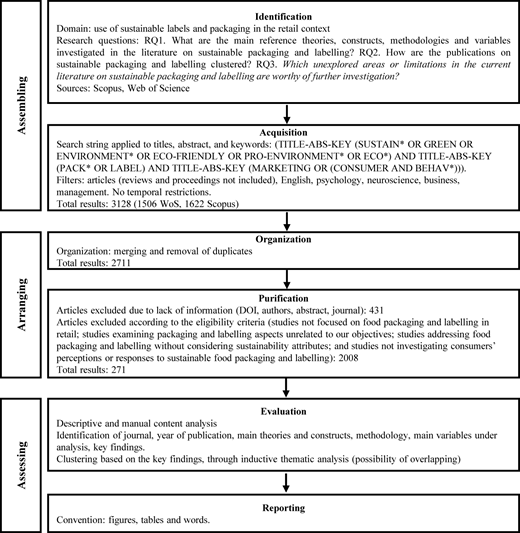
A systematic literature review was conducted in July 2024 following the SPAR-4-SLR protocol (Paul et al., 2021), for its transparent and replicable approach in retail research (de Carvalho et al., 2024). The entire procedure—including the research questions, search strings, applied filters, intermediate and final outputs, exclusion criteria, and evaluation and reporting strategies illustrated in Figure 1—was independently conducted by two researchers to ensure reliability.
The process followed three phases - assembling, arranging, and assessing.
Assembling phase. The assembling stage involved literature identification and acquisition. To address the three research questions previously outlined, Scopus and Web of Science (WoS) were selected as primary sources to minimize database bias and maximize recall. During acquisition, several search strings were tested to balance comprehensiveness and relevance. A broader query was ultimately adopted [1], intentionally excluding the terms “retail” and “food,” as their inclusion could have omitted studies where the food retail context was implicit. To maintain relevance, the broad search was followed by a rigorous qualitative screening focused on the food retail domain. The search was limited to English-language articles within psychology, neuroscience, and business/management, yielding 3,128 results. No temporal restrictions were imposed, allowing to capture the historical evolution of research from its inception. Arranging phase. The arranging stage consisted of two substages: organization and purification. In terms of organization, the dataset was unified in Excel and cleaned from duplicates, yielding 2,711 records. After excluding 431 records with incomplete bibliographic information (e.g, dois, author names, abstracts), 2,280 articles remained. During the purification stage, a stepwise screening process was applied (e.g. Silva and Palsson, 2022). We excluded: (1) studies not focused on food packaging and labelling in retail (e.g. other sustainability topics as food waste management, or industries as fashion); (2) studies examining packaging and labelling aspects unrelated to our objectives (e.g. supply chain management or shelf-life extension); (3) studies addressing food packaging and labelling without considering sustainability attributes; and (4) studies not investigating consumers' perceptions or responses to sustainable food packaging and labelling. To enhance reliability, the exclusion criteria were independently applied by two researchers, with discrepancies resolved through discussion. Following this rigorous cleaning process, the sample comprised 271 studies that met eligibility criteria.
Assessing phase. The final dataset underwent descriptive mapping and content analysis by two independent researchers to examine publication trends, geographic distribution, methodologies, and theoretical frameworks. Abstracts—and full texts when necessary—were manually coded to identify core contributions. Two independent coders identified recurring themes across the reviewed studies, which were then compared and consolidated through discussion into five overarching thematic clusters. Using an inductive thematic analysis (Braun and Clarke, 2006), studies were grouped into five clusters based on their frequency and relevance to consumer perceptions and marketing strategies in food retailing. Each article was assigned to its predominant cluster, with discrepancies resolved through discussion to ensure consistency and reliability. Finally, findings were reported through figures, tables, and narrative synthesis.
3. Results
This section presents the findings on the research questions, examining publication trends over time, tracing the development of literature, and analysing the methodologies, theoretical frameworks, and dependent variables investigated (RQ1). Key insights are summarised into five clusters representing the main contributions of the literature (RQ2). Finally, a research agenda highlights the main gaps and areas for further study (RQ3).
3.1 Annual scientific production and publication sources
The analysis of 271 articles underlines the growing interest in the topic. Only six papers (2.21%) were published before 2000, with 19 (7.01%) between 2001 and 2010, 117 (43.17%) from 2011 to 2020, and 129 (47.60%) since 2021, highlighting the sharp increase in recent years and the rising importance of packaging and labelling in promoting sustainable consumption in retail. This trend reflects both stronger policy measures and growing consumer demand for eco-friendly products, positioning sustainable packaging and labelling as an increasingly central topic in academic and practical debates.
Regarding publication sources, most papers appear in the Journal of Cleaner Production (17.34%), followed by Appetite (6.64%) and British Food Journal (5.90%). Other notable sources include Business Strategy and the Environment (5.17%), International Journal of Consumer Studies (4.80%), Journal of Food Products Marketing (3.69%), and Journal of Retailing and Consumer Services (3.32%), comprising 128 papers in total. The remaining 143 papers are distributed across a highly fragmented set of journals, most of which appear only once or twice, indicating a wide dispersion of research outlets beyond the core sources. Overall, the publications largely derive from journals on food, sustainability, and consumer-related topics.
3.2 Methodologies
Four primary methodologies were identified: quantitative (mainly surveys and experiments), qualitative (including in-depth interviews, ethnography/netnography, descriptive studies, focus groups, and case studies), literature reviews, and mixed-method designs. Quantitative methods dominate, accounting for 220 papers (81.18%), with 138 using surveys (50.92%), 73 experiments (26.94%), and 9 applying other quantitative techniques (3.32%; e.g. application of econometric models to secondary data). Qualitative approaches are used in 25 publications (9.23%), mixed-methods in 20 (7.38%) and literature reviews in 6 (2.21%).
The predominance of survey-based studies indicates a focus on measuring consumers' self-reported attitudes and intentions, while the strong presence of experimental designs reflects increasing efforts to identify causal relationships under controlled conditions. However, the limited use of qualitative and mixed-method approaches suggests there is scope for deeper insights into consumer motivations and real-life practices.
3.3 Theoretical frameworks and constructs employed
Understanding why consumers adopt or resist sustainable practices requires descriptive data but also theoretical frameworks explaining how attitudes, information, and perceptions shape choices. Accordingly, the reviewed publications rely on complementary theories that address both deliberative and heuristic aspects of sustainable packaging and label adoption. This section reports the theories employed by the reviewed papers.
Most studies draw on the Theory of Reasoned Action (TRA; Ajzen and Fishbein, 1980) and successor, the Theory of Planned Behaviour (TPB; Ajzen, 1991), which together account for 20.77% of theoretical approaches. Since TPB extends TRA by adding perceived behavioural control, they are treated as a single framework. TPB explains how attitudes, social norms, and perceived control shape intentions and behaviours, and has been widely applied to sustainable consumer behaviour in food retail (Zhang et al., 2022; Lin et al., 2022). For instance, Koenig-Lewis et al. (2014) show that attitudes and social norms influence eco-friendly intentions, with environmental concern a key mediator.
A key strength of TPB is its flexibility with variables like environmental concern and knowledge included to enhance its explanatory power (Singh et al., 2023). Environmental knowledge, the degree to which consumers actually know the subject (objective), but also the extent to which they feel they have memorised it (subjective; Nguyen et al., 2021), is shown to shape attitudes and intentions (e.g. Zhang et al., 2022; Sun et al., 2021). For example, Zhang et al. (2022) find that knowledge directly affects attitudes, with religious values moderating this effect. Similarly, environmental concern - the willingness to support solutions to environmental issues (Nguyen et al., 2021) - emerges as a key predictor of pro-environmental behaviour (e.g. Singh et al., 2023).
The second most used framework (approx. 6%) is Signalling Theory (Spence, 1973), which addresses information asymmetry in market exchanges and how signals reduce uncertainty. In terms of sustainable products, where ecological attributes are credence qualities, signals such as ecolabels, carbon-footprint labels, and sustainability claims enhance trust and influence willingness to pay (WTP). Trust mediates the effect of label credibility on purchase intention (e.g. Atkinson and Rosenthal, 2014), while perceived risk moderates it (Brach et al., 2018). Empirical applications include the evaluation of the effect of carbon footprint front-of-pack labels (Ang et al., 2024), the impact of sustainability tagging in e-commerce (Sigurdsson et al., 2022), and how credible green advertising fosters trust and reduces perceived risk (Sun et al., 2021). These studies show that signals function not just as information but as tools to reduce risk and shape consumer choices.
Although less frequently used, Cue Utilization Theory (Burnkrant, 1978) is also relevant, explaining how consumers use cues - intrinsic (e.g. taste) and extrinsic (e.g. packaging design and ecolabels) - to infer product attributes. In food retail, extrinsic cues like ecolabels or packaging colours help form perceptions of tastiness, healthiness, and sustainability, guiding choices even when product knowledge is limited (Orlowski et al., 2022). For instance, “natural” labels influence taste and health perceptions (Wang et al., 2023), while packaging colours affect WTP (Hallez et al., 2023). Non-traditional formats and innovative packaging cues also enhance perceived sustainability and purchase intention (Norris et al., 2024).
Together, these frameworks show that sustainable consumption results from the interplay between deliberate planning (TPB/TRA), credible communication (Signalling Theory), and heuristic processing (Cue Utilization Theory), highlighting the multifaceted nature of consumer decision-making and offering a roadmap for future research to integrate these perspectives.
3.4 Most investigated dependent variables
A systematic understanding of the aforementioned dependent variables is essential for grasping relationships in food retail. Identifying under-researched variables helps reveal conceptual and empirical gaps, supporting scholarly progress and evidence-based retail strategies.
Purchase intention - likelihood or willingness to buy - is the most studied dependent variable, influenced by ecolabels or sustainable packaging (Ang et al., 2024; Monnot et al., 2015), environmental concern (Sun et al., 2023), TPB constructs (attitude, subjective norms, perceived behavioural control) (Santos et al., 2021), and socio-psychological and demographic factors (Meet et al., 2024). These TPB constructs often mediate between independent variables and purchase intention.
Another key variable is WTP, the value consumers assign a product (Duckworth et al., 2022; Herrmann et al., 2022), which is driven by similar predictors: labelling and packaging, environmental awareness, knowledge, and individual characteristics.
Less frequently studied variables include satisfaction (Hu et al., 2022; Louis et al., 2021), other sustainable behaviours (precycling - Klug and Niemand, 2021; use of in-store information - Van der Merwe et al., 2022; reuse/recycling - Baird et al., 2022), and acceptance of ecolabelled or eco-packaged products (Xu et al., 2024).
Finally, perceptions, sometimes predictors themselves, are also explored as dependent variables, most notably sustainability (Hallez et al., 2023; Herédia-Colaço, 2023), healthiness (Hallez et al., 2023), quality (Donato and Adıgüzel, 2022), and environmental friendliness (Sokolova et al., 2023), which are shaped mainly by ecolabel design and packaging features, objective (e.g. colour, type) and subjective (e.g. attractiveness).
3.5 Main thematic clusters
An inductive thematic analysis (Braun and Clarke, 2006), based on abstracts and full texts where necessary, was used to code findings and themes across the reviewed studies, and group them into recurring thematic patterns. This identified the five main thematic clusters through which sustainable consumption in food retail has been examined. Cluster 1 focuses on the impact of information and labels on consumer behaviour, with informational cues - such as ecolabels and claims - its primary analytical emphasis. Cluster 2 addresses psychological and emotional drivers of sustainable consumption, highlighting how affective responses and value-based motivations shape sustainable food choices. Cluster 3 examines cognitive and informational processes, particularly consumer awareness, knowledge and education. Cluster 4 captures external and internal influences, emphasising how social norms, cultural context, and perceived behavioural control enable or constrain sustainable consumption. Finally, Cluster 5 focuses on design-based heuristics, examining how packaging design and branding shape sustainable choices.
Although analytically distinct, the clusters show substantial overlap, as many studies engage with multiple dimensions simultaneously. This overlap reflects the inherently multidimensional nature of sustainable consumption, consequence of the interaction of informational, affective, cognitive, and social–contextual processes rather than isolated mechanisms. Accordingly, the clusters represent complementary thematic dimensions rather than mutually exclusive categories. Table 1 summarises their core focus, theoretical foundations, key mechanisms, and empirical findings.
In conclusion, the five clusters show that sustainable packaging and labelling influence consumer behaviour through the interplay of informational cues, affective and value-based motivations, cognitive understanding, social-contextual influences, and design heuristics. Together, the clusters organize the fragmented literature into an integrated view of sustainable food retailing, where packaging and labelling simultaneously function as information cues, trust signals, emotional triggers, educational tools, and choice-architecture elements. Future research can use the clusters to identify underexplored mechanisms and test relationships among their constituent constructs across retail contexts, product categories, and stages of the consumer journey.
4. Future research directions
Despite the progress in understanding sustainable food packaging and labelling, key gaps remain. To better identify drivers and barriers to sustainable consumption, future studies should use innovative methods and theories to explore key variables and their interconnections, fostering more effective marketing strategies and policies, consumer engagement, and innovation in sustainable food retail.
4.1 Methodological approaches
Existing literature offers a limited understanding of the emotional and cognitive drivers behind sustainable behaviours in food. Future research could explore these using diverse methodologies.
Mixed methods: combining qualitative (e.g. in-depth interviews, focus groups) with quantitative methods (e.g. SEM analysis, experiments) to examine how consumers perceive and respond to sustainable packaging and labels.
Neuromarketing and unconscious processes: using tools such as Implicit Association Tests (Koenig-Lewis et al., 2022), eye-tracking, EEG, GSR, PPG and fMRI to explore unconscious processes that influence consumer choices.
Real-world settings: focusing on real behavioural measures (e.g. in-store experiments) to increase external validity, reduce social desirability bias, and bridge the intention-behaviour gap.
New technologies: applying techniques like augmented reality and blockchain to enhance the interactivity and transparency of digital labels, exploring their impact on consumption.
4.2 Theoretical approaches
Theoretical advancements are equally critical. While TPB (Ajzen, 1991) remains widely used, its limitations necessitate the exploration of alternative theories. Construal Level Theory (CLT) (Trope and Liberman, 2010) examines how psychological distance - spanning temporal, spatial, and social dimensions - affects consumer perceptions and choices regarding eco-friendly products. Similarly, Cue Utilization Theory (Olson and Jacoby, 1972) provides a valuable framework for investigating how intrinsic (e.g. recyclable materials) and extrinsic cues (e.g. certifications) influence consumer trust and sustainability perceptions. Emotion-related theories can help explore the role of complex emotions - hope, shame, or indignation - in shaping sustainable purchase intentions.
4.3 Research directions by thematic clusters
Research can also be organized around clusters. Cluster 1 - Future studies should employ longitudinal designs to track the evolution of consumer trust in ecolabels. Techniques like eye-tracking could shed light on how consumers visually engage with labels and their subsequent impact on purchasing decisions. Consumer confusion around complex or multiple labels should also be explored, alongside the effectiveness of digital labels in mitigating this. Cluster 2 - future research should examine emotional responses to sustainable packaging through neuromarketing tools and cultural variations in reaction to sustainability claims. The adoption of sustainable technologies, influenced by emotional and psychological factors, also warrants deeper exploration. Cluster 3 - Future work should assess the effectiveness of targeted informational campaigns in enhancing consumer knowledge and understanding of ecolabels. Identifying effective consumer segmentation strategies, particularly for less informed groups, could optimize educational interventions. Cluster 4 - Studies should analyse how social media, influencers, and online reviews shape consumer sustainability perceptions. Further research should examine how consumers navigate trade-offs between sustainability and other priorities, like price and convenience. Cluster 5 - Innovative formats, including packaging-free shopping and smart packaging, require further empirical assessment. Studies should also explore how branding strategies foster emotional bonds with consumers and enhance loyalty, while identifying which visual packaging cues best capture the attention and drive sustainable choices at points of sale.
5. Discussion and conclusions
This study analyses the evolution of sustainable food packaging and labelling research by systematically reviewing 271 peer-reviewed articles published between 1991 and 2024. Integrating diverse theories, methods, and findings, it provides a comprehensive overview of a fragmented field and identifies key thematic clusters showing how cognitive, emotional, and contextual factors drive consumer adoption of sustainable packaging and labelling. The synthesis supports cumulative theory building and outlines a future research agenda that extends beyond traditional behavioural models to include signalling, cue-utilisation, and practice-based perspectives, focusing on the intention–behaviour gap.
The review shows that sustainable packaging and labelling shape consumer behaviour through interconnected cognitive, emotional, and contextual processes. Clear and credible sustainability labels guide consumers toward responsible choices (Nguyen-Viet, 2022), while visual cues - colours, icons, and typography - influence perceived credibility (Thøgersen and Nielsen, 2016). Packaging materials also affect purchasing, especially among environmentally conscious consumers. Beyond rational evaluation, future orientation and engagement in sustainable value creation reinforce these effects (Yang et al., 2021).
Overall, sustainable consumption in food retailing is a multifaceted phenomenon where rational information and design cues interact with emotional trust, future orientation, and social context. Packaging and labelling act as both information and signalling tools, helping consumers navigate complex sustainability claims. The thematic clusters are interrelated, reflecting the field's interconnected nature and potential for cross-domain insights, and overlaps across clusters reflect the complexity of sustainable packaging and labelling, where informational cues, affective and cognitive processes, social and cultural influences, perceived behavioural control, and design-based heuristics interact rather than operate in isolation.
Theoretically, the findings both support and challenge behavioural models. The TPB (Ajzen, 1991) explains how attitudes, norms, and perceived control influence intentions (Yang et al., 2021), yet the persistent intention–behaviour gap (Prakash and Pathak, 2017) exposes its limits. Complementary theories - Cue Utilization (Burnkrant, 1978) and Signalling (Spence, 1973) - clarify how extrinsic cues and credible certifications foster trust but overlook emotional and habitual factors. Broader frameworks like Construal Level Theory (Trope and Liberman, 2010) could yield more integrative explanations.
Despite its growth, the field remains fragmented and methodologically narrow. Most studies rely on self-reported surveys and experiments, with little observational or longitudinal evidence (Prakash and Pathak, 2017; Santos et al., 2021). Emotional and subconscious factors - pride, guilt, heuristics - are less explored than cognitive constructs (Koenig-Lewis et al., 2014). Research is also geographically concentrated in Europe and North America, neglecting cultural diversity (Alamsyah et al., 2020; Shimul and Cheah, 2023). Emerging topics like digital and smart labelling, package-free formats, and post-purchase behaviours (reuse, recycling, loyalty) remain underexamined.
From a retailing and policy perspective, the review offers several actionable implications to reduce the well-documented intention–behaviour gap by making sustainable choices easier and more salient. First, labels should ensure clarity, simplicity, and credibility, as the proliferation of sustainability labels can generate confusion and reduce trust (Cluster 1 – informational cues). Retailers can complement front-of-pack labels with QR codes and digital tools providing additional sustainability information while relying on third-party certifications to enhance credibility. Policymakers can support harmonized labelling standards, clearer regulations, and stronger monitoring mechanisms to reduce greenwashing and improve comparability across products.
Second, sustainability communication should combine factual information with emotional engagement (Cluster 2 – affective and value-based motivations). Positive emotions such as pride and hope appear more effective than guilt-based appeals in encouraging sustainable choices. Retailers can communicate the environmental and social impact of purchases through shelf signage, loyalty programs, app notifications, and storytelling campaigns, while policymakers can reinforce these efforts through public campaigns emphasizing positive environmental outcomes and collective benefits.
Third, consumer education remains essential to reducing knowledge gaps and scepticism (Cluster 3 – cognitive and informational processes). Retailers can support learning through interactive labels, QR codes, augmented reality tools, and in-store campaigns explaining sustainability claims and certifications. Policymakers can complement these initiatives through educational programs aimed at improving sustainability literacy and consumers' understanding of environmental information.
Fourth, the effectiveness of sustainable packaging and labelling depends on balancing sustainability with price, convenience, and accessibility (Cluster 4 – social influences and perceived behavioural control). Retailers can reduce barriers by offering affordable sustainable alternatives, optimizing shelf placement, creating sustainable bundles, and making greener options the default choice. Policymakers can support these efforts through incentives and measures that increase the affordability and availability of sustainable products.
Finally, packaging design should integrate functional and symbolic cues (Cluster 5 – design-based heuristics). Retailers should use recognizable sustainability signals, intuitive icons, and simplified visual designs that facilitate decision-making while reducing cognitive effort. Smart packaging can further enhance transparency through information on freshness, recycling, and traceability, while policymakers can encourage evidence-based packaging standards and support experimentation with digital and smart-labelling technologies.
This study has limitations. First, the use of Scopus and WoS, exclusively in English, may have excluded relevant contributions, while minor overlap inconsistencies across databases cannot be ruled out. In addition, research on sustainable packaging and labelling is expanding rapidly. As the literature search was conducted in 2024, more recent publications may not be included in this review. Future studies may therefore be needed to capture emerging developments and ensure comprehensive representation of the evolving literature. Beyond these review-specific constraints, the literature is dominated by cross-sectional and intention-based studies frequently reliant on self-reported data, limiting understanding of actual behaviour and perpetuating the persistence intention–behaviour gap. Likewise, the predominance of individual-level frameworks, like TPB, emphasizes attitudes and perceptions while providing weaker explanations of routines, habits, and socially embedded practices. These limitations, plus the limited focus on emotional and cultural influences, highlight the need for more integrative and real-world research approaches. Recent behavioural and field studies (Louis et al., 2021; Torma and Thøgersen, 2024) have begun addressing these shortcomings.
In conclusion, sustainable packaging and labelling are key levers for promoting responsible consumption and enhancing shopper experience (Grewal et al., 2017). Ecolabels and green packaging guide choices when supported by credible information, positive perceptions, and strong policy frameworks that improve the consistency, comparability and comprehensibility of sustainability information. For retailers and policymakers, the message is clear: credibility, clarity, and convenience are vital to turning sustainable intentions into lasting action and tangible environmental and commercial gains.
Note
(TITLE-ABS-KEY (SUSTAIN* OR GREEN OR ENVIRONMENT* OR ECO-FRIENDLY OR PRO-ENVIRONMENT* OR ECO*) AND TITLE-ABS-KEY (PACK* OR LABEL) AND TITLE-ABS-KEY (MARKETING OR (CONSUMER AND BEHAV*)))