


Competence development is a prerequisite for successfully meeting existing and future challenges in the retail sector. However, current human resource development practices are often limited in their scope and offerings. This study sets out to investigate and bring to light informal learning among retail professionals.
This research consists of two exploratory studies focused on store managers and procurement officers, respectively. Based on a typology of learning mechanisms, the authors conducted eleven in-depth interviews, generating a rich body of empirical data centred on how informal learning takes place at work.
The research points out key learning mechanisms for each occupation and offers detailed narratives of how they are embedded in everyday learning. In addition, the findings provide a synthesis of the complex nature of learning mechanisms and their variations in form and orientation.
By generating tangible and explicit knowledge on the topic of informal learning, the results contribute to both professionals, who may actively engage in useful learning mechanisms, and managers, who may develop processes and structures based on key learning mechanisms.
This paper helps to demystify the tacit and often unnoticed learning that takes place at work. In doing so, it broadens the perspective on competence development and facilitates future discussions of human resource development practices in the retail industry and the research community.
1. Introduction
Developing employee competences is a prerequisite for successfully meeting existing and future challenges in the retail sector. Not only is the sector experiencing transformational challenges in terms of digitalisation (Hagberg et al., 2016) and omnichannel re-formation (Jocevski et al., 2019), but there are also fundamental changes in consumer behaviour (Maggioni et al., 2020) that need to be addressed. Simultaneously, all these changes affect the work content of retail employees, thereby significantly altering the competence required. At the same time, the sector suffers from a high turnover of employees (Bureau of Labor Statistics, 2022), and lack of competence development is one of the root causes for leaving. Competence development is likewise one of the main factors for candidates when considering to apply for a job in the retail sector or not (Ellingham, 2016).
Evidently, there is a multitude of reasons to pay attention to competence development in the retail industry, but there is also a need for re-evaluation. Although most companies still focus on formal learning programmes for competence development (Manuti et al., 2015), a large European Union investigation shows that companies with an extensive level of informal learning supersede others, both in terms of employee well-being and company performance (Kankaraš, 2021). Marsick and Watkins (2016) showed that more than 80% of all learning at work is informal; however, such learning often passes by unnoticed and is difficult to grasp for both employees and employers (Manuti et al., 2015). But though the perception of informal learning in practice may be blurred, many scholars have aimed to capture the phenomenon. More explicitly, scholars put forward that informal learning is strongly integrated in its context (Brandi and Iannone, 2021; Marsick and Watkins, 2016) and that there are differences between occupations in how one learns and becomes successful at work (Cheetham and Chivers, 2001). Still, existing research is often focused on either a general context (Nikolova et al., 2014) that aims to find common denominators for all organisations or is focused on individual characteristics that affect informal learning (Ellström and Kock, 2008; Marsick and Watkins, 2016). Thus, most current research is either based on a “one-size-fits-all” assumption or requires a unique understanding of each individual.
To address the call for context-based research and to provide knowledge of how informal learning takes place in the retail sector, we build on the cross-occupational body of knowledge and investigate the characteristics of informal learning in two selected retail occupations. The purpose is to explore how informal learning takes place for these professionals and to shed light on the tacit and often unnoticed learning that takes place at work. To do so, we use a qualitative approach with in-depth interviews with professionals in the retail sector. The results provide insights into the key learning mechanisms for each occupation, including detailed descriptions and explanations of how they work in practice.
The remainder of this paper is structured as follows: Section 2 introduces our view of learning and presents the learning mechanisms that have been identified and applied in the conducted studies. Section 3 describes the methodology, while Section 4 presents the results for each occupation. Section 5 provides a deeper discussion on the nature of learning mechanisms in terms of forms, orientations, combinations, and substitution effects. Finally, Section 6 concludes the paper, providing theoretical and managerial implications, limitations, and suggestions for further research.
2. Frame of reference
2.1 Competence and learning for retail employees
In the retail sector, people and their competence constitute a key asset for all companies (Knee, 2002), and multiple frameworks exist to help sort out the competence requirements (Specialist Vocational Training Ltd, 2021; United States Department of Labor, 2020). These requirements are not always met by university offerings (Pantano et al., 2021; Towers et al., 2020); instead, other formal training is offered by retailers. The need for training is increasing with the ongoing transformations in the retail industry; however, there are many challenges constraining such training. Competence development is often costly for companies, and for workers, there is a compromise between time-consuming learning activities and maintaining efficiency at work (Eraut, 2011). Furthermore, although many established retailers have their own internal education programmes, it is sometimes difficult for such competence development programmes to meet company requirements because of the rapid changes in the industry (Fuller et al., 2007). Informal learning at work in the retail sector is, therefore, becoming increasingly important.
2.2 Informal learning as a process
Informal learning takes place away from structured and formal classroom teaching settings and is typically described as unstructured, contextually dependent and unintentional, with no prescribed outcomes (Tynjälä, 2008). Conceptually viewing learning as a process, this study focuses on understanding how learning evolves. Two fundamental components start and end the learning process: learning activities and learning outcomes. In the middle, learning mechanisms connect learning activities with learning outcomes, explaining why learning happens (Derwik and Hellström, 2021). Learning mechanisms are an important component of the process, as not all learning activities necessarily lead to learning outcomes. Although this conceptualisation of learning might seem simple, in fact, the opposite is true. Informal learning is a complex web of interdependent processes (Billett, 2004), in which one learning activity may trigger multiple learning mechanisms, just as one learning mechanism may connect to multiple learning activities.
2.3 Mechanisms of learning
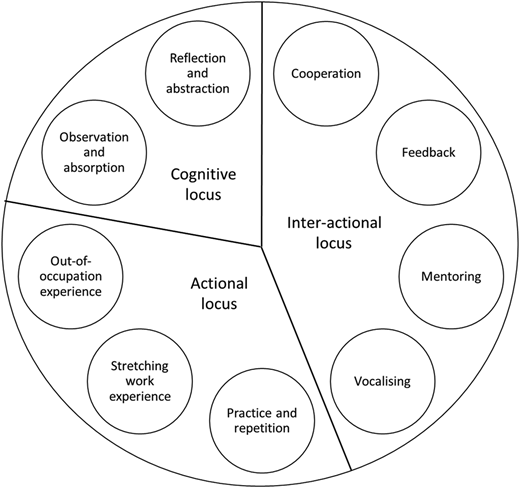
The current study is based on a typology of nine learning mechanisms derived from a theoretical framework of workplace learning mechanisms developed by Cheetham and Chivers (2001) and Derwik and Hellström (2021). Each learning mechanism is related to a range of learning activities and belongs to one of three loci (see Figure 1). Learning mechanisms with an inter-actional locus are related to learning through interaction with the social environment (Billett, 2004), actional learning mechanisms promote learning through doing the job (Ellström and Kock, 2008), and cognitive learning mechanisms are related to learning from individual reasoning and thinking (Nikolova et al., 2014; Tynjälä, 2008).
2.3.1 Inter-actional learning mechanisms
Four learning mechanisms belong to the inter-actional locus: collaboration, feedback, mentoring and vocalising. Collaboration is primarily about learning from two-way, work-based interaction and might, for example, be triggered by intervision (a method for collaborative problem-solving) (Kyndt et al., 2009), participation in multiple communities of practice (Fuller et al., 2007), and communication and interaction with colleagues, other departments, and clients (Tynjälä, 2008). Feedback is about managing one-way directed information from the social environment and is triggered by debriefings (Kyndt et al., 2009), formal performance appraisal, and continuous verbal or nonverbal peer and supervisor feedback (Nikolova et al., 2014; Ellström and Kock, 2008). Mentoring relates to learning from two-way initiated questions and discussions and may be triggered by buddy systems (Kyndt et al., 2009), peer-mentoring group meetings, and, of course, formal mentoring or coaching (Jacobs and Park, 2009). Vocalising is learning from aggregating and transferring information to one's surroundings and can be triggered by teaching activities, sharing information with external persons in a comprehensive way (Cheetham and Chivers, 2001), and coaching others (Jacobs and Park, 2009; Kyndt et al., 2009).
2.3.2 Actional learning mechanisms
Three learning mechanisms belong to the actional locus: practice and repetition, stretching work experience, and out-of-occupation experience. Practice and repetition refer to learning from basic work experiences and is, for example, triggered by doing the job itself (Tynjälä, 2008), incorporating the trial-and-error approach (Jacobs and Park, 2009), and rehearsing for future events (Cheetham and Chivers, 2001). Stretching work experience refers to learning from extended work experience and includes triggers, such as new or challenging tasks (Eraut, 2011; Tynjälä, 2008), complex assignments (Vaughan, 2008), and cathartic incidents (Billett, 2004). Out-of-occupation experience is related to learning from previous or current experiences from outside one's primary occupation and can be experienced both internally and externally. This learning mechanism may be triggered by the transfer of formal education (Tynjälä, 2008), job rotations and pre-entry experiences (Cheetham and Chivers, 2001).
2.3.3 Cognitive learning mechanisms
Two learning mechanisms belong to the cognitive locus: reflection and abstraction and observation and absorption. Reflection and abstraction are the art of learning from cognitive exercises at various levels and may, for example, be triggered by the use of perspective-taking exercises (Edmondson and Saxberg, 2017). Observation and absorption are related to learning from both conscious and unconscious copying and can be triggered by the use of formal or informal observation of peers and job shadowing (Jacobs and Park, 2009).
3. Methodology
With the aim of investigating informal learning in retail, we carried out two exploratory studies. Each study applied a qualitative approach to assist in diving into the details of the informal learning processes of the occupations investigated. A salient feature of these studies is the use of storytelling (Fawcett and Waller, 2014; New and Payne, 1995), which helps to present and explain the results. This approach has previously been successfully applied to investigate other subtle phenomena in the retail sector, such as perceptions of management mistakes (Palmer et al., 2010) and the everyday life of a retailer (Ruth et al., 2021). Below follows a description of how the occupations and respondents were selected and how the data were collected and analysed.
3.1 Research design and selection of respondents
To capture a broad and diverse flora of informal learning, the occupations were selected to reflect variety in terms of professional expertise, type of responsibility, and skill acquisition. In close dialogue with retail representatives, such as industry and union organisations, the following two occupations were selected:
Store managers – Store managers seldom work together with others in the same occupation. Therefore, they lack the opportunity to observe and interact with their peers and learn from them. Simultaneously, they experience grand expectations to develop within, for example, leadership.
Procurement officers – Procurement officers are not only expected to analyse prices but also need to understand the whole system to optimise prices according to requested product quality and delivery service requirements. Most of this competence is learned at work.
Using purposeful sampling (Patton, 2002), eleven respondents were selected to capture a wide range of informal learning experiences, both from work in the occupation itself but also from other related positions before and after work in the occupation. To secure as many aspects as possible, the sampling included a mixture of senior and junior professionals. Senior professionals are expected to have gained a profound understanding of the occupation, including what competences are required and how such competences can be developed. Junior professionals are expected to have a fresher perspective and reflections on workplace learning in their occupations. As shown in Table 1, the respondents collectively had over 200 years of experience in the retail sector.
Characteristics of respondents per study
| Gender | Current position | Years in work life | Years in retail sector | Years in occupation |
|---|---|---|---|---|
| Study 1 – Store managers | 143 | 140 | 80 | |
| Male | Store manager | 16 | 16 | 6 |
| Female | Store manager | 40 | 40 | 35 |
| Female | Store manager | 23 | 23 | 13 |
| Female | Store manager | 18 | 17 | 2 |
| Male | Regional manager for operations | 26 | 24 | 14 |
| Male | Talent sourcing and EVP leader | 20 | 20 | 10 |
| Study 2 – Procurement officers | 81 | 64 | 41 | |
| Male | Procurement officer | 7 | 1 | 1 |
| Male | Senior procurement officer | 13 | 16 | 5 |
| Female | Procurement officer | 15 | 3 | 2 |
| Female | Senior procurement officer | 19 | 17 | 9 |
| Female | Senior procurement officer | 27 | 27 | 24 |
3.2 Data collection and analysis
The data were collected through in-depth interviews and the interview protocol was carefully designed and tested to capture as much information as possible on the topic. All sessions started with the respondents describing the characteristics of a successful fictive person in the investigated occupation. The remaining questions all referred to this fictive person and their journey to success in the occupation. Three rounds of questions were conducted. First, there was an open question about the journey and their views about the learning process needed to become successful in the occupation. This was done to obtain as many of the respondents' original reflections as possible. Next, the learning mechanisms were presented, one at a time, asking how each mechanism contributes to such learning that makes a professional successful. This was done to create awareness of possible learning situations, as informal learning is tacit and does not always take place consciously. In connection with each mechanism, corresponding learning activities were then presented, asking for additional input on the mechanism. At the end of the interview, each respondent was asked to rank each mechanism on a 5-point Likert scale from “Does not contribute at all” to “Contributes to a very high degree”. This final request acted as comparative and reflective reasoning about the mechanisms and their relative contributions to becoming successful in the occupation under study. The interviews lasted approximately 90 min and were recorded and transcribed within a couple of days to ensure accuracy (Edwards and Holland, 2013). The semi-structured protocol enabled the respondents to zoom in and out on the topic (Kvale, 2007), hence generating both an overview of opinions and detailed examples. Thanks to the protocol, the sessions were extremely focused and generated a rich body of empirical data consisting of more than 200 pages of transcriptions.
To cope with the large amount of qualitative empirical data, analysis was conducted continuously and in three coding steps for each study and occupation. First, the empirical data were coded à priori (Stemler, 2001) according to the learning mechanisms presented in the frame of reference (collaboration, feedback, mentoring, vocalising, practice and repetition, stretching work experience, out-of-occupation experience, observation and absorption, and reflection and abstraction). The outcome was a structured set of rich data for each mechanism and occupation. Open coding (Strauss and Corbin, 1998) was then conducted for each learning mechanism and occupation, helping to identify subconcepts and describe, in more detail, the informal learning process for each occupation. Finally, axial coding was applied to determine the relationships among the learning mechanisms and between occupations.
Interviews, transcriptions, and initial coding were conducted by the main author. To improve validity, subconcepts and relationships were discussed and reviewed between the authors during the entire data collection and analysis process (Lincoln and Guba, 1985). In addition, the preliminary results were discussed with the latter respondents in each study after their interviews had been completed. To help facilitate and structure the work, the NVivo 12 software package was used throughout the data analysis.
4. Results
The results point out a range of key learning mechanisms for each investigated occupation, which were found to be more significant than others in the journey to becoming successful at work. The finding of key learning mechanisms for specific occupations is explicable and in line with previous research (Cheetham and Chivers, 2001; Derwik and Hellström, 2021). As each occupation has its own collection of competence requirements or desired learning outcomes, there is also an inferred connection to specific learning mechanisms in the learning process. Therefore, we start by presenting the profile or competence requirements of each occupation and then describe how informal learning takes place based on the identified key learning mechanisms.
4.1 Key learning mechanisms for store managers
A store manager's occupation is broad in terms of its tasks and responsibilities and is not easily defined or limited. The respondents highlighted the great variety of customers, employees, products, seasonal elements, and store formats that make learning a continuous and necessary part of their work life. They described it as follows: “You need to participate and develop—in what happens in society, in retail and everything.” and “I don't live on what I learned 35 years ago.”
A noticeable finding and characteristic of the store manager occupation is the strong connection between the store manager and their store and coworkers, which was sometimes difficult for the respondents to separate when reflecting upon learning. This strong connection condenses down to the core of the profession, which was expressed as: “How can I make this become as good as possible and operate as well as possible when I'm not here?” (i.e. not in the store). Thus, a successful store manager focuses on employees and makes them feel like important cogs in the wheel. This correlates with two repeatedly valued skills: leadership and communication. Other cited skills were economy and visual form or marketing, along with a positive and dedicated mindset. To manage and achieve success in this occupation, three learning mechanisms were highlighted as essential: mentoring, observation and absorption, and practice and repetition.
4.1.1 Mentoring for store managers
Mentoring was unanimously put forward as an essential learning mechanism for store managers, unsurprisingly so for learning related to leadership and handling tough situations, but more surprisingly so for comparing key numbers and learning how to interpret results. Because store managers often work alone, the respondents highlighted a deficit of perspectives for assessing what constitutes good or bad performance. By comparing numbers with peers or other retail experts, such learning can be facilitated. The essence of such conversations is something like the following: “Here's how I read those categories; by comparing with your view of things, it gets so much clearer.” Another participant told, “Let's compare numbers, eh, talk about invoices, are they on the right month … ? What does it look like for you? This is how it looks for me.’
4.1.2 Observation and absorption for store managers
Many of the respondents claimed that observation and absorption are valuable for learning about best practices from other stores. Through this mechanism, store managers can get inputs into display techniques, the pricing landscape, placement, and when things are done in time. One respondent reflected, “My God, would it not be awesome if you could go to another store for a week, imagine what you could learn, if I could go to a … (thinking) … big store of ours!” The value of such observations was highlighted from two perspectives: you learn both what to copy and what not to copy.
Observations of previous store managers were also mentioned as a source of learning, primarily in terms of leadership but also regarding business acumen. One respondent described how she observed her bosses, commenting that it was important to “set a good example when facing her own coworkers. How would you like to be treated yourself? By observing, you can become your best you, and get your coworkers on board”. Another respondent described how he learned a great deal from observing his former store manager, primarily regarding marketing and customer-buying behaviour.
4.1.3 Practice and repetition for store managers
Practice and repetition are found to be vital for becoming successful as a store manager, not so much for the ordinary work in the store but for learning to manage teaching and coworker meetings. Teaching was described as a major part of store managers' daily work. One respondent expressed it as follows: “As a store manager, you do a little teaching all the time. No lectures, of course, but staff meetings, and you talk about your experiences, and what I can do and how I think things should be done to save time and make it easier for them [i.e. the coworkers].” Another respondent commented, “Often we get this [from headquarters]—this thing we are supposed to do—then we have to teach it [to our coworkers].” Teaching can be challenging, and one respondent explained, “If you have 20 employees, they will have heard 20 different things, even if you only told them one thing.” Practice and repetition were said to play an essential role in learning how to manage such communication successfully.
Coworker meetings are another crucial element for store managers. The meetings are important to ensure that “one gathers the herd, because we are a herd, and we must have a common goal—if I have one goal of my own and the coworkers another goal, [it doesn't work]—we must all have a common goal to make this store profitable, we must do it together”. Many respondents highlighted the importance of practice before a coworker meeting: “You simply don't sit down with a coworker unless you are prepared.” For senior store managers, it was suggested that the previous practice was enough. For junior store managers, practice in the form of preparation was advised, for example, by role-playing with a colleague or partner before the meeting.
4.2 Key learning mechanisms for procurement officers
The respondents unanimously highlighted three vital characteristics for a successful procurement officer: social ability, knowledge of the market and industry, and analysis and decision ability. More importantly, the respondents put forward the profession's core as understanding the business and why specific requests need consideration. This was explained as follows: “A successful procurement officer understands why, and not just how. Understanding “how” is something that many can do—you only need to follow the instructions. To close the deal, I need to know, more concretely, what is it really that we are trying to reach?” Although the context differs between procurement officer positions (number of suppliers, types of products, etc.), this core understanding is vital for all contexts, and the respondents highlighted the need for procurement officers to “have an open mind, be curious, dare to ask questions”. Furthermore, the respondents put forward a successful procurement officer to be creative and constantly considering “how can we buy even better products, how can we buy them at an even better price, and really challenge every single part of the supply chain?”.
Obviously, a procurement officer needs a broad profile to become successful, which, according to the respondents, cannot be acquired from school alone. This is also mirrored by the wide range of identified key learning mechanisms for successful procurement officers: cooperation, mentoring, observation and absorption, practice and repetition, and out-of-occupation experience.
4.2.1 Cooperation for procurement officers
Cooperation was considered a vital learning mechanism by all respondents, as it is of great help in obtaining information about the surrounding world, as well as in getting an understanding of the critical “why” question. One respondent described a successful procurement officer as one who “knows about our company and our suppliers, how the market works for those product groups, but maybe also knows something about our competitors, where we need to meet to win market shares, but also, to be able to see a bit forward/into the future: What will happen? Are volume and price on their way up or down?” The list of information desired is thus rather long, and cooperation is an essential learning mechanism for learning as much as possible about this. One respondent described her boss when she was new herself: “I didn't understand it at first, he talks a lot on the phone, but it was so he could hear from every supplier.” For monetary types of input, the empirical data indicate a somewhat problematic situation with respect to sharing information. One respondent commented, “It's difficult—maybe if you worked at several places and have contacts left, then you can get insights, but it's often hush-hush.” Another respondent pointed out that information sharing is not only about contacts but can also involve foul play.
4.2.2 Mentoring for procurement officers
Many of the respondents put forward mentoring as a beneficial way of getting support and learning about reasoning in the procurement officer occupation. “Sitting all alone with your thoughts would be rather difficult”, according to one respondent. A mentor could also be someone who does not have insight into the specific industry but has other experience. One respondent put forward her domestic partner as an example, explaining that: “I learn a lot from him as he has come much further in his career than I have and works with production which is a related field to procurement”. Although the results suggest strong positive outcomes from mentoring, respondents also imply that there is room for improvement. “To have had someone to toss around ideas with and compare prices would have been really useful for me”. Obviously, mentoring options at work are not always satisfactory.
4.2.3 Observation and absorption for procurement officers
The respondents unanimously described observation and absorption as an essential learning mechanism, assisting in the learning of both behaviours and practical knowledge. One respondent talked about her experiences as a purchasing assistant when she was new in the profession: “I have worked for all kinds of people: one psychopath, one who was extremely tough in negotiations, and one who was extremely twisting, making things difficult both for himself and for the supplier. Of course, I have reflected on their behaviour—it has formed me in my career.” In terms of practical knowledge, the results cover small examples from writing “ciao” at the end of emails to form a more positive relationship with suppliers to more encompassing copying. One respondent described how she, based on observation, gained success when she finally was put in charge of her own product group: “ … and then I got peas and beans, a smaller product group, but I embraced it as if it were the biggest at the company, which was really fun because it has done a really nice development, but I kind of just observed and copied what the tomato procurement officers did.”
4.2.4 Practice and repetition for procurement officers
Practice and repetition were consistently pointed to by the respondents as being valuable for learning both the practice itself and for addressing behavioural issues. Arguments were put forward: “It is very difficult to become a successful procurement officer purely through theoretical studies.” and “It was really nice to do the practical work—that is, operational procurement—because suddenly you understood that this is the baseline in the deal.” Regarding behavioural issues, the respondents claimed that repeatedly conducting live negotiations vastly improves negotiation skills or behaviour for juniors, just as learning how to handle large complaints against suppliers requires practice and repetition.
4.2.5 Out-of-occupation experience for procurement officers
All respondents had pre-entry experiences, and they considered out-of-occupation experience useful for becoming successful as a procurement officer, primarily through contributing to system understanding and behavioural issues. One respondent argued, “Getting the customer's thinking, I believe that is very important as a procurement officer because if you don't know what the end-customer wants, it is more difficult to do a good job.” Another respondent claimed, “If you have worked in the warehouse, been at the transport department, been at customer support, you get the full picture of the chain, which broadens your knowledge, so you don't sub-optimise too much.”
Regarding behaviours, relationships are key for the procurement officer occupation. One respondent testified that having worked as a car salesman helped him a great deal when transferring to the procurement officer occupation. He explained, “In the car industry, I have learned to negotiate really well, I have learned to talk to people in a calm way. I have learned to handle upset customers who think I've sold them a faulty car.”
5. Discussion
Informal learning at work is complex and often intangible; therefore, it is difficult to understand and take advantage of. This paper provides insights into how informal learning takes place at work in two retail occupations by presenting the explicit key learning mechanisms for each. This clearly shows that tacit learning is embedded within occupational settings. Furthermore, it shows both similarities and differences in the identified key learning mechanisms; however, informal learning is more complex. We therefore provide a synthesis of the nature of learning mechanisms and their variation in form and orientation, as well as possible combination and substitution effects.
5.1 Forms of learning mechanisms
Although we found that occupations have similar key mechanisms, they may take on different forms depending on the occupation and its profile and competence requirements. For example, observation and absorption were found to be essential for both occupations investigated but in different ways. Procurement officers described the learning mechanism as focused on behaviour: how to talk to suppliers and how to set up a successful negotiation, where learning is achieved through observing colleagues. For store managers, who often work alone with their subordinates, the learning mechanism is more about benchmarking and observing how external others are doing their business than internal observations. For example, store managers like to observe and learn about ways of working with displays, pricing, and marketing from others.
5.2 Learning versus task orientation
Learning mechanisms are the underlying features explaining why learning takes place; however, linguistically, they may also have a task-based orientation that is equally important to becoming successful in an occupation. For example, cooperation may be viewed from both a learning and a task perspective, where the former generates learning outcomes and the latter generates business outcomes. Although the difference is clear in theory, it may still be difficult to distinguish between them in practice. Both business and learning outcomes will lead to success, and both take place in connection to work and may occur unconsciously. It is, however, vital to be aware of the difference because how one learns one's tasks must not be the same as doing the task itself. For example, store managers highlighted vocalising as an essential learning mechanism, explaining that they frequently teach their coworkers to improve the business. However, such vocalising was focused on the task of teaching coworkers, as opposed to the store manager's own learning. Although store managers can achieve success by vocalising, their learning outcomes are limited. Instead, a deeper analysis of the empirical data showed that practice and repetition were the key mechanism for store managers to learn how to teach successfully. Another example is collaboration, which many store managers highlighted as essential to becoming successful in the occupation. However, this success was related to business outcomes for the store rather than to learning outcomes for the store manager. This is in contrast to procurement officers, who actually get learning outcomes from cooperation connected to their need for market information. To avoid misunderstandings of how informal learning takes place and thereby jeopardising valuable learning opportunities, it is important to differentiate between business and learning outcomes.
5.3 Combinations of learning mechanisms
The results display informal learning by presenting identified key learning mechanisms in isolation. In practice, however, there is overlap, and the mechanisms are used in combination. This creates another dimension of learning—a complexity that is difficult to capture in full but deserves to be highlighted. For example, cooperation was found to be a key learning mechanism for procurement officers, but these situations also allowed for the observation of behaviour and interplay between different actors and, hence, subsequent learning. Furthermore, mentoring was a key mechanism for store managers and procurement officers, but insights from this mechanism need to be tested through practice and repetition, for example, in how to conduct a coworker meeting or set up a negotiation. Thus, learning mechanisms are used in combination at work; this creates synergistic effects in the learning process.
5.4 Substitution effects between learning mechanisms
The findings have also revealed substitution effects between learning mechanisms, meaning that one mechanism could replace another in its absence. For example, some procurement officers highlighted the importance of feedback on behavioural matters, primarily for junior respondents. Regrettably, such feedback was considered restricted, which may have to do with the somewhat secretive nature of the occupation. Senior procurement officers may want to keep their best tips to themselves. Interestingly, such learning was then substituted for by another learning mechanism: observation and absorption. The same applies to mentoring, where a few respondents claimed a limited availability of mentoring in practice, inferring the use of other learning mechanisms, such as observation and absorption. Although this means using the second-best mechanism rather than the preferred one, informal learning must still be considered a strong method for competence development because it self-compensates through substitution for deficits in the learning process and the availability of learning mechanisms.
6. Conclusion
Because of rapidly changing competence requirements and the high turnover of employees, the retail sector needs new ways to secure competence development. This paper explores informal learning, which is one critical component to address this competence development challenge but also to meet future demands on lifelong learning (Edmondson and Saxberg, 2017). Competence is perishable, and if we want to stay successful in an occupation, we need to learn continuously. From a lifelong learning perspective, it is therefore vital to understand how informal learning takes place in practice and the potential it possesses for future competence development.
Based on empirically grounded research studies, we have managed to capture and illuminate how informal learning takes place in two retail occupations: store managers and procurement officers. By taking off from a typology of learning mechanisms, the findings reveal key learning mechanisms for each occupation while providing descriptive interpretations and preliminary explanations for each learning mechanism. Thereby, this research assists in transferring unknown and tacit conceptions of how informal learning takes place into explicit knowledge. Such knowledge is a prerequisite for understanding how professionals become successful at work and how such learning can be supported.
6.1 Theoretical and managerial contributions
Our findings on learning mechanisms may seem evident and unsurprising, as informal learning is not revolutionary and very much exists in practice today. However, informal learning often passes by unnoticed and is based more on gut feelings and tradition than on conscious decisions and scientifically based arguments (Eraut, 2011). The current research helps concretise the intangible and complex learning process through the investigation of two retail occupations and their learning at work. By presenting learning as a process and launching a typology of learning mechanisms, we provide a vocabulary that may contribute to future discussions of informal learning in both industry and the research community.
Theoretically, this research complements previous studies that investigate formal training situations (Sabrina and Matthias, 2016) or explore informal training from the perspective of digitalisation (Steinbuss et al., 2017) or external learning situations (Haag et al., 2021). Through the lens of learning mechanisms (Derwik and Hellström, 2021), this research deepens the understanding of how informal learning takes place in the retail sector. This broadens the domain of informal learning that previously explored informal learning from an organisational perspective (Khandakar and Pangil, 2019) or investigated the effects of informal learning rather than the process (Kankaraš, 2021). Moreover, it extends the literature that focuses only on specific informal learning elements at work, such as reflection or learning from errors (Hetzner et al., 2015), by encompassing the entire range of informal learning at work. Furthermore, in doing so, the present research provides a structure that can help in understanding informal learning more systematically, which is in contrast to other research that provides only narrative descriptions (Roberts, 2013).
Managerially, the current research contributes to broadening the perspective of competence development. By generating tangible and explicit knowledge on the topic of informal learning, the results contribute to both professionals, who may actively engage in useful learning mechanisms, and to human resource managers, who may develop processes and structures based on these essential learning mechanisms.
6.2 Limitations and future research
Like all research, the current study also has limitations. First, informal learning is highly contextual, and there is no “one-size-fits-all” method for becoming successful at work. The present study has investigated two retail occupations; thus, there is a range of future research opportunities to explore other occupations in the retail sector. Additionally, to complement the lens of learning mechanisms, communities of practice (Lave and Wenger, 1991) offer a promising research avenue for adding insights into how informal learning takes place for various occupations. Second, a key issue to delve into is how informal learning may be facilitated, not least from a remote and hybrid perspective. The scope of the current research is related to informal learning in traditional workplaces, and although the work situation for some respondents had changed because of pandemic restrictions, the interviews were still based on their insights and experiences from a normal situation. However, the respondents testified that they experienced difficulties in, for example, feedback and observation and absorption when work was increasingly being performed remotely. Therefore, future research may investigate how remote work affects professionals' informal learning and how any negative effects can be offset. Finally, there are limitations to the sample of respondents, which is limited in number and based exclusively on a Nordic context. This may imply better compliance for professionals in similar cultures, so future research may extend or finetune the scope of the respondents. However, by providing thick descriptions of the contextual factors of the occupation as well as of the learning process for each of the two occupations, it is possible to perform naturalistic generalisations, even if the number of respondents is limited in number (Lincoln and Guba, 1985). It should be noted that our purpose in conducting this study was not to generate ultimate verified knowledge but instead to produce inputs useful for both scholars and practitioners when it comes to increasing awareness of and initiating discussions about informal learning.
The authors would like to express their deepest gratitude to all who contributed to making this study possible: all the store managers and procurement officers who generously shared their experiences on informal learning, the anonymous reviewers who provided valuable and constructive feedback and not least the Swedish Retail and Wholesale Council that kindly financed the project.

