The purpose of this paper is to examine the relationship information integration and sustainability of health projects, mediated by project risk management.
The study employs a cross-sectional and quantitative research design, using correlation and regression analysis to test the hypotheses. A sample of 120 key project participants (project managers, coordinators and opinion leaders) was drawn from 40 health projects in the Central Region of Uganda. Data were analyzed using SPSS and Smart PLS.
Information integration and PRM significantly predict the sustainability of health projects in Uganda by 49.1%. Also, PRM partially mediates the relationship between information integration and project sustainability, highlighting the need for stronger risk management structures in ensuring long-term success.
Only a single research methodological approach was employed; thus, future research through interviews could be undertaken to triangulate results.
The study highlights the importance of integrating information-sharing systems to enhance sustainability. Healthy organizations should invest in robust information management frameworks to facilitate knowledge sharing, timely risk assessment, and effective decision-making to boost existence of projects beyond donor funding.
This study contributes to the body of knowledge by finding further support for the relationship between relationship information integration and the sustainability of health projects. It further demonstrates that project risk management partially mediates the relationship between relationship information integration and the sustainability of health projects, an area that has received scant attention in the project management literature.
1. Introduction
The sustainability of health projects is crucial for economic and social development, especially in developing economies like Uganda (World Health Organization [WHO], 2022). A resilient health sector ensures continuous access to quality healthcare, enhances life expectancy, and strengthens human capital, all of which are vital for economic productivity (World Bank, 2021). Sustainable health initiatives help reduce disease burdens, promote public health, and foster national development. Recognizing this, global frameworks such as the United Nations Sustainable Development Goal 3 (SDG3) emphasize the need for strong health systems that can withstand financial and operational shocks (United Nations, 2015). Similarly, Uganda's Vision 2040 and the National Development Plan (NDP) stress the role of a robust healthcare sector in economic transformation and poverty reduction (National Planning Authority, 2020).
Uganda allocates approximately 6.5% of its national budget to healthcare (World Bank, 2024), funding numerous health projects aimed at providing sustainable services. However, despite these commitments, many projects struggle with sustainability due to weak institutional frameworks, financial instability, and inefficient operations (Ministry of Health Uganda, 2023). A key challenge is their inability to continue beyond donor support. For instance, the recent USAID cutoff under President's Emergency Plan for AIDS Relief (PEPFAR) project led to severe disruptions, including over 1.4 million people losing ARV treatment access, 41 babies contracting HIV daily, and over 20,800 healthcare workers losing jobs (Joy for Children Report, 2025).
One critical factor influencing health project sustainability is information integration, which involves seamless coordination, sharing, and utilization of healthcare data (Bagyendera, Nabende, & Nabukenya, 2023). Effective data integration improves decision-making, accountability, and resource allocation (Heeks, 2018). However, its contribution to the health sector in Uganda has received limited scholarly attention. Uganda's health projects continue to operate in silos, with fragmented data systems, poor interoperability, and weak information governance (World Bank, 2021; UNDP Uganda, 2020). These inefficiencies lead to duplicated efforts, resource mismanagement, and reduced project viability. While information integration is essential, its impact on sustainability depends on project risk management (PRM), which helps identify, assess, and mitigate risks affecting project performance (Rodríguez-Rivero, Ortiz-Marcos, Ballesteros-Sánchez, & Sánchez, 2021). Health projects in Uganda face financial uncertainties, policy shifts, logistical challenges, and operational inefficiencies (PMI, 2021). Without structured risk management, even well-funded projects with strong information systems struggle to sustain their impact (Qazi, Shamayleh, El-Sayegh, & Formaneck, 2021).
Despite its importance, there is limited empirical evidence on PRM's mediating role in the relationship between information integration and project sustainability (Magoola, Mwesigwa, & Nabwami, 2023). Most studies focus on financial aspects rather than operational sustainability (Heeks, 2018; Isabekova, 2023) and scholars have called for further research (Mwesigwa, Basulira, Mayengo, & Mugarura, 2024; Arinaitwe, Aikiriza, Kakooza, & Bagire, 2024). Besides, while the Resource-Based View (RBV) and Risk Management Theory offer insights into organizational capabilities and risk frameworks (Barney, 1991; Clifford & Smith, 1995), a comprehensive theoretical model linking these dimensions remains underexplored. Additionally, practical research on how donor-funded projects sustain operations post-funding is scarce (USAID, 2022). This study bridges these gaps by demonstrating that information integration and PRM significantly predict the sustainability of health projects in Uganda by 49.1%. Furthermore, PRM partially mediates the relationship between information integration and project sustainability, highlighting the need for stronger risk management structures in ensuring long-term success.
2. Literature review
2.1 Theoretical review
2.1.1 The Resource-Based View (RBV) theory
As developed by Barney (1991), the RBV theory posits that an organization's ability to achieve long-term success depends on its internal resources and capabilities. According to RBV, competitive advantage arises from resources that are valuable, rare, inimitable, and non-substitutable (VRIN). Organizations that effectively leverage these resources can sustain their operations and adapt to environmental uncertainties. In the context of health projects, sustainability depends on how well projects utilize their internal resources, such as human capital, financial support, technology, and risk management capabilities, to achieve long-term impact (Wernerfelt, 1984). Effective information integration being part of the resources enhances decision-making, improves operational efficiency, and strengthens accountability, all of which are crucial for sustaining health projects (Bagyendera et al., 2023). Within the RBV perspective, a well-integrated information system serves as a strategic asset that can enhance project sustainability by ensuring better planning, monitoring, and service delivery. Effective information integration and risk management can serve as strategic resources, enabling organizations to anticipate challenges, optimize resource allocation, and achieve long-term project outcomes. While prior studies (Riley, Klein, Miller, & Sridharan, 2016; Giannakis, & Papadopoulos, 2016) demonstrate the benefits of information integration, they rarely connect these practices explicitly to RBV, leaving a gap in understanding how internal capabilities translate into sustainable outcomes.
2.1.2 Risk management theory
The Risk Management Theory (RMT) provides a structured approach to identifying, assessing, and mitigating uncertainties that may hinder the achievement of organizational objectives (Smith & Merritt, 2002). The theory posits that organizations can enhance their long-term sustainability by implementing proactive risk management strategies that minimize financial, operational, and strategic threats (Hopkin, 2018). In the context of health projects, risk management is crucial in ensuring that initiatives remain effective, resilient, and sustainable despite funding uncertainties, policy changes, and operational challenges (PMI, 2021). Health projects in Uganda operate in a highly uncertain environment, facing risks such as donor funding cuts, inefficient resource allocation, regulatory changes, and logistical disruptions (Rodríguez-Rivero et al., 2021). Through effective risk identification and assessment, projects can anticipate uncertainties and survive within dynamic operating environments.
Risk Management Theory emphasizes the identification, assessment, and mitigation of potential threats to project objectives (El-Sayegh, Manjikian, Ibrahim, Abouelyousr, & Jabbour, 2021). Existing literature highlights its positive impact on sustainability through improved decision-making, stakeholder engagement, and resource efficiency (Giannakis & Papadopoulos, 2016; Orieno, Ndubuisi, Eyo-Udo, Ilojianya, & Biu, 2024). However, some studies report mixed outcomes, particularly when organizations lack sufficient capacity or institutional support, suggesting that risk management effectiveness depends on context and complementary capabilities. By integrating RBV and Risk Management Theory, this study provides a more comprehensive framework for understanding how internal resources and risk management practices collectively enhance project sustainability.
While RBV and Risk Management Theory offer complementary explanations for project sustainability, their integration provides a stronger theoretical foundation for this study. From the RBV perspective, information integration represents a strategic organizational resource that enhances knowledge sharing, coordination, and decision-making. However, possessing information resources alone may not guarantee sustainable project outcomes. Risk Management Theory explains how these resources are transformed into sustainability outcomes through systematic risk identification, assessment, monitoring, and control. In this regard, project risk management operationalizes information integration by converting available information into actionable strategies that reduce uncertainty, strengthen resilience, and support the continuity of project benefits. Thus, project risk management serves as the mechanism through which information integration contributes to the sustainability of health projects.
2.2 Conceptual review
2.2.1 Information integration
Information integration involves combining data from various sources to create a unified, coherent view, enhancing data management and decision-making within organizations (PMI, 2023). This process consists of two key components: information sharing and collaborative planning. Information sharing entails the exchange of critical data among project members through various communication channels, such as meetings, emails, and online platforms, ensuring that all stakeholders have access to accurate and timely information essential for coordinating activities and making informed decisions (Kordova & Hirschprung, 2023; PMI, 2023). Collaborative planning complements information sharing by engaging stakeholders in joint strategizing and decision-making, aligning goals and actions to improve overall project efficiency (Cai, Jun, & Yang, 2010). By fostering an environment where information is readily accessible, organizations can build trust and prevent misinformation, which could damage their reputation and undermine project success (Asimakopoulos, Antonopoulou, Giotopoulos, & Halkiopoulos, 2025).
2.2.2 Project risk management
Project risk management involves a systematic approach to identifying, analyzing, and responding to risks (Hillson, 2020). When risks are properly managed, they contribute to improved project performance, enabling better planning, resource allocation, and time management (Kutsch & Hall, 2019). In dynamic project environments, effectively managing risks can be the decisive factor between success and failure, underscoring its importance in project management.
The first step in risk management is identifying potential risks using methods such as brainstorming, expert judgment, and SWOT analysis (PMI, 2023). Once identified, the risks are assessed for their likelihood and potential impact using techniques like risk probability and impact assessments, along with Monte Carlo simulations (Schwalbe, 2018). This assessment process helps prioritize risks based on their severity. After assessment, the next step is to develop appropriate response strategies. Kerzner (2017) identifies four key strategies: avoidance (eliminating the risk), mitigation (reducing the likelihood or impact), transfer (shifting responsibility to another party), and acceptance (acknowledging the risk for low-impact situations). These strategies, when applied effectively, ensure that risks are managed properly and that projects remain on track despite uncertainties.
2.2.3 Project sustainability
Project sustainability is an approach that balances environmental, social, and economic aspects to meet the needs of current stakeholders without compromising the ability of future generations to meet their own needs (Mwesigwa et al., 2024). Filene (2011) defines project sustainability as the ability of a project to maintain its operations and impact indefinitely. A project is considered sustainable when it continues to benefit its stakeholders over an extended period and remains relevant in the long term (Laurell, Karlsson, Lindgren, Andersson, & Svensson, 2019; Ssekiziyivu, Mwesigwa, Orobia, & Tusiime, 2022).
For a project to achieve sustainability, it must minimize its negative environmental impact while promoting social initiatives that benefit stakeholders (Fourati & Dammak, 2021; Gangi, D’Angelo, Daniele, Varrone, & Coscia, 2020). The Triple Bottom Line (TBL) framework by Elkington (1997) emphasizes the need for projects to maintain a balance between social, economic, and environmental factors. As Orobia, Tusiime, Mwesigwa, and Ssekiziyivu (2020) highlight, projects have an obligation to society by considering economic, social, and ecological dimensions in their decision-making and operations, ensuring long-term sustainability.
2.3 Relationship between variables
2.3.1 Information integration and project sustainability
Empirical studies consistently demonstrate that information integration enhances project sustainability by improving coordination, transparency, and resource utilization. Anjaria (2024) found that integrated information systems improve operational efficiency and stakeholder engagement, thereby supporting sustainable project outcomes. Similarly, Ssekiziyivu and Banyenzaki (2021) reported that information integration promotes accountability and reduces project failure resulting from communication breakdowns. Mwesigwa et al. (2024) further observed that timely and accurate information enables effective resource allocation and supports the implementation of sustainable project practices.
From a theoretical perspective, the Resource-Based View (RBV) argues that organizations achieve sustainable outcomes by effectively utilizing valuable, rare, inimitable, and non-substitutable resources (Barney, 1991). Information integration represents a strategic organizational resource that enhances coordination, adaptability, and decision-making, thereby strengthening project sustainability (Grant, 1996). Based on this reasoning, the study hypothesizes that:
Information integration is positively related to project sustainability
2.3.2 Project risk management and project sustainability
Project risk management contributes to sustainability by enabling organizations to identify, assess, monitor, and mitigate threats that may undermine project objectives. Previous studies have shown that effective risk management enhances resource efficiency, decision quality, and long-term project performance (Giannakis & Papadopoulos, 2016; El-Sayegh et al., 2021). Similarly, Orieno et al. (2024) reported that integrating risk management practices into project implementation helps organizations address environmental, social, and economic risks, thereby improving sustainability outcomes. Although some studies report context-specific challenges, the overall evidence suggests that effective risk management supports project sustainability.
Risk Management Theory posits that organizational sustainability depends on the ability to proactively identify and manage uncertainties that may threaten project objectives (Hopkin, 2018). Through risk assessment, monitoring, and control mechanisms, organizations can enhance resilience and ensure continuity of project benefits over time. Therefore, this study hypothesizes that:
Project risk management is positively related to project sustainability.
2.3.3 Information integration and project risk management
Information integration plays a critical role in strengthening project risk management by facilitating timely access to accurate and comprehensive information. Integrated information systems improve communication among project stakeholders, reduce information asymmetry, and support early identification of project risks (Aven, 2016; Speier-Pero & Waring, 2021). When information flows effectively across project teams, managers are better able to assess potential threats and implement appropriate risk response strategies.
From the Resource-Based View, information integration represents a strategic organizational capability that improves the utilization of project knowledge and enhances organizational responsiveness to emerging risks. Access to reliable information strengthens risk assessment and supports informed decision-making, thereby improving overall project risk management effectiveness. Accordingly, the study proposes that:
Information integration is positively related to project risk management.
2.3.4 The mediating role of project risk management
Existing evidence suggests that information integration alone may not be sufficient to ensure sustainable project outcomes unless the information generated is effectively translated into risk management actions. Hammouri et al. (2025) found that risk management significantly mediates the relationship between information technology integration and project performance. Similarly, Orieno et al. (2024) indicate that organizations achieve superior outcomes when integrated information systems support proactive risk identification and mitigation processes.
The integration of RBV and Risk Management Theory provides a strong explanation for this relationship. RBV suggests that information integration constitutes a valuable organizational resource that enhances access to timely, accurate, and relevant information. However, the benefits of this resource can only be realized when organizations possess the capability to effectively utilize it. Risk Management Theory explains how project risk management, as an organizational capability, transforms information resources into sustainable outcomes through risk identification, assessment, monitoring, and control. Consequently, project risk management acts as the mechanism through which information integration contributes to project sustainability by reducing uncertainty, strengthening resilience, and supporting the continuity of project benefits. Therefore, the study hypothesizes that:
Project risk management mediates the relationship between information integration and project sustainability.
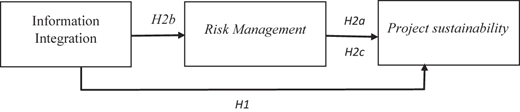
The conceptual model illustrates the hypothesized relationships between the key study variables (Figure 1). Information integration is posited as the independent variable, influencing project sustainability (dependent variable) both directly and indirectly through project risk management (PRM) as a mediating variable. The model is grounded in the Resource-Based View (RBV) and Risk Management Theory, which highlights the role of structured risk processes in mitigating threats to project objectives. This integrated framework provides a clear rationale for the study's hypotheses.
3. Methodology
3.1 Research philosophy and design
The study followed a positivist philosophical approach, which asserts that knowledge is acquired through objective observation and measurement of tangible reality (Saunders, Lewis, & Thornhill, 2023). A cross-sectional research design and a quantitative approach were adopted, enabling data collection at a single point in time to test the formulated hypotheses (Creswell & Creswell, 2018).
3.2 Population, sample size, data collection and procedure
The study focused on 45 health projects operating in Uganda's Central Region, specifically in the districts of Kampala, Wakiso, Mukono, and Buikwe (Ministry of Health, 2018). These districts were selected because they host a high concentration of donor-funded and government-supported health initiatives, offering a diverse and representative setting for assessing project sustainability. From this population, a sample of 40 projects was determined using Krejcie and Morgan's (1970) sampling formula to ensure a statistically adequate and representative sample size. Each project contributed three respondents typically the project manager, project coordinator, and a community opinion leader yielding a total of 120 responses. This multi-respondent approach enhanced data validity by capturing multiple perspectives on information integration, risk management, and project sustainability within each project.
To ensure representativeness, a simple random sampling technique was used to select the 40 projects, giving each eligible project an equal chance of inclusion and thereby minimizing selection bias at the project level. Within each selected project, purposive sampling was applied to identify respondents who possessed relevant expertise and firsthand experience in project implementation and management. This hybrid approach combined the strength of random sampling for generalizability with purposive sampling for information richness and reliability of responses (Saunders et al., 2023; Ssekiziyivu et al., 2022). Potential bias from purposive selection was mitigated by using standardized inclusion criteria (role, tenure, and level of involvement in project activities) to ensure consistency across all projects.
Data were collected using a self-administered questionnaire based on a 7-point Likert scale ranging from 1 = Strongly Disagree (SD) to 7 = Strongly Agree (SA). This scale was chosen for its precision, ease of use, and ability to capture respondents' true evaluations (Neuman, 2011). Additionally, the questionnaire method was selected for its efficiency in reaching a diverse respondent pool and deriving average ratings (Alinda, Wakibi, Ahimbisibwe, & Andabati, 2024; Ssekiziyivu, Bagire, Ngoma, & Nkurunziza, 2023). From each project, three respondents were selected, resulting in a total of 120 participants. Their responses were aggregated at the project level, using each project as the breaking variable.
3.3 Sample characteristics
In terms of years, majority (41%) of the health projects had existed for 4–7 years, indicating a moderate level of project maturity. In terms of location, 38.5% of health projects were implemented in Kampala, followed by 30.8% in Wakiso, 20.5% in Mukono, and 10.2% in Buikwe district, reflecting a concentration of projects in urban and peri-urban areas.
Regarding demographic characteristics, male respondents dominated the study (53.8%), while female respondents accounted for 46.2%. This suggests that most projects are implemented by males, possibly due to the physical demands and flexibility required for certain project tasks. The majority (89.6%) of respondents were above 30 years of age, while only 10.3% were younger than 30. This highlights the experience level of project implementers, which is crucial in handling technical aspects to ensure projects achieve their intended objectives.
Concerning academic qualifications, 80.8% of respondents held a bachelor's degree or higher, while 19.2% had undergraduate diplomas. This indicates that most respondents met the educational requirements for their roles and possessed the necessary knowledge for effective project implementation. In terms of job positions, 57.7% were project supervisors, while 42.3% were project managers. The higher representation of supervisors is likely due to their availability at project sites. Additionally, in terms of experience, 82% of respondents had over five years of experience in the project field, while only 18% had worked for less than five years. This suggests that organizations prioritize hiring experienced personnel with the skills and knowledge necessary for effective project execution, particularly given the dynamic operational environment and the strategic importance of projects.
3.4 Validity and reliability
The instrument met the validity and reliability threshold of 0.7 and above, as recommended by Field (2009). The Content Validity Index (CVI) was 0.80 for information integration, 0.87 for project risk management, and 0.93 for project sustainability. Reliability was assessed using Cronbach's alpha, yielding values of 0.78, 0.91, and 0.94, respectively, all exceeding the recommended 0.7 cut-off (Field, 2009).
Additionally, to establish convergent validity, the principal components for each variable were extracted by running a principal component analysis. Exploratory factor analysis was adopted to reduce the data to a manageable size. Using SPSS, the factor structures are shown in Tables 1–3. More than one factor was derived from each rotated component matrix, essential in establishing convergent validity. Results in Table 1 revealed the factor structure for information integration. Two factors were extracted, with Eigenvalues of 4.527 and 2.225 respectively. The percentage of total variance comes out to be 67.528%, an indication of the total variance is explained by the construed factors out of all variables. Results in Table 2 revealed the factor structure for project risk management. Three factors were extracted, with Eigenvalues of 7.120, 2.037 and 1.322, respectively. The percentage of total variance is 69.861%. Results in Table 3 revealed the factor structure for project sustainability. Three factors were extracted, with Eigenvalues of 6.209, 1.787 and 1.419 respectively. The percentage of the total variance is 62.770%, indicating that the construed factors explain the total variance out of all variables.
3.5 Measurement of variables
Previously developed and validated measures were used. Information integration was measured by information sharing and collaborative planning, adapted from Cai et al. (2010). Project risk management was measured using dimensions such as risk identification and assessment, risk control and risk monitoring based on Project Management Institute (2008). Sustainability was measured using continued benefits, institutionalization and capacity building as earlier applied by Shediac-Rizkallah and Bone (1998) and Namiyingo et al. (2016).
3.6 Data analysis
Data were compiled, sorted, classified, entered, and analyzed using SPSS (Statistical Package for Social Sciences). Descriptive statistics were generated to understand respondent characteristics. Pearson correlation analysis examined relationships between study variables, while regression analysis assessed the predictive power of independent variables on the dependent variable. Smart PLS was used to test for mediation using the bootstrapping approach. The bootstrapping approach was suitable for mediation analysis because it makes no assumption about the sampling distribution of the statistics, it is suitable for small sample sizes (Hair, Hult, Ringle, & Sarstedt, 2022) and provides more accurate confidence intervals for mediation analysis (Zhao, Lynch, & Chen, 2010).
4. Findings
4.1 Correlation analysis results
In order to initially examine the strength and direction of the relationship between information integration, project risk management and sustainability, we performed Pearson (r) correlation coefficient. Results in Table 4 indicate a significant and positive correlation between information integration and sustainability (r = 0.546**, p < 0.01). This suggests that effective information sharing and collaborative planning enhance the long-term viability of health projects. Also, Information integration is significantly correlated with project risk management (r = 0.413**, p < 0.01), indicating that better collaborative planning and information sharing improve risk management practices. More so, Project risk management significantly correlates with sustainability (r = 0.612, p < 0.01), suggesting that effective risk identification, control, and monitoring contribute to long-term project success.
Additionally, the positive correlation between information integration and sustainability and the significant relationship between project risk management and sustainability indicate a possible mediating effect of project risk management in the link between information integration and sustainability.
4.1 Regression results
A multiple regression model was used in the study to examine the extent to which Information Integration and Project Risk Management predict the Sustainability of Health Projects. Table 5 shows that these two variables account for 49.1% of the variance in sustainability (R Square = 0.491), while the adjusted R Square value indicates that 46.3% of the variance is explained after adjusting for the number of predictors. The results further show that Information Integration (Beta = 0.375, Sig. = 0.007) and Project Risk Management (Beta = 0.457, Sig. = 0.001) are both significant predictors of sustainability (p < 0.05). Among the two, Project Risk Management is the most influential predictor, as indicated by its higher Beta value (0.457) compared to Information Integration (0.375).
4.2 The mediating role of project risk management
The mediating effect of project risk management on the relationship between information integration and the sustainability of health projects was tested using SMART-PLS software. PLS-SEM was chosen because it allows for the simultaneous estimation of measurement and structural models, as well as the testing of mediation effects using bootstrapping (Hayes, 2013). A bootstrapping procedure with 5,000 resamples was employed to assess the significance of the indirect effect of information integration on sustainability through project risk management. Bootstrapping is appropriate for mediation analysis because it does not assume normality of the sampling distribution and is robust for relatively small sample sizes (Hair et al., 2022; Wakibi et al., 2024). Compared to the Sobel test, bootstrapping provides higher statistical power and more accurate confidence intervals for the indirect effect (Zhao et al., 2010; Ssekiziyivu et al., 2023).
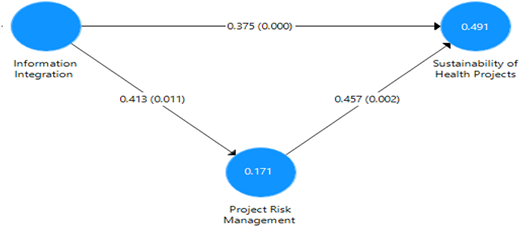
The conceptual model (Figure 2) shows that information integration and project risk management together explain 49.1% of the variance in the sustainability of health projects, indicating a substantial combined effect of the independent variable and the mediator. This approach ensures a rigorous, theory-driven assessment of the mediating role of project risk management.
To assess potential common method bias, a full collinearity assessment using VIF values and Harman's single-factor test was conducted. VIF values ranged from 1.23 to 2.11, well below the threshold of 3.3, indicating no significant multicollinearity or CMB issues. Harman's single-factor test showed that the first factor accounted for 38.5% of the total variance, below the 50% threshold. These results confirm that the observed relationships are not inflated by common method bias.
Table 6 indicates that all direct paths are statistically significant (p < 0.05, t-statistic>1.96) (Hair et al., 2022). Specifically, information integration has a positive direct effect on both project risk management (β = 0.413, p = 0.011) and the sustainability of health projects (β = 0.375, p = 0.000), while project risk management also significantly impacts sustainability (β = 0.457, p = 0.002). Additionally, the indirect effect of information integration on sustainability through project risk management is significant (β = 0.189, p = 0.046). The total effect of information integration on sustainability is strong and significant (β = 0.564, p = 0.000). These results suggest that information integration influences sustainability both directly and indirectly, through its impact on project risk management. Since both the direct and indirect effects are significant and supported, this indicates partial mediation (Hair et al., 2022).
5. Discussion of findings
The results indicate that information integration is positively related to project sustainability. This implies that H1 was supported. This means that the better the information flow and sharing within a project, the more likely the project will be able to thrive in the long run. Key benefits include better decision-making, more efficient problem-solving, stronger collaboration, and the ability to adapt to challenges each of which can support the project's ongoing success and stability. The result concurs with Anjaria (2024), who found out that integrating information systems is key in promoting sustaining projects. The findings are also supported by RBV theory, which posits that organizations or projects can achieve a sustainable competitive advantage by leveraging VRIN resources (Barney, 1991). Information integration serves as a strategic resource that enhances coordination, reduces inefficiencies, and fosters adaptability, thereby contributing to long-term project sustainability (Grant, 1996). By ensuring the effective use of knowledge and data, integrated information systems strengthen stakeholder trust, improve resource utilization, and enhance the overall resilience of projects (Ssekiziyivu & Banyenzaki, 2021; Mwesigwa et al., 2024).
The study also established a positive and statistically significant relationship between project risk management and the sustainability of health projects. This means that H2(a) was supported. This implies that when health projects have the necessary capacity for risk assessment monitoring and control, they can enhance decision-making on control measures, ensuring the continuous provision of services even after the withdrawal of external donor support. These findings align with Coskun, Dikmen, and Birgonul (2023), who argued that visualizing interrelated threats, vulnerabilities, and objectives supports risk mitigation decisions, ultimately contributing to sustainability in construction projects. The results are further supported by Zieba, Durst, and Hinteregger (2022), who found a positive and significant relationship between knowledge risk management and sustainability in organizations.
The results further indicate a positive and significant relationship between information integration and project risk management. This implies that H2(b) was supported. This suggests that project managers and implementers who leverage information integration to generate and disseminate timely and accurate risk-related data are better prepared to address risks as they arise. Effective collaboration among project teams facilitates early risk identification and the swift implementation of control measures, enhancing the success of health projects. These findings align with Alhawari, Karadsheh, Talet, and Mansour (2012), who found that a lack of knowledge or inadequate knowledge sharing during project execution can undermine risk management effectiveness and, in extreme cases, lead to project failure. Similarly, findings concur with Daradkeh (2024) who emphasized that information integration helps mitigate environmental uncertainty. Additionally, Rehacek and Bazsova (2018) asserted that large projects delivering significant value to beneficiaries require greater information resources, time, and attention to risk management compared to smaller, short-term internal projects with flexible deadlines.
Finally, findings indicate that project risk management partially mediates the relationship between information integration and project sustainability. This implies that H2(c) was supported. This means that project risk management is a conduit through which information integration relates with sustainability of health projects. This result confirms Hammouri et al. (2025) who also found out that the mediating role of risk identification effectiveness, indicating that its contribution to successful project risk management is significantly enhanced when it empowers teams to identify potential risks early and accurately.
6. Conclusion and implications
The study establishes that information integration plays a crucial role in enhancing project sustainability by fostering effective communication, collaboration, and decision-making. The findings confirm that well-integrated information systems contribute to project sustainability by strengthening stakeholder trust, improving resource utilization, and increasing adaptability. Additionally, project risk management positively influences project sustainability, particularly in health projects, by ensuring risk identification, monitoring, and control, even in the absence of external support. The results also highlight the strong link between information integration and project risk management, demonstrating that seamless data sharing enhances the ability to identify and mitigate risks effectively. Moreover, the partial mediation effect of project risk management in the relationship between information integration and sustainability underscores the importance of risk management as a strategic mechanism for achieving long-term project success.
6.1 Theoretical implications
This study makes three important theoretical contributions. First, it extends the Resource-Based View (RBV) by demonstrating that information integration is not only a valuable organizational resource but also a resource whose value is realized through project risk management capabilities. While RBV emphasizes the strategic importance of organizational resources (Barney, 1991), the findings show that information resources alone may not guarantee sustainable project outcomes. Rather, their effectiveness depends on the organization's ability to transform information into actionable risk management practices that support long-term project sustainability.
Second, the study advances Risk Management Theory by demonstrating that project risk management is not merely a project control function but a strategic capability that contributes directly to sustainability. The significant mediating effect of project risk management suggests that risk identification, assessment, monitoring, and control enable organizations to convert information resources into sustainable outcomes. This highlights the strategic role of project risk management in achieving continuity and resilience in project environments characterized by uncertainty.
Third, the study contributes to theory by highlighting the importance of donor-dependent contexts such as health projects in developing countries. In such settings, sustainability challenges often emerge from funding uncertainties, institutional weaknesses, and changing stakeholder priorities. The findings demonstrate that project risk management becomes particularly critical in enabling projects to continue delivering benefits beyond donor support. Consequently, the study provides evidence that the interaction between organizational resources and risk management capabilities may be especially important in resource-constrained environments.
Furthermore, Uganda provides a theoretically relevant setting because it represents an environment characterized by donor dependency, resource limitations, and institutional uncertainty. These contextual conditions create a setting where the value of information integration and project risk management can be more clearly observed than in stable and well-resourced environments. Therefore, the findings contribute not only empirical evidence from Uganda but also theoretical insights into how organizational resources and capabilities interact to enhance project sustainability in developing-country contexts.
6.2 Practical implications
This study offers several implications for both project managers and policymakers seeking to enhance project sustainability.
For project managers and organizations, the findings highlight the critical importance of integrating information-sharing systems to support timely decision-making, knowledge exchange, and proactive risk assessment. Organizations should invest in robust information management frameworks that facilitate coordination across project phases and stakeholders. Strengthening project risk management capabilities is particularly vital in sectors such as health, where continuity of service and resilience against uncertainties are essential. Implementing proactive risk management strategies helps ensure that projects remain on track despite unforeseen challenges, resource constraints, or funding limitations.
For policy makers and donors, the study underscores the need to create enabling environments that support sustainable project outcomes. Policymakers should develop guidelines and standards for risk management and information integration to ensure consistent practices across projects. Donors and funding agencies can provide targeted financial and technical support to build organizational capacity in these areas. Additionally, incentivizing the adoption of integrated information systems and technologies can enhance transparency, coordination, and accountability, ultimately improving project sustainability.
6.3 Managerial implications
Project leaders should prioritize establishing clear communication channels and fostering a culture of collaboration to optimize the benefits of information integration. Training project teams in risk management best practices will further ensure that risk identification and mitigation strategies are effectively implemented. Moreover, leveraging technology to streamline data integration and risk management processes will enhance operational efficiency and long-term sustainability.
7. Limitations and future research areas
Despite its contributions, this study has several limitations. First, it focuses on health projects, which limits the generalizability of findings to other sectors such as construction, education, and manufacturing. Future research should examine diverse industries to assess the broader applicability of these results. Second, information integration and project risk management explain only 49.1% of the variance in project sustainability, indicating that additional factors may influence sustainability outcomes and warrant further investigation. Finally, the study relies solely on a quantitative approach, which may not fully capture contextual and nuanced insights. Future research could adopt a mixed-methods design, incorporating qualitative methods such as interviews, to provide a more comprehensive understanding of the mechanisms linking information integration and risk management to project sustainability.