


The core objective of this research is to bridge the notable knowledge gap regarding the interplay between individual company supply chain resilience, digitalization and broader logistics performance metrics. This involves a close examination of how digital practices and mindsets contribute to both proactive and reactive supply chain resilience, as well as the impact on overall logistics performance and the logistics performance index (LPI).
This investigation was carried out through a study of medium-high technology Turkish manufacturing companies, paying particular attention to their engagement with digital technologies. A comprehensive analysis of multi-source data from 403 Turkish manufacturing companies was conducted using path analysis via structural equation modeling, aiming to elucidate the dynamics between these variables.
The study unveiled a markedly negative correlation between supply chain resilience and logistics performance within the context of developing nations such as Turkey. It further illuminated how different facets of digitalization distinctly influence the nexus between proactive and reactive supply chain resilience and overall logistics efficiency in these regions. Notably, a digital mindset was found to weaken the association between proactive resilience and the LPI while exacerbating the adverse effect of reactive resilience on the LPI.
The findings highlight the critical nature of strategic digital adoption and integration for bolstering supply chain resilience and logistics performance, particularly spotlighting the textile sector in developing countries. However, the study’s focus on Turkish manufacturing companies might limit the generalizability of the findings across different contexts and industries.
By underscoring the importance of digital integration in improving supply chain and logistics operations, this research suggests pathways for enhancing economic stability and growth in developing nations, ultimately contributing to broader societal well-being.
This study contributes novel insights into the complex relationship between supply chain resilience, digitalization and logistics performance, particularly in the context of developing economies. Its examination of the differential impacts of digitalization dimensions on this relationship offers valuable perspectives for academics, industry professionals and policymakers aiming to optimize supply chain strategies in the face of global challenges.
1. Introduction
In today’s business world, which is characterized by unpredictability and constant change, the importance of supply chain resilience cannot be emphasized enough. Recent studies have shown that the ability to withstand disruptions and adapt to changes can significantly positively impact logistics performance, underscoring the critical role that supply chain resilience plays in shaping logistics performance within the broader context of the supply chain. In other words, companies that prioritize supply chain resilience are better equipped to handle unexpected events and changes in the market, resulting in improved logistics performance and a competitive edge over others (Wang, 2018). Information, distribution and flexibility capabilities are integral components of supply chain resilience that influence logistics performance and its index (Song, Ma, Zhao, & Zhang, 2022). Furthermore, empirical evidence provided by Li, Wu, Holsapple, and Goldsby (2017) suggests that the various dimensions of supply chain resilience directly impact a company’s performance, indicating a potential link between supply chain resilience and performance metrics, which may include the logistics performance index (LPI).
Supply chain resilience is the ability of a supply chain to react to unforeseen occurrences, handle disruptions and restore operations while preserving the required level of connectivity and control over its structure and function (Jüttner & Maklan, 2011). The strategic aspects of resilience in supply chain management have evolved, with a growing focus on technological considerations (Pettit, Croxton, & Fiksel, 2019). Digitalization, characterized by adopting digital tools and technologies, has been identified as a key enabler of supply chain resilience. Integrating digital technologies into supply chain processes can improve supply chains' ability to adapt, allowing them to anticipate and react to unforeseen events and restore operations by maintaining the desired level of connectivity and control (Alvarenga, Oliveira, Zanquetto Filho, Desouza, & Ceryno, 2022; Ivanov, Blackhurst, & Das, 2021; Li, Li, Liu, & Shou, 2023; Sajjad, 2021). Influencing supply chain resilience with digital maturity and adopting digital tools is crucial in shaping supply chain resilience (Yin, 2022; Yin & Ran, 2022).
Most definitions of the strategy used to make supply chain disruptions resilient can be classified into three main categories: proactive, concurrent and reactive (Hollnagel, 2011). The instability in today’s political atmosphere and unexpected disturbances make supply chains more resilient to overcome these vulnerability risks (Scholten, Sharkey Scott, & Fynes, 2014). When operating in this risky environment, supply chain flexibility is vital to resilience (Piprani, Jaafar, Ali, Mubarik, & Shahbaz, 2022). On the other hand, supply chain hazards are unavoidable; still, compared to proactive measures, most of these reactions are reactive (Shishodia, Sharma, Rajesh, & Munim, 2023). Thus, it appears that proactive capabilities are more effective in SC resilience; in other words, proactive capability has been more neglected than reactive capability in SCs. As a result, one of the goals of this research is to discover the effects of proactive and reactive supply chain capabilities on resilience.
The LPI is a measure that assesses the efficiency of trade supply chains and logistics performance. The LPI serves as a vital tool for assessing and understanding the efficiency and effectiveness of trade supply chains and logistics performance, and it plays a significant role in shaping trade, economic and investment decisions. Improvements in any component of the LPI have been found to positively impact a country's trade volume, benefiting both importing and exporting nations (Zhang, 2022). Supply chain resilience is significant in maintaining efficient logistics operations (Ishfaq, 2012). There is an inter-relationship among individual logistics capabilities and their impact on supply chain resilience. Firms’ logistics capabilities may contribute to overall supply chain resilience, subsequently influencing logistics performance (Mandal, Bhattacharya, Korasiga, & Sarathy, 2017).
Nevertheless, Beysenbaev and Dus (2020) proposed improving the LPI using objective international statistical data instead of a subjective expert survey. The author also mentioned that the current LPI is biased and skewed because it is based on a survey of logistics experts. So, studying supply chains at the firm level is an important area for nations' LPIs.
Studies have highlighted the importance of knowledge management in improving resilience in the supply chain. Digital technologies facilitate information exchange, visibility and collaboration to enhance supply chain resilience (Irfan, Sumbal, Khurshid, & Chan, 2022). Technology can enhance the creation of robust supply networks by improving the ability to detect and address disturbances. Technology may enhance information sharing within and among firms and enable better decision-making, enabling all stakeholders to respond more quickly to disturbances. Technology is insufficient and must be complemented by proficient individuals and suitable processes (Kummer, Wakolbinger, Novoszel, & Geske, 2022). The impact of Industry 4.0 and subsequent technological advancements on supply chain resilience lacks empirical proof and requires further research (Nakandala, Yang, Lau, & Weerabahu, 2023). While macro Logistics Performance and Digitalization have not been directly addressed in the provided literature, the relationship between macro logistics performance and digitalization can be inferred from the impact of digitalization on supply chain resilience and the subsequent influence on logistics performance.
Additionally, the resilience of supply chains can also be a factor in influencing national practices. Organizations that prioritize supply chain resilience through practices such as risk management, collaboration and technology adoption can set industry standards that may be adopted nationally (Nikookar & Yanadori, 2022). Organizations can influence policymakers and industry stakeholders to implement similar practices at a broader scale by demonstrating the benefits of resilient supply chains. In multi-business firms or the same applications in multi-firms, corporate effects tend to dominate over local business-unit conditions, leading to intra-corporate isomorphism (Wim A. Van der Stede). However, this mechanism in the relationship between supply chain resilience at the firm level and LPI at the national level has not been considered through isomorphism.
In addressing these gaps, the main research question is to find out the effect of supply chain resilience on LPI. Nikookar and Yanadori (2022) discussed the importance of collaboration and engagement for individual firms' supply chain resilience and its impact on national logistics performance. However, the direct contribution of individual firms to national logistics performance through resilient supply chain network design is still a gap in the literature (Song et al., 2022). This highlights the importance of the first research question. Additionally, from an enterprise perspective, information technology is crucial to supply chain resilience (Pettit et al., 2019). Thus, this paper's second objective is to discover the role of digitalization. So, we researched the direct impact of technology on supply chain resilience and the indirect effect, as a moderator, on the relationship between supply chain resilience and LPI.
This paper made four contributions to the literature. First, LPI can be directly impacted by firms’ supply chain performance (İrak & Şen, 2021). However, the effects of supply chain resilience on LPI have been researched for the first time. Second, LPI was analyzed at the country level, and any antecedent was calculated at the country level (Qazi, 2022; Sreedevi, Saranga, & Gouda, 2023). However, LPI has several drawbacks from the calculations depending on freight forwarding companies and logistics carriers (Beysenbaev & Dus, 2020). Thus, the literature has not discussed the effects of individual firms’ supply chain resilience. Third, the effects of technology seem more important than those calculated in previous research. Recent research found that even if tracking and tracing services seem important in real LPI, their weighted importance is far less calculated for countries to climb on the list (Rezaei, van Roekel, & Tavasszy, 2018). Thus, the effects of technology seem more important in real supply chain applications than expected results; that direct and moderation effects of digitalization are first analyzed. Four, according to Chowdhury & Quaddus (2017), the reactive and proactive capabilities of resilience are first analyzed on LPI.
2. Literature review and hypotheses development
2.1 Effects of firms’ supply chain resilience on LPI
Supply chain resilience arises from the interplay of resilience at individual, organizational and inter-organizational levels (Adobor, 2019). However, the supply chain's overall resilience may rely more on critical players' capacity to reconfigure resources than on the resilience of all organizations (Sá, Miguel, Brito, & Pereira, 2019). Isomorphism in supply chain management describes how organizations adopt similar practices due to institutional pressures or practices. These isomorphic mechanisms can differ between indigenous firms and multinational corporations, influencing supply chain practices (Wu, Daniel, Hinton, & Quintas, 2013). The level of customization provided to customers also influences supply chain configuration, indicating an isomorphism between market characteristics, product structure and supply chain design (Salvador, Rungtusanatham, & Forza, 2004).
On the other hand, organizations can influence national practices through isomorphism in supply chain management. Institutional pressures and norms shape organizational behaviors and can set a precedent that impacts national or even global practices. Organizations adopting sustainable or efficient supply chain practices can create a ripple effect, encouraging regulatory changes or inspiring best practice guidelines at the national level. When significant players in the market lead by example, it often results in a shift in policy or the establishment of industry standards, thereby affecting national practices. For example, Organizations that leverage innovative supply chain practices to enhance operational efficiency and customer satisfaction can set benchmarks for industry best practices (Yoga, Koestiono, & Wahyuningtyas, 2022). This dynamic underscores the interconnectedness of organizational behavior and broader industry or national policy trends.
The LPI is a benchmarking tool created by the World Bank to evaluate the trade logistics performance of countries (Wiederer, Arvis, Ojala, & Kiiski, 2021). It includes six sub-categories: customs efficiency, infrastructure quality, ease of arranging shipments, logistics services quality, tracking and tracing ability and timeliness (Ranjit, 2021; Yu & Rakshit, 2023). Integrated logistics capabilities positively influence supply chain collaboration, visibility and resilience, improving logistics performance (Mandal, Sarathy, Korasiga, Bhattacharya, & Dastidar, 2016). Furthermore, when incorporated into the supply chain, logistics abilities contribute to the resilience of the supply chain (Mandal et al., 2017). However, not all the LPI dimensions are positively related to resilience. For example, timely delivery and tracking/tracing of exports positively impact resilience, while shipment arrangements, customs quality and infrastructure may not (Olyanga et al., 2022).
Understanding the relationship between firm-level supply chain resilience and infrastructure quality is crucial for optimizing operational efficiency and sustainability. Businesses can positively impact infrastructure quality by integrating resilience-building strategies that align with supply chain performance objectives (Yin & Ran, 2022). For example, embracing strategies like constructing robust supply chain systems and leveraging supply chain capabilities can contribute to the establishment of a more resilient operational environment, laying the groundwork for sustainable infrastructure development and long-term success (Appiah et al., 2021; Yin & Ran, 2022).
The continued validation of resilience impacts the firm's performance and the overall supply chain, emphasizing the significance of resilience in influencing supply chain performance (Ambulkar, Blackhurst, & Grawe, 2015; Pettit et al., 2019). Supply chain resilience compasses capabilities such as flexibility, visibility and velocity in influencing and being influenced by collaboration within the supply chain (Scholten & Schilder, 2015). Key performance indicators such as order lead time, on-time delivery and customer satisfaction are vital in building resilience (Karl, Micheluzzi, Leite, & Pereira, 2018). This highlights the interconnectedness of LPI and resilience in contributing to the overall performance of the supply chain. Recent research by Arslan et al. (2022) supports the relationship between flexibility and resilience, stating that the flexibility of the supply chain significantly contributes to improving its resilience.
Although LPI is the most useful tool for analyzing country-level logistics performance, it has several significant drawbacks. Firstly, the data from the experiences and the relationship with governmental agencies of international freight companies in developing countries represented by domestic firms can be biased (Arvis, Antoci, & Panzer, 2017). Second, Turkiye is geographically located at a strategic point for global logistics due to its unique position at the crossroads of Europe, Asia and the Middle East (Coşkuntuncel & Rad, 2015). A low score for Turkey may not adequately reflect its complex international transit systems and logistics facilities (Arvis et al., 2017; Beysenbaev & Dus, 2020). Third, external factors are not adequately reflected in LPI scores. Bentyn (2021) compared Poland and Turkey, analyzing their LPI index growth path performance. The study found that the reasons behind the divergence in their development are influenced by several external factors that impact the perceived logistic performance of each country.
Rose (2006) states that resilience can be targeted at microeconomic, mesoeconomic and macroeconomic levels. Moreover, resilience depends on individuals, groups and subsystems that resemble a system. Consequently, to achieve a resilient system, resilient components (individuals, groups and subsystems) are required first (Geske & Novoszel, 2022). As a result, the impact of the individual firms’ factors is not fully comprehended from the LPI perspective.
Theoretically, structuration theory, as proposed by Anthony Giddens (Jones & Karsten, 2008), is a social theory that seeks to understand the relationship between individuals and the larger social structures within which they operate. The theory posits that individuals shape social structures through their actions and interactions. It assumes that the structural properties of social systems are composed of individuals’ practices and outcomes (Giddens, 1979, 1984; Turner, 1986). Giddens' structuration theory has been applied across various disciplines, including sociology, management, information systems and education. However, the theory is used for the first time in logistics to explain individual firms’ impact on country-level LPI.
Thus, as studied in the structuration theory, national logistics performance is not independent of supply chains, nor are supply chains independent of LPI. Instead, firms’ supply chain resilience draws on LPI in their actions, and at the same time, these actions decrease and increase nations’ logistics performances.
The first hypothesis on supply chain resilience is formulated, significantly increasing supply chain performance.
Supply chain resilience increases the LPI. Supply chain resilience's reactive and proactive capability dimensions increase the LPI.
2.2 Moderation effect of digitalization
A culture that supports risk management techniques and other methods can help to build resilience. However, the primary concern is whether the firms have the technological capacity to afford these methods and successfully bring them to the chain (Rajesh, 2017). Supporting that view, Singh, Soni, and Badhotiya (2019) found that IT capabilities are essential antecedents of supply chain resilience.
One of the major influences of supply chain resilience is the homogeneity of internal supply-chain processes (Cohen et al., 2022). Thus, technology to steer your supply chain in firms has become more important than past approaches. Moreover, investing in appropriate technologies rather than maintaining an extensive supplier portfolio can be more effective in resilient supply chains (Cohen et al., 2022).
Information technology infrastructure is one of the six segments used in the scoring of the LPI. Wong and Tang (2018) found a significant positive relationship between technology and LPI. However, Arvis et al. (2016) pointed out that despite significant advancements in information and communication technology (ICT), the standard of ICT applications is problematic in many developing nations. When the LPI variables’ dimensions are considered as outputs, it is remembered that all countries are comparatively dominated by technologically advanced nations (Martí, Martín, & Puertas, 2017). In other words, technological advancement provides a comparative advantage for logistics performance.
In developing countries, the performance of the digital logistics market depends mainly on technology. The countries like China, Malaysia and Qatar have the best digital logistics market performance. In contrast, Peru, Colombia and Argentina have the lowest. It's worth noting that some countries with strong logistics market performance, including India, Indonesia, Mexico, Turkey, Brazil, the Philippines and Colombia, lack competitiveness in digital logistics (Kara & Yalçin, 2022). As a result, investments in technology can improve a country's logistics efficiency, which is a vital prerequisite for increasing LPI (Moldabekova, Philipp, Satybaldin, & Prause, 2021). Unfortunately, digitalization can improve logistics in low-income countries. However, adoption is limited due to challenges like infrastructure, finance and policies (Tadesse, 2024). Shortly, In developing countries, the performance of the digital logistics market largely hinges on technology, with nations like China, Malaysia and Qatar leading. In contrast, countries such as Turkiye, Colombia and Argentina lag, and investing in technology is crucial for enhancing logistics efficiency and competitiveness.
Digitalization or digital transformation is the organization's readiness for digital transformation and to propose an innovation strategy for digital transformation (Kontić & Vidicki, 2018). According to the literature, the evolving role of IT departments in digital transformation is increasing due to the utilization of advanced ICT to sustain a competitive advantage in organizations (Hsu, Tsaih, & Yen, 2018). Thus, digital transformation is intricately linked with ICT governance, capabilities and integration. Additionally, Lang and Müller (2021) indicated that the transformation of businesses is heavily driven by ICT projects, further emphasizing the integral relationship between digital transformation and ICT. ICT infrastructure and capabilities are pivotal in enabling and supporting digital transformation initiatives within organizational contexts (Hsu et al., 2018). Hence, Modgil, Singh, and Hannibal (2022) found that AI-facilitated supply chain resilience works more effectively in complex situations of extremely high uncertainty by connecting other nodes in the chain. So, there is still a research gap between technology and supply chain resilience that can research the relationship between individual firm supply chain resilience and technology.
Based on the explanations above, it is evident that ICT and digital transformation predict supply chain resilience and logistics performance.
As the digital transformation variable is expected to be effective in supply chain resilience and logistics performance, moderation efficiency is expected to be significant (Li et al., 2023). Digitalization enhances supply chain resilience, with collaboration serving as a mediator and formal contracts influencing the digitalization–resilience link. Digitalization significantly enhances supply chain resilience (SCR), substantially improving logistics performance. Nevertheless, external factors, like the intensity of disruptions such as COVID-19, only moderately moderate the relationship between SCR and performance without diminishing the impact of digitalization on SCR (Al Tera, Alzubi, & Iyiola, 2024; El Baz & Ruel, 2024). In conclusion, digitalization moderately positively affects SCR and the LPI.
Digitalization moderates the relationship between SCR and LPI positively.
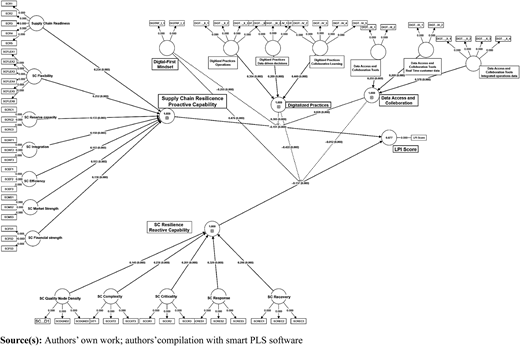
Kontić and Vidicki (2018) defined four dimensions for measuring digital transformation in organizations: a digital-first mindset, digitized practices, data access and collaboration tools and empowered talent. However, one top manager or owner from each firm was surveyed in this research, so it was impossible to survey with empowered talent. This dimension is omitted from the questionnaire. Consequently, H2 is improved to hypothesize three dimensions of digital effects on dependent and independent variables. The research model is shown in Figure 1.
3. Methodology
Turkey’s LPI data for 2007–2022 was taken from the World Bank database (https://lpi.worldbank.org/).
The SCR reactive and proactive capability scale was adapted from Chowdhury & Quaddus's (2017) study. The SCR proactive capability dimension comprises 26 items and seven sub-dimensions. These seven sub-dimensions have been determined as supply chain readiness (5 items), flexibility (6 items), reserve capacity (3 items), integration (3 items), efficiency/effectiveness (3 items) and financial strength (3 items). The “supply chain readiness” scale items are about quickly detecting supply chain disruptions, meeting and forecasting demand disruptions, making necessary preparations during any crisis and establishing a strong security system to protect human resources from a crisis. Flexibility scale items: It is about being flexible in terms of order volume and production schedule, having skilled labor to continue production or service, being flexible in distribution, producing different types of products/services to meet customer requirements and being flexible in contract situations such as ordering, payment and shipment. Reserve capacity scale articles: These articles are related to the existence of spare capacity for machinery, parts, logistics support, buffer (protection) stock for raw materials and spare energy/auxiliary resources. Integration scale items are related to sharing information with supply chain partners, ensuring integration between different company departments and ensuring a collaborative relationship with supply chain partners. Efficiency/effectiveness scale items are about employee productivity, a strong quality control process and the absence of idle capacity and waste. Market power scale items: It is about ensuring the satisfaction of buyers and suppliers, being a preferred brand by buyers and ensuring the existence of a good buyer–supplier relationship. Financial power scale items: It is about the availability of sufficient funds to reduce outages, consistency of profitability and insurance against possible damage and destruction.
The supply chain flexibility reactive capability dimension comprises 15 items and 5 sub-dimensions. These five sub-dimensions were determined as supply chain design quality intensity (3 items), complexity (3 items), criticality (3 items), responsiveness (3 items) and recovery or improvement of the situation (3 items). “Supply chain design quality intensity” scale items: It is about choosing alternative suppliers to avoid supply risks, choosing alternative production facilities to prevent the risk of operational disruptions and preventing buyers from concentrating in a certain geographical region. Complexity scale items are about dealing directly with buyers and suppliers to reduce complexity in the supply chain, the presence of multiple suppliers to avoid supply risk and the presence of multiple buyers to prevent buyer disruptions. Criticality scale items: It is about ensuring the availability of alternative transportation options, not being critically dependent on a supplier and the existence of a critical distribution center. Responsibility scale items are about responding quickly to outages, adequately responding in any crisis and having a response team to mitigate the crisis. Saving or improving the situation scale items: It is about being able to recover quickly in situations such as a crisis, being able to cope with the crisis, reducing the impact of the loss and getting out of the crisis with less cost.
The digital transformation scale was adapted from Kontić and Vidicki (2018) study. The digital transformation scale was determined as a digital mindset (2 items), digital applications (12 items), data access and collaboration tools (8 items). Digital mindset dimension items are about the company benefiting from digital solutions as much as possible and the employees considering improving the process with digital technologies. There are three basic sub-dimensions of the digitized applications dimension. The digitized transactions sub-dimension scale (4 items) is related to the automation and digitalization of the company's basic operational processes, the company's employees reviewing the operations in real-time, the company's digitalization of transactions with suppliers and the company's standardization of processes. The data-based decisions sub-dimension scale (3 items) is about the company making decisions based on data and analysis, expecting clear expectations and measurements in its roles, and systematically collecting and analyzing data. The collaborative learning subscale scale (5 items) is related to the company’s leaders or managers encouraging collaborative problem solving, the company being disciplined in expertise and collaboration, the company supporting experience and learning culture, and the company's values being transparent and open. There are three basic sub-dimensions of the data access and collaboration tools dimension. Data access and collaboration tools – The communication subscale scale (2 items) is related to the company’s development of communication and collaboration tools and the company’s employees' access to flexible computing power and storage. Data access and collaboration tools – real-time customer data subscale scale (2 items) is related to the firm having real-time customer data and integrated end-user data. Data access and collaboration tools – integrated operational data subscale scale (4 items) relates to the firm having integrated financial data, operational performance data, product/service performance data and integrated supply chain performance data.
3.1 Research universe and sample selection
According to the 2022 report of the Turkish Statistical Institute, there are 464,800 companies in Turkey’s manufacturing industry in total, according to size group and technology level (micro, small, medium, SME and large). In this study, considering that it was not possible to reach all the companies in the size group and technology level in the manufacturing industry in Turkey, 979 medium-high technology level companies with 250 or more employees, out of 4,261 large companies, were found suitable for the study (https://data.tuik.gov.tr/).
The structure of the manufacturing industry divides its technological levels into three groups according to the research and development intensities of the OECD. These are those with a high technology level (pharmaceuticals, IT, etc.), those with a medium technology level (main chemistry, cleaning materials, paint varnish, rubber products, etc.), and those with a low technology level (food, textile, clothing, forest products, etc.) are the ones. Companies with medium-high technology levels are the ones that manufacture chemicals and chemical products, weapons and ammunition (ammunition), electrical equipment, machinery and equipment not classified elsewhere, and motor vehicles, trailers and semi-trailers. It is classified as manufacturing other means of transportation (except for air and space vehicles, related machines, and ship and boat construction) and medical and dental tools and equipment. This classification made by the OECD based on technology intensity is not related to labor or capital intensity (https://www.oecd.org/).
The firms’ classifications correspond to the Statistical Classification of Economic Activities in the European Community (NACE Rev. 2). Enterprises with 250 or more persons employed are selected for the survey with the main activity of transportation and/or storage. Main activity: If there is one activity, this activity is taken as the main activity. In cases where the establishments are engaged in more than one type of activity, the main activity is the activity from which most of the value of the gross revenue is obtained.
The data are compiled from the enterprises selected by the sampling method. The questionnaire is filled out by the main headquarters of enterprises covering all local units. The sample unit selection involves using stratified random sampling based on economic activity (following NACE Rev.2) and company size determined by the number of employees. The size categories utilized as micro-enterprises consist of 1 to 9 individuals. Employed in small firms with 10–49 employees. Employed at medium-sized enterprises with 50–249 employees. Employed by large firms with 250 or more employees.
The study data were collected using a survey method. The research survey was sent via e-mail and mobile communication tools. A senior executive from each company was determined as the target participant. The study sent the research survey via electronic mail and mobile communication tools to all senior managers of 979 large manufacturing companies with medium-high technology levels. The data from companies that answered the survey completely (n = 403) were evaluated.
There are many reasons for selecting manufacturing industry companies as the research population. The manufacturing industry is important in the economy and is among the most basic indicators in a country’s development process. As countries develop, the shares of sectors in the economy change. While sectors based on natural resources, such as agriculture, used to have a significant share in the economy, as the country develops, this share is replaced by the manufacturing sector, contributing to the increase in the share of the service sector. Since Turkey is a developing country, the importance of the manufacturing industry increases daily. Manufacturing industries are significant sectors in terms of productivity, efficiency, production and employment. Based on the experiences of developed countries, the importance of the industrial sector’s contribution to economic growth and development after the agricultural sector is increasing. The manufacturing industry, which is accepted as an indicator of the country’s development level, is seen as the locomotive of growth because it leads to the development of other sectors. The manufacturing industry plays a vital role in implementing technology and innovation policies. This is because many R&D and technological innovation activities are carried out in the manufacturing industry (https://www.oecd.org/).
The increasing susceptibility of global supply chains to environmental uncertainties and outsourcing trends has emphasized the significance of SCR in industrial firms (Nguyen Thi, Nguyen Do Khanh, Ha Minh, Do Thi Thuy, & Ngo Tien, 2023). Previous research has highlighted the critical role of SCR in mitigating disruptions and risks in the high-tech manufacturing sector (Siagian, Tarigan, & Jie, 2021; Wang, Luo, & Zhu, 2022). The role of supply chain collaboration and implementing mitigation and adaptation strategies have been identified as crucial elements for achieving SCR (Bezares, Fretes, & Martinez, 2021). Trustful relationships between manufacturers and suppliers, which can increase collaboration, are important for reducing the risk of supply shortage and dynamic demand in the context of the high-tech industry (Ganguly & Kumar, 2019). Digitalization can play a pivotal role in enhancing collaboration within the supply chain, thereby contributing to its resilience. Studies have shown that specific collaborative activities, such as information-sharing, collaborative communication and joint relationship efforts, are facilitated by digital transformation, leading to increased SCR through enhanced visibility, velocity and flexibility (Zouari, Ruel, & Viale, 2021).
Additionally, digital technology has been shown to speed up internal and external information exchange, stimulating more cooperation in the supply chain network (Du & Zhang, 2022). However, the strategic relationships between suppliers and the digital transformation of trust need further investigation into the interrelationships between these concepts for establishing SCR (Faruquee, Paulraj, & Irawan, 2021). Integrating digital technologies facilitates information exchange, cooperation and relationship performance, ultimately key to building and maintaining SCR in high-tech manufacturing.
3.2 Descriptive analyses
To measure the variables of supply chain flexibility proactive ability, supply chain flexibility reactive ability, data access and collaboration, digitalized applications and digital-first mindset variables are used in the research, participants were asked to use a 5-point Likert scale (1 = strongly agree to 5 = strongly disagree) consisting of 63 items in the first part of the survey. In the second part of the survey, descriptive information consisting of three questions, including information about the company and its top manager, was included.
First, the structural equation modeling method measured descriptive information of manufacturing and industrial companies, variables’ reliability analysis and relationships between variables. When the descriptive characteristics of businesses and managers were examined, it was determined that the age of businesses was concentrated between 6–10 years (29%) and 11–20 years (31%). When the age range of the managers was examined, it was determined that the majority were between the ages of 30–39 (42%), and when the managers’ gender was examined, 34% were women and 66% were men.
3.3 Data analysis and fit index values
Table 1 shows all structures' heterotrait–monotrait (HTMT) ratio, correlation coefficients and reliability values. Composite reliability (CR) values are expected to be 0.70 or higher (Brown, 2015; Hair et al., 2020). Cronbach’s alpha (CA) internal consistency reliability value is expected to be 0.70 or higher (Bujang et al., 2018; Considine et al., 2005). In order to measure convergent validity, the average variance extracted (AVE) value is expected to be not less than 0.50. If this ratio is 50% or above, the latent variable explains the variance of reflective indicators (Hair, 2018; Taherdoost, 2016). The HTMT of correlations has recently become the primary criterion for discriminant validity (Voorhees et al., 2016). The HTMT test is found by calculating the geometric mean of the average correlation between items in the same structure (Henseler et al., 2015; Voorhees et al., 2016). It indicates that the HTMT ratio should be below 1.0; if the HTMT value is below 0.90, discriminant validity is detected between a specific pair of reflection structures (Henseler et al., 2015). Also, Table 2 shows the hypothesis test results.
Correlation coefficients, reliability values, heterotrait-monotrait ratios
| Variables | CR | CA | AVE | (1) | (2) | (3) | (4) | (5) | (6) | |
|---|---|---|---|---|---|---|---|---|---|---|
| (1) | Data Access and Collaboration | 0.93 | 0.93 | 0.66 | (0.81) | |0.88| | |0.94| | |0.81| | |0.71| | |0.14| |
| (2) | Digitalized Practices | 0.93 | 0.93 | 0.57 | [0.82] | (0.76) | |1.01| | |0.83| | |0.67| | |0.12| |
| (3) | Digital-First_Mindset | 0.80 | 0.67 | 0.74 | [0.73] | [0.77] | (0.86) | |0.87| | |0.73| | |0.21| |
| (4) | SC Resilience_Reactive Capability | 0.91 | 0.90 | 0.51 | [0.74] | [0.76] | [0.66] | (0.65) | |0.76| | |0.08| |
| (5) | Supply Chain Resilience_Proactive Capability | 0.95 | 0.94 | 0.52 | [0.66] | [0.62] | [0.57] | [0.69] | (0.65) | |0.11| |
| (6) | LPI Score | – | – | – | [0.13] | [0.09] | [0.18] | [0.01] | [0.07] | – |
Note(s): **p < 0.01, M: mean, SD: standard deviation, CR: composite ratio, CA: Cronbach's alpha. [value] = show correlation. (value) = show square root of AVE. |value| = show heterotrait–monotrait ratio
Source(s): Authors’ own work
Hypotheses results
| Relationships | Path value | p-value | Conclusion | ||
|---|---|---|---|---|---|
| Standardized β | |||||
| Hypothesis | Independent variable | Dependent variable | Model | P | Supported/unsupported |
| H1a | Supply Chain Resilience_Proactive Capability | LPI Score | −0.151 | 0.000*** | Rejected |
| H1b | SC Resilience_Reactive Capability | LPI Score | −0.137 | 0.000*** | Rejected |
| H2a1 | Digitalized Practices × Supply Chain Resilience_Proactive Capability | LPI Score | 0.365 | 0.000*** | Accepted |
| H2a2 | Digital-First_Mindset × Supply Chain Resilience_Proactive Capability | LPI Score | −0.255 | 0.000*** | Accepted |
| H2a3 | Data Access and Collaboration × Supply Chain Resilience_Proactive Capability | LPI Score | 0.028 | 0.000*** | Accepted |
| H2b1 | Digitalized Practices × SC Resilience_Reactive Capability | LPI Score | −0.422 | 0.000*** | Accepted |
| H2b2 | Digital-First_Mindset × SC Resilience_Reactive Capability | LPI Score | 0.476 | 0.000*** | Accepted |
| H2b3 | Data Access and_ Collaboration × SC Resilience_Reactive Capability | LPI Score | −0.012 | 0.000*** | Accepted |
Note(s): Path coefficients are standardized. ***p < 0.001, **p < 0.01 and p > 0.01
Source(s): Authors’ own work
4. Discussion
Interestingly, results from the analysis showed that SCR decreases countries’ LPI. Qi, Wang, Zhang, and Wang (2023) highlight that product flexibility, while beneficial in some aspects, is negatively associated with SCR, suggesting that certain capabilities or strategies aimed at enhancing resilience may adversely affect overall logistics performance.
Aloui, Hamani, and Delahoche (2021) emphasized that unforeseen fragilities and vulnerabilities arising from disruptions can negatively affect supply chain performance. This indicates that logistics systems may confront unprecedented vulnerabilities despite efforts to build resilience. Jiang and colleagues conducted a study in 2023 to explore how supply chain integration and big data analytics capability can be structured to enhance proactive and reactive supply chain flexibility. The research revealed that achieving high supply chain flexibility is possible through various antecedent configurations. However, the configurations required for high proactive and reactive supply chain flexibility differ, which may involve alternative effects between different antecedents. Overall, the study highlights the importance of considering different configurations to improve supply chain flexibility, depending on the specific needs of a business.
4.1 Moderator effects of digitalization
The three key factors for digitalization are a digital-first mindset, digitized practices, data access and collaboration tools. According to the results of the path analysis, digitalization is significant between SCR and LPI.
According to our model, LPI has two main antecedents: proactive and reactive SCR. Digitalization decreases the negative effects of reactive capability except for the digital-first mindset dimension of reactive resilience impact (β = 0.476, p < 0.000). More clearly, digital practices and data access and collaboration decrease the negative effects of reactive resilience on LPI. In contrast, a digital-first mindset increases the negative impact of reactive SCR on LPI. Digital mindset is about explaining benefits to key stakeholders (Kontić & Vidicki, 2018). Reactive SCR concentrates on the post-disaster/disruption phase (Chowdhury, Quaddus, & Chowdhury, 2023). The primary goal is to absorb the shock of disruption, minimize the escalation and adverse impact of disruptions along the SC, and return to normal operation (Elluru, Gupta, Kaur, & Singh, 2019). So, Turkish manufacturing companies have not been successful in getting back by using the positive sides of the technology. This is because emerging nations like Turkey lack the human capital needed in the logistics industry to foster an entrepreneurial spirit and a risk-taking attitude that would propel economic growth and development (Cukier, Fox, & Rahnama, 2012). At the organizational level, a digital-first mindset questions established business practices and investigates the boundless opportunities of leveraging a digital paradigm to transform the way we conduct business (Roy, 2021). Thus, it can be concluded that in developing countries, it is hard to recover from disrupted supply chain by digitalized business practices. It is hard to follow up with the latest technologies, or it may result from the unintegration of supply chains into global chains.
Recent studies have provided further support for the findings of research conducted by Lin and Fan in 2024. Their study investigated the impact of supply chain integration on organizational flexibility, digital transformation and sustainable performance. The research indicates that digital technology positively moderates the relationship between internal supply chain integration and organizational performance. However, external supply chain integration does not show any significant moderating effect. The study also demonstrates that companies must prioritize organizational flexibility by ensuring internal and external supply chain integration to achieve sustainability through digital technology. These findings are crucial in helping businesses understand how they can improve their performance and contribute to sustainable outcomes.
Similarly, in their study, Lu et al. (2024) investigate the effect of supply chain governance on supply chain flexibility. At the same time, the mediating role of information processing ability and the moderating role of digital technology process were examined. It has been determined that supply chain governance positively affects supply chain flexibility, and digital transformation reduces the negative effects on these variables. The study presents a new perspective that helps understand the importance of information across supply chain governance in improving SCR and expands the application of information processing theory by explaining the regulatory role of digital transformation.
Lu et al. (2023) studied how supply chain governance affects SCR in China, with a focus on the mediating influence of supply chain finance and the moderating influence of digital technology in emerging countries. The results mediate the relationship between supply chain finance, supply chain governance and supply chain flexibility. It also reveals that adopting digital technology positively moderates the relationship between supply chain governance and supply chain finance. Enrique et al. (2022) studied how digital transformation can improve operational performance in developing countries by creating more flexible supply chains. They found that digital transformation is crucial for achieving such flexibility and improving operational performance. Their research suggests that businesses in developing countries can benefit from digital transformation as it enables them to adapt to changing market conditions and improve their overall performance.
Digital practices include automated data-driven decisions encouraging collaborative learning (Kontić & Vidicki, 2018). Digitalized operations in supply chain management encompass applying digital technologies to enhance various aspects of supply chain activities. This includes using digital tools and platforms to optimize planning, process transactions and facilitate communication among supply chain partners (Liu, Chiu, Chu, & Zheng, 2022). Digitalization in supply chain management also involves adopting digital technologies to improve data flow, analytics and decision-making processes, enhancing visibility, transparency and operational flexibility within the supply chain (Hofmann, Sternberg, Chen, Pflaum, & Prockl, 2019). The digitalization of supply chain procedures also addresses significant supply chain management issues. It contributes to supply chain operations’ overall efficiency and effectiveness by increasing resilience (Bhandal, Meriton, Kavanagh, & Brown, 2022; Khanh Quan, Singh, Thuy Khanh, & Rajagopal, 2023). Reactive resilience deals with recovery, emphasizing the supply chain’s ability to resume operations after disruption. The critical elements suggested by the reactive approach to SCR include alertness, agility, and the ability to recover from disruptive events (Xu, Zhang, & Abdullayeva, 2022). Consequently, it can be said that the digitalization of decision-making and the use of digital tools for existing supply chain platforms increase the efficiency of the reactive supply chain that is recovering and responding to disruptions.
On the other hand, proactive and reactive resilience capabilities can impact different performance indicators (Faruquee, Paulraj, & Irawan, 2023). Proactive SCR concentrates on appropriate supply chain design and proactively develops and manages a disruption management framework to look for warning signs of disruption occurrence (Chowdhury et al., 2023). Analysis results show that a digital-first mindset decreases the negative effects of proactive resilience on LPI (β = −0.255, p < 0.000). Thus, it can be said that different physical firms will offer supply, manufacturing, logistics and sales services, resulting in a dynamic allocation of processes and dynamic SC structures (Ivanov, Dolgui, & Sokolov, 2019).
Nevertheless, digital practices (β = 0.385, p < 0.000) and data access and collaboration (β = −0.028, p < 0.000) increase the negative effects of proactive SCR on LPI. As stated before, automated data-driven decision-making, data access, collaborative learning and real-time customer and integrated operational data are examples of digital practices (Kontić & Vidicki, 2018). The proactive and reactive dimensions of SCR can be improved by enhancing trajectory and operating frontier (Cheng & Lu, 2017). However, Turkiye companies use digitalization to increase revenues instead of anti-crisis tools. Even if the managers understand the importance of the processes and plan to use digital tools in the future (Tazhibekova, Shametova, Maharramov, & Makar, 2023), investments in the latest digital tools are often chaotic and unsystematic due to the lack of a systematic policy in the supply chain management area.
5. Conclusion
This study examines the relationship between SCR, digitalization, macro logistics performance and LPI. The analysis indicates that the relationships between these factors are complex and multifaceted. The study shows that SCR has a negative impact on the LPI of countries. While product flexibility may have benefits in some aspects, it is negatively associated with SCR. This suggests that strategies to enhance resilience may adversely affect overall logistics performance. The study also highlights that unforeseen fragilities and vulnerabilities arising from disruptions can negatively affect supply chain performance. This indicates that efforts to build resilience may not always prevent vulnerabilities.
Digitalization plays a significant role in moderating the relationship between SCR and LPI. The digital-first mindset, digitized practices, data access and collaboration tools are key factors for digitalization. The analysis reveals that digitalization is significant in the relationship between SCR and LPI. Proactive and reactive SCR can impact different performance indicators, with digital practices and data access and collaboration influencing the effects of resilience on LPI. While a digital-first mindset can decrease the negative effects of proactive resilience, digital practices and data access, collaboration may increase the negative impact of proactive resilience on LPI. Whereas a digital-first mindset increases the negative impact of reactive resilience on LPI, digital practices and data access collaboration decrease the negative impact of reactive resilience on LPI.
Overall, our research suggests that the relationship between SCR, digitalization and macro logistics performance is influenced by various factors such as product flexibility, unforeseen vulnerabilities and the role of digital practices in enhancing or potentially hindering resilience and performance. The path analysis highlights the complexity of these relationships and the need for strategic and systematic approaches to leverage digitalization to improve SCR and macro logistics performance.
Acknowledgement, funding and conflict of interest statements as appropriate. We don’t have funding and conflict.

