


This study examines the mediating role of self-organization and entrepreneurial learning behaviors in the relationship between entrepreneurial networking and sustainability of women owned micro-enterprise performance.
We tested our model based on a sample of 518 women-owned micro-enterprises in Eastern Uganda using ordinary partial least squares regression through Smart PLS version 3.3.3.
The results show a direct relationship between entrepreneurial networking, entrepreneurial learning behavior, self-organization and sustainability of women owned micro-enterprise performance. In addition, self-organization mediates the relationship between entrepreneurial networking, entrepreneurial learning behavior and sustainability of women owned micro-enterprise performance. Furthermore, entrepreneurial learning behavior mediates the relationship between self-organization and sustainability of women owned micro-enterprise performance.
The study was cross-sectional; it is possible that the views held by individuals may change over the years.
This research contributes to gender-based sustainability of micro-enterprise performance by empirically testing the anecdotal and conceptual evidence.
1. Introduction
The number of women entrepreneurs is rapidly growing worldwide, making significant contributions to economic development and job creation (Madison, Moore, Daspit, & Nabisaalu, 2022; Rae, Newheiser, & Olson, 2015). Despite this growth, fewer women opt for entrepreneurial careers, and this disparity tends to widen with higher levels of national development (Bullough, Guelich, Manolova, & Schjoedt, 2022). Women-owned micro-enterprises are defined as businesses where women own at least 50% of the capital or hold 26% of the capital while also occupying key top management roles. These enterprises play a crucial role in driving economic and social progress. (IFC, 2017). This underscores the urgent need for increased support and resources to enhance the sustainability and success of women-owned micro-enterprises (Coduras, Velilla, & Ortega, 2018). Sustainability of women-owned micro-enterprise performance means ensuring the long-term viability and success of these businesses through consistent profitability, effective management and resilience against economic and social challenges. It involves maintaining operational stability, achieving financial growth and adapting to changing market conditions, while also contributing positively to the community and supporting the empowerment of women entrepreneurs (UN Women, 2023; World Bank, 2023).
In Africa, women entrepreneurs predominantly focus on sectors such as hotels, food and dining, wholesale and retail commerce, clothing, textiles, leather goods and services like tailoring and hair salons (Aterido & Hallward-Driemeier, 2011; Bardasi, Sabarwal, & Terrell, 2011). In contrast, men in Africa tend to engage in a broader array of industries, including manufacturing, construction, metalwork, woodworking, electronics and machinery (Singh & Raghuvanshi, 2012). Women-owned micro-enterprises are vital to developing economies, accounting for 8 to 10 million businesses, which represents 31 to 38% of all formal firms. These enterprises not only contribute significantly to job creation and economic growth but also empower women by providing them with opportunities for financial independence and leadership (Anum, Wahab, Hamid, & Kureshi, 2022; IFC, 2017). Despite their potential for significant economic and social impact, micro women entrepreneurs in Africa are faced with substantial challenges. The major impediments are limited access to credit, restricted business networks and pervasive gender biases (African Development Bank, 2020). It is estimated that approximately 70% of women-owned businesses struggle with financing issues, contributing to elevated failure rates. Indeed, around 60% to 70% of microenterprises, including those owned by women, may fail within their first few years (IFC, 2019). In Uganda, women are nearly as likely as men to start businesses, with 35.6% of women engaged in entrepreneurship compared to 36% of men (Global Entrepreneurship Monitor, 2012). By 2015, the proportion of women-led enterprises in Uganda had increased to 45% (UBOS, 2015). However, despite this growth, women-led enterprises in Uganda face high failure rates, with over 50% of businesses, including women-owned microenterprises, closing before reaching their second anniversary (Mayanja, Omeke, Tibamwenda, Mutebi, & Mufta, 2021).
Women-owned businesses can achieve sustainability by meeting present requirements without compromising the needs of future generations (Searcy, 2016; Shepherd & Patzelt, 2011). Sustainable development aims to improve social, economic and environmental sustainability (Fonseca & Carvalho, 2019; Khurana, Haleem, & Mannan, 2019). However, women face challenges in patriarchal societies, as they face social and structural barriers in the business world. The liberal feminist perspective assumes women are rational, but socialization processes contribute to gender differences. Women are often confined to the home and excluded from political and economic life in developing nations (Welter, Brush, & De Bruin, 2014). Patriarchal challenges such as limited access to resources, inadequate support systems, restrictive societal roles and reduced networking opportunities in developing countries significantly impact the sustainability of women-owned micro-enterprises (Chaudhuri & Sharma, 2023).
Previous studies indicate that access to finance and business knowledge are central in influencing microenterprise survival (Karakire Guma, 2015; Tonelli & Dalglish, 2012), and entrepreneurs in many developing countries rely on social networks for resources (Lindvert, Patel, & Wincent, 2017; Davidsson & Honig, 2003). Despite mounting research on micro-enterprises in contexts other than the developed world (Mor, Madan, Archer, & Ashta, 2020; Karakire Guma, 2015), there is a paucity of research on the sustainability of women-based micro enterprise performance (Mor et al., 2020). Many studies examine hindrance factors (e.g. Lindvert et al., 2017; Monahan, Shah, & Mattare, 2011), yet practices to sustain women-led microenterprises have received less attention (Maduku & Kaseeram, 2021). Earlier studies on gendered perspectives show significant differences between women-led and men-led enterprises, especially in contexts with institutional and cultural biases against women (Mor et al., 2020; Karakire Guma, 2015). However, the networking behavior of women is viewed as a disadvantage to accessing resources and learning since the networks constitute female peers and family rather than professional consultants (Lindvert et al., 2017; Robinson & Stubberud, 2009). As a result, women-led microenterprises may lack human capital (Coleman, 2007). Despite institutional and cultural challenges, the economic and non-economic value created by micro women-led enterprises is not fully understood. Achieving sustainability in these businesses is crucial for enhancing economic growth, environmental sustainability and promoting gender equality. Effective support can address barriers such as limited resources, inadequate support systems and societal biases, ultimately helping women-owned micro-enterprises thrive and contribute significantly to their communities and economies (Chaudhuri & Sharma, 2023; UN Women, 2023).
The social capital theory (Coleman, 1988) was applied in earlier research, although this theory has limitations because it frequently views social networks as static entities. It might not adequately represent how dynamic and ever-changing entrepreneurial networks are, particularly when it comes to women-owned businesses. A static perspective might not take into consideration the adaptive techniques needed for sustainability in the ever-changing environment of entrepreneurship (Baycan & Tuysuz, 2022). The theory also emphasizes the advantages of the connections and social institutions that are currently in place. However, a key component of entrepreneurial ventures is the self-organization of individuals and groups within a network. Self-organizing behaviors may be necessary for women entrepreneurs in particular to actively navigate and shape their networks. The idea may undervalue the variety of viewpoints and experiences that women bring to entrepreneurship. Other limitations of Social capital theory include gender biases, cultural factors and institutional barriers that influence sustainability of women-owned micro-enterprise performance. A more adaptable framework like complex adaptive systems theory is better suited to address such contextual complexities.
This study contributes to Complex Adaption Systems theory (Holland, 1996), for women to sustain their businesses, they have to continuously re-organize themselves and their businesses adapt to the changing environment, continuously learn, access tangible and intangible resources from social networks to survive and sustain their businesses. We therefore conjecture that, women's business goals and growth expectations are shaped by various social influences like entrepreneurial learning behavior and self-organization that are better explained by Complex Adaption Systems (CAS) theory (Holland, 1996).
Empirically, previous studies focused on direct relationships between study variables majorly in developed economies. In this study, the authors are contributing to the mediating role of self-organization and entrepreneurial learning behaviors in the relationship between entrepreneurial networking and the sustainability of women owned micro-enterprise performance. The study extends the CAS theory perspective in entrepreneurship studies by examining how enterprises as systems can develop the capacity to adapt to uncertain environments in underserved communities (Galkina & Atkova, 2020). This article is structured as follows: introduction, theoretical foundation and the associated hypotheses, methodology, results, discussion, conclusions, implications, limitations and areas for further research.
2. Theoretical foundation, literature review and hypotheses development
2.1 Complex adaptive system theory (CAS)
This study is theorized based on Complex adaptive systems theory (Holland, 1996). CAS theory presupposes that a group of semi-autonomous agents in a network evolve to maximize their fitness with a given stimulus in the environment through an adaptation process. The agents adjust to environmental conditions based on learning from experience and responding to internal and external changes. The individuals or groups engage in repetitive interactions from which sustained system-wide characteristics emerge. As such, CAS proposes that a system undergoes nonlinear changes to evolve into a coherent form through self-organization and learning. Such that, the survival of an agent (e.g. business) depends on how well it interprets environmental stimuli to develop relationships to address change (Ucbasaran, Westhead, & Wright, 2013). CAS theory elucidates the intricate relationship between entrepreneurial networking and the sustainability of women-owned enterprises in developing countries. The dynamics of self-organization and learning behaviors within entrepreneurial networks contribute significantly to the adaptive capacity and resilience of women entrepreneurs, fostering sustainability in the face of challenges unique to developing country contexts in conditions of uncertainty (Engel, Kaandorp, & Elfring, 2017).
2.2 Entrepreneurial networking, entrepreneurial learning behavior and sustainability of women owned micro-enterprise performance
Entrepreneurial networking describes what “entrepreneurs do in creating and shaping network ties and may therefore include tie formation and maintenance behaviors as well as an assemblage of such behaviors into unique networking styles, strategies or processes” (Engel et al., 2017, p. 37). Entrepreneurial networking precedes access to network resources needed to act on an entrepreneurial opportunity for the survival and growth of the micro-enterprise (Mayanja et al., 2019). Entrepreneurial learning is an experiential process involving an entrepreneur’s experience, transformation and knowledge that influence opportunity recognition, action and coping with change (Nogueira, 2019). Micro-enterprise sustainability performance refers to a stakeholder-focused business goal designed to achieve economic, environmental and social aspects of performance within the bounds of nature and society (Searcy, 2016; Patzelt & Shepherd, 2011).
The co-participation of network members results in reflecting, theorizing, experience sharing and developing activities to respond to environmental changes (Mansor & Daud, 2020). Supportive network ties with business owners, customers and suppliers provide women with learning behaviors and opportunities to make meaning of their own experiences and past decisions which may apply to current circumstances (Hunter & Lean, 2018; Ekanem, 2015). Given that entrepreneurial learning behavior is a social phenomenon happening in a given context (Pittaway & Thorpe, 2012), micro-entrepreneur’s networks have a significant contribution to the entrepreneurial learning process. Therefore, entrepreneurial networks create enabling environment for women micro-entrepreneurs to learn new behaviors and practices of how to access and use resources, set individual and business goals which are useful in achieving sustainable micro-enterprise performance in developing economies (Ekanem, 2015; Rigg & O'Dwyer, 2012).
Although several studies have reflected the importance of networks to women entrepreneurs, there is evidence that male entrepreneurs have higher comparative scores of bridging social capital in aggressive and managed-growth venture networks than females (Neumeyer, Santos, Caetano, & Kalbfleisch, 2019). In addition, women are often socially disconnected from the main institutions, have fewer opportunities to acquire new knowledge and women-led entrepreneurial businesses have demonstrated a lower propensity to grow and a higher propensity to exit (Manolova, Carter, Manev, & Gyoshev, 2007). Similarly, Jacob and Munuswamy (2022) posit that economic development cannot occur without the empowerment of women. To ensure that women micro entrepreneurs can establish enterprises successfully and sustainably, it is crucial to provide them with training in entrepreneurial skills, technical knowledge, skill development and marketing strategies. Empowering women in these areas not only enhances their individual capabilities but also contributes significantly to broader economic growth (Kimuli, Sendawula, & Nagujja, 2022).
Entrepreneurial learning behavior partially mediates the relationship between entrepreneurial networking and the sustainability of women-owned micro-enterprises in underserved communities. Undeniably, entrepreneurial networking and learning behavior are necessary for the effective sustainability performance of micro-enterprises in developing economies (Afshan, Shahid, & Tunio, 2021; Ekanem, 2015). CAS theory extends the debate of connectivity in accessing information and learning from network actors. We, therefore, hypothesize that:
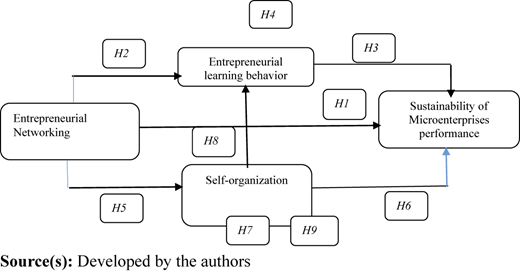
Entrepreneurial networking and sustainability of women owned micro enterprise performance related
Entrepreneurial networking and entrepreneurial learning behavior are related
Entrepreneurial learning behavior and sustainability of women owned micro enterprise performance are related
2.3 Entrepreneurial networking, entrepreneurial learning behavior, self-organization and micro-enterprise sustainability performance
Self-organizing is a behavior that occurs when people are free to network with others and pursue their objectives (Clinton, McAdam, Gamble, & Brophy, 2020). Therefore, self-organization is the communal process of communication, choice and mutual adjustment in the behaviors of members of a given system based on a common goal (Rutherford, McMullen, & Oswald, 2001). When businesses are faced with environmental changes, self-organizing behavior signifies a firm’s internal ability to survive by interpreting external stimuli and creating internal changes that contribute to sustainability performance (Nogueira, 2019).
Notably, entrepreneurial networking has an influence on the self-organization of micro-enterprises in underserved communities. Huque (2017) describes systems that generate information as self-organizing when an entrepreneur’s network as a social system through which information is transmitted as embedded in CAS theory. A micro-enterprise is self-organizing when connected with stakeholders within the community in which it operates to enable open information and materials exchange from nature and interpersonal relationships (Mutebi, Ntayi, Muhwezi, & Munene, 2019, 2022). For example, networks that are a source of cognitive social capital allow the transfer of knowledge and skills among group members which other businesses can implement during environmental change (Ekpe, Mat, & Ekpe, 2015).
Burnett (2023) argue that self-organization enhances agency, responsiveness to demand and resource optimization. By effectively leveraging their networks, women entrepreneurs can exercise greater agency, adapt to market needs and collaboratively manage resources, ultimately leading to improved sustainability outcomes. Despite the significance of these interconnected elements, existing literature frequently treats them in isolation and often relies on gendered stereotypes of women entrepreneurs from developed economies, which limits practical support for women owned micro-enterprises (Arshed, 2023). To bridge these gaps, it is essential to develop an integrated framework, implement training programs focused on self-organization and create strategies that enhance resource sharing within entrepreneurial networks. These initiatives will foster a more supportive environment for sustainable business practices among women entrepreneurs (Rizvi, Qureshi, & Ansari, 2024).
However, Witt, Schroeter, and Merz (2008) suggest that there is no proper evidence that networks can provide access to exclusive resources. Being a member of a network is not enough for women-owned businesses to achieve high performance. Further, Jones and Jayawarna (2010) posted that networks are “reciprocal” and, therefore, they can be as costly as other market transactions. Networking is not a simple independent business activity, but one that is complex and dependent on the multiplicity of other factors. In a business sense, women appear to network in different ways to men, which appears to be driven by industry norms and women’s domestic responsibilities (Sharafizad, 2011). Therefore, since environmental stimuli induce changes within self-organizing systems (Hägglund, 2020), entrepreneurial networking enables micro-enterprises to maintain or form new ties that enable adaptability to environmental changes that enhance sustainability of micro-enterprise performance (Galkina & Atkova, 2020). CAS theory can be used to explain how individuals organize their social conduct to bring about order through interactions with others rather than through outside intervention during uncertain times.
Research indicates that entrepreneurial networking provides essential resources, mentorship and peer support, which enhance women entrepreneurs' access to critical business knowledge and foster innovative practices (Kamarudin, Bakar, & Jamaludin, 2023; Ali, Khan, & Khan, 2022). These learning behaviors contribute to resilience and adaptability, enabling women entrepreneurs to implement sustainable practices that benefit their businesses and communities (Cheng, Zhang, & Wu, 2024). However, scholars argue that an overemphasis on entrepreneurial networking can lead to superficial relationships and may not fully address the barriers women face in leveraging these opportunities (Eddleston & Powell, 2023; Arshed, 2023). While entrepreneurial networking is crucial for enhancing learning behaviors and sustainability of micro enterprises, it is important to develop strategies that strengthen meaningful connections within networks.
Women micro entrepreneurs who continuously adapt to the changing environment may trigger modification of business models, products and service offerings, which can be informed by accumulated knowledge through entrepreneurial learning (Zhang, Wei, Sun, & Tung, 2019; McAdam, Harrison, & Leitch, 2019). Related to economic performance, entrepreneurial learning develops knowledge through startup experience, management experience and industry experience which are positively associated with opportunity recognition and the ability to cope with environmental change (Mayanja, Ntayi, Munene, Wasswa, & Kagaari, 2020; Kuckertz, Kollmann, Krell, & Stöckmann, 2017). Moreover, Santarelli and Tran (2013) operationalized human capital as entrepreneurial learning, experience and professional education that takes place through self-organisation.
The CAS perspective (Holland, 1995) argues that the ability of an agent (e.g. microenterprise) to survive depends on how well individuals understand the environment by developing independent relationships among individuals and/or businesses. A micro-enterprise effort to recognize how its activities negatively impact the environment may influence its willingness to learn better green manufacturing systems to improve environmental performance (de Sousa Jabbour, Ndubisi, & Seles, 2020). For instance, in Uganda, briquette production is enhanced by micro-enterprises willingness to learn waste materials utilization as a source of bioenergy.
In regard to the influence of industry experience on the entrepreneurial networking behaviour of business owners, women are more likely to be disadvantaged by a lack of relevant industry experience (Kwong, Thompson, Jones‐Evans, & Brooksbank, 2009). This is because there are many “givens” within the work environment so if women have to first learn the rules of engagement, they need to devote time to non-core business activities. For instance, women micro-entrepreneurs belonging to social business groups have access to other business owners, learn how to scale production to meet the growing customer base (Zhang et al., 2019). Mamun et al. (2016) found that entrepreneurial networking efforts that create connections with key business actors increase in-resource-organizing competency needed to successfully execute business activities. For example, women entrepreneurs in South Africa leveraged self-organization within culturally sensitive networks, fostering learning behaviors that allowed them to navigate cultural nuances, thus contributing to the sustainability of their enterprises (Carranza, Dhakal, & Love, 2018). Shir and Ryff (2022) emphasize that self-organization in entrepreneurship is an autonomous process that is essential for guiding micro women entrepreneurs in structuring their goals, activities and behaviors to achieve a personal vision, effectively translating their ideal lives into specific entrepreneurial goals and actions. This concept contributes to a broader debate about the role of self-organization in fostering entrepreneurial success, with scholars arguing that self-directed individuals are better equipped to navigate challenges (Fischer, Nguyen, & Strande, 2019). Coleman (1999) highlights the importance of social capital, noting that strong networks can enhance the effectiveness of self-organization by providing essential resources. However, critics caution that an exclusive focus on self-organization may burden entrepreneurs, particularly women, who often face barriers in accessing networks and capital (Arshed, 2023). Therefore, while self-organization is crucial, it should be complemented by systemic resources to achieve optimal entrepreneurial outcomes. Women entrepreneurs who engage in more networking behaviors on social media, cooperating with other businesses are likely to self-organize and develop entrepreneurial learning behaviors created by network actors (Afshan et al., 2021; Alkahtani, Nordin, & Khan 2020). We therefore hypothesize that;
Entrepreneurial networking and Self- organization are related
Self- organization and sustainability of women owned micro enterprise performance are related
Entrepreneurial learning behavior mediates the relationship between entrepreneurial networking and micro enterprise sustainable performance
Self-organization mediates the relationship between entrepreneurial networking and sustainability of women owned micro enterprise performance
Self-organization partially mediates the relationship between entrepreneurial networking and entrepreneurial learning behavior
Entrepreneurial learning behavior mediates the relationship between self-organization and sustainability of women owned micro enterprise performance
The study was developed based on the conceptual model presented in Figure 1 below.
3. Methods
3.1 Data collection
We tested our hypotheses using a sample of women over the age of 18 who own micro-enterprises in Eastern Uganda, specifically in Jinja, Iganga, Bugiri, Tororo, Mbale and Soroti. The selected enterprises had been operational for more than one year and employed between one and seven individuals. This aligns with previous studies on micro-enterprises (e.g. Cardon & Kirk, 2015). Due to the lack of an official registry for women-owned micro-enterprises in Uganda, the study population was initially unknown. Consequently, we employed a snowball sampling technique for data collection, which was necessary given the absence of readily available demographic information about these businesses (Thompson, 2024).
A total of 3,750 women micro-entrepreneurs in Eastern Uganda were approached by research assistants to participate in the study, resulting in 723 responses from willing participants. The research assistants underwent training in ethical data collection practices and were responsible for interpreting all survey questions. Participants completed a paper-based survey, which was self-administered with the assistance of a research assistant. Each respondent was allotted 45 minutes to complete the survey, and data collection spanned six months.
The data were entered into SPSS for analysis, yielding 518 useable surveys after excluding responses with missing data. This resulted in a response rate of 72%, which is considered acceptable (Cardon & Kirk, 2015). In total, 205 responses were discarded due to incomplete information.
3.2 Instrument development and measurement
Entrepreneurial networking was operationalized as a reflective construct with three dimensions which include: interactions with five items, ties with three items and interdependence with three items. The items measuring the dimensions were obtained from Davidsson and Honig (2003), Hazy (2006), Vissa (2012). Some of the interactions dimension items include; I have close working relationship with my business associates; I always get business advice from my business associates; some of the ties dimension items include; I have been able to access cheap products/raw materials through the guidance of other people in the business community and those who finance my business know me personally. Some of the interdependence items include; I have been able to acquire financial resources for my business through other people and other people have been helpful to me in identifying business opportunities.
Entrepreneurial learning behavior was measured as a three-dimensional construct generated from Nogueira (2019), which include; exploratory learning with items like; I ask myself about the things I experience in business and I reflect on my own experiences in the business. The second dimension is collaborative learning with items like I always do things as advised by those ahead of me in business and I like to be told how I can improve my business. Lastly, proactive learning with items like I always remember things that happen suddenly in my business, I am open to learn from interactions with colleagues and I learn from consequences of my work with on others.
Self-organization was operationalized as a reflective construct with two dimensions which include adaptation with three items and emergency with four items. The items measuring the dimensions were obtained from Partanen (2015), Serugendo, Gleizes, & Karageorgos (2005) and De Wolf and Holvoet (2004). Some of the adaptation dimension items include; I allocate more resources on first moving stock and I always change marketing strategies to increase my sales. Some of the emergency items include; I can now manage my business better and I have learnt better ways of handling customers.
Sustainability of microenterprise performance was operationalized based on economic, social and environmental sustainability (Chen et al., 2014; Honig, 1998). Some of the items for economic sustainability include: our micro-firm’s economic performance is at an acceptable level in terms of (1) sales growth, (2) income stability. Some of the items for social sustainability include: Our micro-business (1) enhances our social recognition in society (2) improves our empowerment in society. Lastly, some environmental sustainability items include; our micro-business (1) uses utilities (e.g. energy and water) in an environmentally friendly manner, (2) produces few wastes and emissions.
3.3 Descriptive statistics
Our data shows that majority of respondents were between 26–29 years representing 25 precent, while 30–33 years were 17%. The level of education was 33% had tertiary education and 31% had attained ordinary level of education. Among the respondents 43% were married while 26% were single. Further, 28% were Muslims, while 26.5% were Pentecostal. In terms of business ownership 57.7% were sole proprietorship while 25% were registered businesses. In terms of business category, 23% were in fashion and design, 15.5% were involved in mobile money and 14% general merchandise. The micro enterprises that had existed 1–2 years were 29% while 7 years were 18%. Majority of the women micro entrepreneurs had 1–2 employees representing 41.5%, followed by 1 employee representing 26.7%. Dairy sales were <100, 000 Uganda shillings (US 27) representing 74%, while sales >400,000 shillings was 10%. The major source of capital was personal savings 36.5%, while family and friends was 30%.
3.4 Common method variance
Ketokivi and Schroeder (2004) suggest that common method bias in cross-sectional data can be minimized through procedural and statistical remedies. These include selecting measurements in English, testing with entrepreneurship experts, eliminating unclear wording and allowing anonymous responses to ensure content validity and eliminate right or wrong answers. The study used entrepreneurship literature to measure independent and dependent variables. Statistical remedies included Harman's single-factor test, principal component analysis and PLS-SEM. The principal component analysis revealed nine factors with eigenvalues greater than 1, indicating common method bias. The study also evaluated the variation inflation factor (VIF) for the relationship, finding all inner VIF values below the threshold value of 3.3 as Kock (2015) recommends, indicating common method bias is unlikely to affect the conclusion as shown in Table 1.
3.5 Structural model measurement evaluation
Since the study variables were modelled as second order construct, the measurement validation was done to assess reliability and validity of both high order and lower constructs (Hair, Howard, & Nitzl, 2020), following a two-staged approach (Schuberth, Rademaker, & Henseler, 2020). Reliability was assessed in terms of Cronbach’s alpha coefficient and composite reliability ≥0.7, while validity was assessed in terms of convergent and discriminant. Convergent validity was evaluated using item loading above 0.7 and average variance extracted ≥0.5 (see results in Table 2), while discriminant validity was assessed using Heterotrait– Monotrait Ratio (HTMT) ≤ 0.85 of for both LOC and HOC (see results in Tables 3 and 4). This means that our model is moderately predictive, which further support our models in-sample model fit (Sarstedt, Hair, Cheah, Becker, & Ringle, 2019; Hair, Matthews, Matthews, & Sarstedt, 2017).
Validation of the study instrument (HOC)
| Study variable | Item | β | Item reliability | T-stat | p-values | α | CR | AVE |
|---|---|---|---|---|---|---|---|---|
| Self-organisation | I allocate more resources on first moving stock (AB1) Adaptive | 0.81 | 0.66 | 43.07 | 0.00 | 0.84 | 0.88 | 0.52 |
| I always change my stock from time to time depending on customer’s needs (AB2) Adaptive | 0.85 | 0.73 | 57.51 | 0.00 | ||||
| I always change marketing strategies to increase my sales (AB3)Adaptive | 0.74 | 0.55 | 26.66 | 0.00 | ||||
| I can now manage my business better (EMG1) Emergence | 0.81 | 0.66 | 48.32 | 0.00 | ||||
| I have learnt better ways of handling customers (EMG2) Emergence | 0.81 | 0.65 | 42.69 | 0.00 | ||||
| I learn better ways of doing business on a daily basis (EMG5) Emergence | 0.79 | 0.62 | 36.58 | 0.00 | ||||
| I always overcome my business challenges (EMG6) Emergence | 0.80 | 0.63 | 40.98 | 0.00 | ||||
| Entrepreneurial learning behavior | I like to be told the source of information that can help my business (CLB2) Collaborative learning | 0.71 | 0.50 | 28.89 | 0.00 | 0.86 | 0.89 | 0.60 |
| I always do things as advised by those ahead of me in business (CLB3) Collaborative learning | 0.74 | 0.54 | 29.01 | 0.00 | ||||
| I take customer’s advice seriously as I run this business (CLB4) Collaborative learning | 0.76 | 0.58 | 32.54 | 0.00 | ||||
| I like to be told precisely what is expected of my business (CLB5) Collaborative learning | 0.74 | 0.55 | 32.48 | 0.00 | ||||
| I like to be told what my business should offer(CLB6) Collaborative learning | 0.76 | 0.57 | 34.40 | 0.00 | ||||
| I like to be told how I can improve my business (CLB7) Collaborative learning | 0.75 | 0.57 | 34.49 | 0.00 | ||||
| I ask myself about the things I experience in business (ELB1) Exploratory learning | 0.86 | 0.75 | 64.21 | 0.00 | ||||
| I reflect on my own experiences in the business (ELB2) Exploratory learning | 0.91 | 0.83 | 98.91 | 0.00 | ||||
| I always compare my work performances in the business (ELB3) Exploratory learning | 0.80 | 0.63 | 38.41 | 0.00 | ||||
| I always remember things that happen suddenly in my business (PLB4) Proactive learning | 0.77 | 0.60 | 39.12 | 0.00 | ||||
| I am open to learn from interactions with colleagues (PLB5) Proactive learning | 0.83 | 0.69 | 43.43 | 0.00 | ||||
| I learn from consequences of my work with on others (PLB6) Proactive learning | 0.81 | 0.66 | 32.84 | 0.00 | ||||
| I am always open to adjust with trends on the market (PLB7) Proactive learning | 0.77 | 0.59 | 32.87 | 0.00 | ||||
| Entrepreneurial networking | Those who finance my business know me personally (NT10) Ties | 0.71 | 0.50 | 20.76 | 0.00 | 0.81 | 0.88 | 0.64 |
| I have been able to access cheap products/raw materials through the guidance of other people in the business community (NT8) Ties | 0.75 | 0.56 | 27.51 | 0.00 | ||||
| The suppliers of my business know me personally(NT9)Ties | 0.80 | 0.65 | 41.01 | 0.00 | ||||
| I have close working relationship with my business associates (NT11) Interactions | 0.76 | 0.57 | 40.79 | 0.00 | ||||
| I easily relate well with other members in the business community where I operate (NT12) Interactions | 0.76 | 0.58 | 42.91 | 0.00 | ||||
| I always get business advice from my business associates (NT13) Interactions | 0.78 | 0.61 | 36.44 | 0.00 | ||||
| I always communicate with friends in business (NT15) Interactions | 0.72 | 0.52 | 23.07 | 0.00 | ||||
| NT16 I always give advice to my business associates (NT16) Interactions | 0.73 | 0.53 | 24.30 | 0.00 | ||||
| I have been able to acquire financial resources for my business through other people (NT4) Interdependence | 0.77 | 0.59 | 30.37 | 0.00 | ||||
| Other people have been helpful to me in identifying business opportunities (NT5) Interdependence | 0.84 | 0.70 | 40.16 | 0.00 | ||||
| My close business partners play a key role in the success of my business (NT6) Interdependence | 0.84 | 0.71 | 54.36 | 0.00 | ||||
| Sustainability of microenterprises performance | enhances our social recognition in society (SS1) Social sustainability | 0.86 | 0.74 | 62.76 | 0.00 | 0.77 | 0.83 | 0.70 |
| improves our empowerment in society (SS2) Social sustainability | 0.83 | 0.70 | 42.18 | 0.00 | ||||
| provides freedom and control over the course of our own lifestyle (SS3) Social sustainability | 0.74 | 0.55 | 24.95 | 0.00 | ||||
| Our micro-firm’s economic performance is at an acceptable level in terms of sales growth (ES7) Economic sustainability | 0.80 | 0.63 | 34.70 | 0.00 | ||||
| income stability (ES8) Economic sustainability | 0.86 | 0.73 | 53.27 | 0.00 | ||||
| profitability (ES9) Economic sustainability | 0.83 | 0.68 | 50.55 | 0.00 | ||||
| uses utilities (e.g. energy and water) in an environmentally friendly manner produces few wastes and emissions (EnvS20) Environmental sustainability | 0.85 | 0.72 | 48.87 | 0.00 | ||||
| is concerned about waste management uses small space to set up and operate a business is concerned about hygienic factor (EnvS21) Environmental sustainability | 0.87 | 0.76 | 67.36 | 0.00 |
Source(s): Primary data
Discriminant validity for lower order construct
| Lower order constructs | 1 | 2 | 3 | 4 | 5 | 6 | 7 | 8 | 9 | 10 | 11 |
|---|---|---|---|---|---|---|---|---|---|---|---|
| Adaptive | |||||||||||
| Collaborative learning | 0.442 | ||||||||||
| Economic sustainability | 0.134 | 0.109 | |||||||||
| Emergence | 0.782 | 0.427 | 0.182 | ||||||||
| Environmental sustainability | 0.232 | 0.268 | 0.512 | 0.240 | |||||||
| Exploratory learning | 0.561 | 0.387 | 0.223 | 0.624 | 0.245 | ||||||
| Interactions | 0.429 | 0.407 | 0.117 | 0.447 | 0.295 | 0.329 | |||||
| Interdependence | 0.190 | 0.249 | 0.070 | 0.192 | 0.184 | 0.153 | 0.524 | ||||
| Proactive learning | 0.520 | 0.554 | 0.240 | 0.534 | 0.246 | 0.455 | 0.405 | 0.154 | |||
| Social sustainability | 0.470 | 0.430 | 0.417 | 0.647 | 0.440 | 0.490 | 0.428 | 0.235 | 0.422 | ||
| Ties | 0.464 | 0.340 | 0.124 | 0.332 | 0.285 | 0.278 | 0.695 | 0.599 | 0.382 | 0.190 |
Source(s): Primary data
3.6 Data analysis
We used partial least squares structural equation modeling (PLS-SEM) for our analysis due to its advantages over covariance-based SEM (CB-SEM), especially for predictive purposes in the absence of a well-established theory or model (Hair, Sarstedt, & Ringle, 2019). PLS helps avoid issues like improper solutions and factor indeterminacy (Mutebi, Muhwezi, Ntayi, Mayanja, & Munene, 2022; Fornell & Bookstein, 1982). It is particularly recommended for exploratory research and when the goal is to predict key constructs (Hair, Sarstedt, Hopkins, & Kuppelwieser, 2014). Additionally, PLS is effective for testing mediation hypotheses, as demonstrated in recent studies. Thus, recent studies have analyzed mediating effects with the PLS technique (Dubey et al., 2018).
3.7 Structural model evaluation
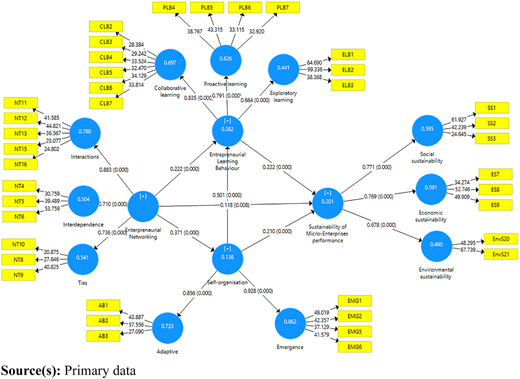
Before testing the hypotheses, the structural equation model was assessed for explanatory power (R2), effect size (F2) and predictive relevance (Q2) for both study variables and their higher-order constructs. The R2 values for the study variables were 0.380 for entrepreneurial learning behavior, 0.137 for self-organization and 0.201 for sustainability of micro-enterprise performance (see Table 5), indicating moderate predictive power and supporting the model's in-sample fit (Mayanja et al., 2021; Sarstedt et al., 2019; Hair et al., 2017). All higher-order constructs had R2 values above 0.5, except for exploratory learning (0.44) and environmental sustainability (0.459), meaning the study variables explain over 50% of the variance in their higher-order constructs (Hair et al., 2020). The effect size (F2) analysis revealed small effects of entrepreneurial learning behavior, self-organization and entrepreneurial networking on sustainability of micro-enterprise performance (0.038, 0.035 and 0.014, respectively). Lastly, a blindfolding procedure with an omission distance of seven assessed predictive relevance using the Q2 index (de la Cruz, Jover, & Gras, 2018; Stone, 1974; Geisser, 1975). The Q2 values (0.070 for the model, 0.138 for entrepreneurial learning behavior and 0.073 for sustainability of micro-enterprise performance) indicate good predictive relevance, supporting the model's predictive accuracy (see Table 6).
Explanatory power (R2)
| R-square | R-square adjusted | |
|---|---|---|
| Interactions | 0.780 | 0.780 |
| Interdependence | 0.504 | 0.503 |
| Ties | 0.541 | 0.541 |
| Adaptive | 0.733 | 0.732 |
| Emergence | 0.862 | 0.862 |
| Collaborative learning | 0.697 | 0.696 |
| Exploratory learning | 0.441 | 0.440 |
| Proactive learning | 0.626 | 0.625 |
| Economic sustainability | 0.591 | 0.590 |
| Environmental sustainability | 0.460 | 0.459 |
| Social sustainability | 0.595 | 0.594 |
| Entrepreneurial learning behaviour | 0.382 | 0.380 |
| Self-organisation | 0.138 | 0.137 |
| Sustainability of micro-enterprises performance | 0.201 | 0.197 |
Source(s): Primary data
4. Results
4.1 Inter-construct correlation
The results in Table 7 indicate that there is a significant positive association between entrepreneurial networking, entrepreneurial learning behavior, self-organization and sustainability.
Descriptive and correlations
| Study variables | Mean | SD | 1 | 2 | 3 | 4 |
|---|---|---|---|---|---|---|
| Entrepreneurial networking | 1.000 | |||||
| Entrepreneurial learning behaviour | 0.408*** | 1.000 | ||||
| Self-organization | 0.371*** | 0.583*** | 1.000 | |||
| Sustainability of micro-enterprises performance | 0.286*** | 0.392*** | 0.383*** | 1.000 |
Note(s): N = 581, ***, correlations id significant p ≤ 0.001 at (2-tails)
Source(s): Primary data
4.2 Direct hypothesis
Using bootstrapping with 10,000 sub-samples and a 95% bias-corrected confidence interval, the results indicate that most of the hypothesized relationships are statistically significant (p ≤ 0.05). Specifically, entrepreneurial networking is positively and significantly related to micro-enterprise sustainability (β = 0.12, p < 0.005). It also has a positive and significant relationship with entrepreneurial learning behavior (β = 0.22, p = 0.000) and self-organization (β = 0.37, p = 0.000). Additionally, entrepreneurial learning behavior is positively and significantly related to micro-enterprise sustainability (β = 0.22, p = 0.000), while self-organization shows a strong positive relationship with entrepreneurial learning behavior (β = 0.50, p = 0.000). Finally, self-organization is positively and significantly related to micro-enterprise sustainability (β = 0.21, p = 0.000).
4.3 Mediation results
We conducted a mediation analysis following Carrion, Nitzl, and Roldan (2017), treating entrepreneurial learning behavior as a mediator between entrepreneurial networking, self-organization and micro-enterprise sustainability. The results show that entrepreneurial learning behavior significantly mediates the relationships between entrepreneurial networking, self-organization and sustainability (β = 0.05, p = 0.000; 95% BCa CI: 0.030–0.08) and (β = 0.11, p = 0.000; 95% BCa CI: 0.07–0.16), confirming the indirect effect. This indicates partial mediation by entrepreneurial learning behavior. Additionally, self-organization partially mediates the relationships between entrepreneurial networking, entrepreneurial learning behavior and sustainability (β = 0.19, p = 0.000; 95% BCa CI: 0.014–0.240) and (β = 0.08, p = 0.000; 95% BCa CI: 0.378–0.412). The results are shown in Table 8 and Figure 2.
Hypotheses results (direct and indirect)
| Direct path | β | T-stat | p-values | BaCCI | Decision |
|---|---|---|---|---|---|
| Entrepreneurial Networking → Entrepreneurial Learning Behaviour | 0.22 | 5.57 | 0.000 | 0.14–30 | Supported |
| Entrepreneurial Networking → Micro-Enterprises Sustainable performance | 0.12 | 2.64 | 0.008 | 0.03–0.20 | Supported |
| Entrepreneurial Networking → Self-organisation | 0.37 | 8.42 | 0.000 | 0.28–0.45 | Supported |
| Entrepreneurial Learning Behaviour → Micro-Enterprises Sustainable performance | 0.22 | 4.81 | 0.000 | 0.13–0.31 | Supported |
| Self-organisation → Entrepreneurial Learning Behaviour | 0.50 | 13.98 | 0.000 | 0.43–0.57 | Supported |
| Self-organisation → Micro-Enterprises Sustainable performance | 0.21 | 4.36 | 0.000 | 0.11–0.30 | Supported |
| Indirect path | β | T-stat | p-values | BaCCI | Mediation type |
|---|---|---|---|---|---|
| Entrepreneurial Networking → Entrepreneurial Learning Behaviour → Micro-Enterprises Sustainable performance | 0.05 | 3.73 | 0.000 | 0.03–0.08 | Partial Mediation |
| Entrepreneurial Networking → Self-organisation → Micro-Enterprises Sustainable performance | 0.08 | 3.78 | 0.000 | 0.04–0.12 | Partial Mediation |
| Entrepreneurial Networking → Self-organisation → Entrepreneurial Learning Behaviour | 0.19 | 7.15 | 0.000 | 0.14–0.24 | Partial Mediation |
| Self-organisation → Entrepreneurial Learning Behaviour → Micro-Enterprises Sustainable performance | 0.11 | 4.61 | 0.000 | 0.07–0.16 | Partial Mediation |
| Total effect | β | T-stat | p-values | BaCCI |
|---|---|---|---|---|
| Entrepreneurial Networking → Entrepreneurial Learning Behaviour | 0.41 | 10.47 | 0.000 | 0.33–0.48 |
| Entrepreneurial Networking → Micro-Enterprises Sustainable performance | 0.29 | 7.19 | 0.000 | 0.20–36 |
| Entrepreneurial Learning Behaviour → Micro-Enterprises Sustainable performance | 0.22 | 4.81 | 0.000 | 0.28–45 |
| Entrepreneurial Networking → Self-organisation | 0.37 | 8.42 | 0.000 | 0.13–31 |
| Self-organisation → Entrepreneurial Learning Behaviour | 0.50 | 13.98 | 0.000 | 0.43–0.57 |
| Self-organisation → Micro-Enterprises Sustainable performance | 0.32 | 7.769 | 0.000 | 0.23–40 |
Source(s): Primary data
PLS-SEM for sustainability of microenterprises performance
PLS-SEM for sustainability of microenterprises performance
5. Discussion
The results show that entrepreneurial networking positively and significantly influences the sustainability of microenterprises performance. This connotes that the more women micro entrepreneurs build interactions with others through close working relationship, aiming at getting business advice from business associates, the more likely the woman micro entrepreneur will achieve sales growth, income stability and profitability. Relatedly, women micro entrepreneur ties developed with friends, relatives and acquaintances are a social support to accessing cheap finances, products/raw materials through the guidance of other people in the business community. The results are in line with Searcy (2016) who found out that small business owners in rural communities rely on informal networks to improve their performance. CAS theory empathizes the role of interactions by agents through feedback which is useful for business performance.
Entrepreneurial networking and entrepreneurial learning behavior is positively and significantly related. This means that the interactions with other network members help women micro entrepreneurs to get advice, identify business opportunities and new business partners. The access to useful information help the women micro entrepreneurs to learn better ways of handling resources and customers. Further, entrepreneurial networks help women to reflect about their own experiences, compare their work performances in the business, always do things as advised by those ahead of them in business. Women are likely to always be open, adjust with trends on the market and adapt to the challenging environment which is not favorable to women micro entrepreneurs. This is in congruence with Hunter and Lean (2018) who posits that entrepreneurial networks provide women with learning opportunities to make meaning of their own experiences and past decisions which may apply to current circumstances.
Further, entrepreneurial learning behavior and sustainability of women owned micro enterprise performance have a positive and significant relationship. This means that women micro entrepreneurs, who develop exploratory learning behavior, tend to question about their experience in business, reflect on their own experience in the business and always compare their work performances in the business. This usually helps them to understand their business environment, improve on the business performance. Relatedly, collaborative learning is source of information about the expectations from customers, provide freedom and control over the course of actions to improve lifestyle and the business performance of women micro entrepreneurs. Contextually, it was established that proactive learning like remembering things that happened among competitors, learning from consequences of working with others make women micro entrepreneurs open to adjustments with trends on the market. Therefore, entrepreneurial learning behavior influence individuals to improve on how they operate in the environment sustainability. The findings are consistent with Lattacher, Gregori, Holzmann, and Schwarz (2021) posits that entrepreneurial learning behavior among gender is an important construct recognized in starting new business and growth. Learning experiences across gender influence their knowledge and motivations, to start, grow and sustain their micro enterprises.
Entrepreneurial networking and self-organization are also positively and significantly related. This means that the connections between individuals with like minds could easily be tapped into by getting business advice from business associates related well with other members in the business community. The entrepreneurial networks support women micro entrepreneurs by adapting to the environment for easily allocating more resources on first moving stock depending on customer’s needs. This helps to change marketing strategies to increase the business sales. In addition, interactions among micro women entrepreneurs create emerging patterns that develop through relations with a wider community. The connections help women to manage their businesses better, like handling customers, doing business on a daily basis and overcoming business challenges. Consequently, entrepreneurial networking through connections and access to resources provide support to micro women entrepreneurs to self-organize during turbulent times. This finding is in line with Mutebi et al. (2019) who posits that self-organizing encourage individuals to think and come up with novelty systems, products and services to pursue the same goal of addressing changes in environment. This supports CAS theory interactions and honest feedback help individuals to re-organize.
Subsequently, there is a positive and significant relationship between self-organization and sustainability of women owned micro enterprise performance. This means that whenever there is a better self- organizational levels like use of available resources to suit the context like coming up with novelty systems, products and services. The micro women entrepreneurs that adjust their operations, patterns and resources, evaluate the needs of customers create adaptive process that create savings from space occupied and operate business using minimal utilities. The self-re-organization skills obtained from previous experience through interactions with social network actors, customers, suppliers and competitors improve competitiveness. The findings are consistent with Huque (2017), self-organization help women to increase their income, stabilize and professionalize their business activity, improve of their status within the family unit and strengthen their capacity which are useful for enhancing micro-enterprise sustainable performance.
The study also found that self-organization and entrepreneurial learning behavior are also positively and significantly related. This suggests that self- organization influences entrepreneurial learning behavior of women micro entrepreneurs. Relatedly, micro entrepreneurs who adapt to the dynamic environment, scan the emerging patterns arising from unfolding events are likely to develop entrepreneurial learning behavior to survive in entrepreneurial landscape. Self- organization is useful in developing business marketing strategies to increase sales and overcoming business challenges arising from liability of smallness. This is consistent with Hägglund (2020), who posts that self-organization help individuals to explore opportunities and exercise their agency to set and strive for what they envision.
The study also found that entrepreneurial learning behavior partially mediates the relationship between entrepreneurial networking and sustainability of women owned micro enterprise performance. This suggests that entrepreneurial learning behavior influences entrepreneurial networking and micro-enterprise sustainable performance. The more women micro entrepreneur continuously learns from social network, the more they become adaptive. This contributes to the understanding of the roles and responsibilities they perform. Further, the results infer that women micro entrepreneurs that learn from past business experiences develop mechanisms and procedures which help them adapt to a dynamic operating environment. This is consistent with the findings of Mamun et al. (2016) who postulates that women micro entrepreneurs are able to come up with patterns that efficiently use the tangible and intangible resources that enhance business sustainability performance. CAS theory states that networks are useful when they adapt to the environment, actors learn from each other to support their business in turbulent environment.
Self-organization partially mediates the relationship between entrepreneurial networking and sustainability of women owned micro enterprise performance. This means that when women micro entrepreneurs develop spontaneous order arising from local interactions with network actors, new ideas about products, processes and customers emerge. The women entrepreneur who develop new behavior that emerges from positive feedback is likely to be useful in adapting to the environment. This happens by immersing in collaborative and creative processes to solve business and societal problems. Micro entrepreneurs, who continue interacting through entrepreneurial networks, are likely to attach meaning to new emerging patterns in dynamic environment. This is consistent with Galkina and Atkova (2020) who states that, the more individuals engage in open communication and discussions, the more likely they facilitate their microenterprises in reconfiguring into a system that supports economic, social and environmental sustainability.
Further, we note that self-organization partially mediates the relationship between entrepreneurial networking and entrepreneurial learning behavior. This partial mediation accounts for 46% variation. This means that self-organization can impact directly and indirectly entrepreneurial networking and entrepreneurial learning behavior. This means that in a dynamic women micro entrepreneurs can re-organize their business activities by using entrepreneurial networks and entrepreneurial learning behavior to achieve sustainability of women owned micro enterprise performance.
Finally, we note that entrepreneurial learning behavior partially mediates the relationship between self-organization and sustainability of women owned micro enterprise performance. This mediation accounts for 52% directly and indirectly through entrepreneurial learning behavior. This means that in a dynamic environment, it is important for micro entrepreneurs to transform their experiences into knowledge. This is achieved when an entrepreneur become accommodator (enthusiastic learners who welcome new experiences), diverger (who like to think things through before taking action); assimilator (who like to consider things from an analytical, logical and objective way) and converger (who enjoy solving problems and seeing how their ideas work out in practice). Entrepreneurial learning behavior is useful in helping an individual to explore new options, collaborate with others to access useful information and being proactive exploiting opportunities. The finding resonates with Mutebi, Muhwezi, and Munene (2021) and Nogueira (2019) who denotes that self-organization help individuals to reallocate resources, respond to crises, understand customers and market dynamics based on entrepreneurial networks.
6. Conclusion and implications
The study concludes that entrepreneurial learning behavior plays a partial mediation between entrepreneurial networking and sustainability of women owned micro enterprise performance. Further, there is a partial mediating effect of self- organization in the relationship between entrepreneurial networking and sustainability of women owned micro enterprise performance. In addition, self-organization mediates the relationship between entrepreneurial networking and entrepreneurial learning behavior among women micro entrepreneurs. The application of Complex Adaptive Systems (CAS) theory provides a comprehensive understanding of the mediating effects of self-organization and learning behaviors in the relationship between entrepreneurial networking and the sustainability of women owned micro enterprise performance in developing countries. Through dynamic networking, self-organization and adaptive learning, women entrepreneurs navigate challenges, capitalize on opportunities and contribute to the sustained success of their enterprises in diverse and often challenging contexts.
6.1 Implications
6.1.1 Policy implications
Governments and development agencies should create structured initiatives to enhance networking among women-owned micro-enterprises. This includes organizing themed events, skill-building workshops and seminars to promote collaboration and resource sharing. Key actions involve identifying stakeholders, establishing digital platforms for ongoing connection, gathering feedback for improvement and launching targeted marketing campaigns to boost participation.
Training programs should aim to enhance self-organization skills for women entrepreneurs, focusing on goal-setting, time management and strategic planning. This includes developing structured workshops and resources that empower participants to effectively manage their businesses and achieve their objectives.
Educational institutions should create regional information hubs to support women-owned micro-enterprises by providing access to resources on business trends, market opportunities and entrepreneurial best practices. These hubs would offer networking events, mentorship programs and training workshops to foster community and enhance essential skills. By combining tailored curricula with these supportive services, women entrepreneurs will be better equipped to succeed in their ventures.
6.1.2 Managerial implications
Micro-enterprise owners should prioritize building and maintaining networks with fellow entrepreneurs, mentors and industry stakeholders. A strong network offers essential access to resources, knowledge and support, which are vital for long-term sustainability. Engaging actively can lead to collaborative opportunities and shared growth.
Women micro-entrepreneurs should adopt self-organization practices to enhance their operational efficiency. Implementing structured planning and reflection can improve responsiveness to market changes. By fostering a systematic approach, entrepreneurs can better allocate their resources and manage their businesses effectively.
Women entrepreneurs need to utilize their networks to identify funding opportunities, partnerships and resources that support business growth. Networking can provide insights into available financial support and collaborative ventures. This proactive approach can significantly contribute to sustainability and success.
Women micro-entrepreneurs should focus on developing learning habits and set aside time for personal development. Engaging in workshops and actively communicating with peers enhances their skills and knowledge. Additionally, embracing environmental sustainability through eco-friendly practices like using natural resources wisely and networking groups can strengthen their business’s social responsibility and market appeal.
6.1.3 Limitations and future research
The study was conducted in six Eastern Uganda districts, suggesting that individual views may change over time, recommending future research with longitudinal design and exploring further constructs like exploratory learning and environmental sustainability.
Funding: The authors funded the study.
N.B: This study did not involve human or animal subjects, and therefore, ethical committee approval was not required.

