


This study aims to comprehensively examine the environmental, health, economic and social benefits of carbon capture technologies (CCTs) in Bangladesh, thereby contributing to sustainable green environments.
This study adopts a unique approach to quantitative surveys and primary data analysis. It actively involves diverse stakeholders in data collection, including policymakers, industry professionals and the public, ensuring a comprehensive understanding of the subject matter.
Implementing CCTs in Bangladesh brings about a host of benefits. It not only leads to a significant reduction in CO2 (carbon dioxide) emissions, thereby improving air quality and public health but also it stimulates public awareness and education, bolstering support for CCTs. The economic benefits are diverse, encompassing job creation and industry expansion, painting a promising picture for Bangladesh’s future. In essence, CCTs can enhance Bangladesh’s social well-being and quality of life, presenting a viable roadmap for sustainable, long-term development.
While this study provides significant insights into the impact of CCTs on people’s lives in Bangladesh, it is essential to recognize its limitations. However, this ongoing study is crucial in advancing sustainable technologies, underscoring the necessity for continual research and enhancement to ensure a sustainable future.
This study stands out for its comprehensive examination of the social effects of CCTs in a developing country. Integrating diverse data types and methods provides unique insights to policymakers, business leaders and academics. These insights empower decision-makers to advocate for green technologies and sustainable development in similar contexts, fostering informed decision-making and strategic planning.
Introduction
Carbon capture technologies (CCTs) offer a big chance to protect the environment and slow climate change (Bui et al., 2018). These technologies can reduce the amount of CO2 released into the air, lowering global warming and making the air cleaner (Tewari, Phuat, & Sedaralit, 2023). However, knowing how these tools affect people is essential for many to use and accept them. A crucial part of getting CCTs used is making people aware of and educated about them. Researchers have researched that well-informed groups are more likely to support environmental projects (Anwar et al., 2018). In addition, official support and regulatory frameworks are needed to set up the infrastructure and provide incentives for using CCT (Anwar et al., 2018; Wennersten, Sun, & Li, 2015; Zhang, 2021). Investing in carbon capture projects is also very important because it leads to new ideas and the ability to grow (Torvanger, 2019). Community participation is also essential for building local support and ensuring everyone fairly shares CCTs' benefits (Tewari et al., 2023). When figuring out the social effect of CCTs, many things have to be considered, such as overall well-being and quality of life, the reduction of carbon emissions, the improvement of public health, the growth of green spaces, the creation of jobs, and the reduction of carbon emissions (Anwar et al., 2018; Pianta, Rinscheid, & Weber, 2021; Tewari et al., 2023). With many parts, this method ensures that we fully grasp how CCTs can help create lasting green environments (Wennersten et al., 2015). However, the study aims to investigate these factors and thoroughly analyze the social effects of carbon capture technologies. Therefore, this helps people understand how these technologies can protect the environment and make communities healthier (Zhou et al., 2024).
Bangladesh is a country in South Asia with many environmental problems because of its large population, fast development, and susceptibility to climate change. Through public programs and international agreements, the country makes its dedication to promoting sustainable development and lowering the flow of greenhouse gases transparent (Anwar et al., 2018). Still, people are giving up on and using advanced carbon-reduction tools similar to carbon capture (Tewari et al., 2023). Bangladesh's energy industry is a significant source of CO2 emissions because it uses fossil fuels to make electricity (Majumder, Islam, & Hossain, 2019). As the country tries to balance economic growth and environmental protection, CCTs are an excellent way to lower pollution and support growth (Kibria, Haroon, & Nugegoda, 2018; Majumder et al., 2019). Adding CCTs to the energy industry can help Bangladesh meet its Paris Agreement pollution reduction goals (Hossain, Hasan, Sarkar, Karim, & Bhuiyan, 2023). The people of Bangladesh need to be aware of and open to carbon capture methods for them to work. Research has shown that when people learn more about environmental problems, they may support sustainable solutions less (Majumder et al., 2019). Although carbon capture technologies (CCTs) have been the subject of extensive worldwide research, more is needed to know their particular socioeconomic and environmental effects in poor nations, especially Bangladesh (Shahbaz, Mahalik, Shah, & Sato, 2016). Most research focuses on developed countries, with notable differences between emerging economies such as Bangladesh and developed countries regarding infrastructure, regulatory frameworks, and economic capacities (Wilberforce, Baroutaji, Soudan, Al-Alami, & Olabi, 2019, 2021). Therefore, limited attention has been given to developing nations (Aneesh & Sam, 2023). Most of the research on CCTs that has been done so far has focused on affluent nations (Hossain et al., 2023); Bangladesh and other developing countries have experienced particular difficulties in implementing and obtaining the benefits of these technologies (Rahman, Noor, & Ahmed, 2022). Bangladesh requires specific research on CCT implementation due to its unique socioeconomic circumstances, dense population, and vulnerability to climate change (Chowdhury, Hasan, & Islam, 2022; Islam, 2021). Even though a complete social impact analysis is absent, most studies examine the technical and financial elements of CCTs (Aneesh & Sam, 2023). Still, they need to carry out a full social impact analysis. This study covers the social well-being and quality-of-life enhancements that are especially pertinent to Bangladesh, including the advantages for public health, job development and environmental awareness. Also, policy fabrics play a huge role in making it easier for people to give up their CCTs. Effective programs and rules are needed to encourage people to use these technologies (Anwar et al., 2018). Infrastructure investment for carbon capture is another crucial component. Bangladesh needs significant financial resources to create and implement CCTs on a large scale. Technology support and international funding can be substantial (Halsnæs & Verhagen, 2007; Wennersten et al., 2015). Furthermore, community involvement is necessary to guarantee that local people actively participate in environmental projects and that the advantages of CCTs are widely dispersed (Kabir et al., 2016). In Bangladesh, evaluating the social impact of CCTs entails looking at how they affect social well-being, economic growth, and public health. While developing jobs in the green technology industry can spur economic growth, improved air quality from fewer emissions can also lead to better health outcomes (Anwar et al., 2018; Kabir et al., 2016; Kibria et al., 2018). Green areas can also improve people's quality of life and general social well-being (Wennersten et al., 2015). This study emphasizes how carbon capture technologies can promote a sustainable green environment and enhance community well-being. It attempts to investigate the social impact of these technologies in Bangladesh.
Bangladesh is confronted with significant environmental obstacles due to its rapid industrialization, dense population, and susceptibility to climate change (Hossain et al., 2023; Kabir et al., 2016; Mohazzem Hossain, Biswas, & Raihan Uddin, 2024; Rahman et al., 2022). The energy sector, which is highly dependent on fossil fuels, substantially contributes to air pollution and adverse health effects due to its heavy reliance on CO2 emissions (Moghayer et al., 2023; Raihan et al., 2022). Although the government has committed to decreasing emigration through transnational agreements, its adoption of advanced carbon reduction technologies, such as carbon prisoners, is still constrained. Comprehending the societal ramifications of these technologies is critical for their effective implementation and broad adoption in Bangladesh (Raihan et al., 2022).
The principal objective of this study is to assess the social impact of CCTs on promoting sustainable green environments in Bangladesh. The primary aim of the exploration is to determine the effects of CCTs and their associated benefits on a sustainable green environment. Through an evaluation of the efficacy of carbon emissions technologies in mitigating CO2 emigration, this investigation offers invaluable insight into how Bangladesh can attain its environmental aspirations and improve environment quality (Hossain et al., 2023), as well as contribute to the resolution of health concerns and the reduction of healthcare expenditures (Hossain et al., 2023; Rahman et al., 2022) shed light on the viable benefits of CCTs, such as promoting environmentally conscious practices and generating employment opportunities, both of which are conducive to sustainable and profitable development. Evaluating the effects on social well-being and quality of life can provide insight into the broader societal advantages of CCTs, including promoting community engagement and support for environmental initiatives (Anwar et al., 2018).
Literature review
Growing concern over climate change has urged expansive exploration into carbon reduction technologies, including Carbon Capture storage (CCS). This literature review examines studies on the social impact of CCTs, specifically their applicability to Bangladesh and the legal structures and technical developments in nations that effectively implement CCTs (Zhang, 2021). Policymakers and other stakeholders in Bangladesh can create plans influenced by international experiences and a better understanding of global viewpoints.
Carbon capture technologies (CCTs)
Carbon capture technologies involve landing CO2 emissions from artificial sources and power shops and storing them underground to prevent them from entering the atmosphere. This knowledge is key for addressing climate change, as CCTs can significantly reduce CO2 emissions (Bui et al., 2018). In addition to enhancing economic performance through cost savings and improved operational efficiency, these technologies can help firms diminish their environmental impact and carbon footprint (Dechezleprêtre, Koźluk, Kruse, Nachtigall, & De Serres, 2019). Many researchers argue that meeting global climate targets without similar technologies is demanding (Friedlingstein et al., 2022). Various technological obstacles exist in developing and applying carbon capture technologies (Mitić, Fedajev, Radulescu, & Rehman, 2023). The technological developments—such as increased capture efficiency and cost reduction—necessary for successful carbon capture are covered by Gibbins and Chalmers (Nahrin, 2020). They point out that even though much development has occurred, more innovation is required to make CCTs widely commercially viable. According to an existing study, organizations can significantly expand a variety of performance metrics, such as economic, functioning, and environmental metrics, by incorporating ecological deliberations into their strategic decision-making operational procedures (Terwel, Harinck, Ellemers, & Daamen, 2009). Empirical investigations have shown that carbon capture technologies effectively reduce CO2 emissions (Shahbaz et al., 2016). For example, CCTs can capture up to 90% of CO2 emissions from industrial sources (Bui et al., 2018). Similar noteworthy emissions reductions were recorded in pilot programs (Pianta et al., 2021). This implies that Bangladesh's adoption of CCTs may result in a significant drop in CO2 emissions.
Environmental and health benefits (EHB)
One of the primary benefits of CCTs is reducing carbon emissions, directly improving air quality. Studies have shown that polluted air quality leads to better public health issues, reducing the prevalence of respiratory and cardiovascular conditions (Hossain et al., 2023). In Bangladesh, where air pollution is a primary health concern, espousing CCTs could have significant public health benefits (Kabir et al., 2016). Combining carbon capture devices with renewable energy sources can increase their efficiency. Investigate building a more robust and sustainable energy infrastructure by integrating CCTs with renewable energy sources like solar and wind power (Mohazzem Hossain et al., 2024). This strategy can guarantee a consistent supply of renewable energy while assisting in reducing dependency on fossil fuels—public health benefits directly from lower emissions-induced improvements in air quality. A study in Bangladesh demonstrated a correlation between lower air pollution levels and fewer respiratory illnesses (Kabir et al., 2016). This suggests that implementing CCTs may improve population health outcomes.
Economic growth (EG)
The economic benefits of CCTs include job creation and the stimulation of green industry. Many scientists suggest investing in carbon capture structures can drive economic growth by creating new employment openings in the green technology sector (Rahman et al., 2022). The success of CCTs depends on investment. Significant financial resources are needed to develop and implement these technologies efficiently (Hossain et al., 2023). They contend that international financing and public-private partnerships can significantly advance CCT initiatives, especially in developing nations like Bangladesh. The cost of capture and the value of carbon credits, which can offer financial incentives for enterprises to adopt these technologies, are other factors that determine the economic viability of CCTs. CCTs offer economic advantages in terms of industry growth and job creation. Funding for carbon capture projects in poor nations significantly increased the jobs in the green technology industry (Kibria et al., 2018). This implies that implementing CCTs in Bangladesh might promote economic growth.
Social well-being and quality of life (SWQL)
Enhanced air quality, public health, and economic benefits contribute to societal well-being. Community engagement in environmental creativity further strengthens social cohesion and support for sustainability. Involving stakeholders and communities is essential to the effective implementation of CCTs. Emphasizes the importance of including neighborhood groups in environmental preservation initiatives (Nahrin, 2020). In addition to addressing concerns and ensuring that the benefits of CCTs are spread fairly, effective engagement tactics can assist in establishing trust. In Bangladesh, where there is a high level of community involvement in environmental projects, this strategy can help make carbon capture projects more acceptable and successful. Researchers have demonstrated that CCTs can support sustainable development by boosting environmental quality, generating jobs, and improving public health (Bui et al., 2018; Kabir et al., 2016; Wennersten et al., 2015). These advantages can improve economic resilience and social well-being, especially in emerging nations like Bangladesh. A higher quality of life is associated with the societal acceptability of CCTs (Kabir et al., 2016). Their meta-analysis found that communities that benefited from creating jobs and better air were more supportive of these technologies.
Sustainable green environments (SGE)
Diminishing carbon dioxide (CO2) emissions is one of the foremost vital ways CCTs can help moderate worldwide warming (Smit, Park, & Gadikota, 2014). CCT's capacity to diminish barometrical CO2 levels is imperative in lessening the seriousness of climate change and worldwide warming (Lal, 2004). This decay, too, depends on the conservation of biodiversity and environmental agreements. CCT's CO2 capture and capacity capabilities can encourage a more consistent move to renewable energy sources (Rubin & Zhai, 2012). For instance, a cheap energy system can be set up using CO2 released during bioenergy production (Bio-CCS), which can cause harmful emissions (Mitić et al., 2023). Sending CCT has the potential to produce green business openings and boost maintainable industry financial development (Halsnæs & Verhagen, 2007; Shahbaz et al., 2016). This financial calculation is significant for environmental sustainability and the openness of green endeavors in the long run (Stuart Haszeldine, 2009). Carbon capture technologies cannot lead to sustainable green environments without improving natural sustainability, lowering greenhouse gas emissions, supporting renewable energy sources, and improving natural carbon sinks (Halsnæs & Verhagen, 2007; Nahrin, 2020; Stuart Haszeldine, 2009). Therefore, CCT can contribute to the achievement of environmental adjustment and the moderation of climate change. The CCT's move to a feasible economy makes green employment in renewable vitality, vitality proficiency, and maintainable horticulture possible (Mitić et al., 2023; Nahrin, 2020). These occupations contribute to financial development and the decrease in unemployment.
Consequently, the following Table 1 explores the relevance of some empirical findings incorporated in the Bangladesh study context.
Empirical findings incorporated in the Bangladesh study context
| Author(s) & year | Study focus | Country/context | Key findings | Relevance to the current study |
|---|---|---|---|---|
| Bui et al. (2018) | Carbon capture and storage (CCS) | Global | CCS can capture up to 90% of CO2 emissions, but economic viability still needs to be improved | Focuses on the latent CCTs in Bangladesh but identifies the economic encounters |
| Chowdhury et al. (2022) | Climate change adaptation in Bangladesh | Bangladesh | CCT's various barriers are hindering sustainable adaptation | It highlights the importance of socioeconomic and environmental for sustainable development |
| Hossain et al. (2023) | The study aims to assess the use of carbon capturing | Bangladesh | Low air pollution levels resulted in a considerable decrease in pneumonia and reduced health expenses | Demonstrates the advantages of CCT deployment for public health in Bangladesh |
| Kabir et al. (2016) | Understanding and attitudes on climate change and its effects on Bangladesh's health | Bangladesh | Environmental awareness in a community is associated with stronger support for sustainable projects, yet awareness impedes the adoption of green technology such as CCTs | Draws attention to how crucial awareness and education are to the effective application of CCTs |
| Wennersten et al. (2015) | Long-term advantages of CCTs for community involvement and social wellness | Emphasis on developing nations' global | Environmental initiatives enhance public health and social integration is essential to CCT's success | The study's emphasis is on public and community participation in Bangladesh |
| Majumder et al. (2019) | An analysis of Bangladesh's efforts to reduce and capture carbon | Bangladesh | It Highlights Bangladesh's dedication to cutting emissions in line with international accords and draws attention to infrastructure shortcomings for technologies such as CCTs | Focuses on the upgraded technology and infrastructure requirement to execute CCTs in Bangladesh |
Source(s): Author created through literature reviewed
Conceptual model development
Carbon capture innovations can capture up to 90% of CO2 outflows from mechanical sources, diminishing nursery gasses within the air (Bui et al., 2018). This diminishment straightforwardly connects with advancements in discussing quality. The relationship between discussion quality and open well-being in Bangladesh found that lower discussion contamination levels lead to fewer respiratory and cardiovascular conditions (Kabir et al., 2016). This recommends that embracing CCTs can result in considerable benefits for open-minded well-being by improving discussion quality. However, speculations in the carbon capture framework can drive financial development by creating new work openings within the green innovation segment (Rahman et al., 2022). Therefore, subsidizing carbon capture ventures in developing nations significantly boosts work creation within the green innovation industry, advancing maintainable financial development (Kibria et al., 2018). This is often pivotal for Bangladesh's improvement, adjusting financial and natural needs. Nevertheless, the coordinate interface between diminished CO2 outflows and progressed open well-being results (Hossain et al., 2023; Majumder et al., 2019). The significance of open mindfulness and instruction on almost natural issues (Majumder et al., 2019). Their inquiry has shown that well-informed communities are more likely to back and take advantage of feasible innovations like CCTs, resulting in superior open health overall. On the other hand, community cooperation is crucial for effectively actualizing CCTs (Tewari et al., 2023). Indeed, experimental evidence emphatically underpins the speculation that executing carbon capture innovations contributes to economic green situations. Therefore, in this research, a central hypothesis (H1) was generated in the conceptual framework Figure 1:
Applying CCTs significantly contributes to sustainable green environments by improving environmental and health benefits, economic growth, social well-being, and quality of life in Bangladesh. Nevertheless, the following conceptual framework is drawn from the hypothesis associated with three dimensions to develop the structural equation model (SEM):
Carbon capture technologies → environmental & health benefits.
Carbon capture technologies → economic growth.
Carbon capture technologies → social well-being quality of life.
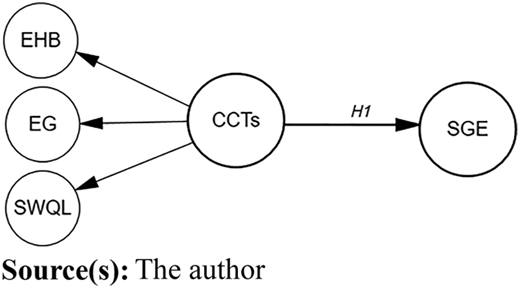
Green habitats are more sustainable when pollution decreases, and cleaner technology improves health outcomes. A healthy population can engage in more economic activities and improve the quality of life in their communities. CCTs free up resources devoted to environmental conservation and sustainable development activities by lowering the public health burden of pollution-related disorders (Haines et al., 2009). CCTs can significantly enhance public health and environmental sustainability in Bangladesh, where health problems associated with environmental degradation are prevalent (Islam, 2021; Kjellstrom & McMichael, 2013). The economic growth fueled by CCTs is anticipated to be more sustainable than that of conventional growth models based on fossil fuels (Victor, 2010). Green economic growth guarantees that environmental sustainability is not sacrificed for economic progress (Bowen & Hepburn, 2014). CCTs encourage sustainable practices that lessen industries' environmental impact and improve long-term financial stability by promoting a green economy (Kumar, 2017). Therefore, CCTs provide a workable route to accomplishing Bangladesh's sustainable development goals (SDGs), which must simultaneously manage ecological hazards and encourage economic growth (Islam, 2021). Yet, enhancements in social well-being, namely in health, education, and poverty alleviation, are essential for advancing environmentally viable landscapes (Griscom et al., 2017). Enhancing social well-being through CCTs might encourage community involvement in environmental conservation efforts in Bangladesh, where many communities are extremely vulnerable to the effects of climate change (Chowdhury et al., 2022).
Methodology
This study research design uses a mono-methods approach and quantitative data to evaluate the social impact of CCTs on sustainable green environments in Bangladesh. The data for the study is gathered via physical survey data analysis. Non-probability sampling techniques are applied when not using probability sampling (Patton, 2002). Purposive sampling is frequently regarded as the most appropriate non-probability sampling technique for studies that concentrate on particular insights (Palinkas et al., 2015), especially when addressing specialized topics (Etikan, 2016) like the social impact of CCTs on sustainable green environments in Bangladesh. As a result, this approach maximizes the depth and relevance of the data gathered, offering insightful information directly related to the study's goals. However, partial Least Squares structural equation modeling (PLS-SEM) is a powerful statistical method for complicated models with several components (Hair, Hult, Ringle, & Sarstedt, 2014). To ensure the validity and reliability of the results, the right sample size must be chosen (Henseler, Hubona, & Ray, 2016). Ten times the number of structural paths intended at a specific model build is a typical best practice for PLS-SEM (Kock & Hadaya, 2018). On the other hand, a sample size of 150–200 respondents is advised to reach 80% statistical power at a significance level of 0.05 and an effect size of 0.15 (medium effect) (Bollen, 1986). In any case, a larger sample size increases robustness and accuracy (Oakland, 1953). Therefore, 200 is considered an adequate sample size for SmartPLS software, given the standard effect size and desired statistical power. Yet, the study's target population includes stakeholders directly or indirectly impacted by the Dhaka division's CCTs. However, the target respondents were selected from the general public, industry professionals, and policymakers, the target who presented relevant and informative data for the study. Likert scale questionnaires were applied and included in the survey to quantify responses (Kibria et al., 2018). However, the data was collected from February to March 2024 through a physically conducted survey with closed-ended questionnaires distributed to the target respondents. A Likert scale of 1 to 5 points is easy to understand to decide where the middle point is neutral (Jiří, Cristina, Carlos, Jean-Pierre, & Tristan, 2021; de Winter & Dodou, 2010). Therefore, this study selected a Likert scale of 1 to 5 points, where 1 is strongly disagree, 2 is disagree, 3 is neutral, 4 is agree, and 5 is strongly agree. A total of 327 questionnaires were distributed, and finally, the complete data form was collected from 293 respondents, whereas the final data of 280 was taken to finalize the statistical analysis. However, the total data sets were three categories of respondents: generally public, industrial professionals, and policymakers (41, 54, and 5%, respectively).
Data analysis tools
Survey data was analyzed using two software programs, SPSS and Smart-PLS, which help research the societal effects of CCTs in Bangladesh (Hair et al., 2014; Ketchen, 2013). However, PLS-SEM can handle complicated models with several constructs and indicators (Kwong-Kay, 2013). Consequently, PLS-SEM maximizes the explained variance of the dependent components, making it more prediction-focused (Henseler et al., 2016). So, PLS-SEM lets researchers simultaneously look at the measurement model (how latent variables are related to the indicators) and the structure model (how latent variables are related). However, SPSS applied for descriptive statistics of the survey data was summarized by descriptive statistics, including mean, median, and standard deviation (Shi & McLarty, 2009). Indeed, in this study, to get ethical clearance from the appropriate institutional review board, all participants were asked for their informed consent, which guaranteed their privacy and allowed them to leave the study at any time.
Results and discussion
Collinearity statistics
It is crucial to check the model's good relations factor for collinearity issues. However, if any collinearity issue exists, there are two factors to check: tolerance or variance inflation factor (VIF). To establish the no collinearity issues when tolerance becomes ≥0.10 or ≤0.30, then no issues in the data sets. Therefore, the survey data analyzed through SPSS found a tolerance range of 0.77 to 0.94, higher than the threshold value and VIF range of 1.06 to 1.32. Thus, both factors confirmed their threshold value and no multicollinearity issues.
Exploratory factor analysis (EFA)
EFA is an effective and popular method for examining the underlying variable structure (Osborne & Fitzpatrick, 2012). However, an EFA analysis was conducted to confirm that the measurement variable is reliable for further study, as shown in Table 2. Table 3 shows that reliability and validity analysis concern the accuracy of a method's measurements. The consistency of a measure—that is, whether the outcomes can be repeated under the same circumstances—is referred to as reliability (Louangrath, 2018). The accuracy of a measure—whether the results reflect what they are intended to measure—is referred to as validity (Louangrath, 2018; Preston, 2009). However, all Cronbach’s alpha is higher than the benchmark line (≥0.70) (Santos, 1999), which confirms all the items are reliable and valid.
Rotated component matrix
| KMO and Bartlett's test | |||
| Kaiser-Meyer-Olkin measure of sampling adequacy | 0.75 | ||
| Bartlett's test of sphericity | Approx. Chi-Square | 2752.79 | |
| df | 120 | ||
| Sig. | 0.00 | ||
| Component | ||||
|---|---|---|---|---|
| 1 | 2 | 3 | 4 | |
| EHB1 | 0.82 | |||
| EHB2 | 0.85 | |||
| EHB3 | 0.88 | |||
| EHB4 | 0.86 | |||
| EG1 | 0.87 | |||
| EG2 | 0.81 | |||
| EG3 | 0.81 | |||
| EG4 | 0.75 | |||
| SWQL1 | 0.63 | |||
| SWQL2 | 0.78 | |||
| SWQL3 | 0.82 | |||
| SWQL4 | 0.79 | |||
| SGE1 | 0.70 | |||
| SGE2 | 0.78 | |||
| SGE3 | 0.80 | |||
| SGE4 | 0.76 | |||
Note(s): Extraction Method: Principal Component Analysis
Rotation Method: Varimax with Kaiser Normalization
Rotation converged in 6 iterations
Source(s): Survey data analysis by SPSS
Reliability and validity test
| Mean | Std. deviation | Corrected item-total correlation | Cronbach’s alpha | |
|---|---|---|---|---|
| EHB1 | 4.10 | 0.99 | 0.80 | 0.88 |
| EHB2 | 3.80 | 0.99 | 0.77 | 0.89 |
| EHB3 | 3.96 | 1.05 | 0.81 | 0.87 |
| EHB4 | 3.88 | 0.99 | 0.78 | 0.88 |
| EG1 | 4.20 | 0.8 | 0.80 | 0.79 |
| EG2 | 4.20 | 0.8 | 0.73 | 0.82 |
| EG3 | 4.10 | 0.9 | 0.70 | 0.83 |
| EG4 | 4.20 | 0.8 | 0.62 | 0.86 |
| SWQL1 | 3.75 | 1.0 | 0.55 | 0.80 |
| SWQL2 | 4.06 | 1.0 | 0.64 | 0.75 |
| SWQL3 | 4.01 | 0.96 | 0.68 | 0.74 |
| SWQL4 | 4.06 | 0.95 | 0.64 | 0.75 |
| SGE1 | 3.7 | 1.0 | 0.57 | 0.80 |
| SGE2 | 4.02 | 1.0 | 0.68 | 0.74 |
| SGE3 | 3.96 | 0.99 | 0.70 | 0.73 |
| SGE4 | 3.93 | 1.0 | 0.59 | 0.79 |
Source(s): Survey data analysis by SPSS
Measurement model
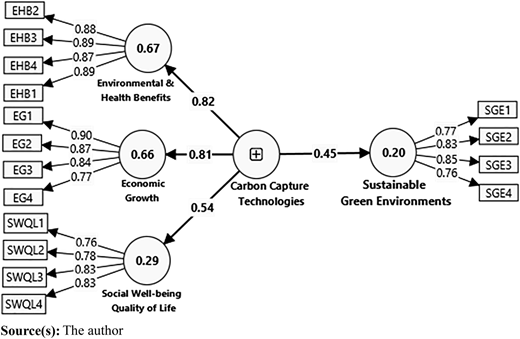
Due to the realization that PLS-SEM's unique methodological qualities make it a competitive alternative to the more widely used covariance-based SEM methodology. PLS-SEM is a statistical modeling technique that constantly improves the model (Hair et al., 2014). A partial least squares structural algorithm with measured variables having significant factor loadings is shown in Figure 2. Modeling complex interactions between latent variables and their indicators using a variance-based approach is known as partial least square structural equation modeling or PLS-SEM. The model above shows a latent variable with four indicators (EHB1, EHB2, EHB3, and EHB4) with outer loadings ranging from 0.87 to 0.89, that is, EHB. This indicates a good correlation between the latent variable and its indicators. Accordingly, other constructs showed a strong correlation, with each outside loading exceeding the 0.50 threshold criterion (Hair et al., 2014). There was a strong correlation between the constructs' Path Coefficients (β). The standardized path coefficients should be approximately 0.20; ideally, 0.30 is more significant (Benitez, Henseler, Castillo, & Schuberth, 2020; Kroonenberg & Lohmoller, 1990). However, the path coefficients range in value from −1 to +1 (Dijkstra, 2010; Dijkstra & Henseler, 2015). There is a substantial association between each of the latent variables. As a result, the path coefficients verified the constructs' strong and positive connection. Therefore, all indicators have high outer loadings (>0.70), indicating that each accurately measures the latent variables they represent. Because the path coefficients, which are important markers of this research, demonstrate strong correlations between specific constructs. Therefore, the factors of CCTs, which were also measured by three dimensions, influenced 20% of the variance in the sustainable green environment, according to the SGE's R-squared value of 0.20. Consequently, the model fits the data well regarding explained variance for constructs.
Cronbach's alpha measures a scale item's internal consistency or reliability (Santos, 1999; Wheaton, Muthen, Alwin, & Summers, 1977). Good reliability is often indicated by values greater than 0.70 (Hair, Black, Babin, & Anderson, 2010). Values above 0.70 are generally acceptable, indicating good reliability (Eunseong & Seonghoon, 2015). However, all constructs have Cronbach's alpha values above 0.80, indicating high internal consistency, as shown in Table 4. Composite reliability assesses the reliability of a construct in SEM. In addition, rho_a is an alternative measure of composite reliability, similar to Cronbach's alpha, whereas rho_c is a more conservative measure of composite reliability, considering the actual factor loadings ≥0.70 (Henseler, Ringle, & Sarstedt, 2015). On the other hand, AVE measures the variance a construct captures relative to the amount due to measurement error (Henseler et al., 2016; Mia et al., 2022). Values greater than 0.50 are appropriate since they show that the construct captures more variance than error (Zhang, Dawson, & Kline, 2021). Therefore, high composite reliability and Cronbach's alpha values indicate that all constructs show internal solid consistency. It even suggests that each construct's indicators measure the same fundamental idea and are highly connected. Nevertheless, assessed through AVE, most constructs meet the threshold of 0.50, indicating that they capture a substantial portion of the variance in the indicators. However, carbon capture technologies have an AVE of 0.39, suggesting that this construct may have issues with convergent validity and that not enough of the variance is captured by it. Therefore, a discriminant validity with high composite reliability and appropriate AVE values generally supports discriminant validity, suggesting that constructs are distinct. Table 5 shows the correlation matrix's Heterotrait-Monotrait ratio (HTMT), which assesses discriminant validity in PLS-SEM (Henseler et al., 2015). Discriminant validity ensures that a construct is genuinely distinct from other constructs by empirical standards (Campbell & Fiske, 1959). Lower HTMT values indicate better discriminant validity of thresholds, and HTMT values below 0.90 liberal criterion indicate adequate discriminant validity (Campbell & Fiske, 1959; Henseler et al., 2015). Carbon capture technologies vs economic growth: HTMT value is 0.91. This exceeds the liberal threshold of 0.90, indicating a potential issue with discriminant validity. However, the rest of the HTMT values are lower than the threshold value, indicating good discriminant validity for all other pairs of constructs. This suggests that these constructs are distinct and well-defined in the model.
Construct reliability and validity – overview
| Cronbach's alpha | Composite reliability (rho a) | Composite reliability (rho c) | Average variance extracted (AVE) | |
|---|---|---|---|---|
| Carbon capture technologies | 0.85 | 0.86 | 0.88 | 0.39 |
| Economic growth | 0.86 | 0.87 | 0.91 | 0.71 |
| Environmental and health benefits | 0.91 | 0.91 | 0.93 | 0.78 |
| Social well-being quality of life | 0.81 | 0.82 | 0.88 | 0.64 |
| Sustainable green environments | 0.82 | 0.82 | 0.88 | 0.65 |
Source(s): Author’s field data result estimates from SmartPLS v4.1
Discriminant validity
| Carbon capture technologies | Economic growth | Environmental and health benefits | Social well-being quality of life | Sustainable green environments | |
|---|---|---|---|---|---|
| Carbon capture technologies | – | ||||
| Economic growth | 0.91 | ||||
| Environmental and health benefits | 0.88 | 0.54 | |||
| Social well-being quality of life | 0.74 | 0.26 | 0.20 | ||
| Sustainable green environments | 0.58 | 0.30 | 0.30 | 0.69 | – |
Source(s): Author’s field data result estimates from SmartPLS v4.1
Structural equation model
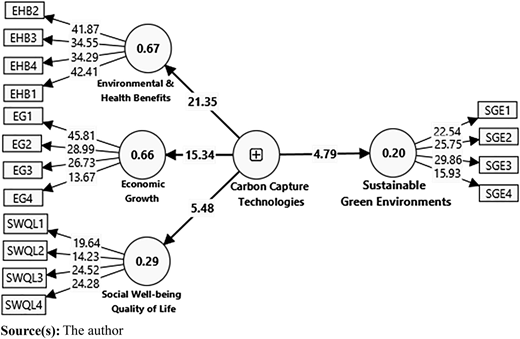
In Figure 3, a hypothesized path model shows that solid path coefficients suggest improvements influenced by three dimensions of CCTs: EHB, EG, and SQWL. These dimensions indicated a robust positive relationship significantly contributes, positively affecting carbon capture technologies. Therefore, CCTs also have significant and positive associated with sustainable green environment engagement. Table 6 presents the hypothesized path coefficients with three dimensions. It includes the original sample path coefficients, the sample mean, standard deviation (Std. Dev.), t-statistics, p-values, and remarks on hypothesis and first-order dimensions acceptance. Hypothesis H1: Carbon Capture Technologies → Sustainable Green Environments: The indices of the original sample are 0.45, and the sample mean is 0.45, Std. Dev.: 0.09, t-statistics: 4.79, and the p-values: 0.00; therefore, the central hypothesis demonstrated statistical significance in supporting the conceptual model. However, a moderate, significant positive relationship exists between Carbon Capture Technologies and Sustainable Green Environments. The t-statistic and p-value of 0.00 indicate that this relationship is statistically significant, with a t-value greater than 1.96 from the threshold value with a p-value less than 0.01 (Hair et al., 2017). Therefore, all first-order dimensions were indicated above the threshold value of t-statistics and p-values, and reflective paths show significant relationships. The strong relationships suggest that advancements in carbon capture technologies are positively associated (first-order dimensions, such as H1a, H1b, and H1c) with sustainable green environments. This highlights the multifaceted benefits of carbon capture technologies beyond environmental impacts.
Path coefficients
| Original sample | Sample mean | Std. Dev. | t-statistics | p-values | Remark | |
|---|---|---|---|---|---|---|
| Carbon Capture Technologies → Environmental and Health Benefits | 0.82 | 0.82 | 0.04 | 21.35 | 0.00 | Dimension H1a supported |
| Carbon Capture Technologies → Economic Growth | 0.81 | 0.8 | 0.05 | 15.34 | 0.00 | Dimension H1b supported |
| Carbon Capture Technologies → Social Well-being Quality of Life | 0.54 | 0.54 | 0.1 | 5.48 | 0.00 | Dimension H1c supported |
| Carbon Capture Technologies → Sustainable Green Environments | 0.45 | 0.45 | 0.09 | 4.79 | 0.00 | Hypothesis H1 supported |
Source(s): Author’s field data result estimates from SmartPLS v4.1
Discussion and conclusion
The study's empirical findings support the considerable influence of CCTs on various socioeconomic and environmental factors in Bangladesh by highlighting multiple positive correlations between the assumptions. The statistics demonstrate a robust positive association between CO2 emission reduction and CCT adoption. This result bolsters the idea that CCTs successfully lessen the damaging environmental effects of industrial activity. Improving air quality directly correlates with reducing emissions, and public health depends on it. To begin with, dimension 1, public health, significantly improves when adopting carbon capture technologies. As anticipated, reducing CO2 emissions has a direct positive impact on public health. Reduced situations of air adulterants drop respiratory and cardiovascular conditions, attesting to the hypothesis that CCT relinquishment enhances health issues in Bangladesh. In addition, dimension 2, implementing carbon capture technologies, leads to significant job creation and economic growth. Implementing CCTs appreciatively correlates with profitable benefits, including job creation and economic growth. The data suggest that investments in CCT systems stimulate profitable exertion, create employment opportunities, and contribute to sustainable, profitable development in Bangladesh. Furthermore, in dimension 3, the relinquishment of carbon capture technologies enhances social well-being and quality of life. Better air quality, health issues, and profitable benefits enhance the overall quality of life, supporting the path that CCTs contribute to societal well-being.
Theoretical implications
The study's conclusions advance the theoretical knowledge of how CCTs affect society in underdeveloped nations like Bangladesh. The present study contributes to the body of knowledge on environmental technologies and their socio-economic impacts by providing empirical evidence of the connections between the deployment of CCT and different social outcomes. The research supports the claim that CCTs improve social well-being, economic growth, and public health while lowering carbon emissions.
Practical implications
The findings highlight how crucial solid legislative frameworks, public awareness efforts, and significant financial commitments are to implementing CCTs effectively. Bangladeshi policymakers and business executives can use these insights to develop and execute policies that encourage CCTs. The study also emphasizes the need for community involvement in promoting environmental efforts, which can guarantee that the benefits are distributed fairly among various social groups. This study offers a fresh viewpoint by using quantitative analysis to evaluate the social impact of CCTs. The mono-methods approach provides a thorough comprehension of these technologies' diverse impacts. Additionally, by concentrating on Bangladesh, the study fills a vacuum in the literature about using CCTs in developing nations, expanding the purview of already-existing theoretical frameworks.
Departure from early studies
In dissimilarity to earlier studies by Chowdhury et al. (2022), Kabir et al. (2016), Majumder et al. (2019) applied CCTs in more generic settings. They did not emphasize specifics for sustainable green development. In contrast to earlier research that focused mainly on the technical and financial components of CCTs, this study explores social factors, such as community well-being, public health, and awareness. This divergence from conventional assessments provides a more comprehensive understanding of the advantages and difficulties of implementing CCTs. This study is distinct from previous ones in that it strongly emphasizes public perception and policy support. The results support prior research that highlights the efficiency of CCTs in lowering emissions and improving public health, such as Bui et al. (2018). This study, however, goes one step further by providing quantitative evidence of the socioeconomic advantages of CCTs within the framework of a developing nation such as Bangladesh. In contrast to earlier research that concentrated on technological and financial viability, according to Chowdhury et al. (2022), this study emphasizes the broader societal effects, such as economic growth and community well-being. The case for using CCTs as a multifaceted approach to sustainable development is strengthened by this agreement with an expansion of earlier research.
Limitations, value, and further study
Despite its contributions, the study has limitations. Dependence too much on self-reported data from surveys and questionnaires may introduce response bias. The accuracy and accessibility of secondary data on emissions and health outcomes may also impact the outcomes. The findings may not be as applicable in other contexts due to the study's focus on Bangladesh. This study is unique because it thoroughly analyzes the social effects of CCTs in the context of developing nations. Several target respondents of data sources and methodological techniques are integrated to improve the findings' robustness. Policymakers, business stakeholders, and scholars interested in environmental technology and sustainable development will find the study insightful. Future research could use longitudinal data to examine the long-term impacts of CCTs, thereby addressing the limitations mentioned in this study. Extending the research to include comparative studies with other developing nations would improve its generalizability. Furthermore, investigating the interactions between CCTs and other environmental technologies may offer a more profound understanding of the cooperative benefits of several sustainability projects.
In conclusion, this study emphasizes how carbon capture technologies substantially influence Bangladesh's efforts to create environmentally friendly, sustainable ecosystems. Through showcasing the advantages of decreased emissions, better public health, economic expansion, and elevated social welfare, the study emphasizes the significance of public knowledge, policy backing, and community involvement in the effective execution of CCTs. The results lay the groundwork for more studies in this crucial field and advance our theoretical and practical understanding of environmental technologies. This study demonstrates the beneficial effects of carbon capture technologies on Bangladesh's ecology and socioeconomic conditions. The results show that CCTs significantly improve social well-being, economic growth, and public health in addition to lowering CO2 emissions. It also emphasizes the vital role that community involvement, policy support, and public knowledge play in promoting the adoption of these technologies. The study offers insightful information about how CCTs might support sustainable development in Bangladesh, giving industry leaders and governments a solid platform to promote and apply these technologies. To further improve environmental and social results, future studies should investigate the long-term effects of CCTs and how they might be integrated with other sustainability programs. According to Bui et al. (2018), the present study incorporated that CCTs can significantly reduce CO2 emissions, improve air quality, and improve public health, which shows how important it is to reduce air pollutants to improve public health (Bui et al., 2018). According to Hossain et al. (2023), previous studies have shown that less air pollution is linked to fewer health problems, supporting these findings (Hossain et al., 2023). However, this study emphasizes economic growth and the financial advantages of CCTs, such as creating jobs and encouraging green businesses, while highlighting the importance of social and environmentally sustainable green development and public-private partnerships according to the previous studies (Hossain et al., 2023; Kibria et al., 2018; Rahman et al., 2022). Moreover, the study also showed that according to Wennersten et al. (2015), CCTs can significantly reduce CO2 emissions, improve air quality, and improve public health, highlighting the social effects of environmental projects on people's quality of life (Wennersten et al., 2015). On the other hand, Bui et al. (2018) and Shahbaz et al. (2016), Indeed, this study focuses on the impact of CCTs in Bangladesh. As highlighted earlier, it fills a gap in the research that primarily examines developed countries and contributes new ideas for developing countries (Bui et al., 2018; Shahbaz et al., 2016).
The author contributed fully to this work.

