
Shot peening from the eyes of experience)
Article Type: Interviews From: International Journal of Structural Integrity, Volume 1, Issue 1
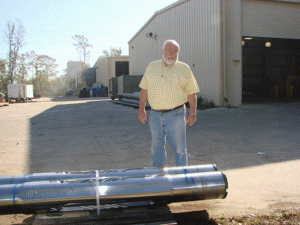
Q. Mr Spinner, tell us about your history with surface engineering?
A. My first exposure to surface engineering was while working for GE Jet Engine in the mid-1960s while I was still in college. We were using glass bead peening to restore shape to extremely thin-walled structures that had become deformed during a diffusion bonding process. My true career in surface engineering started in earnest in late 1972 when I joined Wheelabrator in sales and marketing. This was an interesting period in surface engineering as the automotive industry was beginning stress, or compression, peening on a high volume basis for leaf springs. I was involved with much of the initial testing of higher production machines, and was amazed at the increased stress profiles that were accomplished with this “new technology”. Also, Boeing was doing their first testing for production machinery for peen stress forming in the mid-1970s, and I was involved in some of the early prototype testing for production equipment. I will always remember the first time I saw a 2 in. thick sheet of aluminium that was completely contoured with nothing but stresses imparted by highly controlled directional shot peening. I stayed in the basic surface preparation and surface engineering until 2000 when I became involved with ultrasonic impact treatment with Applied Ultrasonics in Birmingham,Alabama. This technology was new to the Western World, and I was involved in launching the technology into the USA in a very broad range of applications. Again, I was truly amazed at the properties, both remedial and preventive, for fatigue life extension and SCC amelioration that could be created by this technology. In 2007, I joined Superior Shot peening in Houston, Texas where we work hand-in-hand with all of the major oil field service companies in enhancing tool life, fatigue life extension and SCC remediation, through surface engineering.
Q. Shot peening is one of the oldest surface treatments. Yet, large research effort goes to it. In your opinion is it needed and why?
A. Absolutely! Shot peening may be one of the oldest surface treatments, but it still is the most effective surface treatment for most fatigue abatement solutions. I believe that there is still much to be learned about effective shot peening for maximum component life benefits. It is also my opinion that many peening applications could be optimized. I have been asked many times over the years by customers if I thought they were peening enough, or, to me, more importantly, if they were over peening. I have seen many installations where people are peening, and they really do not have a firm grasp of what peening really is, or what they are truly achieving. Many of the specifications in use are extremely old, and they “have always done it this way” is a common response. Additionally, life testing is lengthy and expensive, as well as the physical testing, X-ray diffraction for depth of compression, is costly and time consuming. This is why I feel that research efforts should be maintained in an effort to completely optimize the technology.
Q. Despite the potential benefits we get in the case of fatigue endurance limit, experimental results from single edge notched specimens have shown small or no improvement of the crack growth rate after shot peening. Do you have any ideas why?
A. My opinion on this has always been that the notch “interrupts”the immediate sub-surface grain refinement that has occurred during the peening process. I also feel that the creation of a notch creates a small, but real,stress riser. I believe that the combination of these two will accelerate crack propagation. Also, if the notch exceeds the depth of compression, you are now operating with an unprotected area, from a compression standpoint, and essentially have a very small area that is now “un-peened”.
Q. Do you believe that the profile of the residual stresses and cold work is important?
A. Yes. The proper profile of residual stresses assures the most uniform treatment. For instance, some treatments will give an extremely high level of compression, say 50 per cent greater, at and just below the surface (0.01 mm),and then drops off rapidly to essentially zero compression at 0.07-0.01 mm. In my opinion this creates excessive surface work hardening, destroying the ductility, and a non-uniform distribution of sub-surface compression and is detrimental to the fatigue life when compared to a more uniform stress profile where the maximum compression is achieved at say 0.025 mm, then decrease at a gradual rate until it reaches close to zero compression at approximately 0.13-0.14 mm. My experience says that this uniform distribution is better for fatigue life enhancement, and provides a much more uniform grain refinement profile. For SCC prevention, uniform grain refinement is extremely important.
Q. In your opinion, which are the parameters that we need to pay attention?
A. Intensity, particularly in relation to the thickness of the material, as well as the type of material, being peened is critical. Also, good uniform coverage of +100 per cent is essential. It is my opinion that pursuing coverage rates of 150 per cent and higher, is a “band aid” approach for insurance against possible faulty inspection. If the equipment is calibrated to give saturation peening, and +100 per cent coverage is obtained, I feel that this is the ultimate situation. My fear in the excessive coverage situations is that over-peening occurs, and peaks can be bent which may exceed the elastic limits of the material and create a micro tear, which is most assuredly a potential propagation point for a fatigue crack and ultimately premature failure of the component.
Q. Recently, many shot peening companies have introduced superfinishing in order to optimize further the potential of shot peening to improve fatigue resistance. What you believe?
A. I have not personally been involved in super finishing, but the concept makes sense. Based on the various reports and testimonials that I have read, the super finishing removes the smallest finite surface imperfections that can act as initiation points. This technology appears to me to be best suited for very thin cross-section components.
Q. Can you please describe for the readership of International Journal of Structural Integrity (IJSI) your worst nightmare in the business?
A. My worst nightmare is when a client comes to me with a component that has no history, and they want me to tell them how it should be peened for maximum fatigue life enhancement. No matter how experienced you feel that you are, or how smart you think you are, this is a formula for potential disaster. I always fear that I have missed something, or have not taken into account all of the variables, and often sit on pins and needle awaiting results. This is where a“crystal ball” or a good predictive methodology would be of great use.
Q. There is a growing number of scientists who believe that we need to increase the research budget on surface engineering despite the economic crisis. Do you believe that this should be done?
A. Absolutely! Every one is pushing the envelope today in terms of weight reduction, and thus thinner and lighter materials, as well as higher bend/strain loadings, and desiring increased fatigue performance. For something basic like a leaf spring or crankshaft, or valve stem, this is fairly straight forward with the materials currently in use. However, if you wish to explore higher strength materials that will see higher loads in duty, adequate and meaningful research must be done to make sure all aspects are covered. One such case is the use of high strength steel, >500 MPa, in the deterioration of strength and fatigue strength in the HAZ of the welds. High intensity, precision applied compressive stresses after targeted stress relief of the tensile stresses can enable the use of the materials in applications previously not possible.
Q. You have been recently involved in the development of a commercial code for the optimisation of shot peening for fatigue applications. This was done even though most of your clients, even in the aerospace sector, still use Almen intensity as the primary parameter to classify shot peening. FAA also seems to follow this rule. Can you explain to the readership of IJSI your driving force behind such decision?
A. The key word that you used is optimisation. What does this really mean?Does the fact that a set of peening specifications based on history and experience for similar applications of similar materials gives acceptable results mean that the optimal conditions have been met? To me, it does not. Does the component have the ability to perform better if different process parameters were used? Would the component be safer if the true optimum conditions were met?To me, if there were a true predictive commercial code that is flawlessly verified through exhaustive statistical evaluation that yields repetitive data with high confidence intervals, I believe that choosing the correct parameters for fatigue life enhancement and SCC abatement would advance years in a single step, while providing maximum life enhancement for each component, while providing design engineers a tool to design components much more efficiently.
Dan Spinner


