Family policies aimed at reconciling the pressures of family and work shape women's employment outcomes. Yet, very few studies have examined their impact on employment that is not formally registered with authorities. The study aims to investigate whether, and to what extent, different family policies influence women's participation in unregistered employment.
The study used individual data from the 2004–2022 European Social Survey, combined with information on country-level indicators of family policies. Multi-level linear probability models were applied to analyse data.
Findings suggest that family policy arrangements that reinforce traditional gender norms and limit women’s economic opportunities contribute to gender disparities in unregistered employment. In countries with higher part‑time childcare coverage or shorter leaves, women were found to be more likely to take up unregistered jobs, most likely to balance paid work with caregiving responsibilities and/or to make ends meet. Given that unregistered employment is associated with poor working conditions and limited social protection, such policies may deepen the existing gender inequality in the labour market. In countries where women have more economic independence and fewer care obligations, the gender gap in unregistered employment was smaller.
This study addresses a critical gap in the literature by demonstrating that certain family policies may increase women's dependency on informal income sources.
Introduction
Employment that is not registered with the appropriate authorities remains a pervasive phenomenon in European labour markets (Williams and Kayaoglu, 2017; Hazans, 2011). This has harmful consequences for employees and society at large. Unregistered employment is associated with inadequate access to social protections, poor working conditions, and limited trade union representation and collective bargaining rights (OECD/ILO, 2019). States lose tax revenue as well as their capacity to regulate working conditions and services (ILO, 2013). To tackle this issue, there have been continuing research efforts to understand the prevalence of such employment and its structural causes.
There is a broad consensus that informality is associated with limited state intervention in labour markets and welfare arrangements (Williams, 2023). Empirical evidence indicates that in weaker welfare states people are more likely to rely on informal income opportunities due to inadequate social protection and lower levels of labour market regulation (Mara, 2021; Krasniqi and Williams, 2017). However, previous research has not considered how welfare state arrangements shape labour market outcomes differently for men and women. Feminist scholars have convincingly shown that gender hierarchies are deeply embedded in welfare systems. This body of work highlights the significance of the interplay between social policies, gender relations, and family in shaping gendered labour market outcomes (Ciccia and Sainsbury, 2018; Orloff, 2009). Building on this perspective, this study aims to re-evaluate the relationship between unregistered employment and welfare states, taking into account their “stratifying nature in terms of gender” (Jensen et al., 2009, p. 12).
To understand how welfare states shape gendered labour market outcomes, it is important to consider the degree to which they relieve economic and social dependency on family members (Cho, 2014). Of particular importance are family policies aimed at reconciling the demands of employment and family care. Childcare and leave policies shape not only women's access to the labour market but also the nature of their engagement, despite the presence of other contributing factors (Ferragina, 2020). Such policies either challenge or reproduce prevailing gender norms and inequalities in the labour market (Lomazzi et al., 2019; Budig et al., 2016). Ultimately, they influence the types of jobs that women can access and are likely to take up (Seo, 2023).
Given the above, it is plausible that if family policies facilitate gender equality in the labour market, they may mitigate the need for women to engage in unregistered employment. Women's involvement in informal paid activities has been attributed to their disadvantaged position in the labour market and household (Windebank and Williams, 2010; Leonard, 1998). While such employment encompasses a wide range of different activities and underlying motives (Williams, 2023), women's participation is characterised by greater economic dependency, precariousness and vulnerability than men's (Duman, 2023; ILO, 2023; Julia et al., 2019; Windebank and Williams, 2010). Caregiving responsibilities may also drive mothers to pursue work in the informal sphere, which can provide flexibility to balance paid employment with family demands (Fodor and Kispeter, 2014; Luleva, 2010; Leonard, 1998). For example, Fodor and Kispeter (2014) argue that the lack of institutional support for reconciling work and family has made mothers an ideal supply of informal employees in Hungary: “an invisible reserve army of labour” (p. 393).
The purpose of this study is twofold. First, it contributes to the discussion on the structural causes of unregistered employment and gendered informality. In European countries, there are notable gender differences in exposure to unregistered employment, resulting in a variance between men and women regarding level of social risk and eligibility for employment protections and social security (ILO, 2023; Julia et al., 2019; Hazans, 2011). This study examines whether and to what degree family policies aimed at reconciling work and family shape these gender differences. Second, multiple studies have highlighted the need to consider more diverse labour market outcomes in order to fully understand the consequences of family policies on women's employment (e.g. Hook and Li, 2020). By focusing on gender differences in unregistered employment, this analysis offers a more nuanced perspective on how family policies reinforce or mitigate gender inequalities in the labour market.
This study uses pooled waves of the 2004–2022 European Social Survey (ESS) combined with the Eurostat and Organisation for Economic Co-operation and Development (OECD) regional data. The dataset contains information on employees working without a formal contract (unregistered employment) and on family policy measures across 25 European countries. Given the hierarchical structure of the data, multilevel linear probability models (LPMs) are used for the analysis.
The article is organised as follows. First, it reviews previous literature on unregistered employment and its main characteristics. Second, it examines the relationship between gender and informal employment in Europe. Given the lack of research on unregistered employment, this discussion makes use of the broader literature on informal employment. The next section explores how family policies influence gendered patterns in the labour market. Here, not just the family policy configurations are considered, but also their expected gendered outcomes in the domain of paid and unpaid work. Based on this literature, the article then presents testable hypotheses. It then describes the data, methods, and variables used, followed by descriptive findings and multilevel LPMs with interpretations. Finally, the article concludes with theoretical and policy implications.
Unregistered employment
Unregistered employment is a particular type of informal employment: an “employment relationship not registered with the authorities when it should be registered” (Williams, 2023, p. 107). This includes employment in which employers, who are legally required to declare employment relationships, fail to do so in order to evade taxes, social security contributions, and other labour regulations, such as overtime remuneration. Given the hidden nature of unregistered employment, empirical studies have typically used the non-existence of a formal contract as a proxy for such employment (e.g. Williams, 2015; Krasniqi and Williams, 2017; Hazans, 2011).
Informal employment may be divided into two ideal types. The “upper tier” consists of voluntary informal own-account work by skilled workers, while the “lower tier” is characterised by involuntariness and poor working conditions (Williams, 2023). Unregistered employment is often associated with the latter. It is more often taken up due to limited job opportunities and economic necessity than is other forms of informality (Williams, 2023; Williams and Oz-Yalaman, 2021). Empirical studies associate the lack of a formal contract with adverse working conditions, including involuntary part-time hours, unpaid overtime work, an inadequate physical work environment, limited access to non-wage benefits and training opportunities, and a low salary (Duman, 2023; Healy and Ó Riain, 2021; Julia et al., 2019; Williams and Horodnic, 2019; Hazans, 2011). Such employment frequently involves either very short or very long working hours (Julia et al., 2019). In Williams and Horodnic's (2019) study based on the European Working Conditions Survey, those lacking a formal contract reported worse career prospects and job security than did formal employees. However, the authors concluded that conditions in such employment are not always worse, as unregistered employment may, for example, offer benefits in terms of autonomy and flexible scheduling.
Gender and informal employment
The relationship between gender and informal employment has thus far received limited scholarly attention in Europe. As Windebank and Williams argued in 2010, “relatively little thought has been given to the gender disparities in informal work compared with the geographical and socioeconomic inequalities” (p. 94). This statement still holds over a decade later. However, despite the gap in research, there is still ample evidence from which to draw meaningful conclusions.
It has been noted that informal employment both reflects and reinforces existing gender inequalities in the labour market and unpaid domestic sphere (Windebank and Williams, 2010; Leonard, 1998). Women are more likely to take insecure, low-quality informal jobs in the service industry, such as cleaning, domestic help, or food service, whereas men are more likely to engage in voluntary-based “upper-tier” informal activities in skilled trades or professional services (ILO, 2023; Julia et al., 2019; Williams, 2011; Windebank and Williams, 2010; Leonard, 1998). There appears to be a similar gender gap in working hours within informal employment, as in formal employment, with women working shorter hours than men (ILO, 2023; Julia et al., 2019). Among those employed informally, women tend to earn lower wages than men due to their shorter working hours and concentration in low-income segments (Duman, 2023; OECD/ILO, 2019).
Prior studies have also highlighted that women may take up informal employment to meet their societal expectations as mothers while also providing financially for their family. As argued by Luleva (2010), “women turn to informal work not only out of economic necessity but also because they are motivated by their ideas of motherhood, care for their children and self-sacrifice for their family” (p. 237). Studies from both the Global South and Europe have shown that women with caregiving responsibilities may engage in informal employment to take advantage of shorter working hours and flexibility regarding how, where, and when work is performed (Berniell et al., 2021; Fodor and Kispeter, 2014; Luleva, 2010; Katungi et al., 2006; Leonard, 1998). Informal own-account and home-based work, but also unregistered employment, have been associated with autonomy and flexibility for workers (Williams and Horodnic, 2019).
Given the historical dominance of the male-earner/female-carer models, women have been characterised as “ideal recruits for the informal employment practices” (Leonard, 1998, p. 113). From this perspective, the expectation has been that women will generally be more drawn to informal employment. However, while this may hold for temporary, part-time, and other secondary jobs in the formal labour market, the evidence for informal employment is more ambiguous.
Based on the EU-wide Eurobarometer surveys, men are more exposed to undeclared work (Williams and Horodnic, 2017) and informal self-employment (Williams and Windebank, 2021). However, the evidence regarding unregistered employment is more mixed. In Hazans' (2011) study based on the ESS data, female workers were more likely to take up unregistered employment (no formal contract) than were men. Further evidence indicates that in the European service industry women face a higher risk of lacking a formal contract (Williams and Horodnic, 2018). On the other hand, Krasniqi and Williams (2017) provided contrasting evidence suggesting that it is men, rather than women, who are more likely to be exposed to unregistered employment.
In any case, it seems clear that gender differences in unregistered employment vary by country (Williams, 2021; Hazans, 2011). Hazans (2011) found that women were more likely to work without a formal contract in Southern and Western Europe, whereas such association was less pronounced in the Eastern Europe and Nordic countries. However, these cross-country differences have yet to be explained. This study examines whether and to what degree different family policies shape gender differences in unregistered employment participation.
Do family policies shape women's unregistered employment?
Family policy research is closely tied to the theoretical development of gender and welfare state studies. Gendered welfare state research originally emerged as a critical response to the male bias in mainstream welfare analysis, which predominantly emphasised state–market relations and social provision within the sphere of production (Ciccia and Sainsbury, 2018). This led to a reorientation of research towards the gendered division of labour and the politics of welfare states (Orloff, 2009). Feminist scholars, in particular, highlighted how gender relations are inscribed in welfare state policies and how they challenge and reproduce the social and economic dependencies of women on their male partners.
This study centres on explicit family policies that are related to the public provision of cash, time, and services designed to reconcile care duties and work (hereafter “family policies”). There is a substantial body of empirical evidence on how family policies influence both women's overall participation in the labour market (Ferragina, 2020) and the quality of their employment (Seo, 2023). They directly shape maternal employment opportunities by influencing the amount of time mothers need to devote to childcare responsibilities. Yet, they also influence the labour market outcomes of both mothers and non-mothers by transforming cultural values and normative assumptions about what is desirable or acceptable for women in the areas of paid and unpaid work (Seo, 2023; Lomazzi et al., 2019; Zoch and Schober, 2018; Pfau-Effinger et al., 2009).
Family policy studies on employment outcomes most often focus on childcare services and leave policies. Childcare services help reconcile work and care, promoting maternal employment and reducing mothers' need to switch to lower-status family-friendly occupations (Ferragina, 2020). They also have wider implications for female employment, as they “disrupt existing gender norms and certain gender biases of employers” (Seo, 2023, p. 7). The availability of formal childcare is associated with more gender-egalitarian attitudes regarding family roles and female employment (Lomazzi et al., 2019). By shaping expectations about mothers' and would-be-mothers’ caregiving responsibilities and productivity, it has the potential to reduce gender-based employer discrimination in hiring and pay (Correll et al., 2007). Empirical evidence consistently shows that public childcare services increase women's labour market participation, working hours, and career advancement, as well as reduce the motherhood wage penalty (Ferragina, 2020; Misra et al., 2011).
Accessible childcare services foster women's economic opportunities and levels of independence. This may prevent them from turning to informal spheres for income opportunities. Firstly, unregistered employment often entails rather poor and undesirable working conditions, and it is frequently taken up due to lack of alternative income opportunities. Secondly, access to childcare services can reduce the pressure on mothers to engage in unregistered employment for flexibility in balancing work with caregiving responsibilities.
However, previous studies have underlined the importance of differentiating between full-time and part-time care services. Seo (2023) argues that part-time care services maintain assumptions of a male breadwinner. Consequently, mothers may face limited labour market opportunities, as they are not fully relieved of caregiving responsibilities. As shown by Seo (2023), in countries where formal care is more commonly provided on a part-time basis, women are more likely to take jobs that offer part-time hours and flexible scheduling. Brewer et al. (2022) demonstrated that the availability of full-time childcare contributes to women's attachment to the formal labour market, whereas the effect is less pronounced with part-time care services. Therefore, the following hypotheses are proposed.
Higher full-time childcare service coverage is associated with a lower likelihood of women participating in unregistered employment.
Higher part-time childcare service coverage is associated with a higher likelihood of women participating in unregistered employment.
Leave policies for mothers, which allow temporary time off from paid work for childcare, are designed to balance family and work responsibilities. However, particularly long leaves “may maintain family finances while also weakening mothers employment – serving as both friend and foe” (Budig et al., 2016, p. 124). Such long detachments from employment can, in turn, bring human capital losses and missed opportunities for professional development (Morosow, 2019). Lengthy leaves are associated with traditional gender norms (Seo, 2023) and discrimination by employers, who become reluctant to hire women of childbearing age (Glass and Fodor, 2011; see also Misra et al., 2011).
By nudging women towards the secondary labour market, lengthy leaves may also increase women's participation in unregistered employment. Fodor and Kispeter (2014) found that extensive parental leaves for mothers in Hungary contribute to “the construction of mothers (and would-be mothers) as marginalised workers” (p. 393). Long leaves, resulting in long absences from work, have encouraged employers to discriminate against women in hiring. Due to these gender-based constraints, women frequently need to accept work in the informal economy (Fodor and Kispeter, 2014).
Conversely, too short leaves or none at all may drive women to exit the workforce to care for their children or to pursue secondary jobs that are compatible with caregiving responsibilities (Morosow, 2019; Thévenon and Solaz, 2012). As such, they are associated with employment and career penalties for mothers (Budig et al., 2016; Misra et al., 2011). They also foster traditional gender norms regarding women's positions in the labour market. Schindler et al. (2025), using data from 48 countries, found that greater financial support and longer leave availability “reduce the norm that mothers should (prescriptive norm) and actually do (descriptive norm) all the childcare” (p. 17). Therefore, the following hypothesis is proposed.
Short and long mothers' leaves are associated with a higher likelihood of women participating in unregistered employment.
Finally, family policies can be measured not only through their institutional arrangements but also by the outcomes they are expected to produce. To do so, comparative family policy research has adopted the concept of “defamilization” to assess the extent to which welfare states relieve economic and social dependency on family members (Cho, 2014). Defamilization can be viewed as measuring the extent to which welfare states facilitate women's access to (formal) paid employment. It may also refer to how effectively welfare states relieve women of caregiving responsibilities. These two outcomes are often intertwined, as relief from caregiving responsibilities tends to improve women's employment opportunities (Cho, 2014; Kröger, 2011).
Accessible and quality childcare services are generally considered to have a positive effect on defamilization, as they reduce the care burden and promote access to the (formal) labour market (Ferragina, 2020). By promoting women's economic independence and independence from care, such services are hypothesised to reduce women's likelihood of taking up unregistered employment. Under such conditions, women should have more quality employment opportunities available, and mothers may maintain higher labour market attachment during childbearing. In contrast, part-time childcare services, and particularly short and long leaves, assume mothers' caregiving roles and may limit economic opportunities for women (Seo, 2023). Consequently, these may contribute to women's participation in unregistered employment to make ends meet and/or balance paid work with caregiving responsibilities. Therefore, to consider not just the policy level but also the expected country-level outcomes of these policies, the following hypotheses are proposed.
A higher gender gap in formal employment is associated with a higher likelihood of women participating in unregistered employment.
Greater care responsibilities for women are associated with a higher likelihood of women participating in unregistered employment.
Methodology
Data
Multiple data sources were required to test the hypotheses. The country-level variables were derived from the ESS, the Eurostat, and the OECD Family Database. Individual-level data were collected through the ESS, which is a cross-national survey measuring values, beliefs, and behaviours of people living in Europe. Conducted biennially with a comparable design in all participating countries, the survey provides information on employees' participation in unregistered employment (lack of formal contract). The samples are representative of each country's resident adult population (aged 15 and over) within private households.
Data from 10 ESS waves (2004–2022) were pooled into a single dataset that included respondents aged 18–69 in paid employment (employees, self-employed, and those working in a family business). This included individuals who were employed at the time of the survey or had been in paid employment at any point since the beginning of the previous two calendar years. Due to limitations in the availability of family policy indicators in country-level data, the first ESS round (2002) and several countries had to be excluded from the final dataset. Additionally, some participants were excluded due to missing values in one or more key variables required for analysis. The final data incorporate respondents from 25 countries: Austria, Belgium, the Czech Republic, Denmark, Estonia, Finland, France, Germany, Great Britain, Hungary, Iceland, Ireland, Italy, Latvia, Lithuania, the Netherlands, Norway, Poland, Portugal, Slovenia, Slovakia, Spain, Sweden, Turkey, and Switzerland. Of the 220,925 employed respondents, 10,478 were in unregistered employment.
Dependent variable
The dependent variable is a dummy that indicates whether respondents have engaged in unregistered employment. The questions used to identify respondents' employment were based on the following questions from the ESS survey: (1) “In your main job are/were you an employee, self-employed or working for a family business” and (2) “Do/did you have a working contract of limited, unlimited duration, or do/did you have no contract?” A person was identified as working in unregistered employment if they reported working without a contract as an employee or family worker.
The legal position of contractual arrangements varies significantly across Europe. For example, a written labour contract is mandatory in most East-Central European and Nordic countries. In many other countries written contracts are encouraged but not legally required, or they are only mandated for non-standard jobs (Williams and Kayaoglu, 2017). However, even when a written contract is not necessary, a legally binding contract as such is still generally required but can be agreed upon verbally or by implication (Clyde & Co LLP, 2017; Williams and Kayaoglu, 2017; Hazans, 2011). Additionally, employers are often required to provide their employees with written and signed terms of employment. From the employees' perspective, such documents may be considered as good as a working contract (Hazans, 2011). Given that the ESS questionnaire asks employees whether they generally work without a contract (but does not specify a written contract), it is likely that the questionnaire primarily identifies employees who work without a legal contract and terms of employment. Therefore, their employment may be classified as unregistered.
Independent and control variables
Both individual- and country-level independent variables are needed to test the hypotheses. The individual-level independent variable is gender, which is self-reported as male or female, given that the ESS does not include non-binary gender options. The following country-level independent variables are measured for each country for the years 2004, 2006, 2008, 2010, 2012, 2014, 2016, 2018, 2020, and 2022 (see Supplementary material for further details).
Coverage rate of formal childcare services (Eurostat): The first measure refers to the percentage of children under 3 years old receiving 30 h or more of formal childcare services per week. The second captures part-time coverage, measured as 1–29 h of formal care per week. Given the care of small children has a higher impact on the care burden and employment of mothers, this study applied the measurement of formal care for children under 3 years old, rather than for older children (see Seo, 2023).
Length of leave available for mothers (OECD Family Database): the maximum time the state provides financial support for childcare at home, regardless of job protection. This includes the combined duration of maternity, parental, and home care leave, expressed in quarter-years.
Gender gap in employment (Eurostat): the difference in employment rates of men and women aged 20−64 (in percentage points). This captures the extent to which men are overrepresented in formal employment.
Share of mothers as homemakers (ESS): the percentage of mothers who report housework or caring for children or others as their main activity (“Main activity in the last 7 days: Housework, looking after children, others”). This reflects the extent of unpaid care work undertaken by women in each country.
The control variables were selected based on prior studies regarding employee characteristics associated with unregistered employment (Krasniqi and Williams, 2017; Hazans, 2011). They are as follows: age (18–29, 30–39, 40–49, 50–59, and 60–69 years), living area (urban or countryside), immigrant status (born in the country, yes or no), children living in the same household (no children, 1–2 children, or over 3 children), industry (agriculture, manufacturing, construction, accommodation and restaurants, health and care, transport and storage, wholesale and retail trade, or other), student (yes or no) and education based on the International Standard Classification of Education (ISCED 0–2, ISCED 3–4, or ISCED 5–8).
Analytic strategy
Due to the hierarchical structure of the data, this research employed three-level LPMs. Individuals were nested within country-years (n = 206), which were in turn nested within countries (n = 25). Nesting country-years within countries accounted for individuals within a single country being more similar than those from different countries, as well as for individuals observed in the same country and year being more similar to each other than those from different years (Schmidt-Catran and Fairbrother, 2016).
The LPMs were chosen over logit models to aid convergency and account for the small number of countries. The models were estimated using a restricted maximum likelihood estimation procedure, which yield more accurate p-values and confidence intervals for contextual effects with a limited number of upper-level units (Elff et al., 2021). To capture whether and to what extent gender differences in the likelihood of participating in unregistered employment are shaped by family policies, the country-level variables were interacted with a dummy variable for being a woman. To ensure reliable estimates, country-year-specific random slopes on gender when modelling cross-level interactions were allowed. Omitting them could have led to unmodelled heteroskedasticity and cluster-correlated errors (Heisig and Schaeffer, 2019).
In the first step of analysis, a multilevel model assessed whether men or women are more likely to engage in unregistered employment. Next, each model introduced a new family policy variable, followed by its interaction with gender in the next model. A quadratic interaction term was included to capture the potential non-linear relationship between gender and leave length. All models were adjusted for all individual-level control variables. Given the limited number of country-level observations, incorporating country-level control variables that may influence cross-country variations in unregistered employment could have resulted in an over-specified model.
As a robustness check, countries were excluded one at a time from each model to evaluate whether outlying cases influenced the associations between family policy measurements and participation in unregistered employment for men and women. The results remained robust to the exclusion of any single country.
Findings
Prevalence of unregistered employment
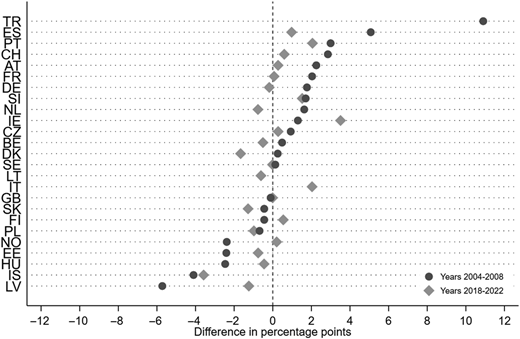
Figure 1 displays the gender differences in the prevalence of unregistered employment in each country and how they vary across time. Observations from 2004 to 2008 (ESS rounds 2, 3, and 4) and from 2018 to 2022 (ESS rounds 9, 10, and 11) were pooled for each country. Pooling ESS rounds ensured a sufficient sample size of individuals in unregistered employment. Gender differences were calculated by subtracting the percentage of women in unregistered employment (within the female employed population) from that of men. Positive values indicate higher female participation, while negative values reflect higher male participation. Analytical weights provided by the ESS were applied to correct for differences in selection probabilities, nonresponse, noncoverage, and sampling errors.
First, the gender gaps in unregistered employment in 2004–2008 are examined. The largest gaps in participation were found in Turkey, Spain, Portugal, and Switzerland, with the women's share in unregistered employment around 11, 5, 3, and 3 percentage points higher than the men's, respectively. There are a few countries where men were more often engaged in unregistered employment, most notably in Latvia and Iceland, where the men's share was around 6 and 4 percentage points higher than the women's, respectively. In many countries, including the Czech Republic, Belgium, Denmark, Sweden, Lithuania, the UK, Slovakia, Finland, and Poland, there were no identifiable gender gaps (less than a 1 percentage point difference).
The results change somewhat when examining gender gaps in 2018–2022. For the most part, the gaps narrowed over the years. For example, in Spain, the difference in participation rates between women and men decreased from 5 percentage points to 1. This is partly explained by the overall drop in unregistered employment participation rates over the years (not reported here), which has diminished notable differences between men and women. In the years from 2018 to 2022, Ireland had the largest gender gap in terms of women being more often in unregistered employment (4 percentage points).
Multilevel models
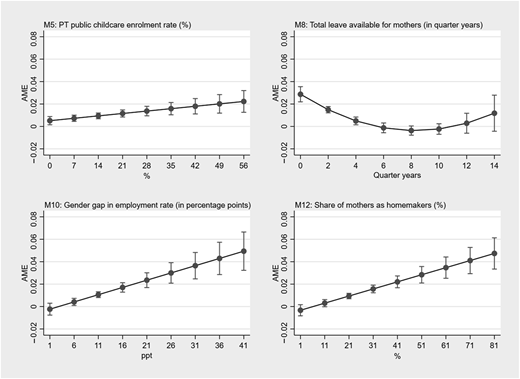
Table 1 shows the coefficients of the independent variables and their standard errors for the multilevel LPMs (see Supplementary file for the full table). The first model shows the main effect of gender on participation in unregistered employment, followed by each family policy measure and its cross-level interaction with gender. For statistically significant cross-level interaction effects, average marginal effects (AMEs) were estimated to quantify and facilitate easier interpretation of the impact of family policy on women's participation in unregistered employment relative to men (Figure 2).
Prior to testing the hypotheses, the study first estimated whether men or women were generally more likely to work in unregistered employment. The results from Model 1 show that women were significantly more likely to participate in unregistered employment, while holding the other factors constant. This aligns with the findings from Hazans (2011), who applied the earlier instalments of the ESS in his study. Given the contradictory findings from the other studies (e.g. Krasniqi and Williams, 2017), which found that men were more likely to engage in unregistered employment, the results seem contingent on the data and research design.
It is expected that availability of full-time childcare services prevents women from taking up unregistered employment (H1). In Model 3, cross-level interaction was statistically not significant (p > 0.05), suggesting that full-time childcare services did not impact women's relative likelihood of being in unregistered employment. Therefore, H1 is rejected. While the lack of full-time childcare services is associated with limited labour market opportunities for women (Brewer et al., 2022), this does not seem to be reflected in the realm of unregistered employment.
H2 states that women are more likely to engage in unregistered employment in countries with higher part-time childcare coverage. According to the results from Model 5, gender differences in unregistered employment were indeed influenced by part-time childcare services. The interaction between part-time childcare coverage rate and gender was statistically significant (p < 0.01). To further illustrate that relationship, the AMEs are plotted in Figure 2. Positive values indicate a higher likelihood of the participation of women relative to men. For example, in countries where over 28% of children were enrolled in part-time care services, women were approximately 2 percentage points more likely than men to be unregistered employees. Given its comparatively low prevalence relative to formal employment, such gender differences may be considered substantial. Thus, H2 is supported.
Based on H3, it is expected that both short (or no) and long leaves would contribute to women's participation in unregistered employment. Models 7 and 8 examine whether there is a linear or a curvilinear relationship between the length of leaves available for mothers and women's unregistered employment, respectively. Both relationships were statistically significant (p < 0.001). However, graphical interpretation of the AMEs revealed no meaningful curvilinear effect. So, no leaves or short leaves increased the likelihood of unregistered employment for women relative to men, while the effect of longer leaves was weak and uncertain, given the wide confidence intervals. Therefore, H3 is only partly supported.
Finally, H4 and H5 predict that better access to formal employment and fewer care obligations reduce women's reliance on unregistered employment. There appears to be such a relationship, as indicated by the statistically significant interaction terms in Models 10 and 12 (p < 0.001). As shown in Figure 2, in countries where gender gaps in employment rates were wider, and where a larger share of mothers were homemakers, women were more likely to be unregistered employees. Therefore, H4 and H5 are supported.
Discussion and conclusions
Prior studies have emphasised the need to consider broader labour market outcomes to better evaluate the impact of family policies on women's employment (e.g. Hook and Li, 2020). While some family policy configurations promote gender equality in the labour market, others encourage women to leave the workforce or drive them to low-quality jobs. Yet, little is known about whether such marginalisation contributes to gender differences in informal employment. In this study, this relationship was investigated within the context of unregistered employment.
Part-time childcare services and particularly short or no leaves for mothers were found to increase the likelihood of women being unregistered employees. Given that such family policies foster the mother's role as primary caregiver, it is plausible that mothers in these countries are opting for unregistered jobs to combine employment with caregiving responsibilities. After all, unregistered employment is associated with shorter working hours and flexibility regarding how, where, and when work is performed (Julia et al., 2019; Williams and Horodnic, 2019; Fodor and Kispeter, 2014). However, it is also evident that gender stereotypes tend to translate into structural inequalities. These policies may also reinforce normative assumptions about women's weaker position in the labour market and consequently shift also non-mothers towards unregistered employment.
Instead of focusing solely on institutional designs, it is important to also evaluate how family policies influence individuals' independence from or reliance on family relationships. The findings suggest that family policies that promote gender equality in care responsibilities and foster access to the (formal) labour market for women can reduce gender gaps in unregistered employment. However, improving women's access to the labour market does not necessarily lead to positive outcomes if it confines them to low-quality and non-standard jobs. Therefore, to achieve genuine gender equality, family policies must foster women's formal employment and address statistical discrimination, occupational segregation, and wage disparities. This requires that family policies challenge traditional gender norms that restrict women's independence and economic opportunities in the labour market, for example by promoting fathers' caregiving roles (Seo, 2023; Lomazzi et al., 2019; Zoch and Schober, 2018). At the very least, policymakers should be aware of the potential unintended consequences of leave and childcare policies on gendered informality when adjusting their generosity, duration, and availability. Women's overrepresentation in unregistered employment may reinforce gender inequalities in the labour market, given its poor working conditions and limited social protection.
As a novel contribution, the study shows that participation in informal employment is determined not only by interactions between the state, employers, and employees, but also by gendered arrangements of work and family. To date, research on informality in the European context has been almost entirely gender-blind. European-wide comparative studies (Krasniqi and Williams, 2017; Hazans, 2011) have demonstrated gender differences in the likelihood of informal activities, but the causes of these disparities have remained unexplained. Although gendered work has been extensively studied, this increasingly common form of employment continues to be overlooked in gendered welfare state research (for an exception, see Pfau-Effinger et al., 2009). Therefore, understanding the role of welfare states in shaping gendered labour market patterns requires extending the explanatory framework to include family policies, defamilization, and their gendered impacts on informality. This is particularly relevant for welfare states where informal paid activities are widespread, and employers rely heavily on female informal labour.
There are limitations to this study that should be considered. First, beyond its focus on unregistered employment, it did not cover other forms of informal employment that are conducted on a self-employment basis or that fall outside the binary understanding of informality (e.g. envelope wages). Second, the analysis was restricted to family policies of particular designs, neglecting fathers' leaves and the generosity of leave benefits, which may affect incentives and constraints for women. However, considering alternative family policies may be difficult because of limited comparative data available. Third, the results should not be interpreted causally due to potential endogeneity and omitted variable bias. Unobserved country characteristics correlated with family policies and gendered informality may have confounded the estimates and may account for the significant policy effects in the models. Fourth, this study assumed that family policies shape gender differences in unregistered employment both directly and by challenging and reinforcing gender norms. While previous literature points to such an indirect association (see Seo, 2023), this is not explicitly tested.
A further potential limitation is that data on participation in unregistered employment were collected through a survey. These data may be unreliable if respondents were unwilling to disclose sensitive information about their employment relationship. The literature provides mixed evidence regarding the impact of social desirability bias on survey-based measures of illicit work. Arezzo et al. (2024) report in their study that a considerable number of respondents refused to openly admit working informally, whereas Williams (2015) suggests that respondents are not that secretive about such activities. However, it should be noted that in this study respondents were considered unregistered employees if they reported working without a labour contract. Therefore, the absence of explicit mention of illegal or illicit activities most likely mitigates social desirability bias.
To further understand the relationship between family policies and gendered informality, future studies should employ alternative data sources and test whether the findings of this study are consistent with other types of informality. Moreover, it is important to take into account that gendered employment outcomes of family policies tend to vary according to women's socioeconomic backgrounds and occupational positions (see Ferragina, 2020). Finally, studies should examine how broader social, political, cultural, and economic contexts shape the effects of family policies, rather than focusing solely on their direct impacts. Applying research designs that address potential endogeneity and provide stronger causal evidence would also be beneficial.
The supplementary material for this article can be found online.