


The study aims to examine the relationship between the Parental Religious Socialization Index (PRSI) and individual autonomy concerning religious freedom, comparing the role of family agency with that of broader social networks.
How does religious upbringing shape the experiences of young Nones in societies with differing secularization paths, such as Italy and Russia? To explore this question, the PRSI is introduced and tested for validity on a sample of university students (N = 1810, including 645 Nones).
The findings suggest that country of origin plays a role in how Nones perceive the significance of the PRSI, with Russian Nones displaying slightly higher levels of endorsement. Regarding religious freedom, Italian Nones showed the strongest support for the freedom to choose one’s religious or non-religious identity and to speak openly about religious matters. In contrast, Russian Nones prioritized the values of human dignity, the search for individual truth and the pursuit of personal spiritual fulfillment. Additionally, for Russian Nones, the PRSI is associated with the support of the idea of human dignity as connected to religious freedom, and in the Italian case, the stronger association is found between the PRSI and frequency of worship. Social networks appear to play a more significant role than the child–parent relations in shaping more autonomous positions in religious matters in both samples. The results are discussed in comparison with groups adhering to majority religions.
The results highlight certain limitations, particularly the absence of longitudinal data to track long-term trends in religious socialization and the lack of control for parents’ religious backgrounds, which could provide a more nuanced understanding of intergenerational religious shifts. Another limitation is the overrepresentation of women (more than 70% of respondents), which may influence responses on topics such as gender and religious leadership.
These findings have important implications for social institutions, particularly in creating pluralistic spaces that foster the development and respect of “diverse sensibilities” and encouraging dialogue between secular and religious worldviews (Breskaya et al., 2024). In particular, religious education classrooms – where social justice, morality, respect for difference, and religious equality are central aims – play a crucial role in equipping young people with “a language to articulate their perspectives or a grammar to enter into meaningful conversation with others” (Strhan and Shillitoe, 2022, p. 271).
Our study suggests that at least two key factors are crucial in addressing the research question of this study: (1) the perceived importance of child-family communication and the specific ways in which secular or religious worldviews are transmitted at home, and (2) the role of the social milieu and broader social networks in filling gaps in the formation of individual choices and autonomy in matters of religion.
Current studies on Nones highlight the need for a more detailed examination of their sociodemographic, political, economic and spiritual-religious characteristics. Our research suggests that it is particularly important to explore the extent to which Nones’ choices regarding (non)religion are deliberate and autonomous, as well as the kinds of experiences they bring to young people. Our findings raise important questions about what is actually transmitted through religious upbringing – is it primarily religious family identity, a break from previous religious affiliations, or the development of individual autonomy in shaping one’s spiritual experiences and worldview? Furthermore, what role does the family play in fostering individuals – whether spiritual, religious or secular – who value personal choice and autonomy?
1. Introduction. Toward an analysis of religious disaffiliation and individual autonomy
The fastest-growing group of religious Nones – individuals who do not align themselves with any specific religion – has been recognized as a sign of secularization across various parts of Europe, the United States, and Canada since the 1980–90s (Kosmin et al., 2009; Thiessen and Wilkins-Laflamme, 2017; Voas and McAndrew, 2012; Wallis, 2014; Wilkins-Laflamme, 2015, 2023). Sociological discussions on this phenomenon (Beaman and Tomlins, 2015; Burge, 2021; Smith and Cragun, 2019; Zuckerman, 2009, 2012) highlight the diversity among the religious Nones, emphasizing that they do not form a homogeneous group (Cragun and Hammer, 2011; Madge and Hemming, 2017). At the same time, Nones do not completely reject belief, practices, or spiritual experiences; rather, they exhibit varying patterns of engagement across intellectual, ritual, material, emotional, and relational dimensions within the culture of modernity. This highlights the ongoing competition and divisions between secular and religious perspectives (Beider, 2022; Drescher, 2016; Lee, 2015). As a result, the need for more nuanced measures to distinguish sub-groups within Nones has been suggested [1]. A comparative analysis of inherited (non)religion (Wilkins-Laflamme, 2020) examines the broader social milieu alongside the “intergenerational retention of religion/non-religion” within families. This perspective highlights how values of autonomy and independence transmitted at home interact with the post-Christian social context for Millennials in the U.S. and Canada (Wilkins-Laflamme, 2020, p. 139).
Against this backdrop, it is interesting to note that the recent rise of the Nones in Central and Eastern Europe (Central and Eastern Europe (CEE)) (Bognár and Trzebiatowska, 2022; Borowik, 2006; Bubík et al., 2020), has occurred despite a post-1989 religious revival, which saw a rapid increase in religious affiliation and trust in religious institutions following the fall of communist regimes (Borowik and Tomka, 2001; Marinović Jerolimov et al., 2004; Tomka, 2011; Zrinščak and Črpić, 2017).
As Inglehart (2021) discusses in Religion’s Sudden Decline: What’s Causing It, and What Comes Next?, comparative data from 1990 to 2019 on the importance of religion shows that “the resurgence of religion in ex-communist countries was losing momentum” (Inglehart, 2021, p. 15). He identifies two key factors driving the secularization trend: the first is “a long-term rise in existential security,” and the second is “a recent surge in support for individual-choice norms” (Inglehart, 2021, p. 57). The latter is primarily understood as reflecting a greater acceptance of gender equality norms and increased tolerance toward divorce, abortion, and homosexuality. Inglehart noted that cross-national data indicate most countries less tolerant of individual choice norms are former communist societies, where religion and nationalism rapidly substituted the ideological void (Inglehart, 2021, p. 49). Therefore, adherence to individual choice norms has a strong negative effect on religious belief at the individual level; thus, individuals who embrace these norms tend to be less religious, a trend that is particularly pronounced among the younger generation. Furthermore, Inglehart posits that there is often a time lag between changes in objective social conditions and cultural shifts, as deeply rooted norms typically evolve slowly and are influenced by generational change.
Amid these circumstances, the rise of religious Nones among the younger generation in ex-communist countries can be viewed as evidence supporting the correlation between declining religiosity and development of more individualistic value systems. Nevertheless, certain issues still require clarification. The observations highlighting generational differences in traditional religiosity (Breskaya and Zrinščak, 2024), combined with the rise of more individualized forms of religion in Central and Eastern Europe (Pollack and Müller, 2006), suggest the need for closer examination of the factors shaping religious socialization, the patterns it follows, and the effects it has on both traditional and alternative expressions of religiosity. Whether these variations stem from differences in predominantly Orthodox and Catholic patterns of religiosity [2] (Tomka, 2006; Meulemann and Schmidt-Catran, 2023), or whether they reflect the relationship between individualized and traditional forms of religiosity in countries that have experienced prolonged periods of enforced atheism and evolving patterns of religious upbringing (Zrinščak, 2004; Gärtner, 2022), remains a question that requires further analysis.
This article explores the relationship between religious and non-religious affiliations among young people and their perceptions of more individualized choices related to navigating (non-)religiosity in two countries shaped by Western and Eastern Christianity: Italy and Russia. Cross-national comparisons of the socialization of Nones are a relatively new field of study (Thiessen and Wilkins-Laflamme, 2017; Beider, 2022; Wilkins-Laflamme, 2020), especially when comparing cases with varying political and religious traditions. We aim to analyze young Nones in the Italian and Russian samples, considering that patterns of religious socialization have remained consistent in Italy, while they have undergone significant transformation in post-communist Russia (Breskaya et al., 2022). Drawing on primary data collected in 2018–2019 from Italian and Russian university students (N = 1,810), we assess the extent to which religious upbringing is associated with religious disaffiliation in the Italian and Russian samples.
We aim to verify the question of how more individualized choices, traditional religiosity, and the roles of family and friends are linked to this process. To this end, we first explore the perceived significance of childhood religious socialization for young people and analyze patterns of religious upbringing introducing the Parental Religious Socialization Index (PRSI). Second, we investigate the relationship between the PRSI and perceptions of individual autonomy and choices related to religious freedom, comparing the role of family with that of broader social networks among young Nones. We also examine the Nones’ perceptions of female religious leadership (FRL) to explore how autonomous and free choices in religious matters are connected to broader principles of gender equality.
2. Theories of intergenerational change and religious residue
Inglehart (2021) argued that usually “there is a substantial time lag between changing objective social conditions and cultural change. The norms one grows up with seem natural and legitimate, and abandoning them brings stress and anxiety. Consequently, deep-rooted norms usually change slowly, largely through intergenerational population replacement” (p. 51). Moreover, he specified that a strong sense of purpose in life is linked “with relatively high levels of subjective well-being. One’s belief system need not be religious; the crucial thing is having a firm set of convictions” (Inglehart, 2021, p. 49).
Similar to this observation, Cipriani (2017) specified that in various societies, “the salient features of religions are consolidated and remain,” thus being “transmitted from one generation to another almost without a break” (Cipriani, 2017, p. 23). In this process of transmission, “value is not a ‘bequest’ in itself, limited to its specific content, but rather a more consistent baggage capable of containing multiple principles, articulated guiding ideas, and specifically targeted aims” (Cipriani, 2017, p. 25). In this regard “new possibilities of choice and action emerge, allowing individuals to set aside certain elements and attribute importance to others throughout their lives” during the life course of individuals (Cipriani, 2017, p. 25).
For the study of family socialization among religious Nones, these observations raise important questions regarding the transmission of value systems in the context of religious disaffiliation and the role of “religious residue” in shaping (non)religious preferences in later stages of adulthood (Beider, 2022). Beider noted, “Even if religiosity does diminish, a religious residue remains” (2022, p. 53). Furthermore, while social and religious norms and values, primarily transmitted through family socialization, can serve as robust predictors of an adult’s religious worldview (Klingenberg and Sjö, 2019), it is essential to consider the changing patterns of family religious socialization within specific cultural and political contexts. The (non)religiosity of young people can only be understood as a product of religious upbringing when this upbringing is continuous (Divisenko et al., 2019). In contrast, as demonstrated in post-communist contexts, only recently have conditions permitted an analysis of young people’s religiosity as an outcome of family religious socialization. Since the 1990s, only the second generation of parents has been able to freely socialize their children in religious matters, transmitting beliefs and values at home while openly practising their faith in public on a daily basis. The lack of religious freedom has historically restricted the public manifestation of religion and narrowed the space for shared family practices and experiences.
While recent studies indicate a general trend of an increasing number of young Nones, highlighting the similarities between Western and Eastern European societies, albeit with varying degrees of intensity, some studies (Pew Research Center, 2017) have also noted differences in countries with an Orthodox-majority population compared to those dominated by Catholic-majority tradition in the CEE region. A detailed analysis suggests that Generation X members in predominantly Orthodox countries tend to have stronger religious beliefs than their counterparts in predominantly Catholic countries, as well as Millennials and Baby Boomers [3]. Conversely, in predominantly Catholic countries or those with religiously mixed populations or non-religious majorities, the Silent Generation [4] holds the strongest religious beliefs (Breskaya and Zrinščak, 2024).
3. Notes on the rise of Nones among Italian and Russian youth
Despite the difference in religious tradition, political regimes, and records on religious freedom, young Nones illustrate growth in predominantly Catholic Italy and Orthodox Christian Russia. According to 2017 data, approximately 35% of Italians aged 18 to 34 identified as non-believers, a significant contrast to the 13% of non-believers among those 65 and older (Garelli, 2020). In the same period, only 9% of the 18–34 age group attended religious services weekly, compared to nearly 17% of those aged 35–44 and 19% of individuals aged 55–64. Additionally, about 14% of people in the 18–34 age group reported praying daily. More detailed studies (Giordan, 2009, 2010) indicate that the most prevalent adolescent spiritual orientation falls under the “indifference” type. This group is characterized by minimal to no engagement with prayer, a lack of interest in seeking life’s meaning, and no reliance on the Church for spiritual growth. The 2021 national poll in Russia revealed notable changes compared to 2017 in response to the question, “What worldview or religion do you consider yourself a follower of?” While Orthodoxy remains a strong common denominator for religious identification among Russians, the share of Orthodox Christians has declined by 9% points (from 75 to 66%), whereas the proportion of non-believers increased by 7% points (from 7 to 14%) [5]. The percentage of individuals who identify as believers “but do not belong to any particular denomination” remained stable at 4%. Among young people aged 18–24, the 2021 poll indicated that 43% identified with Orthodox worldviews, 22% as non-believers, and 7% as believers without affiliation to any specific denomination. However, the data from 2023 indicated even stronger dynamics within this category of young people, with 42% self-identifying as non-believers [6].
4. Methodology
The data for this study come from the 2018–2019 survey on Social Perception of Religious Freedom (Breskaya et al., 2024). The developed questionnaire has five thematic sections measuring participants’ perceptions of various dimensions of religious freedom, broader human rights principles, socioreligious and sociopolitical contexts, and sociodemographic characteristics. The questionnaires were completed by 1,035 Italian and 775 Russian university students. The universities were selected based on their status as public non-confessional institutions, ensuring a diverse range of students without a strong religious affiliation. We selected a convenience sample of young people studying at bachelor’s and master’s levels in social sciences and humanities at the University of Padova and Moscow State University to test the measuring instrument. While we did not impose gender quotas, the higher proportion of female respondents (∼75%) reflects broader trends of female students in social sciences. The survey took approximately 40 min to complete. The survey was conducted using the Paper-and-Pencil Interviewing (PAPI) method in Italy and Google Forms in Russia. Participation was anonymous, and questionnaires were administered on university premises under the supervision of a trainee sociologist. The PRSI is introduced in Section 4.2, which is composed of five items designed to explore the dynamics of child-parent relationships and perceived significance of growing up in a religious family. Each item on the PRSI is rated on a five-point Likert scale, where 1 represents “I disagree strongly” and 5 denotes “I agree strongly.” For the samples of religious Nones, the PRSI demonstrated good internal consistency, with an alpha coefficient of α = 0.87 for the Russian sample and α = 0.82 for the Italian sample. The common interpretation framework suggests that an alpha (α) value between 0.80 and 0.89 indicates good reliability.
The Individual Autonomy Scale (Breskaya et al., 2024) includes three items that emphasize the significance of religious freedom, linking it to human dignity, the search for individual truth, and the pursuit of personal spiritual fulfillment. These variables were measured using 5-point Likert-type response scales.
In terms of sample characteristics, participants were aged 19–24 years, with mean ages of 21 for the Italian sample and 20 for the Russian sample. Additionally, over 90% of young participants in both samples held national citizenship (see Table 1).
Sample characteristics, Italy and Russia (valid cases: Italy, n = 1,035; Russia, n = 775; %, except for age)
| Italy | Russia | |
|---|---|---|
| Age (mean) | 20.8 | 20.1 |
| Female | 77.8 | 76.5 |
| Citizen | 92.9 | 90.2 |
| No religion | 29.9 | 43.9 |
| Roman Catholic | 63.8 | 0.5 |
| Christian Orthodox | 1.7 | 42.6 |
| Belief in God | 48.2 | 52.5 |
Source(s): Table created by author
Among Italian university students, we found that nearly 30% identified as Nones, while this figure was higher among Russian participants, at almost 44%. Those affiliated with the majority religious tradition comprised almost 64% of the Italian sample and 43% of the Russian sample.
5. Results
5.1 Religious practices of Nones
This section presents an analysis of individual prayer and worship, taking into account the differences both across the two samples and within each sample. Table 2 suggests answers to the question – “How often do you pray in your home or by yourself?” – across three groups: religious Nones, adherents of majority religions, and religious minorities [7] in the assessed countries. In both the Italian and Russian samples, nearly 92% of religious Nones report never praying at home. Those affiliated with majority religions show a significantly lower rate of non-practice: approximately 34% of Catholics in Italy and 31% of Orthodox participants in Russia never engage in home or individual prayer. Furthermore, 24% of Catholics among Italian youth and nearly 14% of Orthodox Christians among Russian youth do pray regularly, with weekly and daily prayer combined.
Frequencies of prayer and (non)religious belonging (valid cases n: Italy – Nones = 303, Catholics = 648, religious minorities = 58; Russia – Nones = 341, Orthodox = 330; religious minorities = 74)
| Never | Occasionally | At least once a month | At least once a week | Nearly every day | ||
|---|---|---|---|---|---|---|
| Nones | Italy | 91.7 | 5.6 | 1.3 | 0.7 | 0.7 |
| Russia | 92.1 | 6.2 | 1.2 | 0.0 | 0.6 | |
| Majority | Italy | 33.6 | 39.4 | 3.1 | 9.3 | 14.7 |
| Russia | 30.9 | 49.4 | 6.1 | 3.0 | 10.6 | |
| Minorities | Italy | 20.7 | 20.7 | 1.7 | 1.7 | 55.2 |
| Russia | 23.0 | 31.1 | 10.8 | 5.4 | 29.7 |
Note(s): Majority religion: (Italy) = Roman Catholics and (Russia) = Christian Orthodox
Source(s): Table created by author
A similar trend is observed among participants from religious minorities, who demonstrate a higher frequency of prayer compared to those from majority religions. In Italy, around 21% of religious minorities report never praying, while in Russia, this figure rises to 23%. This indicates that religious minorities are generally more active in their prayer practices than the followers of majority religious tradition.
In terms of worship (Table 3), the differences among religious Nones and religious minorities become slightly less pronounced. Almost 83% of Italian Nones and 72% of Russian Nones report non-attendance, when asked “Apart from special occasions (like weddings), how often do you attend a religious worship service (e.g. in a Church, mosque or synagogue)?”
Frequencies of worship and (non)religious belonging (valid cases n: Italy – Nones = 303, Catholics = 648, religious minorities = 58; Russia – Nones = 341, Orthodox = 330; religious minorities = 74)
| Never | Some-times | At least once a year | At least 6 times a year | At least once a month | Nearly every week | Several times a week | ||
|---|---|---|---|---|---|---|---|---|
| Nones | Italy | 82.6 | 10.5 | 5.3 | 1.3 | 0.3 | 0.0 | 0.0 |
| Russia | 72.1 | 21.4 | 4.4 | 2.1 | 0.0 | 0.0 | 0.0 | |
| Majority | Italy | 28.2 | 26.2 | 16.0 | 6.2 | 6.3 | 14.5 | 2.5 |
| Russia | 11.5 | 32.7 | 29.1 | 16.1 | 5.8 | 4.2 | 0.6 | |
| Minorities | Italy | 34.5 | 32.8 | 8.6 | 5.2 | 3.4 | 6.9 | 8.6 |
| Russia | 27.0 | 25.7 | 23.0 | 5.4 | 9.5 | 8.1 | 1.4 |
Note(s): Majority religion: (Italy) = Roman Catholics and (Russia) = Christian Orthodox
Source(s): Table created by author
Among those Italians who belong to Catholicism, almost 28% never attend mass, and almost 12% confirm this among Russian participants belonging to Orthodox tradition. A notable difference is that Orthodox Christians are almost six times less likely to never worship compared to religious Nones. In the Italian sample, this trend is also evident, where three times fewer Italian Nones report never attending worship compared to Catholics. As for religious minorities, almost 35% never worship among the Italian and 27% among the Russian participants.
5.2 Religious upbringing of Nones
This section provides a comparative analysis of the religious upbringing of religious Nones in Italian and Russian samples, focusing on three key issues. First, it investigates the perceived significance of childhood religious socialization within families while accounting for differences across various groups. Second, we introduce and analyze the PRSI, exploring the dynamics of child-parent relationships and family environments that contribute to religious upbringing and assessing the perceived significance of these factors among Nones. Finally, we evaluate participants’ opinions on whether children should be raised in the religion chosen by their parents.
Figure 1 presents data on participants’ perceptions of the importance of religious upbringing within the family, specifically in response to the statement: “It was important for me that in my childhood I grew up in a religious family.” Not surprisingly, in both the Italian and Russian samples, the Nones category shows a notably higher percentage of participants expressing strong disagreement (31.9 and 36.4% respectively) or disagreement (36.5 and 25.2% respectively) with this statement compared to other groups.
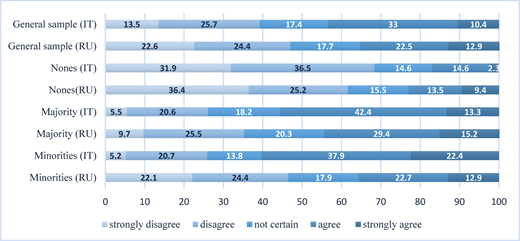
The perceived significance of growing up in a religious family (valid cases: Italy, n = 996; Russia, n = 745; %). Note: Majority religion: (Italy) = Roman Catholics and (Russia) = Christian Orthodox. (Source: figure created by author)
The perceived significance of growing up in a religious family (valid cases: Italy, n = 996; Russia, n = 745; %). Note: Majority religion: (Italy) = Roman Catholics and (Russia) = Christian Orthodox. (Source: figure created by author)
Interestingly, among Italian Nones, a combined total of 68.4% expressed disagreement (both strongly disagreeing and disagreeing), while in the Russian sample, this figure stands at 61.6%. Therefore, religious Nones in the Italian sample exhibit less support for the importance of their religious upbringing compared to their Russian peers. In contrast, for all other groups, the level of disagreement (including both strongly disagreeing and disagreeing) is higher in the Russian sample than in the Italian sample. In contrast, the importance of their religious upbringing is endorsed by 16.9% of Italian Nones and 22.9% of Russian Nones.
Affiliates of the majority religious tradition (Catholicism in Italy and Eastern Orthodox Christianity in Russia) exhibit a notable proportion of participants who agree or strongly agree on the importance of growing up in a religious family. Specifically, 55.7% of Catholics in the Italian sample and 44.6% of Orthodox Christians in the Russian sample express this sentiment. Furthermore, members of minority faiths also show significant agreement, with 60.3% in the Italian sample and 35.6% in the Russian sample affirming this view. Overall, individuals from Italy (43.4%) demonstrate a higher level of agreement with the statement about the importance of growing up in a religious family compared to their peers in Russia (35.4%).
An independent-samples t-test was conducted to assess whether the importance of religious upbringing for Nones varied significantly between the two samples. The results indicated no significant difference in the importance of religious upbringing between the Italian sample (M = 2.19, standard deviation (SD) = 1.108) and the Russian sample (M = 2.34, SD = 1.338); t(640) = −1.57, p = 0.06. In short, this means that country variance does not have a statistically significant effect on how Nones perceive the importance of growing up in a religious family.
As a next step, we introduce the PRSI, which comprises five items designed to explore the dynamics of child-parent relationships and family environments that contribute to religious upbringing (Figure 2). Additionally, the PRSI assesses the perceived significance of these factors among individuals identified as religious Nones.
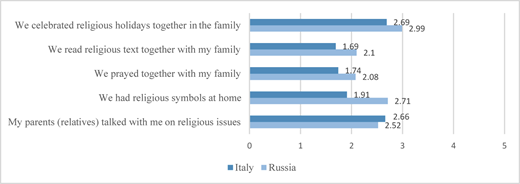
Perceived significance of items from the Parental Religious Socialization Index (PRSI) among Italian and Russian participants (valid cases: Italy, n = 304; Russia, n = 341). (Source: figure created by author)
Perceived significance of items from the Parental Religious Socialization Index (PRSI) among Italian and Russian participants (valid cases: Italy, n = 304; Russia, n = 341). (Source: figure created by author)
In both samples of Nones, perceptions of various items on the PRSI reflect disagreement or negative valence regarding the importance of religious upbringing within the family [8]. Among the Italian Nones, only two out of five items indicate a mean value greater than 2.60: “We celebrated religious holidays together in the family” (M = 2.69) and “My parents/relatives talked with me about religious issues” (M = 2.66). For the Russian Nones, the same statement – “We celebrated religious holidays together in the family” (M = 2.99) – along with “We had religious symbols at home” (M = 2.71) are more significant compared to other issues, though negative valence was also evident in their responses.
An independent-samples t-test was conducted to determine whether the PRSI scores differed between religious “Nones” in two samples. We found that there is a statistically significant difference in how Nones perceive the importance of their parents’ transmission of specific aspects of religious upbringing between the Italian (M = 2.15, SD = 0.822) and the Russian sample (M = 2.48, SD = 1.082); t(641) = −4.35, p = 0.001.
These results conflict when comparing responses to a single direct question with perceptions measured by the PRSI. It is not surprising that a straightforward question about the significance of religious upbringing may be less informative about cross-sample differences than more detailed measures, like the PRSI, which capture practical aspects of the parent-child relationship regarding the intergenerational transmission of religious values and practices.
As the final step of analysis, we explored the normative views of the Nones regarding the more autonomous and independent strategies for religious upbringing within families by asking them to express their attitudes toward the statement: “Children should be raised in the religion chosen by their parents” (see Figure 3). Strongly disagreed with this statement almost 6 out of 10 Italian Nones and 4 out of 10 Russian Nones. In short, this means that Italian Nones in our sample have a more autonomous perspective compared to Russian Nones, emphasizing that (non-)religious convictions should be determined and developed according to the individual needs and experiences of the children. When combining those who strongly disagree and those who simply disagree, almost 9 out of 10 Italian Nones and 7 out of 10 Russian Nones share this vision indicating the importance of providing more freedom of choice in matters of religion to a child.
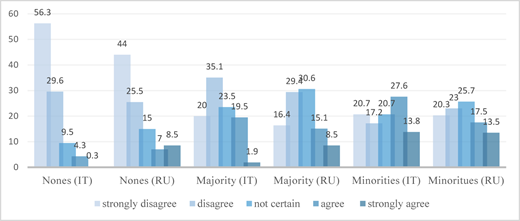
Religious upbringing by parental choice (valid cases: Italy, n = 1,008; Russia, n = 745; %). Note: Majority (IT) = Roman Catholics and Majority (RU) = Christian Orthodox. (Source: figure created by author)
Religious upbringing by parental choice (valid cases: Italy, n = 1,008; Russia, n = 745; %). Note: Majority (IT) = Roman Catholics and Majority (RU) = Christian Orthodox. (Source: figure created by author)
Among the participants who agree and strongly agree with this norm, there are members of religious minorities in Italy (41.4%) and Russia (31%), as well as individuals affiliated with the majority religions: 21.4% of Catholics in Italy and 23.6% of Orthodox Christians in Russia share this view. It is noteworthy that a significant percentage of Catholic participants (55.1%) and Orthodox Christian believers (45.8%) disagree (including both “disagree” and “strongly disagree”) with the principle that children should be raised in the religion chosen by their parents. Ambivalence toward this norm is most evident among Russian youth affiliated with the Orthodox Church (30.6%), followed by members of Italian minorities (27.6%), minorities in the Russian sample (25.7%), and Italian Catholics (23.5%). T-test statistics allowed us to conclude that country of origin significantly impacts perceptions of the degree of freedom children should have, according to the vision of the Nones. A similar difference was observed among affiliates of majority religious groups (p = 0.002), while no significant difference was found among members of religious minorities (p = 0.256) regarding the country effect [9].
Therefore, Nones in both samples significantly reject the idea of being raised in the religion chosen by their parents, reflecting a broader trend towards individual autonomy in religious beliefs. The higher levels of uncertainty among the participants belonging to majority religions (2 out of 10 young Italians and 3 out of 10 young Russians) may point to a struggle between traditional beliefs and contemporary views on religious freedom, particularly in the context of changing societal conditions.
5.3 Individual autonomy, social networks, and female leadership
The child-parent relationship in the context of (non)religious upbringing is shaped by a broader social milieu and networks of social relationships, especially during secondary socialization when young people interact with significant others beyond their parents, such as friends and other relatives. Our study proposes that the PRSI, combined with the influence of a participant’s social networks, is crucial in understanding their views on religious autonomy and socialization.
We measured participants’ broader social connections using the statement: “I often meet with (or talk to) relatives or friends,” assessed on a five-point Likert scale ranging from strong disagreement to strong agreement (Table 4). This variable, alongside the family environment, was analyzed to explore the role of the broader social networks in fostering the autonomy of Nones in making their spiritual choices. The data suggest that 9 out of 10 Italian Nones and Catholics frequently meet or communicate with their relatives and friends. Similarly, nearly 8 out of 10 Russian Nones and 9 out of 10 Orthodox Christians also maintain regular contact with their social networks. This means that broader social networks and interactions have to be examined along with transmission of secular/religious values at home and parental influence when assessing individual autonomy of young people in making their religious and non-religious choices.
Social networks of participants: Intensity of relationships with relatives and friends (valid cases: Italy, n = 993; Russia, n = 745; %, row)
| Italy | Russia | |||||
|---|---|---|---|---|---|---|
| Nones | Majority | Minority | Nones | Majority | Minority | |
| Disagree | 6.3 | 4.1 | 7.1 | 9.7 | 3.9 | 6.8 |
| Not certain | 2.0 | 3.2 | 8.8 | 12.9 | 8.2 | 10.8 |
| Agree | 91.7 | 92.7 | 84.2 | 77.4 | 87.9 | 82.4 |
Note(s): Disagree (sum of “strongly disagree” and “disagree” answers), Agree (sum of “agree” and “strongly agree” answers); Majority: (Italy) = Roman Catholics and (Russia) = Orthodox Christians
Source(s): Table created by author
Previous studies have suggested that individual autonomy is closely tied to the subjective meanings individuals attribute to religious freedom (Breskaya et al., 2024). For the current study, we propose additional items not previously explored, aiming to better evaluate the role of religious upbringing within families and broader social networks in shaping the concepts of individual autonomy among Nones, compared to other religious affiliates. This approach helps in understanding how these factors contribute to their sense of autonomy and their individual choices of (non-)religious identities.
Across most items (Table 5), participants show strong agreement (with mean values above 4.20) and, in some cases, general agreement (mean values above 3.40) with the suggested statements, indicating the significance of individual choices regarding religious/secular worldviews and principles of religious freedom. Italian Nones scored the highest (M = 4.64), followed closely by Russian Nones (M = 4.55), in their support for the importance of freedom to choose one’s religious/non-religious identity. Similarly, freedom to speak on religious matters openly and freely received high agreement, with Italian Nones scoring a mean value of 4.47 and Russian Nones a mean value of 4.09.
Perceptions of individual autonomy concerning religious freedom meaning (valid cases: Italy, n = 1,007; Russia, n = 745; %, row)
| Italy | Russia | |||||
|---|---|---|---|---|---|---|
| Nones | Majority | Minority | Nones | Majority | Minority | |
| Freedom to choose my worldview | 4.19 | 4.24 | 4.33 | 4.43 | 4.61 | 4.35 |
| Freedom to choose my religious/non-religious identity | 4.64 | 4.55 | 4.45 | 4.55 | 4.56 | 4.39 |
| Freedom to speak on religious matters openly and freely | 4.47 | 4.39 | 4.38 | 4.09 | 4.21 | 4.05 |
| It is connected with the idea of human dignity | 3.66 | 3.78 | 3.86 | 4.04 | 4.00 | 3.91 |
| It is connected with search for individual truth | 3.76 | 3.91 | 4.10 | 4.23 | 4.31 | 4.11 |
| It allows everyone to pursue their personal spiritual fulfillment | 3.86 | 4.05 | 4.09 | 4.12 | 4.39 | 4.23 |
Note(s): Majority: (Italy) = Roman Catholics and (Russia) = Christian Orthodox
Source(s): Table created by author
In contrast, Russian Nones placed greater importance on connecting religious freedom with concepts of human dignity (M = 4.04), search for individual truth (M = 4.23) and spiritual fulfillment (M = 4.12), compared to their Italian counterparts who scored lower in these areas (M = 3.66, M = 3.76 and M = 3.86, respectively).
Pearson’s correlation results (Table 6) highlight the differing roles of family and social networks (relatives and friends) in influencing individual religious and non-religious choices for Nones, as well as their perceptions of autonomy regarding religious freedom. The more Russian Nones endorse the PRSI, the more they support the idea of human dignity as connected to religious freedom (r = 0.16, p < 0.01). In both samples of Nones, religious practices are positively associated with the PRSI. However, in the Italian case the association is stronger between the PRSI and frequency of worship. The social networks appear to play a more significant role than the child-parent relations in establishing a more autonomous position in religious matters in both samples. For Russian Nones, social networks are crucial in shaping how individuals define and explore their religious or non-religious identities (r = 0.31, p < 0.01), seek for individual truth (r = 0.31, p < 0.01), and pursue their spiritual fulfillment (r = 0.26, p < 0.01). For Italian Nones, frequency of meeting or talking with relatives and friends is associated with the choices of religious or non-religious identities (r = 0.23, p < 0.01) and speaking on religious matters openly and freely (r = 0.18, p < 0.01).
Correlations (Pearson’s r, 2-tailed) between the PRSI, social networks, and individual autonomy for Nones (valid cases: Italy, n = 304; Russia, n = 341; r)
| Italy | Russia | |||||
|---|---|---|---|---|---|---|
| PRSI | Social networks | FRL | PRSI | Social networks | FRL | |
| PRSI | 1.00 | 0.11 | 0.04 | 1.00 | 0.01 | 0.00 |
| Social networks | 0.11 | 1.00 | 0.05 | 0.01 | 1.00 | 0.30** |
| To choose my worldview | 0.01 | 0.06 | 0.10 | −0.01 | 0.17** | 0.31** |
| To choose my religious/non-religious identity | −0.04 | 0.23** | 0.15* | −0.11* | 0.31** | 0.33** |
| To speak on religious matters openly and freely | 0.06 | 0.18** | 0.19** | 0.11* | 0.15** | 0.23** |
| It is connected with the idea of human dignity | 0.07 | 0.11 | 0.05 | 0.16** | 0.19** | 0.30** |
| It is connected with search for individual truth | 0.08 | 0.11* | 0.02 | 0.05 | 0.31** | 0.44** |
| It allows everyone to pursue their personal spiritual fulfillment | 0.09 | 0.02 | 0.03 | 0.08 | 0.26** | 0.38** |
| Children should be brought up in the religion chosen by their parents | 0.26** | −0.10 | −0.01 | 0.55** | −0.12* | −0.20** |
| Frequency of prayer | 0.12* | 0.04 | 0.00 | 0.13* | −0.01 | −0.14* |
| Frequency of worship | 0.22** | 0.01 | 0.01 | 0.13* | −0.04 | −0.15** |
Note(s): Correlations are statistically significant at p < 0.05 (*) or p < 0.01 (**); we interpret correlations as weak positive (r < 0.15), moderately strong positive (0.15 ≤ r < 0.30), and strong positive (r ≥ 0.30); FRL = Female religious leadership
Source(s): Table created by author
We also examined the attitudes toward FRL by asking whether “Women should have the same right to become religious leaders as men.” Among Italian Nones, two issues were particularly sensitive to FRL – the choice between religious and non-religious identity (r = 0.15, p < 0.05), and the ability to speak openly and freely on religious matters (r = 0.19, p < 0.01). Instead, for Russian Nones, a broader social network is associated with support for FRL (r = 0.30, p < 0.01), as are perceptions of individual autonomy.
Our findings suggest that the more Nones agree that children should be socialized into their parents’ religion, the more they recognize the importance of family religious upbringing. This connection is observed in both Russia and Italy; however, this association is nearly twice as strong in Russia (r = 0.55) compared to Italy (r = 0.26), with both correlations being statistically significant (at p < 0.01). This difference can be attributed to Russia’s history of stronger secularization and the communist period, during which religious choices became closely tied to family traditions, making family socialization a crucial factor in transmission of religious/secular values.
In both samples, Pearson’s correlation results indicate that for the followers of the majority religions (Table 7) that child-parent relations during the process of religious socialization is positively associated with religious freedom as the principle linked to the idea of human dignity, search for individual truth, and pursuit of personal spiritual fulfillment. As well, the PRSI family plays a crucial role in shaping religious practices, particularly prayer and worship. Among Catholics in Italy, the correlations with a frequency of prayer and worship are r = 0.40 and r = 0.42, respectively, both significant at the p < 0.01 level. Similarly, for Orthodox Christians in Russia, the correlations are r = 0.36 for prayer and r = 0.40 for worship, also significant at p < 0.01.
Correlations (Pearson’s r, 2-tailed) between the PRSI, social network, and individual autonomy for followers from majority religion (valid cases: Italy, n = 637; Russia, n = 330; r)
| Italy | Russia | |||||
|---|---|---|---|---|---|---|
| PRSI | Social networks | FRL | PRSI | Social networks | FRL | |
| PRSI | 1.00 | 0.07 | −0.13** | 1.00 | 0.07 | −0.26** |
| Social networks | 0.07 | 1.00 | 0.08 | 0.07 | 1.00 | 0.02 |
| To choose my worldview | 0.01 | 0.09* | 0.12** | −0.02 | 0.12* | 0.23** |
| To choose my religious/non-religious identity | −0.10* | 0.07 | 0.14** | −0.11* | 0.07 | 0.26** |
| To speak on religious matters openly and freely | 0.00 | 0.16** | 0.09* | −0.11* | 0.07 | 0.25** |
| It is connected with the idea of human dignity | 0.21** | 0.12** | 0.06 | 0.21** | 0.05 | 0.06 |
| It is connected with search for individual truth | 0.19** | 0.17** | 0.04 | 0.16** | 0.19** | 0.14* |
| It allows everyone to pursue their personal spiritual fulfillment | 0.22** | 0.08* | 0.12** | 0.14* | 0.21** | 0.08 |
| Children should be brought up in the religion chosen by their parents | 0.39** | 0.01 | −0.18** | 0.32** | 0.01 | −0.29** |
| Frequency of prayer | 0.40** | −0.02 | −0.20** | 0.36** | 0.01 | −0.17** |
| Frequency of worship | 0.42** | 0.02 | −0.27** | 0.40** | 0.05 | −0.24** |
Note(s): Correlations are statistically significant at p < 0.05 (*) or p < 0.01 (**); we interpret correlations as weak positive (r < 0.15), moderately strong positive (0.15 ≤ r < 0.30), and strong positive (r ≥ 0.30); FRL = Female religious leadership; Majority religion: (Italy) = Roman Catholics and (Russia) = Christian Orthodox
Source(s): Table created by author
It is interesting to note that in the Italian sample, the fact that Catholic participants often meet and talk with relatives and friends is associated with speaking freely and openly on religious matters, searching for individual truth, and achieving spiritual fulfillment, although the overall impact remains moderate. While in both samples the influence of social networks is less direct in choosing religious/non-religious identity, for Orthodox Christians in the Russian sample, social networks play a slightly more pronounced role in personal spiritual fulfillment (r = 0.21, p < 0.01). For the followers from the majority religious traditions, in both samples, FRL has a negative correlation with the PRSI, with the idea that children should be brought up in the religion chosen by their parents, and with religious practices; however, it is positively associated with some aspects of religious freedom, such as choices of worldview, identity, and open and free speech on religious matters.
6. Discussion and conclusion
This study aimed to compare two samples of young Nones to examine the distinct ways in which their non-religious affiliation and perceptions of individual autonomy are linked to the patterns of family religious upbringing as well as their broader social networks. Moreover, we were interested in considering to which degree Italian and Russian young non-affiliates differ from their peers belonging to majority and minority religious traditions. We considered the results against the current discussion on the impact of childhood religious socialization for Nones (Thiessen and Wilkins-Laflamme, 2017; Wilkins-Laflamme, 2020; Beider, 2022) and the hypothesis of Inglehart (2021) regarding the relationship between declining religiosity and increasing individual choices by extending the latter to individual choices concerning religious freedom and specifically issues of FRL.
Our findings suggest, first, that in both samples of Nones, there is a notably higher percentage of participants expressing disagreement with the importance of being grown as a child in a religious family (Figure 3). These findings align with the comparative study by Wilkins-Laflamme (2020), which indicates that Millennials are increasingly identifying as non-religious, even when coming from more religious family backgrounds. This trend is attributed to the fact that “social environment has become significantly more secular, compared with that of their parents and grandparents” (Wilkins-Laflamme, 2020, p. 147). The analysis of how participants in this study perceive the significance of various aspects of religious upbringing within the family allows for a deeper exploration of the autonomy of Nones in terms of religious and secular choices. It also sheds light on the dynamics of child-parent communication regarding religion in contemporary families.
Therefore, our second finding is that with the introduced PRSI we can conclude that young Nones are more sensitive to such aspects of communication with their parents about religious topics, such as celebrating holidays and discussing religious matters, rather than engaging in prayer together or reading religious texts in their family environment (Figure 2). Apart from the item regarding the importance of conversations about religious issues in the family, which was slightly greater favored by the Italian Nones, all other four items received slightly stronger endorsements from the Russian Nones, albeit with negative valence. The only result that nearly approached the midpoint (3.00) and indicated a positive valence was observed in the responses of the Russian Nones regarding the celebration of religious holidays within the family.
This analysis suggests two distinct ways in which parental presence is experienced during childhood: one centers on creating an atmosphere of religious holidays and sharing those experiences, while the other emphasizes the importance of conversations about religious narratives, ideas, and meanings. Additionally, we observed that the country of origin significantly influences perceptions of parental religious socialization among individuals identifying as Nones. The result showing that Russian Nones favored the PRSI more (M = 2.48, SD = 1.082) compared to Italian Nones (M = 2.15, SD = 0.822) with t(641) = −4.35, p = 0.001), is somewhat counterintuitive, especially given the ruptures in the continuity of religious socialization during the Soviet period. The parents of Russian Nones in our study are nearly the first generation to raise children in the more liberal religious environment of the post-1990s period. One possible explanation is that in Russia, religion became more of a private, family-centered matter due to the suppression of religious institutions and the limitation of collective religious practices. Therefore, even those who don’t formally identify with a religious tradition (Nones) may still recognize the crucial role of the family in transmitting identities and worldviews. Another explanation is suggested by the framework of “diffused religion” (Cipriani, 2017), even though it emphasized that transmission of religious baggage without ruptures, it can assist in interpreting these data indicating cultural relevance of religious upbring for Nones in a Russian sample. In this regard, one result of this study is particularly intriguing, confirming that despite lacking formal religious affiliation, Nones still recognize the significance of celebrating religious holidays in their childhood at home (in the Russian sample). This suggests that family religious socialization has a lasting cultural impact beyond formal religious identity.
Third, in both samples, perceptions of individual autonomy and issues related to choices of worldviews and identities were strongly endorsed by Nones (Table 5). Italian Nones scored the highest in supporting the importance of the freedom to choose one’s religious or non-religious identity. Similarly, the freedom to speak openly and freely on religious matters received higher agreement among Italian Nones compared to their Russian counterparts. Perceptions of religious freedom as a means of seeking for individual truth are higher among both Russian Nones and adherents of Orthodox Christianity compared to Italian Nones and Catholics. A similar trend is observed in the perception of religious freedom as the pursuit of personal spiritual fulfillment.
Fourth, Pearson’s correlation results indicated that various aspects of individual autonomy were more strongly associated with the PRSI and broader social networks in the sample of Russian Nones. In general, social networks in Russia play a more critical role in shaping how individuals define and explore their religious or non-religious identities. The PRSI is associated with religious practices for Nones in both samples, though the effect is slightly more significant in the Italian sample regarding worshiping together with parents. For adherents of majority religions (Italian Catholics and Russian Orthodox Christians), the association between religiosity (measured through prayer and worship) and the perceived importance of PRSI is stronger than it is for Nones.
These findings raise important questions about what is actually transmitted through religious upbringing – is it primarily religious family identity, a break from previous religious affiliations, or the development of individual autonomy in shaping one’s spiritual experiences and worldview? Furthermore, what role does the family play in fostering individuals – whether spiritual, religious, or secular – who value personal choice and autonomy? Current studies on Nones (Wilkins-Laflamme, 2015, 2020; Drescher, 2016) highlight the need for a more detailed examination of their sociodemographic, political, economic, and spiritual-religious characteristics. Our research suggests that it is particularly important to explore the extent to which Nones’ choices regarding religion are deliberate and autonomous, as well as the kinds of experiences they bring to young people.
Our study suggests that at least two key factors are crucial in addressing this question: (a) the perceived importance of child-family communication and the specific ways in which secular or religious worldviews are transmitted at home, and (b) the role of the social milieu and broader social networks in filling gaps in the formation of individual choices and autonomy in matters of religion. These findings have important implications for social institutions, particularly in creating pluralistic spaces that foster the development and respect of “diverse sensibilities” and encouraging dialog between secular and religious worldviews (Breskaya et al., 2024). In particular, religious education classrooms – where social justice, morality, respect for difference, and religious equality are central aims – play a crucial role in equipping young people with “a language to articulate their perspectives or a grammar to enter into meaningful conversation with others” (Strhan and Shillitoe, 2022, p. 271).
Fifth, when examining gender equality in terms of FRL, we found that there is no significant association between the PRSI and FRL among Nones in both samples. However, this association is present among those who identify with the majority religion, but it has a negative directionality. The more young Catholics and Orthodox Christians endorse the significance of religious upbringing in the family, the less they support the idea of FRL. Additionally, among Italian Nones there is no association between FRL and religiosity; in contrast, a negative association between these variables was observed among Nones in the Russian sample. This finding aligns with Inglehart’s theory (2021) on religious decline and the rise of individual choice norms, which suggest a greater acceptance of gender equality as societies become more secular.
Interestingly, the individual autonomy of Nones is strongly associated with support for FRL, particularly in the Russian sample. Almost all aspects of religious freedom are positively correlated with support for FRL, except for the belief that “children should be brought up in the religion chosen by their parents.” Among Italian Nones, support for FRL is positively linked to the freedom to choose one’s religious or non-religious identity and to speak on religious matters openly and freely. These findings offer a new perspective on the relationship between freedom of religion and gender equality among young Nones, raising the question of whether the argument on the rise of individual choice norms and secularization fully encompasses both freedom of religion and from religion.
The research model used in this study of Italy and Russia, based on a middle-level comparison, enhances analytical sharpness (Landman, 2009; Breskaya et al., 2024) by integrating a detailed analysis of key concepts within contrasting individual contexts. This model provides stronger empirical support for the theoretical framework. Notably, the findings suggest that religious socialization has a lasting impact beyond formal religious identity. At the same time, these results highlight certain limitations, particularly the absence of longitudinal data to track long-term trends in religious socialization and the lack of control for parents’ religious backgrounds, which could provide a more nuanced understanding of intergenerational religious shifts. Another limitation is the overrepresentation of women (more than 70% of respondents), which may influence responses on topics such as gender and religious leadership. Future research should aim for a more balanced gender sample to enhance generalizability.
Notes
For example, Beider’s study (2022) distinguishes between disaffiliates – those who reject religious belonging during their lifetime – and lifelong Nones, who have never been religiously affiliated.
Considering the differences in social representations of Eastern and Western Christianity at both institutional and individual levels, Tomka (2006) highlighted that the institutional dimension of Western Christianity emphasizes moral and religious laws shaped by rationalization and bureaucratization. This resulted in greater Church autonomy and a well-structured organizational framework. In contrast, the individual dimension in Western societies allowed for greater personal autonomy, including non-religious alternatives and a clearer differentiation between the sacred and profane spheres. These characteristics are less pronounced in societies influenced by Eastern Christianity.
In Central and Eastern Europe (CEE), members of Generation X (born between 1965 and 1980) had religious socialization during the period surrounding the fall of the Berlin Wall. In contrast, Millennials (born between 1981 and 1997) were much younger at the time, with most being under 15 years old. In Orthodox-majority countries, belief in God was reported by 87.9% of Generation X members, 85.1% of Millennials, and 85.8% of Boomers (born between 1946 and 1964). Meanwhile, in Catholic-majority countries, 77% of Generation X, 77.2% of Millennials and 80.4% of Boomers expressed belief in god. For more details, see Breskaya and Zrinščak (2024).
Members of the Silent Generation were born between 1928 and 1945.
VZIOM “Lent 2021”, data accessed October 4, 2024: https://wciom.ru/analytical-reviews/analiticheskii-obzor/velikii-post-2021.
VZIOM “Religion and Society: Monitoring”, data accessed October 4, 2024: https://wciom.ru/analytical-reviews/analiticheskii-obzor/religija-i-obshchestvo-monitoring.
In the Italian sample, nearly 6% of participants belonged to various religious minorities, including Muslims (2.4%), Orthodox Christians (1.7%), and others. In the Russian sample, almost 10% of young people identified with religious minorities, comprising 4.4% Muslims, 1.7% from other Christian traditions, 1.6% Buddhists, 0.5% Roman Catholics and others.
In interpreting these mean scores, we rely on the following rule: 1.00–1.79 = disagree totally; 1.80–2.59 = disagree; 2.60–2.99 = negative valence; 3.00–3.39 = positive valence; 3.40–4.19 = agree and 4.20–5.00 = agree totally.
An independent-samples t-test was conducted to examine the differences in perceptions of religious freedom among Nones in two samples. The results revealed a statistically significant difference in the normative understanding of children’s religious freedom during the process of their upbringing between the Italian sample (M = 1.63, SD = 0.850) and the Russian sample (M = 2.11, SD = 1.277); t(643) = −5.52 and p = 0.001.

