


Anderol back higher efficiency and productivity through oil analysis
Anderol back higher efficiency and productivity through oil analysis
Keywords: Lubricants, Synthetic oil, Productivity
Lucian Fletcher III, manager of marketing technical service, and Ed Edelson,Analytical/Technical Service Manager, ANDEROL Inc., a unit of Kaufman Holdings Corporation remind us that water and oil do not mix.
This statement is especially true when it comes to industrial lubricants. Water is a major problem for maintenance and production engineers working on offshore platforms. It is detrimental to the rotating components of sophisticated turbomachinery employed, and the lubricants used to keep them running efficiently. While it is inevitable that these pumps, compressors, and turbines will come in contact with water on offshore platforms, maintenance professionals can mitigate water's deleterious effects, as well as identify equipment issues, by participating in an on-going oil analysis program.
Routine oil analysis as a practice has been around since before World War II,and is still used as an effective tool for increasing the life of turbomachinery. It consists of a series of tests that determine the condition of equipment components and in-service lubricants, and helps maintenance personnel answer the following questions:
Is this component at risk of equipment failure?
How much longer can my lubricant last?
Has my lubricant been contaminated?
By implementing an on-going oil analysis program, maintenance professionals are able to extend equipment component life and lubricant life, identify early warning signs of contamination, minimize unscheduled maintenance, extend drain intervals, and support warranty claims.
Oil analysis procedure and guidelines
To garner the most accurate results from an oil analysis, maintenance and production engineers should follow these guidelines for taking oil samples from turbomachinery:
1 The machine being sampled should be brought to its normal operating temperature.
2 Samples should be taken when the machine is online, if possible, or within 30min of shutdown if online is not possible.
3 Ensure a turbulent flow (fully mixed) point, not a dead leg or stagnant area.
4 Oil samples should always be taken in the same manner and from the same sampling point.
5 Sample points could be:
tubing from reservoir or sump;
valve on pressurized return from system, prior to the filter;
valve on pressurized supply to system, prior to the filter;
valve on reservoir wall, special fitting; and
drain from reservoir or sump (valve or plug).
6 Use a clean, dry container to draw oil samples. Ship the sample in the plastic bottles provided in the test package kit.
7 Do not sample a machine immediately after an oil change or after a large amount of make-up oil has been recently added.
8 Always set sample intervals to catch problems early – sampling is always less costly than repair or lost production.
Oil samples must be taken before they are drained from the turbomachinery because if oil is deemed acceptable for continued use, there is no way the product can be reused for components such as hydraulics and gearboxes.
Oil analysis tests
Water content test (Karl Fischer test)
The water content test identifies the amount of water in a lubricant. Water is not compatible with most lubricants, thus, the results of this test are extremely important for maintenance professionals on offshore platforms. The higher the water content, the faster the lubricant's oxidative stability and performance will deteriorate. Equipment is susceptible to loss of viscosity and/or hydrolysis as a result of water in the lubricant, which may be the cause for excess friction of moving or rotating components. In addition, excess water,combined with heat, can accelerate the formation of organic acids that also lead to corrosion and ultimately component failure.
If the test results indicate that water contamination is a recurring problem,maintenance technicians should consider a lubricant with a higher water tolerance. This characteristic will ensure that the lubricant can sustain its performance characteristics in applications where water constantly comes into contact with the product.
Wear metals
As part of an oil analysis, a wear metal test is conducted to determine the amount and morphology of suspended particles in the oil. A routine metals analysis may be conducted by spectroscopic methods, such as ICPES, or a more detailed look at wear metals can be obtained by ferrography. Presence of certain metals provides insight to the maintenance technician of the rate at which internal components are wearing or corroding. This test can also indicate the rate of lubricant additive depletion. In addition, it is important for maintenance personnel to closely monitor sodium content when the offshore platform is operating in a saltwater environment.
An unused sample of oil must also be analysed to generate the most accurate results in order to establish a baseline. Each lubricant is engineered differently to impart unique performance characteristics that may include some metallic component(s) in its formulation. For example, if a wear metal test indicates that a lubricant contains 10-25ppm of silicon, it may appear that the lubricant is contaminated and needs to be changed. However, if the original formulation includes a silicon- based anti-foamant additive, this level is acceptable and no immediate action is required.
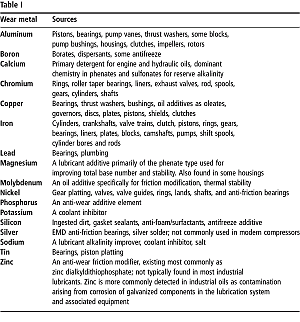
When equipment components such as bearings, gears, and pistons wear, the metal that these components are composed of can be found in the lubricant. Most machinery components have a metallic signature or “fingerprint”which can help make informed conclusions about the component's condition. Table I shows the list of metals and their possible sources.
Viscosity
Viscosity is the measure of a lubricant's resistance to flow. A lubricant's viscosity can fluctuate due to several factors – exposure to extreme temperatures and water content being the most prevalent for turbomachinery on offshore platforms. If the viscosity has decreased, it indicates that the lubricant could be contaminated with water or a lighter fluid, such as a hydraulic fluid, and could result in premature equipment wear. If the viscosity has increased, it indicates that there may have been an increase in operating temperatures and/ or excess oil consumption. In any event, any fluctuation of the viscosity number indicates that the performance of the lubricant is being compromised and may not be able to provide sufficient equipment protection. In general, an increase of more than 10-25 per cent (depending on the type of equipment) or decrease of more than 10 per cent indicates that the lubricant should be resampled and an investigation of the causes should be initiated before the lubricant is changed.
The viscosity measurement is exceptionally important when analyzing compressor lubricants used for gas gathering applications. Traditional mineral oil and synthetic- based compressor lubricants are soluble in gas, and gas is soluble in the lubricant. This relationship causes a deleterious effect on both the viscosity of the lubricant and the gas stream. By selecting a lubricant that is resistant to this absorption, it not only provides a longer application life but also improves the quality of the gas being processed.
FTIR spectroscopy
Fourier transform infrared (FTIR) spectroscopy is used to determine the purity of an oil sample. This test identifies any contaminants in the oil through the use of infrared light. Each chemical substance absorbs infrared energy differently, so this test can detect even the smallest amounts of impurities in the oil. Each lubricant has its own unique infrared signature. The chemical structure of oil changes during oxidation or degradation and will be identified as a change in that fingerprint during this test. If significant changes in the structure of a lubricant are detected in the FTIR spectrum, the oil should be examined for potential causes and changed if further investigation warrants it.
Total acid number (TAN)
TAN is the number of milligrams of potassium hydroxide required to neutralize one gram of oil. The TAN test indicates the amount of acid and acidic constituents in a lubricant. Most industrial oils have TAN levels close to zero that slowly increase with normal use. It is important to note that the significance of the acid number differs between mineral oil and synthetic-based lubricants. An acid number of two in a mineral oil-based product indicates considerable degradation; the same degree of degradation in synthetic lubricant is not reached until the acid number approaches four or more. As this number increases, it indicates lubricant oxidation, contamination with acidic components, depletion of anti-oxidants, or an increase in thermal conditions in the machinery. If the number rises above acceptable levels, system corrosion may occur.
Conclusion
To maximize the benefits of used oil analysis, it is imperative to perform comparative studies of samples taken at different points of a machine and lubricant's service life. Each application is different and affects the lubricant differently. Conducting a trend analysis helps to identify acceptable levels of contaminants in a lubricant and forecast equipment issues long before they escalate in intensity or cause catastrophic problems. By predicting equipment issues, it enables maintenance personnel the luxury to schedule repairs or change outs at more opportune times in a proactive rather than a reactive manner.
While the application of oil analysis solves long-term lubricant and machinery problems in a cost-effective manner, special care must be taken when choosing a lubricant provider. Consider a partner with in-depth knowledge of lubricant formulations and applications, and in-house expertise to interpret the results of routine oil analysis tests.

