
1-20 of 4248
Keywords: KLIBOR
Close
Follow your search
Access your saved searches in your account
Would you like to receive an alert when new items match your search?
Journal

Publishes quality and in-depth analysis on current issues within Islamic and Middle Eastern finance and management.
Journal Articles
International Journal of Islamic and Middle Eastern Finance and Management 1–26.
Published: 01 October 2026
Includes: Supplementary data
Journal Articles
International Journal of Islamic and Middle Eastern Finance and Management 1–14.
Published: 01 October 2026
Includes: Supplementary data
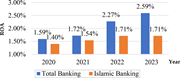
in Islamic banking financing resilience and sustainability support: a regime-switching analysis on Indonesian banking
> International Journal of Islamic and Middle Eastern Finance and Management
Published: 01 October 2026
Figure 1. ROA of Indonesian banks in 2020–2023 Source: OJK, 2024 and summarized by the authors A bar chart compares R O A for total banking and Islamic banking from 2020 to 2023, showing higher values for total banking in every year. The horizontal axis shows the years 2020 to 2023, and t... More about this image found in ROA of Indonesian banks in 2020–2023 Source: OJK, 2024 and summarized b...
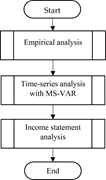
in Islamic banking financing resilience and sustainability support: a regime-switching analysis on Indonesian banking
> International Journal of Islamic and Middle Eastern Finance and Management
Published: 01 October 2026
Figure 2. Research methodology Source: Authors’ own work A flowchart starts with Start, then proceeds through empirical analysis, time-series analysis with M S V A R, and income statement analysis, before reaching End. More about this image found in Research methodology Source: Authors’ own work A flowchart starts wit...
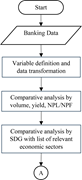
in Islamic banking financing resilience and sustainability support: a regime-switching analysis on Indonesian banking
> International Journal of Islamic and Middle Eastern Finance and Management
Published: 01 October 2026
Figure 3. Empirical analysis process flow Source: Authors’ own work A flowchart starts with Start, then proceeds through banking data, variable definition and data transformation, comparative analysis by volume, yield, N P L and N P F, and comparative analysis by S D G with relevant economic... More about this image found in Empirical analysis process flow Source: Authors’ own work A flowchart...
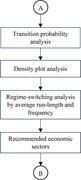
in Islamic banking financing resilience and sustainability support: a regime-switching analysis on Indonesian banking
> International Journal of Islamic and Middle Eastern Finance and Management
Published: 01 October 2026
Figure 4. MS-VAR process flow Source: Authors’ own work A flowchart continues from point A through transition probability analysis, density plot analysis, regime-switching analysis by average run-length and frequency, and recommended economic sectors, before continuing to point B. More about this image found in MS-VAR process flow Source: Authors’ own work A flowchart continues f...
in Islamic banking financing resilience and sustainability support: a regime-switching analysis on Indonesian banking
> International Journal of Islamic and Middle Eastern Finance and Management
Published: 01 October 2026
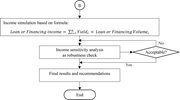
Figure 5. Income statement analysis process flow Source: Authors’ own work A flowchart continues from point B through income simulation, sensitivity analysis and an acceptability check, leading to final results and recommendations. The process continues from point B with income simulation b... More about this image found in Income statement analysis process flow Source: Authors’ own work A fl...
in Islamic banking financing resilience and sustainability support: a regime-switching analysis on Indonesian banking
> International Journal of Islamic and Middle Eastern Finance and Management
Published: 01 October 2026
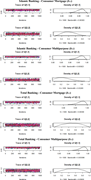
Figure 6. Trace plot and density plot for consumer mortgage and multipurpose Source: Authors’ own work A set of trace and density plots compares Q 1,1 and Q 2,2 for Islamic and total banking consumer mortgage and multipurpose models. The plots compare 4 models: Islamic Banking Consumer Mort... More about this image found in Trace plot and density plot for consumer mortgage and multipurpose Source...
Journal Articles
International Journal of Islamic and Middle Eastern Finance and Management 1–26.
Published: 30 September 2026
in Do Shariah-ESG indices offer downside risk protection? Regime-dependent evidence from Sukuk and Islamic equity benchmarks
> International Journal of Islamic and Middle Eastern Finance and Management
Published: 30 September 2026
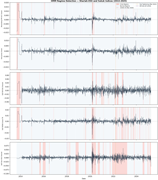
Figure 1. HMM-identified crisis and normal regimes for five Shariah-ESG and Sukuk indices (2013–2025) Note: Shaded areas (pink) indicate crisis regimes identified by the two-state Student-ν HMM (high-variance state). Vertical dotted lines mark three macro-financial events: the 2018 EM sell-... More about this image found in HMM-identified crisis and normal regimes for five Shariah-ESG and Sukuk ind...
in Do Shariah-ESG indices offer downside risk protection? Regime-dependent evidence from Sukuk and Islamic equity benchmarks
> International Journal of Islamic and Middle Eastern Finance and Management
Published: 30 September 2026
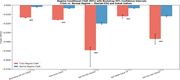
Figure 2. Regime-conditional CVaR (95%) with bootstrap 95% confidence intervals: crisis versus normal regime across five Shariah-ESG and Sukuk indices Note: Red bars = crisis-regime CVaR; blue bars = normal-regime CVaR. Error bars represent bootstrap 95% confidence intervals (B = 5,000 replications). ***p < 0.001 for the bootstrap permutation test of H0: ΔCVaR = 0. Bootstrap p-values (p = 0.000) are shown below each index label. CVaR estimated at the 95% confidence level using HMM-assigned regime observations Source: Author’s own work based on data from Bloomberg and S&P Dow Jones Indices A grouped column chart compares C V a R at 95 per cent for crisis and normal regimes across 5 Shariah E S G and Sukuk indices. The grouped column chart compares crisis and normal regime C V a R at 95 per cent, with bootstrap 95 per cent confidence intervals, across 5 indices. Bloomberg E M G C C Sukuk has crisis C V a R near negative 0.014 and normal C V a R near negative 0.002. Dow Jones Sukuk has approximately negative 0.016 and negative 0.003. S and P E M E S G Shariah has approximately negative 0.050 and negative 0.020, with wider confidence intervals for the crisis regime. S and P M E N A Sukuk T R has approximately negative 0.012 and negative 0.003. S and P Dev E S G Shariah has approximately negative 0.037 and negative 0.012, again with a wider crisis confidence interval. Each index has p equals 0.000 and 3 asterisks. More about this image found in Regime-conditional CVaR (95%) with bootstrap 95% confidence intervals: cris...
Journal Articles
International Journal of Islamic and Middle Eastern Finance and Management 1–25.
Published: 29 September 2026
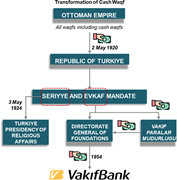
in Islamic banks as nazhir: governance and business model foundations for sustainable cash waqf management
> International Journal of Islamic and Middle Eastern Finance and Management
Published: 29 September 2026
Figure 1. Vakif Bank’s cash waqf model in Turkey Source: Ozdemir (2017) A flow diagram traces the transformation of cash waqf from the Ottoman Empire to Turkish institutions and VakifBank. The flow begins with the Ottoman Empire and all waqfs including cash waqfs. On 2 May 1920, the sequence continues to the Republic of Türkiye, then to the Seriyye and Evkaf Mandate. From this mandate, one branch dated 3 May 1924 leads to the Türkiye Presidency of Religious Affairs. Another branch leads to the Directorate General of Foundations. A further branch leads to Vakif Paralar Mudurlugu, which connects back to the Directorate General of Foundations. Money icons mark several stages involving cash waqf. In 1954, the Directorate General of Foundations connects to VakifBank. More about this image found in Vakif Bank’s cash waqf model in Turkey Source: Ozdemir ...
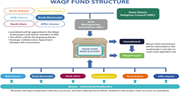
in Islamic banks as nazhir: governance and business model foundations for sustainable cash waqf management
> International Journal of Islamic and Middle Eastern Finance and Management
Published: 29 September 2026
Figure 2. Waqf fund structure in Malaysia Source: Link to the website of mywakaf. A flow diagram presents the waqf fund structure linking donors, participating Islamic banks, a joint committee, investment and a waqf project. The flow begins with individual and institutional donors. They contribute through R H B Islamic, Bank Muamalat, Bank Islam, Maybank Islamic, Bank Rakyat and Affin Islamic. Each bank then opens its respective collection account. Next, the collected funds are credited to the waqf fund main account at the lead bank. One participating bank is appointed as the lead bank for the waqf fund project and becomes a member of the Joint Management Committee J M C, while the other banks participate in the consortium. Strategic collaboration is then arranged between the consortium and the State Islamic Religious Council S I R C. The J M C oversees the waqf fund main account. From the main account, funds then move towards investment and the waqf project. Investment proceeds then flow to the waqf project. Finally, returns from the investment are channelled back to the waqf project and also used to cover some operating costs. More about this image found in Waqf fund structure in Malaysia Source: Link to the web...
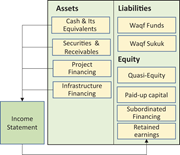
in Islamic banks as nazhir: governance and business model foundations for sustainable cash waqf management
> International Journal of Islamic and Middle Eastern Finance and Management
Published: 29 September 2026
Figure 3. Balance sheet structure Source: Authors’ own A financial structure links assets to an income statement and groups waqf funds, sukuk and equity components under liabilities and equity. The structure divides financial items into assets, liabilities and equity. Assets include cash an... More about this image found in Balance sheet structure Source: Authors’ own A financial structure li...
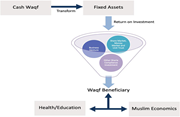
in Islamic banks as nazhir: governance and business model foundations for sustainable cash waqf management
> International Journal of Islamic and Middle Eastern Finance and Management
Published: 29 September 2026
Figure 4. Proposed cash Waqf Structure for waqf-based bank Source: Authors’ own A flow diagram traces cash waqf through fixed assets and investment returns to waqf beneficiaries, health, education and Muslim economics. The flow begins with cash waqf, which transforms into fixed assets. Next, fixed assets generate a return on investment. The return then passes through investment options comprising business venture, share market, money market and unit trust, and other Sharia compliance investment. These investments then flow to the waqf beneficiary. Finally, the waqf beneficiary connects with health and education on one side and Muslim economics on the other. More about this image found in Proposed cash Waqf Structure for waqf-bas...
in Islamic banks as nazhir: governance and business model foundations for sustainable cash waqf management
> International Journal of Islamic and Middle Eastern Finance and Management
Published: 29 September 2026
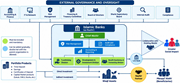
Figure 5. Proposed organizational structure of nazhir operations in islamic banks Source: Authors’ own A flow diagram presents a waqf management structure linking B U S governance, operational divisions, investments, waqf assets, partners and beneficiaries. The flow begins with oversight fr... More about this image found in Proposed organizational structure of nazhir operations in islamic banks S...
in Islamic banks as nazhir: governance and business model foundations for sustainable cash waqf management
> International Journal of Islamic and Middle Eastern Finance and Management
Published: 29 September 2026
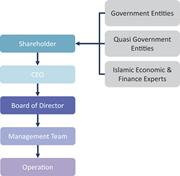
Figure 6. Proposed governance structure of waqf operations in islamic banks Source: Authors’ own A flowchart links shareholder groups to the C E O, board of director, management team and operation. The flow begins with government entities, quasi government entities and Islamic economic and finance experts, which connect to the shareholder. The shareholder then leads to the C E O. Next, the C E O leads to the board of director. The board of director then leads to the management team. Finally, the management team leads to operation. More about this image found in Proposed governance structure of waqf operations in islami...
Journal Articles
International Journal of Islamic and Middle Eastern Finance and Management 1–36.
Published: 29 September 2026

