


Drawing on the transformational leadership (TL) and knowledge-based view (KBV) theory, the present study investigates the impact of TL on radical innovation (RI) through the mediation of knowledge management capabilities (KMCs) and moderation of competitive intensity (CI) of textile and apparel industries with an Asian context.
Data were collected from the relevant stakeholders of the industry-university collaboration teams with a structured survey questionnaire. Working with 304 textile and apparel industry respondents, structural equation modeling based partial least square (PLS-SEM) is used to test the conceptual framework. PLS-SEM technique was applied to test the hypothesis using Smart-PLS 3.8 packages program.
The results proposed TL has a positive impact on KMC and RI. Furthermore, the study reveals KMC positively mediated the relationship between TL and RI. This mediation is conditional on the moderating role of CI for the KMC (knowledge acquisition capability + knowledge-sharing capability) path to RI. Conversely, moderation of CI is insignificant and does not influence on fostering RI.
Leaders and managers have realized creative and innovative culture is built within the organizations by leader-follower collaboration through actual knowledge acquisition and knowledge sharing. Moreover, industry policymakers and practitioners establish the knowledge management department to enhance the innovation culture among the firms' stakeholders to encourage RI to sustain the global business market.
The study has introduced KMC as a mediator and CI as a moderator in the proposed model between TL-RI and KMC-RI. Further, it explores the linkages between TL, KMC, CI and RI.
1. Introduction
Firms invest in creativity and innovation in a highly competitive environment to stay competitive and sustainable. Moreover, firms look to innovation to improve their competitive edge in the face of technological changes, shorter product life cycles, globalization and market demands (Le, 2020; Villaluz & Hechanova, 2019). In addition, innovative capacity, flexibility and successful adaptation of changes (Lei, Leaungkhamma, & Le, 2020) are the main factors that determine firms' performances. Radical innovation (RI) plays a crucial role because it enables firms to achieve and maintain competitive advantages and deliver high customer value. RI is the firm's ability to:
Introduce and execute new ideas,
Manufacture new products,
Offer new services,
Develop new processes,
Develop new technologies,
Re-design new organizational structures,
Consrtuct new strategies and programs to improve performance and sustainability (Le & Lei, 2019; Lei et al., 2020). For example, Amazon offers an innovative service transformation, effectively leveraging Internet technology to revamp the business acquisition and distribution systems. Additional examples of RI involve hybrid cars, hydrogen fuel cells, optical fibers and scanners for computer tomography.
Transformational leadership (TL) theories emphasize emotions, beliefs and values. A transformational leader positively influences a firm's RI through intellectual stimulation, encouraging open-mindedness, inspiring and motivating employees' innovative behaviors (Choi, Kim, Ullah, & Kang, 2016). Transformational leaders use charisma, motivation and intellectual enthusiasm to enhance employees’ radical creativity, which will likely enhance RI (Bass, 1999; Bass & Avolio, 2000; Conger, 1999). However, according to Le (2020), an understanding of the direct relationship between TL and RI is still poorly developed. Consequently, the present study focuses on how and when TL influences RI. To do so, we consider the mediating role of knowledge management capabilities (KMCs) (knowledge acquisition and sharing) and the moderating mechanism of competitive intensity (CI).
Previous studies have shown that KMCs enable firms to use current knowledge and expertise to develop incremental innovation and improve knowledge exploitation to foster RI (Le, 2020; Lei, Khamkhoutlavong, & Le, 2021). There is some evidence of a correlation between TL in innovation, learning, organizational innovation (Gumusluoglu & Ilsev, 2009) and KMCs (Birasnav, Albufalasa, & Bader, 2013). Moreover, TL has an exponential influence on innovation (Bass, 1999; Conger, 1999). Additionally, some studies have shown that dynamic capabilities influence innovation, competitiveness and firm performance (Carneiro, 2000; Darroch, 2005).
The knowledge-based view (KBV) emphasizes that knowledge is a firm's most valued and strategic asset. KMC plays the role of a precursor to organizational innovation and is an intervening mechanism between TL and innovation.
CI is one of the environmental market factors linked to a firm's innovation (Martinez-Conesa, Soto-Acosta, & Carayannis, 2017) and RI (Kmieciak & Michna, 2018) and is probably linked to knowledge management. When rivalry increases and consumers have more choices, firms strive to increase the knowledge relating to their customer needs to offer them unparalleled and unique products and services. Hence, when rivalry is fiercer, firms need to allocate more resources for acquiring, transmitting, applying and implementing knowledge about their rivals activities.
Countless researchers have given high regard to TL and RI. However, previous research has witnessed quite diversified results about the effect of TL on RI, such as negative, significant, positive and no relationship outcomes (Gui & Lei, 2021). Moreover, these inconsistent findings suggest the need to consider other factors in the relationship between TL and RI. Therefore, the research objective of this study is to investigate how KMCs condition the effects of TL on RI performance and how CI moderates the association of KMC and RI.
This study makes two contributions, and the first is the study's extension to develop a theoretical proposition that outlines the indirect effects of transformational leaders on RI through KMC and CI. Accordingly, the researcher explicitly tests the mediating and moderating role in the relationship between TL, KMC and RI. The second contribution extends TL and KBV theory related to RI. To achieve this last contribution, we have shown how KMC affects knowledge acquisition and sharing, leading to RI.
2. Literature review and hypothesis development
2.1 Transformational leadership and knowledge acquisition capability
According to Burns (1978), TL is the mechanism through which managers and employees raise righteousness, encouragement, inspiration and determination in pursuing, acquiring and sharing knowledge. Previous research has shown links between TL and knowledge management process, organizational learning and innovation, organizational performance through the product and process innovation (Birasnav et al., 2013). Brown (1994) argued for TL contributions in an emerging technology revolution, such as RI. However, several scholars have thought of knowledge acquisition capability (KAC) to acquire, share and implement knowledge within an organization. Several studies have shown that TL helps foster a supportive work environment and ensures an organization's KMC (Le & Lei, 2018).
We propose that TL evokes KAC in two ways. First, a firm's KAC is willing to learn external knowledge, assimilate and extend it to new commercial ends and be a strong catalyst for all KBVs. According to researchers, KAC can recognize and gain new ideas, insights and information from different sources, including consumers, manufacturers, dealers and rivals. Second, according to the knowledge capability's view, the dynamic capability is the constructive growth, improvement or adjustment of an organization's resource base. Consequently, studies have demonstrated a positive correlation between TL behaviors and KAC.
Transformational leadership positively influences knowledge acquisition capability.
2.2 Knowledge acquisition capability and radical innovation
In a highly knowledge-intensive environment, firms are encouraged to actively seek partners from whom they may acquire new information and knowledge to successfully improve the ability to generate RIs (Xie, Wang, & Zeng, 2018). KAC refers to firms developing new technologies and know-how from external partners (Xie et al., 2018). A KAC includes the process of acquiring, collecting and accumulating information. The knowledge acquired may be foundational to RIs creating new goods, services, manufacturing methods for new consumers or developing markets (Xie et al., 2018).
The KAC will undoubtedly increase RI for several reasons once it allows firms to acquire and accumulate external knowledge. Knowledge acquired from outside the firms significantly assists employees' creative behavior. The emerging consumer and the business knowledge further develop employees' experiences, broaden their thinking and advance innovative actions. Firms can encourage knowledge acquisition from external collaborators to promote RI initiatives, generate radical ideas and create an innovative environment that fosters performance and growth. Moreover, holding a KAC helps firms renew their knowledge stock. According to Birasnav, Rangnekar and Dalpati (2011), transformative leaders' priorities to create a set of knowledge-related values, assumptions and beliefs shape employees' attitudes toward completing knowledge tasks and participating in knowledge management processes.
Knowledge acquisition capability is positively related to radical innovation.
2.3 Mediating role of knowledge acquisitions capability
According to the literature, TL substantially impacts innovation capacity through knowledge acquisition by fostering a positive and collaborative environment favorable to supporting changes and establishing RI (Le & Lei, 2019; Yang, Nguyen, & Le, 2018). The greater the capability to acquire knowledge from outside, the greater the possibilities for companies to obtain more external knowledge over a given period (Wu & Chen, 2012). The literature stresses the significant impact of TL on the employees' ability to acquire knowledge. Specifically, transformational leaders can encourage KA processes by transforming employees' positive attitudes and behaviors toward KA in the organization (Lei et al., 2020). There are positive links between employee perceptions of TL and organizational support for knowledge processing like KAC. Consequently, firms are more willing and able to promote innovation, creativity and experimentation. The information gained from outside partners allows employees to expand their thinking, advance their creative ideas and improve their RI (Xie et al., 2018).
Knowledge acquisition capability positively mediates the relationship between transformational leadership and radical innovation.
2.4 Transformational leadership and knowledge sharing capability
Scholars define KS as exchanging knowledge and jointly creating new knowledge between employees. Previous studies have shown that transformational leaders guide employees toward specific targets concerning the TL-KS relationship, such as encouraging employees to exercise and cultivate their knowledge and skills. They also facilitate access to relevant knowledge and encourage employees to share a large amount of knowledge and experience with colleagues (Nguyen, Shen, & Le, 2021). According to Gui and Lei (2021), TL directly and indirectly influences KSC operations by increasing the employees' sense of justice and trust in leader-follower relationships. Transformational leaders cultivate employees' intellectual capital and foster respect and trust by offering a clear vision and a sense of purpose (Xiao, Zhang, & de Pablos, 2017). Likewise, Le and Lei (2017) emphasized effective knowledge management and sharing systems within the organization's stakeholders to improve the innovation capability for establishing and enhancing the firm's RI. Transformational leaders may encourage knowledge sharing by developing a feeling of loyalty among the organization's members. Building trust and facilitating employee access to implicit knowledge are more likely to enhance KS.
Furthermore, establishing organizational commitment and mutual trust among employees improves the KS process. Moreover, developing emotional relationships with their leader may strengthen KS activities (Al-Ahmad Chaar & Easa, 2021). Conversely, Bass and Avolio (1990) showed that TL motivates employees to uplift their self-interest in the building team or organization. TL also encourages strengthening team spirit and cultivating the urge to help other team members share knowledge. Finally, firms with better knowledge-sharing capabilities may build open communication between the leaders to enhance innovation and establish RI.
Transformational leadership positively influences knowledge-sharing capability.
2.5 Transformational leadership and radical innovation
The interaction, association and collaboration between creative employees and leadership reflect the diversity of leadership practices and the spectrum of information technology. These factors establish the RI culture through implementing the KMCs and proper CI among the textiles firms. Transformational leaders support the workforces by improving morale, engagement, motivation, work efficiency, subordinates' job performances and productivity. Likewise, TL encourages associates to perform surprisingly or exceptionally, and the result is noticeable and remarkable. The firms grant staff a fair amount of influence over their roles and the authority to make judgments once qualified. Due to the highly competitive economy, transformational leaders must move to satisfy consumer expectations quicker, sooner and more than ever.
Further, experts used to link the influence of transformational leaders to individual creativity and innovation development. A minimal study explored the linkages between innovation and TL (Howell & Higgins, 1990) and showed that TL indirectly influences the KMC through encouragement, motivation, intellectual stimulation, moderation of behavior, personalized mentoring and individualized influence to foster RI. Moreover, based on the above discussion, TL directly influences RI.
Transformational leadership positively influences radical innovation.
2.6 Mediating role of knowledge sharing capability
Scholars have defined KS as the process of exchanging knowledge among employees to produce new knowledge collectively. Moreover, KS and TL interaction generate experiences, skills, unique understandings, insights, intuitions, documentation, reports, processes, regulations and handbooks (Lei et al., 2020). Recent research has shown that TL positively affects employees' desire, aspiration and ability to share knowledge (Lei et al., 2020). Knowledge sharing seems to improve firms' innovation capabilities (Le & Lei, 2019; Yang et al., 2018). Le and Lei (2019) found that transformational leaders can create knowledge-sharing behaviors by creating a knowledge-supportive culture and creating a set of values, assumptions and beliefs, thus improving the firms' capacity to engender RIs. Prior research shows that TL makes circumstances that enable employees to develop their knowledge and skills, access relevant information and share knowledge and expertise with peers (Nguyen et al., 2021). According to Nguyen et al. (2021), TL fosters knowledge sharing among employees by developing intellectual capital, an unclouded vision and a sense of purpose, and establishing respect and trust. Furthermore, Le and Lei (2018) emphasized the importance of establishing a favorable environment of trust among employees and leaders to enhance RI.
Knowledge-sharing capability positively mediates the relationship between transformational leadership and radical innovation
2.7 Moderating role of competitive intensity between knowledge acquisition capability and radical innovation
CI encompasses multiple rivals, lack of information and lack of know-how for further development opportunities (Auh & Menguc, 2005). Scholars have identified CI as a critical motivator of innovation (Kmieciak & Michna, 2018). Moreover, intense competition entails violent price wars, advertising efforts and multiple product offerings. For example, technology-intensive firms, such as the electronics industry, face faster technological transition, more and higher complexity and severe competition. Firms need to leverage their competitive edge and attract consumers when industry competition heats up, either targeted at lowering costs or introducing innovations in manufacturing processes.
Firms tend to be more attentive to their competitors due to highly competitive conditions. They invest in R&D and in radical product creation, design and innovation to separate themselves from rivals. However, leaders can resort to effective knowledge management environments. These effective environments allow employees to practice and improve their knowledge and skills, promote practical knowledge and exchange acquired knowledge and experiences with colleagues in an open and friendly manner.
Knowledge acquisition and knowledge sharing between the subordinates can enhance innovation in the competitive environment. On the other hand, TL controls corporate features, such as culture, policies, structures, incentives and resources, and inspires employees to innovate, aiming at RI. Moreover, the firms' managers resolve the CI through innovation to avoid technical obsolescence and predict market shifts (Abebe & Angriawan, 2014). Innovative firms should use their expertise and knowledge to avoid risks, uncertainties and confusion regarding establishing RI.
Competitive intensity positively moderates the relationship between knowledge acquisition capability and radical innovation.
2.8 Moderating role of competitive intensity between knowledge-sharing capability and radical innovation
The intensity of competition is the degree of market rivalry a company faces. This market is characterized by frequent promotion battles, fierce price competition, substantial efficiency reduction and change demands to cope with the competition. Further, elevated levels of competition may impact how firms use their knowledge resources, and those firms need to feel less pressure and desire to avoid the risk of innovation failures (Chen, Liu, & Cheung, 2014). Moreover, KSC creates opportunities to optimize organizational resources to meet those needs and develops strategies and efficiencies, giving the firm a competitive advantage for fostering RI. However, previous research has shown that transformational leaders play a critical role in promoting knowledge-sharing capability and boosting innovative capacity (Le & Lei, 2019; Lei et al., 2020). Consequently, knowledge sharing improves the competitiveness of the organization. Besides, a firm needs to use information and knowledge to threaten rivals and succeed.
Additionally, firms may get market information more quickly if they have better knowledge, market access, skills and available information (Hou, Hong, & Zhu, 2019). In contrast, TL plays a vital role in creating a working atmosphere that effectively implements knowledge management as a prerequisite to enhance organizational learning. Based on KBV theory, CI enhances RI.
First, firms experience elevated levels of CI and are prone to join other firms to reduce competitive tension and product failure threats since mutual gains and the pursuit of shared goals are at the core of business relationships. On the other hand, intense competitive complexity usually restricts the cooperative potential for radical advancements (Zahra & Bogner, 2000). The leaders believe that implementing high-risk and cost-effective radical technologies would significantly influence their concurrent operational roles and functioning (Zahra & Bogner, 2000).
Second, a firm with knowledge-sharing capability will positively contribute to RI in the face of the highly CI. As a result, firms can turn this knowledge-sharing capability into a profitable knowledge management opportunity by introducing transformative innovation to capture emerging market shares and optimize revenues from innovative and creative goods. As CI grows, the firm increasingly depends on the external competition for the organization's internal growth and survival. However, transformational leaders realize how an organization's volatile business environment can open possibilities for RI.
Competitive intensity positively moderates the relationship between knowledge-sharing capability and radical innovation.
3. Method
To test the hypotheses, we collected the data using a survey from managers of textile departments, BEPZA, EPZ and scholars (survey available from the authors upon request). We have adapted the survey from the source and translated it from English to Bengali, and we further followed the back-translation procedure to check its accuracy. We submitted the survey to an initial pretest with 20 senior managers to evaluate whether the informants understood what we asked. We mailed numerous textile firms and scholars with a cover letter stating the research aims and objectives. The bulk of the participants included directors and managers. We collected data between February and August 2020.
We have administered 563 questionnaires, 339 returned and 304 were complete and usable in our study. The participants were primarily male (90.5%) and a few females (9.5%). Considering education levels, graduates were 44.1%, and postgraduate 42.1%.
3.1 Variables
RI refers to the breakthrough of new ideas, products, services and technologies. We calculated RI using four items adapted from Avlonitis, Papastathopoulou and Gounaris (2001) and Song and Thieme (2009). For example, “Our firm introduces new products/services that are more radically new to the market” and “Our firm introduces new products/services that require more radically change in customers' way of using them.” We used a Likert-type scale anchored in 1 – strongly disagree – and 5 – strongly agree.
We measured transformational leadership with five items (Podsakoff, MacKenzie, Moorman, & Fetter, 1990). For example, we asked respondents, “The firm's management is always on the lookout for new opportunities for the organization” and “The firm's management succeeds in motivating the rest of the company.” We used the same 5-point Likert scale.
KMC comprised two dimensions: knowledge acquisition and knowledge sharing, based on Gold, Malhotra, and Segars (2001) and Schulz (2001). Knowledge acquisition capabilities determine the extent to which current systems can acquire information from innovation stakeholders. We asked respondents to rate in the 5-point Likert type scale three items, including “Our firm has processes that can continuously acquire information from customers” and “Our firm has processes that can continuously acquire information from external partners.”
Knowledge-sharing capabilities capture the degree to which existing systems can communicate information across innovation partners. We assessed KSC with four items such as “Our firm has processes that can continuously exchange information with its customers” and “Our firm has processes that can continuously share information between all parties involved in new service development.”
We characterized competitive intensity in the strategy as the degree to which firms exert demand on each other within a given market. The CI was measured based on Jaworski and Kohli (1993), with three items such as “Price competition is a hallmark of our industry” and “One hears of a new competitive move very frequently.” We used the five-point Likert-type scale anchored in 1 – strongly disagree – and 5 – strongly agree.
3.2 Analytical procedures
The results were analyzed using SPSS 26.0 and SMART-PLS 3.8 version tools. We have used Harman’s one-factor test. Further, we have used principal axis factor analysis (Harman, 1976) and found that a single construct explained 33.2% of the overall initial variance. One component accounts for almost 1/3 of the total variation, and the result recommends a lower value of less than 50%. The variance inflation factors were within the accepted values (see Table 1).
Measurement model quality criteria
| Constructs/Measures | Items | Loading | CA | rho_A | CR | AVE |
|---|---|---|---|---|---|---|
| Transformational leadership | TL1 | 0.785 | 0.807 | 0.822 | 0.872 | 0.630 |
| TL2 | 0.766 | |||||
| TL3 | 0.826 | |||||
| TL5 | 0.798 | |||||
| Knowledge acquisition capability | KAC1 | 0.912 | 0.865 | 0.871 | 0.917 | 0.787 |
| KAC2 | 0.864 | |||||
| KAC3 | 0.884 | |||||
| Knowledge-sharing capability | KSC1 | 0.873 | 0.865 | 0.869 | 0.908 | 0.711 |
| KSC2 | 0.845 | |||||
| KSC3 | 0.830 | |||||
| KSC4 | 0.824 | |||||
| Competitive intensity | CI1 | 0.883 | 0.728 | 0.782 | 0.844 | 0.645 |
| CI2 | 0.800 | |||||
| CI3 | 0.718 | |||||
| Radical innovation | RI1 | 0.778 | 0.854 | 0.854 | 0.902 | 0.697 |
| RI2 | 0.871 | |||||
| RI3 | 0.811 | |||||
| RI4 | 0.876 |
4. Results
We developed and evaluated the measurement model's internal reliability, convergent validity and discriminant validity. To validate every construct and determine the construct's reliability, we used Cronbach's α, rho A and composite reliability. For calculating and measuring internal reliability and validity, the value of Cronbach's α, rho A and composite reliability should exceed the value of 0.7 (Hair, Anderson, Tatham, & Black, 2006). We found Cronbach's α values ranging from 0.728 to 0.865, rho A values from 0.782 to 0.871 and composite reliability values from 0.844 to 0.917. We thus confirm internal reliability. We further assessed the convergent validity and AVE and item loadings. In Table 3, we observe that all AVE values were greater than 0.5 (Fornell & Larcker, 1981). The average variance extracted (AVE) ranged from 0.630 to 0.787. We may calculate the discriminative validity by taking the square root of the AVE meaning above all other cross-correlations. This analysis finds that each construct's square root of AVE is greater than the standard cross-correlation construct. Thus, we have a reasonable discriminatory validity (see Table 2).
Bootstrapping results for structural modal evaluations
| Hypothesis | Path | Path coefficient (β) | t-statistics | p values |
|---|---|---|---|---|
| H1 | TL → KAC | 0.826 | 41.111 | 0.000** |
| H2 | TL → KSC | 0.684 | 15.538 | 0.000** |
| H3 | TL > KAC → RI | 0.430 | 10.926 | 0.000** |
| H4 | TL > KSC → RI | 0.088 | 3.023 | 0.003** |
| H5 | TL → RI | 0.805 | 14.956 | 0.000** |
| H6 | TL > KSC → RI | 0.330 | 5.080 | 0.000** |
| H7 | KAC-RI → RI | 0.041 | 1.734 | 0.084 |
| H8 | KSA-RI → RI | 0.044 | 1.919 | 0.056 |
Note(s): ** means 95% significance level
Latent variable, correlations, convergent and discriminant validity
| Fornell-Larcker matrix | Heterotrait-Monotrait Ratio (HTMT) | |||||||||||
|---|---|---|---|---|---|---|---|---|---|---|---|---|
| Mean | SD | CI | KAC | KSC | RI | TL | CI | KAC | KSC | RI | TL | |
| CI | 3.948 | 0.997 | 0.803 | |||||||||
| KAC | 3.867 | 0.984 | 0.848 | 0.887 | 0.813 | |||||||
| KSC | 3.695 | 1.040 | 0.633 | 0.643 | 0.843 | 0.781 | 0.740 | |||||
| RI | 3.924 | 0.985 | 0.810 | 0.864 | 0.707 | 0.835 | 0.885 | 0.893 | 0.817 | |||
| TL | 3.212 | 1.008 | 0.903 | 0.826 | 0.684 | 0.919 | 0.794 | 0.743 | 0.753 | 0.802 | 0.877 | – |
Note(s): N = 304; p < 0.10; *p < 0.05; **p < 0.01; ***p < 0.001; TL, transformational leadership; KAC, knowledge acquisition capability; KSC, knowledge-sharing capability; RI, radical innovation; CI, competitive intensity
4.1 Structural modeling and hypothesis testing
We developed and established the structural model to evaluate and analyze the path relationships among the proposed constructs in the hypothesized modal. We used the bootstrapping technique to test our proposed hypothesis, with a significant level of 0.005 (P < 0.005) and path coefficient. We used, in the bootstrapping, the 5,000 subsamples to show the path coefficient's significance (Hair, Sarstedt, Ringle, & Mena, 2012). The interaction and association between the DV and IV were assessed and calculated by path coefficient (β) and t-statistics above 1.96 at a 5% significance level.
To assess a structural model's explicative strength, we have utilized the R2 value of the dependent variable. We have displayed the consequences of bootstrapping in Table 3. The outcome supports the hypothesis suggested H1 (T = 41.111, β = 0.826, P < 0.001) and H2 (T = 15.538, β = 0.684, P < 0.001). Thus, a firm with higher TL will significantly be associated with knowledge management practices (KAC and KSC). This finding shows that leadership significantly influences KMC fostering RI. Further, the result supports H3 (T = 10.926, β = 0.430, P < 0.001) and H4 (T = 3.023, β = 0.088, P < 0.003). Thus, a firm with greater KMC is significantly associated with RI in the ready-made garments industry.
The results support H5 (T = 14.956, β = 0.805, P < 0.001), meaning that TL improves the generation of RIs. Thus, we conclude that TL has great significance on the RI of the textile firm, and thus H6 (T = 5.080, β = 0.330, P < 0.001) is significant. Figure 1 provides the path coefficients and p-values, and R2 and Q squares in the following.
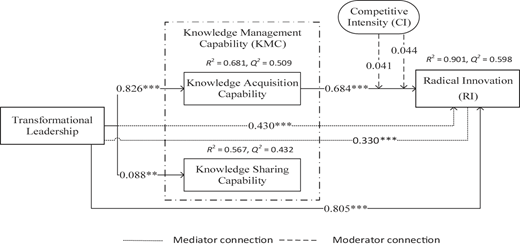
Bootstrapping results of path coefficient and p-values
Bootstrapping results of path coefficient and p-values
To test H3 and H6 on the mediation, we used bootstrapping, using 5,000 samples with 95% confidence intervals. Observing the results in Table 4, KAC mediates the relationship between TL and RI (T = 10.926, β = 0.355, P = 0.000), and we can confirm H3. We also confirm H6 that KSC mediates the relationship between TL and RI (T = 5.080, β = 0.060, P = 0.004). Therefore, the hypothesis confirmed that KMC significantly affects TL and RI. Moreover, KMC directly affects RI, and TL indirectly affects RI through KMC.
Hypothesis testing of mediation and moderation effect
| Indirect effects | Confidence intervals bias corrected | |||||||
|---|---|---|---|---|---|---|---|---|
| Path | β | Total effect | VAP | t-values | p values | 2.5% | 97.5% | Decision |
| TL → KAC → RI | 0.355 | 0.826 | 0.430 | 10.608 | 0.000** | 0.022 | 0.140 | Mediated |
| TL → KSC → RI | 0.060 | 0.684 | 0.088 | 2.881 | 0.000** | 0.783 | 0.861 | Mediated |
| Indirect and total effects | Confidence intervals bias corrected | |||||||
|---|---|---|---|---|---|---|---|---|
| Path | β | Total effect | VAP | t-statistics | p values | 2.5% | 97.5% | Decision |
| KAC-RI → RI | 0.041 | 0.346 | 0.041 | 1.734 | 0.084 | −0.024 | 0.069 | Not sig |
| KSA-RI → RI | 0.044 | 0.065 | 0.044 | 1.919 | 0.056 | −0.072 | 0.018 | Not sig |
Note(s): ** means 95% significance level
Testing the moderations – Firms engage in innovation activities, generating new products and services to survive and prosper. The tests of H7 (T = 1.734, β = 0.041, P < 0.084) and H8 (T = 1.919, β = 0.044, P < 0.056) do not allow us to confirm the hypotheses. Table 4 shows the results of the tests for the moderation effects of CI, KMC, and RI.
5. Discussion and conclusion
Firms invest substantial efforts and resources to introduce knowledge-enhancing practices for flourishing creative thinking, creativity and innovation. The knowledge-enhancing practices improve the firms' skills to produce innovative goods and technologies in a competitive environment. This research adds TL and the association of RI to the existing literature, and the research also offers contributions so that KMC can promote RI. In our sample, the findings demonstrated that TL and KMC affect RI. Moreover, the study shows that the mediating effect of KMCs (KAC + KSC) is significantly associated with TL and RI. This study also highlights the importance of TL. However, we could not find a moderating effect of CI on KMC and RI relations.
This study contributes to TL, KMC and RI literature. First, the conceptual framework consists of mediation and moderation of KMC and CI and drives eight hypotheses for accomplishing study goals and objectives. Second, the study empirically tested the conceptual modal and hypotheses and found TL positively linked to RI. This study shows a remarkable interaction between TL and KMC and TL and RI. The KMC positively mediates the relationship between TL and RI, and we found a positive interaction between TL and RI. Moreover, TL seems to encourage and nurture the employee's minds and thoughts for knowledge acquisition, sharing and applying the acquired knowledge.
Our research has managerial implications that firms may use to foster RI. For example, establishing a knowledge management department may enhance the acquisition, sharing and dissemination of knowledge among stakeholders to encourage RI. Transformational leaders play an essential role as they work as a vital mechanism to introduce procedures, facilitate the transmission of acquired knowledge and implement it in other departments, possibly fostering RI initiatives. In addition, managers can enhance TL practices, by setting priorities, applying multiple strategies so that employees can acquire and improve their knowledge and building trusting relationships to develop RI.
5.1 Limitations and future research avenues
There are a few limitations worth noting. First, limited sample size and data from an only source increase generalizability to different circumstances. Future studies may examine different industries and cultural settings to capture more significant variability and a larger sample. Second, a longitudinal study could help us better grasp the examined relationships and explore new relations. For example, exploring environmental uncertainty, knowledge creation, organizational learning and generative learning are possible moderator dimensions. New researchers shall explore generative learning in associations between TL, knowledge management mechanism and RI.
The authors acknowledge the support from the key program of National Natural Science Foundation of China (Grant No. 71832004).

