Internet research using partial least squares structural equation modeling (PLS-SEM)
Innovation and diffusion of PLS-SEM
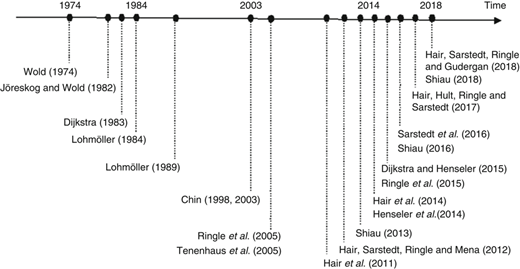
Since Wold (1974) developed the PLS algorithm more than 40 years ago, the method has evolved considerably, particularly in recent years. Indeed, numerous researchers have contributed to expanding awareness and applications of what is now known as PLS-SEM. Today, PLS-SEM belongs to the common portfolio of multivariate analysis methods (Hair, Black, Babin and Anderson, 2018). But the road to its widespread adoption among researchers and practitioners was not always straightforward and sometimes bumpy. Figure 1 visualizes some key publications that contributed to the development and diffusion of PLS-SEM.
PLS-SEM was standing in the shadows of the more popular covariance-based SEM (CB-SEM) method for many years. A likely reason was Jöreskog’s development of the LISREL software, which led to the early widespread adoption of CB-SEM. In contrast, without software, PLS-SEM remained relatively unknown – notwithstanding early research comparing the methods and offering guidance for their choice (Jöreskog and Wold, 1982; Dijkstra, 1983). This pattern continued for almost 20 years despite several fundamental advantages of PLS-SEM. The primary advantages of PLS-SEM include the relaxation of “hard” distributional assumptions required by the maximum likelihood method used to estimate models using CB-SEM, and PLS-SEM’s ability to easily estimate much more complex models with smaller sample sizes (Jöreskog and Wold, 1982).
Lohmöller (1984) introduced the LVPLS software to estimate causal models and later published the comprehensive PLS-SEM textbook Latent Variable Path Modeling with Partial Least Squares (Lohmöller, 1989). Then in the early 1990s, Falk and Miller (1992) published their Primer on Soft Modeling. Despite these developments, little interest was shown in the method until Chin (1998) introduced the method to business research in his seminal article in Marcoulides’s (1998) edited volume Modern Methods for Business Research, followed by his release of PLS-Graph (2003) – the first software package with a graphical user interface for PLS-SEM analyses. While the availability of PLS-Graph (Chin, 2003) accelerated the use of PLS-SEM, particularly in management information systems (Ringle et al., 2012; Hair, Hollingsworth, Randolph and Chong, 2017), applications grew exponentially following the release of the free SmartPLS 2 software (Ringle et al., 2005) that included many analysis options and quickly became the most popular PLS-SEM software (e.g. Ali et al., 2018; Nitzl, 2016; Ringle et al., 2018). About the same time, Tenenhaus et al.’s (2005) seminal article was released, which summarized PLS-SEM’s statistical properties and introduced it to a broader audience of methodological researchers. Also, international conferences such as the International Symposium on PLS and Related Methods started gaining momentum. In this regard, the 2005 PLS conference in Barcelona (Spain) certainly shaped the field by forming a strong and collaborative research community, as evidenced in Esposito Vinzi et al.’s (2010) highly popular Handbook of Partial Least Squares, which compiled papers from that conference.
PLS-SEM use in applied research accelerated rapidly after the release of several overview articles and textbooks such as the Hair et al. (2011) article “PLS-SEM: indeed a silver bullet,” Hair, Sarstedt, Ringle and Mena’s (2012) review article “An assessment of the use of partial least squares structural equation modeling in marketing research,” and the “Primer on partial least squares structural equation modeling (PLS-SEM)” (Hair et al., 2014; Hair, Hult, Ringle and Sarstedt, 2017), which has been translated into five languages. Numerous special issues focusing on methodological extensions and applications of PLS-SEM, such as in Long Range Planning (Sarstedt, Ringle and Hair, 2014; Hair, Ringle and Sarstedt, 2012; Hair et al., 2013), Journal of Business Research (Cepeda-Carrión et al., 2016) and Quality & Quantity (Henseler, 2018), opened publication opportunities for researchers focusing on improving and applying the method. Increased interest in the method among applied researchers manifested itself in the 2015 PLS User Conference in Seville (Spain), organized by Jörg Henseler (University of Twente), Christian M. Ringle (Hamburg University of Technology), José Luis Roldán (University of Seville) and Gabriel Cepeda-Carrión (University of Seville), which marked a highlight in the history of PLS-SEM.
These publications and conferences greatly contributed to the dissemination of PLS-SEM, not only in business research, but also in engineering and various fields of natural sciences such as agriculture, ecology, environmental sciences, geography and psychology. During that same period, Ringle et al. (2015) released the SmartPLS 3 update, a state-of-the-art program that not only provided basic analysis options and assessment criteria (Shiau and Chau, 2016; Huang and Shiau, 2017), but also supported advanced supplementary methods and novel model evaluation metrics. In parallel, various other software packages have been introduced, including ADANCO, PLS-GUI, SPAD-PLS, WarpPLS, XLSTAT-PLSPM and several R extensions such as matrixpls and semPLS. Finally, in 2018, Hair, Sarstedt, Ringle and Gudergan published Advanced Issues in Partial Least Squares Structural Equation Modeling (Hair, Sarstedt, Ringle and Gudergan, 2018), which extended the coverage of PLS-SEM to include more complex analysis approaches.
Influenced by Hair, Ringle and Sarstedt, and other recognized PLS-SEM methodologists, Shiau published a book in the Chinese language, Introduction and Application of Statistical Analysis: SPSS+ PLS-SEM (SmartPLS) in 2013 (Shiau, 2013). The book covers basic PLS-SEM concepts and techniques as well as step-by-step instructions for using the SmartPLS 2 software. It was the first SmartPLS book in the Chinese language and became the market leader in Taiwan, China, Hong Kong and Macau. Three years later, Shiau (2016) published the follow-up title Introduction and Application of Statistical Analysis: SPSS+ SmartPLS 3 (PLS-SEM); its second edition (Shiau, 2018) also covers formative measurement model assessment as well as mediation and moderation. The book quickly became the most widely used PLS-SEM book in Taiwan, China, Hong Kong and Macau.
Parallel to the release of user-friendly software and textbooks, methodological research has developed numerous extensions of the original PLS-SEM method, which greatly extended the toolbox of researchers working with the method. Examples include the confirmatory tetrad analysis (Gudergan et al., 2008), importance-performance map analysis (Ringle and Sarstedt, 2016), higher-order modeling (Becker et al., 2012), measurement invariance of composite models procedure (Henseler et al., 2016), endogeneity assessment (Hult et al., 2018), mediation analysis (Nitzl et al., 2016) and moderation (Fassott et al., 2016). Segmentation and uncovering unobserved heterogeneity represents a particularly critical issue in PLS-SEM to ensure the validity of results and findings. For this purpose, several techniques have been introduced to PLS-SEM such as finite mixture PLS (Hahn et al., 2002), prediction-oriented segmentation (Becker et al., 2013) and iterative reweighted regression (Schlittgen et al., 2016). Furthermore, researchers have proposed a range of novel model evaluation metrics such as the heterotrait-monotrait ratio of correlations (Henseler et al., 2015; Franke and Sarstedt, 2019), the reliability statistic ρA (Dijkstra and Henseler, 2015), model comparison criteria (Sharma, Sarstedt, Shmueli, Kim and Thiele, 2019; Sharma, Shmueli, Sarstedt, Danks and Ray, 2019) and PLSpredict (Shmueli et al., 2016, 2019). Several researchers also have adjusted the original PLS-SEM algorithm to mimic results of CB-SEM, which assumes a common factor model (e.g. Bentler and Huang, 2014; Dijkstra and Henseler, 2015; Kock and Sexton, 2017), leading to the emergence of new guidelines for the method’s use (e.g. Henseler et al., 2017), which, however, have triggered controversies (Hair, Hult, Ringle and Sarstedt, 2017; Hair et al., 2019).
Many of these developments emerged from sometimes fierce debates about PLS-SEM’s performance and general suitability for social sciences research (Khan et al., 2019). Contributions suggesting both strengths and limitations of the method have appeared at a rapid pace, with some articles concluding that researchers should “discontinue the use of PLS” (Rönkkö et al., 2016, p. 24). But more balanced perspectives on PLS-SEM’s strengths and limitations point to differing assumptions, for example about the underlying data and measurement types (e.g. Marcoulides et al., 2012; Henseler et al., 2014; Sarstedt et al., 2016; Hair, Hult, Ringle, Sarstedt and Thiele, 2017), with recent works concluding that researchers should “feel the love for PLS” (Petter, 2018, p. 12).
The field has benefited from these debates and continues to do so. Newcomer researchers, such as Faizan Ali, Necmi K. Avkiran, Julen Castillo Apraiz, Walid Chaouali, Jun-Hwa Cheah, Nicholas Danks, Marcelo L. D. Silva Gabriel, James Gaskin, Rasoul Ghollamzadeh, Lacramioara Radomir, Hengky Latan, Yide Liu, Mumtaz A. Memon, Rebecca Mitchell, Christian Nitzl, Soumya Ray, Jan H. Schreier, Florian Schuberth, Sandra Streukens, Hiram Ting, and Fosso W. Wamba, continue to advance the field. Also, experienced instructors such as Jan-Michael Becker, Diógenes de Souza Bido, Gabriel Cepeda Carrión, Jörg Henseler, José L. Roldán, Thurasamy Ramayah and Mostafa Rasoolimanesh have considerably contributed to PLS-SEM’s dissemination. New research associations, such as the Sarawak Research Society with their Journal of Applied Structural Equation Modeling, and numerous researchers who present PLS-SEM workshops worldwide, have increased the method’s dissemination. There clearly is a bright future for PLS-SEM!
This special issue of Internet Research extends these developments by introducing advanced methods to a wider audience in an effort to broaden the understanding of phenomena in the internet and information systems fields. In doing so, the special issue covers methodological papers that introduce new procedures as well as empirical articles that apply state-of-the-art PLS-SEM analyses.
The special issue’s lead article by Khan et al. (2019) presents the results of a social network analysis that identifies the knowledge infrastructure of PLS-SEM research. Using 84 methodological studies published in 39 journals by 145 authors from 106 universities as input, the results show that the PLS-SEM knowledge network is rather fragmented, with authors working in partly isolated silos. The analysis identifies authors, countries and institutions that dominate the network as well as journals that play a key role in disseminating PLS-SEM research. Finally, the authors’ burst detection analysis indicates that method comparisons and extensions, for example, to estimate common factor model data or to leverage PLS-SEM’s predictive capabilities, feature prominently in recent research.
Franke and Sarstedt (2019) extend recent simulation studies on discriminant validity measures, contrasting the use of cutoff values (i.e. heuristics) with inferential tests. Their results provide further evidence for the robustness of the heterotrait-monotrait ratio of correlations (HTMT) criterion as an estimator of disattenuated (perfectly reliable) correlations between constructs, whose performance parallels that of Jöreskog’s (1971) standard constrained Phi approach. In addition, the authors identify McDonald’s (1999) procedure as a promising supplemental test to assess discriminant validity, while criticizing the widely used Fornell and Larcker’s (1981) criterion on conceptual and empirical grounds.
Rademaker et al. (2019) propose a modification of Dijkstra and Henseler’s (2015) consistent PLS-SEM (PLSc-SEM) algorithm that accommodates indicators with correlated measurement errors. Results from a simulation study show that the modified PLSc-SEM algorithm performs well in the presence of error correlations, particularly for large sample sizes. Their study also offers support for the original PLSc-SEM algorithm’s robustness in such settings.
Klesel et al. (2019) propose two overall tests for multigroup comparisons in PLS-SEM that consider the entire model structure, rather than analyzing individual parameter estimates across groups (Sarstedt et al., 2011). The tests adopt the squared Euclidean distance and the geodesic distance to compare the model-implied indicators’ correlation matrix across groups. The authors’ Monte Carlo simulation provides insights into the sensitivity and specificity of both permutation-based tests, and offers support for their statistical power.
In the final methodological article of this special issue, Sánchez-Franco et al. (2019) combine natural language processing and PLS-SEM to analyze how sentiments expressed in more than 45,000 customer reviews of 33 US hotels impact relationship quality. First and foremost, the study makes an important methodological contribution by showing how non-structured data such as opinions can be coded to serve as input for a PLS-SEM analysis to test hypothesized patterns of relationships among constructs. This unique merger of exploratory and confirmatory approaches will hopefully encourage follow-up applications of the method and extensions that combine machine learning and PLS-SEM methods.
In the special issue’s first empirical article, Ghazali et al. (2019) investigate factors that drive continued use of Pokémon Go, one of the most popular augmented reality games. Drawing on uses and gratifications theory, the authors derive a complex path model in which flow and enjoyment mediate the relationship between uses and gratifications-related constructs (achievement, challenge, escapism and social interaction) and continued use of Pokémon Go. Extending prior research in the field, the model also considers the impact of social influence on user behavior. Analyzing data from 362 Pokémon Go players, the authors find support for enjoyment’s crucial role for continued use, whereas flow exerts no direct impact. Ghazali et al.’s (2019) paper not only makes a valuable contribution to research on augmented reality applications, but also offers a showcase on how to analyze multiple mediation relationships in the context of PLS-SEM.
In the second empirical study of this special issue, Zhang et al. (2019) investigate how virtual try-on technologies, as increasingly used by online retailers, impact consumers’ purchase intentions. Integrating utilitarian, hedonic and risk perspectives, the authors find that perceived usefulness, enjoyment and privacy risk impact consumers’ attitudes toward virtual try-on technologies, which, in turn, influence their purchase intentions. Using advanced PLS-SEM analyses, the authors also find support for the robustness of the results in terms of gender and age. Zhang et al. (2019) also illustrate how to extend standard PLS-SEM analyses by using more advanced analysis techniques such as PLSpredict (Shmueli et al., 2016) and MICOM (Henseler et al., 2015).
Cheah et al. (2019) compare the effects of selfie promotion and celebrity-endorsed advertisements on consumers’ decision-making process. Using the AISAS model as a theoretical framework, the authors find that the use of selfie promotions has a stronger effect on a customer’s sharing intentions. The authors also test several sequential mediations to offer a more nuanced analysis of their hypothesized models and compare the models using PLSpredict (Shmueli et al., 2016) and information theoretic model selection criteria (Sharma, Sarstedt, Shmueli, Kim and Thiele, 2019; Sharma, Shmueli, Sarstedt, Danks and Ray, 2019).
Finally, Krey et al. (2019) examine the influence of emotional vs functional ads on consumers’ evaluations and adoption of smartwatches. Analyzing data from almost 1,000 smartwatch users, the authors show that functional ads elicited high levels of hedonic values, whereas emotional ads produce higher levels of functional value. Additional analyses offer support for the moderating impact of personal innovativeness and extraversion. The study therefore offers important guidance for advertisers working in this rapidly expanding market.
We are confident that the papers presented in this special issue make important contributions toward both methodological and applied empirical perspectives. We also believe the special issue as a whole helps to further the emancipation of PLS-SEM from CB-SEM as long called for by Rigdon (2012), and echoed in follow-up studies (e.g. Rigdon et al., 2017; Sarstedt, Ringle, Henseler and Hair, 2014; Sarstedt et al., 2016). It is time to move beyond the PLS-SEM vs CB-SEM rhetoric and acknowledge composite-based methods as an important element of multivariate statistical analysis.