


Contactless socio-technical transformations
The entire world has experienced significant transformations in various aspects of human life due to the COVID-19 pandemic. This event, which has produced an enormous number of infectious and fatalities on a global scale within a very short period, has threatened our society with very strong propagation power. In response, most countries have locked down businesses, limited the movement of citizens and implemented social distancing to decelerate the rate of transmission of this virus among people. As a result, the entire world has been forced to move toward remote or contactless societies, known as “New Normal” (e.g. Dwivedi et al., 2020; Gursoy and Chi, 2020; Pani et al., 2020). In line with this societal transformation, the importance of digital technologies has enormously increased, and their role has disruptively evolved (Carroll and Conboy, 2020; Leclercq-Vandelannoitte and Aroles, 2020; Pan and Zhang, 2020).
As a result of the COVID-19 pandemic, most office workers have been forced to work at home using remote-work computing platforms like video conference applications, requiring significant transformations of organizational work processes, business practices and employee responsibilities (Carroll and Conboy, 2020). As most people have been required or want to limit their daily physical movements, online shopping and contactless deliveries have dramatically increased in terms of volume and variety, demanding new product/service designs and corresponding changes not only in business strategies and operations but also in technology infrastructures and applications (e.g. Gursoy and Chi, 2020; Pani et al., 2020).
More importantly, such disruptive socio-technical transformations triggered by the COVID-19 pandemic would continue even after the pandemic. Hence, it is crucial to understand the drivers, processes and consequences of these ongoing and inevitable transformations toward contactless services, organizations and societies. To address this urgent yet profound research need, this special issue is intended to promote research regarding the role of digital technologies in emerging remote or contactless transformations at the individual, technology, service and organization levels, which are interdependent or co-influencing, as shown in Figure 1.
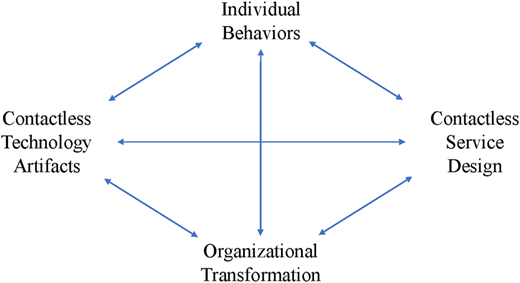
Particularly, this special issue focuses on the following four points. The first point is the emerging issues in individual behaviors in the new contactless environment at the individual level. The second point is the features and changing roles of contactless technology artifacts at the technology level. The third point is the creation of new contactless service design features and the development of contactless design policies at the service level. The last point is the digitally enabled organizational innovations and the emerging digital resources/capabilities for contactless organizational transformation at the organization level.
First, understanding users’ or customers’ behavior is one of the most critical research streams in the information systems (IS) field (Wixom and Todd, 2005; Wu and Lu, 2013). Although previous behavioral studies have already covered various aspects of user behavior in the IS field such as technology acceptance/adoption, user motivation, user interaction and experience, human–computer interaction, information privacy and computer security, the topics and questions in this stream are still evolving. The contactless technologies used by individuals and organizations during pandemics and other disasters such as the Internet of Things (IoT), service robots, artificial intelligence (AI) and virtual reality (VR)/augmented reality (AR), have formed new user behaviors and brought new theoretical concepts to the research field (Lee et al., 2022).
Second, in the rapid change to a new environment, i.e. New Normal, the roles of digital technology are becoming more critical. In traditional settings, services were created and delivered mainly via face-to-face contacts. In the new environment, however, these processes have to be done mainly through remote or contactless technology artifacts such as self-service systems, remote working systems, distance education systems, service robots and internet streaming platforms (Burleson et al., 2023; Kim et al., 2023b; Waizenegger et al., 2020). In this situation, the scope and depth of contactless technology artifacts’ functions and features should be varied and evolved according to the emerging needs or users in New Normal (Brem et al., 2020; Froehle and Roth, 2004).
Third, as every individual and organizational environment has become complicated due to the societal transformation caused by the COVID-19 pandemic, human requirements are getting more difficult to be grasped, and thus “design” becomes a critical subject in this transformation, i.e. to New Normal. Verganti (2009) argues that design is a vehicle to create new meanings by understanding complex and latent human behaviors and synthesizing new design features beyond technology-driven innovation. With this notion, IS and innovation studies have also considered a variety of design features of digital innovation in transforming traditional work styles, organizational behaviors and interaction protocols with new services (Nambisan et al., 2017; Nylén and Holmström, 2019; Yoo et al., 2010). Nevertheless, “contactless service design” has been developed mostly by a technology-driven approach, releasing a research dilemma – how/what contactless service design features could represent the contextual inquiry of human behaviors (desires, needs and requirements) and transform organizational issues and challenges over time?
Lastly, as the business environments have changed dramatically during the COVID-19 pandemic with emerging market demands and changing compliance requirements, organizations are facing significant challenges in adapting to the huge uncertainties (e.g. Carroll and Conboy, 2020; Gursoy and Chi, 2020). While many organizations have failed to adjust to such hyper-uncertain environments, some organizations have successfully adapted to the new environments through organizational innovations of their operations and product/service development or through organizational transformations of their business, particularly using contactless digital technologies (Koo et al., 2022). Hence, another set of research topics will be the role of digital technologies in transforming organizations or businesses to be responsive to the contactless society and its new requirements.
Table 1 summarizes important research topics of each of the four components of contactless digital transformation.
Potential research topics of contactless socio-technical transformation
| Components | Potential topics/questions |
|---|---|
| Contactless technology artifacts |
|
| Individual behaviors |
|
| Contactless service design |
|
| Organizational transformation |
|
Special issue process and final articles
Given the four topic areas on the contactless socio-technical transformation, this special issue received 83 submissions, dealing with diverse theoretical and methodological perspectives. After a rigorous multiround peer-review process, seven full-length papers were chosen for their publication, considering their contributions to the research needs raised by this special issue.
The first article, “The role of privacy and emotion in ARBS continuing use intention”, is by Ya Yin and Carol Hsu. This article highlights augmented reality–based services (ARBS) as a contactless commerce mechanism. It views that “privacy” is the most critical concern for users to determine whether to use the ARBS continuously or not. Based on this, the authors examined how augmentation quality, discrete emotions (joy and frustration) and privacy perceptions could influence users’ ARBS continuing use intention. This article provides a positive direction for system designers and commerce organizations regarding what features should be configured to make people continue to use ARBS (Yin and Hsu, 2023).
The second article, “Using augmented reality for shopping: a framework for AR induced consumer behavior, literature review and future agenda”, is by Marc Riar, Nannan Xi, Jakob J. Korbel, Ruediger Zarnekow and Juho Hamari. This article emphasizes AR shopping as a contactless socio-technology context. By using a systematic review, this article suggests a framework incorporating dynamics in AR-related shopping and customer’s technology adoption factors. Based on this, the authors discussed 13 future research agendas for the community of research and practice (Riar et al., 2023).
The third article, “Does gender really matter? Exploring determinants behind consumers’ intention to use contactless fitness services during the COVID-19 pandemic: a focus on health and fitness apps”, is by Yonghan Zhu, Rui Wang, Rongcan Zeng and Chengyan Pu. This article develops a theoretical framework on consumption values and perceived risks to investigate the determinant factors behind consumers’ intention to use health and fitness apps during the COVID-19 lockdown. This article contributes to research on the acceptance and use of health and fitness apps as contactless tools. It also provides diverse messages for fitness providers and app developers, focusing on what features/functions can encourage consumers to reach their physical goals (Zhu et al., 2023).
The fourth article, “Investigating the net benefits of contactless technologies in quick-service restaurants: the moderating roles of social interaction anxiety and language proficiency”, is by Kyung Young Lee, Sumin Han, Soo Il Shin and Sung-Byung Yang. This article seeks to configure which food ordering IT artifact/service is more effective in the context of quick-service restaurants during the pandemic situation. The authors tested the relationships among actual use, use continuance intention, satisfaction and net benefits between self-service kiosks and mobile applications for food ordering. As the first empirical study on these variable configurations, it represents a feasible direction for hospitality and service industries to make successful digital transformation using contactless technologies (Lee et al., 2023).
The fifth article, “Insights into customers’ psychological mechanism in facial recognition payment in offline contactless services: integrating Belief–Attitude–Intention and TOE–I frameworks”, is by Wen-Lung Shiau, Chang Liu, Mengru Zhou and Ye Yuan. In this article, the authors investigate the psychological decision-making mechanism of customers in the use of facial recognition payment by integrating the belief–attitude–intention (B–A–I) model and the extended technology–organization–environment–individual (TOE–I) framework. This article contributes to research on contactless technology services from a multidimensional perspective for co-acting and co-evolving. It also suggests guidance for suppliers/developers of payment systems and merchants to increase convenience, reduce privacy risks and optimize the system design (Shiau et al., 2023).
The sixth article, “Anticipating the antecedents of feedback-seeking behavior in digital environments: a socio-technical system perspective”, is by Xi Zhang, Xuyan Wang, Fangqing Tian, Dongming Xu and Longwei Fan. This article examines the impact of the digital feedback environment and individual learning goal orientation on their feedback-seeking behaviors (i.e. feedback inquiry and monitoring) based on socio-technical system theory. This article contributes to research on feedback-seeking behaviors in digital collaboration/environments supported by contactless digital technologies and provides practical implications for enhancing work efficiency (Zhang et al., 2023).
The last article, “How can we achieve better e-Learning success in the new normal?”, is by Sodam Kim, Jumin Lee, Sang-Hyeak Yoon and Hee-Woong Kim. In this article, the authors develop an e-Learning success model through a mixed-methods approach, including exploratory, confirmatory and complementary studies. This article contributes to research on contactless digital technology in education services by providing a comprehensive framework for achieving e-Learning success in the new normal. It also suggests a variety of practical guidance for e-Learning service providers to enhance system quality, for instructors to achieve e-Learning success and for students to improve themselves through e-Learning systems (Kim et al., 2023a).
Special issue articles for the four components
Contactless technology artifacts: All articles in this special issue cover diverse types of contactless technology artifacts such as AR-based service applications (Yin and Hsu, 2023), AR for shopping (Riar et al., 2023), healthcare and fitness apps (Zhu et al., 2023), self-service kiosks and food-ordering mobile apps (Lee et al., 2023), facial recognition payment (Shiau et al., 2023), digital tools (e.g. DingTalk and WeChat) (Zhang et al., 2023) and e-Learning systems (Kim et al., 2023a). Particularly, five articles investigated the interactions between users and contactless technology artifacts and showed that contactless technology artifacts positively affect the acceptance and (continuous) intention to use, although their research contexts are different (Kim et al., 2023a; Lee et al., 2023; Shiau et al., 2023; Yin and Hsu, 2023; Zhu et al., 2023). On the other hand, two articles investigated the role of contactless technology artifacts and their impacts on the new society (Lee et al., 2023; Riar et al., 2023).
Overall, the articles in this special issue deal with contactless technology artifacts in various contexts. However, they mainly focus on some technologies or types of artifacts, such as AR or mobile apps, and the user’s experience at the individual level. In future research, it is necessary to expand the concept and scope of contactless technology artifacts to understand them more comprehensively. In addition, research considering various levels can contribute to expanding current knowledge about contactless technology artifacts. Particularly, first, the development of new concepts and theories for contactless technology artifacts is required. Although the special issue articles cover diverse contactless technology artifacts, their conceptualizations of the artifacts in terms of their core functions and features are deemed still insufficient. Therefore, developing more precise conceptualizations of contactless technology artifacts and their relevant theories is necessary in future research. Second, the extended scope and depth of contactless technology artifacts will be essential. It is also necessary to investigate the diversity of types and levels of users and environments requiring contactless technology artifacts. For example, various case analyses will be useful, especially using more diversified theoretical and methodological approaches like a configurational approach using the major factors derived from the cases.
Individual behaviors: Individual users’ adoption and usage behaviors are still an important research area in the IS and other academic disciplines. This special issue aims to cover this adoption and user behavior issues as a core part of understanding contactless digital technology development and its diffusion in society and the market, and most articles in this special issue successfully cover various aspects of user behaviors in the context of contactless technology.
Overall, the articles in the special issue suggest new concepts and comprehensive theoretical frameworks of existing theories for user behaviors. Particularly, Yin and Hsu (2023) suggest users’ extended appraisal tendency involving privacy risks and benefits in the context of AR-based services. Riar et al. (2023) suggest that AR technology can be deeply attached to users’ psychological and behavioral outcomes using AR shopping tools. The authors emphasize that the AR technology’s technical ability, such as interactivity, vividness and informativeness, can enhance utilitarian and hedonic motivations and experience in the shopping context. Zhu et al. (2023) suggest the importance of consumption values and the gender effect when using health- and fitness-related apps. The authors tried to extend the theory of consumption values and the theory of perceived risk to explain the specific user behavior of emerging health and fitness apps during the pandemic times. Lee et al. (2023) suggest an IS success model, which can explain the different user behaviors in using distinctive contactless technologies. Shiau et al. (2023) propose an extended model to explain user behavior regarding the facial recognition payment systems in China. Kim et al. (2023a) also articulate the importance of online interaction during the e-Learning process.
Contactless service design: The articles in this special issue also address some important questions in service design. By inviting Heskett’s definition of service design (Heskett, 1986), the addressed questions by the articles can be summarized in two ways. One is “what service design” could mediate customers and organizational strategic intent, and the other is “how service design” could configure customers’ requirements and organizational strategic goals. With the aspect of “what service design,” AR technology in shopping environment (Riar et al., 2023), health and fitness apps (Zhu et al., 2023), quick-service restaurants with self-service kiosks and mobile applications (Lee et al., 2023) and facial recognition payment (Shiau et al., 2023) account for what contactless service design artifacts could offer alternative services and afford desirable customer’s experiences. With the aspect of “how service design,” on the other hand, the role of privacy in AR-based services (Yin and Hsu, 2023), e-Learning success in New Normal (Zhang et al., 2023) and feedback-seeking behavior in a digital environment (Kim et al., 2023a) configure how contactless service design can be continued, used or successfully mediated with customers, testing their human behaviors.
Nevertheless, the current special issue articles still reveal some limitations concerning human-centered design opportunities. Most studies tested the relationships between contactless technology artifacts and users’ adoption and behaviors. Therefore, it needs more contextual studies to explore customers’ complex requirements (e.g. latent/systemic problems, needs and desires) in determining successful contactless service design features. Also, it requires configuration studies of how organizational strategic intent could lead to better contactless service outcomes, whether it is tangible service design or organizational service processes.
Organizational transformation: Although most of the special issue studies were conducted at the individual level, they provided some relevant implications at the organizational and industry levels, especially regarding digital innovation or transformation for contactless service provision and contactless process transformation. Particularly, Yin and Hsu (2023) and Riar et al. (2023) studied the behavioral factors for a contactless shopping service enabled by AR technology. The two articles emphasize the emerging demand for such digitally enabled service transformations to contactless, especially during the COVID-19 pandemic. Their findings will be useful for the organizations that need to implement similar transformations for new forms of market competition. Similarly, Zhu et al. (2023) also discuss the need for service-level transformations toward contactless environments and what should be considered in service development and provision, especially the gender difference in the relationship between risk perceptions and the health and fitness app use intention. In addition, both Zhang et al. (2023) and Kim et al. (2023a) investigate the emerging phenomena in the context of remote education, which has been significantly demanded during the COVID-19 pandemic in various settings. When considering the continuous demand of such remote educational environments even after the COVID-19 pandemic, their research findings are believed to be important and useful to both academics and practices.
The special issue articles generally highlight the need for organizational transformations toward contactless business environments. Although the current articles do not cover all of the important topics like contactless operations and business transformations and their governance for control and support through organizational digital infrastructure, they provide important insights into academics and practices regarding digitally enabled organizational transformations for contactless businesses.
Future agenda: a co-evolution perspective
Through this special issue, we called for research on the four components of contactless socio-technical transformation, i.e. contactless individual behaviors, technology artifacts, service design and organizational transformation, which are believed to be interdependent or influence each other since they are likely to co-evolve through the COVID-19 pandemic that has affected all aspects of human and organizational activities. However, the articles of this special issue may not explicitly present the possibility of interdependent relationships among the components due to the specific research settings, e.g. the unit of analysis, the research scope, the theory bases adopted and the research methods used. To overcome this shortcoming in our current articles, we suggest a comprehensive theoretical perspective, i.e. a co-evolution perspective, which calls for continuous research works in the research stream of the contactless socio-technical transformations.
According to the co-evolution perspective, societal evolution happens through the co-influences among the different levels of evolution (Johnson et al., 2016; Lewin and Volberda, 1999; Volberda and Lewin, 2003). Following Huygens et al. (2001) and Rodrigues and Child (2003), we draw an integrated framework of contactless co-evolution processes, which include the contactless services (for the contactless technology–human interactions) at the Micro level, the organizational transformations at the Meso level and the industrial transformations at the Macro level. Please refer to Figure 2.
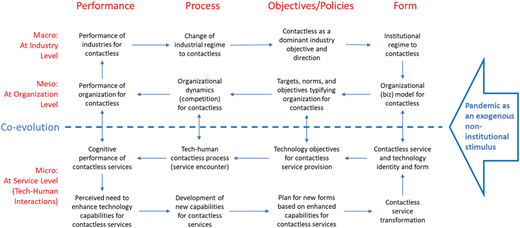
As illustrated in Figure 2, the transformations at the various levels (i.e. Micro, Meso and Macro) happen simultaneously by following specific sequences and also through interactions. When the COVID-19 pandemic happened, all levels of our society were disruptively affected by this exogenous noninstitutional stimulus. While most organizations, services and individuals became chaotic, some alternative solutions emerged and started to be accepted as new practices, e.g. remote classes using Zoom sessions. Such emergent contactless solutions affected organizational business models, and the adjusted or modified business models further changed the objectives and policies of organizations toward more contactless practices and service provisions. These organization-level chances again influence the objectives of services and their embedded technologies. These changes continued to transform other areas of each level (i.e. Meso and Micro) while influencing each other. Subsequently, the organization-level transformations drove industry-level transformations, while the service-level transformations led to individual-level transformations in technology–human interactions (e.g. the adoption of contactless technology artifacts like service robots). These evolutions are still ongoing, and they are what we have observed during the COVID-19 pandemic.
The co-evolution perspective suggests three directions for future research. Firstly, the evolution at each level should be further investigated. As presented in Figure 1, our special issue particularly calls for further studies on the four components of contactless socio-technical transformation for the research agenda in Table 1. Secondly, the co-evolution perspective illustrated in Figure 2 suggests investigating the specific interaction processes and conditions between the Meso and Micro levels. This is about the links between the four components in Figure 1. Lastly, the co-evolution perspective and our framework for the contactless socio-technical transformation suggest a comprehensive view to investigate these evolutions occurring at multiple levels simultaneously from various perspectives and approaches. For example, the systems perspective with a configurational approach can apply the holistic systems view to find the interdependent relationships among multiple factors that comprise a system. On the other hand, the process perspective considering time ordering can detect the entities or events changing over time with their sequences (Burton-Jones et al., 2015).
This work was supported by the National Natural Science Foundation of China (Grant No: 72110107003).

