The study aims to provide a comprehensive understanding of the existing literature on women’s leadership in academia by identifying the existing challenges for their underrepresentation, and proposing a new-age leadership interventions to address the inherent systemic biases and develop foster an equitable academic climate.
The study employed bibliometric analysis to map the literature by investigating publication and geographical trends. Techniques like citation, co-citation, bibliographic coupling and co-word analysis identified seminal research and emerging themes, providing insights into research developments and facilitating identification of avenues for future research.
Our study highlights how social, organizational and individual barriers disadvantage women academic leaders. Existing enablers for women in leadership, like mentorship, leadership development and family friendly policies, focus on bringing change within the prevailing academic culture, reinforcing the notion “women need support”, overlooking the influence of systemic barriers. Such interventions are often ineffective in bringing sustainable change. We propose integrating AI/machine learning (ML) technologies in leadership selection to reduce bias arising from subjectivity.
This study contributes to the discourse on gender inequality in academic leadership by offering a robust understanding of the research topic and informing avenues for future research.
Policymakers and higher education institutions can use the findings of the study to aid the formulation of policies, initiatives and institutional procedures to mitigate the prevalent gender bias in academia and cultivate an inclusive culture for growth of women.
The paper analyses women’s under-representation as academic leaders and proposes a novel data-driven intervention using gamification, AI and ML, aiming to reshape gender dynamics in academic leadership.
Introduction
Women have made significant advancements in academia globally, particularly by surpassing men in earning educational degrees and occupying academic positions (Khan, Sulaiman, Nazir, Khan, & Awan, 2024; Llorens et al., 2021), yet, their representation in academic leadership roles remains disproportionately low (van Helden, den Dulk, Steijn, & Vernooij, 2023; Le Fevre, Meng, & Foreman-Brown, 2024). This under-representation of women as academic leaders raises questions about the fairness of academic processes, which claim to champion equity, access and inclusion for all. Several reasons have emerged in literature to explain the persistent gender gap in academic leadership. Earlier leadership theories like Great Man Theory and Trait theory attributed gender gap to the perceived gender roles and perceptions citing that women lacked intrinsic traits for successful leadership (Tremmel & Wahl, 2023). However, later researchers debunked this view by showing no empirical evidence of a difference in leadership effectiveness of men and women (Jonsen, Maznevski, & Schneider, 2010; Maheshwari, 2021; Farhan, 2022).
Subsequently, it was assumed that with an increase in number of women in academic workforce, the issue of underrepresentation would be solved as increased women in lower academic positions will naturally lead to more women in leadership race, known as the “pipeline myth” (Neville, 2022). However, this assumption proved inefficient, as women leaders continued to be disproportionately low, emphasizing that the journey to leadership positions for women is challenging, described as a “labyrinth” (Eagly & Carli, 2007); where the path is not linear and women encounter multiple obstacles along the way. Thus, these findings gradually shifted the research focus from blaming women for lacking leadership abilities to investigating structural and organizational barriers in academia (Burkinshaw & White, 2017; Sadaf, Bano, & Rahat, 2024).
Alongside these factors, the introduction of neoliberal policies in higher education institutions (HEIs) further exacerbated gender disparities, creating a volatile, unstable, complex and ambiguous (VUCA) environment. These policies prioritize competitiveness, performance and productivity to stay competitive and relevant in the global market (Fauzi, Tan, Muhamad Tamyez, Abd Aziz, & Wider, 2024), manifesting as quantifiable metrics in academia like publication productivity and securing research grants, disproportionately burdening women, who are constantly navigating through multiple personal and professional responsibilities (Guarino & Borden, 2017). This culture typically favours traditional leadership styles, aligned with male traits, promoting toughness, individualism and competition, while alienating women and reinforcing existing biases (Fitzgerald, 2018; Leathwood & Read, 2013). The prevailing competitive culture often equates the image of an ideal academic leader with a stereotypical male – someone who spends long hours in the office, lacks emotional attachment outside work and embodies strong, strategic, visionary and goal-directed qualities (Beerkens & Hoek, 2022). Such an environment creates potential barriers for women seeking leadership positions (e.g. directors, deans and vice-chancellor positions), as the agentic traits like assertiveness, controlling and independent, deemed necessary for success in this dynamic HEI environment contrast sharply with the communal traits like nurturing, empathy and caregiving typically associated with women. In the light of these factors, the study to aims to create a deeper understanding of the multifaceted factors that hinder the progress of women leaders in academia, by conducting a thorough analysis of the existing literature.
Through bibliometric analysis, we will map the research landscape, examine thematic developments and understand the intellectual structure of the field. By synthesizing these findings, we will identify gaps in the current research and propose targeted future directions. The next section presents methodology, followed by results and discussion, our proposal for intervention and concludes with implications.
Methodology
Bibliometric analysis
It is a quantitative method to map and identify patterns within a particular research field by tracing the past and present developments and forecasting future trends (van Eck & Waltman, 2010). Utilising statistical methods, it reveals key themes, research developments, publication trends, influential authors, highly cited articles, influential countries, citations per article and keywords, providing a comprehensive overview of the field (Bouckenooghe, Schwarz, Kanar, & Sanders, 2021; Ellegaard & Wallin, 2015; van Eck & Waltman, 2010). Bibliometric analysis is increasingly being used across disciplines due to its efficacy in guiding literature mapping by identifying pivotal studies and analysing research patterns (Singh, Sharma, Bali, Sharma, & Shah, 2023).
Our study employed this approach to uncover novel insights in women’s leadership in academia, which might be overlooked in traditional reviews. The analysis helped in identifying the knowledge gaps, facilitating the identification of areas requiring nuanced focus, and ultimately informing our research proposition. For this study, we have used a combination of various bibliometric techniques to gain a deeper understanding of the research field, as discussed in subsequent sub-sections (Chang, Huang, & Lin, 2015).
Citation analysis
Citation analysis is used to identify the most influential articles in the research area (Donthu, Kumar, Mukherjee, Pandey, & Lim, 2021). The impact of the article is directly proportional to the number of citations it has received. This technique helps in identifying key papers, journals and authors who have played a crucial role in shaping the research field.
Co-citation analysis
Co-citation analysis is a bibliometric technique to map the intellectual structure of a field by examining how frequently papers are cited together (Donthu et al., 2021). This approach helps in identifying seminal literature and clusters of related studies, revealing underlying themes in the area (Trujillo & Long, 2018). In a co-citation network, two publications are connected if they co-occur in the reference list of a third publication, thus effectively tracking the evolution of ideas and highlighting underexplored areas, creating a robust base for subsequent research through insights gathered from the analysis (Zhao et al., 2024).
Bibliographic coupling
Bibliographic coupling is a bibliometric technique whereby it is assumed that two papers sharing common references will have intellectual similarity in their content (Donthu et al., 2021). This technique is used to divide papers into thematic clusters based on shared references. Unlike co-citation analysis, this technique helps to trace the present developments of themes in a research field and helps in identifying potential research topics (Phan Tan, 2022).
Co-word analysis
Co-word analysis is another bibliometric technique that explores patterns and interrelationships among keywords by examining their co-occurrence in publications (Zhao et al., 2024). Unlike co-citation analysis, which maps the intellectual structure of the research field through cited papers, co-word analysis visualizes the semantic landscape of the research through word associations (Narong & Hallinger, 2023). The visualization of keyword relationships helps in gaining deeper insights into the current research trajectory, enabling detection of related concepts, emerging research trends and identify areas of convergence and divergence in research focus over time, leading to targeted research directions (Radhakrishnan, Erbis, Isaacs, & Kamarthi, 2017).
Data collection and screening
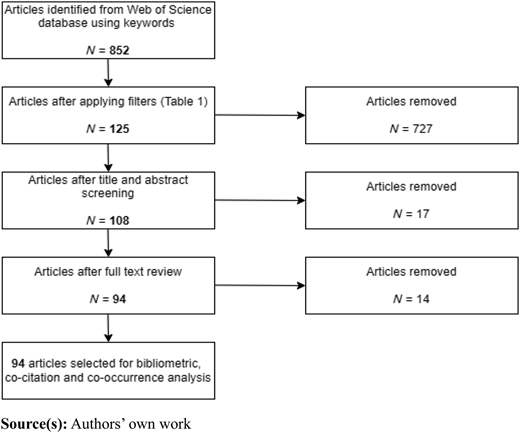
We selected Web of Science (WoS) for data collection, a widely recognized and globally acclaimed database owing to its extensive coverage across social sciences, arts and humanities (Baumgartner, 2010). WoS stands out for its excellence in quality and thoroughness, essential for bibliometric research (Zhao et al., 2024). The search was conducted in September 2024 to capture the recent studies in the area. For this study, we employed a comprehensive search strategy with carefully chosen keywords and Boolean operators (Table 1) to maximize relevant results, which resulted in 852 results, starting from 1995. In the next step, we included only peer-reviewed journal articles to ensure academic credibility and rigour (Araneda-Guirriman, Sepúlveda-Páez, Pedraja-Rejas, & San Martín, 2023), purposefully excluding other types of documents to maintain coherence in the dataset (Zhao et al., 2024). Moreover, the search was confined to English-language articles to ensure consistency in analysis, which resulted in 125 articles (from the year 2008), narrowed to 94 articles through a rigorous two-stage screening – title and abstract screening, followed by full text review of remaining articles (Figure 1).
Tools
We used VOSviewer (van Eck & Waltman, 2010) for exploring, visualizing and mapping data (Gaviria-Marin, Merigo, & Popa, 2018). The software facilitated a quantitative review through bibliographic coupling of sources, organizations and countries and mapped document co-citation and keyword co-occurrence. This approach helped in understanding the depth and breadth of existing literature by providing insights into the structure, evolution, conceptualisation and developments in the area and highlighting future research scope (McBurney & Novak, 2002).
The next section presents the results and discussion arranged in the order of publication trends, geographical trends, citation, co-citation, bibliographic coupling and co-word analysis.
Results and discussion
Publication trends
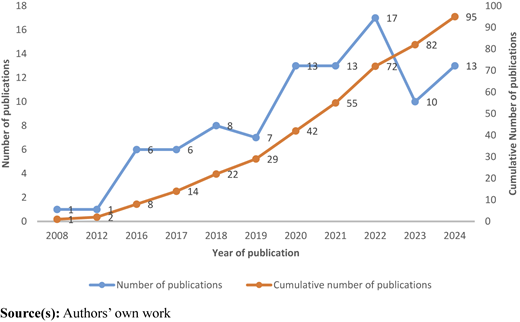
The yearly and cumulative distribution of articles on this topic displayed in Figure 2, indicates a notable surge in the discourse on gender bias in academic leadership roles. This could be due to a confluence of various factors, such as social movements like #EverydaySexism, #WomenShould, #HeForShe, #MeToo and #GenerationEquality, which have raised awareness, started discussions and attracted visibility around gender bias, influencing public and academic interest globally on gender inequality in leadership. Furthermore, the recognition of diversity and inclusion as a critical factor for societal advancement and innovation has propelled research in the area (Prince & Francis, 2023). The United Nations’ Sustainable Development Goal 5 on achieving gender equality and women empowerment by 2030 has been significant in guiding research to contribute meaningfully to inform policy and bring educational reforms. Together, these factors have resulted in an upward trend in research, with outcomes aiming to bring future educational reforms and drive organizational changes.
Geographical trends
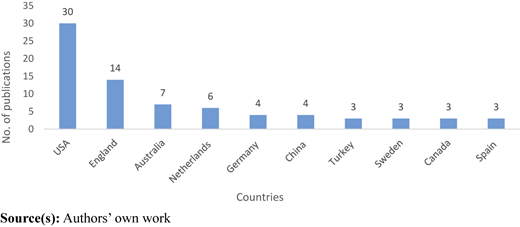
Figure 3 demonstrates the geographical distribution of publications, with the United States leading with thirty publications, followed by England (fourteen) and Australia (seven), demonstrating an increased recognition of gender disparities in academic structures and leading to increased scholarly attention in these regions. Such contributions have played a key role in the implementation of affirmative actions and gender-responsive policies, like ADVANCE (2001) and SEA initiative (2017) in the USA, Athena SWAN charter (2005) in England and SAGE-Athena SWAN (2016) in Australia, to promote institutional reforms for an equitable workplace. Researchers from Asian countries, where research output is comparatively lower, can engage in learning the benchmark practices from North American and European countries, who have already highlighted and are addressing the issue; thus, the topic gets increased global attention.
Citation analysis
This analysis helped in uncovering the most influential papers in the research area (Table 2). El-Alayli, Hansen-Brown, and Ceynar (2018) highlight the differential gender expectations of students’ for faculties. While male faculty are accepted as dominant and assertive, women faculty are expected to be caring and nurturing. Deviation from the preconceived expectations of women results in aggression and unfair attitudes from students, which lead to emotional burden, stress and burnout for females. Role incongruity theory (Eagly & Karau, 2002) explains this, as women face negative reactions when their behaviour deviates from gender stereotypes. The mismatch causes a negative perception about women’s abilities, potential and performance (Hogue, 2016; Wagner, Rieger, & Voorvelt, 2016).
Systemic barriers, like social stereotypes, informal interactions amongst peers, everyday sexism and patriarchal organizational culture also obstruct the advancement of women (Olmedo-Torre et al., 2018; Seron, Silbey, Cech, & Rubineau, 2016). Such barriers may undermine women’s confidence, especially in visibly male-dominated fields like engineering and science, technology, engineering and mathematics (STEM), propelling them to seek other professional opportunities, leading to loss of talent (Chaffee, Lou, Noels, & Katz, 2020; Van Veelen & Derks, 2022). Further barriers include masculine academic environment, sexist interactions, biased promotion opportunities, unconscious bias and stereotype threat (Erthal et al., 2021; Subbaye & Vithal, 2017; Treviño et al., 2017, 2018). Lutter and Schröder (2020) delve into the impact of parenthood on the academic journey and highlight that while having children may result in a decline publication productivity of women, highly motivated women continue to persist even after life-altering personal changes, suggesting women are better able to manage multiple tasks, thereby making them good choices for leadership. Diehl and Dzubinski (2016) categorised these barriers into three levels, namely social (macro), organizational (meso) and individual (micro), identifying 27 gender-based leadership barriers across sectors. Diehl, Stephenson, Dzubinski, and Wang (2020) further developed the “Gender Bias Scale” to quantify the perception and experience of gender bias by women.
Interventions to mitigate the influence of these barriers include the role of academic leaders, like department deans and chairs, in bringing a positive change in department climates and cultures by recognising the problem and showing commitment towards inclusion (Bystydzienski, Thomas, Howe, & Desai, 2017). Similarly, giving women the agency to document their perspectives and opinions can bring sustainable changes (Savigny, 2017). However, Tzanakou and Pearce (2019) and Powell, Ah-King, and Hussénius (2018) put forward critical perspectives on gender equality initiatives in universities. They argue that, despite noble intentions, gender-equality policies are poorly designed. While they create an illusion of feminism and equality, they fail to challenge established gender norms. Academia is a highly gendered space, espousing neoliberal values where performance and productivity are measured via metrics. Quantifiable measures foster an inhospitable environment for women who are precariously balancing personal and professional commitments. This finding is also echoed by Brabazon and Schulz (2020) and Davies, Yarrow, and Syed (2020), who highlight how the neoliberal nature of academia is a barrier for women wishing for advancement.
Co-citation analysis
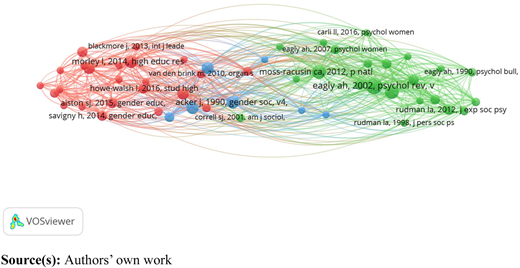
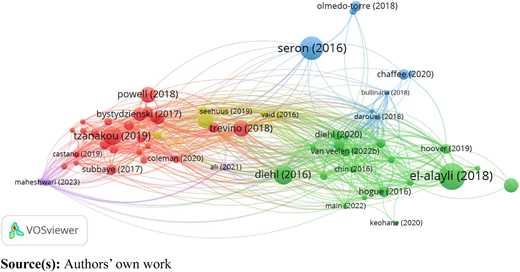
This analysis identified seminal publications, helping trace the knowledge structure and foundational research base. For this, we established a threshold of five citations, yielding 52 documents from 5,712 cited references. Figure 4 represents the visual co-citation analysis, highlighting three distinct clusters representing groups of studies that are frequently cited together. Table 3 shows the top 15 co-cited documents.
Cluster 1: Deconstructing the gendered nature of academia
Organizations, including academia, are traditionally built around masculine norms (Acker, 1970, 2010). Although educational institutions claim to be meritocratic, they mirror socio-cultural norms, resulting in biased evaluation for men and women (Özkanlı & White, 2009). The image of an ideal academician, shaped by societal perceptions of male competence (Benschop & Brouns, 2003) positions women as outsiders who must work harder to prove themselves (Correll, 2001). Furthermore, women are disproportionately burdened with “academic housekeeping”: teaching, committee work and departmental service, limiting time and opportunities to build intellectual and social capital necessary for leadership roles (Guarino & Borden, 2017), resulting in the under-representation, often wrongly attributed to their lack of aspiration and capability (Sadaf et al., 2024). Such bias creates an unreceptive atmosphere for the growth of women’s talent.
Based on this misconception, existing solutions aim to “fix” women, blatantly ignoring systemic disparities in academia, to conform to the “ideal” (a.k.a. masculine) level of competency (Acker, 2012a, b). However, these solutions are not effective, as they fail to acknowledge different strengths and personalities of men and women (Eagly & Johnson, 1990). Thus, to address this, we need to integrate intersectional approaches that recognize the unique challenges faced by women, especially women of colour (Corneille, Lee, Allen, Cannady, & Guess, 2019).
Despite some progress at closing the gender gap, disparities continue to persist because of the gap between policy and practice (Ahmed, 2012). For interventions to be successful, the focus should shift from viewing women as the “problem” to investigating systemic bias in academia contributing to this gap (Burkinshaw & White, 2017; Fotaki, 2013). Interestingly, sometimes women are given leadership positions, creating an illusion of fairness. However, such positions are usually precarious, known as “glass cliff”, with women set up for failure, making it easier to blame them and reinforcing the existing narrative of women being unfit leaders (Morgenroth, Kirby, Ryan, & Sudkämper, 2020; Ryan & Haslam, 2005). Furthermore, the introduction of neoliberal practices in higher education (HE) with their objective evaluation criteria poses hurdles for women (Teelken & Deem, 2013), as it fails to take into account the multifaceted roles of women (Probert, 2005), by solely focusing on the unidirectional goal of staying competitive. Therefore, to counter these challenges and create meaningful and sustainable change, women must be empowered to advocate for themselves and shape policies that influence their career decisions (Savigny, 2014).
Cluster 2: Hidden bias: the societal roots of gender inequality
The persistent under-representation of women in leadership roles is a consequence of the deeply ingrained socio-cultural norms, historically favouring men in positions of power and privilege (Eagly & Karau, 2002; Rudman, Moss-Racusin, Glick, & Phelan, 2012; Rudman, Moss-Racusin, Phelan, & Nauts, 2012). Social role theory (Eagly, 1987) states that women are traditionally positioned in domestic chores like housekeeping, kitchen duties and managing kids and the elderly, thereby likening them to communal traits like empathy, caregiving and nurturing. Men, on the other hand, are positioned as breadwinners that requires agentic traits like competitiveness, aggressiveness, confidence and power (Heilman, 2001). This has led to a widespread perception that men are better suited for power (Eagly, 2007), reinforcing “think manager, think male” phenomenon (Schein, 1973). Subsequently, women who try to imbibe traditional leadership traits experience scrutiny, backlash and judgement (Heilman, 2012; Koenig, Eagly, Mitchell, & Ristikari, 2011), due to a perceived mismatch between leadership roles and feminine roles, leading to feeling under-competent, devalued and demotivated (Rudman & Glick, 2001; Rudman, Moss-Racusin, Glick, et al., 2012; Rudman, Moss-Racusin, Phelan, et al., 2012).
In academia, opportunities and responsibilities are often allocated by dominant groups, majorly comprised of men, who with their cognitive association with stereotypes, take biased decisions (Heilman, 2001; Moss-Racusin, Dovidio, Brescoll, Graham, & Handelsman, 2012). In addition, a strong influence of social conditioning also creates hurdles for implementation of gender equality policies and initiatives. Along with the explicit manifestation of the bias towards women, Lyness and Heilman (2006) highlighted its unconscious nature displayed through harsher judgement parameters like numerical evidence such as grades, suggesting the bias may be unintentional at times. Glick et al. (2000) also highlighted the difference between hostile sexism and benevolent sexism, reflecting that men do not always consciously discriminate against women. The societal perception of women as soft and someone who needs protection, leads to men assuming the role of protector and inadvertently causing bias, suggesting the role of social conditioning in perceiving women. Although recent researchers identified a significant shift in the way women were seen, with recognition of their unique strengths and competencies (Eagly, Nater, Miller, Kaufmann, & Sczesny, 2020), the continual under-representation suggests that addressing this issue needs a paradigm shift from viewing women as the problem towards devoting dedicated efforts to dismantling the societal perceptions and systemic factors causing the disparity.
Cluster 3: The meritocracy myth of academia
The concept of academic meritocracy, suggesting that individuals are evaluated solely based on abilities and achievements, has been challenged in recent years (Powell & Arora-Jonsson, 2022). The facade of neutrality in academic processes through objective factors like publication productivity, time spent in the office, the number of research projects secured, and collaboration between institutions, often masks underlying structural barriers that impede the women’s advancement as leaders (Barnacle et al., 2024). Women have fewer opportunities to serve as journal editors or receive less citation for their work, which are key to increasing recognition in the academic community (Fonseca, 2023). Women in academia constantly have to prove their worth and merit despite similar qualifications as men counterparts, revealing double standards in perceived competence of women (Foschi, 2000; Ridgeway, 2001). Furthermore, women academicians are likely to be overburdened with academic service work, hindering their career progression (Guarino & Borden, 2017). These findings expose the limitations of the meritocracy narrative. The notion of gender-neutral academic meritocracy appears to be a myth that masks persistent inequalities in academia (Clarke, Hurst, & Tomlinson, 2024). To address these disparities, institutions must move beyond superficial measures and engage in deeper structural reforms that acknowledge and address the complex interplay of factors affecting women’s careers in academia.
Bibliographic coupling
Theme 1: Neoliberal academic structures and its consequences
The papers in this cluster discuss the impact of neoliberalisation on academic structures. Academic space is a male bastion, where women are struggling to achieve parity with men despite possessing similar qualifications as men (Davies et al., 2020; O’Connor, 2020; Subbaye & Vithal, 2017). Over the last few decades, the HE landscape has evolved considerably, with significant shifts in teaching pedagogy due to globalization, neoliberal policies, accreditation, international competitiveness, performance ranking parameters and technological innovations. This change has transformed how HE institutions operate and subsequently redefined the role of academic leaders (Brabazon & Schulz, 2020; Wijaya Mulya & Sakhiyya, 2021). The primary agenda in academia is centred around performance metrics, where quantitative measures like research publications, funds and collaborative projects are prioritized over teaching and knowledge-sharing. This change has significant implications for women academics who are constantly navigating between multiple professional and personal roles. While male academics tend to focus solely on research, female academics are burdened with teaching, mentoring, counselling and administrative duties that do not leave them any time to pursue leadership roles, thereby putting them at a disadvantage (Erthal et al., 2021; Lendák-Kabók, 2021). Even with policies aimed at achieving equality, the desired outcome has not been achieved, signalling the need for a deeper transformation in the way academia is perceived (Tzanakou & Pearce, 2019). In such cases, the role of leaders like department chairs and deans is essential to foster an inclusive environment (Bystydzienski et al., 2017). Moreover, women must continually share and document their experiences to achieve lasting change (Savigny, 2017). Thus, a shift in academic structures and cultural perceptions is warranted for gender inclusivity.
Theme 2: Glass cliff in academia
The communal traits socially ascribed to women, like nurturing, empathetic and collaborative, sharply contrast with the agentic traits like aggression and dominance, deemed essential for academic leadership. This mismatch results in women experiencing lower job satisfaction and commitment and reduced confidence (Rehbock, Knipfer, & Peus, 2021; Van Veelen & Derks, 2022). Moreover, academia is characterized by a masculine work culture where women continually experience barriers like discrimination, glass ceiling, gender bias and work–life conflict (Coleman, 2020). Diehl and Dzubinski (2016) categorised these barriers into three levels, namely social (macro), organizational (meso) and individual (micro), and developed a scale to quantify gender bias (Diehl et al., 2020). These systemic challenges are likely to result in attrition of women, leading to the continuance of the under-representation of women as academic leaders. Chin (2016) and Acar and Sümer (2018) further explore the barriers and highlight “glass cliff” in academia, where women are given leadership positions, which apparently appear aligned with gender equality initiatives, but are precarious positions with a high likelihood of failure. The blame for failure can be transferred to women, thus reinforcing stereotypes about leadership roles as incompatible with women’s capabilities. To combat these challenges, Settles (2020) and Coleman (2020) outline enabling mechanisms to overcome these challenges, like networking, finding support systems, knowledge-sharing sessions that can guide younger women, building strong connections, mentoring, self-determination and resilience.
Theme 3: Gender stereotypes in STEM
This cluster explores the impact of gender stereotypes on the career choices of men and women, especially in STEM fields. The choice of profession by men and women is heavily influenced by cultures and practices surrounding the professions (Seron et al., 2016). For instance, men try to avoid professions traditionally linked with women, like nursing and primary school teachers, as they perceive such choices as threats to their masculine ideals (Chaffee et al., 2020). Likewise, women often feel less confident about fitting into STEM, due to its predominantly male culture (Seron et al., 2016). Factors like unfriendly environments, heavy workloads, fewer role models, social stereotypes about the “image of an engineer” may lead to women may discourage them from pursuing STEM careers (González-Pérez, Martínez-Martínez, Rey-Paredes, & Cifre, 2022; Olmedo-Torre et al., 2018). Thus, gender stereotypes continue to shape career choices, which needs to be addressed on an urgent basis.
Theme 4: Gendered biases influencing academic advancement
Research has shown that academic advancement is often influenced by gendered biases. Women are expected to focus on teaching and mentoring activities, roles aligned with the stereotypical image of women as nurturers. While men are more likely to spend most of their time on research, crucial for advancement and progress in academia (Judson, Ross, & Glassmeyer, 2019). Even with comparable professional qualifications, men occupy esteemed positions like journal editors, editors-in-chief and members of professional societies and are recipients of prestigious awards (Vaid & Geraci, 2016), which also help in their advancement. Moreover, women’s reproductive age coincides with their professional advancement timeline, complicating their progress. As primary caregivers of children, women often prioritize domestic duties over professional duties, putting them in a significantly disadvantageous position in terms of advancement (Lutter & Schröder, 2020). Despite multiple gender quotas to aid the progress of women (Park, 2020), they continue to remain under-represented, highlighting the pervasive influence of gender-based leadership barriers (Seehuus, 2019).
Theme 5: Challenges faced by women academics in Asian higher education contexts
Women academics in Asian contexts, like Pakistan (Ali & Rasheed, 2021) and Vietnam (Maheshwari, 2023; Maheshwari, Nayak, & Ngyyen, 2021), face significant leadership challenges, stemming from the strong patriarchal social culture that influences organizational processes and decisions. Despite possessing requisite skills and expertise, women continue to face gender discrimination, harassment and intimidation at senior levels. While the under-representation of women as academic leaders is a global concern, there is a dearth of research focusing on Asian contexts, which leads to overlooking the influence of culture and context in perpetuating gender-based discrimination. This cluster signals the need to expand the research horizon to include diverse cultural contexts and experiences, which will help in developing a comprehensive outlook of the issue, and enable the creation of targeted strategies to address the challenges.
Co-word analysis
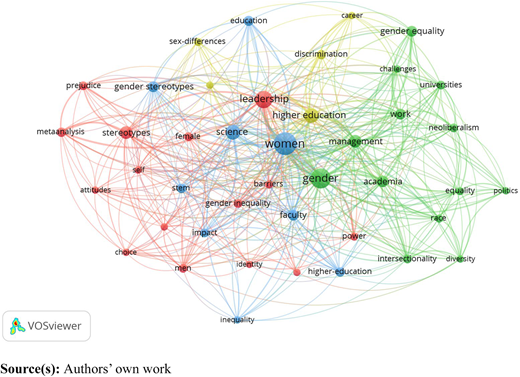
Cluster 1: Beyond neoliberalism: an intersectional approach to gender equity
Neoliberal policies have reshaped academia by shifting focus from collegiality to competition and productivity (Morley & Lund, 2021). While such policies aim to level the playing field through objective evaluation criteria for faculty and leaders, they have, in reality, exacerbated gender disparities (Brabazon & Schulz, 2020), by favouring agentic traits like competition and aggression, associated with males; pushing women out of the leadership pipeline due to perceived lack of fit due to their communal traits (Tzanakou & Pearce, 2019).
Furthermore, the neoliberal agenda of staying competitive influences research output and funding opportunities, key to staying relevant in academia. Access to these opportunities is linked to networking, collaboration and strong social capital, which is male-dominated due to their affiliation with conventional networking structures like the old boys’ network, further challenging women (Castelao-Huerta, 2022; Settles, 2020). Gender equality initiatives within neoliberal frameworks are often ineffective, as allocation of rewards and promotions remains tied to societal perception of ideal leader, limiting women’s progress (Crimmins, Marshall, & Read, 2024). In such complexity, intersectionality offers a critical lens to examine the oppression experienced by women in academia, from overlapping identities of race, colour and nationality (Śliwa, Gordon, Mason, & Beech, 2024). Intersectionality, a term coined by Crenshaw in 1989, discusses that women experience obstacles from overlapping identities based on race, class, colour, nationality, etc. along with organizational bias (Lendák-Kabók, 2021). Despite its relevance in academia, such an approach has not been used to investigate inequality in academic settings (Jouwe, 2015). Thus, using an intersectional approach will shed light on structural factors like power dynamics and male privilege within academia, reinforcing bias. The incorporation of context-sensitive factors in policy development and strategy formulation will result in an ideal institutional transformation model with minimized disparity in academic leadership (Bilimoria & Singer, 2019; Maheshwari, Gonzalez-Tamayo, & Olarewaju, 2023).
Cluster 2: Gendered academia: women’s journey to leadership
Though perceived as egalitarian and collegial, academia is inherently masculine, intensified by social prejudices, stereotypes and informal organizational structures favouring hegemonic masculinity (Rehbock et al., 2021; Purvee, Zanabazar, & Bat-Ulzii, 2024). Research shows that internalized gender schemas pose formidable barriers for women leaders, due to perceived mismatch between leadership traits and feminine roles, reinforcing bias against women (González-Pérez et al., 2022; Hogue, 2016). This phenomenon is also reflected in organizational decisions, influencing promotion and advancement (Chin, 2016). Women, who become leaders, are expected to embody servant leadership style, while men are encouraged to exhibit authoritarian behaviour, exposing the academic double standard. Additionally, men receive more praise for success and less blame for failure, while women face scrutiny and penalty (Chin, 2016).
Even policies aimed at increasing women’s representation inadvertently place the burden on women to imbibe masculine traits aligned with effective leadership for academic success (Van Miegroet, Glass, Callister, & Sullivan, 2019). This leads to loss of confidence and motivation in women, ultimately causing disengagement, and contributing to the “leaky pipeline” (Ayyildiz & Banoglu, 2024). Thus, academia should adopt approaches that leverage the unique traits of women and address systemic barriers to ensure inclusivity, rather than teaching women to conform to the traditional notions (Yousaf & Schmiede, 2017). Strategies should focus on individual-level interventions like enhancing self-efficacy, self-perception and confidence, while also focusing on organizational factors that lead to the creation of a supportive and enabling environment for the growth of women leaders (Silver et al., 2024).
Cluster 3: The impact of stereotypes on women’s STEM careers
Women experience greater discrimination in STEM fields, compared to social sciences, reflecting an underlying perception that women are not “natural” scientists (Moss-Racusin, Pietri, van der Toorn, & Ashburn-Nardo, 2021; Olmedo-Torre et al., 2018). STEM is traditionally associated with male traits like concentration, logical reasoning, mental toughness and dedication (Zawistowska, 2017), while women are likened to people-oriented fields like arts and humanities (Cheung & Halpern, 2010). These stereotypes lead to discouragement, increased anxiety and undermined self-belief in women (Smeding, 2012), creating a “chilly climate” for women where they experience exclusion, judgement and isolation (González-Pérez et al., 2022; Gupta, 2017). Consequently, fewer women sustain in STEM, leading to lack of women role models for younger women to look up-to (Kelly, McGarr, Lehane, & Erduran, 2019).
Additionally, women in STEM are likely to encounter barriers like lower citation rates (Larivière, Ni, Gingras, Cronin, & Sugimoto, 2013), less chances to be invited as conference speakers (Fonseca, 2023) and conflict with ideal scientist perception (Mendez & Watson, 2024), leading to lower chances of progress. A key strategy to address this discrimination is effective leadership (Cuthbert et al., 2023). However, research highlights that although majority of leaders acknowledge the bias, they fail to show strong and sustained commitment to handle the issue, undermining existing gender equality policies (Bystydzienski et al., 2017). STEM culture has historically blamed women for their underrepresentation, protecting the narrative of academic meritocracy by not recognizing the ingrained systemic disparities (Gupta, 2020). While the culture of STEM is stubborn and resistant towards change, the leader must play a crucial role not only in creating gender awareness but also actively working towards dismantling the barriers by using steps such as implementing formalized and transparent procedures (Van Miegroet et al., 2019) to ensure fair opportunity.
Cluster 4: Addressing discrimination in higher education: a call for change
Discrimination is a well-recognized evil in HE, creating a hostile environment for women by undermining their academic excellence and impacting their physical, emotional and mental health (Coleman, 2020; Kalaitzi, Czabanowska, Fowler-Davis, & Brand, 2017). Addressing this issue requires intentional and active involvement of leaders (Carvalho, White, & Machado-Taylor, 2013) and a shift in underlying gender assumptions (Bystydzienski et al., 2017). Affirmative actions and reforms are insufficient to foster inclusivity unless accompanied by a strong desire to change (Yen et al., 2019). Institutions must adopt a well-rounded approach, involving individual accountability, policy reforms and transforming organizational culture, through implementing zero-tolerance policies against discrimination, gender-sensitive training for faculty and staff and creating safe spaces for marginalized voices. Additionally, universities should prioritize hiring and promoting diverse candidates, particularly in leadership positions, to ensure diversity in decision-making bodies. By taking these concrete steps and maintaining a steadfast dedication to equality, HEIs can work towards creating truly inclusive environments where all academicians can thrive.
Recommending new-age intervention: leveraging data to promote equitable academic leadership appointments
Women encounter a plethora of challenges in their leadership journey, stemming from social, organizational and individual factors. Social stereotypes about gender roles continue to be the primary drivers in perpetuating bias, which subsequently exerts profound influence on organizational processes like salary decisions, hiring and promotion (Benschop & Brouns, 2003; Acker, 2012a, b; Fotaki, 2013; Meza-Mejia, Villarreal-García, & Ortega-Barba, 2023). Thus, achieving optimal effectiveness and efficiency of interventions warrants a fundamental transformation in the perception of gender roles in society, which will organically permeate organizational structures and restructure gendered processes. While reshaping societal perceptions of gender roles is the ultimate long-term goal, the pervasive under-representation of women as leaders’ calls for immediate solutions.
Unlike other sectors, academia typically recruits for faculty positions based on teaching and research abilities (Davenport et al., 2022), overlooking the administrative and leadership aptitude (Player, Randsley de Moura, Leite, Abrams, & Tresh, 2019). When the faculty is eventually promoted as leader, he/she may be unprepared to handle leadership roles due to no prior experience, resulting in seeking external sources for guidance. While males have supportive network of colleagues and mentors to help navigate through leadership complexities, females experience isolation, scrutiny and lack of peer support, leading to disengagement and loss of motivation and a “leaky pipeline” (Ayyildiz & Banoglu, 2024).
To address these challenges, we propose a data-driven leadership selection process, leveraging the ethos of academic meritocracy. We suggest establishing an internal leader identification system to select potential leaders, followed by simulated leadership challenges through gamification tools to assess their capabilities. A combination of mind-stimulating activities to check leadership aptitude, alongside a comprehensive 360-degree assessment from seniors, peers and subordinates, will check the leadership capability and generate a probable pool of candidates. While we acknowledge chances of potential bias in this assessment procedure, aggregating data from large-scale, multi-level populations will significantly minimize individual bias, ensuring an objective evaluation. Candidates meeting the threshold score will be screened, and those below the requisite score will be given personalized development plans drawing from the results of the tools and feedback, ensuring a future-ready talent pool of potential leaders.
Next, machine learning models can match candidates’ competencies with the requirements of leadership roles, minimizing subjective bias intrinsic in traditional selection procedures by relying on data rather than personal judgements. Based on this assessment, we will have a final pool of candidates, based on merit for final interviews to determine their potential fit for leadership roles. Although there is an inevitable chance of potential bias at the final level of the interview, we can ensure that women are reaching the penultimate level, which can restore belief in the fairness of the academic process and offer hope to future women leaders. At the final interview level, ideally, candidates will be judged based on their competency and leadership potential. By implementing these data-driven solutions, academic institutions can focus on the objective assessment of competent individuals, leading to an equitable environment. The full potential of women in academic leadership roles can be harnessed, and the “leaky pipeline” can be addressed, and ultimately, paving the way for a sustainable change in the academic landscape, through active and mindful contribution.
Limitations and scope for future research
The study relies on results from a single database, i.e. WoS, which may introduce sampling bias by excluding journals not indexed in this database, impacting the comprehensiveness of this analysis (Mumu, Saona, Haque, & Azad, 2022). Nonetheless, WoS is the most widely utilised database for scientific analysis, due to its credibility and reliability (Merigó & Yang, 2017). Our dataset is limited to articles from 2008 to 2024 due to targeted inclusion-exclusion criteria to ensure alignment with research objectives, leading to a temporal restriction resulting in the omission of some publications published before 2008 or articles focusing on primary and secondary education. Future research could benefit from incorporating other databases like Scopus, EBSCO and Google Scholar and grey literature like reports or working papers to ensure comprehensive analysis. Our proposed intervention can also be tested in a real-life setting.
Conclusion
The persistent under-representation of women in academic leadership demands concerted efforts from all stakeholders, including university administrations, policymakers, faculty and funding agencies, to review and revise existing academic procedures, removing biases in hiring and promotion. Despite initiatives to address the issue like diversity training and leadership workshops, the perpetual low number of women leaders indicates that the root cause of the issue is deeper than frequently cited factors that “blame” the women. Current policies are inefficient, since they focus on “fixing” women within the existing academic culture, rather than addressing underlying social biases and structural barriers. Sustainable progress requires understanding the multifaceted nature of obstacles in a woman’s career and recognizing that leadership is a dynamic process requiring adaptability, collaboration and vision – traits that are not gender-specific. An equitable workplace should acknowledge and harness the unique strengths of individuals. Implementing data-driven academic practices will ensure bias-free, accountable and transparent decisions, creating a leadership pipeline where all competent individuals have the same opportunity to succeed.
Implications of the study
Our study underscores the need for societal transformation in women’s perceived roles for an equitable academic environment. While it is a long-term goal, the findings of this study provide a compelling case for the immediate employment of data-driven interventions based on machine learning (ML), AI and gamification for fair leadership competency assessment. The insights can guide practitioners and policymakers to address specific barriers, ensuring a fair selection process. Academic institutions should prioritize adopting these data-driven methods to ensure capable women have equal opportunities for leadership roles. The strategies can be adapted across different academic systems worldwide, acknowledging cultural and regional variations in gender biases and leadership structures. However, data-driven interventions must be carefully designed to avoid perpetuating biases embedded in historical data to ensure transparency in algorithmic decision-making.