Currently, India has forayed into signing numerous trade agreements with heightened activity being witnessed in recent times. Although government officials anticipate that free trade agreements (FTAs) may potentially enhance exports, numerous exporting firms, particularly the smaller firms remain unaware of the benefits of preferential tariffs. To understand the perceptions relating to the utility of these trade agreements by India’s textile and garment exporter community.
To accomplish this aim, we conducted in-depth interviews with 16 Indian exporters and two policymakers in the textile and clothing sector. Further, themes and subthemes were obtained using qualitative content analysis.
The results reveal a lack of exporters’ knowledge on the use of trade agreements and their complementary nature as a major impediment to the trade agreements’ usage, the administrative costs are considered high, especially by the smaller enterprises. Further, more public support is demanded by the exporters in the employment of trade agreements.
To ensure the success of FTAs, coordinated government efforts in the sector are essential to boost production and, consequently, enhance trade. The study offers vital policy implications for making the FTA model successful for the stakeholders as well as meeting the government’s economic objectives.
This is the first study, specifically targeting India’s textile and garment exporters to explore their perceptions of trade agreements. This study offers a novel understanding of how trade agreements are perceived and utilized at the grassroots level of international trade.
1. Introduction
A free trade agreement (FTA) represents the second form of economic integration following a preferential trade area (PTA). When two countries or more mutually decide to diminish or abolish tariffs among themselves, while setting discretionary tariffs for non-member countries, it results in the formation of an FTA. Thus, the institutionalization and legalities for forming an FTA are significantly less when compared to other trade liberalization forms, such as a customs union or a common market. It is advantageous for countries to enter an FTA when their economic structures are complementary rather than competitive. Countries, which foray into an FTA, keep their external tariffs and trade regulations with non-member countries, unlike those in customs unions and common market. FTA’s static effects encompass trade creation, trade diversion and shifts in the terms of trade. Trade agreements are more beneficial when countries specialize in different product categories and have divergent economic structures. Verbit (1969) cites the importance of free trade areas for developing nations as diminishing tariffs and ameliorating foreign trade constitute a significant proportion of their economic activity and may leverage growth. World Trade Organization (WTO) members are under obligation to provide to its other members the Most-Favored-Nation (MFN) treatment concerning customs-related duties and charges on imports, tax regulations, and miscellaneous trade-related measures; however, under the General Agreement on Tariffs and Trade (GATT) Article 24, FTAs are an exception to this rule, allowing member countries to provide mutual advantages.
Post the failure and the sluggish progress of multiple WTO rounds, the world is currently witnessing a growth in the number of Preferential Trade Agreements (PTAs) [1] being negotiated and implemented, particularly in the last two decades, emerging as an irreversible feature in trade (Crawford & Fiorentina, 2005). This proliferation comes with its pros and cons. As of 2017, PTAs contributed to over half of world trade. (United Nations Council for Trade and Development [UNCTAD], 2018). Several theories on the proliferation of PTAs exist. Previous studies indicate that the slow progress under multiple GATT/WTO rounds may not be the only reason for the emergence of the new regionalism. Baldwin (1993) noted that regionalism in the European Community and the United States of America triggered a domino effect for the other countries, motivating them to participate in the RTA process due to the fear of losing out on market access and forging more regional partnerships. Furthermore, the debate on the economic merits of pursuing an FTA as a substitute for multilateral and unilateral trade liberalization remains unsettled (Athukorala, 2020).
An FTA may offer numerous advantages to its member countries such as fostering interregional trade enhancing competitiveness, and boosting productivity and efficiency. In an exhaustive literature survey on the gains and detrimental effects of trade agreements, Drozdz and Miškinis (2011) reveal trade agreements’ various advantages including, increased specialization in goods, enhanced economic welfare, employment growth driven by increasing exports, enhanced investment climate, prevention of monopolies, higher surplus raw materials exchange, increased intra-industry trade, output, higher production efficiencies resulting in a more competitive and efficient domestic industry. The disadvantages include trade imbalance, high transaction costs, increased dependency on global markets, structural unemployment, dumping and unfavorable terms of trade particularly for those countries, whose economies are largely agricultural driven.
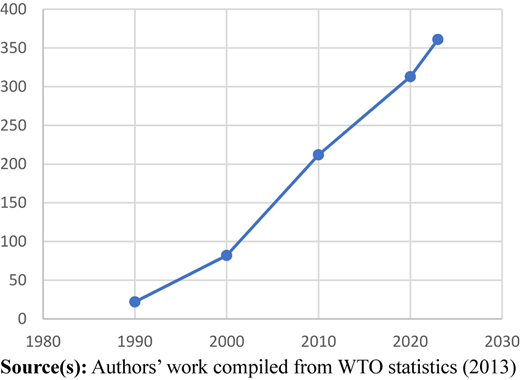
According to WTO’s latest report (2023), with their rapid global growth, FTAs have emerged as the most prevalent trade integration form world over (World Trade Organization [WTO], 2023). Figure 1 depicts the rise in the rise in the cumulative number of FTAs in the last three decades.
1.1 India and trade agreements
India has actively participated in numerous trade agreements and has been an active WTO and GATT member since 1 January 1995 and 8 July 1948, respectively (WTO, 2023). India’s trade agreements increased from the 1990s, as it embarked on the liberalization, privatization and globalization (LPG) model. Seshadri (2009) discusses the three phases of India’s trade agreements. The first phase commenced with its closest neighbors Bhutan and Nepal. The second started with the India-Sri Lanka FTA (ISLFTA) and the South Asian Free Trade Agreement (SAFTA). The most recent third phase began with India negotiating the north-south kind of agreements with various western nations. In the latest development, India has completed its trade negotiations with UAE and Australia.
Currently, India is actively negotiating trade agreements with the US, Canada, Australia, Gulf Cooperation and New Zealand. Table 1 provides a comprehensive overview of India’s signed and concluded, recently concluded, and those under negotiation trade agreements. Further, after a decade of negotiations, India ultimately opted out of the Regional Comprehensive Economic Partnership (RCEP) [2] trading bloc (Pohit & Pal, 2020).
1.2 Textile and clothing sector
The textile and clothing sector is India’s second largest employer providing direct employment and jobs in allied industries to 45 and 100 million people, respectively (investindia.com). In GDP terms, the sector accounts for 2.3% of the country’s GDP, 13% industrial production and 12% exports. Additionally, India’s contribution to the world textile and clothing trade is approximately 4%. According to the Federation of Indian Chambers of Commerce and Industry (FICCI) (2023) report, in 2022, the sector’s valuation stood at US$ 165 billion, with a domestic market and export contribution of US$ 125 billion and US$ 40 billion, respectively. Focusing on a sustained positive outlook, the market size is projected to grow at a 10% compound annual growth rate (CAGR) reaching US$ 350 billion by 2030. In 2022, the global clothing market was estimated at around US$ 1.7 trillion in 2022 with a potential to grow at a CAGR of approximately 8% to reach US$ 2.37 trillion by 2030. The global sectoral trade stood at around US$ 910 billion in 2021, with a projected CAGR of 4%, expected to reach US$ 1.2 trillion by 2030.
Besides being a significant contributor to export revenue and employment, the rationale behind the study’s focus on India’s textile and garment exporters is due to the fact that the industry operates in a fiercely competitive global market, facing intense competition from emerging players such as Vietnam, Malaysia and Cambodia, who have leveraged favorable trade agreements to strengthen their market position. Thus, understanding how Indian exporters perceive and navigate the costs, benefits, enablers and impediments of trade agreements is crucial.
1.3 Major contribution of this study
By undertaking an exporter survey in India’s textile and clothing sector, this study seeks to gain in-depth insights into the exporter’s perceptions of FTAs. Further, it addresses a key gap in the existing body of literature. Previous literature has largely focused on the economic implications of trade agreements (e.g. Bhattacharyya & Mandal, 2016; Khati & Kim, 2022; Singh, 2021) as well as their sectoral impact (e.g. Basu, 2022; Francis, 2011; Veeramani & Saini, 2011) while studies focusing on end-user is lacking. Thus, this research by analyzing the perceptions of the stakeholders aims to inform policy to increase the knowledge and application of the trade agreements within India’s textile and clothing sector, to inform policy development, strategic planning and future research. It also adds to the academic literature by giving voice to the exporter perspective, which is significant for forming effective industry-specific strategies and fostering sustainable growth in this pivotal economic sector for utilizing India’s numerous FTA schemes.
Hence, this study formulates the following research question:
How do textile and garment exporters perceive the costs, benefits, enablers and impediments associated with the use of trade agreements in their export operations?
2. Review of literature
2.1 A brief overview of trade theories, transaction costs and market access
Trade theories have developed over time to explain international trade patterns. The theoretical foundations lie in Smith's (2002) theory of absolute advantage, which posits that if one country has a distinct advantage over the other in the production of one good, while the other excels in the production of another, both countries gain from trading, thus differing from mercantilist view. Ricardo (1817) demonstrated that even when nations lack an absolute advantage in the unit production cost of all their tradeable goods, they may still benefit from international trade by focusing on their relative efficiency and are not required to protect their high-cost domestic industries. Building on these ideas, Heckscher and Ohlin’s (1991) theory suggested that countries export goods that intensively use their abundant resources, which was further refined by Samuelson (1948), who explained that the relative price of one good raises the real return of the factor that was used heavily in its production while lowering the real return on the other.
Modern theories have expanded beyond factor endowments to address economies of scale and market imperfections. Krugman (1979)’s new trade theory emphasizes the critical role played by economies of scale and network effects and a desire to achieve production efficiencies and product variety, even between similar countries, challenging traditional models. It notes that specialization and trade may be attributed to increasing returns to scale and imperfect competition, even when countries possess similar factor endowments. Balassa’s (1965) revealed comparative advantage measure analyzes how trade liberalization affects market access and comparative advantage across nations.
Additionally, Melitz (2003) in their heterogeneous firm model showed that trade liberalization leads to resource reallocation as only the most efficient firms participate in export markets, significantly impacting industry dynamics.
Coase’s (1937) and Williamson’s (1985) foundational theories on transaction cost economics explore how transaction costs affect the firms’ boundaries and the decision to organize economic activity within a firm versus through contracts and markets. Further, it explains minimizing the costs of exchanging goods in the market. Additionally, these theories suggest that barriers like tariffs, compliance costs and regulatory standards hinder the efficiency of international exchanges. Reducing these costs is crucial for promoting trade, a principle that underpins the establishment of Free Trade Agreements (FTAs). Den Butter and Mosch (2003) note that the presence of trust between trading partners reduces transaction costs potentially fostering trade.
Market access, a key component of trade liberalization, is influenced by both tariff and non-tariff barriers. Anderson and Wincoop’s (2003) gravity model of trade quantifies the effect of trade barriers on trade volume highlighting the importance of market access. This is a popular model for analyzing the economic impact of FTAs. Empirical studies, such as Kawai and Wignaraja (2009a), focus on how FTAs in East Asia attempt to improve market access by reducing tariffs and simplifying rules of origin (ROO) [3]. However, complex ROO and administrative burdens often reduce the effectiveness of these agreements, especially for smaller firms. These are detailed further in the next section.
2.2 Impact of trade agreements on stakeholders
2.2.1 Studies in East Asian region
For the majority of the developed nations, the government releases preferential data, making information readily accessible. Alternatively, for developing nations such as India, such data regarding the volume of goods utilizing the preferential trade route is lacking. Numerous studies exist on the utilization and awareness of trade agreements and the factors influencing their usage in East Asian nations.
For Thailand exporters, Wignaraja, Olfindo, Pupphavesa, Panpiemras, and Ongkittikul (2010) demonstrated a positive effect of the FTAs on their business plans, while the business costs increased due to multiple ROOs. Hence, the exporters emphasized a need for a harmonized ROO system. Auto companies had higher utilization rates compared to electronics and T&C companies. Kawai and Wignaraja (2009b) found consistent results across stakeholders in Japan, Singapore, Korea, Thailand and the Philippines with the higher-income countries exhibiting a more extensive private support system in comparison to middle-income countries. Julien, Joyal, and Deshaies (1994) surveyed Quebec small and medium enterprises (SMEs), finding 26.4% as sufficiently informed, with the media being the top information source. The agreement was favored due to new market access, lower raw material prices and more competition. Quimba, Moreno, and Andrada (2022) highlighted the significance of larger preferential tariff margins and the need to focus on stimulating FTA use among Philippine firms.
Hiratsuka, Sato, and Isono (2009) found lacking knowledge as well as lack of utilization among Japanese firms. Larger firms’ utilization in electronics, garments and autos was greater with larger economic partners compared to the small and medium firms. Sri Lankan exporters found the ROO to be burdensome, the cost of documentation as high and a lack of institutional support. (De Mel, Jayaratne, & Premaratne, 2011). Tambunan and Chandra (2014) showed a low utilization rate in the Association of South East Asian Nations (ASEAN) [4] SMEs owing to difficulties such as lack of information, complicated policies and difficult outreach. Cheong and Cho (2009a) found that although about half of the firms found FTAs to be beneficial, only one out of five Korean firms surveyed utilized FTAs. Cheong and Cho (2009b) emphasized the employment of a more neutral and lenient ROO form. Inama, Crivelli, and Ha (2022) found shortcomings in ROO administration and their cumbersome management in ASEAN member states.
Ahmed, Ahmed, and Sohail (2010) concluded that few exporters were familiar with the Pakistan-Sri Lanka FTA agreement and they reported difficulties in obtaining certificates of origin. Takahashi and Urata (2010) conducted a quantitative survey of Japanese firms revealing the limited magnitude of foreign trade with the FTA partner countries, challenges in getting the certificate of origin, lack of understanding of FTAs and the narrow scope of FTA tariff preference [5].
Cheong, Kim, and Cho (2010) on FTA use in Korean firms affirm that a self-issuing system may be an incentive for Japanese companies’ utilization of FTAs. Qu and Zhang (2023), emphasize reducing ROO costs and accelerating tariff reductions. Martinez (2024) examines MSMEs’ employment of RTAs, detailing advantages such as access to cheaper intermediate goods due to lower tariffs, increased exports, enhanced business opportunities, greater production networks and increased participation in regional and global supply chains. However, it also identifies problems including complex regulatory requirements and high administrative costs or intensified competition from foreign firms. Legge and Lukaszuk (2024) identified fixed cost components as a barrier, particularly for urgent shipments, while Kasteng, Kokko, and Tingvall (2022), using firm- and transaction-level data on Swedish imports from South Korea, showed that preference utilization was more influenced by the size of import transactions than by the preference margin size.
Song (2022) in their survey on small- and medium-sized enterprises in the South Korean textile industry revealed that compatibility and trading partner influence positively affect FTA use, while complexity leads to a detrimental impact. Additionally, no association was found between organizational context factors and FTA utilization. Kang and Nam (2022) recommended policymakers reduce ROO burdens and strengthen cooperation with related agencies to enhance FTA utilization. Hayakawa, Jinji, Laksanapanyakul, Matsuura, and Yoshimi (2023) in a study on Thailand’s imports from China quantified procurement and fixed costs related to RTA utilization, revealing increased FTA use as costs declined.
2.2.2 Studies in India
Shyam and Geetha (2011) observed that consumers in the fisheries sector benefited from a diversified product range and consistent year-round availability. Exporters expressed favorable opinions, citing gains from expanded economies of scale, broader export opportunities and improved market access. Jha (2013) analyzed the adoption of preferential trade schemes by Indian exporters through a review of the number of preferential certificates issued. The findings suggested that RTAs alone had not significantly boosted exporters’ market share in partner countries. While the increase in imports resulted in an increase in total imports from the RTA partners, this was not true for exports.
A FICCI (2013) survey revealed that according to 50% respondents the trade agreements’ influence on the exports of key industries was absent. While 35% recognized that the current FTA in goods aided in the reduction of input costs, positively affecting their imports into India while 65% viewed no impact of the liberalized import regime. Pandey and Unnikrishnan (2023) citing evidence from previous literature suggest that relaxation of stringent ROO requirements, measures for boosting trade and robust domestic policies can significantly widen the scope and potential of future FTAs. According to Krishna (2021), “rules of origin” are designed to prevent deflection in trade resulting in limited preferential utilization. Further, with the increase in the number of agreements, varying ROOs in multiple, overlapping PTAs may be burdensome for organizations. Tandon (2020) makes a strong case for making FTAs inclusive by SME participation and emphasizes upon lack of information and the additional costs imposed for integrating into global value chains(GVCs). Thus, the participation of SMEs in trade needs to be improved and strengthened through focused interventions. Table 2 provides a brief summary of the aforesaid literature.
@@Further, it is significant to emphasize that Indian exporters face unique challenges in utilization of trade agreements compared to East Asian and Western region. Many exporters, particularly SMEs lack awareness and understanding due to inadequate information access and limited institutional support. SMEs struggle with limited access to structured support mechanisms like trade facilitation centers and advisory services. Additionally, high documentation costs and complex and often inefficient bureaucratic system hurdles makes it difficult to obtain necessary certificates of origin. The diversity in India’s export base, with a significant share in sectors like textiles, agriculture, and small manufacturing, often complicates the process of meeting technical standards and sanitary measures imposed by trade partners. Furthermore, there is insufficient harmonization of trade facilitation measures, and exporters often encounter logistical inefficiencies that hinder their ability to compete internationally. Finally, domestic market pressures and fluctuating trade policies, influenced by political protectionist sentiments, may potentially create an unpredictable environment for exporters.
2.2.3 Conceptual framework
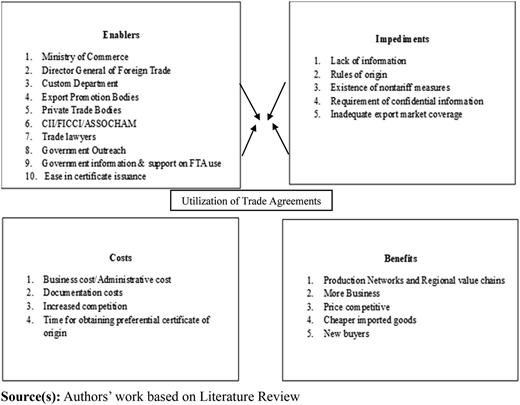
The extensive literature review provided a comprehensive understanding of the body of knowledge relating to the costs, benefits, enablers and impediments of the practical utility of these trade agreements to the exporters. The stakeholder study analysis led to the understanding of variables that affected the usage of trade agreements based on costs, benefits, impediments, and enablers. The variables were captured by established studies in the literature. These studies have been conducted in the context of Asian region. (Hirastuka et al., 2009; Kawai & Wignaraja, 2009a; Wignaraja et al., 2010; De Mel et al., 2011; Kallumal, 2015). This ensured that the qualitative exporter survey is well-grounded in established theories and empirical evidence as evident in Figure 2.
2.2.4 Novelty of the research
India is currently on a signing spree of trade agreements; however, utilizing FTAs is not mandatory for the firms, thus, it is vital to understand how firms perceive FTAs. Studies on India’s FTA utilization and the factors impacting it are clearly lacking in the existing literature. To the authors’ best understanding, no study till date has performed an in-depth qualitative survey in India, specifically in the textile and clothing sector to understand how businesses perceive the FTAs. Further, only two studies have examined the effect of trade agreements on the parties involved Jha, 2013; Shyam & Geetha, 2011). Additionally, the impact on final stakeholders relating to the usage to perceived costs, benefits, impediments, and enablers of the trade agreement was found lacking.
Moreover, few studies (CII, 2015; FICCI, 2013) have quantitatively examined the use and awareness of trade agreements at stakeholder’s level. Therefore, it is significant to corroborate these quantitative survey data analysis results with a qualitative perception of stakeholders. It is also essential to study how users and nonusers perceive the cost, impediment, enablers, and benefits of the agreement. The current research aims to narrow this literature gap by undertaking an in-depth qualitative analysis of India’s textile and clothing exporter’s perceptions on trade agreements.
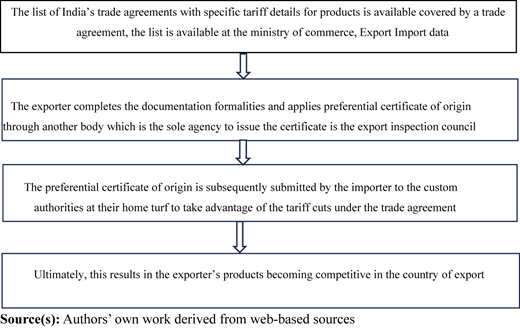
The framework for utilization of FTA in Indian-context follows a specific path as shown in Figure 3 below.
3. Material and methods
3.1 Research philosophy, design, and sampling
This research follows an interpretivism philosophy. According to Klein and Myers (2001), in interpretivism knowledge is acquired and filtered through the lens of social constructions including language, consciousness, and shared meanings. Thus, laying more emphasis on human behavior through social constructions which involves language and interpretation of human behavior and the phenomenon is not generalized to the whole population. (Creswell, 2007). The focus of this study was to gather in-depth insights on exporter’s perceptions of use of trade agreements, thus, interpretivism was most suitable to examine the subjective perspectives and implications that individuals attach to their actions and decisions. Trade agreement utilization is influenced not only by objective economic factors but also by exporters' interpretations, perceptions, and judgments of the agreements' impact on their business operations. An interpretivist approach allows for a deeper exploration of how exporters perceive the advantages and challenges associated with trade agreements, considering their unique business contexts, market experiences, and cultural contexts. This approach emphasizes qualitative methods, such as interviews or case studies, which can capture the nuances of exporters' attitudes, motivations, and the reasoning behind their utilization of trade agreements. In contrast, a purely quantitative approach would only yield statistical insights into whether or not exporters are utilizing these agreements, but it would fail to uncover the reasons and motivations behind their actions.
3.1.1 Research design
The research design is exploratory; thus, it lacks a formal structure and is flexible. Further, it provides an in-depth exploration of the exporters’ views on their perception costs, benefits, impediments, and government role, offering learning on a continuous basis. It identifies the boundaries of the environment in which the issues, opportunities or areas of significance occur to assess what might be found and potentially be relevant to the research (Van Wyk, 2012). Semi-structured in-depth interviews involving open discussions with the exporters were conducted to explore their views and insights on the subject. Upon going through the extensive review of literature, we identified a set of questions to understand the exporters’ viewpoints to offer necessary policy recommendations.
The participants were informed that their decision to participate was voluntary, they could quit the study at any point they desired without any penalties. Further, they were ensured on the anonymity and confidentiality of the results. They were also informed that the results will be used solely for the purpose of this research study. The study involved surveying a small group of exporters on their views regarding trade agreements. Company names were anonymized, and no personal or sensitive data was collected. As the survey focused solely on opinions and maintained participant confidentiality, ethical clearance was not deemed necessary. However, the research adhered to general ethical standards, ensuring confidentiality and respect for the participants.
3.1.2 Sampling method
Purposive sampling, wherein the researcher relies on their judgement to select the sample size was employed. This is also called judgement sampling as the informant is selected based on the qualities they possess. Hence, it is important to ensure the competence of the participant in the case of purposive sampling (Tongco, 2007). The participants were selected via a flyer, which was put on the LinkedIn social media account of the researchers. The export companies were selected based on the following criterion: Participants should have knowledge of trade agreements. (Alvi, 2016), holding position of company head, Chief Executive Officer (CEO), presidents, company should be located in the major textile and garment hubs of Tirupur, Delhi/NCR, Kolkata, and South India. We received 58 initial responses. Of these potential respondents, only 55 were sent a questionnaire based on their knowledge of India’s trade agreements. Upon filtering, 16 were determined to be aware with reasonable knowledge on India’s trade agreements.
The semi structural mode of interviews ensured that the researcher could dig in well to digest the participants’ insights into the issue under consideration. Export markets were the key source of income/profit for the exporters that took part in the interviews. All the exporters, who responded to the questionnaire were aware of India’s existing trade agreements. Additionally, to gain in-depth insights from a policy viewpoint, the questionnaire was put to two directors of export promotion councils for their specific views. Some companies were relatively new, and others had more than five years of establishment. These exporters belonged to small, medium, and large-sized companies (Table 3) classified on the basis of annual turnover and investment in plant and machinery. Some companies were relatively new, and others had more than five years of establishment. They were enquired about their knowledge and perceptions relating to cost, benefits, uses, awareness, and government role of trade agreements. While ten of these export companies utilized, 6 were not using the trade agreement.
3.1.3 Sample size
The sample size consisted of 16 exporters and 2 policymakers, who possessed fairly good knowledge of trade agreements. In qualitative designs, a sample size anywhere from 5 to 50 is considered adequate. (Dworkin, 2012). Sample size is determined by saturation where a new set of in-depth interviews do not produce any new relevant knowledge. (Mason, 2010). The sample size is determined based on information power is the criterion utilized to determine the sample size, which implies that if the sample holds greater information pertinent for the actual study, the lower is the number of participants required. (Malterud, Siersma, & Guassora, 2016). These two facets of qualitative research design led to sample size determination.
Thematic saturation in this study was reached, when no new themes or insights emerged from the data analysis. After conducting and analyzing a series of in-depth interviews with exporters, we noted that additional interviews were yielding repetitive and redundant information. This indicated that the major patterns and themes related to exporters' perceptions, motivations, and challenges in utilizing trade agreements had been comprehensively captured, ensuring a thorough understanding of the research topic. Thus, the final sample size of 16 exporters and 2 policymakers provided diverse perspectives regarding their perception of the utilization of trade agreements.
3.1.4 Survey instrument
An open-ended, unstructured questionnaire was prepared for the study. The questionnaire consisted exporters’ personal details such as company size, annual turnover, employee strength, incorporation date. The questions were based on usage, awareness, cost, benefit, impediments, and enablers in the utilization of FTAs. Face to face interviews were conducted with the respondents on Zoom video conferencing platform as it was deemed convenient for the respondent. A prior date and time were set with the participants for the proposed interview. An audio recording was performed for the personal interviews, and subsequently the audio transcript was exported in a word file in the researcher’s password protected personal computer. As per policy, after a two-year period, all data will be destroyed by the researcher.
Semi-structured questions allow for generating new hypotheses and further inquiries as participants share their narratives (Bufkin, 2006). The questions framed for the qualitative questionnaire are a continuous reflective process, commonly shaped and enhanced at every stage of a reflective and interactive exploration (Agee, 2009).
3.1.5 Reliability and validity
A qualitative research study is useful to its readers when it meets specific criteria for trustworthiness. Trustworthiness or truth valuer refers to the researcher’s confidence in the data, methods, and findings of his study. These are crucial to the usefulness and integrity of the findings. (Cope, 2014). Guba’s (1985) criterion, forms the basis of the present study. The four main criteria adopted by Guba akin to the positivist approach of establishing validity and reliability are as follows:
Credibility (internal validity): ensures that the study is measuring what its intent is. (2) Transferability (external validity): measures the applicability of the study’s findings in other situations. (3) Dependability (reliability): obtains similar results when work is repeated with the same methods and participants (4) Confirmability (objectivity): ensures that the research and conclusions are focused on the informants’ knowledge rather than the researcher’s characteristics and findings.
Further, to ensure the study’s trustworthiness, member-checking was performed. To accomplish this, the results were shared with the exporters, and if any discrepancies were found in the transcription or the coding processes, these could be checked by the participants at this stage. Member checking was utilized to ensure the trustworthiness of the study. The participants were invited to assess the preliminary findings and provide feedback on whether the themes and interpretations accurately reflected their perspectives. This process allowed for data validation and ensured that the study’s conclusions were credible and resonated with the exporters’ perceptions, thereby enhancing the reliability and authenticity of the research outcomes. Thus, member-checking ensured the trustworthiness of this study.
3.1.6 Research method
Content analysis is a widely employed qualitative research technique to examine the textual data content and aligns with the naturalistic paradigm. (Hsieh & Shannon, 2005). This encompasses organizing raw data into categories or themes through logical inference and inductive reasoning. Further, careful scrutiny and constant comparison by the researcher results in the formation of themes and categories (Zhang & Wildemuth, 2009). Thus, the key aim of content analysis is to structure data, derive meaningful insights, and form realistic conclusions. This approach preserves the methodological strength of the quantitative method, and widens the application to the qualitative aspect, connecting the quantitative and qualitative data. (Mayring, 2000).
There are three ways of performing content analysis. (Hsieh & Shannon, 2005). The current study utilizes a conventional approach. The analysis was performed under the manifest category, which has a wide nature. This involves an in-depth text analysis, reading it numerous times, and eventually arriving at initial codes from the text itself. (Miles & Huberman, 1994; Morgan, 1993; Kondracki, Wellman, & Amundson, 2002). The next step involves sorting out codes and forming categories to examine their interconnectedness. After this categorization, sub-themes are framed, which is the first level of categorization. The second level involves the regrouping of sub-themes for forming core themes. Meaningful clusters emerge from these categories. (Coffey & Atkinson, 1996; Patton, 1990).
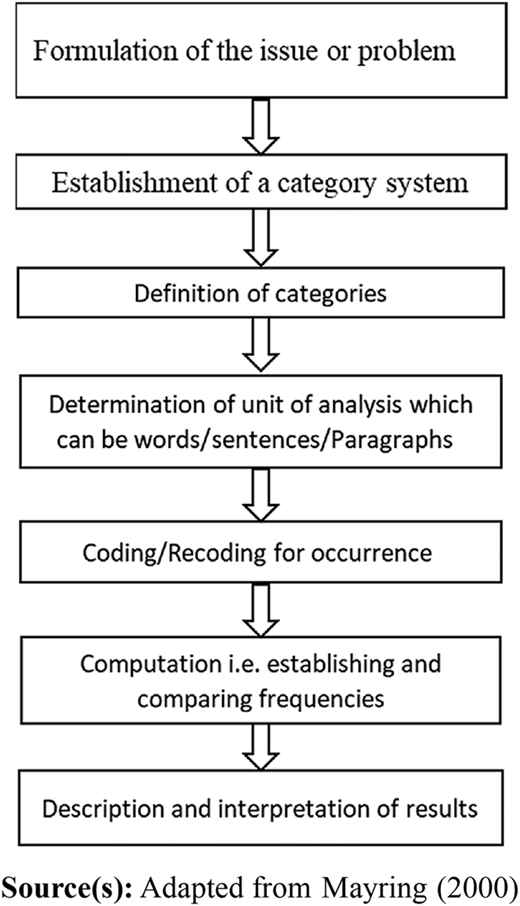
The qualitative step consists of assigning categories to the text in relation to the text passages; the frequency of that categorization emerges as the quantitative step. The various steps used in performing content analysis in the current research are as follows:
Data Collection: The interviews were pre-recorded, and the text and verbalizations were transcribed and rewritten into MS Word. Next, data was coded through an excel file. Subsequently, data was exported into AtlasTi software for extracting themes and subthemes from the coded text. First, the collected data was read and re-read to gain in-sights into participants’ perceptions. The important words and those, which recurred commonly in participants’ input were coded. The coding process evolved through several stages: initial, focused, and axial coding. Initially, open coding segregated the data into discrete parts, identifying key concepts and labeling them in a descriptive manner. This phase generated a broad range of preliminary codes from the raw data. Next, focused coding involved a more selective process, where the most frequent or significant codes from the initial phase were refined and grouped to identify broader themes. Finally, axial coding was conducted to establish relationships between these themes, connecting subcategories and understanding the data’s underlying structure.
Defining the level of analysis: The unit of analysis, which were the sentences spoken by the participants were identified as a theme and the entire text was condensed.
Coding: The condensed text was broken into codes. This is a process of selective reduction. Codes were two words long. The frequency of occurrence of a concept was the basis on which coding was performed. Thereafter, open codes were created. We systematically reviewed the interview transcripts, scrutinizing participants’ exact words and phrases regarding trade agreements. For example, participants frequently stated that “FTAs are not the sole criterion” and often mentioned other considerations, such as “we also have various export promotion schemes.” These recurring phrases were first coded as trade agreement limitations and importance of alternative incentives. Upon further analysis of these initial codes, we observed a clear pattern: participants emphasized that while trade agreements are influential, they are not the sole determinants of export success resulting in forming the overarching theme Trade Agreements Not the Sole Criterion. Similarly other themes were derived. The sample analysis process relating to development of codes, subthemes, and themes is explained in Tables A1 and A2 of Appendix.
Categorization: A category is formed by grouping together related or interlinked codes with one another. Codes are grouped into categories when they represent various aspects of the text’s content that are interconnected, whether through similarities or differences.
Forming Themes: Subsequent themes symbolized a latent meaning found in two or more categories. Subthemes typically contribute to or help derive the main theme. In content analysis, we start by identifying detailed subthemes through coding and subsequently group these subthemes together to form a larger, overarching theme. We were able to authentically represent participants’ views and provide a nuanced understanding of how export strategies are influenced by a combination of factors beyond trade agreements.
Reassessing and reexamining the coding categories: Sometimes, while analyzing themes, two different subcategories may convey similar idea. Thus, to make the analyses cohesive and based truly on the participants responses, it is significant to reassess the coding categories. This process may also reveal new insights or prompt for theme adjustment to better capture the complexity of the data. Figure 4 shows the framework used for performing content analysis
4. Results
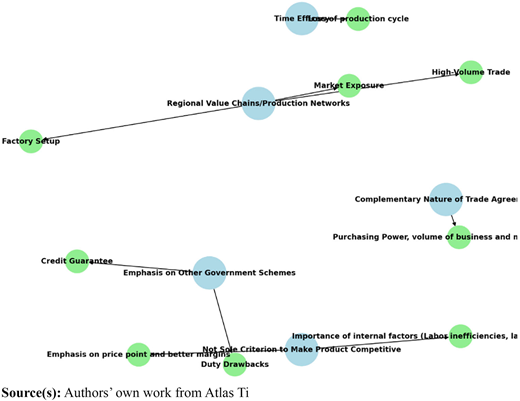
First, the data was coded into MS Excel. Subsequently, it was put into the Atlas. Ti Version 7.0 software. This software assists in extracting various themes from the qualitative data by structuring the coded data. Once we structured the data, we were able to create hierarchies, relationships, and networks (Figure 5).
The qualitative survey led to the identification of the following themes and subthemes relating to exporters’ perceptions on FTA influencing factors.
4.1 Perception on benefits
More Competitive: Twelve of the export companies cited their product becoming more competitive. This helped them to compete with low-cost players such as Bangladesh in the global market and enhance the profitability of their business. Only two emphasized on the cheaper cost of imported goods as a benefit, as most of their imported inputs were from China. Further, none stated the importance of increased market access or their willingness to venture into new markets because a trade agreement was signed with the country.
Complementary Nature: Sixteen stakeholders, that is, all export companies cited trade agreement as being complementary in nature. An exporter explained, “these agreements are only felicitators. They may not be the only reason an exporter will start to export; he will go where the flow is.
Thus, majority would not export to a country just because a trade agreement exists. They will head to where there is a definite market, purchasing power and, buying capacity in the importing countries for their products. Exporter B.
Internal Problems: According to 66 per cent of those interviewed, a trade agreement was not a factor in making their product competitive in the global markets; agreed to by both users and nonusers of the trade agreement They cited internal inefficiencies and bottlenecks as major issues. A large exporter from Tirupur detailed, “labor in countries like Bangladesh is 20–30 per cent more efficient than ours.”
Importance of production networks: Joining regional production networks in the future was quoted as significant by ten of the export companies. They were looking forward to the signing of trade agreements with countries where they had more exposure. Many were looking forward to agreement with Australia and United Kingdom to take advantage of these markets through Regional Value Chains (RVC) [6] if India did not sign an agreement directly. A medium-sized exporter from Surat explained:
Right now, we make very little use of FTAs such as AIFTA, but in future, we hope for FTA to be signed with Britain, EU and US or join regional value chains to make use of these agreements. The signing of these agreements will surely give a strong boost to our products. Exporter M.
Other Government Schemes: Exporters also cited importance of other schemes which they felt were more important than trade agreements. One exporter from Tirupur, having an annual turnover of over 350 crores described:
We at Tirupur are a 14,000-crore turnover cluster, but very few exporters are interested in trade agreements. Majority of us utilize the ECGS that is the export credit guarantee scheme. This is what we know. Focus is not on these agreements. This is an insurance scheme for us exporters. Exporter B.
4.2 Perception on costs
Miscellaneous Costs: Almost half of the companies comprising of both the users and nonusers believed that eventually the benefit would exceed the costs. The users frequently mentioned the difficulty in obtaining the certificate of origin, process not being smooth, and mishandling at customs. Additionally, five viewed the delays at customs and lack of transparency as a significant cost. An exporter noted that exporting to newer countries could bring in communication problems owing to language as well as barriers between the countries’ authorities. The policy makers from the export promotion bodies believed viewed the costs as minimal, and the entire process as smooth for the exporters. A policy maker at Apparel Export Promotion Council (AEPC) noted, “The government is trying to bring the entire system online.”
Time efficacy: Thirteen of the stakeholders emphasized the importance of time in the issuance of preference certificate as the major cost of using trade agreements. If there are more bottlenecks in using the trade agreements, this leads to the loss of production cycle and an increase in lead times, which is prime most in the textile and clothing industry. An exporter from the New Delhi region described,
Nothing is more important than time in exporting if we talk in terms of clothing. The importers want their products on time as the customers are weary about the fashion. It is all about what is fashionable at that given time, a little delay can lead to losses. We cannot afford to lose the production cycle. Exporter H.
Perception varied on company size: The large sized companies did not focus on FTA costs, whereas the smaller companies found the costs difficult to bear. The larger companies put the documentation costs as negligible and frequently quoted having separate departments that dealt with it or outsourcing the work to forwarders. The smaller companies viewed the documentation costs to be a big hurdle, and the cost paid to the forwarders and the shipping company as high. All the stakeholders were in mutual agreement that the trade agreements’ benefits surpassed the costs. An exporter stated:
There is no importance of these costs as compared to the benefits, whether it is a smaller exporter or a big exporter, all should seek advantage from trade agreements. There is no delay at customs and the goods follow a normal procedure. Exporter J.
4.3 Perception on impediments
Lack of Knowledge: The most widely acknowledged impediment was the lack of knowledge by majority of nonusers. The users also cited insufficient knowledge as a major impediment. There was a general lack of awareness among the exporters specifically, among the smaller exporters. According to a member of the export promotion organization, the exporters lacked “basic zeal.” An exporter quoted, “otherwise, who would not like to make their product more competitive in the importing country.” Four of the nonuser companies with basic level knowledge wanted to know more about these agreements and asked us to send documents related to trade agreements via e-mail. Thirteen export companies claimed ignorance as a major deterrent in using FTA. The export companies faced difficulty in understanding the jargon used in the agreements. A large garment export company from Mumbai explained:
Simplicity of language and process is vital. I think the government should send emailers to all the exporters and clarify industry specific trade agreements in simple language. The government should also mention the process to avail the benefit. Exporter K.
Lacking transparency: Half of the export companies noted a lack of transparency and facing various bottlenecks in using the trade agreements. Due to this, malpractices were widespread. Few also cited problems facing issues at customs. A medium-sized exporter from Delhi/NCR region contended:
Customs department is not transparent, there is no information provided. Sometimes we feel that we are being purposefully neglected. They make it difficult for us, sometimes harass us. The process is not clean”. Exporter G.
Sparse Market Coverage: Twelve mentioned sparse market coverage as an impediment. According to majority, the market coverage was not adequate for them to use the trade agreement. Only one exporter mentioned the existence of a nontariff barrier as an important impediment.
4.4 Perceptions on enablers
Agency Support: Ten of the companies stated having received support from the export promotion bodies. The major complaints included lack of sectoral importance; no online information provided by the government. All companies prioritized the importance of knowledge dissemination and active exporter involvement. It is noteworthy that none of the export companies received any sort of assistance from a private source or private trade organization. Self-certification, online support with online document submission, conducting seminars, involving exporters, and communication in the negotiation process were the key to easing and smoothening the use of trade agreements. The policy makers emphasized on more comprehensive agreements that should provide services and visas to the exporters.
Online Support: This was vocalized by thirteen companies in the discussion regarding the smoothening the FTA process, which would offer the necessary information for making FTA the use easier, keeping them abreast with the government policies. The sub-themes identified were electronic data exchange systems and flow of filtered information. “The entire process must be made online including the legalization of documents.” stated Exporter D
Sector-Specific Support: While discussing the specific bodies from which the exporters sought support, majority emphasized upon the support received from the various export promotion bodies. Specifically, The Cotton Textiles Export Promotion Council (TEXPROCIL) for textile exporters and APEC for apparel exporters. These were majorly relied upon to pass and seek information from the government. A large exporter from Tirupur, while actively praising the work of AEPC revealed:
We at the Tirupur cluster are getting immense help and support from AEPC, it represents us in the government and whatever the government likes to communicate to us, in general, and suggestion we need to put to the government and whatever issues we are facing. This is much helpful. Exporter E.
Proactive support with active communication: This was a major enabler sought by the exporters, involving various subcategories including more guidance, support to the exporters and exporters’ approval while framing trade agreements with various countries. The CEO of one of the larger textile companies with an annual turnover of more than 1,200 crore asserted. “There should be adequate ground work when new FTAs are signed. The government should consult more with exporters rather than relying on bureaucracy”. Exporter N
The frequency of occurrence of these themes extracted from the exporter interviews are summarized in Tables 4 and 5 presents the summarized results for the themes and subthemes obtained.
The study’s results are in line with other global studies. For Japanese firms, Takahashi and Urata (2010) and Hiratsuka et al. (2009) identified that Japanese firms faced challenges such as limited trade volumes with FTA partners, insufficient knowledge about FTAs, and the high costs associated with documentation and application processes, leading to low utilization rates. Further, emphasis was laid upon smoothening of the application methods as well as enhanced help from public and partially-public institutions. Tambunan and Chandra (2014) stated scarcity of knowledge as the key hurdle to FTA use by ASEAN firms. Vanhnalat, Phonvisay, and Sengsourivong (2015) showed a lack of information as major hurdle for businesses in Laos. De Mel et al. (2011) highlighted the challenges faced by Sri Lankan exporters, including insufficient information and high documentation costs, alongside opportunities for expanded business. Similarly, Kawai and Wignaraja (2009a) identified the lack of information as a significant barrier. For Thai firms, the perceived benefits included enhanced market access and new business opportunities, while documentation costs and reliance on public sector support emerged as prime enablers.
Although, ROO were not found to be a significant theme in this study, studies in East Asian region demonstrate how these can be a major impediment to the use of trade agreements. Similar to Kawai and Wignaraja (2009b) findings, this study emphasizes that trade agreements serve a complementary role rather than being the sole determinant of competitiveness highlighting the significance of regional value chains and the positive impact of sector-specific support. Similar to this study, Hayakawa et al. (2023) state that time and administrative burdens present considerable costs, which align with the concerns expressed by exporters in this study. However, unlike Medalla (2011)’s work, which suggests a relatively higher awareness and efficient use of trade agreements in more developed economies, this study reveals a pronounced lack of awareness and transparency among Indian exporters. Additionally, the differences in perceived documentation costs between smaller and larger firms uncovered in this research underscore a unique challenge not as prominently featured in previous studies, adding a new dimension to the discourse on trade agreement utilization.
In Indian context, Deloitte (2017) report indicates low application rates due to lacking knowledge and complex origin rules as key challenges. MVIRDC world trade Centre’s report (2018) stated low application rates owing to a scarcity of understanding. Other difficulties noted were the narrow preference margin, increased transaction costs owing to complex ROO, and hurdles receiving a preferential certificate of origin. Saraswat, Priya, and Ghosh (2018) highlighted key barriers to FTA utilization, such as inadequate awareness, minimal preference margins, procedural delays, high administrative costs, and non-tariff barriers. Similarly, a recent study by Pandey and Unnikrishnan (2023) highlighted the need for relaxed ROO requirements, improved trade facilitation measures, and supportive domestic policies to unlock the full potential and broaden the impact of future FTAs.
5. Conclusion and policy suggestions
5.1 For exporters
Knowledge dissemination: Currently, Indian firms require understanding and knowledge to gain advantages from FTAs. Thus, newer and less expensive approaches for spreading FTA based knowledge to increase awareness should be looked into (e.g., employing FTA portals, forming a support group of FTA experts’, and bringing to light other firms’ success stories). For example, a practical scenario could involve Indian agricultural exporters, such as those dealing in spices or tea, who benefit from preferential tariffs under the India-ASEAN Free Trade Agreement. These exporters may perceive the FTA as a critical tool to enhance competitiveness in ASEAN markets. However, a challenge might arise if they lack knowledge about specific ROO or the paperwork involved, limiting their ability to benefit.
SME focused outreach: In India, majority of the textile and garment firms are concentrated in the SME sector. Although, few SMEs utilize FTAs, the attitude of the rest is indifferent. Considering the existing framework employed by many SMEs to supply goods to large domestic corporations, FTAs prove valuable not only for facilitating exports but also for sourcing essential components required for production. Hence, it is significant that the government focuses its efforts to empower SMEs in the use of FTAs. For example, textile and apparel exporters from India, particularly SMEs in states like Tamil Nadu or Gujarat, may use the India-UAE Comprehensive Economic Partnership Agreement (CEPA) to access the UAE market with reduced tariffs. However, these exporters might face barriers like language issues or lack of guidance on understanding the nuanced provisions of the agreement, such as the ROO for textile products.
Importance of organizational learning: Concerning practical implications, the study’s findings emphasize that for firms to effectively utilize FTAs requires expertise and familiarity regarding ROOs and COOs, emphasizing underscoring the vital importance of organizational learning in enabling exporting SMEs to benefit from preferential tariffs. Hence, they should be provided an appropriate level of officer and managerial training, specializing in ROO and other FTA-related concepts.
Development of business models: The CEOs and the companies’ top brass should motivate employees to attend FTA based learning activities as well as channelize resources for decreasing the workload of staff responsible for the filing of the FTA.
Self-certification system: Exporters will be highly motivated to use an FTA if the government commences the self-certification system, as is the norm with other developed countries. It is significant that the government of India emerges proactive in accepting a self-issuing system for preferential certificate of origin, while strengthening the penalty for failing verification.
5.2 For government bodies
Inclusion of stakeholders’ opinions: It is important to have a bottom-up approach in negotiations with FTA partners such that all stakeholders’ interests are adequately addressed. Thus, it is significant to improve business participation in FTA consultations and advocacy. To accomplish this measure, consultation and training are paramount. Comprehensive consultations both before and during FTA negotiations will facilitate FTA utilization amongst the exporters and can aid in resolving stakeholders’ issues. Such consultations help export firms to examine the gains and challenges regarding their business plans. Furthermore, industry-specific seminars and targeted training programs can provide more practical and relevant guidance for businesses across various sectors.
Schemes promotion: Promoting India’s FTAs with major trading countries is necessary, as well as examining schemes necessary for enhancing FTA utilization. The dissemination and structure of FTA-related information should be strengthened to better support enterprises, focusing on practical utility rather than solely promoting FTAs by emphasizing their benefits to exporters. In particular, it is challenging for SMEs to understand the details of the existing FTAs and the related rules for their own products due to manpower constraints. Hence, it is pertinent to reinforce a system of supporting FTAs.
Simplicity in ROO: Simpler origin rules benefit businesses, as overly complex and industry-specific requirements are more likely to deter trade. Thus, simplicity is a powerful incentive for firms to adopt FTAs. Firms may not consider the potential savings from using FTAs due to the complexity in utilizing them. A simpler ROOs regime with relaxed policies can propagate the use of FTAs.
Non-tariff measures: A strong ecosystem for utilizing FTAs also warrants that the government focuses on bringing down non-tariff measures as these can further add to the lopsided nature of trade and negate the positive effects of a FTA.
Operating costs and electronic data exchange: To further reduce the operational and transactional cost of utilizing the FTAs, the government should prioritize measures in reducing these costs for ensuring that SMEs are not penalized for using FTAs but rather are presented with favorable opportunities for their utilization.
Preferential data collection: The data collection on the filing and use of preferential certificates should be streamlined. This will provide key information on the use and effective implementation of FTAs. By enhancing data collection, particularly on FTA use, would aid in improving the effectiveness of FTAs.
5.3 For trade organizations
Sector-specific concessions: Trade promotion measures should work simultaneously with other sector and trade-enhancing measures, including quality improvement, implementation of labor laws, use of the latest technology, fashion-focused approaches, cost and time effectiveness, and so on.
Further, the recommendations vary based on the size of the firm. Thus, small and large firms may benefit from diverse policy recommendations as follows:
5.4 Policy recommendations for SMEs
Innovative Information Dissemination: Implement cost-effective methods to spread knowledge about FTAs, such as online portals and the creation of expert pools. This can help SMEs, who often lack resources, to better understand and utilize FTAs without incurring high costs. Currently Indian firms require information and knowledge to fully benefit from FTAs. For example, a practical scenario could involve Indian agricultural exporters, such as those dealing in spices or tea, who benefit from preferential tariffs under the India-ASEAN Free Trade Agreement (FTA). These exporters may perceive the FTA as a critical tool to enhance competitiveness in ASEAN markets. However, if they lack knowledge about specific ROO or the paperwork involved, this may limit their ability to fully capitalize on the agreement’s benefits. This scenario can highlight the need for government programs to raise awareness among small exporters about how to navigate FTAs effectively.
SME-Focused Outreach Initiatives: Develop targeted outreach programs specifically for SMEs, particularly those in sectors like textiles and garments. The government should provide resources and organize training sessions to guide SMEs through the FTA processes, emphasizing the benefits of reduced tariffs and simplified access to international markets. For example, The India-UAE Comprehensive Economic Partnership (CEPA) for Textile and Apparel Exporters Textile and apparel exporters from India, particularly SMEs in states like Tamil Nadu or Gujarat, may use the India-UAE Comprehensive Economic Partnership Agreement (CEPA) to access the UAE market with reduced tariffs. However, these exporters might face barriers like language issues or lack of guidance on understanding the nuanced provisions of the agreement, such as the ROO for textile products.
Simplified Rules of Origin: Simplifying the ROO is crucial for SMEs that may lack the manpower and expertise to navigate complex requirements. A streamlined and less burdensome ROO regime will make FTAs more accessible and appealing. In particular, it is challenging for SMEs to gather details on FTAs due to resource constraints. The system of supporting FTAs for SMEs should be reinforced.
Support for Self-Certification: Introduce a self-certification system to reduce administrative burdens for SMEs, making it easier for them to comply with FTA regulations. This can motivate more small businesses to engage in international trade while ensuring compliance through effective but straightforward verification processes.
Operational Cost Reductions: Reduce operational and transactional costs associated with using FTAs. Government initiatives should aim to minimize the financial and administrative challenges that SMEs face, fostering a more favorable environment for trade. the Indian government simplifies the process by creating an online portal that guides exporters step-by-step on how to utilize FTA benefits, such as the reduction of customs duties under the India-Sri Lanka FTA. This could reduce barriers related to paperwork and compliance costs, making the FTA more accessible to all exporters.
Managerial Training and Knowledge Accumulation: Provide officer and managerial training to SMEs, focusing on key concepts like ROO and FTA utilization. Such programs can empower smaller firms to build the necessary expertise to navigate FTAs effectively. Government Initiatives for SME Awareness To overcome the knowledge gaps faced by small exporters, Indian government, through agencies like the Directorate General of Foreign Trade (DGFT), organizes workshops and webinars focused on educating SMEs about how to leverage FTAs., as seen in the implementation of the India-EU FTA where certain sectors saw increased participation after such educational campaigns.
Data Collection and Analysis: Streamline data collection processes to capture information on SME FTA utilization. This data can help policymakers refine their strategies to make FTAs more accessible and beneficial for smaller exporters.
5.5 Policy recommendations for large firms
Stakeholder Consultation: The government should encourage large firms to participate alongside the government during FTA negotiations. These consultations will enable large exporters to share their insights and help tailor FTAs to their specific needs, such as securing favorable terms for entry into new markets. It is important to have a bottom-up approach in negotiations with FTA partners such that the interest of all the stakeholders is adequately addressed. Thus, it is significant to improve business participation in FTA consultations and advocacy.
Sector-Specific Trade Promotion: Work alongside sector-enhancing measures, like technological advancements, labor law implementation, and quality improvement. Large firms can leverage these policies to enhance their competitiveness and capitalize on the advantages provided by FTAs. A sector-specific trade promotion scenario could involve large automotive manufacturing firms in India utilizing the India-Japan Comprehensive Economic Partnership Agreement (CEPA). For example, these firms could benefit from reduced tariffs on auto parts imported from Japan, allowing them to lower production costs.
Advanced Organizational Learning: Encourage large firms to invest in comprehensive learning programs for their staff. CEOs and executives should allocate sufficient resources to develop in-house expertise in FTA administration and ROO, making their operations more efficient and compliant.
Focus on Non-Tariff Barriers: A strong ecosystem for the use of FTAs also warrants that the governments focus on bringing down the non-tariff measures as these can further add to the lopsided nature of trade and negate the positive effects of a FTA. Large firms, which may already be adept at handling tariffs, would benefit more from government efforts to reduce non-tariff measures. Addressing these barriers can help them maximize the advantages of FTAs. For instance, if a fruit exporter from India faces relaxed and clear phytosanitary regulations in the European market, the exporter could avoid costly delays related to inspections, thus ensuring fresher deliveries and higher market competitiveness.
Preferential Data Collection and Analysis: Collect detailed data on large firms' use of FTAs to assess their effectiveness. This data can be used to fine-tune trade policies and identify areas where large exporters need more support or specific interventions.
Market Expansion Assistance: Provide resources and support for large firms’ strategic market-entry initiatives. This could include negotiating favorable conditions within FTAs, offering market intelligence, or providing networking opportunities with foreign partners.
This segmented approach addresses the unique challenges and opportunities faced by SMEs and large firms, making the policy recommendations more practical and tailored to their respective needs.
6. Summary and discussion
Thus, we conclude that exporters perceive trade agreements as offering significant benefits, primarily in enhancing product competitiveness and facilitating access to larger markets, though majority view these as complementary rather than the main driver for exporting. While the agreements help exporters compete with low-cost producers and enable participation in regional value chains, internal challenges like labor inefficiencies and sectoral bottlenecks often hinder global competitiveness. Costs, including delays in documentation, customs issues, and time inefficiencies, are noted, especially by smaller companies who struggle with the high costs of documentation and shipping. Major impediments include a lack of knowledge, poor transparency in the process, and limited market coverage. To overcome these challenges, exporters highlight the need for more knowledge dissemination, simplified processes, and greater support from public export promotion agencies, particularly through online resources and sector-specific guidance, to make the use of trade agreements more efficient and accessible.
The signing spree of trade agreements by India is futile if exporter’s do not utilize it. As noted in the study, for majority of the T & C exporters, FTAs are neither important nor a singular point for initiating trade. Our study concludes that currently FTAs are not very popular among the T& C exporters in India. This is attributed to several factors, primarily the lack of knowledge amongst the small sized export companies. Further, for the success of FTAs, it is important that progress also be made in the WTO reforms, for global free trade to be achieved.
As suggested by the latest report (FICCI, 2023), accomplishing a $350 billion market requires fostering competitiveness, excelling in manufacturing, making the textile value chain robust, and adopting eco-friendly practices by reducing waste. Further, it necessitates embracing government initiatives and schemes. The industry must prioritize automation and digitalization to enhance efficiency, invest in workforce development and skill-building, and strategically leverage FTAs to access new markets. Developing expertise in synthetic and technical textiles, alongside adopting global manufacturing best practices, will further support growth. Additionally, enhanced government support for existing textile clusters can empower MSMEs to build capabilities and compete effectively on the global stage. Similar to Ramaswamy, Choutagunta, and Sahu study (2021), that sheds light on increasing regional trade-flows by eliminating tariff and non-tariff barriers, increasing investments in transport infrastructure and improving partner’s overall productivity positively effecting GDP and thus, trade.
In conclusion, the study highlights the need to better integrate FTAs into India’s national trade policy, actively promote their utilization, and establish robust support mechanisms for Indian SMEs. It contends that the government’s efforts to facilitate business-oriented FTAs have been insufficient. Instead of merely advocating FTAs’ benefits, the study underscores the importance of implementing targeted initiatives and programs to enhance their practical adoption by the SME firms.
6.1 Limitations and scope for future studies
Although, this study examined the T & C exporters’ perceptions on FTA utilization, it has few limitations. First, since only exporters in the textile and clothing sector were examined, the results cannot be generalized to other sectors. Further, only those exporters were surveyed, who had knowledge about the agreement, thus, the knowledge gap may be wider. Second, the FTA use was considered majorly from an exporter point of view. The views of importers from other countries, custom officials and policy makers should also be included. A future study can undertake an in-depth analysis of views of other stakeholders as well. Sample size is another limitation of this study. This study used survey data from a small and limited number of exporting firms from India’s textile and clothing sector. Thus, we do not mean to generalize the results to other sectors and the industry as a whole. Fourth, this study did not examine the usage of trade agreements in actual terms, which is determined by the frequency of the issuance of FTA COOs. In future, research study can utilize data from actual FTA use and compare it with intended use. Despite challenges relating to surveying and data collection (Wignaraja, 2014), future studies should assess the association between intention and behavior in FTA utilization. Fifth, the use of content analysis as the sole study method is also subject to limitations., as it may oversimplify complex phenomena and fail to fully capture the nuances of participants' perspectives. The method’s focus on identifying patterns can overlook the deeper, contextual insights that might emerge from more interactive approaches, such as ethnography or in-depth case studies. This can limit the richness and depth of the findings. Last, it is difficult to generalize the results to other industries and regions, as the unique challenges and dynamics present in this sector may not translate well to different contexts.
In future, studies should consider a comparative survey of FTA awareness and utilization across sectors and geographical regions. Undertaking a larger survey study to understand the knowledge and application of FTAs across India’s major sectors will prove beneficial for FTA use in future. Another research focus in a future study could be the long-term impact of FTAs on exporter growth, who have used FTAs over a period of five to ten years, evaluating how these agreements have contributed to the growth of new markets, higher export volumes, and improved business strategies. This would provide a deeper understanding of how FTAs influence the sustainability of Indian exports in the global market.
Additionally, a larger sample size will enable researchers to explore the full range of experiences that exporters face when navigating FTAs. It will also help to understand if certain sectors, like textiles or pharmaceuticals, perceive FTAs differently from others like agriculture or services. A larger study, with a more diverse sample of exporters from different sectors (e.g., agriculture, pharmaceuticals, textiles, manufacturing) would help to better understand how FTAs affect exporters in different contexts. This could involve surveying hundreds of exporters across different states, with a particular focus on comparing the experiences of small and medium enterprises (SMEs) versus large corporations. Future research could explore the effectiveness of various government programs aimed at raising awareness among Indian exporters about FTAs, particularly among SMEs and industries that are less exposed to international trade.
In addition to expanding the sample size, future research may adopt mixed-methods approaches, by mixing quantitative surveys with in-depth interviews or case studies. This would provide both a broad overview of exporter perceptions and a deeper understanding of individual experiences, helping to capture a fuller range of perspectives.
Additionally, further research could explore how awareness campaigns and government initiatives to support FTA usage influence exporters' engagement with trade agreements. Research could also focus on the role of trade associations and chambers of commerce in educating exporters about the benefits of FTAs.
About the authors


The authors would like to thank Dr Arun Sahay, Dr A.K. Dey for their useful insights on the subject.
Notes
The term FTA and PTA have been used interchangeably throughout the manuscript.
A free trade agreement between 15 Asia-Pacific countries from strengthening economic ties and reducing trade barriers.
Rules of origin determines a product’s nation origin that is essential for implementing tariffs.
The ASEAN countries consist of Brunei, Cambodia, Indonesia, Laos, Malaysia, Myanmar, the Philippines, Singapore, Thailand, and Vietnam.
FTA preference rate represents the gap between the MFN and FTA tariff rates.
RVCs Regional Value Chains (RVCs) are networks where different parts of making a product are done in various countries within the same region.
Declaration of interest: The Authors declare that there is no conflict of interest.
Funding: This research received no specific grant from any funding agency in the public, commercial, or not-for-profit sectors.