


The banking industry in India is contributing substantially to the economy, with over 7% of the GDP as part of the service sector. This study focuses on returns and volatility within the public and private sector bank indices, examining key characteristics such as persistence and leverage effect.
The current study used the daily closing prices of ten public sector and seven private sector bank indices from the Bombay Stock Exchange (BSE) between April 1, 2008, and March 31, 2024. The data is analyzed using GARCH, GARCH-M, and EGARCH models.
The results show volatility persistence in most indices, except for the Central Bank of India, which exhibits a faster mean-reverting process. The GARCH-M model reveals an insignificant risk premium across all indices, suggesting that investors may not be adequately compensated for taking on additional risk, potentially leading them towards more conservative investment approaches. Furthermore, the EGARCH model is the most effective for capturing volatility in the sampled indices.
The current study is limited to analysing the returns and volatility of the banking sector, utilizing daily closing prices of indices and employing a univariate model to capture volatility characteristics. It can serve as a basis for future research to expand beyond the banking sector, applying multivariate models better to understand the effects of returns and volatility across sectors, and using different time intervals to capture a fuller picture of market dynamics.
Previous research has extensively focused on returns and volatility across various sectors; however, limited attention has been given to the banking sector. This study fills a gap by examining the Indian banking sector specifically. The insights gained from the study can be valuable for investors, as they enhance the understanding of stock market volatility, thereby aiding in portfolio construction and improving strategic investment decisions and risk management.
1. Introduction
The banking industry plays a crucial role in a nation’s economic growth, serving as a significant part of the finance industry, with approximately 70% of capital flowing through banks. A country’s GDP is derived from various sectors, including agriculture, industry, and services. In India, more than 50% of the GDP comes from the service sector, which includes economic and social services. The banking sector, which falls under economic services, contributes more than 7% to the GDP (Kotle, Mal, Pawar, Bhosale, & Roy, 2020). The banking sector plays a vital role in economic expansion and development by providing resources to individual entrepreneurs and underserved sectors. It plays a crucial role in stock market activities and is considered the backbone of the economy. The banking sector of India has experienced significant growth, but it has also been subject to periods of turbulence due to factors such as regulatory changes, shifts in monetary policy, economic slowdowns, and global financial instability. These events have caused stock price fluctuations and increased return uncertainty, leading to volatile market conditions.
Volatility is a common phenomenon on stock exchanges around the world. It refers to fluctuations in share prices. It allows for anomalous returns. However, a high amount of volatility causes hesitancy among investors because it increases risk and contributes to market inefficiencies. (Akhtar & Khan, 2016). Stock market volatility stands as a significant risk element that exerts an impact on asset pricing. More significant swings in stock prices correlate to more substantial variances in returns (Bhat, Shakila, Pinto, & Hawaldar, 2024). Volatility refers to the extent of variation in the returns of the underlying assets. Micro and macroeconomic variables influence financial market fluctuations. The market is susceptible to fluctuations caused by economic news. Favourable news is expected to boost the financial market; however, markets may respond unpredictably. Numerous factors, such as speculation, irrational investment behaviour, and misinterpretation of news, contribute to the erratic movement. Bhowmik and Wang (2020) conducted a study and elucidated the factors that additionally affect price fluctuations in the stock market. Initially, they demonstrated the influence of monetary policy on the stock market. According to them, if liberal monetary policy is implemented, the possibility of the stock market index going up. Conversely, implementing a stringent monetary policy within the year results in a decline in the stock market index. Another aspect they have described is the impact of interest rate liberalisation on risk-free interest rates by stating that the fluctuations in risk-free interest rates exhibit a pronounced correlation with the prevailing stock market. As interest rates rise, risk-free rates increase, elevating the cost of capital allocated to the stock market. The examination of volatility is crucial since it may hinder the growth of the financial system and economy. According to the Wealth Effect theory, consumers feel hopeful and spend more when stock values improve. On the contrary, when stock prices decline, individuals consume less. The fall in consumption adversely affects investments and economic growth (Levine & Zervos, 1998). Speculators increase the volatility while long-run, prudent investors bring stability to the market. These investors sell their equities when prices are high and buy them when prices are low (Campbell & Viceira, 2005).
The study investigates volatility persistence and leverage effect within public and private sector bank indices using univariate GARCH family models. The study also focuses on risk-return relationships by applying the GARCH-M model. Additionally, it seeks to identify which models most effectively capture volatility behaviours in the banking sector, determining superior performance across different volatility patterns to provide insights into market dynamics and risk management strategies.
2. Review of literature
Previous studies have explored return volatility, persistence, and the leverage effect in financial markets. Most of these studies, including Susruth (2017), Aliyev, Ajayi, and Gasim (2020), Kayral, Alagoz, and Tandogan (2020), Bora and Adhikary (2021), Umar, Mirza, Rizvi, and Furqan (2023), and Sunita, Prakash, and Gupta (2023), confirmed the presence of volatility persistence and leverage effects in return series. However, Nyamongo and Misati (2010) and Umar et al. (2023) presented notable exceptions. Nyamongo and Misati (2010) found evidence of volatility persistence; however, they reported an insignificant leverage effect. Similarly, Umar et al. (2023) identified volatility persistence in daily returns but found no persistence in weekly or monthly returns. However, they did observe asymmetries in daily returns.Vevek, Selvam, and Sivaprakkash (2022) studied the Nifty index using daily closing prices and confirmed both volatility persistence and unpredictability during the study period. Rana (2022), in his investigation of return volatility in Nepal during the COVID-19 pandemic using linear and nonlinear models, identified a leverage effect but found no evidence of a risk-return relationship. Further studies on BRICS nations offered varying insights. Sabbaghi (2020) conducted an empirical analysis to explore volatility risk among firms with the highest ESG ratings, specifically examining how good and bad news influences the risk associated with these firms. The findings provide empirical support for the hypothesis that the effect of news on the volatility of ESG firms is more pronounced in the case of negative news compared to positive news. Jain and Mehrotra (2021) performed an analysis of returns and volatility among selected ESG-rated companies in the Indian stock market. Their findings indicated that companies across all three sectors exhibit low risk while generating positive returns. In contrast, the majority of these companies showed a negative correlation with market volatility. Bora and Basistha (2021) conducted a comparison of stock price returns in the Indian stock market before and during the COVID-19 pandemic. Their findings indicate that the stock market in India faced increased volatility during the pandemic. Additionally, they observed that returns on the indices were higher in the pre-COVID-19 period than in the period during the pandemic. Ganguly and Bhunia (2022) found the stock markets of Russia and India to be highly volatile, with the leverage effect present only in India’s market. Additionally, they identified long-term relationships between the Russian and Chinese stock markets and the Indian and South African markets. Ghulam and Joo (2023) corroborated these findings, noting volatility persistence and predictability across BRICS nations. They observed a significant leverage effect in Brazil, India, and South Africa, an insignificant impact on Russia, and no leverage effect in China. Gupta, Vaishali, and Kumar (2024) demonstrated that ownership structure significantly influences ESG disclosure practices across firms. This relationship is crucial from a financial perspective, as ESG performance has been increasingly recognized as a determinant of firm valuation, investor perception, and risk assessment. Sreenu (2024) examined how COVID-19 affected stock market returns in India. The results reveal a negative relationship between the daily growth rates of COVID-19 cases and deaths and stock returns. Bhattacharjee, Nandy, and Lodh (2024) studied how different sectors of the National Stock Exchange of India responded to uncertainties arising from the COVID-19 pandemic. Their findings show that sectoral indices were stable before and after the announcement, but volatility in some sectors decreased afterward.Al-Zoubi and Bashir (2007) examined the Amman Stock Exchange (ASE), finding a positive risk-return relationship and evidence of asymmetry. Mollah and Mobarek (2009) observed that emerging markets show higher risk-return trade-offs and greater predictability than developed markets. Abdalla (2012) found a negative, insignificant risk-return relationship in Egypt, while in Saudi Arabia, the relationship was positive but also insignificant. Zakaria and Abdalla (2012) supported the positive correlation between volatility and expected returns, highlighting a positive risk premium in the Saudi exchange. Singh and Tripathi (2016), using the GARCH-M (1,1) model, found a positive but insignificant risk premium. Similarly, Chen (2015) identified a positive risk-return trade-off in Shenzhen but a negative relationship in the Shanghai Stock Exchange. Refai, Eissa, and Zeitun (2017) examined sector-level volatility in Jordan, finding a positive risk-return relationship before the financial crisis but a negative, insignificant relationship during the crisis. They observed weak evidence of volatility asymmetry and an insignificant risk-return trade-off. Drachal (2017) studied various countries and found a negative risk-return trade-off in Bulgaria, Latvia, Lithuania, and Montenegro, while Estonia showed a positive relationship, defying expectations comparing volatility models, several studies—including Alberg, Shalit, and Yosef (2008), Joshi (2010), Liu and Hung (2010), Wong and Cheung (2011), Gupta (2024) and Kumar, Sharma, and Kaushal (2025) all concluded that the EGARCH model is superior for capturing volatility, especially when addressing asymmetries. In contrast, Banumathy and Azhagaiah (2015) found that the GARCH and TGARCH models were the most effective for modelling symmetric and asymmetric volatility. Dixit and Agrawal (2019) identified the P-GARCH model as the most suitable for predicting and forecasting stock market volatility in the BSE and NSE markets. Bahadur (2009), Nugroho et al. (2019), and Sharma, Aggarwal, and Yadav (2020) compared linear and non-linear GARCH models and found that the GARCH (1,1) model outperformed non-linear models with insignificant leverage effects. Akhtar and Khan (2016) also confirmed the PGARCH model as the best fit for modelling the conditional volatility of daily return series in the KSE market, while the GARCH model was deemed most appropriate for weekly return series volatility.
Based on the discussion and previous literature, there is a lack of sufficient evidence on return, volatility, persistence, and leverage in the context of the banking sector. While numerous studies have focused on other sectors of the Indian stock market, the banking sector has largely been overlooked, with only a few studies available. Additionally, research on the relationship between risk and returns using the GARCH model in this sector remains scarce. Furthermore, there is still an ongoing debate regarding the effectiveness of symmetric versus asymmetric models in capturing volatility. The literature highlights a gap in research on these models, particularly in accurately capturing volatility in the banking sector’s stock market. The present study is conducted to address this gap.
3. Methodological approach
This section explains the research methods and data used for modelling volatility. The following text offers a detailed and comprehensive explanation of the methodological approach applied in the study.
3.1 Objectives of the study
To analyse the presence of volatility clustering and persistence in Indian banking sector stock returns.
To examine the risk-return relationship in the Indian banking sector stocks by employing the GARCH-M model.
To assess the leverage effect in Indian banking stock returns using the EGARCH model.
To determine the best-fit model for accurately capturing the volatility of Indian banking stock returns.
This study analyzes the daily closing prices of 10 public sector and 7 private sector bank indices from the Bombay Stock Exchange (BSE) between April 1, 2008, and March 31, 2024. The selected public sector banks include State Bank of India (SBI), Punjab National Bank (PNB), Bank of Baroda, Canara Bank, Central Bank of India (CBI), Indian Bank, Indian Overseas Bank, Union Bank of India, UCO Bank, and Bank of Maharashtra. In contrast, the private sector banks sampled are HDFC Bank, ICICI Bank, Axis Bank, Citibank, Federal Bank, IndusInd Bank, and Kotak Mahindra Bank. The selection is based on the availability of daily closing prices over the study period, as data from 2008 to 2024 of these seven private sector banks is available. BSE has been chosen as the data source because it is India’s largest and oldest stock exchange, having the nation’s largest companies listed. The period from 2008 to 2024 is relevance due to several significant economic events that have occurred during this period. The 2007 global financial crisis triggered widespread market instability, followed by a recovery in international financial markets. Additionally, general elections in India were held in 2014 and 2019, impacting the financial markets. Furthermore, the COVID-19 pandemic had far-reaching effects on the global economy, making this time frame critical for studying financial trends.
3.2 Estimation technique
Various statistical tools have been used to analyze the data, including descriptive statistics, the Unit root test, the ARCH—LM test, GARCH, GARCH-M, and EGARCH, which are relevant to the objectives of the present study. Similar models have already been applied by Sharma et al. (2020), Gupta (2023), Singh, Singh, Kumar, Kumar, and Alruwaili (2024), Kumar (2024), and Gupta (2024) to model the volatility.
3.3 Descriptive statistics
In this study, descriptive statistics are applied to examine variability, comprising the mean and median as markers of central tendency, along with standard deviation, skewness, and kurtosis. The Jarque–Bera test is used to identify the homogeneity of return distributions. Additionally, time graphs displaying daily closing prices and returns of market indexes enable a greater understanding of the data patterns. To analyse the returns and volatility of the sampled indices, the daily closing prices are first converted into log returns using the following formula:
= returns
= daily closing prices
3.4 Unit root test
Stationarity is a crucial condition for time series data. Keeping this in view, two widely used tests, the Augmented Dickey-Fuller (ADF) test and the Phillips-Perron (PP) test, are employed to assess the stationarity of time series data. The tests are based on two hypotheses:
The return series exhibits a unit root, indicating that the mean return is non-stationary.
Alternative Hypothesis (H1): The return series does not have a unit root, indicating that the mean return series is stationary.
Although both tests aim to identify the presence of a unit root, they differ in their approaches.
Augmented Dickey-Fuller (ADF) Test Equation:
The ADF test accounts for higher-order correlation by including lagged terms of the dependent variable.
Phillips-Perron (PP) Test Equation:
The Phillips-Perron test differs from the ADF test in handling serial correlation and heteroscedasticity in the error term. It adjusts the test statistics without adding lagged difference terms, as is done in the ADF.
3.5 ARCH effect test
The ARCH–LM test is used to evaluate heteroscedasticity in the residuals and identify the presence of the ARCH/GARCH effect, as proposed by Engle (1982).
To test for ARCH of order p, the following auxiliary regression model was used.
In this framework, ‘u' refers to the squared residual, which the primary regression model can evaluate. The secondary regression model, however, incorporates lags of ‘p' to capture potential temporal dynamics. The null hypothesis for this analysis posits that there is no ARCH effect present in the residuals.
3.6 Volatility modelling
Time series data usually shows three main characteristics: volatility clustering, a fat-tailed distribution known as leptokurtic, and the leverage effect. Therefore, modeling such a series requires advanced statistical models (Salameh & Alzubi, 2018). The first two conditions are addressed by using specific statistical models, GARCH and GARCH-M, while the third condition is studied using the EGARCH model.
3.7 ARCH model
The ARCH model, as proposed by Engle (1982), serves as the foundation for all advanced GARCH models. It assumes that current volatility is affected by lagged squared residuals of the previous period. The model is specified as
The conditional variance must always be strictly positive, as a negative variance would be meaningless. Let q represent the number of previous. terms and <1, terms, and it is essential for the process to be covariance stationary. The ARCH model has specific requirements: the return series should be stationary, and a test must be performed to check for the presence of the ARCH effect in the series. The model serves two primary purposes: first, it measures volatility in time series models, and second, it provides a framework for analysis. Despite its usefulness, the ARCH model has the following limitations. The model assumes that positive and negative shocks have the same impact on volatility. It only accounts for the effect of past squared residuals on volatility and relies on a more significant number of parameters. Additionally, the model is restrictive, capturing volatility over short periods but failing to measure long-term fluctuations. It does not consider volatility persistence, which is crucial for understanding the mean-reverting process and the speed at which it reverts to the mean.
3.8 GARCH model
Bollerslev (1986) developed the GARCH model, which addresses the limitations of the ARCH Model.
Where.
constant term
ARCH effect and short-run persistence
GARCH effect and long-run persistence
Is the first leg of the squared return
is referred to as trailing variance
condition variance
The conditional variance depends on its past value and the square of the previous residual. Bollerslev (1986) proposed the GARCH (1,1) model (Ahmed, Vveinhardt, Streimikiene, & Channar, 2018), which can be expressed as follows:
The essential condition is that in the variance equation, parameters must remain positive, and also that α + β must be less than, but close to, one. In case summation represents its coefficient equal to one, it is termed as an integrated GARCH process (Ugurlu, Thalassinos, & Muratoglu, 2014).
The GARCH model offers significant advantages over the ARCH model by addressing some of its limitations, but it still has its drawbacks. One fundamental assumption is that positive and negative news have the same effect on volatility. However, adverse shocks (bad news) tend to have a greater impact on volatility than positive ones. Additionally, the GARCH model assumes that a fixed number of lagged squared residuals and lagged conditional variances affect current volatility, which limits its ability to capture more complex dynamics in the data. Furthermore, the model imposes a non-negativity constraint on its parameters to ensure the conditional variance remains positive; however, this can introduce estimation challenges and pose limitations in specific applications.
3.9 GARCH-in-mean (GARCH-M) model
The GARCH-M model is an integral part of the GARCH family of models, incorporating the variance term within the mean equation to enhance the analysis of financial data. It was introduced by Bollerslev, Engle, and Wooldridge (1988) and is an extension of the standard GARCH model, incorporating the trade-off between risk and return (Dedi & Yavas, 2016).
where Mean equation
Variance equation
Where the represents the risk premium when it is positive and statistically significant, indicating that the increased risk leads to a rise in the mean return.
3.10 The exponential GARCH (EGARCH)
The left side of the equation reflects the log of the conditional variance, suggesting that the asymmetric effect is exponential instead of quadratic, which guarantees non-negative conditional variance forecasts. Refers to estimating the prior period’s variance, representing the relationship between current and historical volatility. It implies that it measures the degree of volatility persistence of conditional variance in the previous period. Denoting that the information is concerning to the volatility of the previous time. It also signifies the magnitude of the unexpected shocks’ impact) indicating information concerning the leverage effect (γ > 0) and asymmetry (γ≠0) (Derbali & Hallara, 2016). To test for the presence of leverage effects, the hypothesis γ = 0can be used. If γ≠0, the effect is asymmetric (Al‐Zoubi & Bashir, 2007).
To determine the best-fitting model among linear and nonlinear models, the log-likelihood criterion (AIC) by Akaike (1973) and the Bayesian Information Criterion (BIC) by Schwarz (1978) are used. Various researchers have utilized similar criteria to identify the most suitable model for accurately capturing volatility, including studies by Liu, Erdem, and Shi (2010), Javed and Mantalos (2013), Agiakloglou and Tsimpanos (2022), Gyamerah (2019), Gupta (2023), Singh et al. (2024), and Kumar (2024).
3.11 Akaike’s Information Criterion
Akaike’s Information Criterion (AIC) is a commonly used criterion for model selection, helping to identify the most appropriate model by balancing how well it fits the data and its complexity. AIC is computed by subtracting twice the log-likelihood of the model from the total number of estimated parameters. The model with the lowest AIC is deemed the best fit. This criterion includes relative entropy, like Kullback-Leibler (K-L) information, which penalizes complex models, preferring simpler models with fewer parameters. Kullback-Leibler (K-L) information in AIC has two parts: measuring the gap between observed and predicted values and penalizing model complexity. Choosing the best model with AIC involves comparing AIC values, where lower values suggest a better trade-off between model accuracy and complexity (Bhat et al., 2024).
In this model, “n” represents the dimensionality, “σˆ2” is the estimated white noise variance, and “T” is the sample size, defining their relationship as follows: As indicated by the dimensionality “n” and the estimated white noise variance “σˆ2”, the model’s complexity is balanced against the sample size “T.”
3.12 Bayesian Information Criteria (BIC)
Schwarz originally developed the Bayesian Information Criteria (BIC) within a Bayesian framework to accurately estimate the true model’s dimensions. BIC assumes that the correct model is within the candidate models considered, requiring a substantial sample size for optimal performance. The true model must be included in the set of potential models for accurate results. BIC is a valuable tool for selection when the true model is part of the model space being evaluated and when a sufficient sample size is available to support its effectiveness.
Figure 1 depicts the closing prices of public and private sector bank indices from April 1, 2008, to March 31, 2024. The trend in these closing prices reveals an inconsistency in both mean and variance. Throughout the observed period, all bank indices show fluctuations, indicating a non-stationary nature. This lack of stationarity is evidenced by the unpredictable behavior of the closing prices (Ponziani, 2022). Consequently, the first step in time series analysis is to achieve stationarity. To accomplish this, the data is transformed into a stationary series using the natural logarithm of the current period’s price divided by the previous period’s price (Gupta, 2023). During the COVID-19 period, Figure 1 illustrates a decline in the closing prices of most banks, followed by a subsequent recovery. Furthermore, it indicates that after 2008, the closing prices for the majority of banks experienced another upward trend.
 The graphs feature the following banks: State Bank of India (SBI), Punjab National Bank (PNB), Bank of Baroda, Canara Bank, Central Bank of India, Indian Bank, Indian Overseas Bank, Union Bank of India, UCO Bank, Bank of Maharashtra, HDFC, ICICI, Axis Bank, City Bank, Federal Bank, IndusInd Bank, and Kotak Mahindra Bank. For all graphs, the horizontal axis represents years from 2008 to 2024 in increments of 2 units, while the vertical axis shows stock closing prices in Indian Rupees with increments varying by bank. The State Bank of India ranges between Rupees 100 and Rupees 800, Punjab National Bank fluctuates between Rupees 50 and Rupees 300, Bank of Baroda moves within Rupees 50 to Rupees 300, and Canara Bank ranges from Rupees 20 to Rupees 180. The Central Bank of India varies between Rupees 40 and Rupees 140, while the Indian Overseas Bank lies between Rupees 40 and Rupees 240. Indian Bank ranges from Rupees 90 to Rupees 600, UCO Bank between Rupees 20 and Rupees 160, Union Bank of India between Rupees 100 and Rupees 500, and Bank of Maharashtra between Rupees 10 and Rupees 90. On the right page, private sector banks are plotted. HDFC Bank shows consistent growth between Rupees 300 and Rupees 1,800, ICICI Bank ranges between Rupees 200 and Rupees 1,200, and Axis Bank follows a similar upward path from Rupees 200 to Rupees 1,200. City Bank fluctuates between Rupees 30 and Rupees 250, Federal Bank trades between Rupees 20 and Rupees 180, and IndusInd Bank rises sharply from Rupees 100 to Rupees 2,000. Kotak Mahindra Bank demonstrates the strongest upward trajectory, ranging from Rupees 200 to Rupees 2,200.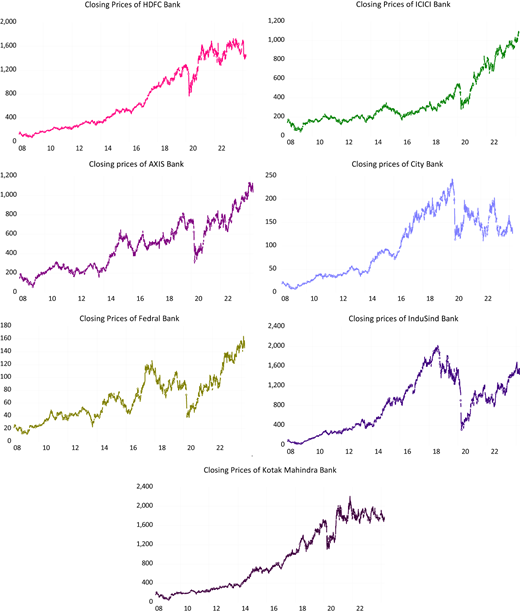
Plots of closing prices of public and private banks. Figure by authors
The graphs feature the following banks: State Bank of India (SBI), Punjab National Bank (PNB), Bank of Baroda, Canara Bank, Central Bank of India, Indian Bank, Indian Overseas Bank, Union Bank of India, UCO Bank, Bank of Maharashtra, HDFC, ICICI, Axis Bank, City Bank, Federal Bank, IndusInd Bank, and Kotak Mahindra Bank. For all graphs, the horizontal axis represents years from 2008 to 2024 in increments of 2 units, while the vertical axis shows stock closing prices in Indian Rupees with increments varying by bank. The State Bank of India ranges between Rupees 100 and Rupees 800, Punjab National Bank fluctuates between Rupees 50 and Rupees 300, Bank of Baroda moves within Rupees 50 to Rupees 300, and Canara Bank ranges from Rupees 20 to Rupees 180. The Central Bank of India varies between Rupees 40 and Rupees 140, while the Indian Overseas Bank lies between Rupees 40 and Rupees 240. Indian Bank ranges from Rupees 90 to Rupees 600, UCO Bank between Rupees 20 and Rupees 160, Union Bank of India between Rupees 100 and Rupees 500, and Bank of Maharashtra between Rupees 10 and Rupees 90. On the right page, private sector banks are plotted. HDFC Bank shows consistent growth between Rupees 300 and Rupees 1,800, ICICI Bank ranges between Rupees 200 and Rupees 1,200, and Axis Bank follows a similar upward path from Rupees 200 to Rupees 1,200. City Bank fluctuates between Rupees 30 and Rupees 250, Federal Bank trades between Rupees 20 and Rupees 180, and IndusInd Bank rises sharply from Rupees 100 to Rupees 2,000. Kotak Mahindra Bank demonstrates the strongest upward trajectory, ranging from Rupees 200 to Rupees 2,200.Plots of closing prices of public and private banks. Figure by authors
The analysis of Figure 2, which displays the return series trend for public and private sector bank indices, provides valuable insights into the nature of the data. As illustrated, stock return movements exhibit both positive and negative trends. However, it is noteworthy that the positive shocks differ from the negative shocks, highlighting an asymmetrical relationship (Gupta, 2024). The observed variance fluctuates around the mean, indicating that the series demonstrates stationarity. Furthermore, the presence of volatility clustering is apparent in the data, where periods of low volatility are succeeded by similar periods, while high volatility phases follow the same pattern. This phenomenon suggests that significant price changes tend to occur in clusters, resulting in a persistence of price change amplitudes over time (Gokbulut & Pekkaya, 2014).
 The grid of 17 time series plots illustrates the returns of various banks from 2008 to 2024. The horizontal axis in each graph represents the years, while the vertical axis captures the returns in percentage terms. The plots reflect the performance of a mix of public sector, private sector, and foreign banks, each showing distinct patterns of volatility, growth, and decline. Public sector banks such as State Bank of India, Punjab National Bank, Bank of Baroda, Canara Bank, Central Bank of India, Indian Bank, Indian Overseas Bank, Union Bank of India, UCO Bank, and Bank of Maharashtra generally display higher volatility with frequent spikes and sharp downturns, particularly during the 2008 global financial crisis and the 2020 COVID-19 market crash. Among them, most banks exhibit significant fluctuations, with returns swinging widely between negative and positive extremes, except for State Bank of India, Punjab National Bank, Bank of Baroda, and Canara Bank, which show relatively more controlled movements despite occasional volatility. Private sector banks HDFC Bank, ICICI Bank, Axis Bank, City Bank, Federal Bank, IndusInd Bank, and Kotak Mahindra Bank exhibit comparatively stable returns, though they still experience noticeable declines during major crisis years, especially in 2008 and 2020. These banks demonstrate narrower ranges of fluctuation compared to public sector banks, indicating greater resilience, although they remain vulnerable to large-scale economic shocks.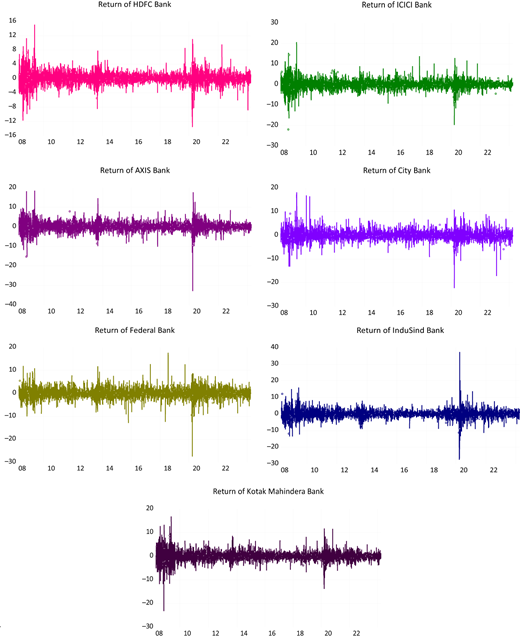
Plot of returns series of public and private banks. Figure by authors
The grid of 17 time series plots illustrates the returns of various banks from 2008 to 2024. The horizontal axis in each graph represents the years, while the vertical axis captures the returns in percentage terms. The plots reflect the performance of a mix of public sector, private sector, and foreign banks, each showing distinct patterns of volatility, growth, and decline. Public sector banks such as State Bank of India, Punjab National Bank, Bank of Baroda, Canara Bank, Central Bank of India, Indian Bank, Indian Overseas Bank, Union Bank of India, UCO Bank, and Bank of Maharashtra generally display higher volatility with frequent spikes and sharp downturns, particularly during the 2008 global financial crisis and the 2020 COVID-19 market crash. Among them, most banks exhibit significant fluctuations, with returns swinging widely between negative and positive extremes, except for State Bank of India, Punjab National Bank, Bank of Baroda, and Canara Bank, which show relatively more controlled movements despite occasional volatility. Private sector banks HDFC Bank, ICICI Bank, Axis Bank, City Bank, Federal Bank, IndusInd Bank, and Kotak Mahindra Bank exhibit comparatively stable returns, though they still experience noticeable declines during major crisis years, especially in 2008 and 2020. These banks demonstrate narrower ranges of fluctuation compared to public sector banks, indicating greater resilience, although they remain vulnerable to large-scale economic shocks.Plot of returns series of public and private banks. Figure by authors
4. Empirical results
4.1 Descriptive statistics
Table 1 shows the descriptive statistics summary of sampled Banks’ returns from 1 April 2008 to 31 March 2024, revealing interesting insights into the performance of different banks. The study shows that the IndusInd Bank has the greatest mean return compared to other banks, indicating that investors of the IndusInd Bank are making more profit compared to other banks. In contrast, the Indian Overseas Bank has the lowest mean return. All the banks have a negative value as their minimum value, indicating that all the investors investing in these stock indices are at a loss. On the other hand, the maximum positive value refers to what the investors are gaining after investing in such Banks (Gupta, 2024). The maximum loss is −32.87051% if invested in the Axis Bank and the maximum gain is if invested in the InduSind Bank. The highest standard deviation value in the Indian bank, as compared to other bank indices, suggests that the return of this bank is more volatile than other banks. On the contrary, the return of the HDFC Bank is less volatile. Skewness values indicate positive skewness for most of the Banks, suggesting the potential for minor losses and few large gains, except for ICICI Bank, AXIS Bank, Federal Bank, and Kotak Mahindra Bank, which exhibit negative skewness, indicating low yields most of the time. The kurtosis values for all sampled Banks are greater than 3, suggesting a leptokurtic distribution, and the Jarque Bera test rejects the normal distribution hypothesis for the return series of all indices, with p-values below the five percent significance level. Public sector banks exhibit higher volatility compared to private sector banks, which show higher mean returns and lowest volatility, implying more stable and strong performance in the latter. This suggests that investing in public sector banks may involve higher risk but potentially lower returns. In contrast, private sector banks offer more stable and predictable performance for investors seeking lower-risk investments.
Output of descriptive statistics for public and private sector banks index returns
| Index/Statistics | Mean | Median | Max | Min | Std. dev | Skewness | Kurtosis | Jarque-Bera |
|---|---|---|---|---|---|---|---|---|
| State Bank of India | 0.038311 | 0.02639 | 27.3612 | −17.4653 | 2.590951 | 0.452766 | 10.6187 | 9710.337* |
| Punjab National Bank | 0.005608 | 0.00000 | 37.9794 | −15.59348 | 2.595245 | 0.560586 | 17.0103 | 32587.02* |
| Bank of Baroda | 0.006165 | −0.1657 | 18.2322 | −19.59537 | 2.446715 | 1.089937 | 11.3605 | 12314.25* |
| Canara Bank | 0.025439 | 0.06788 | 32.2458 | −23.18921 | 2.704017 | 0.229143 | 11.5615 | 12129.04* |
| Central Bank of India | −0.005345 | −0.14323 | 18.2322 | −22.25811 | 2.794218 | 0.434703 | 11.3736 | 11691.2* |
| Indian Overseas Bank | −0.019495 | −0.16168 | 18.2327 | −16.48919 | 2.720765 | 0.875567 | 9.91878 | 8402.319* |
| Indian Bank | 0.030524 | −0.05535 | 19.457 | −15.84033 | 2.911546 | 0.472336 | 7.73442 | 3844.709* |
| Uco Bank | 0.009116 | −0.17513 | 18.2001 | −15.99646 | 2.781426 | 0.858314 | 8.85692 | 6144.762* |
| Union Bank | 0.002249 | 0.00000 | 29.3186 | −14.26196 | 2.811701 | 0.342238 | 7.85102 | 3959.148* |
| Bank of Maharashtra | 0.006165 | −0.1657 | 18.2322 | −19.59537 | 2.446715 | 1.089937 | 11.3605 | 12314.25* |
| HDFC Bank | 0.0607 | 0.0500 | 15.099 | −13.475 | 1.7092 | 0.023799 | 1.7786 | 99.81.574* |
| ICICI Bank | 0.0524 | 0.011 | 20.706 | −2.19512 | 2.412 | −0.05 | 11.2149 | 11133.88* |
| AXIS Bank | 0.0501 | 0.027 | 18.525 | −3.28705 | 2.456 | −0.398927 | 16.0027 | 27994.36* |
| City Bank | 0.0498 | 0.00000 | 18.052 | −2.22991 | 2.2027 | 0.225028 | 13.3174 | 17593.09* |
| Federal Bank | 0.0493 | 0.00000 | 17.532 | −2.74835 | 2.3361 | −0.313047 | 11.1107 | 10916.13* |
| IndusInd Bank | 0.0756 | 0.037 | 37.204 | −2.7317 | 2.660 | 0.189725 | 22.2902 | 61406.78* |
| Kotak Mahindra Bank | 0.0608 | 0.043 | 16.816 | −2.32242 | 2.1675 | −0.201294 | 11.7278 | 12592.85* |
Note(s): *, ** and *** represents p-value <1%, 5% and 10% respectively
4.2 Unit root test
This study employs the Augmented Dickey-Fuller (ADF) and Phillips-Perron (PP) tests to investigate the stationarity properties of the return series of the sample banking. The results in Table 2 show the presence of stationarity in the banking return series. The p-values from both tests fall below the 5% significance level, leading to the rejection of the null hypothesis that the series is non-stationary. This rejection suggests that the return series exhibits stationarity traits, indicating a deviation from a random walk process and suggesting mean-reverting behavior.
Results of the ADF and PP tests
| Banks name | Augmented Dickey-Fuller test | Phillips Perron test |
|---|---|---|
| t-statistic | Adj. t-stat | |
| State Bank of India | −59.08593* | −59.05334* |
| Punjab National Bank | 60.67446* | −60.86909* |
| Bank of Baroda | −61.95868* | −61.95185* |
| Canara Bank | −60.4608* | −60.508* |
| Central Bank of India | −54.93914* | −55.48078* |
| Indian Overseas Bank | −58.31814* | −58.37298 |
| Indian Bank | −57.92858* | −58.06392* |
| Uco Bank | −57.97231* | −57.92409* |
| Union Bank | −60.3755* | −60.39638* |
| Bank of Maharashtra | −58.38349* | −58.25278* |
| HDFC Bank | 46.65654* | −60.34253* |
| ICICI Bank | −59.70805* | −59.63601* |
| AXIS Bank | −61.04492* | −61.04529* |
| City Bank | −61.62912* | −61.63952* |
| Federal Bank | −59.92253* | −59.95199* |
| IndusInd Bank | −59.64693* | −59.753* |
| Kotak Mahindra Bank | −60.43972* | −60.39113* |
Note(s): *, ** and *** represents p-value <1%, 5% and 10% respectively
4.3 ARCH- LM test results
The ARCH-LM test applied to assess autoregressive conditional heteroscedasticity (ARCH) effects in the return series of various banks produced definitive results. Heteroscedasticity in residuals is beneficial for time series analysis. The ARCH-LM test serves as a method to assess the presence of the ARCH effect in residuals. A significant result from the ARCH-LM test indicates that the ARCH effect exists in the residual series, signaling that it is appropriate to model index return volatility using the GARCH methodology (Gupta, 2024). The analysis in Table 3 reveals p-values less than the level of significance, leading to the rejection of the null hypothesis of no ARCH effect in the residuals of all banks’ returns. This indicates the presence of time-varying variance, suggesting that volatility does not remain constant but exhibits clustering over time, thus satisfying the conditions for ARCH and GARCH models. The ARCH-LM test confirms significant heteroscedasticity, justifying the use of GARCH-based models for volatility modelling.
Results of the ARCH LM test
| Index/Statistics | State Bank of India | Punjab national Bank | Bank of Baroda | Canara Bank | Central Bank of India | Indian Overseas Bank | Indian Bank | Uco Bank | Union Bank | Bank of Maharashtra | HDFC Bank | ICICI Bank | AXIS Bank | City Bank | Federal Bank | IndusInd Bank | Kotak Mahindra Bank |
|---|---|---|---|---|---|---|---|---|---|---|---|---|---|---|---|---|---|
| ARCH-LM test Statistic | 99.22383* | 12.37048* | 38.41967* | 16.17177* | 260.7865* | 461.335* | 61.03156* | 291.1761* | 49.02776* | 212.9477* | 60.84244* | 268.1255* | 37.53291* | 176.6036* | 33.34513* | 31.93289* | 205.1201* |
Note(s): *, ** and *** represents p-value <1%, 5% and 10% respectively
4.4 GARCH model results
The study has employed the GARCH model to assess the symmetric volatility of return series across both public and private sector banks. The results, as depicted in Table 4, indicated that the coefficients of the GARCH model, ARCH, and GARCH are positive and statistically significant at the one per cent level, and the symbols α and β represent them. These coefficients provided insights into the influence of recent and distant news on current volatility, distinguishing between short-term and long-term volatility dynamics. The significance of ARCH: The comparison between the GARCH and ARCH coefficients revealed the presence of volatility clustering within the return series of the banks. A higher GARCH coefficient relative to the ARCH coefficient signified volatility clustering, where periods of high volatility are followed by additional high volatility periods, and vice versa for low volatility clusters. In addition, the beta coefficient in the GARCH model is the highest in the City Bank and the lowest in the Central Bank of India, indicating that the City Bank is more volatile and the Central Bank of India is less volatile due to persistent volatility. On the other hand, the alpha coefficient is the highest in the case of Central Bank of India and lowest in City Banks denotes the more significant effect of recent news on Central Bank of India volatility and lowest on the City Bank. Furthermore, the analysis of the sum of the ARCH and GARCH coefficients, which is closer to one for all indices except the Central Bank of India (CBI), indicated the presence of volatility persistence. In the case of the Central Bank of India (CBI), where the sum is less than one, it denotes the Fastest mean-reverting process compared to the other indices. This persistence implied that volatility takes a substantial amount of time to dissipate from the market, with high volatility persistence suggesting a slower mean-reverting process and low volatility persistence indicating a faster mean-reverting process. The study’s findings align with those (Mittal & Goyal, 2012), emphasising that while high volatility can present opportunities for increased profits, it can also introduce inefficiencies into the volatility persistence indicating that investors are more influenced by sudden price changes, leading to reluctance in investing in the market (Hameed & Ashraf, 2006). Additionally, the application of the ARCH-LM test to reassess the ARCH effect in the residuals of return series indicated the absence of the ARCH effect, providing further insights into the volatility dynamics of the banks under study.
Results of the GARCH model
| Index | Constant(µ) | Constant(c) | α (ARCH term) | β (GARCH term) | Persistence(α+β) | ARCH LM |
|---|---|---|---|---|---|---|
| State Bank of India | 0.037765 | 0.24841* | 0.124009* | 0.831803* | 0.955812 | 0.230706 |
| Punjab National Bank | 0.001426 | 0.790019* | 0.150285* | 0.745751* | 0896036 | 0.550565 |
| Bank of Baroda | 0.050303 | 0.450817* | 0.109782* | 0.830215* | 0.939997 | 0.33684 |
| Canara Bank | 0.016889 | 0.465056 | 0.099755* | 0.841389* | 0.941144 | 0.071292 |
| Central Bank of India | −0.018239 | 2.663608* | 0.295943* | 0.390247* | 0.68619 | 0.196198 |
| Indian Overseas Bank | −0.042783 | 0.929398* | 0.200225* | 0.684568* | 0.884793 | 0.167321 |
| Indian Bank | 0.001092 | 0.653313 | 0.086178 | 0.838235 | 0.924413 | 1.072881 |
| Uco Bank | 0.001152 | 1.394437* | 0.229418* | 0.608535* | 0.837953 | 0.057792 |
| Union Bank | −0.012428 | 0.853569* | 0.118155* | 0.777731* | 0.895886 | 0.331827 |
| Bank of Maharashtra | −0.011489 | 0.934901* | 0.143435* | 0.704504* | 0.847939 | 0.446422 |
| HDFC Bank | 0.0802* | 3.46E−06* | 0.060215* | 0.925409* | 0.985624 | 0.83695 |
| ICICI Bank | 0.000912* | 7.57E−06* | 0.083117 * | 0.903714* | 0.986831 | 3.34E−05 |
| AXIS Bank | 0.000843* | 9.50E−06* | 0.076530* | 0.905431* | 0.981961 | 0.017096 |
| City Bank | 0.000709 | 2.64E.06* | 0.023495* | 0.970853* | 0.994348 | 14.60880* |
| Federal Bank | 0.000578* | 2.19E−05* | 0.062691* | 0.895961* | 0.958652 | 1.8279 |
| IndusInd Bank | 0.001323* | 6.92E.06* | 0.094548* | 0.897000* | 0.991548 | 1.269185 |
| Kotak Mahindra Bank | 0.000734* | 5.08E−06* | 0.066924* | 0.919028* | 0.985952 | 1.718523 |
Note(s): *, ** and *** represents p-value <1%, 5% and 10% respectively
4.5 GARCH-M model results
The study employed the GARCH-M to analyze the risk-return trade-off within the banking sector, with results presented in Table 5. The term Lambda (λ) represents the risk premium and is insignificant across all banks, suggesting that investors in the banking sector are not rewarded for taking additional risks. This indicates a lack of risk premium offered to investors. This absence of a risk premium may lead to increased risk for investors, potentially driving them towards risk-averse investment approaches within the banking sector. The significant ARCH coefficient signifies the presence of short-term volatility, reflecting the impact of recent news on current volatility. Additionally, the significant GARCH coefficient indicates the existence of long-term volatility and the influence of past volatility on current volatility. The summation of the ARCH and GARCH coefficients being close to one demonstrates volatility persistence, implying that volatility tends to persist over an extended period. While in Central Bank of India and the sum is identified as not close to one, it is found to be less than other bank indices, suggesting the presence of the fastest mean-reverting process in Central Bank of India. Furthermore, the application of the ARCH LM test to assess the presence of ARCH effects in the residuals of returns series of public and private sector banks suggests the absence of ARCH effects in the residuals of all banks, as indicated by p-values exceeding the one per cent level of significance, accepting the null hypothesis of ARCH effect absence and rejecting the alternative hypothesis of no ARCH effect Khan, Rehman, Khan, and Xu (2016), Othman, Alhabshi, and Haron (2019).
Results of the GARCH-M model
| Index | Constant(µ) | Risk premium(λ) | Constant(c) | α (ARCH term) | β (GARCH term) | Persistence(α+β) | ARCH-LM |
|---|---|---|---|---|---|---|---|
| State Bank of India | −0.001719 | 0.010171 | 0.250934* | 0.125177* | 0.830102* | 0.955279 | 0.217747 |
| Punjab National Bank | −0.014557 | 0.002723 | 0.793341* | 0.150460* | 0.745075* | 0.895535 | 0.53635 |
| Bank of Baroda | 0.060219 | −0.001727 | 0.449975* | 0.109657* | 0.830456* | 0.940113 | 0.33923 |
| Canara Bank | −0.06048 | 0.012171 | 0.470986* | 0.101236* | 0.839265* | 0.940501 | 0.081789 |
| Central Bank of India | 0.041364 | −0.009439 | 2.653845* | 0.295932* | 0.391694* | 0.687626 | 0.207207 |
| Indian Overseas Bank | −0.07867 | 0.00641 | 0.929039* | 0.200356* | 0.684475* | 0.884831 | 0.140094 |
| Indian Bank | −0.131036 | 0.017979 | 0.638114* | 0.085080* | 0.841077* | 0.926157 | 1.160795 |
| Uco Bank | 0.091908 | −0.014413 | 1.342456* | 0.225108* | 0.619167* | 0.844275 | 0.011404 |
| Union Bank | −0.176515 | 0.023506 | 0.896702* | 0.121714* | 0.768826* | 0.89054 | 0.203715 |
| Bank of Maharashtra | 0.048716 | −0.011917 | 1.003443* | 0.149214* | 0.687455* | 0.836669 | 0.323274 |
| HDFC Bank | 0.00082 | −0.10542 | 3.46E−06 | 0.060224 | 0.925398 | 0.985622 | 0.83979 |
| ICICI Bank | 0.000686 | 0.678298 | 7.57E−06* | 0.083183* | 0.903645* | 0.986828 | 0.001076 |
| AXIS Bank | 0.000512 | 0.908044 | 9.53E−06 | 0.076616* | 0.905255* | 0.981871 | 0.02139 |
| City Bank | 0.00082 | −0.00313 | 0.0268* | 0.023765* | 0.97056* | 0.994291 | 4.882645 |
| Federal Bank | −0.00054 | 2.463986 | 2.26E−05* | 0.064361* | 0.892898* | 0.957259 | 1.622033 |
| IndusInd Bank | 0.001252* | 0.20311 | 6.94E−06* | 0.094624* | 0.896886* | 0.99151 | 1.262858 |
| Kotak Mahindra Bank | 0.000565 | 0.658386 | 5.07E−06* | 0.066877* | 0.919121* | 0.985998 | 1.693066 |
Note(s): *, ** and *** represents p-value <1%, 5% and 10% respectively
4.6 EGARCH model results
In financial modelling, the limitation of symmetric models lies in their inability to account for leverage and the asymmetric effects of different types of news on volatility. According to symmetric models, positive and negative news have an equal impact on volatility, which does not align with the reality where the impact of positive and negative news differs. To address this limitation, Nelson introduced the EGARCH model, which allows for different effects of good and bad news on volatility (Petrică & Stancu, 2017). The EGARCH model detects asymmetric volatility, and the results are presented in Table 6, showcasing the presence of asymmetry and leverage effects denoted by the parameter γ. The Gamma coefficient in the EGARCH model is negative and significant for State Bank of India, Bank of Baroda, HDFC Bank, Axis Bank, ICICI Bank, City Bank, Federal Bank, IndusInd Bank and Kotak Mahindra Bank. This negative and significant coefficient indicates that volatility increases more after negative returns than positive returns, suggesting that non-complementary news has a greater impact than complementary news on volatility. Conversely, positive and significant Gamma coefficient are observed in case of UCO Bank, and Maharashtra Bank, which denotes the impact of good news more than bad news on volatility. The study is consistent with the findings of Haniff and Pok (2010). Furthermore, the ARCH and GARCH coefficients in the EGARCH model are significant in all sampled Banks, signifying the substantial impact of past error terms and previous volatility on current volatility. The significant ARCH coefficient implies that previous squared errors influence the current volatility. The significant GARCH coefficient demonstrates that past volatility influences the current volatility, highlighting volatility persistence. The summation of ARCH and GARCH coefficients indicates that in most of the sampled banks, volatility persistence is present, suggesting long-term dependence where past volatility shocks continue to influence current and future volatility (Abdalla, 2012). Volatility persistence is assessed in this study using the summation of ARCH and GARCH coefficients. The sum of these coefficients exceeds one, as observed across all the studied banks which indicates a scenario where volatility shocks persist over time without quick decay. This phenomenon signifies long memory effects, wherein past volatility shocks continue to influence current and future volatility levels, leading to prolonged periods of high and low volatility (Behmiri & Manera, 2015). Moreover, the application of the ARCH LM test to detect the ARCH effect in the residuals of returns across various indices revealed that there is no ARCH effect present in most indices. However, exceptions are noted in the case of, HDFC Bank, City Bank, Federal Bank, IndusInd Bank, and Kotak Mahindra Bank, where the ARCH effect is detected This implies that, in these specific cases, the volatility of returns is influenced by past errors, showcasing a certain level of persistence in volatility. The findings align with existing literature that emphasises the significance of volatility persistence in financial markets. Studies have shown that volatility persistence is a common feature in various markets, with the GARCH model often used to capture this phenomenon effectively (Alotaibi & Morales, 2022). The persistence of volatility can be attributed to factors such as structural changes, outliers, and sudden shifts in volatility, all of which contribute to the long-term effects observed in market dynamics (Klein & Walther, 2016).
Results of the EGARCH model
| Index/Parameter | Constant(µ) | Constant(c) | α (ARCH term) | β (GARCH term) | γ (Asymmetric effect) | Persistence(α+β) | ARCH LM |
|---|---|---|---|---|---|---|---|
| State Bank of India | 0.031746 | −0.096798* | 0.231232* | 0.948741* | −0.020588* | 1.179973 | 0.728602 |
| Punjab National Bank | 0.029706 | 0.007325 | 0.263000* | 0.892772* | 0.003798 | 1.155772 | 0.912666 |
| Bank of Baroda | 0.034251 | −0.037044* | 0.206577* | 0.937987* | −0.024871* | 1.144564 | 1.206413 |
| Canara Bank | 0.021086 | −0.015947 | 0.195668* | 0.933254* | −0.012182 | 1.128922 | 0.227906 |
| Central Bank of India | −0.014172 | 0.346981* | 0.460066* | 0.652220* | 0.017825 | 1.112286 | 0.278401* |
| Indian Overseas Bank | −0.031573 | 0.058603* | 0.433367* | 0.797849* | 0.008639 | 1.231216 | 0.000897 |
| Indian Bank | −0.025475 | 0.035732** | 0.239710* | 0.893195* | −0.003854 | 1.132905 | 0.667512 |
| Uco Bank | −0.001029 | 0.036526* | 0.900345* | 0.233477* | 0.022504* | 1.133822 | 0.540235 |
| Union Bank | 0.018887 | 0.052976* | 0.335785* | 0.845655* | 0.037966* | 1.18144 | 0.476847 |
| Bank of Maharashtra | 0.00016 | 0.057349* | 0.288690* | 0.844895* | 0.060865* | 1.132905 | 0.199473 |
| HDFC Bank | 0.000518** | −0.181266* | 0.113017* | 0.988593* | −0.040154* | 1.133585 | 5.191667** |
| ICICI Bank | 0.00017 | −0.188865* | 0.127754* | 0.988116* | −0.079427* | 1.10161 | 0.801983 |
| AXIS Bank | 0.0002 | −0.2266356* | 0.133000* | 0.983589* | −0.059374* | 1.11587 | 0.667751 |
| City Bank | 0.000465 | −0.067629* | 0.056221* | 0.996419* | −0.018852* | 1.116589 | 25.19646* |
| Federal Bank | 0.000143 | −0.198949* | 0.087458* | 0.982380* | −0.036121* | 1.05264 | 6.154022* |
| IndusInd Bank | 0.001000* | −0.238032* | 0.175631* | 0.986430* | −0.055362 | 1.069838 | 3.486527*** |
| Kotak Mahindra Bank | 0.000550** | −0.187948* | 0.127562* | 0.988702* | −0.029862* | 1.162061 | 5.534224** |
Note(s): *, ** and *** represents p-value <1%, 5% and 10% respectively
4.7 AIC and SIC output of the GARCH, GARCH-M, and EGARCH models
In this study, log-likelihood (LL), Akaike Information Criterion (AIC), and Schwarz Information Criterion (SIC) values are utilised to compare different models. The results presented in Table 7 indicated that the EGARCH model is the most appropriate for capturing the volatility of returns for a wide range of banks, such as State bank of India, Bank of Baroda, Indian Overseas Bank, Indian Bank, Union Bank, Bank of Maharashtra, HDFC Bank, ICICI, AXIS Bank, Federal Bank, IndusInd Bank, and Kotak Mahindra Bank. However, for Punjab National Bank, Canara Bank, Central Bank of India, and UCO Bank, the GARCH model with the lowest AIC and SIC values is considered the most suitable. In the case of City Bank, the GARCH-M model is identified as the best-fitted model for capturing volatility dynamics. Overall, the EGARCH model demonstrated superior performance in accurately capturing the volatility of both public and private sector bank indices, as evidenced by higher log-likelihood values and lower AIC and SIC values. The EGARCH model is particularly effective in capturing asymmetric responses to shocks, providing a more accurate representation of volatility dynamics in financial markets (McAleer, 2014).
LL, AIC, and SIC output of GARCH, GARCH-M, and EGARCH models
| Models | GARCH(1,1) | GARCH-M(1,1) | EGARCH(1,1) | ||||||
|---|---|---|---|---|---|---|---|---|---|
| Index/Parameter | LL | AIC | SIC | LL | AIC | SIC | LL | AIC | SIC |
| State Bank of India | −8500.614 | 4.297935 | 4.305873 | −8500.306 | 4.298285 | 4.30781 | −8497.874 | 4.2970564 | 4.306581 |
| Punjab National Bank | −9239.889 | 4.671495 | 4.679433 | −9239.864 | 4.671988 | 4.681513 | −9239.523 | 4.671816 | 4.681341 |
| Bank of Baroda | −9223.317 | 4.663121 | 4.671059 | −9223.308 | 4.663622 | 4.673147 | −9211.618 | 4.657715 | 4.66724 |
| Canara Bank | −9391.826 | 4.747071 | 4.755007 | −9391.406 | 4.747364 | 4.756887 | −9395.289 | 4.749325 | 4.758848 |
| Central Bank of India | −9401.978 | 4.7534 | 4.761338 | −9401.571 | 4.753699 | 4.763225 | −9634.558 | 4.871429 | 4.880954 |
| Indian Overseas Bank | −9219.552 | 4.661219 | 4.669157 | −9219.349 | 4.661622 | 4.671147 | −9202.664 | 4.653191 | 4.662716 |
| Indian Bank | −9679.328 | 4.893546 | 4.901484 | −9678.555 | 4.893661 | 4.903186 | −9565.721 | 4.836645 | 4.84617 |
| Uco Bank | −9404.042 | 4.754443 | 4.762381 | −9403.069 | 4.754456 | 4.763981 | −9665.193 | 4.886909 | 4.896434 |
| Union Bank | −9568.977 | 4.837785 | 4.845723 | −9567.644 | 4.837617 | 4.847142 | −9382.624 | 4.744125 | 4.75365 |
| Bank of Maharashtra | −8926.069 | 4.51292 | 4.520858 | −8925.722 | 4.51325 | 4.522775 | −8895.075 | 4.497764 | 4.507289 |
| HDFC Bank | 11164.72 | −5.63907 | −5.631132 | 11164.72 | −5.63857 | −5.62904 | 11177.17 | −5.644855 | −5.63533 |
| ICICI Bank | 9810.699 | −4.954876 | −4.946938 | 9810.94 | −4.95449 | 4.944967 | 9874.791 | −4.986756 | −4.977231 |
| AXIS Bank | 9694.431 | −4.896125 | −4.888187 | 9694.812 | −4.89581 | −4.88629 | 9704.968 | −4.900944 | −4.891419 |
| City Bank | 9791.301 | −4.945074 | −4.937136 | 9240.897 | −4.66645 | −4.65692 | 9787.989 | −4.942895 | −4.93337 |
| Federal Bank | −9487.869 | −4.791748 | −4.78381 | 9488.974 | −4.7918 | −4.78228 | 9509.434 | −4.80214 | −4.792614 |
| IndusInd Bank | 9579.948 | −4.838276 | −4.830338 | 9579.985 | −4.83779 | −4.82826 | 9605.658 | −4.850762 | −4.841237 |
| Kotak Mahindra Bank | 10351.03 | −5.227907 | −5.219969 | 10351.21 | −5.22749 | −5.21797 | 10361.86 | −5.232876 | −5.223351 |
5. Finding and conclusion
The present study explores the return and volatility characteristics, volatility persistence, and leverage effects in the Public and Private Sector Bank indices. Further study also assesses the risk and return relationship using the GARCH-M model and compares the linear and non-linear GARCH models to find the best-fitted model. Daily closing prices of all the samples from 1 April 2008 to 31 March 2024 are used to achieve the study’s objectives. The study applied linear and non-linear GARCH models to the data analysis. The findings reveal that the IndusInd Bank has the highest mean return, suggesting that, on average, it has performed the best out of the Banks considered. This means that investors in the IndusInd Bank have generally seen higher returns than other banks. Conversely, the Indian Overseas Bank’s lowest mean return means it has underperformed relative to the other Banks. Investors in the Indian Overseas Bank have seen lower returns than other banks. The study highlights substantial differences in volatility among Indian banks. Most of the Public sector banks exhibit higher volatility and positive skewness, suggesting both greater risk and the potential for higher returns. In contrast, private sector banks offer more stable performance, characterised by Higher mean returns and volatility, making them attractive for risk-averse investors. Employing ADF and PP tests confirms the stationarity of the return series, while the ARCH-LM test identifies the presence of the ARCH effect. The GARCH model analysis reveals that the City Bank exhibits the highest beta coefficient, indicating greater volatility, whereas the Central Bank of India shows the lowest volatility. The alpha coefficient is notably higher for Central Bank of India, reflecting a stronger response to recent news than the Central Bank of India. Examining the ARCH and GARCH coefficients reveals volatility persistence across most indices, except the Central Bank of India, demonstrating a quicker mean-reverting process. Additionally, the GARCH-M model uncovers an insignificant risk premium across all sampled Banks, suggesting that investors are not adequately compensated for taking on additional risk, which may promote a shift toward more conservative investment strategies. The EGARCH model further uncovers leverage effects in several indices, indicating that negative returns increase volatility more than positive returns. However, the volatility of UCO Bank, and Bank of Maharashtra, respond more strongly to good news than bad news. The study also identifies significant impacts of past error terms and previous volatility on current volatility across most of the banks, emphasising the long-term influence of volatility shocks.
The EGARCH model is the most effective among linear and non-linear models for capturing the volatility of returns for a wide range of banks, including the State Bank of India, Bank of Baroda, Indian Overseas Bank, Indian Bank, Union Bank, Bank of Maharashtra, HDFC Bank, ICICI, AXIS Bank, Federal Bank, IndusInd Bank, and Kotak Mahindra Bank. In contrast, the GARCH model is better suited for specific institutions, such as Punjab National Bank and Canara Bank. The GARCH-M model is identified as the optimal choice for City Bank. Overall, the EGARCH model demonstrated superior performance in accurately capturing the volatility of both public and private sector bank indices, as evidenced by higher log-likelihood values and lower AIC and SIC values. The results are consistent with those of Gutpa (2024), Kumar (2024), and Singh et al. (2024). The findings underscore the complexities of volatility dynamics within public and private sector banking, highlighting the importance of employing advanced modelling techniques for more accurate financial predictions and informed investment decisions.
6. Implications of the study
In financial markets, volatility serves as a risk indicator that is beneficial for both investors and regulators. This volatility triggers a range of responses among market participants; while some view it as a chance to profit, others perceive it as a risk. As a result, both investors and portfolio managers are particularly attentive to stock market fluctuations. To ensure positive returns, portfolio managers and hedgers strive to minimize excess volatility. In this context, a solid quantitative strategy is essential for assessing stock market volatility to guard against negative price changes (Gupta, 2024). The findings of this study offer valuable insights for investors, policymakers, and analysts. Investors can refine their portfolios by leveraging these findings, opting for public sector banks that offer the potential for higher returns, albeit with increased risk, or selecting private sector banks for greater stability with lower expected returns. A deeper understanding of volatility persistence and the leverage effect can assist investors and fund managers in implementing effective risk management strategies, enabling them to mitigate losses during periods of heightened volatility. The presence of high volatility makes it possible to earn high profits, but it also leads to market inefficiency (Mittal & Goyal, 2012). The presence of an insignificant risk premium implies that investors are unable to earn above-average returns by taking higher risks. Furthermore, an awareness of varying volatility levels across different banks facilitates the construction of diversified portfolios that effectively balance risk and return. The study insights can be used by Policymakers to evaluate the stability of the banking sector, potentially leading to improved regulatory measures aimed at managing systemic risks, particularly in public sector banks characterized by higher volatility. Furthermore, the identification of asymmetric/leverage effect in volatility can help market analysts and traders in understanding the potential impact of news events on bank indices, thereby refining trading strategies and improving market predictions. Through the identified model, Analysts can enhance their forecasting capabilities regarding the future performance and volatility of banking indices. Finally, financial advisors can utilize insights into how market sentiment reacts to positive and negative news to guide their clients in making more rational investment choices. The outcomes of this study also hold implications for capital requirements; banks exhibiting high volatility persistence may necessitate larger capital buffers, and regulators can strengthen capital adequacy assessments by incorporating volatility-adjusted metrics.
7. Limitations and future scope of the study
This study focuses on analyzing the returns and volatility of the banking sector using daily closing prices and a univariate model to capture volatility characteristics. Future research will expand this scope to include multiple sectors, incorporating daily, weekly, and monthly closing prices. Additionally, it will explore return and volatility spillover effects using multivariate economic models, providing a more comprehensive understanding of market dynamics and interdependencies across sectors.
Author’s contribution
All authors contributed equally to this study’s work.

